
You are currently browsing petebrook’s articles.
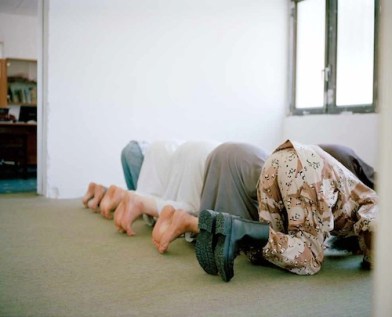
The Prison Governor of the Huda Foundation for prison and Reform, Misrata, prays with colleagues. © Louis Quail
Louis Quail makes a habit of going to zones that have been hit hard by human or natural emergency. He does so after said emergencies have tempered down and the world’s media has generally moved on. I celebrated his close and slow study of Haitians in May, 2010, a full four months after the devastating earthquake.
In the year since the end of the war, Quail has been in Libya. A small selection (seven) of his portraits were featured on the Guardian website yesterday. Quail has 25 images including candid, landscape and street shots on his website. The full body of work (I’ve viewed a PDF) comprises 25 interviews and 58 images.
Included in Quail’s series are three images from a prison.
“The model for the prison is an Islamic one where the prisoners are treated like their brothers, security is minimal with only one gate and a few guards. There is a strong sense of mutual respect and focus on Islam,” writes Quail.
Here I post two images and extended quotes that Quail recorded.
“We respect human rights here,” says a prison guard. “We repair them psychologically and think about how to make them good people – to turn them from fighters into civilians. Gadaffi taught them no respect. He told them they were better than other Libyans.”
“We want all prisons to be like this – if we don’t deal with the prisoners properly we will store up problems for the future – but it’s not popular with the government. It’s not a vote winner.”
“We are under-resourced at the moment. Our doctors and nurses are prisoners who have been trained by Medicine sans Frontiers and volunteers. We have 25 guards and access to 25 katibers outside, but even the prisoners tell us they will not run away because it’s much safer here for them here.”
But forgiveness and forward thinking is difficult when transition and immediate history has been so violent.
“We can’t deny there have been some human rights abuses, deaths in custody, torture in the revolutionary stages,” says a prison guard. “The families here in Misrata have seen their members killed and the girls raped. […] We have some mercenaries [in the prison] but to be honest, most died in the war. There was very little sympathy for them, there were many executions. They were from places like Darfur and Sudan, often on drugs or drunk. The doctors reported 700 cases of rape in Misrata, 132 of them on civilians aged between 12 and 15 years old.”
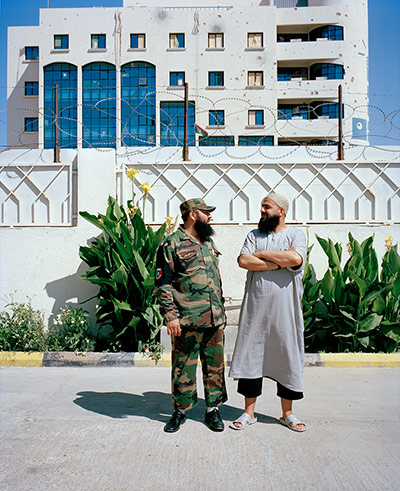
Omar, a previous Gadaffi militia member, talks to one of the prison guards at The Huda Foundation for Prison and Reform, in Misrata. © Louis Quail
“I was an elite fighter in Regiment 32 ran by Gadaffi’s son,” says Omar, a former Gadaffi loyalist. “In April 2011, I was fighting in Misrata, many people were dying and injured and I was shot in the legs, unable to move and was caught. It’s ok here. It’s very calm, they treat us like brothers. I have heard about other prisons where It’s not so good. After spending time here I no longer want to be a fighter, now we have to forgive each other and move on.”

Mercedes Smith, a formerly incarcerated person, reads a letter from her currently imprisoned son, at a relatives house where she lives after working all day on July 13, 2012, in Manhattan New York. Ms. Smith is not allowed to live with her family while she is on bail because her mother still lives in the same building as where the crime took place. Ms. Smith served 20 years for 2nd degree manslaughter and was released in 2010. (Photo by Ashley Gilbertson / VII)
– – – – – – – – – – – – – – – – – – – – – – – – – – – – – – – – – – – – –
Think Outside The Cell, a NYC based advocacy group, and VII Photo Agency recently collaborated to create a media campaign to educate the public about the continued struggles for felons post-release. This conversation with Ashley Gilbertson is the final part of a five part series, ‘Ending The Stigma Of Incarceration.’
(Part One): Think Outside The Cell / VII Photo Partnership
(Part Two): A Conversation With Ron Haviv
(Part Three): A Conversation With Ed Kashi
(Part Four): A Conversation Wtih Jessica Dimmock
– – – – – – – – – – – – – – – – – – – – – – – – – – – – – – – – – – – – –
This text has been edited from longer conversation.
– – – – – – – – – – – – – – – – – – – – – – – – – – – – – – – – – – – – –
PP: In part four I spoke with your colleague Jessica Dimmock. How was it working with her?
AG: It was easy. Jess is a photographer as a primary, so she knows how photographers move. We went back to Mercedes’ home one night and Mercedes went into her room and opened a letter. I looked through the door and I saw that it was a handwritten letter and I knew that her son was in prison. It was from her son. She started reading, I took some frames and moved out the way and Jess could shoot. That was an isolating scene that was very poignant – reading a letter from your son, while you are on parole, in a house that you’re trying to get out of.
PP: Why should we care about prisons and their aftermath?
AG: In the aftermath of prison, ideally, prisoners are changed members of society. Prisons are a place where people can at least try to signify to society that they have made recompense for crimes they’ve committed. Why is it important that we pay attention? The size of it. Until I met Mercedes Smith, I had no idea of the intensity of the problems former prisoners are facing.
PP: What type of problems?
AG: Housing. Mercedes living with a family member in housing projects in Manhattan. She wants to move on from that, but housing is so expensive that for her to actually afford something is really hard. And this is where all these elements that former prisoners face come together; she’s working two jobs part time and she’s looking for a third job. But it is very difficult for her to find any type of third job because she has curfew hours. Getting back to her apartment after curfew means she’ll break her terms of parole and potentially face going back to prison. For her to get an apartment she needs a third job.
Say if she wanted to move to New Jersey where housing is cheaper, she can’t. Her terms of parole require her to stay in New York State.
PP: Does she have good support?
AG: She was in a fortunate position because when she came out of prison to a very supportive and loving family. It is not quite accurate to say that Mercedes is fortunate because, in fact, she has worked very hard to get to where she is. Her children had been cared for by her mother and they visited her regularly while she was in prison and they had relationships. So, even after having done 20 years in prison, she had a warm and supportive environment to come back to and that’s something that – as I came to understand the issue better – a lot of people are lacking.
Mercedes is a really supportive mother who is doing everything she possibly can for her children. Two of her children live with her mother, one is down South and one is in prison. I saw her speaking a couple of times with her son that is in prison and it was a really warm and loving exchange – the tone of conversation that we all wish we could have with our mum.
PP: What did Mercedes hope of the project? Why did she go in front of cameras?
AG: Mercedes never said she felt like a role model, but she has figured out how to get out of the hole and she wants to save other women time and energy as they try to do so.
Both of Mercedes’ jobs work around her existence today as a parolee and as a former prisoner. She works with Women On The Rise Telling HerStory (WORTH), a group that lobbies for women who are imprisoned and particularly women who are giving birth in prison. The work plays directly into Mercedes’ experience, as she gave birth to her youngest child in prison, I believe.
Her other job is working with women just out of prison and giving them advice about what they have at their disposal; what organizations that might get in touch with. It is a mentor role. And she works at that second job with her own mentor.
PP: Your work is always about America.
AG: I research ideas and become interested in issues at a concept level, then I’ll start meeting people – community leaders in Pontiac, Michigan, for example, or in the case of Bedrooms Of The Fallen, family members. Everything I do is about America.
I see America as this sort of social experiment. I grew up in Australia; in the Commonwealth. I’ve lived in America for nine years, yes, but it remains so foreign to me. I hadn’t met a large group of Americans until 2003 when they marched into Iraq. I learnt more about America in Iraq than I did in America over those first few years [of the War on Iraq].
Working on different issues, here in America, is to continue to look at this experiment. The way Americans wave flags. It’s the same as how Australians wave flags, but in many ways it is very different.
The way Americans carry guns, the way they incarcerate people – it’s the world leader in so many poor statistics, but then in many great statistics too. I find it so bizarre to work here. There’s just an endless wealth of material. I don’t work on things I have a passing interest in. I have to be actively engaged … and, usually, angry.
Each aspect of American culture I look at, whether that’s politics, incarceration, war, treatment of veterans at home, suicide, post traumatic stress disorder, the auto industry, the economy – each thing adds to this tapestry that I’m trying to understand, and I want to, I just don’t know if I ever will.
PP: Why has VII pursued a partnership with TOTC?
AG: This partnership appealed because it was looking at a project in a way that offered solutions, with stories of people who were actively getting out of the problem, trying to create solutions to it. That is compelling.
I’d say it is a traditional approach to go to a prison and photograph the scenes and problems there. Or, to go to “convict alley” in Harlem, where there is the highest concentration of parolees living within a certain numbers of blocks in Harlem.
I was reading about speech-writing the other day and they were saying at the end of strong speech is a call to action. Both Ronald Day and Mercedes stand as a call to action. It doesn’t matter that they’ve been convicted of crimes because they’ve gotten beyond that and turned into people who empower those around them.
PP: VII wants to extend the project. Do you think you’ll continue involvement?
AG: I hope very much that the project goes on, and that it goes national. Think Outside The Cell is an incredibly powerful approach to this problem, so to see it produced on a national level would be compelling. I’d like to be involved, but I’d like more to see other photographers brought in.
It turned from an issue that I cared about into something that I all of a sudden became involved in. For a lot of us working in the press, it takes a significant amount for us to be shocked by certain things we see people come up against.
The opportunity that I’ve had to meet these inspiring people who are working to get out of this rut and try to change it at a policy level – that should be regarded by as wide a swathe of people as is possible.
– – – – – – – – – – – – – – – – – – – – – – – – – – – – – – – – – – – – –

LG VX5400 flip hone. Born 2006. Laid to rest 2012.
After 6 years with the same LG flip phone, it was long overdue to get a smartphone. The timing was right to get the iPhone 5. Friends who’ve had iPhone’s in the past just want to hold the 5, “It’s so light,” they fawn.
I waited a day to turn the iPhone on – I was hesitant because I was about to voluntarily submit to yet more corporate networks. But, I’d reconciled that with my decision to go for an iPhone weeks ago when I placed the order. Breathe deeply. Sync the thing with Twitter. First app? Instagram. It reamins the only app on my phone.
So yeah, I’ll be using Instagram with the handle @p3t3brook. But I have rules.
THE RULES
1. No cats.
2. No dogs.
3. No cocktails.
4. No pints/jugs of ale.
5. No frothy coffees.
6. No plates of food.
7. No babies. Already bent that rule with my second Instagram pic, but the baby is unidentifiable and I tell myself that the leaf the chubby baby hand holds is the actual subject.
THE WHY
It’s not that there’s anything wrong with cats, dogs or babies; they are wonderful things in life to be with and be around, but as I don’t have any children or pets, it’s hard for me to justify why I’d make photos of those things.
As for food, well, food has become the fastest most unquestioned trope on Instagram. People used to think it silly to waste film on photographs of food, but the digital age allows us to indulge a common urge. We all want to share – and brag about – what we’re about to demolish. Food Instagram photos are part homage, part evidence, part guilt sharing, part all sorts of things but not something I want to be part of. There’s too many photos of food online and you don’t need any more from me.
On beer, cocktails and coffees, just read the previous paragraph replacing the word ‘food’ with the word ‘drink.’
THE WHAT
So what does that leave? Here’s a few things I think are a bit of a challenge.
1. Street photography. Must be well edited. High contrast, light and shadow, unknowing subjects, knowing subjects, reflections, bustle. Avoid reliance on signs; you want the picture to tell you the story, not words (I’ve already failed on that one.)
2. Strange unidentifiable details, preferably achieved by found texture, not filter, but I’ll still take a mix of the two.
3. Inside views of current projects. Tidbits. Teasers.
4. New landscapes. Mad infrastructure. Clever combinations of light as it pings off man-made stuff. LOOK UP!
5. Portraits of strangers.
I’ll try to make images along these lines and I’ll find value in others’ doing the same. So, an emphasis on photos made on the fly and inpublic yes. Which is precisely the point of having a camera with you all times. But, I still want to bring a standard to it – if I feel a photograph is poking fun at someone, or voyeuristic in a creepy way, or that the photographer decided not to get close enough or maybe even have a conversation, I might not Like it.
If Instagram is used consciously, it can be an exercise in mindfulness. Look for interesting views, take the pic, upload, put the phone in your pocket. I want people around me to know that I’m using it in a directed manner. Instagram (and its streaming-app-brethren) counters browbeaten, downward gazes. It remedies our forgetfulness to look up.
Clearly, the majority of what is on Instagram is not good photography, but I reckon we’re seeing millions of experiments of people heading toward good photography, AND at a faster pace than in the past. The end result? Hopefully, widespread understanding of what makes a good photograph.
ALL OVER THE PLACE
If you are short of things to read on the topic of Instagram and cell phone photography:
From Memory To Experience: The Smartphone, A Digital Bridge (Stephen Mayes on Jens Haas’ blog)
Wired Opinion: Rip Off the Filters – We Need a Naked Instagram (Wired.com)
Dappled Things: Pinkhassov on Instagram (The New Inquiry)
Everyone shoots first: reality in the age of Instagram (Verge)
Instagram — It’s About Communication (John Stanmeyer)
Stefano De Luigi’s iDyssey (The New Yorker)
Instagram, The Nostalgia Of Now And Reckoning The Future (Buzzfeed)
Hipstamatic Revolution (Guernica Magazine)
Ben Lowy: Virtually Unfiltered (New York Times)
Magnum Irrelevant? (Wall Street Journal)
Instagram: Photography’s Antichrist, Savior, Or Something In Between? (Huffington Post)
Picturing Everyday Life in Africa (New York Times)
reFramed: In conversation with Richard Koci Hernandez (Los Angeles Times)
In an Age of Likes, Commonplace Images Prevail (New York Times)
Why Instagram is Terrible for Photographers, and Why You Should Use It (Photoshelter)
New Economies of Photojournalism: The Rise of Instagram (British Journal Of Photography)
Instagram Isn’t an App, It’s a Publishing Platform (So Treat It Like One) (Photoshelter)
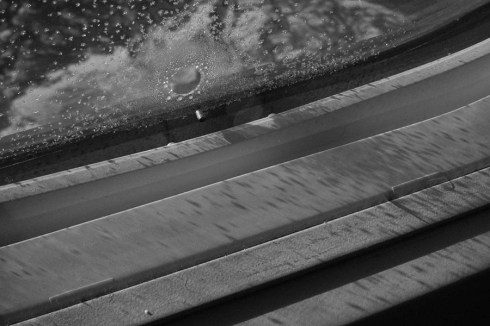
Doug Lowell, from the series Seated
Eye On PDX is spreading its wings. It’s not migrating and flying the coop, but rather subdividing itself and doubling the product.
From beside a fire pit last month, I asked Blake Andrews if he wanted join the meandering inquiry into photographers here in Portland, OR. Blake hopped on board. The fact Blake lives in Eugene, two hours south, does not effect his credentials. He’s up here every other week to shoot, talk and gallery-hop. Besides, he knows everyone here that needs to be known; he lived in Portland years ago before it was post-Cool.
Eye On PDX is an ongoing series of profiles that feature a brief interview with a PDX photographer accompanied by a handful of photos.
Blake’s profile of Douglas Lowell expands Eye on PDX to B. And Blake is delivering awesome content that I simple can not. “Has a photograph ever made you cry?” Blake asks Doug. C’mon! Awesome.
Doug and Blake’s to-and-fro is lively and considered – the photobook as poetry and the importance of ideas over place. Read the full interview with Doug Lowell.
One point of clarification. When Blake says, “Pete will handle all of the photographers who are imprisoned felons and I will handle the rest,” he is having a lark. Any photographers I interview who work in Portland and happen to be felons will not be imprisoned.

The dining room. © Mariam Amurvelashvili
Mariam Amurvelashvili, a Georgian photographer has been documenting lives inside Georgia’s prisons since 2004.
She has not, however, the author of images of beatings and rape that surfaced in the past month, sparked protests among horrified citizens, forced the resignation of Georgia’s senior prison official, and rocked Mikheil Saakashvili’s government.
DOCUMENTARY vs. EXPOSE
I’ve argued in the past that the photo and video footage that changes a system is rarely that made by a documentarian. It is the expose, the surveillance tape, the illicit and leaked images that reveal to wider society the worst acts of closed institutions. Amurvelashvili’s work is interesting, concerned, but it doesn’t have a pointed edge.
This is by no way a criticism; it’s just worth considering how we think about images. I made a similar plea a couple of weeks ago when I asked how we should compare Michal Chelbin’s portraiture with mobile phone camera shots taken by Russian juvenile prisoners.
ABUSE REPLACES ABUSE
Amurvelashvili’s basic position is a simple one – that the deprivation of liberty by imprisonment is the greatest measure by which one man can punish another. I agree with her. Furthermore, the prison should not degrade the prisoner nor violate human rights with poor conditions, inadequate food or abuse of any kind. In 2004, Amurvelashvili reports, a Tbilisi prison held over ten times the prisoners than its design capacity allowed.
When Amurvelashvili began photographing Georgian prisons I expect she thought she was photographing the end of an era. The new prisons of a newly democratic Georgia could cleanse itself of it’s communist past and notorious prison archipelago. Unfortunately, the new super jails have engendered a more-exacted breed of violence.
Journalist Gavin Slade argues the roots to the abuse scandal are the associated policies of zero tolerance and mass incarceration pursued recently in Georgia which has one of the highest incarceration rates in the world – 531 prisoners per every 100,000 people.
Problems, summarised here, have long been rife throughout Georgia’s prison system. Beginning in late 2010, reports emerged of physical abuse. Ksani prison was under scrutiny by the Georgian Public Defender’s Office in 2011 for poor treatment of inmates.
Newer facilities such as Ksani prison, says Amurvelashvili, were designed to be sanitary, have adequate healthcare, libraries and family visitation. And yet, last month’s torture scandal within Ksani proves that care for prisoners extends far past concerns about conditions and to the philosophy of leadership and the break-down of discipline among the staff. Ksani was a hell hole.
Listen to this interview with a prisoner who was beaten and electrocuted in Ksani Prison.
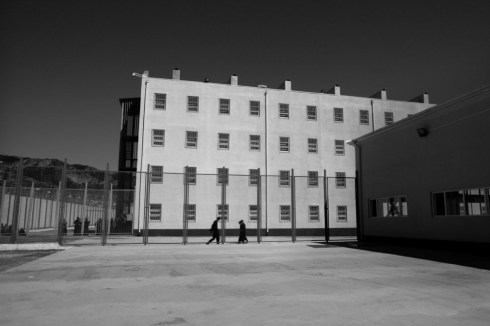
Ksani prison. © Mariam Amurvelashvili
If an authority cannot control nor redirect its prison population into productive activities, the prison is likely too large. It is probably overcrowded, too. State authorities need to understand that better conditions in prisons reduces crime. Reduce populations and pursue alternatives to incarceration. And find leaders with moral fibre.
AMURVELASHVILI ELSEWHERE
Bigger images here, and featured portfolios on Georgian Photographers website here.
Conscientious likes Amurvelashvili’s Dukhobors a portrayal of a Christian sect in Georgia/Russia. Fotovisura has a gallery of her photos of animal sacrifice and behind bars.

Photo: Roger May. (Source)
You’d think after 26 months in an Iranian prison, Shane Bauer would not be interested in seeing the inside of another cell. Think again. As I’ve noted before, Bauer is a journalist with human rights at the core of his stories.
Since his return to the U.S. he has been increasingly involved in describing the real problem we have with our approach to corrections. From Bauer’s Mother Jones feature piece:
I’ve been corresponding with at least 20 inmates in SHUs around California as part of an investigation into why and how people end up here. While at Pelican Bay, I’m not allowed to see or speak to any of them. Since 1996, California law has given prison authorities full control of which inmates journalists can interview. The only one I’m permitted to speak to is the same person the New York Times was allowed to interview months before. He is getting out of the SHU because he informed on other prisoners. In fact, this SHU pod—the only one I am allowed to see—is populated entirely by prison informants. I ask repeatedly why I’m not allowed to visit another pod or speak to other SHU inmates. Eventually, Acosta snaps: “You’re just not.”
Bauer excavates the policy and the logic, if you can call it that, used by the CDCR in their categorisation of prisoners and how those policies lands individuals in solitary. Pelican Bay State Prison, the oldest state-built Supermax, is Kafkaesque in its imprisonment of prisoners classified as gang affiliated. Bauer describes the *evidence* used by the CDCR in its case tying Dietrich Pennington to gang activity.
In Pennington’s file, the “direct link” is his possession of an article published in the San Francisco Bay View, an African American newspaper with a circulation of around 15,000. The paper is approved for distribution in California prisons, and Pennington’s right to receive it is protected under state law. In the op-ed style article he had in his cell, titled “Guards confiscate ‘revolutionary’ materials at Pelican Bay,” a validated member of the Black Guerilla Family prison gang complains about the seizure of literature and pictures from his cell and accuses the prison of pursuing “racist policy.” In Pennington’s validation documents, the gang investigator contends that, by naming the confiscated materials, the author “communicates to associates of the BGF…as to which material needs to be studied.” No one alleges that Pennington ever attempted to contact the author. It is enough that he possessed the article.
Getting out is a Catch-22 that is best described by Bauer than I.
For the longest time, there was a media blackout in California prisons and very few journalists got in to the SHU. I have heard from a few reporters and photographers this year who have visited Pelican Bay’s SHU but on a very tightly controlled media tour. Ultimately, Bauer wants to decode what purposes are served by solitary confinement. The CDCR argues it keeps prison violence down, but …
Prison violence fluctuates for myriad reasons, among them overcrowding, gang politics, and prison conditions. It’s impossible to say for certain what role SHUs play; what is clear is that in states that have reduced solitary confinement — Colorado, Maine, and Mississippi — violence has not increased. […] Since Mississippi State Penitentiary at Parchman released 75 percent of inmates from solitary in the mid-2000s, violence has dropped 50 percent. CDCR officials claim California is different because the gang problem is worse here, though they don’t have data to confirm this.
Bauer goes on to compare the correspondences he received as a prisoner with the letters he receives from Californian prisoners during his investigation. He describes the extreme psychological stress of solitary confinement and possibility of less labyrinthine regulation of SHUs with forthcoming CDCR policy changes (which may or may not transpire.)
He also offers readers to chance to contact the prisoners in the article.
Recommended read.
– – – – – – – – – – – – – – – – – – – – – – – — – – – – – – –
UPDATED: Oct 23rd, 2012
See Shane Bauer’s two-part conversation with Amy Goodman on Democracy Now – one and two – and his support for California Hunger Strikers alongside Sarah Shourd and Josh Fattal in Oakland, Oct, 2011.

For Three Strike, Northern Irish photographer Adam Patterson made portraits of men who had been sentenced to term-to-life sentences under Three Strikes Laws. The men have in common the fact all their releases were secured due to the work of the Stanford Three Strikes Project.
Patterson writes, “In 1997, William Anderson stole a dollar in loose change from a parked car. He was arrested and sentenced under California’s voter-approved “three strikes and you’re out” law. Mr Anderson’s two previous convictions of daylight residential burglary in 1985 now accounted for his first two strikes, allowing his petty theft from the car to trigger the hammer blow—the third strike. He was sentenced to 25 years to life in state prison. A number of states in the US have the three strikes law, under which criminals who persistently offend are given increasing penalties. Yet in California there remains one glaring difference that many believe is a catalyst for continued injustice. While the first two strikes must be “serious or violent” crimes, the third strike does not. This discrepancy has allowed criminal prosecutors to press for a variety of life-crippling sentences for the most minor of offences.”
Three Strike is four images.
VIDEO
Journalists Kelly Duane de la Vega and Katie Galloway‘s must-see multimedia documentary Three Strikes Of Injustice appeared on the New York Times website recently.
Three Strikes Of Injustice opens with an apology by Judge Howard Broadman, made to Shane Taylor. Broadman sentenced Taylor to 25-to-life for a non-violent offense fifteen years ago. It was Taylor’s third conviction. Taylor speaks from prison over the telephone and his family is interviewed. It’s very hard to disagree with Taylor’s tearful 19-year-old daughter who observes the absurdity of a 25-to-life sentence.
Duane and Galloway had long standing interest interest in prisons (they released Prison Town in 2007) but like Patterson was drawn to the work of the Stanford Three Strikes Project and specifically their 2010 study that showed that more than 4,000 inmates in California are serving life sentences for nonviolent offenses under the three-strikes law.
BIOGRAPHIES
Adam Patterson (b. 1982), received a postgraduate bursary in 2008 from the Royal Photographic Society to undertake a project on youth gang culture in London. He holds an MA in Photojournalism and Documentary Photography from the London College of Communication. He has worked with the BBC Panorama documentary team in Dubai, Chile and the UK and on documentary projects addressing issues such as the slave labor trade in Dubai and the rise of cheap heroin in Wales. He helped smuggle a digital camera to Chilean miner Edison Pena, who then photographed underground conditions while trapped during the Copiapó mining accident between August and October 2010,
– – – – – – – – – – – – – – – – – – – – – – – – – – – – – – – – – – – – –
Kelly Duane de la Vega and Katie Galloway received the best documentary screenplay award this year from the Writers Guild of America, West, and the Gotham Independent Film Award for best documentary last year, for their film Better This World.
Three Strikes Of Injustice was partly funded by David W. Mills, a Stanford law professor who supports Proposition 36 and has advocated reform of California’s three-strikes law.
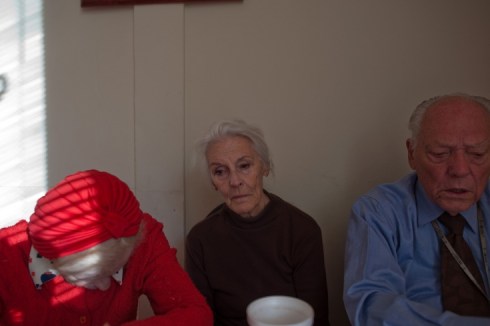
Jeanie, after crying over William’s depiction of women being “easily beguiled,” 2012. © Isadora Kosofsky
Sometimes it takes a while for great photography to percolate, for me at least. I’ve been aware of Isadora Kosofsky‘s documentary of Adina, Jeanie and Will – three seniors in a love triangle – for several months but spent some time with it yesterday.
Kosofsky’s series, titled The Three is potent and unique work full of surprise and bittersweet optimism. I’m not much like Adina, Jeanie and Will, but I am immediately interested in their story and emotions. They’re giving something a go which is less than ideal and it wears on them, but there are bright spots too. There’s a lot to mull over when considering who Kosofsky’s subjects are, where they’ve been and where they may be going.
It seems trite to suggest it, but by tapping the inconvenient messiness of emotion, Kosofsky’s work gets at some truth inherent to life. Truth, huh? Dangerous label when attached to photography.
Isadora Kosofsky is a Los Angeles-based documentary photographer. Her work can be seen here.

 Prison Photography