
You are currently browsing petebrook’s articles.

Lorenzo Meloni‘s series Amal begins by quoting a 21 year-old Palestinian, “In my short life, I’ve seen nothing that makes me hope for peace; I’ve only seen destruction, death, pain. In my life, I’ve only seen the sea once.”
Amal contains a variety of styles and weaves the viewer through multiple emotions in a short space of time. It’s confusing … in a good way. That depth fits with the complex politics of the region.
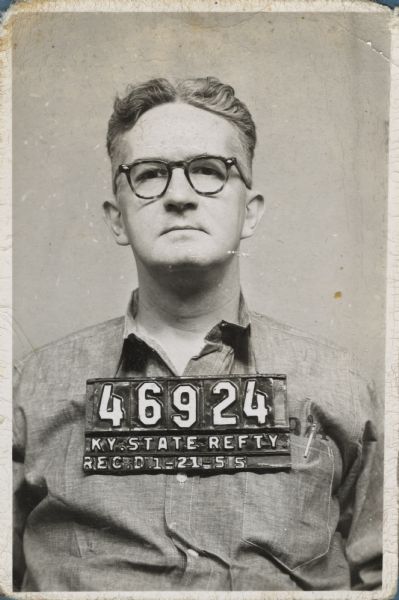
CARL BRADEN
I was surfing through the Wisconsin Historical Archives, like you do, and came across the above image of Carl Braden.
Braden and his wife Anne Braden were journalists-turned-activists who were part of the union movements and later the radical interracial left of the 40s and 50s. The Braden’s bought a house on behalf of the Wade family, their African American friends in suburban Louisville, Kentucky. When neighbours found out a Black family had moved in they burnt a cross outside the house and went after the Braden’s. Carl was charged with sedition in what is known as the Wade Case. Carl was sentenced to 15 years and served 8 months, eventually paying $40,000 to get out.
The Anne Braden Institute (ABI) now operates out of the University of Louisville. The ABI has a Flickr stream of scenes from her full life.
KARL BADEN
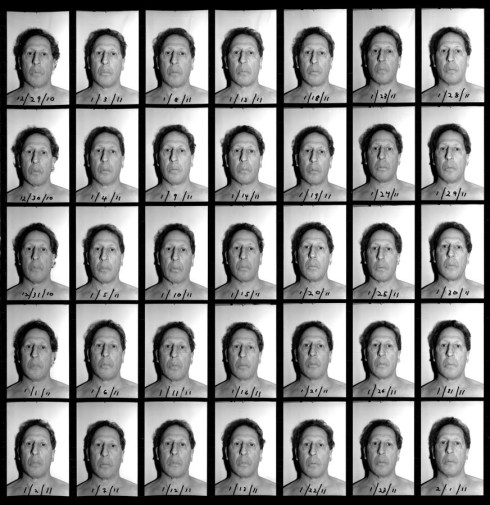
Karl Baden has chosen to put himself in the picture everyday for 24 years. Somewhere he has set up a self-imposed mugshot identification room. All these can be seen at his website Every Day.
It’s worth noting that Baden and Noah Kalina are the original and best for these vaguely masturbatory, mirrored versions of themselves in time-lapse. Others include a girl with a nice set of scarves, two dudes (one and two) with beard-growing missions, a guy with an 800 day commitment and Homer Simpson.
There is also Diego Goldberg who self-documents he and his family once a year, every year on the 17th June.
Baden has established a unique set of data for a limited case study in visual anthropology. The date runs like an I.D. number at the bottom of his shots.
As Baden describes the project, he removes emotion and variables from the photography, just as police or criminal justice photographers do for mugshots:
Every Day is performed within a set of guidelines. […] Reserved exclusively for this procedure are a single camera, tripod, strobe and white backdrop. […] I use the same type of high-resolution film (Kodak Technical Pan until it was discontinued in 2007, Ilford Pan F since then) and the same strobe lighting. The camera is always set and focused at the same distance. When taking the picture, I try to center myself in the frame, maintain a neutral expression and look straight into the lens.
Baden lists the key tenets of Every Day to be mortality; incremental change; obsession (its relation to both the psyche and art-making); and the difference between attempting to be perfect, and being human. I’ll grant him those things, but I also wonder is does the project not feel like a sentence?
And my question to you, readers, is what should we make of this type of project? It could be just inventive fun or it might be one of the most present-minded approaches to photography there is? I can’t decide.
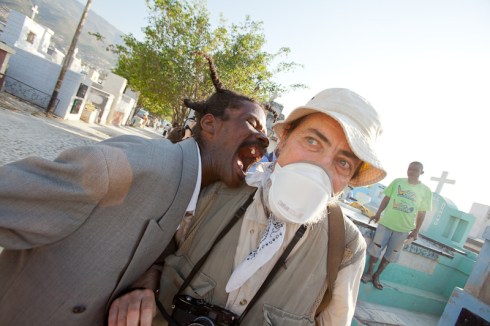
Bruce Gilden’s street shooting methods polarise opinion. His “ambush tactics” (for want of a better phrase) are, for some, the exercise of any photographer’s right in public space, for others he just goes about stuff in a rude way.
Anyway, here’s a TMZ-style photo exclusive of Gilden in front of the camera and not behind it. Gilden the ambushed; not Gilden the ambusher.
Journalist Jake Warga made these photographs in April. Warga was not part of Gilden’s entourage. We can presume that Gilden, at this time, was shooting Haiti: 15 Months Later.
I was critical of Gilden in the aftermath of the Haiti earthquake suggesting his images were little more than a digitised freak-show.
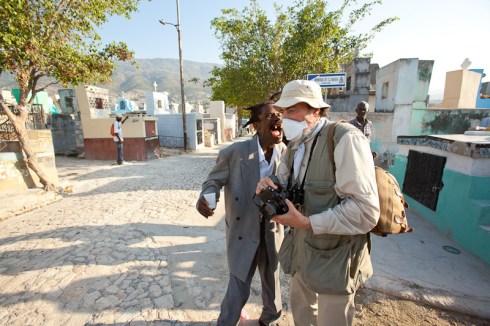
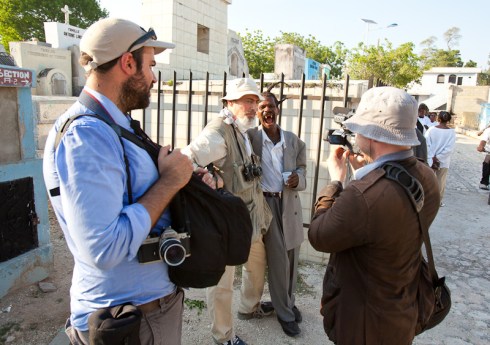
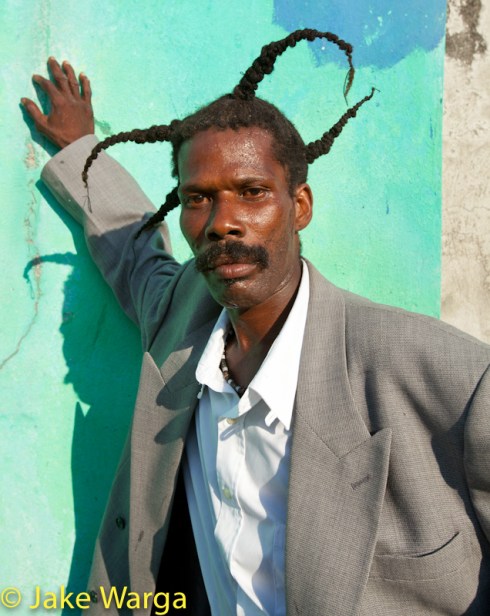
Warga was not surprised the Haitian, who he described as “drunk out of his mind on cheap wine” was attracted to the documentary film crew following Gilden through the graveyard with their photo accoutrements.
“He wanted his photo taken,” says Warga, “I try not to be seduced by spectacle but it was the only way he’d leave me alone. In turn, he gravitated towards Gilden’s cameras, joining the circus of gazes already in Bruce’s orbit.”
The bizarre nature of this interaction can be put down to a mixture of grief, inebriation, intrusion, Gilden’s personal theatre, and the scene acted out by the Haitian man. And all this in a cemetery.
This is probably just another day at the office for Gilden who makes a habit of hanging out with violent persons.
Confusing layers here no doubt, but for me, the take away is Gilden’s flitting averted eyes (top image). As if part of some karmic return, this Haitian man getting up in Gilden’s grill can be read as a metaphor; as a spectre, and brief embodiment, of Gilden’s many victims down the years.
The tables are turned and it looks briefly unsettling doesn’t it?

When we get down to the poorest and most oppressed of our population we find the conditions of their life so wretched that it would be impossible to conduct a prison humanely without making the lot of the criminal more eligible than that of many citizens. […]
The vast majority of our city populations are inured to imprisonment from their childhood. The school is a prison. The office and the factory are prisons. The home is a prison. To the young who have the misfortune to be what is called well brought up it is sometimes a prison of inhumane severity. […]
This imprisonment in the home, in the school, in the office and the factory is kept up by browbeating, scolding, bullying punishing disbelief of the prisoner’s statements and acceptance of those of the official, essentially as in prison. The freedom given by the adult’s right to walk out of his prison is only a freedom to go into another or starve: he can choose the prison where he is best treated: that is all.
— George Bernard Shaw, The Crime of Imprisonment (1946), originally published as Imprisonment in 1925.
Upon reading this 80 year old quote from George Bernard Shaw, I couldn’t help think of the persistent economic inequality of Western capitalism. It’s difficult to fathom why the gap between the rich and the poor has accelerated. The gap is NOW the largest it has EVER been.
The U.S. income gap between rich and poor is the greatest among Western industrialized nations:
The data also revealed that the number of Americans at the very bottom of the income ladder are at record highs. About 6.3 percent of the population are below half the poverty line – $10,977 for a family of four – up from 5.7 percent. This was the highest level since the government began tracking this group in 1975.
Shaw petitioned for the erasure of private property. When Shaw won the Nobel Prize for literature, he took the medal but refused the money. We needn’t take a Shawesque position of martyrdom, just an honest look.
The Pew Center reported this week that those that lost MOST in the economic downturn were African Americans and Hispanic families.

NPR reports that the “mistake” African American and Hispanic families made was to by into the American Dream by way of bricks and mortar:
“What’s pushing the wealth of whites is the rebound in the stock market and corporate savings, while younger Hispanics and African-Americans who bought homes in the last decade — because that was the American dream — are seeing big declines,” said Timothy Smeeding, a University of Wisconsin-Madison professor who specializes in income inequality.
The statistics are repulsive:
The median wealth of white U.S. households in 2009 was $113,149, compared with $6,325 for Hispanics and $5,677 for blacks, according to the analysis released Tuesday by the Pew Research Center. Those ratios, roughly 20 to 1 for blacks and 18 to 1 for Hispanics, far exceed the low mark of 7 to 1 for both groups reached in 1995, when the nation’s economic expansion lifted many low-income groups to the middle class.
The white-black wealth gap is also the widest since the census began tracking such data in 1984, when the ratio was roughly 12 to 1.

How does this relate to prisons?
Well, it occurs to me that if one is living way, way below the poverty line, then the energy to worry about someone elses circumstances is going to be a low priority. If “free” society is in fact – as Shaw suggests – a prison of downward mobility then, quite simply, why bother?
Shaw goes on to argue that at least people in prison don’t have to worry about the provision of food, shelter, nor the payment of taxes. It’s a bleak point indeed when one begins to argue for the merits of prison above and beyond open society (we must also remember Shaw is writing before the era of mass incarceration about the jails of Edward V’s England; he might not so readily espouse the benefits of the U.S. Supermax.)
All this brings me to the ongoing debate about permissive attitudes and failing morality in modern society. Sometimes it seems the issue isn’t what the shared values should be, but that shared values should, at the very least, exist in some form.
In Rude Britannia John Burns’ Sunday Op-Ed for the New York Times, quoted was Ed Milliband, leader of the opposition Labour Party in the UK:
“What is a young person, just starting out in life, trying to do the right thing, supposed to think when he sees a politician fiddling the expenses system, a banker raking off millions without deserving it, or a press baron abusing the trust of ordinary people?”
In such terms, it’s obvious why people don’t care about prisoners or functioning penal institutions.
People are either poor and as such prisoners of society; or they’re cast early in adulthood as amoral, beer-swilling louts whose disruption is perceived as potentially requiring the discipline of prison; or they are witnesses to the crimes and corruption of those in power and conclude it’s a free-for-all anyway.
The drive for crass tabloid journalism, the reluctance for prison reform, the race-to-the-bottom rhetoric of war, and political gridlock over issues (debt ceiling, anyone?) are all driven by lack of imagination.
The UK and the US, in their own ways, could easily get behind an idea. The idea just needs to prioritise social justice action and be imaginative.

Identity Paranoia by Bartek (Bart) Pogoda and Silvia Sencekova has very little to do with the many single images of people in masks or photographs of people with s#%t over their heads.
The skill is in doubling and sometimes tripling the gaze within the pictures. The longer you spend with these photographs the more subtle they reveal themselves.
Not to forget this is a love story. The two masked loners eventual meet one another, leading us only to presume that they really do need the masks and aren’t wearing them for our amusement.
Creepy faces attached to bedenimed euro-bodies wouldn’t be in any of my recipes for photo-appeal, but Pogoda and Sencekova have changed my mind on that.
Oh, and it’s FUNNY, I think.
LINKS
More BIG images here on his blog.
Silvia Sencekova takes pictures of beds and flying dogs.


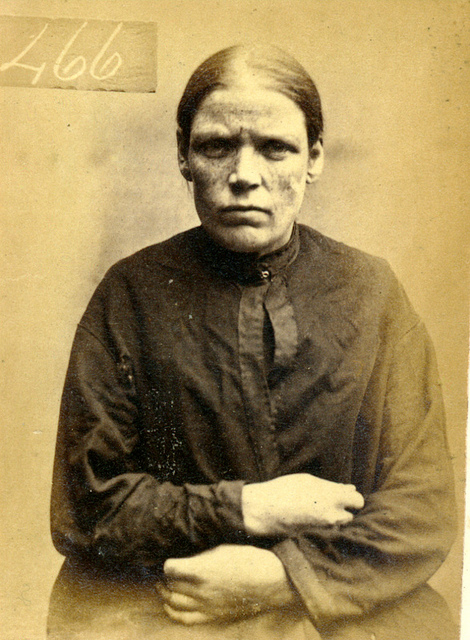
Catherine Flynn was sentenced to 6 months at Newcastle City Gaol for the conviction of the crime – stealing money from person. Age (on discharge): 34; Height: 5.1; Hair: Brown; Eyes: Blue; Place of Birth: Ireland; Status: Married.
Courtesy of the Tyne & Wear Archives & Museums, there’s an absolutely beautiful set of portraits of criminals from the early 1870s in Newcastle, England.
This incongruous bunch is made up of men and women; young and old. Most have been sentenced to short-terms for theft of items (in most cases) necessary for survival – including boots, trivets, chickens, tobacco, oats, beef, or, in one case, four rabbits.
The portraits, which date from 1871-1873 are posed with much intention. Usually, the sitter rest a forearm on the chair back and sits with clasped hands. Sometimes they grip the lapels of their coat. All eerily poised.
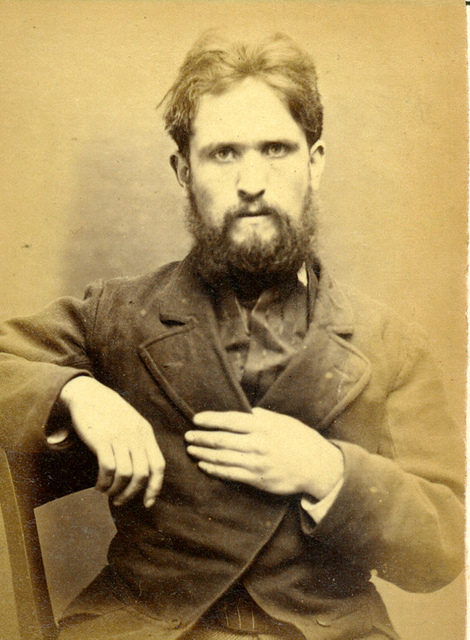
John Richards was convicted of the crime – stealing money from person and was sentenced to 3 months at Newcastle City Gaol. Age (on discharge): 25; Height: 5.5½; Hair: Brown; Eyes: Blue; Place of Birth: Plymouth; Status: Single; Occupation: Hatter
This set of portraits remind me a lot of the well-circulated and well-loved portraits of criminals from the archives of the Police and Justice Museum, Sydney Australia. When I posted about them in January, 2011, I pointed out the obvious fact that they went beyond the sole purpose of identification one expects of police photography; Portraits, Not Mugshots.
When Alec Soth reflected on their quality and his constant search for excellence, he remarked, “I once again wonder why I bother with photography. It seems unfair that an anonymous police photographer can be as good as Avedon and Arbus.” Alien, and teasingly inaccessible, these portraits from Newcastle hold a similar power over the viewer.
In occurs to me, antique photographs allow us to distantly gawp toward ‘the other‘ – and precisely because they are ‘the other’. We can do this with more-or-less impunity and without the ethical problems of objectifying those in the photographs. I presume this is because the people are dead and the era is gone? There’s next-to-no political fallout for lazy interpretation of this century-old ‘other’?
Compare this to the politically fraught task and responsibility of gazing over photographs of other cultures in contemporary society. ‘The other’ is reinforced and made safe by the passing of time. However, ‘the other’ separated not by time, but only by space in our world today is very problematic.
Just something to think about, but not to taint your enjoyment of this dusty, eye-feast of portraiture.

Jane Farrell stole 2 boots and was sentenced to do 10 hard days labour. Age (on discharge): 12; Height: 4.2; Hair: Brown; Eyes: Blue; Place of Birth: Newcastle; Married or single: Single.
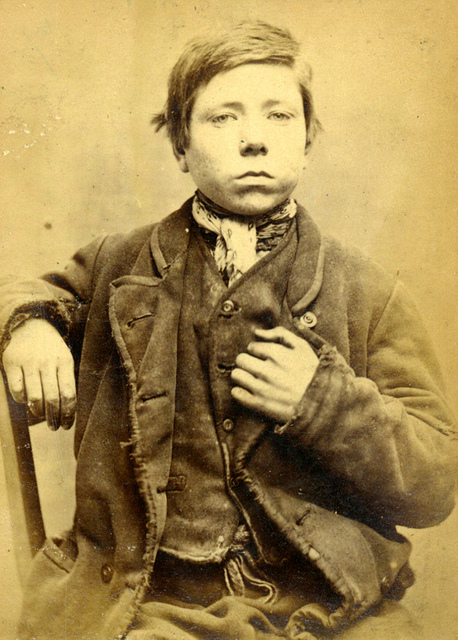
Also know as James Darley, at the age of just 16, this young man had been in and out of prison, but on this occasion he was sentenced for 2 months for stealing some shirts. Age:16; Height: 5.0; Hair: Brown; Eyes: Hazel; Place of Birth: Shotley Bridge; Work: Labourer.
MUGSHOTS
Elsewhere on Prison Photography:
In Joliet, Fine Art Photographers Have Got Nothing on Anonymous Inmates
Who Owns the Rights to A Mugshot?
HAT TIP
Thanks to Aaron Guy, curator for the photography collection of The North of England Mining Institute, for the link. Here’s Aaron sharing some of his discoveries [1], [2] in the archives on his personal blog, and here’s his @AaronGuyUK Twitter account.

INTRODUCTION
Los Angeles based photographer, Adam Amengual says of his series Homies:
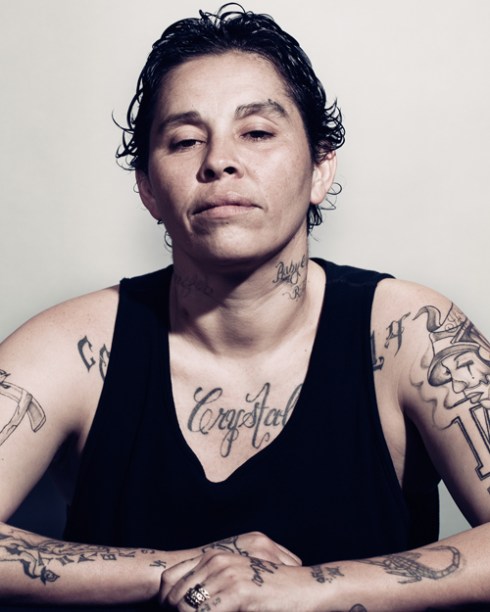
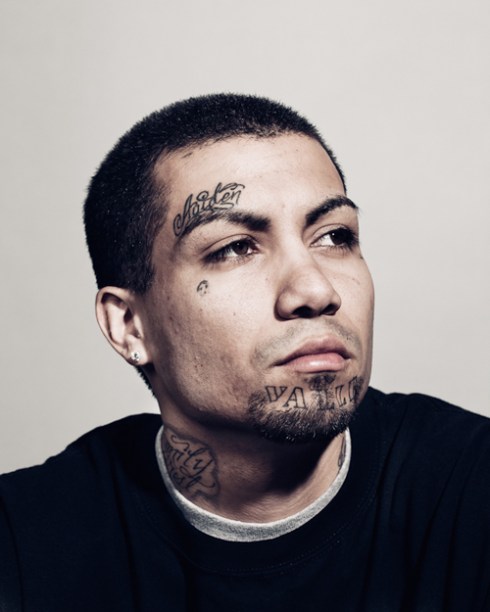
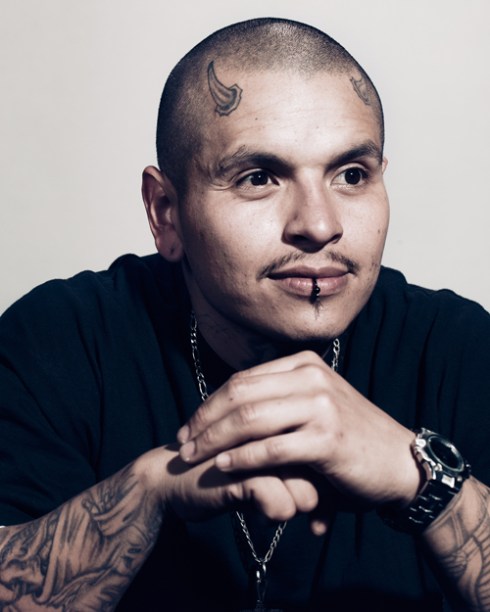
“Through the help of the non profit Homeboy Industries I photographed people who have made the decision to change their lives for the better. The people in these images are current or former gang members and most had spent time incarcerated before walking through the doors at Homeboy Industries. Through a variety of services, Homeboy Industries helps these men and women redirect their lives and provide them with hope for their futures.”
Homies is very striking; the unorthodox subjects under studio lighting both captures and confuses the imagination when reading the portraits. Not surprisingly, Homies has done the rounds recently, appearing on Wesley, Kate and Joerg‘s blogs. I wanted to find out more about the community at Homeboy Industries, about Adam’s decision-making and about his reception at Homeboy when he turned up with his gear.
CONVERSATION
Prison Photography: Were you invited along to Homeboy Industries or did you approach them?
Adam Amengual: I approached them. The subjects are a mix of employees, active and non-active gang members who are seeking one of the many services that Homeboy provides.
I heard a story on NPR about Rev. Greg [Boyle] and Homeboy Industries, which sparked my interest to explore the story photographically. It was a six month process, stemming from my initial contact, to the shoot, and then finally the follow up interviews.
PP: Why were you motivated to make this series?
AA: I have been interested in gangs and cults for a long time. I am very interested in why people join these kinds of groups. Simply put, they are looking for love and a sense of family. Gangs, for example, take advantage of people who have emotional needs that were not fulfilled at home. That is not the case with every single person that joins a gang, but definitely the majority.
Tim Hetherington talked about how his documentary pictures came from a place of personal curiosity. It was a way to locate himself in the world. I relate to that. I use photography as an excuse to meet people or to answer questions that I am interested in. Homeboy turned out to be a venue for me to fulfill my interests in gangs through pictures. Additionally, the current and former gang members have a very distinct looks; I knew it would make for a visually interesting project.
I’m very interested in how people can break a family’s misfortune or shake an inherited “curse” such as addiction, racism, or gang affiliation. It’s very easy for children to repeat a parent’s mistakes. It takes so much effort, courage, and persistence to take a stand and say, this will not happen to my children. After interviewing a few of the people in my pictures I came to understand that the majority of them are trying to be a better example for their kids.

PP: Describe the reputation of Homeboy Industries in Los Angeles and how it relates to the particular gang culture and the cycles of crime that exist in LA. I’m asking what the public know and think of this type of program. Are they supportive/proud? Do they care?
AA: Unfortunately, I do not think that most Angelenos are all too aware of Homeboy Industries and the great work that they are doing. I often have to explain what the organization is when I am talking about my project. But, I will say that most people are very interested when I explain how the organization works and what it’s all about. So, that is certainly a very good thing.
As for the people that have heard of Homeboy, they are very supportive, but usually they just think it’s a place for job training. People are pretty blown away when I list all the classes, counseling, tattoo removal provided by Homeboy. Don’t get me wrong, job training is a huge part of what they do there and it makes the biggest difference, but all the other services in combination with the job training make Homeboy very effective.
PP: Is Homeboy Industries distinctly Angeleno?
AA: Homeboy Industries is distinctly Angeleno. You hear that right out of the mouths of the people who work there, as well as from those that use their services. People travel from all over the country and the world to study what Rev. Greg has created. Time and time again you will hear people say that there is only one Homeboy Industries. They don’t mean “we’re better than you”, they’re just speaking to the fact that it is such an incredibly unique place.
PP: Your work was recommended to me by your former instructor Stephen Tourlentes. I have featured his work on Prison Photography before. Tell us about your education, your philosophy and what you think are the responsibilities of photographers.
AA: I really appreciate Steve sending you my work. I was a teaching assistant for his lighting class. I studied fine art photography at Mass Art in Boston.
I did not plan on studying fine art photography specifically, but I fell into it; I actually rebelled against it for a number of years. Even while I was in school, I wanted to be a commercial photographer, and at that time I had it in my head that Mass Art was cheating me out of something that other more commercial programs were offering.
Little did I know that the ideas professors Stephen Tourlentes, Nickolas Nixon, Abelardo Morell, and Laura McPhee were instilling in me would mold me into the artist and photographer that I am and continually strive to be.
At Mass Art I was schooled in what it meant to be a visual artist and that makes more sense to me now than it ever did before. It’s like the lessons your parents teach you when you’re a kid that you totally don’t get at the time.
Photography is a like trade in a lot of ways; a metal worker can just make guide-rails for stairs or she can be a sculptor. Both take a lot of talent and training, but they are very different mindsets. I’ve learned a lot over the last seven years by assisting commercial photographers – great technical skills, work ethic, and business sense, but all of that, in a sense, I got paid to learn. My professors at Mass Art taught me a way of thinking that’s a lot harder to learn outside of an academic setting. Unless you have an amazing circle of artist friends that are constantly talking about your work and its’ context to the world, you will have a hard time seeing your work from a fine art point of view. I’m not sure if I always had that in me, or if a seed was planted and it took a bit of schooling and time to mature, but I see myself as an artist first and a photographer second.
Photography is very important as a document, a reference for viewers to understand the past and people & places that they’ll not interact with in person.
As for the responsibilities of photographers, that is a hard one. I know what I feel to be my responsibility, especially with my personal work, and that is to make honest pictures. I have a lot of friends in both the fine art world and the commercial side of photography, and I like that. I enjoy discussing the strengths and weaknesses of both worlds, but commercial photography (advertising and editorial) tends to not ask as many questions.
You can compare the world of cinema to the world of photography. There is documentary film-making like Restrepo, moving narratives like in The Kings Speech, or popcorn-mindless-fun like Transformers. There’s a lot of variety and they’re all entertaining on some level. It really depends on the viewer to make the choice on what they want to consume because if there is an audience someone will produce for it.

PP: You’ve said that in the future you would like to photograph juveniles sentenced to life without parole (LWOP). Why this particular group?
AA: Juvenile lifers are a group that I am really drawn to “putting a face on”. A lot of times you hear statistics, particularly ones that relate to the prison system, and it upsets people or makes them feel like something is wrong. But, truthfully, those statistics are just a bunch of words and numbers. When you actually see a person that is affected by the system, then the meanings within the issue make lasting and meaningful impressions.
I had heard some statistics about LWOP juveniles and asked who are these kids? What is their story?
I saw a documentary When Kids get Life on PBS, it was informative but it only covered a few stories in Colorado. Many other states impose this sentence, and I would like to show more broadly who these people and families are. One of the men I photographed and interviewed for Homies was sentenced to life at 17. He spent 27 years behind bars. Why did he end up there? The easy answer is a violent crime, but the harder question to answer is why did he commit that crime in first place? I’m sure that if you took a look at 50 people serving time in prison you could find a lot of similarities in their formative years.
Furthermore, the idea of youth in our culture, what most people envision as the best years of your life, is the opposite of being stuck in prison. I think this is an idea that could be understood in a visual manner and could make a strong point when looking at a portrait of someone in that position.
PP: What are your general thoughts on the prison systems in the US – from your own perspective and also the perspectives of those you’ve photographed.
AA: Prisons are an example of what American culture does best, we look for the quick and easy way to “fix” anything. Get fat, get plastic surgery, something you bought breaks, throw it out. We have a hard time looking at the source of problems and want to just sweep many away.
I am currently reading Gabor Mate’s book In the Realm of Hungry Ghosts. Gabor talks about how at one point it was thought that genes made you a drug addict and this was accepted so quickly because as a society we want to say that a person was messed up from the get go, had no chance, that there was nothing we could do. As it turns out, genes have only the slightest effect on how a person develops negative issues in life. How a person is raised and early life experiences is what really determines the kind of functioning role they will have in society. Treating society with preventative medicine, to make sure people do not commit crimes, join gangs, etc. is a lot harder to do.
Almost every person I talked to at Homeboy, that had done any kind of serious time, said that prison just makes you an even worse criminal. To quote one of my subjects, “You go in there with the weed problem you come out strung out on dope…” Another thing that I was told is that the longer you are in there, the more you have to adapt to being in prison and learn to survive. Then you have to re-adapt to “normal society” once released. If you do not re-adapt and most do not, that prison mentality will cause you to end up right back in there.
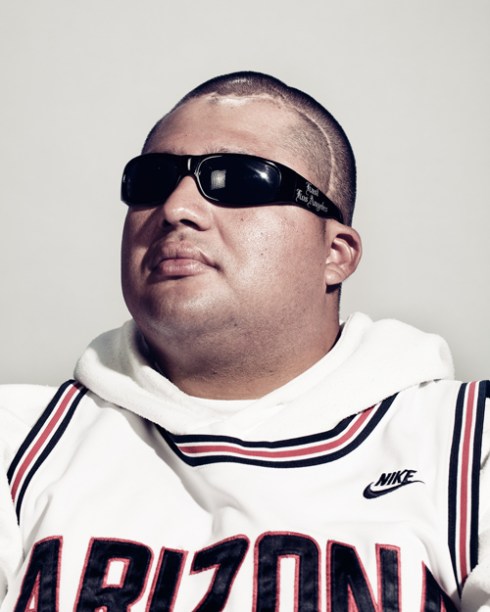
PP: I don’t usually ask about techniques or lighting (I am not a photographer), but your Homies portraits have a particular look. Explain your choices in setting up the portraits.
AA: A few of my biggest influences in photography are Thomas Struth, Rineke Dijkstra, and Stefan Ruiz. All three have worked in the portrait style that I chose for this series. Studio portraits satisifed both logistic and aesthetic concerns.
When I first approached Homeboy Industries, I wanted to photograph a subjects in their home environment, but it was made fairly clear from the start that I would not be able to do that. I was told that if I was more than welcome to shoot on Homeboy’s premises. I knew I did not want the Homeboy facility to overpower the individuals I was making portraits of, and to do that I needed to visually remove the environment.
When shooting a studio style portrait I sometimes like to use a bit more of a hyper-real light source, nothing over the top, but a light that has a physically descriptive character to it. It cannot be too distracting. I don’t want the viewer paying more attention to the lighting than the actual subject.
For three reasons, I wanted these pictures to be a tighter crop. One, I have always been really into Flemish Portrait paintings from the 17th century. The lighting and chest up crop was, in my opinion perfected by painters like Van Dyke. Two, I wanted to focus on the face as well as the hands; tattoo culture is such a big part of their appearance that I really wanted to show those details. Three, shooting in this style begs a comparison to a mug shot. A majority, if not everyone in this series has had a mug shot taken of them at one time in their past. I feel I have flipped that old image of them showing them as proud and iconic. It is a visual metaphor for the transformation they are bringing to their own lives.
PP: Did you give your subjects direction? What did they want to convey through your photographs.
AA: I gave them only a few cues. Everyone that I photographed were all proud to be at Homeboy and proud of why they were there. They know that they are taking steps in the right direction, and I really wanted to capture that. I mentioned old painted portraits, pride and stoicism, to make sure they got the idea that I wasn’t looking to make a smiley Sears portrait. I photographed them digitally so I was able to show them exactly how their pictures were going to look and feel. I think this really helped with the collaboration.
When first photographing someone there is always a trust to be gained, this can take anywhere from a few seconds to an hour, even more sometimes. After the first few people at Homeboy saw how the images were going to look, more and more people then wanted to be photographed. I believe they felt it was a chance to document and celebrate this positive action in their lives. It was an incredible experience to be a part of.


 Prison Photography