
You are currently browsing the category archive for the ‘Activist Art’ category.

Poster created by the Students for a Democratic Society (SDS) advocating support of prison rebellions, and the abolishment of alleged racist prison terror. Source: Wisconsin Historical Society
The most famous prison rebellion in American history began in the early hours of September 9th, 1971.
I’ve written about the Attica Prison Uprising before, mainly in relation to Cornell Capa’s involvement in the general politics of prisons and his testimony during the inquiry that followed the riot.
I wanted to share an image of this poster and ask you if you can imagine this type of visual being used today. It wouldn’t happen. Universities are less and less incubators for radical action; prison issues are rarely incorporated into overarching critiques of capitalism; and, sad to say, solidarity and Socialist motifs are derided in today’s media culture of garish graphics, breasts, comments of misdirection and ridiculous 24-hr coverage.
Not wanting to end on a down note, these groups are working against our society of excessive, blaring infotainment. Check them out.

Ex-Clandestine Centre for Detention, Torture and Extermination Automotores Orletti, Buenos Aires. Plug used for the picana eléctrica (cattle prods) in the torture chamber. © Erica Canepa
The Remaining by Erica Canepa is mostly interior photographs of the sites used for detention and torture during Argentina’s Dirty War (1976-1983). Also included are a few portraits of survivors, notably Victor Basterra whose photos taken while he was prisoner have been used in trials for crimes that occurred at the main prison, The School of Naval Mechanics (ESMA).
Canepa’s title for the series comes from a quote by Basterra:
“The military dictatorship began with the idea of culturally changing Argentinian people. It has been a progressive change towards a more individualist, selfish and insensitive society that reached its apogee during the Nineties, but where the basis was brutally planted during the dictatorship era. What you see outside the window is what’s remaining, what we are left with. It is today’s Argentina, that shows the indelible marks of genocide, but in which I can still see the ideals that we fought for.”
– Victor Basterra, ex detainee of the Clandestine Centre for Detention, Torture and Extermination ESMA, 2011.
Though not apparent in the photographs alone, Canepa’s project is not just a tribute to the students, university professors, intellectuals, artists, sports men, workers and others who opposed the Jorge Rafael Videla military dictatorship, but also a call for us to view the aftermath of extreme political violence. It is about the acknowledgement and attachment – or not – of subsequent generations.
Canepa’s work is laudable but the photographs are surely just an entry point to the massive and terrifying details of the Dirty War (1976-1983), a terror that “disappeared” over 30,000 Argentinians. Canepa’s lengthy accompanying text would suggest she is aware of the limitations of photography:
The junta did not achieve its goal, the deletion of a generation’s ideals. The lives of the ex-desaparecidos are living proof of this. […] Sometimes, a smell takes them back to the horror, sometimes a tear rolls down their cheek. They cannot explain the reason why they survived and they ask themselves this question every day. They are alive, and they feel the responsibility to help justice make its course. […] The country is rebuilding the truth and owning it, learning how not to commit the same mistakes, learning how to live without fear. The scar left by the military dictatorship is painful, but not crippling. The survivors are no longer victims. They resisted: they went back to school, they now have families and they have careers.
What you can see outside the window, what you can read in people’s eyes is the strength and the courage to believe in a fresh start.
What you can see outside the window is ‘the remaining’: it’s today’s Argentina.
If you are interested by this topic you should look also at the photographs of Paula Luttringer and Joao Pina.
Sin Olvido is an archive of photographs and descriptions of 3,400 victims of the Dirty War.
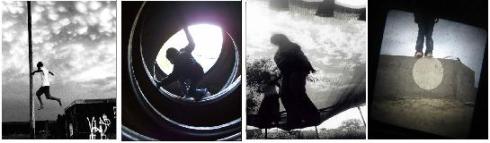
Founded in 2005 by by Emily Schiffer, a Magnum Foundation Emergency Fund grantee, My Viewpoint on South Dakota’s Cheyenne River Reservation, is a youth photography initiative “invested in young people’s inherent visual curiosity.” The images from Seeing is Fun are captivating.
The program has students (ages 6-20) apprentice with professional photographers, working in both analog and digital photography and printing their images in an onsite darkroom
My Viewpoint is run through the Sioux YMCA in Dupree, SD, and in partnership with Daylight Community Arts Foundation.
From the Daylight Magazine blog:
Shipping and Receiving: Photographs and Letters Between Venice, CA and Dupree, SD
August 6–September 30, 2011
Venice Arts Gallery in Venice, California
Opening Reception: Saturday, August 6, 5-8 p.m.
This exhibit features the photographs taken by students in the My Viewpoint photography program, and highlights a collaborative photographic exchange between the youth in the My Viewpoint program and youth at Venice Arts, conducted over 2010 and 2011.
Children of the Cheyenne River
July 23–September 4, 2011
Fovea Exhibitions in Beacon, New York
Opening Reception: Saturday, July 23, 5–7 p.m.
Artist Reception & Talk with Emily Schiffer: Second Saturday August 13, 5–9 p.m.
This exhibit is comprised of medium format black & white photographs of the students in the My Viewpoint photography program by the program’s founder Emily Schiffer, accompanied by a narrative text that explores Schiffer’s perspective on her evolving relationship with them, as well as photographs and text from the students.


Sometimes it’s associated with a British band, and sometimes it associated with people who are banned.

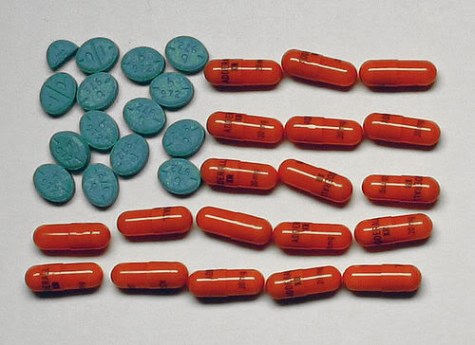
It’s about pills, madness and control. It’s about healing.

It’s about awesome fashions and it’s about bad accessories.


It’s about poor decisions by presidents.

It’s about corporate control and corporate profits.


It’s about death to ours and death to theirs.


Sometimes, it’s about imperialism.

It’s about religious freedom and freedom of religion.


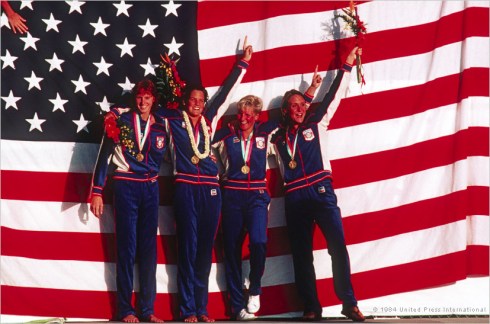
It’s about fake sportspersons and real sportspersons.

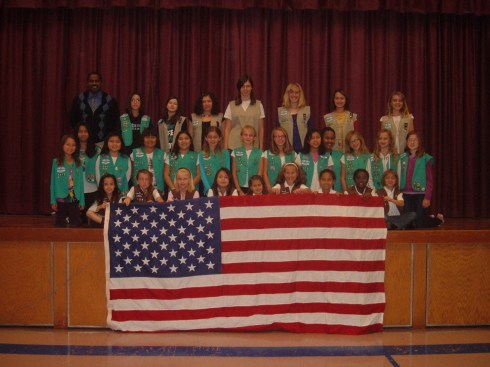
It’s about God and it’s about children.
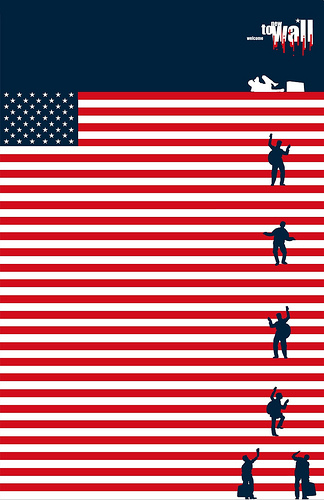
It’s about we the people, not them the people.

It’s about bigotry and it’s about a permanent underclass.


It’s about cold beer, cupcakes and weed.
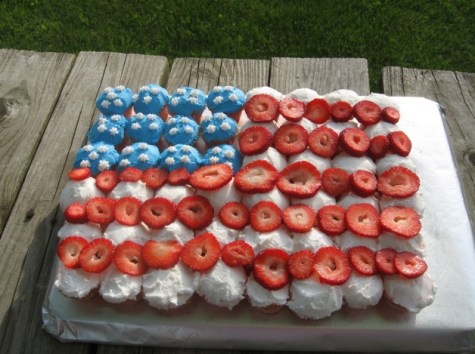
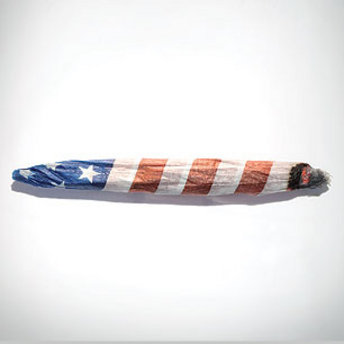
Images sources: Rolling Stones lips; Prison bars, from Teen in Jail; American flag of pills, by Talia Marisa; Heels, Fashion Munster; Spectacles, Linda Lovelock wears American flag sunglasses during the 2010 Tax Day Tea Party April 15, 2010 in Pleasanton, California. Tea Parties were held across the United States to denounce tax day. More than a thousand people attended the Tax Day Tea Party at the Alameda County Fairgrounds. (April 14, 2010 – Photo by Justin Sullivan/Getty Images North America); Bush family; Corporation flag; ISBN flag, via Adbusters; Coffin at night, Sudanese men look at the flag-draped coffin of U.S. diplomat John Granville, 33, who worked for the USAID, as it is received by U.S. officials in Khartoum, Jan. 3, 2008. (AP); US flag bomb graphic, via Daily Bleed; Imperialism flag, Christian cross, on eBay; Star-spangled burqa; Rocky Balboa shorts; Olympic winners, via Astropix (Teammates in the USA women’s 4 x 100 meter relay swim team stop in front of a giant American flag to wave to fans after winning the gold medal and setting a world record in the finals of the event during the 1984 Olympics in Los Angeles. From left are Jenna Johnson, Dara Torres, Carrie Steinseifer, and Nancy Hogshead.); Child’s drawing, via Fire Andrea Mitchell; School class photo, via Valley Community Newspaper (The Girl Scouts who meet for troop activities at Martin Luther King Jr. Elementary School had an American flag flown over the nation’s capitol on Dec. 6 to honor the school. Photo Credit: Unknown); Immigration wall graphic, by Luis Boix; “Does my fag offend you?” bumper sticker; Immigrant labour graphic, by La Mustia; Supermarket beers, via Corks and Kegs; Cupcakes, The Cupcake blog; Spliff, from Rolling Stone via The War on Drugs is a War on Me.
THE BACKGROUND
In one of modern politics’ most outrageous adoptions of Doublespeak, Governor Arnold Schwarzenegger – in 2004 – renamed the California Department of Corrections the California Department of Corrections and Rehabilitation.* You can see videos – here and here and here – of the press conference announcing not only a change in name, but a supposed change in the management philosophy of the CDCr.
At that time, legal challenges were being made over the adequacy of healthcare. Following the 2004 criticisms and despite the 2004 promises, consistent constitutional healthcare was not provided to the prison population of California.
The CDCr failed to deliver on both medical care and meaningful rehabilitation. To prove the emptiness of the rhetoric we can look to John Gramlich’s report for the PEW Center’s Stateline last month. Gramlich made the point, that shortly after Schwarzenegger’s rebranding the “administration cut funding for prison rehabilitation programs by about 40 percent.”
THE PUSHBACK
It’s just as well for you and I, a diligent group of California citizens have for 17 years challenged the claim on the CDC acronym and since 2004 reclaimed entirely the discarded California Department of Corrections name. The CDC works to put right misleading messages, empty words and muddy communication.

Founded in 1994, the California Department of Corrections (CDC) describes itself as “a private correctional facility that protects the public through the secure management, discipline, and rehabilitation of California’s advertising.”
Above is the CDC’s latest correction of fact and assault on complacency. From their website:
The California Department of Corrections (CDC) has unveiled a new campaign of bus shelter ads to celebrate America’s assassination of Osama bin Laden.
Released prior to July 4th, a total of ten ads in MUNI bus shelters throughout San Francisco were apprehended, rehabilitated and discharged without incident. The ten liberated ads represent each year in the long decade spanning the declaration of the War on Terror by President Bush and the eventual demise of al-Qaeda’s elusive leader.
Joining in celebration with millions of US civilians after the demise of bin Laden, the red, white and blue advertisements not only pay patriotic tribute to our country, but also celebrate the unsung history of American assassinations.
The rehabilitated advertisements are currently at liberty and seem to have successfully readjusted to public life. However, these ads will remain under surveillance by department staff to prevent recidivism and any potential lapse into prior criminal behavior.
You gotta love direct action. View more works here.
* You may have noticed I always refer to the Golden State’s prison system as CDCr; using a lowercase “r” is an simple text-based slight but it makes the point.
(Via the ever-wonderful Just Seeds Blog.)

© Marjorie Jean-Baptiste/Fotokonbit
After my extended commentaries on photography in Haiti after the January 2010 earthquake, I’d like to bring attention to a non-profit producing and teaching photography workshops and putting cameras in the hands of Haitians.
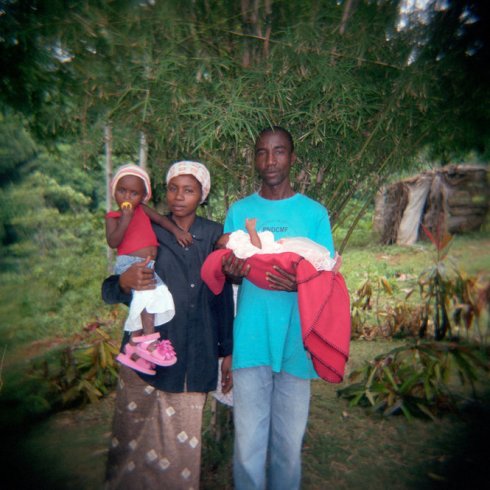
FotoKonbit is a non-profit organization “created to empower Haitians to tell their own stories through photography. […] Inspired by the Creole word “konbit” which can be defined as the coming together of similar talents in an effort towards a common goal, we use our skills as photographers, educators, and artists to make a positive difference, through photography. By partnering with established Haitian organizations, FotoKonbit is uniquely positioned to inspire hope through creative expression and provide Haitians with the opportunity to document their reality and share it with the largest possible audience.”
The FotoKonbit team is made up of Frederic Dupoux, Ralph Dupoux, Maggie Steber, Marie Arago, Noelle Theard, Tatiana Mora Liautaud and Edwidge Danticat.
As TIME notes:
One of the most innovative uses for the photographs has been as documentary evidence for aid organizations. During three recent workshops for teenagers and younger adults living in tent communities, participants were asked to photograph aid efforts that they thought were successful, and to demonstrate needs that had not yet been met. Fotokonbit’s partnership with the American Embassy helped to get the work seen by the international aid community in Haiti.
In addition to these laudable humanitarian uses of Haitians photographs, is the simple fact that these images represent something distinctly different to the majority of Western media. How often have we seen naked, entranced worshipers prostrate in the waterfalls of Saut d’Eau? And how often are photographs from Haiti wrought with some outsider hyperbole or gratuitous pain? I don’t want to vilify photographers, especially as many such as Jonas Bendiksen and Louis Quail are committed to nuanced story telling.
Just to say that perhaps the mundane serenity of the landscape photograph below probably would not appear in our mainstream media.
And the market shot is just beautiful.


More images at TIME LightBox.
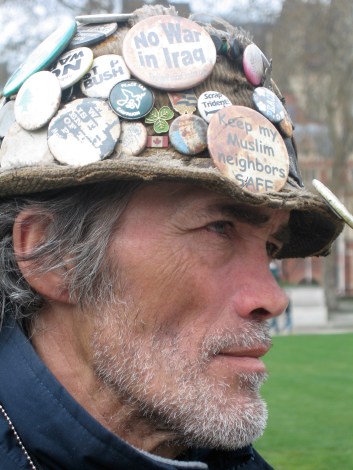
Brian Haw, Parliament Square, April 2008 © Pete Brook
Sad news this weekend. Global citizen and hero of the anti-war protest movement Brian Haw died aged 62 on the 18th June. His efforts, legacy and importance can be learnt about at http://www.brianhaw.tv/index.php
For nearly a decade, Brian Haw held a permanent presence in Parliament Square outside the UK Houses of Parliament. The only time he left the “camp” was to attend court hearings – many of them involving attempts by authorities to evict him.
While Haw was undergoing treatment for lung cancer in March, London Mayor Boris Johnson won a court ruling to finally evict Haw.
In 2007, Haw was voted ‘Most Inspiring Political Figure’ by the viewers of Channel Four.
That same year, artist Mark Wallinger recreated Haw’s protest inside Tate Britain. Wallinger won the Turner Prize for art a few months later.
Uncompromising and committed beyond the capacities of most others, Haw’s protest was a visual reminder to every single UK member of parliament that Bush had an agenda, Blair was wrong and the war on Iraq was waged on a pack of lies.
Haw actually began his protest in June 2001; against economic sanctions and the effects on civilian populations, particularly children. That’s a full five months prior to the U.S. invasion of Afghanistan in November 2001. Did he tap the zeitgeist? Did he intuit that the western powers were about to embark upon a decade of imperialist military incursion? Will an activist-commitment such as his – that captures the hearts and attention of a nation – exist again? One hopes so.
R.I.P. Brian.
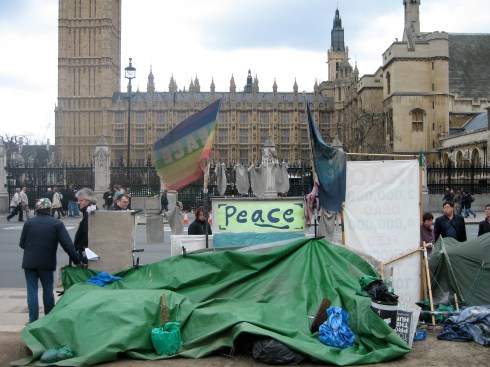
Brian Haw’s camp, Parliament Square, April 2008 © Pete Brook
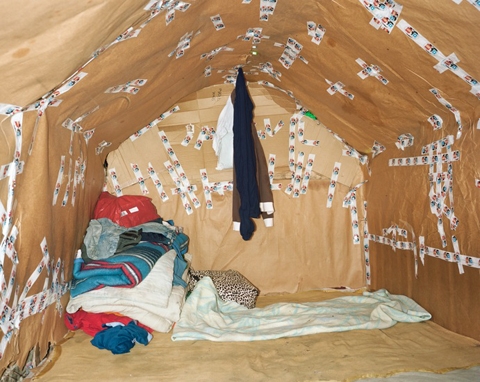
From the series Shelter by Henk Wildschut. From a shortlist of six photographers’ projects, Wildschut won the 20,000 Euro DUTCH DOC AWARD.
Last weekend was the Dutch Doc Festival.
The theme for this years Dutch Doc Festival is the slow type of journalism, which “focuses on long-term projects that frequently involve a strong personal commitment and steer clear of passing fashions. Projects that revisit a (pre-documented) subject in a sequel or to create a new sequence in follow-ups after set periods of time.”
Photoblogging duo Mrs. Deane were involved in the festivities and asked other bloggers and I to pitch in. They emailed:
To underline the relevance of the online community in shaping the contemporary debate, we would like to invite a number of what we consider ‘distinct voices’ to contribute to the festival via our presence. We would tremendously appreciate it, if you could select three photographic projects that you feel should be considered when discussing what’s needed right now, what people should be looking at, what has been forgotten, or what new projects are leading the way in the field of documentary photography (especially the kind that is also moving within the confines of the fine art galleries).
Ignoring the last criteria, I unapologetically picked three very political projects. Mrs. Deane posted my response over there, and I cross-post here for good measure.
THREE NEEDED PROJECTS
At a time when images rifle across our screens and retinas usually serving the purpose of illustration or corporate propaganda, the resolve of photographers to create bodies of work that deal with politics — and often large narratives too — can be read as either foolhardy or enlightened. I’ll pick the latter.
Kevin Kunishi’s work in Nicaragua, Joao Pina’s documentary in South America and Mari Bastashevski’s documents from Chechnya explore to varying degrees, “what has been forgotten.” Photography is art and art should be political. If we considered remembering and memory the first act in resistance against injustice then these three projects are high art.

From los restos de la revolucion © Kevin Kunishi
Kunishi’s Los Restos de la Revolution is a poignant look at the remains and the survivors of the Nicaraguan civil war. The portraits feature both former Sandanista rebels and former US-sponsored Contras. The mundane everyday details alongside deep psychological scars following conflict can be easy to turn ones back on when the bombs stop lighting up the skies. And it is easy to forget the US’s imperial policy and meddling in this conflict. One wonders if Afghanistan will ever have a cushion of a similar period of peaceful time to be part of a similar look back at the experiences and actions of its citizenry amid conflict.

From File 126 © Mari Bastashevski
Mari Bastashevski’s File 126 documents spaces previously inhabited by abductees who were “disappeared” during the Russian/Chechen conflict. Bastashevski says, “the abducted are incorporeal, as if they never were. They are no longer with the living, but they are not listed among the dead.” This is a particularly brave project given the state forces complicit in the departures are still in power and their reactions to Bastashevski’s inconvenient conscience are unknown.

From Operation Condor © Joao Pina
Joao Pina’s Operation Condor expansive work across South America, wants to both document and “provide evidence” for ongoing memory and trials into cases of of extrajudicial torture, kidnap and murder by the various Right-wing Military Juntas in South America during the 1970s and 80s. Like Nicaragua [and Kunishi’s work] the US had a strong influencing hand in either establishing or propping up many of these hardline governments. The crimes of thirty years ago are barely on the radar of the Western world however. How quick we forget! Pina is currently raising money for the next phase of his project at Emphas.is.
Colin and Joerg’s Selections
Mrs. Deane got a couple of other expert opinions.
Colin Pantall selected Third Floor Gallery, Timothy Archibald and Joseph Rock.
Joerg Colberg plumped for Brian Ulrich, Milton Rogovin and Reiner Gerritsen.

 Prison Photography