
You are currently browsing the category archive for the ‘Activist Art’ category.
RIGO 23 recently accompanied Robert H. King (formerly one of the Angola 3, now released), Emory Douglas (printer and legend of revolutionary graphic art) and Billy X Jennings (you HAVE to click that link!), three veterans of the Black Panther Party, on their recent trip to Porto and Lisbon in Portugal.
RIGO emailed:
“Here’s a little clip from the mural I painted at a housing complex south of the River Tejo in Lisbon to commemorate the visit to their community by Robert, Emory and Billy. Robert is a survivor of 29 1/2 years of solitary confinement; Emory Douglas was the Minister of Culture for the Black Panther Party.”
I have mentioned RIGO’s art in support of US political prisoners before. His TRUTH mural in San Francisco marked Robert H. King’s 2001 quashed conviction. RIGO continues to advocate for Herman Wallace and Albert Woodfox, the remaining Angola 2.
He supports Mumia’s ongoing legal battles and RIGO also recently joined Michelle Vignes – a true matriarch of radical documentary photography – for an exhibition in solidarity with Leonard Peltier. (Details and review of the show at the Warehouse Gallery in Syracuse, NY. Closed Feb. 6th)
RIGO conceived of the space as an imaginary museum – The Tate Wikikuwa Museum: North America 2024. Tate Wikikuwa is Leonard Peltier’s Lakota name and 2024 is the year of his next parole hearing. It showcases arts & crafts by the Oglala Sioux and Peltier’s paintings, as well as documents, books, writings and educational material. Making use of Peltier’s colour choices, RIGO created a spiritually and politically charged space.

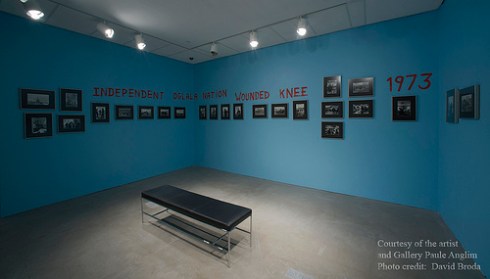
I would have loved to have seen Vignes’ prints of Peltier and the AIM Movement exhibited within the mood set by RIGO’s installation.
For such an important photographer of America’s West Coast counter cultures and radical movements, Vignes does not have a large web presence; there is a paucity of reviews and there are few images too. Next time I’m in the Bay Area, I will have to pay a visit to UC Berkeley’s Bancroft Library which acquired her archives in 2003.
Look out for more about Michelle Vignes on Prison Photography in the future.
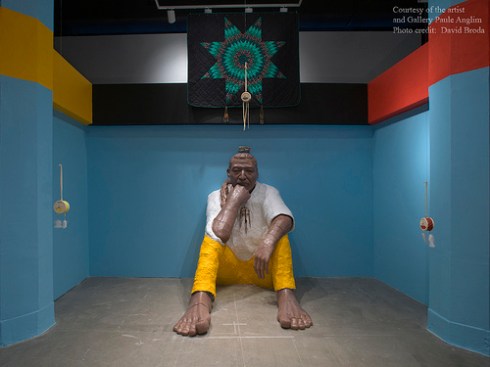
Photo Credits: All images David Broda
(Found via Just Seeds and Bob Gumpert)
PAUL RUCKER
In May of 2009, Paul Rucker partook of a two week residency at the Blue Mountain Center. The theme: Prison Issues.
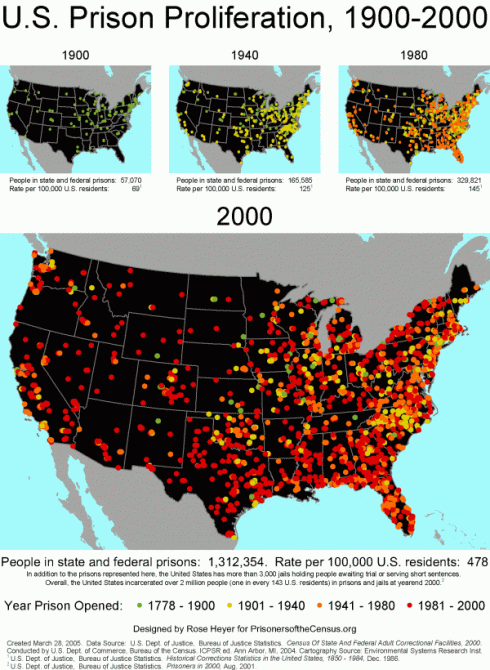
During his research he happened upon some pioneer GIS maps by Rose Heyer which modeled the growth of the US prison system. With the information he composed an original score. A note to accompany each carceral outpost to blink into existence in the “Land of the Free.”
232 years in 10 minutes and 45 seconds.
ROSE HEYER
Incidentally, Rose Heyer is a wonderful thinker. She developed the GIS methodology for the Prisoners of the Census project, enabling quick calculations of how Census Bureau’s prison miscount distorts representative democracy.
Heyer produced the map U.S. Prison Proliferation, 1900-2000 and she co-authored Too big to ignore: How counting people in prisons distorted Census 2000, Importing Constituents: Prisoners and Political Clout in Massachusetts Importing Constituents: Prisoners and Political Clout in Texas, Importing Constituents: Prisoners and Political Clout in Ohio, and Thirty-Two Years After Attica: Many More Blacks in Prison but not as Guards. Rose is now GIS and CAD consultant in California.
(Source)
Following up on my post about Julie Green’s The Last Supper, I think it is necessary to make an overview of the photography and painting projects that consider America’s death penalty by meals of depicting last meals and last meal requests.
Celia A. Shapiro
Shapiro’s recreations of last meals in lurid colour are possibly the best known within this subject matter. She made the series Last Supper in 2001. Of Shapiro’s work, critic Fred Ritchin said it proves the US only executes poor people. Ritchin’s position might be true, but as Julie Green reminded me most inmates, particularly in Southern states are limited to food from the prison kitchen and usually to a budget of $20. States that rarely employ the death penalty offer a generous $50 or no limit at all.
In all their garishness, Shapiro’s works are reminiscent of Martin Parr’s work. Parr too photographed the food of the poor; fish and chips, cupcakes, bangers and mash and trays of tea. Whatever Parr claims about objectivity there is a snide judgement in his work. Indeed it is his strength that his pictures show us the true absurdity of many of our dietary mores.
Shapiro’s work disgusts me. It disgust me in a good way. It angers me. Each of Shapiro’s images represent a life extinguished … gassed, cooked, fried. It’s hard to stomach. Good art evokes strong response.

John William Rook, age 27, executed by North Carolina, 9/19/86. © Celia A. Shapiro
James Reynolds
James Reynolds‘ Last Suppers was well received in 2009 but the interest in his birds-eye view still-lives seemed short-lived. I suspect they were appreciated more for their unorthodox view of a infrequently seen subject and for their role as conversation starter, than they were as lasting pieces of art.
The visual discipline of the institutional orange trays of containing in most cases a bizarre allocations of food, fairly reflects the irrationality of a state killing a citizen.
There is something maddening and suffocating about Reynolds’ ordered still-lifes. The demarcated space of the foodstuffs reminds me of aeroplane meals. For the executed it all comes down to a tightly presented meal, and this is meal is absurd.

© James Reynolds
Jonathon Kambouris
Jonathon Kambouris‘ efforts with The Last Meals Project is roughly contemporary with Reynolds (completed over 2009/2010). Judging by the shadows to the chicken legs, cups of coffee, Kambouris places food items ontop of a blown-up mugshot of a (infamous) inmate mugshot and makes the photograph from directly above, looking down.
Kambouris is tying his desire for a debate about the death penalty to the most renowned and media-coveted men and women. I am not convinced this is a good tactic as (whipped up) emotions about serial killers is not the place to begin a rational discussion on the symbolic foolishness of the death penalty. I think a better place to start a progressive debate – at least within the framework of art – would be Taryn Simon’s The Innocents or the painter Dan Bolick’s Resurrected. The existence of innocence on America’s death rows is a powerful argument working in favour of death penalty abolition.
One footnote to add is my astonishment at Kambouris’ statement at Feature Shoot: “In 2010 this photo essay traveled to Singapore to be shown in the Singapore Fringe Festival: Art and the Law. Ironically, Singapore has an extremely strict death penalty stance and I was informed that it is part of school curriculum to watch an execution take place.” Kids spectating murder? Can that be true?
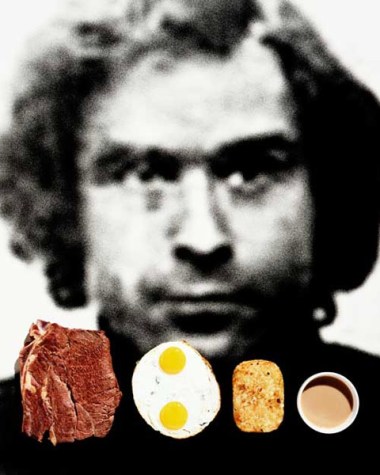
Name: Ted Bundy; Last meal: Steak, eggs, hash browns, coffee; Sentence: Death by electric chair; Executed: January 24, 1989, 7:16am; State: Florida. © Jonathon Kambouris
Mat Collishaw
Mat Collishaw goes all Flemish Master on his last meals. Except it isn’t the girl with the pearl earring chomping down on that lettuce it was Karla Faye Tucker a few hours before she was lethally injected by the State of Texas in 1988. Flemish still lives were part allegories of life, death and cycles of nature but frequently used items of trade as story telling devices. Knowledgable viewers would identify flowers or precious metals from across the globe brought by the Dutch merchants that dominated sea-trade in the 16th and 17th centuries.
In the age of supermarkets and year round strawberries, the global food trade and who runs is of little significance. The inference in Collisaw’s work is that America trades in sublime murder.
Found via Art Most Fierce.

Karla Faye Tucker (2010). C-Print, 73 x 60 com (29 x 24 inches) © Mat Collishaw
Jacquelyn C. Black
Black’s … last meal … (Courage Press, 2003) is a curious little publication. It is clearly an act of conscience. The studio photography is very literal without the interpretation we see in other artists’ works. I cannot be sure Black’s prints have ever gone on exhibition. Black pairs images of last meals with text of last statements.
When one is looking at photography in order to draw critical conclusion, it is often the absence if photography (or more precisely, the presence of something unexpected) that can provide the Eureka! moment. I am somewhat desensitised to the issue of state violence; I suspect the emotive response Black and her peers expect of the viewer, I do not deliver. It was therefore, an absent image and text in its place that caught my attention and really drove home the spiteful retribution of execution:
ASKED THAT HIS FINAL MEAL BE GIVEN TO A HOMELESS PERSON
(REQUEST DENIED)
… last meal … includes valuable auxiliary material – on the history of capital punishments; on statements made in landmark legislation; and on US death penalty statistics. Black also lists political resources for anti-death penalty activism.

Name: Anthony Ray Westley
Executed:May 13, 1997
Education: 8 years
Occupation: Laborer
© Jacquelyn C. Black
Barbara Caveng & Ralf Grömminger
Glowing like fast food menu boards but with the deliberateness of illustrations in a noodle bar, Grömminger’s photographs mounted in lightboxes for Caveng’s Final Meals installation are a bit pop. Any illusion of vitality is deflated by the procedural details of the eater’s execution.

Detail from ‘Final Meals’, installation by Barbara Caveng, 2000. Backlit boxes: Steelcases (40 x 40 x 18cm) with a pane on one side to pull, showing the execution protocol. Two audiostations with final statements. Meals photographed by Ralf Grömminger
Kate MacDonald
“The leftover table scraps relate the humanity of the condemned to our own ordinary experience,” says Kate MacDonald of her painted Last Meals series. That’s a bit poetic for me. More powerful is the fact these plates are empty. The remnants of sauce and chicken bone are primordial and bloody. Just as these items were devoured, so too will be the body that consumed them. Despite the polystyrene cup and plastic cutlery there is something very animalistic about MacDonald’s oil paintings.
Last Meals featured in the Texas Moratorium Network’s exhibit Justice For All? Artists Reflect on the Death Penalty, in which MacDonald and peers considered the injustices embedded within the death penalty; “Mental health and lack of advocacy, racial discrimination, poverty, and at the issue’s most basic argument, the possible innocence of the executed.”
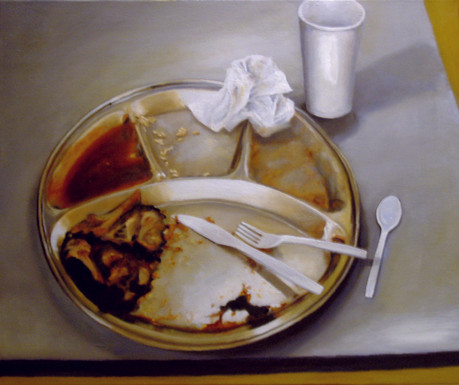
The last meal of Ruben Cantu, believed to be wrongfully convicted and executed in Texas. (24 x 20 inches), oil on canvas. © Kate MacDonald
As of May 2009, there had been 1165 U.S. state-sanctioned executions since 1976.
– – – – – – – – – – – – – – –
UPDATE: August 19th 2012
Two more projects.
Helen Grace Ventura Thompson
Ventura Thompson’s website. Her work in The Guardian. My thoughts.

© Helen Grace Ventura Thompson
and
Julia Ziegler-Haynes
Ziegler-Haynes’ website. Her work.

© Julia Ziegler-Haynes
– – – – – – – – – – – – – – –
UPDATE: December 14th, 2012
Henry Hargreaves
Hargreaves‘ No Seconds is a series of 10 stark photographs that re-create last meals alongside the name, age and conviction of the murdered individual. See more of his work on Raw File, Wired.com

© Henry Hargreaves
– – – – – – – – – – – – – – –
UPDATE: January 29th, 2013
Patrick Guns
For My Last Meals, 2007-2009, Guns asked 54 chefs to interpret 54 last meals.
“From this list of last meals, I asked renowned chefs to choose a meal according to their affinity for cooking and to recreate these last wills without any fear of asserting their own Humanism. As a tribute to a deceased man, their creations are more concerned about Man than about the Cook,” writes Guns.
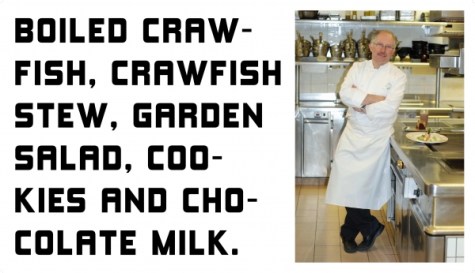
© Patrick Guns
– – – – – – – – – – – – – – –
If you have any other projects that need adding to the list, please get in touch.
– – – – – – – – – – – – – – –
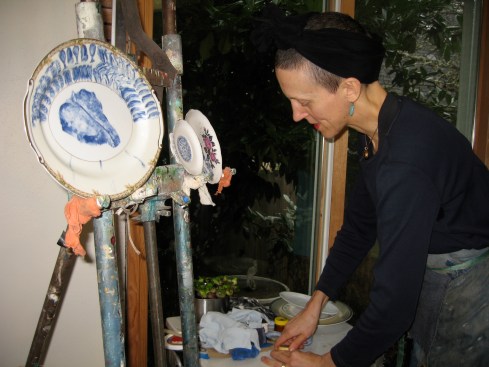
Julie Green in her studio. Photo Credit: Pete Brook
I recently visited Julie Green at her studio in Corvalis, Oregon. For the past twelve years, between her responsibilities as Professor of Art at Oregon State University, Green has been painting plates. Each plate quietly marks the life of a man or woman executed in the US and each depicts their final meal request.
Green’s The Last Supper has steadily grown down the years. There are now approximately 450 plates in the series and, when exhibited, they come together in a ghostly feast of absent eaters. I imagine a toast to the fury and retribution of US society.
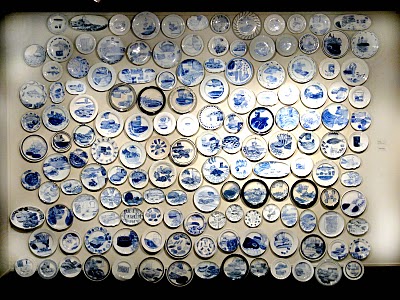
The Last Supper exhibited at Oregon State University (OSU). Photo credit: Doug Russell
Green acquires all her plates from thrift stores and bargain barns. Her preference is plain white plates, but she’ll tolerate flashes of navy or gold. The plates showing the last meals of female prisoners are occasionally a little more elaborate and may include floral decorations.
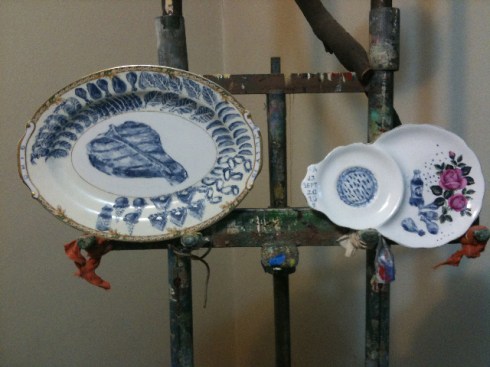
Two plates partially complete, for The Last Supper series, Julie Green’s studio, Corvalis, Oregon. Photo Credit: Julie Green
In some instances, last meals were refused and a statement was offered instead. Although, Green withholds the identity of the inmates, cursory internet sleuthing can pair meals with murdered prisoners. Writes Kelly Klaasmeyer for Houston Press:
Odell Barnes, Jr. [was] a Texas death row inmate. Barnes’s case caught international attention and caused Pope John Paul II to urge then governor, and presidential candidate, George W. Bush to show “compassion.” Barnes was executed, and Green has painted his last request on a gold-rimmed oval plate: “Justice, equality, peace.”
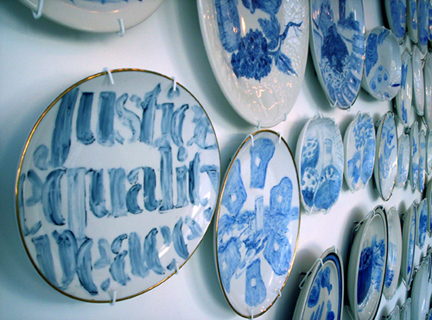
The Last Supper exhibited with Odell Barnes Jr.’s ‘Justice Equality Peace’ plate in the foreground. Photo credit: Aswin Subanthore

Mineral paint and Julie’s hand. Photo credit: Pete Brook
Green uses mineral paint, sometimes called porcelain paint. “I often add cobalt blue pigment to the mineral paint. Sometimes Nassau blue,” says Green. The paint slides across the reused plates and the effect is one of translucent foodstuffs. To fix the paint, Technical advisor Toni Acock kiln-fires each plate at 1,400 degrees Fahrenheit.

Kiln firing plates, January 2011. Photo credit: Deborah Gangwer
Finding out the last meal requests from across the States is not complicated work. As a matter of process, the last meal is usually included in media coverage. Until 2003, the Texas Department of Criminal Justice published its own online record of last meal requests. Green will also write to state authorities; the information is public record and always forthcoming. The fact that the details of last meals secured as part of procedure, and as part of the service of information to the wider public, is both significant and perplexing to Green. Why our fascination?
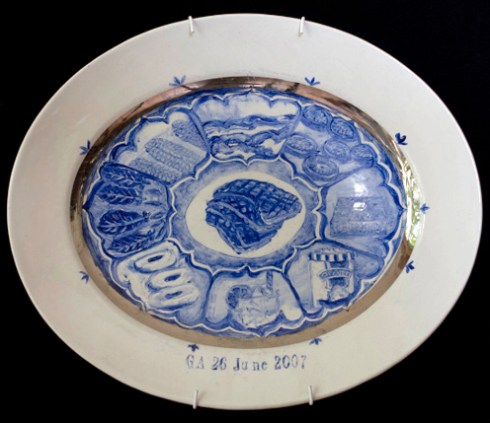
The Last Supper: Georgia 26th June 2007. Four fried pork chops, collard greens with boiled okra and “boiling meat”, fried corn, fried fatback, fried green tomatoes, cornbread, lemonade, one pint of strawberry ice cream and three glazed donuts. Mineral paint fired on to porcelain, 9″ x 15″
In keeping with her other projects, The Last Supper is an act of meditation. (Green was diligently painting shells on sheets with fabric paint before, during and after the Gulf oil spill of 2010.) Through the act of painting, Green takes on a critical awareness that – unfortunately – many of us choose to ignore. The Last Supper is both a remarkable dedication to mindful art practice and, for Green, an unsettling focus on violence.
“I think about food, choice, and whether inmates are able to eat the food they order,” says Green. “Specific food requests, often-local specialties, provide clues on region, race, and economic level.”
I don’t think Julie would mind me calling her a foodie (she made some hearty organic soup and bread for us to share), and so to her it is logical that the connection between the body, health and living intertwine with circumstance of education, socialisation and (potential) institutionalisation.
Aware of “the heinous crimes committed, the victims, the individuals executed, the large number of minorities on death row, and the margin for error in judicial process” Green is undoubtedly invested in the politics of prisons and anti-death penalty. And yet her response as an artist is apt, personal and all the more powerful for it. If she is angry, it is quiet anger.
Many photographers have chosen last meals as their subject. Possibly the best known is Celia Shapiro. Critic Fred Ritchin has referred frequently to Shapiro’s work saying that its power lies in the food choices of men and women clearly of lower economic status, but Green corrected this view; often a choice is not ‘choice’. Prisoners in most states have a budget of $20. “Inmates in some states are limited to food available in the prison kitchen,” says Green “There is a great deal of red meat but few lobsters, no sushi, and no Godiva chocolate.” The chocolate is usually Hershey’s.

Julie Green’s self-made reference book of food images. Photo credit: Julie Green

Plate from The Last Supper series waiting to be fired. Firing seals and dries the mineral paint. Photo credit: Pete Brook
The Last Supper plates were first displayed at University of Liverpool Art Museum, UK in 2000.
Later they have been on show at the University of California at Santa Cruz; Copia American Center of Food, Wine and the Arts, Napa, CA; Oregon State University, Corvalis; The Wing Luke Asian Museum, Seattle; The Hunter Museum of American Art, Tennessee; Living Arts, Oklahoma; Fort Collins MOCA, Colorado; The Spencer Museum of Art, University of Kansas; The Mulvane University Museum of Art, Kansas; Reed College, Portland, OR; and DiverseWorks, Texas.
Awaiting their next outing, the plates are numbered, ordered and locked in Green’s basement. I found some irony in that.
And when is The Last Supper project complete? “I’ll stop painting plates when the US ceases with the death penalty,” says Green.
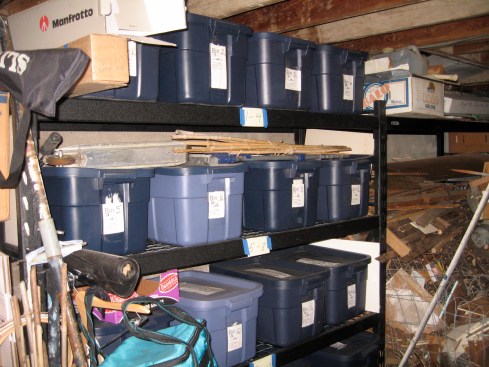
Between exhibitions, Green stores the plates in her basement. These sixteen tubs contain approximately half of the collection. Photo credit: Pete Brook
In 2003, Green was interviewed about The Last Supper on the NPR program The Splendid Table.
In 2008, The Last Supper was shown as part of the San Francisco State University show Criminal along with artists such as William Pope. L and Deborah Luster. Green’s work was included in the follow up book PRISON/CULTURE, (Ed. Bliss, Sharon E., Kevin B. Chen, Steve Dickison, Mark Dean Johnson & Rebeka Rodriguez) and published by City Lights. In 2010, I reviewed PRISON/CULTURE as “simultaneously a consolidation of achievement, a fortification of resources and celebration of resistance. PRISON/CULTURE may be a book with a Californian focus, but it has national and international relevance. Succinct, well researched, egalitarian and lively. For me, PRISON/CULTURE is the best collection of works by any US prison reform art community up until this point in history.”
FURTHER READING: FOOD AND DEATH
Cabinet Magazine: Debt, Guilt, and Hungry Ghosts: A Foucauldian Perspective on Bigert’s and Bergström’s Last Supper
Famous Last Meals blog
Dead Man Eating blog
Food in the Arts: The da Vinci Mode: Last Suppers, Old & New
THE DEATH PENALTY ON PRISON PHOTOGRAPHY
Media and the Aftermath of an Execution: Poring Over the Apparatus of Death
Louisiana Sues Its Own Death Row Prisoners
Photographer Scott Langley talks about the Death Penalty
STATISTICS
On her website, Green provides the following statistics.
As of May 2009, there had been 1165 U.S. state-sanctioned executions since 1976:
438 Texas
103 Virginia
90 Oklahoma
67 Missouri
67 Florida
43 North Carolina
45 Georgia
42 South Carolina
42 Alabama
27 Louisiana
27 Arkansas
28 Ohio
23 Arizona
19 Indiana
14 Delaware
13 California
12 Nevada
12 Illinois
10 Mississippi
6 Utah
5 Maryland
4 Washington
3 Montana
3 Nebraska
3 Pennsylvania
3 Kentucky
2 Oregon
5 Tennessee
1 Connecticut
1 Colorado
1 Idaho
1 Wyoming
1 South Dakota
0 New Hampshire
0 Kansas
3 U.S Federal Government
States without the death penalty: Alaska, Hawaii, Iowa, Maine, Massachusetts, Michigan, Minnesota, New Jersey, New Mexico, New York, North Dakota, Rhode Island, Vermont, West Virginia, Wisconsin, and Washington D.C.
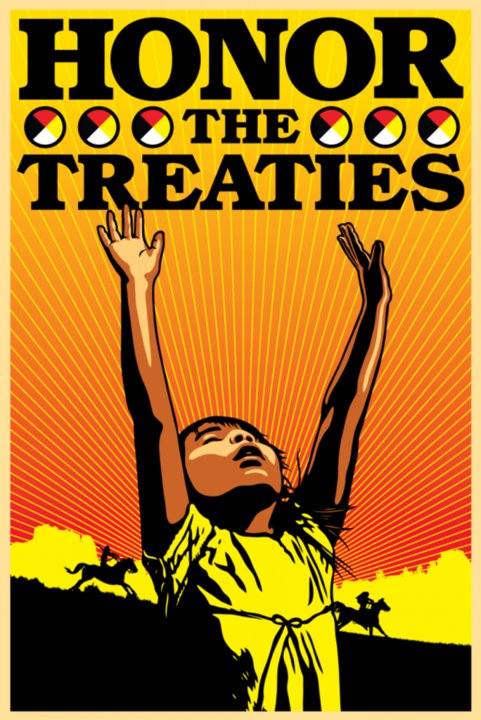
Late last year, Aaron Huey and I met at his favourite coffee shop in Seattle (the only coffee shop in the city without WiFi, as far as I know). During our chat, his phone was buzzing; on the line was Emphas.is finalising the details of his Pine Ridge Billboard Project pitch.
PINE RIDGE RESERVATION
Ever since Huey’s powerful and viral TED talk last year, he’s been inundated with inquiries from people wanting to get involved and contribute. Huey admitted to being conflicted by his unexpected propulsion into the centre of a nebulous political energy, partly because he doesn’t have all the answers and partly because his work still doesn’t sit well with some of the Lakota community. Understandably, some Lakota don’t want images of broken homes and broken bodies to be consumed by white America. Still, Huey has the faith of the majority within the Lakota people.
With a story so large and important – and solutions so complex – Huey was unsettled with the status and future of his Pine Ridge documentary work; he had not pushed the political issue as far as it warranted. From his Emphas.is pitch:
I have been documenting the Pine Ridge Indian Reservation for the past six years. Recently I have realized how inappropriate it is for this project to end with another book or a gallery show. […] Your involvement will help raise the visibility of these images by taking them straight to the public—to the sides of buses, subway tunnels, and billboards. I want people to think about prisoner of war camps in America on their commute to work. I want the message to be so loud that it cannot be ignored.
Emphas.is has given Huey, the Lakota people and us the opportunity to see and react to the work in unmissable public locations. It puts it in the face of D.C. politicians. Huey has enlisted the help of Shepard Fairey and artist and activist Ernesto Yerena who created visuals for the Alto Arizona campaign.

Source: http://www.webpages.uidaho.edu/~rfrey/329treaties_and_executive_orders.htm
PRISONER OF WAR CAMP #344
Huey’s photographs depict high unemployment, broken families, alcohol abuse and life expectancy lower than that in Afghanistan. The statistics are shocking.
But more than that, Huey’s photographs show the legacy of the lies and broken treaties of the US government stretching back over a century. If the Treaty of Fort Laramie (1868) had been observed, then the Lakota and associated Sioux tribes would own land stretching across five states.
To refer to the Pine Ridge Indian Reservation as a prisoner of war camp may seem incendiary to some, but this is how many of the Lakota see their existence. The Black Hills have been stolen and the Lakota live on the most infertile land fenced in on all sides by an encroaching dominant culture that they’ve predominantly experienced as oppressing and damaging. The solutions are not simple, but awareness and a will to action is.
Pine Ridge Indian Reservation is prisoner of war camp #344.
EMPHAS.IS
I have offered what support I can to the new crowd-funding platform Emphas.is with articles here on Prison Photography and for Wired.com. Three of the online critics I respect most (Colin, David and Joerg) have also put their weight behind it. I am chuffed to see Aaron’s proposal off the ground and I’d ask you seriously to consider funding the Pine Ridge Billboard Project.

Mock-up of a wall installation using 24x 26″ posters, proposed Pine Ridge Billboard Project
OUTLETS FOR ACTION: Throughout the campaign a website honorthetreaties.org will be formed. Aaron will build the site as a point of reference for those who want to know more about the history and the (broken) treaties of the Sioux and other tribes. There will be direct links to assist grassroots Native non-profits in places like Pine Ridge.The first partner is Owe Aku.
More on Aaron’s blog here.
Buy a 18×24 print signed by Shepard Fairey and Aaron Huey to support the project!

Ara Oshagan sat down for an interview with Boy With Grenade to talk about his project Juvies from the California Youth Detention system. Oshagan talks about “access, his process and the state of documentary photography today.” It’s long but parts make good reading.
“There is a certain pragmatism in my outlook. I knew I could not have access to these kids outside of the limited access that I had when I went in. So I did not worry about that. I made sure that I was totally ready—physically and mentally—when I did spend time with them, to make the absolute most of that time, to be fully in the “space” with them, to have a clear mind, to connect as much as possible, and hope that this connectivity will translate into good photographs.”
“To make good photographs, I feel, one must create a good process. Photographs can never be an end; they necessarily must be a byproduct of an experience, a process. That connectivity with your subject matter must be present. If you go into a situation with the sole purpose of making “good photographs” you will invariably fail. Or at least, I will.”
Read the full interview.
I’ve written about Oshagan’s Juvies on Prison Photography once previously.
For all sorts of reasons, my life is a whirlwind right now.
With regard Prison Photography and what it all means, might mean, things are tabled for renegotiation. Rejigging.
The renegotiation is in thinking of more creative ways to share new content, but also leverage old content to make it available to interested parties.
A complete redesign of Prison Photography is on the cards; old interviews and criticism would resurface again. But overhaul is not scheduled within the next year. In the meantime, there exist novel means to share the archive of information on Prison Photography.
This week, I made the trip to Coventry University to guest lecture for the Picturing the Body (#PICBOD) course. Course leader Jonathan Worth is a lesson in enthusiasm. With the backing by Jonathan Shaw and the assistance of Matt Johnston along with a host of others within and beyond the photo deptartment’s walls, Jonathan Worth is creating something wholesome, giving and pioneering.
Worth and his collaborators are building a model for free, online photography curricular in criticism and practice for both BA and MA students; students in Coventry and across the globe.
My presentation ‘Tattoos, scars and tears, Robert Gumpert’s work in San Francisco jails’ (which you can listen to here) focused on Robert Gumpert‘s ever developing project ‘Take A Picture, Tell A Story‘. As an introduction and to provide context to Robert’s work, I summarised the work of photography within sites of incarceration throughout the history of the medium.
Following the lecture, Jonathan Worth suggested the introduction alone could constitute a lecture. I would venture farther and say it could warrant a full course in itself.
I’m writing a few syllabi presently and – in the spirit of #PICBOD – I realised I should be sharing my notes.
So, here they are … on a cachable page for perpetuity.
A BRIEF HISTORY OF PRISON PHOTOGRAPHY (IN LOOSE CATEGORIES)
Before the golden age of photojournalism, the photographing of prisoners was used for purposes of identification, order and discipline. The two part mugshot (front view and profile view) was standardised by Alphonse Bertillion. Police departments adopting the system had in-house technicians and photographers but they are anonymous in history.
Remarkable archives by anonymous police photographers exist the world over, but two noteworthy collections are in New Orleans and Sydney.
American prisons fell on to the radar of professional and committed photojournalists in the sixties and seventies, more and more. Three Magnum photographers (Eve Arnold, Bruno Barbey, Danny Lyon) went to Texas. Arnold returned to the subject again and again. The Lone Star state had a punitive prison culture with reform commonly taking the form of hard labor on the chain gang; images echoed those of slavery in the South.
The “exotic” prison (Late 70s, 80s, USA):
Morrie Camhi’s photographs of California prisoners remain some of the most authentic portraits made within US prisons. Douglas Hall Kent, spent years and published at least two books on prison tattoos. Garry Winogrand stopped by Huntsville for the prison rodeo. The much lesser known Ethan Hoffman produced a book titled Concrete Mama about Walla Walla Penitentiary in Washington State. The brutality and tenderness of interactions between prisoners as depicted by Hoffman are surprisingly frank.
Pioneers in prison documentary photography/photojournalism (1980s and 90s in USA):
Cornell Capa (Attica, NY, USA); Taro Yamasaki (Michigan), Ken Light (Texas), James Nachtwey (Texas and other Southern states), Bruce Jackson (Arkansas), Alan Pogue (Texas).
Contemporary to the Americans (above) was the anomalous Jean Gaumy. In 1976, Gaumy was the first photographer allowed access to a French Prison.
Contemporary prison photography (1990s, 2000s):
Lori Waselchuk (Angola, Louisiana), Ara Oshagan (California juveniles), Victor Blue (California), Andrew Lichtenstein (multiple states).
Collaborative/rehabilitative projects (2000s):
Casey Orr (Leeds, England), Mohamed Bourouissa (Paris, France); Deborah Luster (Louisiana, USA), Klavdij Sluban (France and Eastern Europe), Mikhael Subotzky (South Africa), Steve Davis (Washington State, USA); Robert Gumpert (San Francisco, USA); Leah Tepper Byrne (USA)
Eastern European and Former USSR (Late 90s, 2000s):
Much of the photography from the former Soviet bloc is characterised by the grey abandonment of it all. Into the new millenium, younger photographers took less documentary approach with more nuanced fine art engagement with the inmates of Russia and its satellites. Examine the work of Christian Als (Latvia), Carl de Keyzer (Siberia), Yana Payusova (Russia), Sasha Maslov (Ukraine); Delmi Alvarez (Latvia) and Jane Evelyn Atwood.
Western Europe:
Generally, a more tactical use of technique and viewing from photographers such as Nico Bick (Netherlands), Juergen Chill (Germany), Matthieu Pernot (France and Spain), David Moore (London, UK) Danilo Murru (Sicily and Sardinia); Lizzie Sadin (Multiple countries); and Melania Comoretto (Italy).
Guantanamo (2002 – ):
Many photographers have addressed Guantanamo including Paolo Pellegrin, Brennan Linsley, Tim Dirven, Chris Maluszynski, Bruce Gilden, Louie Palu and Christopher Sims. Above all others, Edmund Clark has made the best contribution with emotive images from former detainees’ homes, letters of the detainees and an extremely engaging essay from Dr. Julian Stallabrass.
Political memory (20th and 21st centuries):
Donovan Wylie (Northern Ireland), Paula Luttringer (Argentina), Dana Mueller (US POW camps), Phillip Lohoefener (East Berlin Stasi prisons) and Anna Schteynschleyger (Former USSR).
Archives of Atrocities:
Willhelm Brasse, known as the Photographer of Auschwitz during WWII; the photographers of Tuol Sleng in Cambodia during the Kymer Rouge regime (1975-1979); Victor Basterra, Naval Mechanics School (ESMA), Buenos Aires, Argentina during the Dirty War (1976-1983)
Conceptual:
Chris Jordan‘s large digital composites that stack 2.3million prison uniforms upon six floor-to-ceiling cnavases approach the depressing scale of US incarceration. Featured in ‘Invisivle’ a summary of his first ten years or so probing military and state secrets, Trevor Paglen “stalked” previously clandestine extrajudicial prisons used in the global war on terror. Broomberg and Chanarin, on a tour of Afghanistan rolled-out sheets of photographic paper on days of historical importance, in one case a jail-break.
Africa (21st Century):
Without exception the photographs of African prisons focus n the deplorable conditions, the mistreatment of children and usually both. Julie Remy (Guinea), Fernando Moleres (Sierra Leone), Lynsey Addario (Uganda & Sierra Leone), Nathalie Mohadjer (Burundi), Joao Silva (Malawi).
INQUIRY NOT GENRE
Given the breadth of photogs’ motives and the different uses of these images it is foolhardy to think of prison photography as a genre. I have taken to calling it a ‘non-existent’ genre.
The website Prison Photography is an inquiry, primarily into the uses and abuses, creation, consumption and distriubtion of images within highly politicised institutions. The photograph is only the beginning.
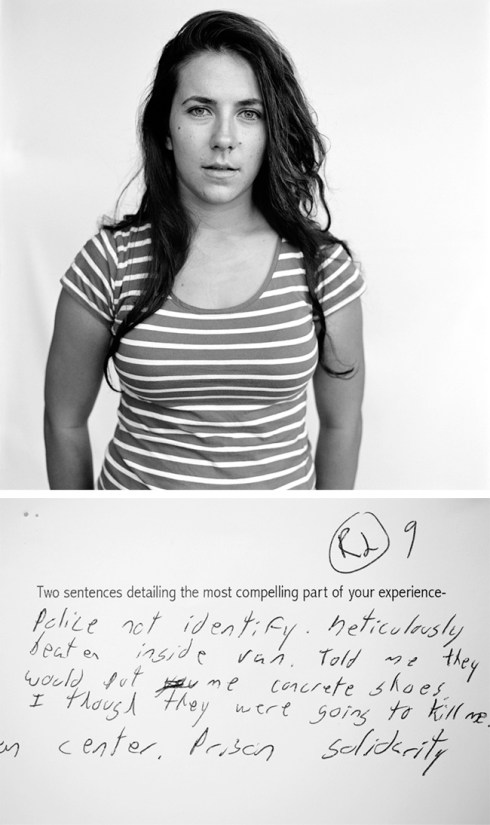
National Post photographer, Brett Gundlock was one of the 304 protestors arrested during the G20 protests in Toronto, last June.
Since last Summer, and dissatisfied generally with the representation of the protests, Gundlock has tracked down many of those also taken into custody. He has asked each of them to provide a (very) short statement on the experience of being processed through protest-policing and city jail.
In March, Gundlock will mount a show for the portraits and accompanying testimonies. For this he has already crowdfunded the $1,500 necessary via RocketHub. You can read more about the project here or you can watch Gundlock’s video intro.
Picturing Victimhood
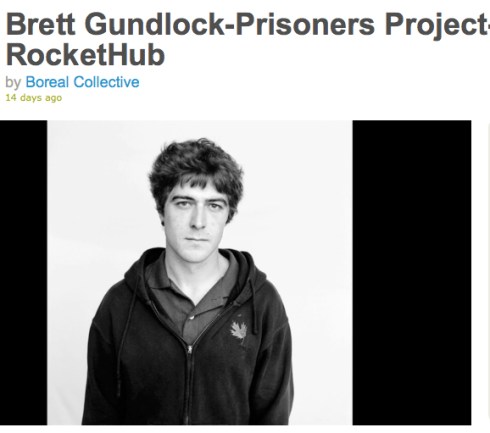
Gundlock’s portraits are rather austere, which probably fairly reflects the seriousness with which many protestors take to their direct actions. In formal arrangement, they echo the look of two very famous photographers before him.
Marc Garanger, a young French soldier was pressed into a fortnight of taking 2000 identity pictures of Algierian women. Garanger considered himself – as military man and photographer – as an aggressor. His female subjects as victims. Although, as Fred Ritchin describes, when Garanger returned to Algeria decades later he was warmly received by the sitters and their families. And thus squashing the simplistic presumptions of the Western audience.
Richard Avedon’s In The American West was the work of a fascinated, brave yet perverse outsider. Perhaps the most amazing aspect of In The American West was that Avedon – under the guise of fine art – used his camera to adopt an outsider engagement with his subject akin to ethnographic research. In 20th century America, no less.
Whatever we might think of Avedon’s awe and reverence to his cowboys and oil-workers, they are set up as victims by means of their exclusion from the comfortable predictability of majority America.
Photographically, one end of the spectrum (Garanger, Avedon, Gundlock) depicts victims quiet and silent, while the other has them wailing in grief and duress. I’d suggest in this visual environment, Gundlock has made the right decision to ask for written recollections of the moment from his subjects.
Brett Gundlock is part of Boreal Collective.
Found via drool

 Prison Photography