
You are currently browsing the category archive for the ‘Activist Art’ category.
“It was everything: kidnapping people, shelling civilian quarters, bombs, torturing, electrical shots, killing in the streets or killing in the prisons. And I did not think that what I was doing was bad.”
– Testimony of a perpetrator of crimes featured in ‘Lebanon’s Missing‘, a film by Dalia Khamissy
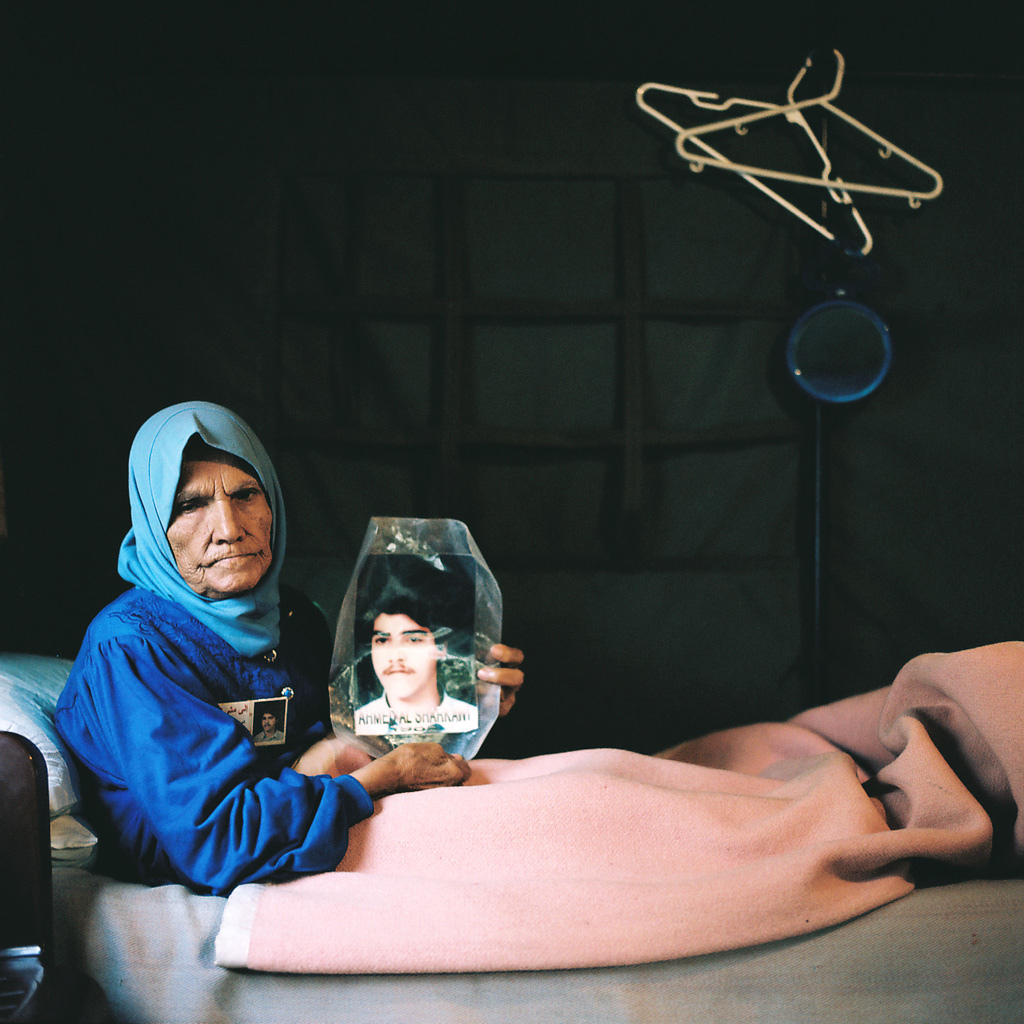
When Benjamin Chesterton of duckrabbit came across Dalia Khamissy‘s work from Lebanon, he was hooked and worked to present her work as a radio documentary combining Khamissy’s commentary with her photographs and film footage.
Ben hopes it will be the first of many such collaborations/presentations with the BBC World Service.
In my email inbox, from Ben:
Today, [Lebanon’s Missing] the first documentary and photofilm was published. It will be played worldwide seven times on the BBC World Service and BBC Radio 4.
It’s about the estimated 17,000 people kidnapped during the Lebanese civil war and never seen again. It’s a genuinely brilliant presentation by Dalia, with some great photos and video for the film (which is really meant as a teaser for the documentary).
Few know about the Missing in Lebanon, which is why I think it’s an important story to be heard. Not because the broadcast will change anything dramatically but because memory is resistance against the same atrocities being repeated.
Please take five minutes to watch the film and, if it moves you, download the podcast of the documentary. Dalia deserves enormous respect for this work. It was a brave story for her to take on.
Hopefully, the BBC will commission more programs of this nature, which would be great for photographers working on important stories who would like to reach a genuinely large audience.
I hope so too Ben, and I hope the duck magic becomes a permanent fixture on the World Service wires.
FURTHER READING
Conscientious: A Conversation with Dalia Khamissy

© Maja Daniels
You may have noticed that I like to talk not only about prisons but also about other total institutions.
Maja Daniels‘ Into Oblivion photographed on a Protected Unit of a French geriatric care institution “attempts to create a discussion about our institutionalized, modern way of living as well as the use of confinement as an aspect of care.”
Many of the images in Daniels’ series feature patients at the door to the secured wing:
“Ruled according to the “principle of precaution”, residents in the unit can circulate freely within the secured area but due to a lack of activities and a limited presence of carers in the ward, the locked door becomes the centre of attention for the elders who question the obstruction and attempt to force it open. The daily struggle with the door, damaged due to repeated attempts to pick the lock, can last for hours.”

Cast of One Flew Over the Cuckoo’s Nest posing for their photograph on location at the Oregon State Hospital, Salem, Oregon, 1974. © MaryEllen Mark.
MARY ELLEN MARK
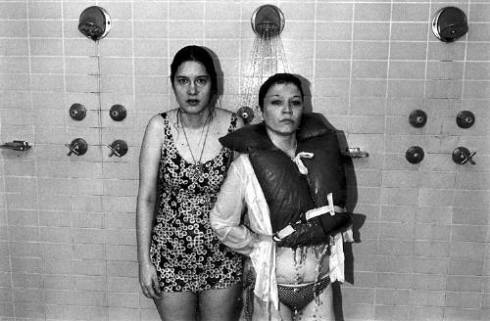
Mary Ellen Mark first went to Oregon State Hospital (OSH), Salem, OR in 1974 to photograph the cast and set of Milos Forman‘s 1975 adaptation of Ken Kesey’s novel One Flew Over the Cuckoo’s Nest. (Mark often shot on film sets).
During the filming, Mark met the women of Ward 81. She promised to return and after over a year of negotiations with the hospital authorities and families of residents she was allowed to live on Ward 81 with writer Karen Folger for 36 days. American Suburb X has republished Folger’s essay for Mark’s book giving a familiar and surprising account of the routines and dreams of the women on Ward 81.
Mark’s book was a breakthrough. Granted, photographs of Oregon State Hospital existed previously, but Mark’s work was a pioneer intimate portrait of an American group outside of the dream, outside of the reality. LIFE magazine had covered an OSH camping trip before. Oregon Historic Photograph Collections have 14 images of OSH.

Horsing around. © Marl Ellen Mark, 1974
© Marl Ellen Mark, 1974

Mary Frances Peeking from Tub, 1976. © Mary Ellen Mark.
Mark’s Ward 81 was a personal call to action; she cared deeply about the residents and wanted to use photography to describe their lives. Mark contends in all interviews I have read that the treatment of patients was good and fair.
Prison Photography has touched upon institutions developing an “art” persona overtime through the work of several art photographer, specifically Stateville Prison, Joliet, Illinois. The architectural form of Stateville can be pinned as the common fascination that drew art photographers Gursky, Dubois, Goldberg and Leventi.
Alternatively, the preoccupations at Oregon State Hospital are varied. In some cases, the emergence of a new story to be told and in others an homage to past photographic action at the institution.
DAVID MAISEL
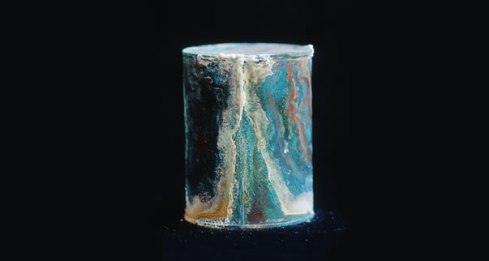
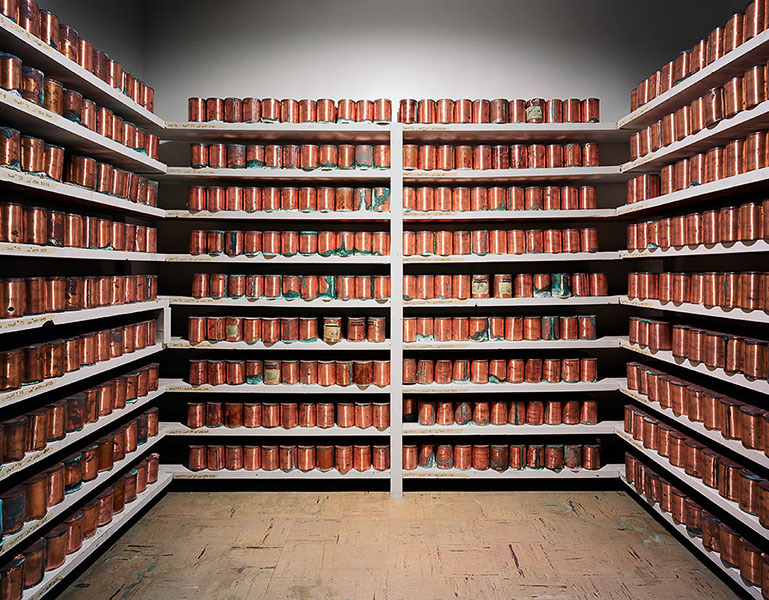
David Maisel‘s Library of Dust is a meditation on the cremains of former OSH patients. Until 2004, the urns were locked in a basement and not public knowledge. The patients died at the hospital between 1883 (the year the facility opened, when it was called the Oregon State Insane Asylum) and the 1970’s; their bodies have remained unclaimed by their families.
Over a period of twenty years the basement in which the urns were locked flooded repeatedly. Studio360 describes well the chemical reactions ongoing between the copper, elements within the ashes and substances afixed by flood water. Maisel’s studies are a “yearbook of the socially dispossessed.”
The Oregonian newspaper won the 2006 Pulitzer for Editorial Writing in its coverage of the forgotten remains and the sad scandal of silence. The story caught the attention of the nation and Maisel’s work toured the country to wide acclaim. Maisel talks about his work here and BLDGBLOG has the best text as entry point to the multiple layers in Library of Dust.
© David Maisel

© David Maisel
The Mental Health Association of Oregon summarises Maisel’s work well:
The tale behind the canisters is indeed deeply disturbing. They hold the remains of 5,121 people who languished in the psychiatric hospital in — many of them for their entire adult lives — for reasons that nowadays might require nothing more than a Zoloft prescription and some couch time. The patients’ conditions listed in hospital records include “worries about sex” and “worries about money” — “things everyone walks around with today,” Maisel says. When these patients died, their relatives either had no money for a burial or no interest in claiming the bodies.
Maisel positions the work within the taboos of “craziness”, “death” but also links Library of Dust to his earlier mineralogical studies. Interestingly, Maisel’s title was first uttered by a custodian of another state institution. Maisel explains:
On my first visit to the hospital, I am escorted to a decaying outbuilding, where a dusty room lined with simple pine shelves is lined three-deep with thousands of copper canisters.
Prisoners from the local penitentiary are brought in to clean the adjacent hallway, crematorium, and autopsy room. A young male prisoner in a blue uniform, with his feet planted firmly outside the doorway, leans his upper body into the room, scans the cremated remains, and whispers in a low tone, “The library of dust.” The title and thematic structure of the project result from this encounter.
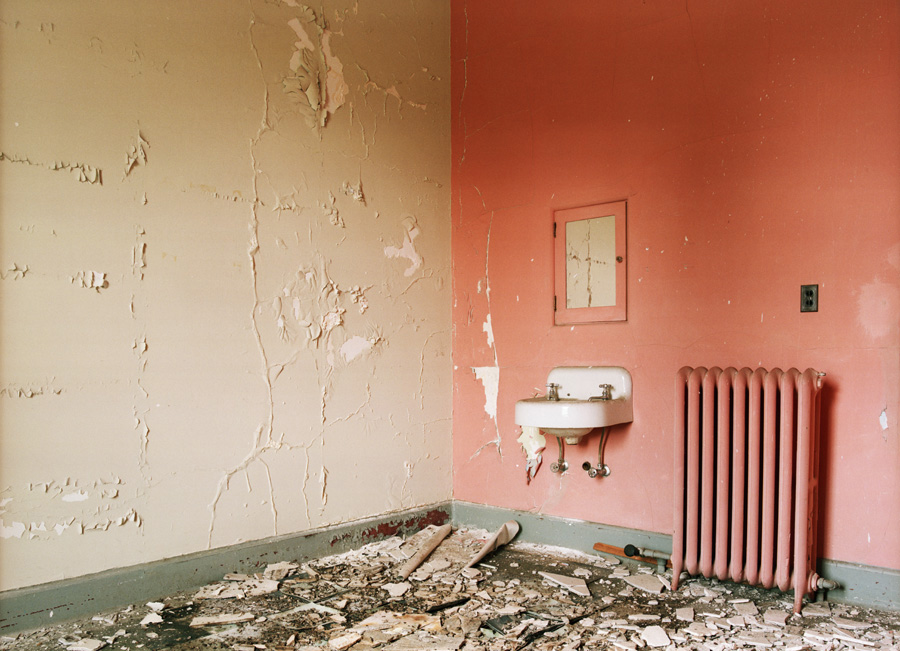
While on site, Maisel also made some interior studies of the decaying fabric of the building. The series is Asylum. OSH was shuttered in 2005 and demolition began in 2008. A new facility is slated for completion in 2012.
Asylum 2. Doctor’s Office, Ward 66, Abandoned portion of J Building. © David Maisel.

Asylum 3. © David Maisel

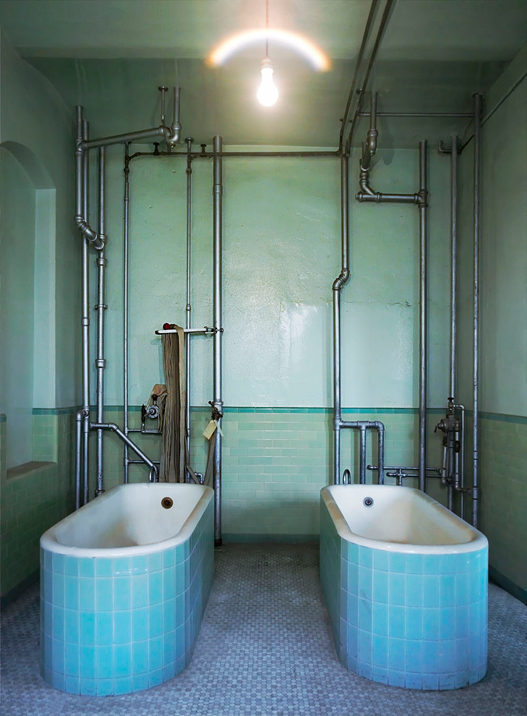
Asylum 7. Tubs, Ward 7, Abandoned portion of J Building. © David Maisel
Maisel’s studies of the interior are less complex or politicised as the poetics of Library of Dust. Nevertheless, bare these images in mind as you read on.
CHRISTOPHER PAYNE
Between 2002 and 2008, Chrsitopher Payne took on the largest photographic survey to date of America’s decaying psychiatric hospitals. For Asylum, Payne visited scores of old facilities and OSH was among them.
Interestingly Payne, photographed the storage room of cremains but didn’t extrapolate the stories into a memorial of politics as Maisel expertly did. And once, again the steep sided tiled bath tubs make a reappearance.
Oliver Sacks wrote the essay for Payne’s book. It is a ranging historical narrative of palatial institutions that could provide the best and the worst of care, but in most cases rarely prepared the patient for release back into society, “most residents were long-term.” The essay is accompanied by some wonderful historic postcards and generally Sacks tries to push us away from a narrative of “snake pits” and “hells of chaos” when thinking of psychiatric hospitals.
On Payne’s work, Sacks’ description is exactly how it appears, “[Payne’s photographs] pay tribute to a sort of public architecture that no longer exists. They focus both on the monumental and the mundane, the grand facades and the peeling paint.”
© Christopher Payne

© Christopher Payne
Peeling paint and broken down fixtures is a preoccupation of many a photographer. Architectural enthusiasts, disaster journalists and fine art photogs have all conspired to bring us the genre of “ruin porn” which continues to baffle and frustrate as much as it engages (but that discussion is for another time).
BILL DIODATO
This inquiry began when Bill Diodato contacted me with news of his book release. c/o Ward 81 is a conscious revisit to OSH; a closing of the circle of photographic practice put into motion by Mary Ellen Mark 30 years previous. Indeed, Mark provides the foreword:
‘It’s painful for me to look at these pictures. They evoke feelings of life and death. I can hear the sounds of women running through hallways and someone shouting, “Meds, meds, come and get your meds.” I can hear the crying of a woman being locked down in restraints. I can hear the music of the jukebox at the once-a-week dance with the women of Ward 81 and the men of Wards 82 and 83. Bill’s book brings me back to the haunted cell in which I slept in a deserted ward right next to Ward 81. I swear I heard people walking above me all night. This was so puzzling because the floor was not occupied. Bill’s images confirm the feeling that I always had—that Ward 81 was and still is inhabited by many ghosts. ‘ (Source)
Diodato states that this book is about the “demise of institutional services’ and it’s effect on women.” When Diodato visited both he and Warden Marvin Fickle knew he would be the last person to document the infamous closed-off Ward 81.
c/o Ward 81 is more focused than Payne’s one stop of many on his tour US psychiatric hospitals and it is more intentional than Maisel’s context-giving shots that rightly or wrongly have formed the backdrop to Library of Dust. Diodato is paying homage to the cultural impact of golden-age documentary photography as much as the site itself.
“The physical crumbling and decaying cells, represent the end of old, corrupt, poorly-run asylums and bring about a sense of closure for the women of Ward 81,” explained Diodato by email. But I can’t help think that’s a superimposition of idea upon the images. Mark’s refuted allegations poor treatment of patients in some interviews, yet talks of “hauntings” in the book intro quoted above. OSH did become known for substandard mental health care provision, but was it a constant of the institution, over all its years?
In addition to being a requiem to the occupants, residents and survivors of OSH, Diodato’s images are a requiem to public awareness.
The silenced and invisible lives of the population within OSH and similar facilities is a shameful past. Diodato’s images represent for me a breakdown in social responsibility for one another. How else can we explain OSH’s unclaimed remains for over 5,000 individuals? Families wrote their relatives out of family history just as the old asylums of the 19th and 20th century allowed the public to erase patients from the social fabric.

© Bill Diodato
© Bill Diodato

© Bill Diodato
Oregon State Hospital was demolished in 2008. A new era and a new regime of treatment and control is to be established upon completion of the new proposed complex (below). What – if any – will be the photographer’s interaction with the new $458 million complex and its residents?

FURTHER READING
“Mary Ellen Mark – 25 Years” (1990) Pt. I and “Mary Ellen Mark – 25 Years” (1990) Pt. II
Interview: Mary Ellen Mark on Photography (Oregonian)
Interview: The Unfiltered Lens of Mary Ellen Mark

Mona Dancing with a Man, 1976. © Mary Ellen Mark.
Prisoner Advocate Elaine Brown on Georgia Prison Strike: “Repression Breeds Resistance”
Elaine Brown appeared on Democracy Now! today. Amy Goodman described the strike as the biggest in American History.
Brown alleged an inmate paid $800 to a prison guard for a cell phone.
Goodman suggested the term cell-phone has realised its true meaning.
‘CELL’ PHONES
Also, for the New York Times, in Inmates in Georgia Prisons Use Contraband Phones to Coordinate Protest, Sarah Wheaton describes how ‘prison protest has entered the wireless age’ and how gang, religious and race divisions were put aside to organise the strike.
Note: The Georgia DoC say they have locked-down the prisons. Not true. The inmates locked themselves down, refusing to leave their cells.
Biggest Prison Strike in American History
Prison strikes are a rarity these days, with prison populations fragmented, disciplined, docile, estranged from society and stripped of tools for political mobilisation.
There’s a growing number of reports coming out of Georgia, where the strike is now into its fourth day. You should read the excellent Prison Law Blog for a summary of communications and developments – Georgia Prisoners Strike for Better Conditions.
As Sara points out:
“Relative to the state’s population, it has an outsize reach. In Georgia, 1 in 13 adults is either in prison, in jail, on probation, or on parole — the highest rate of correctional control in the country. (Nationwide that figure is 1 in 31.) According to the Sentencing Project, over 4% of Georgia adults and almost 10% of African-Americans cannot vote due to felony disenfranchisement laws.”
The strike is based on reasonable demands; notably, demands applicable to issues in many state prison systems:
· A LIVING WAGE FOR WORK: In violation of the 13th Amendment to the Constitution prohibiting slavery and involuntary servitude, the DOC demands prisoners work for free.
· EDUCATIONAL OPPORTUNITIES: For the great majority of prisoners, the DOC denies all opportunities for education beyond the GED, despite the benefit to both prisoners and society.
· DECENT HEALTH CARE: In violation of the 8th Amendment prohibition against cruel and unusual punishments, the DOC denies adequate medical care to prisoners, charges excessive fees for the most minimal care and is responsible for extraordinary pain and suffering.
· AN END TO CRUEL AND UNUSUAL PUNISHMENTS: In further violation of the 8th Amendment, the DOC is responsible for cruel prisoner punishments for minor infractions of rules.
· DECENT LIVING CONDITIONS: Georgia prisoners are confined in over-crowded, substandard conditions, with little heat in winter and oppressive heat in summer.
· NUTRITIONAL MEALS: Vegetables and fruit are in short supply in DOC facilities while starches and fatty foods are plentiful.
· VOCATIONAL AND SELF-IMPROVEMENT OPPORTUNITIES: The DOC has stripped its facilities of all opportunities for skills training, self-improvement and proper exercise.
· ACCESS TO FAMILIES: The DOC has disconnected thousands of prisoners from their families by imposing excessive telephone charges and innumerable barriers to visitation.
· JUST PAROLE DECISIONS: The Parole Board capriciously and regularly denies parole to the majority of prisoners despite evidence of eligibility.

Daniel Ellsberg, left, at a news conference in 1973 in Los Angeles. In 1971, Mr. Ellsberg passed to a reporter for The New York Times a copy of a secret report casting doubt on the war in Vietnam. Associated Press
Based upon Cablegate commentary and mutterings thus far, it is reasonable to describe an opponents’ “Hierarchy of Targets”.
At the top of the pyramid is Julian Assange, second is the suspect (possibly Bradley Manning?), then come the collective of highly-skilled professionals working for Wikileaks, next are the supporters of Wikileaks (journalists, liberals, conspiracy nuts, libertarians, hackivists, net-neutrality fans, free-speech advocates, Bush-haters, China-haters, Gaddafi haters … lots of haters, you get the point). And finally – as I said, based upon commentary – toward the bottom of the pile would be Wikileaks’ major media partners, The New York Times, The Guardian, Der Spiegel and Le Monde.*
The leading newspapers of these four major powers should be and are beyond reproach. The absence of criticism toward these newspapers is telling.
Given the impossibility of controlling this outflux of data, the US Government is relying on tactics of distraction – and retribution – to elevate Assange and then take him down.
The US Government is probably well aware of the information yet to be leaked. Remember, while the cables number 251,287, of which 15,652 are “Top Secret”, only 1,344 have been published thus far.
NEWSPAPERS THEN, THE INTERNET NOW
The Nixon Whitehouse tried to smear the reputation of Daniel Ellsberg, the man who leaked the Pentagon Papers. Nixon’s painting him as a loose-nut, breaking into his psychotherapists surgery and stealing private health files to later sling shit. The thing is, before Nixon got to that he was trying to take down the media too. First he got an injunction on The New York Times. Next Ellsberg went to The Washington Post so they were next to be silenced. Through remarkable networks Ellsberg got copies of the Pentagon Papers out to 17 papers and the deluge was impossible to control.
For the Pentagon Papers leak, Ellsberg photocopied 7,000 papers himself, then photocopied those again. He delivered boxes of files by hand. 1971 was a pre-computer age; it’s easy to forget.
It is also easy to forget that Nixon administration shut down the New York Times’ publication of the Pentagon Papers for four whole days. Ellsberg’s leak brought about The New York Times vs. The United States of America, and ever since the separation between government and free press has been constitutional protected (if not always used to advantage by partisan “news” networks.)
Because of that court case – as much as the unlimited distribution possibilities of the internet – Assange and Wikileaks didn’t have to worry about any government closing down the four newspapers it had chosen as allies and partners.
As newspapers had gone before, so internet server companies followed; Assange predicted both the pressure from the government and the capitulation from Amazon and other server companies.
AREN’T WIKILEAKS AND NEWS ONE AND THE SAME?
Given that Wikileaks is only releasing individual cables after a partner has researched, redacted and discussed editorial ethics and responsibility, and given that in that light there is no difference in substance of Wikileaks’ publishing and that of its partners, why is Wikileaks singled out?
Assange claims to be a journalist. Given his blatant care (partnering with thousands of professional journalists) thus far in protecting the safety and identity of people mentioned in the cables, it seems like a fair claim.
I agree with the point of view that the Afghan or Iraq War Logs were not the equivalent to the Pentagon Papers; they told us only what we knew. We knew war was violent, we knew nasty alliances existed, we knew civilians were slaughtered, we knew no-one was in control as they claimed, we knew Iraqi’s carried out sectarian killings on one another and we could guess the allied forces turned a blind eye. Alternatively, in the way that the U.S. Embassy Cables are challenging a super power with legitimate accusations of Imperialism against it, the Embassy Cables leak could be an equivalent.
Interestingly, Ellsberg is in no doubt. If he was leaking the Pentagon Papers today, he’d be using the internet.
*Somewhere in the hierarchy of targets, there’s an argument to include Wikileaks’ methods and technologies (encryption, mirror sites, Wikileaks’ documents-cache poised for release should things not go Assange’s way). However, to keep it neat, I prefer the hierarchy of targets be made of people, not tactics.
There’s so much to be read and said about the unraveling stories and analysis of the Wikileaked Embassy Cables. The coverage by the Guardian, the New York Times’ Lede Blog and Kevin Poulsen and friends at Wired.com have been my main sources.
I cannot recommend highly enough David Campbell’s analysis – Wikileaks: From the personal to the Political.
Here’s some important snippets:
Wikileaks does publish the cables with the redactions made by media partners. (The Guardian explains how it does this here). So at the time of writing, Wikileaks has released only 1,203 of the 251,287 cables contained in the leak. This makes the coverage of the cables a prime example of networked journalism from which all partners, including the public, win.
…
In 2009, Wikileaks and Julian Assange won the prestigious Amnesty International New Media Award for exposing hundreds of alleged murders by the Kenyan police, an act which led to a United Nations investigation.
…
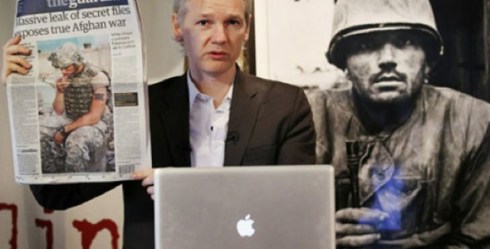
Assange is holding up a copy of The Guardian displaying a front-page story on the earlier release of the Afghan war logs. He is standing with his laptop. In the background is Don McCullin’s famous 1968 photograph of a shell-shocked marine from Hue in Vietnam. Signifying, first, the relationship between Wikileaks and its media partners, second, the role of the Internet, and third, the historical memory of the Vietnam War that hangs over current American military operations…
And just two more things from me.
1. If Julian Assange and his employees were Chinese they’d be lauded in the US as heroic dissidents and champions of free speech.
2. When was the last time rape was the headline story across the globe for a 48 hour period? Rarely? Never? Ever? Unfortunately, in this instance, I think the topic of rape will merely serve as a prop in the distraction techniques of mass media as existing powers attempt to divert the issue – from the global cultural sea change upon us – to the witch-hunt of America’s newest most-wanted. Dialogue about women’s rights, societal violence, machismo and misogyny is vitally important, but again it is diluted, set aside. The discussions that are occurring are, for the most part, not the right ones.
In my spare time I enjoy sorting my socks in color sequence, imagining the sound of volcanoes and simulating flight with the aid of Google Earth.
On a recent “flight” out of Boeing Field, here in Seattle, I noticed a plucky peace protest right under the nose of one of Americas largest military contractors.
Behind Lockheed Martin, Boeing is the second biggest defence contractor in the nation.
Keep you eye on the top left as I zoom in …

… closer …
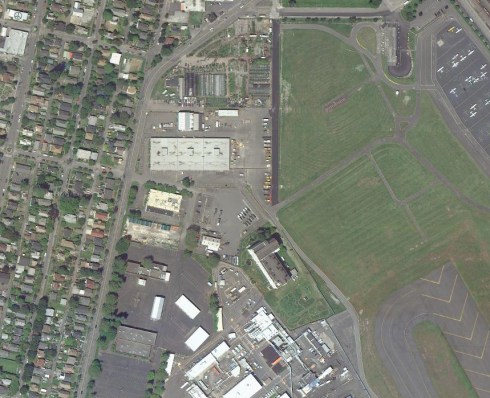
… closer ….

… hooray! Whoever you are, you peace-luvvin’, rooftop decoratin’ hippiester, I salute you.

MAKE ART, NOT BOMBS
Kirk Crippens contacted me a few months back to tell me about his work at San Quentin. He’s working on a documentary on the SQ Insight Garden Project.
He’s also working on Hidden Population, a personal project of unorthodox portraiture.

I suspect for Crippens, the ‘back of the head approach’ is a novel workaround of DoC legal restrictions on identifiable depictions of men in its custody. As applied to a US prison population, Crippens’ work is original and rather beguiling; how many of his subjects are aware of the camera’s glare? Does the notion of victimhood surface here? How often does the bowed head recur? It is very difficult to imply penitence in prison portraiture without relying on cliche. The doo-rags, beanie-hats, neck hair, peeping tattoos and ubiquitous blue cotton mean these images fluctuate between personal and abstract.
For such a simple idea, Crippens could go a long way with it. It is still a work in progress so I just want to bring your attention to it right now. Hopefully, I’ll get Kirk on PP soon to discuss it at length.
BACKS OF HEADS
To compose images of the back of the subjects’ heads is the same approach adopted by Eric de Vries for ‘Invisible Scars’ – portraits of the Khmer Rouge labour camps, Cambodia. In terms of political context, the two sets of subjects are constellations apart , but I thought the shared technique was worth noting.
CRIPPENS
In 2010, Kirk Crippens achieved significant success with Foreclosure, USA. He had three solo exhibitions of his and nine group shows throughout 2010. Crippens was named in Photolucida’s Critical Mass Top 50 for 2010. Foreclosure, USA also won the Blue Earth Prize For Best Project Photography at the PhotoAlliance 2010 Our World Portfolio Review. Crippens was recently nominated for the 2011 – 2013 Eureka Fellowship Program, a project of the Fleishhacker Foundation.

 Prison Photography