
You are currently browsing the category archive for the ‘Activist Art’ category.
An Omar Broadway Film aired on HBO last month. Omar smuggled a video camera into Northern State Prison, New Jersey and documented for six months. The film was debuted at the 2008 Tribeca Film Festival.
There are many reasons I believe in prison reform, the wasted potential is one, the wasted dollars is an other, the systematic violence is the reason to which this film speaks. Shadow and Act review it here.
Below is a video interview with Douglas Tirola, one of the directors, about how the film got made.
Talk to anyone about American documentary photography, they’ll probably mention Danny Lyon. Talk to anyone about prison documentary photography and they’ll definitely mention Danny Lyon.
In terms of US prison journalism, Lyon was the first photographer to a) give a shit, b) gain significant access, and c) distribute journalist images far and wide.
I had read Nicole Pasulka’s interview with Danny Lyon when it was published for The Morning News in December, 2008. I have since begun reading Like a Thief’s Dream (currently 100 pages deep). As in many cases, it takes an AmericanSuburbX reissue to press the issue.

Renton in his cell, Walls Unit, Huntsville, Texas, 1968. © Danny Lyon
I have a few things to say about the chapters I’ve read so far, but those thoughts need more brewing. While I mash those brain-hops, I’d like to draw your attentions to Lyon’s comments about prisons in America:
“You really need a friend, or family member inside a prison, to appreciate what we are doing. America has two million people inside of her prisons. Only China, a dictatorship, tops us in this growth industry. I like to think of the words of Fredrick Douglas “Be neither a slave nor a master.” All of us, outside of prisons, are the masters.“
“Prisons should be turned into bowling alleys, schools, and daycare centers, or demolished. We could probably do better with 90 percent of the inmates being released. Communities should deal with offenders on a local level. Review panels should meet with all of the 200,000 prisoners doing life sentences. Many of these people are harmless and aged, and should be released. I would like to see review panels sent into all the prisons, to meet with inmates face to face. Most should be released.“
“When I was working in the Texas prisons (1960s and 70s) there were 12,500 men and women inside and no executions. Today there are 200,000 in Texas and they kill prisoners all the time. Prisons are now everywhere, a major employer in upstate New York. Simply put, everything about prison is worse.”
“The best way to change yourself is to go outside your world into the world of others. It’s a big world out there. The worst thing about New York City is that all the young people that gather there are extremely like-minded. Creative people are comfortable there, but they are preaching to the choir. I always wanted to move Brooklyn to Missouri. Everyone would benefit.” (Source)
I couldn’t – and have not – ever put it better myself.
– – – – – – – –
Buy a signed copy of the book Like a Thief’s Dream at Danny Lyon’s website, Black Beauty.

Postcard sent by the author to Renton in prison in the early 1980s
Afghanistan is a very poor country, placed 174th out of 178 in the Human Development Index. The literacy level is 50% for men and 20% for women and the average life expectancy is below 44 years. Only one in three people have clean drinking water and life expectancy is 43. It has suffered many years of war. This is a very challenging environment in which to introduce a formal, state-wide justice system based on written texts, record-keeping, databases (and a regular supply of electricity) and all the appropriate protections for the rights of suspects, defendants and prisoners that accompany such systems in the West.
Source: Alternatives to Imprisonment in Afghanistan. A Report by the International Centre for Prison Studies (February 2009)
Manca Juvan, the subject of a post on Sunday, also photographed in an Afghanistan women’s prison. Juvan is only one of several photographers to take on this subject matter – Anne Holmes, Andrea Camuto, Katherine Kiviat, and David Guttenfelder being others.

The entrance door to Walayat Women's Prison, Kabul. Currently 33 women and 16 children are kept imprisoned. © Manca Juvan, May, 2003
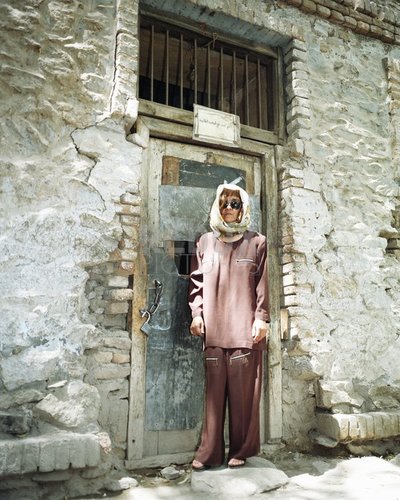
Suhila Fanoos, 25 years old, Walayat women's Prison guard standing in front of the Women's prison holding 32 female inmates for crimes such as skipping home and leaving their family responsibilities. Sign above her head reads "Prison of Women". Photographed in Kabul, Afghanistan July, 2003. © Katherine Kiviat/Redux Pictures
HOW TO APPROACH THESE PHOTOGRAPHS?
The portfolios of Juvan and her contemporaries had me thinking. Many photographs were from 2003 or later in 2007/08 (due to media coverage of allegations of abuse or the construction of a new prison).
I’d like to present a few images, but am I only comfortable doing so if I also provide an accurate summary as it is NOW for women imprisoned in Afghanistan.
Firstly, I just like to point out the two pairings above and below. Kiviat and Juvan (above) both show the same portal at Walayat women’s prison, Kabul. In 2004, one year later, Kiviat also photographed this door which is the same as that shot by Andrea Camuto (below). Camuto identifies the door as belonging also to Walayat women’s prison.
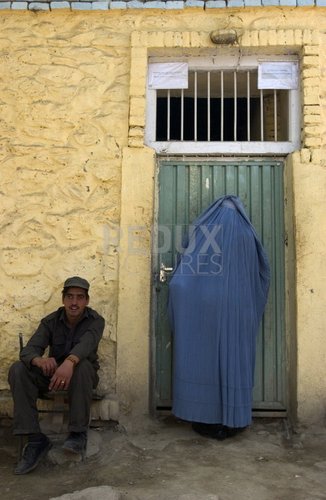
The women's prison in Kabul, A woman speaks to female prisoners through the peep hole of the prison door. © Katherine Kiviat/Redux. 2004
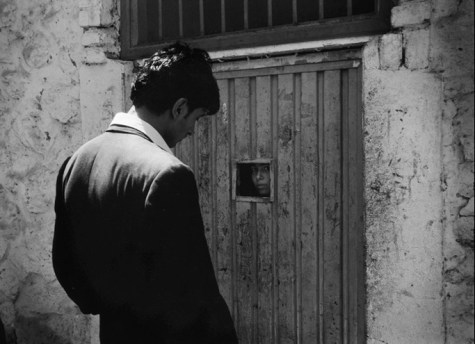
Visitation, Walayat woman's prison, Afghanistan © Andrea Camuto
WAYALAT WOMEN’S PRISON
Wayalat still operates as a prison, but it no longer houses female inmates. A 2003 IRIN report detailed the dire need for humane facilities at Wayalat:
‘According to Lt-Col Habibuallah, in charge of Wolayat prison, the present building with its 17 rooms and four toilets was built some 90 years ago to accommodate up to 200 people. “There are 511 men and 32 women imprisoned here,” he said. There were no categories for offenders and the accused and convicted were generally mixed together, including some inmates on death row. “There are no basic facilities, no ambulance, no proper medicine and health care, and the increasing problem of overcrowded rooms is a tragedy,” Habibuallah said. Even the 35 staff members lacked access to a toilet and were forced to sleep on the roof or in the courtyard at night. “We have worse conditions than the prisoners,” he claimed. Women inmates fare slightly better. Located in a separate building, the painted cells house between five and seven prisoners each, but the lack of adequate health care is felt more by the detained women.’
Manca Juvan‘s work focused on the women and their children in Wayalat. Katherine Kiviat‘s work is part of a larger body of work describing the new roles and careers (including that of prison guard) of women in Afghanistan. The collection is called Women of Courage.
Andrea Camuto‘s work, shot in 2005, 2007 & 2009 followed returning refugees and the “forgotten” women of Afghanistan to the cheaper countryside rents, to the hospitals … and to the prisons if necessary.
The common theme for these photographers is the injustice suffered for many women whose imprisonment is based upon judgement for “moral crimes” and “bad character” including sentences for adultery (which includes inappropriate acts both in and out of wedlock), being drunk, wanting a divorce or even just leaving a husband for a night to stay with family after suffering a beating.
PUL-E CHARKI
On the outskirts of Kabul, Pul-e Charkhi is Afghanistan’s most notorious prison. It has been used by every regime to house it’s enemies.The unearthing of mass graves in 2002 confirmed the Soviets’ use of the site for mass-killings and the Americans adopted and expanded the prison to house Taliban fighters. In 2006, there was a major rebellion and riot by the prisoners.
Anne Holme‘s work from Pul-e Charkhi was conducted in 2007. Holmes’ story is that of the struggle to raise children inside the walls, the quashing of legal rights and despite the “warden’s genuine concern” the inability of the justice system to provide fair hearing for the women.

Pul Charki's womens prison just on the outskirts of kabul is rough living. Inmates do not receive adequate medical attention, they cannot send or receive mail, and many of the women there have yet to learn the crime with which they have been charged. © Anne Holmes
In April 2008, David Guttenfelder visited Pul-e Charkhi. His work, Kids in Prison reveals disturbing figures – “There are 226 young children in Afghanistan’s prisons, including many who were born there. They have committed no crime, but they live among the country’s 304 incarcerated women.”
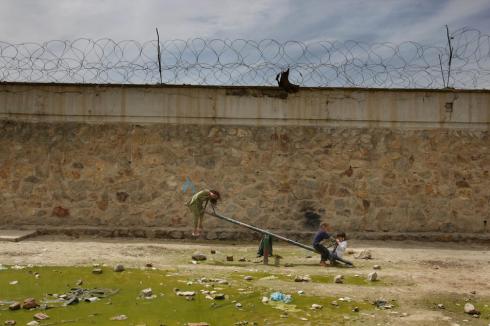
Jamila, left, plays on a seesaw with children of other female inmates on the prison yard of Pul-e Charkhi prison in Kabul, Afghanistan April 17, 2008. Jamila, age 7, and her mother, Najiba, who is serving a seven year sentence for adultery, have been in prison for 10 months. © David Guttenfelder/AP
Pul-e Charkhi was a brutal living environment. This report details inadequate sanitation, frigid winter temperatures, rape and humiliation.
In the same month that Guttenfelder photographed – April, 2008 – the women and children of Pul-e Charkhi were moved to a new purpose built facility. Recognising the special requirements of female prisoners, Badam Bagh was constructed by the United Nations Drugs and Crime Office (UNODC) with the financial support of the Italian Government.
The two videos below offer some comparison between the two facilities:
PUL-E CHARKHI
BADAM BAGH WOMEN’S PRISON
LYSE DOUCET AT BADAM BAGH
To bring us right up to date, the best reporting is not that in the photographic medium, but straight news reporting. Lyse Doucet‘s report for the BBC is a must see.

(I have applauded Doucet’s journalism in the mens’ wings at Pul-e Charkhi before).
At a moment when the White House is to open talks with the Taliban and the media is comfortably using the phrase “unwinnable war”, it is perhaps responsible to consider the lives of those caught up in the broken justice system of Afghanistan. The prisons of Afghanistan are one of the last priorities for a society that is war torn and divided. Afghanistan hasn’t got the resources to support the basic human rights of those it incarcerates when the rights of those outside prison walls cannot be guaranteed.

Mari Bastashevski photographs the rooms of victims of kidnap. “Abduction as a concealment tactic became prevalent in 2000 during the second Russian-Chechen conflict. The practice continues today. The rooms are preserved by family members who don’t know the fate of their loved ones,” says Bastashevski.
It’s no surprise that since her Open Society Grant and subsequent exhibition in New York and Washington D.C., Bastashevski should have become the trendiest thing in art-documentary. (The New Yorker, Lens Blog, ThePhotographyPost)
I’m not being flippant here; I think her work is remarkable and I also think it is successful in translating the bleakness of the situation for abductees and the families left behind (not all photography can elevate an issue in this same way).
‘File 126: Disappearing in the Caucasus’ has all the right ingredients to hook the Western audience; the cachet of post-Cold-War politics; the same cold-exoticism of photographers such as Carl de Keyzer or Bieke Depoorter; the details of anaesthetised domestic interiors; and fundamentally, hundreds of profoundly tragic and must-be-heard stories about political terror.
Russian-born Bastashevski read the case files before she began visiting families. Human rights organizations in the Russian North Caucasus have spent years documenting the abductions of young people, which they attribute to the state security forces conducting a brutal counter-insurgency campaign[ …] Some stories verged on madness, like the genteel lady who was certain, after five years, that her sons were still alive in a secret prison in the forest, if only she could reach them. (Source)
DIFFERENT CONTINENT, SAME CRIME
One of the reasons I am so interested in Bastashevski’s work is that it mirrors the work – intellectually and in terms of its activism – of those photographers exploring and documenting the legacies and memories of the Disappeared in Argentina. (“Those photographers” I have written about before here, here, here and here).
– – – – – – – – – – – – – –
Image Caption: On June 10th, 2009 a group of military officials conducted a special, counter-terrorism, operation in Nazran, Ingushetia. In a course of the night, the men seized out of bed and dragged away a 23 year old Albakov Batyr. For two weeks Batyr remained missing. On June 13th., 2009, after two weeks of silence and uncertainty Batyrs mother saw her son on television. Literally torn to pieces, with arms barely connected to the torso, his body was dressed into insurgency clothing and was displayed covered in bullet holes. The TV network announced Batyr as one of the most wanted terrorist leaderer, killed during a spec. operation in the mountains. © Mari Bastashevski
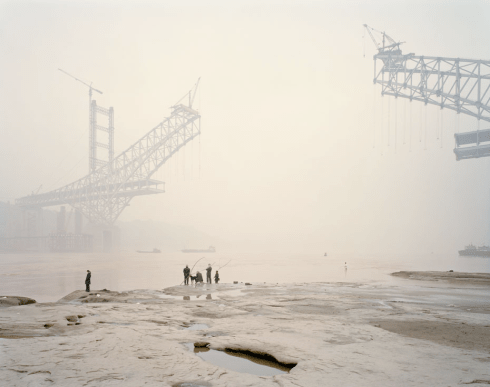
2009 winner, Nadav Kander is on the jury for this years Prix Pictet.
That means two of the eight jurors I knew of. The other six are new to me:
The Prix Pictet Growth will judged by an internationally recognised panel of experts led by Professor Sir David King, Director of the Smith School of Enterprise and Environment at the University of Oxford. Other members of the judging panel include Shahidul Alam, Photographer, Curator and Founder of the Drik Agency in Bangladesh; Peter Aspden, Arts Writer for the Financial Times; Michael Fried, Art Historian and Critic; Loa Haagen Pictet, Pictet & Cie’s art consultant; Nadav Kander, Winner of the second Prix Pictet; Christine Loh, CEO of Civic Exchange, Hong Kong; and Fumio Nanjo, Director of the Mori Art Museum, Tokyo.
Last week, I sent this clip over to Brendan Seibel who knows a thing or two about punk, rock and Bay Area discontent.
In return, Brendan sent this clip describing it as “one of those what-the-f#@k moments when San Francisco was cool.”
Just thought you should know.

After today’s verdict, it would be understandable if we concluded that – in the eyes of the law – Oscar’s life didn’t matter. The jury had verdict options of murder, voluntary and non-voluntary manslaughter. They choose the latter; the most lenient. After slaying Grant in front of hundreds of witnesses, Johannes Mehserle may well be out of prison in two years. face a five to 14 year sentence if he is not granted probation (Source for the correction).
There’s so much to say about this verdict. Simply, I’ll say today was a sad day for justice, for Oscar’s family and for his memory.
Print from Just Seeds

I’ve talked about biologist Nalini Nadkarni and the Sustainable Prisons Project in Washington State before here and here.
Well, Nadkarni is back at TED again, this time delivering a quick 6 minute piece on how the things we consider static – trees, perceptions, prejudices and the lives of prisoners – are all open to change … if we see the possibilities, if we allow the possibilities.
At times, Nadkarni’s implored arguments (about tree art) are a bit of a stretch, but ultimately I am focused only on the practical & repeatable efforts her team is making to engage the prison population – a population of whom most others have given up.

 Prison Photography