
You are currently browsing the category archive for the ‘Activist Art’ category.
What do I want from this year? I want to continue the fun I have researching. I want a rip-roaring online symposium on race, diversity and photography. I want to be continually surprised by the things I discover. I want to deliver juxtapositions that make one pause. I want to do more interviews with photographers. I want to talk to more people in prison education. I want to change one persons view and then move on from there.
Covering Photography is the type of site I love to stumble across. Much like PhotoEphemera it is a site of tangential but significant importance to the role of photography in wider culture.
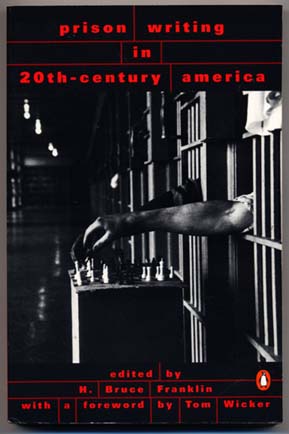
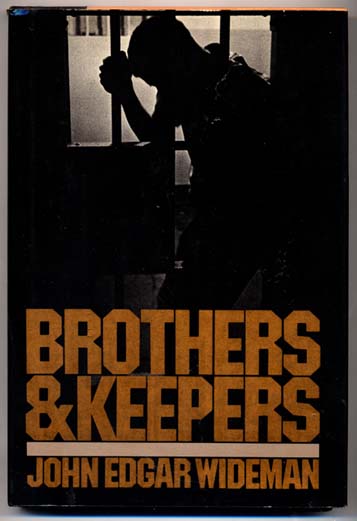
There are four books in the archive that feature prison photography. I have talked before about Cornell Capa‘s commitment to prison issues. Danny Lyon‘s career as a journalist is indelibly tied to American prisons. Arthur Tress and especially Charles Gatewood are not known for their prison photography.
I have bunched book covers with hand-picked works of each photographer as a playful convergence to kick off the new year.
ARTHUR TRESS

Halloween © Arthur Tress

Link
CORNELL CAPA

Russian and American soldiers, part of the Allied occupation forces, at a multinational party, Berlin 1945. © Cornell Capa/Magnum
Link
DANNY LYON
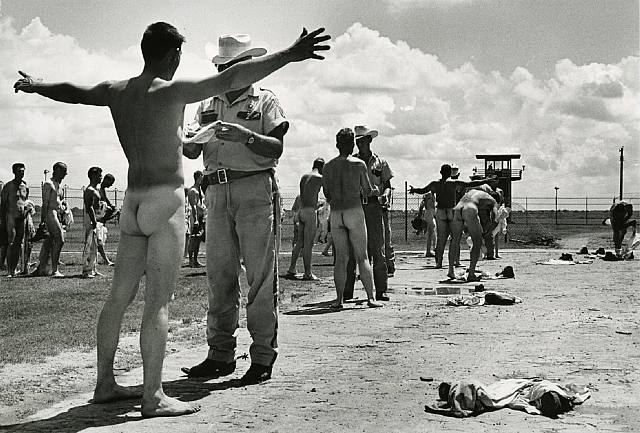
Texas Prison, Ramsey Unit © Danny Lyon

Link
CHARLES GATEWOOD

Wall Street © Charles Gatewood
Link
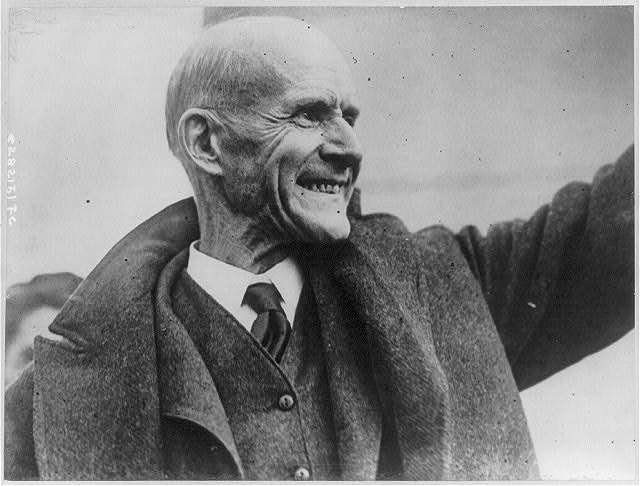
Eugene V. Debs, Five times Socialist candidate for President, as he leaves the Federal Penitentiary at Atlanta, Georgia on Christmas Day, 1921. Library of Congress Prints and Photographs Division, LC-USZ62-75578 (B&W film copy neg). Photoprint copyrighted by Underwood & Underwood, No. S/282,151/FC.
Eugene V. Debs is a hero for the prison reform movement. Which is strange given that prison reform per se wasn’t his main cause. Debs was a labor rights advocate, union organiser and Socialist Party pioneer.
Debs was a harsh critic of American draft policies of the First World War; he was accused of sedition and labeled a traitor by Woodrow Wilson. Debs’ June 1918 anti-war speech saw him arrested under the war-time espionage law. He was sentenced to 10 years. He was effectively a political prisoner.
It is the statement Debs delivered in his court hearing that has inspired generations of prison activists:
Your Honor, years ago I recognized my kinship with all living beings, and I made up my mind that I was not one bit better than the meanest on earth. I said then, and I say now, that while there is a lower class, I am in it, and while there is a criminal element I am of it, and while there is a soul in prison, I am not free.
Given that Marx’s Das Kapital was published in 1867, Debs’ adoption of Socialism is relatively late. Ironically, it was while he was imprisoned in Woostock, Illinois during 1895 that he read Marx’s work and upon release became an avowed Socialist.
Debs ran for the US Presidency five times; first as a member of the Social Democratic Party of the United States (1900) and later as the candidate for the Socialist Party of America (1904, 1908, 1912 & 1920). In both the 1912 and 1920 elections Debs’ received nearly one million votes, 6% and 3.4% of the popular vote, respectively.
The 1920 campaign was run from within prison – after his 1918 speech he was convicted in April of 1919. The photograph above is of Debs’ release on Christmas Day, 1921 when his sentence was commuted to time served.
Debs legacy lives on partly in the form of the Eugene V. Debs Award. Past winner include Studs Terkel, Howard Zinn, Kurt Vonnegut, Molly Ivins, Pete Seeger and Ralph Nader.
Musings on the ‘Third Candidate’
I am always fascinated by the presence of historical figures who have disturbed the prevalent two party system of America. As unsavory as George Wallace was, his impact as a third candidate is worth measuring. Today, Ralph Nader’s name is synonymous with the term ‘third candidate’ and for his involvement in the 2000 general election his is vilified as the reason Al Gore did not become president. I am sick of hearing such a whinging and backward logic. Al Gore did not become president of the United States because he failed to win enough Electoral College votes and we well know the hanging, Floridian chaddy reasons for that.
People’s criticism of Nader says more about their surrender to a seemingly perpetual two party system than it does of his perceived faults.
Nader has made the point that neither the suffragettes or civil rights activists made it to elected office but that didn’t prevent them effecting massive change. If people are criticising any third candidate it is because they are more focused on the intractable two-party system than they are on their own agency and potential to effect change.
Image source.

The greatest priority for sentencing reform must be to dismantle the Three Strikes Law.
Three Strikes has not made society safer, it has only handed down overly-punitively long sentences.
Familial support during incarceration is the largest deciding factor in helping released prisoners to stay clean. It is therefore great to see Families to Amend California’s Three Strikes, a grassroots activist group focusing the voices of disenfranchised family members against unjust sentencing policy … and doing it well. Check out the videos and the resources page.

This post is a while overdue. As I am sure you know, Medecins Sans Frontier launched Condition: Critical this year. It is a website to bring together the many stories of victims of the war, assemble video and photo tools for activism and to leave messages of support. That’s right … no money, just a letter and awareness.
As part of the effort, my mate Ben has had his hand in the first four videos pushed out to the world. Ben’s summary of this conflict and humanitarian situation;
“Its the world’s deadliest conflict since the second world war and yet the majority of people have never heard of it. According to the IRC at least at least 5 million Congolese have died in more than a decade of conflict sparked off by the 1994 genocide in neighboring Rwanda. Most of the deaths are linked to a lack of medical facilities as the ability to access medical care in Eastern Congo has crumbled with the war.”
Ben’s team trained the comms people out in the field to gather stories and then they edited it to relay the stories in a powerful, respectful way. First hand tales and simple honest images. No gore, only testimony.
Drawing the War is the troubling tale of a boy carried away by opposition forces and set to work.

There are four videos from the MSF Condition Critical campaign on duckrabbit vimeo profile. The other three are Mishoka’s Story, Bahati’s Story, and Francoise’s Story.
So it seems that Ben has had some success in challenging and changing the public relations that non-profits and charities have to their global audience. Now all he, us and the people of Congo require it awareness, effort and mindshare.
Ben has asked us to do one or four of four things: 1. Leave a message of solidarity on the map; 2. Twitter about it and link to it on Facebook (for Twitter use #conditioncritical); 3. Embed one of the video’s on their blogs; 4. Write something about the project. Tewfic, Mark, Charlie, Mediastorm, Daniel and Boing have done their bit. Pass it along.
WHILE WE ARE ON MSF
I also recommend following the MSF Photoblog, managed by Bruno Decock (I think) as it endeavours (commendably) in public to deliver relevant balanced, effective, non-sensational and representative photographs of Africa. Not easy!
Photographers Dominic Nahr, Julie Remy, Martin Beaulieu, Robin Meldrum, Yasuyoshi Chiba and Cedric Gerbehaye have been involved in the collaborations with MSF for Condition Critical.
[Author’s Note: This is the first in a three part series on prisons in Africa. Through the lens of three different photojournalists, we will see the conditions and lives within prisons of Guinea, Burundi and Sierra Leone.]

© Julie Remy. Inscriptions by young prisoners.
Julie Remy has photographed stories in Rwanda, Mali, Zambia, Malawi, and for her series on prisoners – Guinea.
In September 2008, Médecins Sans Frontières (MSF) began an emergency intervention in the civilian prison of Guéckédou in southeastern Republic of Guinea. Remy’s documented the food and medical aid effort.
“We have problems with food and illness here. There are no medications. There is no doctor. Since 2007, 30 people have died here and the doctor didn’t come.” Inmate, 19 months in prison
Guéckédou was over-crowded, unhygienic and without proper ventilation. As a result, some inmates were malnourished, most dehydrated and many with respiratory and skin diseases. It was recorded that prisoners with tuberculosis shared cells with the general population. Incubation of disease was a major concern.
I have no idea how the prison conditions of Guéckédou compare fifteen months on.

© Julie Remy. At the Guéckédou Civilian Prison, inmates wash only with water on a non regular basis. This prisoner shows the photographer his scabies. Due to poor sanitation prisoners suffer various skin diseases.
Remy worked in dark surroundings. As MSF vouched, “The scene that meets the eye upon entering the chambre noire “dark room” is beyond belief. Some 26 prisoners, crammed into a space of about three by four meters, can only be made out by squinting.” These images are part of a specific, urgent campaign, so it would be offensive of me to pay them any aesthetic critique. The awareness is what matters here.
MSF made good use of Remy’s photographs to produce a short video explaining the situation and dire need for intervention.
I’d like to emphasise that Remy (as a photographer) and MSF were in Guéckédou because of extreme circumstances at the national level. The poor conditions in the prison can be attributed to a number of larger structural instabilities. The men in these photos are one constituency suffering from a regional crisis. MSF explains; “The failure to ensure basic minimum standards in Guinea’s prisons can be linked to the country’s generally poor human and economic development. Ongoing instability and conflict in neighboring countries have long impacted on Guinea, while strikes and civil unrest have emerged in-country over the past few years. The ongoing international increase in food prices, especially in 2008, has exacerbated Guineans’ already precarious living standards and food insecurity.”
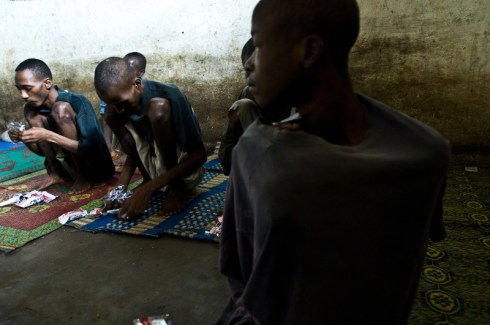
© Julie Remy. Malnourished prisoners received plumpy nut provided by MSF at the Guéckédou civil prison.
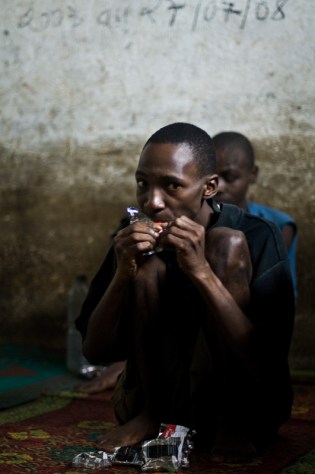
© Julie Remy. Malnourished prisoners received plumpy nut provided by MSF at the Guéckédou civil prison.
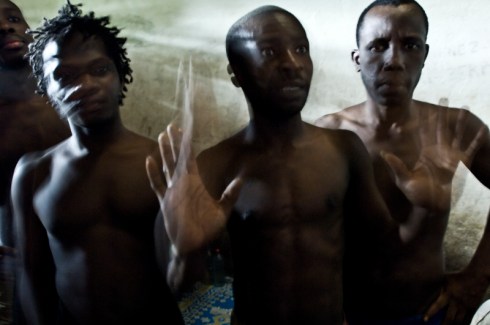
© Julie Remy. A prisoner tells us that he is innocent. That he has done nothing and still has not been judged. He says he does not know why he is held here in the “Chambre noire” where a dozen prisoners are tied to a bar and held with another dozen in a barely lit cell. Guéckédou civil prison.
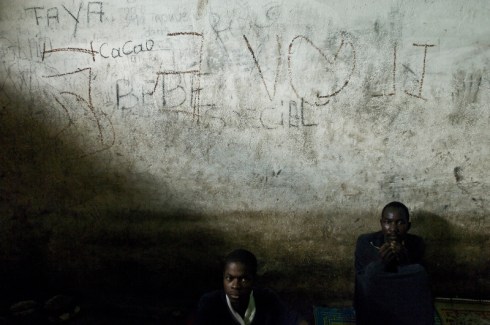
© Julie Remy
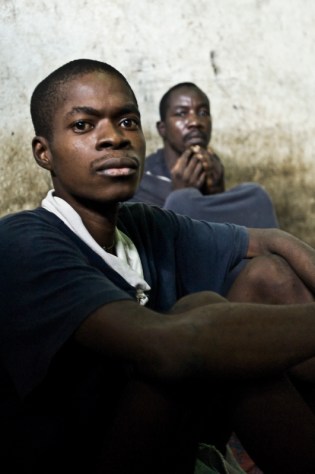
© Julie Remy
When the opportunity arises, I think it is important for audiences to view images like those two above within each others context. The first image is a dank, alienating environment in which the oppressive shadows and walls dominate. Whereas the second image (probably taken within a matter of seconds) is a well lit portrait centred on the gaze and associated emotions of the man; the prison environment is not stated. Precisely because MSF and Remy were present due to the physical effects of this environment on these men, both are valid photographic approaches.
The consequent written report from this aid intervention released in February 2009 continued with a call for systemic reform:
“Although the sub-standard conditions in Guinean prisons can be attributed partly to poverty and the country’s limited resources, these factors alone do not explain the absence of response to recurring malnutrition and the unacceptable living conditions in Guéckédou and other prisons. Guinean national authorities bear the ultimate responsibility to uphold the fundamental human rights of its inhabitants, including its incarcerated population.”
I, like many others invested in the photojournalism/documentary community, want to see less images of suffering in Africa and more images of the uneventful days; the boring normal times, perhaps some quiet smiles and tears. Add to that some local African photographers and we’re on the right track. (See recent commentary by Paul Melcher, Daniel Cuthbert and Ben Chesterton for more on this).

© Julie Remy
In closing I’d like to offer a caveat for the three part ‘Prisons in Africa’ series.
African prisons – that is, sites of incarceration across a land mass the size of Western Europe, Argentina, China, India and the USA combined – are each unique. Generally, conditions will be poorer than in prisons of developed nations, but every prison has its own culture, rules and circumstance. In Africa, as in the rest of the world, prisons usually exhibit the worst of a nation; retribution and anger, neglect and apathy.
Photographers are compelled to visit prisons known to them through local knowledge or national notoriety; we must expect there is a story to be told. The prisons I will feature in this three-part series will not be pleasant, but I think the three featured photographers are sincere and the stories are important.
While the men in these images may deserve pity, Africa as a continent does not. Africa deserves our respect and our time.
Nations in Africa, as with all places featured in the photojournalism we consume, should be places we think about visiting. I seriously encourage anyone and everyone to make an extended visit. Opportunities to dilute the media images of places and people with first hand interaction with those places and people will only have positive results. If only we had the opportunities, good reason and resources to visit and live in new places frequently.
(Disclosure: I lived in East Africa for five months. That time made more complex and less harried my perspective of the world. The largest culture shock was returning to the UK.)
__________________________________________________________
Official Bio: Julie Remy is an award winning documentary photographer specializing in human rights, health, travel and the environment. What she captures through her viewfinder and what she tells in written word she believes will contribute to bringing hope and respect and perhaps assist in gaining access to the care and knowledge they deserve.

Source
UNKNOWN DETAINEES
Stan posted this a couple of days ago. Three suicides covered up in 2006.
Now a 58-page study prepared by law faculty and students at Seton Hall University in New Jersey starkly challenges the Pentagon’s claims. It notes serious and unresolved contradictions within a Naval Criminal Investigative Service (NCIS) report – which was publicly released only in fragmentary form, two years after the fact – and declares the military’s internal investigation an obvious cover-up. The only question is: of what?
I have highlighted the death of prisoners in US military custody before, in Iraq and in Pakistan.
These deaths seem to be suicide. Should we be surprised? Doesn’t the military deal in death. Prisons are miserable. Locking enemies and captors up behind closed doors is eventually going to lead to homocide or suicide. The stresses and stressors are too large.
Inevitably the question is why would the authorities usher a cover up? My guess because they didn’t want a closer look at the entire operation at Guantanamo.
Just another tragedy in the long list to come from that corner of Cuba.

Elsewheres, the Detainee 063 has launched a blog and twitter feed of the Guantanamo interrogation log of Mohammed al-Qahtani. It is being published in real time. Each entry appears exactly seven years after it was first recorded.
This is the best deadpan and frigid use of twitter since Jenny Holzer, who incidentally has done her own amazing work on the ‘war about terrorism’.
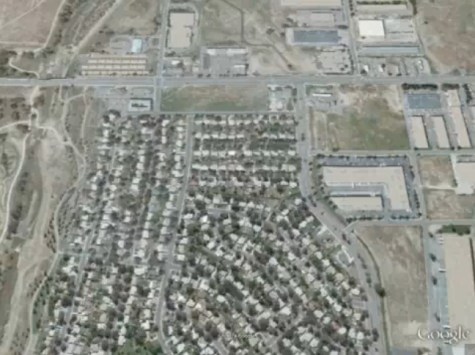
Aurora Detention Facility, Aurora, Colorado, Google Earth Screenshot
POSITIONING PRISONS IN SPACE AND IN OUR MINDS
One of the main stated goals of Prison Photography is to bring visual documents of prisons in America and abroad to a wider audience, so I was very excited to hear about Thousand Kites‘ newest initiative.
Incarceration Nation is a prison mapping and image bank that (un)earths the presence of prisons in our communities using Google Earth videos and user generated content. Our goal is to provide bloggers, researchers, activists, and interested citizens access to often suppressed images of the U.S. prison industrial complex.
Thousand Kites artist Nick Szuberla tells it as it is:
PRISONS AND ABANDONED INFRASTRUCTURES
Minutes after viewing the nations’ subdivided carceral systems lounging up against the nations’ desert mountains, rural towns and even sub-divided suburbs, I came across the BLDGBLOG analysis of California City:
In the desert 100 miles northeast of Los Angeles is a suburb abandoned in advance of itself—the unfinished extension of a place called California City. Visible from above now are a series of badly paved streets carved into the dust and gravel, like some peculiarly American response to the Nazca Lines.
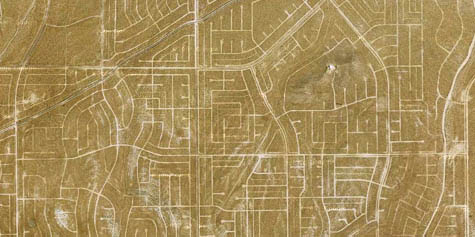
Geoglyphs of Nowhere
BLDGBLOG continues:
And it’s a weird geography: two of the most prominent nearby landmarks include a prison and an automobile test-driving facility run by Honda. There is also a visually spectacular boron mine to the southeast – it’s the largest open-pit mine in California, according to the Center for Land Use Interpretation – and an Air Force base.
The prison is the California City Correctional Center, a private prison run by Corrections Corporation of America (CCA) for federal authorities. If you want to buy shares in CCA and profit from the misery of and warehousing of human beings CCA operates on the stock market under CXW. But, please note: By investing in CCA you automatically qualify as the sperm of the devil and invite a dump-truck of shat-karma to your door and into your life.

The Geometry of Incarceration
Szuberla’s opinion that prisons are hidden is indisputable; prisons are willfully sited in remote locations. Policy provides prisons with predictable, constant, distant operating funds – even when local monies may dwindle.
PRISONS, ECONOMIES, FILM
Prisons, while occasionally a boon to local economic health, are always moral and morale parasites to their host towns.
Prison Town is a great film that follows the workers and residents of Susanville, CA. Initial apprehension, curiosity and hope for what prisons could bring to a suffering economy soon turn to realizations that the prison spurred mainly minimum wage jobs outside the institution and destroyed the will of those working inside.
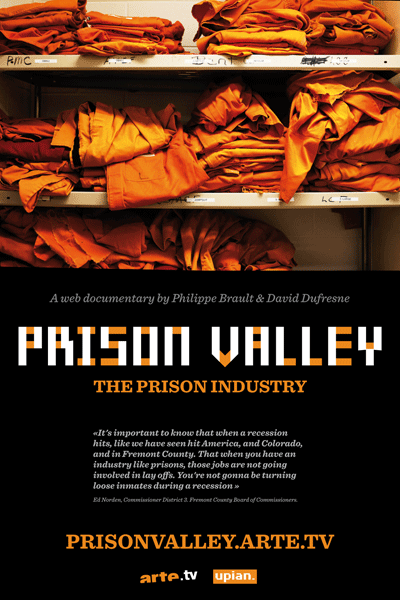
Prison Valley is a web-documentary in production right now by Frenchmen David Dufresne and Philippe Brault. It looks at Colorado’s prison towns during the recent recession.

Belva Cottier and a young Chicano man during the Occupation of Alcatraz Island, May 31, 1970. Photo: © 2009 Ilka Hartmann
Today marks the fortieth anniversary of the start of the Indian Occupation of Alcatraz, an action that lasted over eighteen months until June 11th 1971.
Photographic documents of the time are surprisingly scant. Over the past few decades, Ilka Hartmann‘s work has appeared almost ubiquitously in publications about the Indian Occupation. We spoke by telephone about her experiences, the dearth of Native American photographers, the Black Panthers, Richard Nixon, the recent revival of academic research on the occupation and what she’ll be doing to mark the anniversary.
Your entire career has been devoted to social justice issues, particularly the fight for Native American rights. Did your interest begin with the Alcatraz occupation?
No, it began earlier. I came the U.S. in 1964 and that was during the human rights movement. I was a student at the time but I really wanted to go and work with the Native Americans on the reservations of Southern California. I was connected to the Indian community here through a friend who had emigrated to California earlier. I learnt very early about the conditions for American Indians. It reminded my of what I had learnt as a teenager about Nazi rule.
When the occupation began I wanted to go but I couldn’t because I was not Native American, but I waited until 1970.
Concurrently you were photographing the Black Panther movement – centered in Oakland – and the other counter culture movements of the late sixties in the Bay Area. How did they relate to one another?
They were all the same, each group struggling to advertise their conditions, the police brutality and the lack of educational and cultural institutions. I was involved in the fights for American Indians, African Americans, Chicano and Asian Americans in Berkeley. We were protesting as part of the Third World Strike. For me everything was connected and it was the same people who were speaking up later at Alcatraz.
My new book is actually about the relations between the different groups of the civil rights movement. There was a lot of solidarity between groups. The Black Panther Party understood this. Many people think that the Black Panthers were concentrated on their own politics but they understood solidarity and got a lot of help from non-Black people. If you look at my pictures of the Black Panther movement a lot of supporters were the white students of Berkeley. There is a saying, “The suffering of one, is the suffering of everybody”.
In the Bay Area people were so willing to help the Indians at Alcatraz and help in the Black Panther movement and they really felt things were going to change.
I was a student at UC Berkeley and stopped in February 1970. I went to Alcatraz in May of 1970. I had learnt to open my eyes and emotions at UC Berkeley through all the different groups we had.
How many times did you visit Alcatraz during the occupation? And how long did you stay each time?
I only went twice to the island. It is funny because I didn’t even know if my photographs would turn out. I had a camera that I’d borrowed from a friend with a 135 mm Pentax lens … and also a Leica that a friend have given me too. But I didn’t have a light-meter for the Leica so I didn’t know if the photographs I took in the fog would come out. It was so light. I was amazed that they came out. I also went over in a small boat that same year.
So I made contact sheets and tried to get them published which was a big problem because you had to really work on that. My first picture of the occupation was published in an underground paper called the Berkeley Barb then in June 1971 I was at KQED, a Northern California Television station, for an interview with an art editor. I had hitch-hiked there from the area north of San Francisco and I just opened my box of pictures to show him topics I was concerned about when over the intercom came an announcement “The Indians are being taken from Alcatraz.”
I saw some video guys run by, I grabbed my bag and camera and asked them if I could join them. They said, “Yes, ride with us and say you are with us.” We got into an old VW and drove around on the mainland to see the occupiers and that is how I got those shots of the removal. It was an incredible coincidence because I actually lived far from the city. It’s quite incredible. I only went two times during the occupation and then I got those shots afterward.
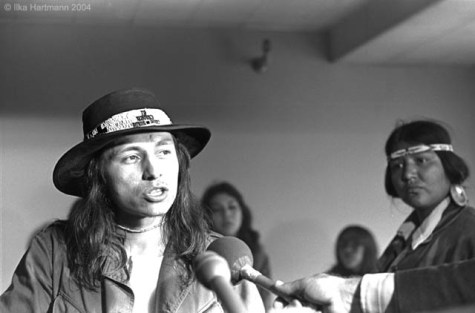

From then on I made contact with people and in that year I showed my pictures at an Indian Women’s conference, making very good friends with people in the American Indian movement. From then on I went to cultural events, powwows and so on and my pictures appeared in the underground press. I wrote articles and people contacted me for images. That’s how I made the connection.
So really you made no arrangements?
I didn’t make any arrangements. I followed everything from the first day in the papers and on that day in May … on May 30th the Indians asked all the journalists to go and I wanted to be there. That’s how it all started; they invited us there that day.
Did you realize at the time how profound an historical event it was?
Yes, I always felt how important it was. This was the first time they [Native Americans] spoke up. All over the world people wrote about it and the cause became known globally, and especially known in the United States. I believed in it … I still do.
What are your lasting memories of your time and work during the occupation?
It was a prison that had been closed so it was surrounded by barbed wire fence. Some of it had become loose and I took some pictures. The wire swung loose in the air and there was a sound across the island of the wind whispering over it. And if you looked out over the beautiful waters, you really got the sense – with the barbed wire – that the Indians were prisoners, as well as occupiers of the Bay. Prisoners of the Bay; which means prisoners of the World. In that sense I really had a strong feeling of the prison.
How did you react to the environment?
For me, strangely, the experience of going to Alcatraz has always been a very high and wonderful experience. It is hard for me to even explain. Of course I know it was a prison. On the tour of Alcatraz I got very upset, especially during the part when you’re taken downstairs to learn about the lesser known incarceration of Elders and also the cells for those people who didn’t want to go to war. So of course I know it is was a prison, yet when I go there I am struck by exuberance and hope about [Indian] people being able to make statements about their conditions.
I was a witness to that and wanted to be a conduit for those statements. There were no American Indian journalists, we were nearly all white. There was one Indian photographer, John Whitefox, who is now dead. But he lost his film. So we really saw it as our job, politically, as underground photographers and writers to cover what was part of the revolution and social upheaval.
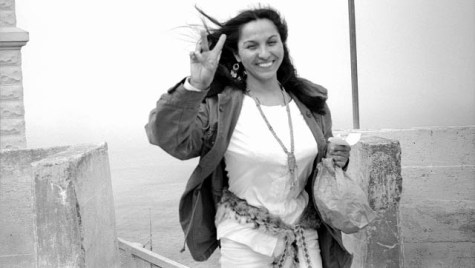
Eldy Bratt, Alcatraz Island, May 1970. Photo: © 2009 Ilka Hartmann

Two Indian children play on abandoned Department of Justice equipment. Alcatraz Island, 1970. Photo: © 2009 Ilka Hartmann
San Francisco Bay has a strange history with islands, incarceration and subjugation. San Quentin was the focus of the Black Panther resistance – it is just ten miles north of the city. Angel Island was an immigrations station for Asians – it is known as the “Ellis Island of the West” and some Chinese migrants were kept there for years. And, then there’s Alcatraz. How do you reconcile all this?
It’s totally horrible to me. I come form Germany. Before I came I’d heard about Sing Sing on the river on the East coast. It was a horrible thought to me that they could put people in such prisons.
I drive past San Quentin most days, I have actually been inside and taken photographs. And of Angel Island – it is almost sarcastic to imprison people like that; it’s such a contradiction to the beauty of the Bay. It’s the hubris of human beings to do that to one another.
Of course there are people who should be in prison, like at San Quentin, but certainly the Chinese should not have been treated like that on Angel Island. The Indians and the anti-war demonstrators should absolutely not have been treated like that on Alcatraz. Actually the authorities were respectful to the antiwar demonstrators than they were to the Indians, but still both are an aberration of human nature to treat others like that. I don’t know what to do with murderers but I do know I am against the death penalty.
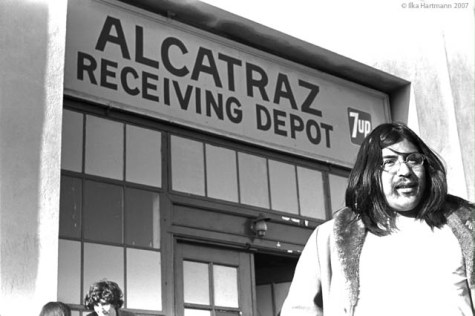
An Indian man arrives at Pier 40 on the mainland following the removal in June 1971. Indians of All Tribes operated a receiving facility on Pier 40, where donated materials were stored and where Indian people could wait for boats to transport them to Alcatraz Island. Photo: © 2009 Ilka Hartmann

"We will not give up". Indian occupiers moments after the removal from Alcatraz Island on June 11, 1971. Oohosis, a Cree from Canada (Left) and Peggy Lee Ellenwood, a Sioux from Wolf Point, Montana (Right). Photo © 2009 Ilka Hartmann
How do you see the situation for Native Americans today?
When I started there was said to be one million American Indians and now statistics say there are one and a half million. This is down to two things: first, the numbers have increased, but secondly more people identify as Native Americans where they had tried to hide it before due to racism and prejudice.
I went on one trip with a Native American Family for six weeks across the southwest and I kept asking if the Indians were going to survive and there was some doubt, but now people really think the culture is growing and there has been a notable revival. There advances being made dealing with treatments for alcoholism and returning to free practices of traditional worship. I know that the Omaha are talking of a Renaissance of the Omaha culture. My friend and historian, Dennis Hastings, who was also an occupier of Alcatraz, said to me ten years ago “It could still go either way. Half the Native peoples are debilitated with alcoholism and the other half are vibrant and healthy.”
Great afflictions still exist but there are many more Indians who are able to function in the Western aspects of society and traditional ways of life. When I entered the movement there was only one [Native American] PhD; now there are over a hundred. There is hope now.
What we felt came out of Alcatraz was the influence that it had on Nixon. Because he was a proponent of the war I always used to think of him in only negative ways but that is a learning experience too. It is a shock that someone responsible for the deaths of so many people in the world, of so many Vietnamese, could do something good. He signed the American Indian Religious Freedoms Act (1978). Edward Kennedy also worked a lot on these laws.
We believe the returns of lands such as Blue Lake/Taos Pueblos in New Mexico and lands in Washington followed on from the occupation of Alcatraz. There is a famous picture of Nixon with a group of Paiute American Indians. I believe a former high school sports coach of Nixon’s from San Clememnte was Native American and so we think this teacher influenced him.
As a result of Alcatraz, as well as the land takeovers, the consciousness has been raised among non-Indians and this was very important. People in the Bay Area were very supportive of the occupation, until the point where people were not responsible; it got messy the security got too strong and there were drugs and alcohol. Bad things did happen but in the beginning all that was important to expose to the world was written about, particularly by Tim Findley and all the writers working to get this into the underground press.
Until about 15 years when Troy R. Johnson and Adam Fortunate Eagle wrote and researched their books we didn’t understand everything that had happened – we just knew it was exhilarating. We now have the information of policy changes and the knowledge of people who went back to the reservations; leaders such as Wilma Mankiller who was the principle chief of the Cherokee for a long time. Dennis Hastings was the historian of the Omaha people and brought back the sacred star from Harvard University.
Many people have done things to allow a return to the Native culture and it is so strong now – both the urban and reservation culture. American Indians are making films about urban America – part of modern America but also within their Indian backgrounds. Things have changed enormously.
The benevolence of Richard Nixon is not something I’ve heard about before!
Yes, You can read more about it in our book.
What will you be doing for the 40th anniversary?
I’l be going to UC Berkeley. I’ve been working on an event with a young Native American man who is part of the Native American Studies Program which was established in 1970 as a result of the Third World Strikes. I walked and demonstrated at that time many times. I’m very happy to be returning. LaNada Boyer Means who was one of the leaders of the occupation will be present. We’ll be thinking of Richard Aoki, who was a prominent Asian American in the Black Panther movement, who died just a few months ago.
When these people would lead demonstrations, I would photograph it and then I’d rush to the lab, work through the night to get them printed the next day in the Daily Cal and then have to teach my classes and then take my seminars and it would go on like that for weeks.
So, a young man Richie Richards has organized a 40th Anniversary celebration at Berkeley. It includes events that will run all week, films, speakers, I’ll be showing my slides and then on Saturday we’re going to Alcatraz for a sunrise ceremony. Adam Fortunate Eagle, who wrote the Alcatraz Proclamation, will lead the ceremony on the Island.
In addition at San Francisco State where the 1969 student protests originated their will be a mural unveiled to mark the occasion. There have already been recognition ceremonies for ‘veterans’ of the occupation this week in Berkeley and starting tonight there are events for Native American High School students from all over the area in Berkeley also. Interest has really rekindled recently. The text books have really changed so much and I think that is excellent for younger generations.
And many more to come …
Thanks so much Ilka.
Thank you, Pete.
_________________________________________
For this interview I used Ilka’s portrait shots from the occupation. There are many more photographs to feast on here and here.
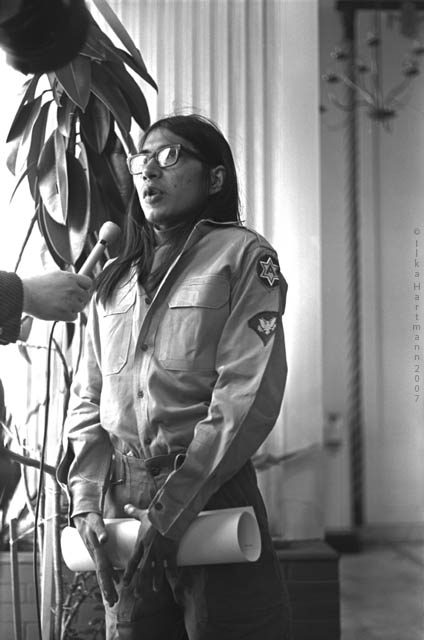
Overcoming exhaustion and disillusionment, young Alcatraz Occupier Atha Rider Whitemankiller (Cherokee) stands tall before the press at the Senator Hotel. His eloquent words about the purpose of the occupation - to publicize his people's plight and establish a land base for the Indians of the Bay Area - were the most quoted of the day. San Francisco, California. June 11th 1971. Photo Ilka Hartmann

 Prison Photography