
You are currently browsing the category archive for the ‘Amateur’ category.
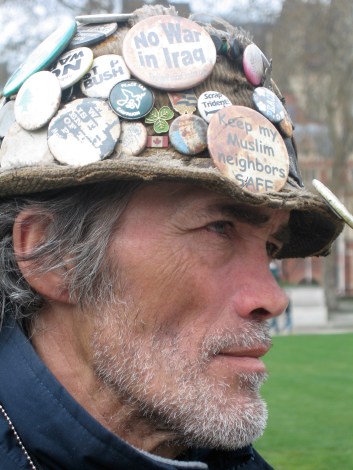
Brian Haw, Parliament Square, April 2008 © Pete Brook
Sad news this weekend. Global citizen and hero of the anti-war protest movement Brian Haw died aged 62 on the 18th June. His efforts, legacy and importance can be learnt about at http://www.brianhaw.tv/index.php
For nearly a decade, Brian Haw held a permanent presence in Parliament Square outside the UK Houses of Parliament. The only time he left the “camp” was to attend court hearings – many of them involving attempts by authorities to evict him.
While Haw was undergoing treatment for lung cancer in March, London Mayor Boris Johnson won a court ruling to finally evict Haw.
In 2007, Haw was voted ‘Most Inspiring Political Figure’ by the viewers of Channel Four.
That same year, artist Mark Wallinger recreated Haw’s protest inside Tate Britain. Wallinger won the Turner Prize for art a few months later.
Uncompromising and committed beyond the capacities of most others, Haw’s protest was a visual reminder to every single UK member of parliament that Bush had an agenda, Blair was wrong and the war on Iraq was waged on a pack of lies.
Haw actually began his protest in June 2001; against economic sanctions and the effects on civilian populations, particularly children. That’s a full five months prior to the U.S. invasion of Afghanistan in November 2001. Did he tap the zeitgeist? Did he intuit that the western powers were about to embark upon a decade of imperialist military incursion? Will an activist-commitment such as his – that captures the hearts and attention of a nation – exist again? One hopes so.
R.I.P. Brian.
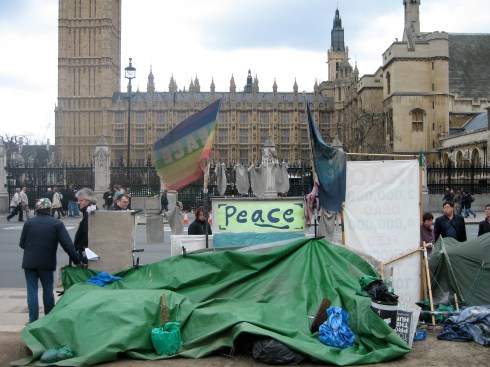
Brian Haw’s camp, Parliament Square, April 2008 © Pete Brook
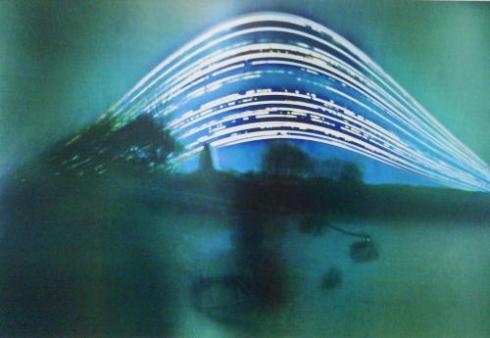
Photographer Mark Woods-Nunn and FLACK, a charitable social enterprise which works with homeless people in Cambridge, UK have put together an intriguing project.
Varsity Mag says, “the attachment of beer-cans to assorted lamp-posts is not another example of misguided modern art. A thin sheet of photographic paper was placed in each can, exposed to the world by only a tiny pin-hole, silently and vulnerably capturing an image.”
Good stuff.
Found via British Photographic History Blog.
Well, well, well. All sorts of commentary on the importance of photographs surrounding the assassination of Osama bin Laden and President Obama’s announcement in the East Room with reenactment of his speech for the still cameras.
From the White House Situation Room (now with added memes) and Reuters’ bloody gallery (WARNING: Graphic images of corpses) to whether we deserve or need to see bin Laden’s bullet-riddled head. Then there’s Senator Scott Brown’s faux-pas over a hoax photograph. Not to mention the reported different versions of the actual event.
For all the best articles click on the links over on Raw File Blog’s twitter feed, where I’ve been compiling them all day.
There’s still one photo – to be precise its caption – that is bothering me. And it’s this one:

White House photographer, Pete Souza, captioned the image thus: “President Barack Obama and Vice President Joe Biden, along with members of the national security team, receive an update on the mission against Osama bin Laden in the Situation Room of the White House, May 1, 2011.”
Except everywhere I’ve seen it used, the inference is that the White House team are watching a live feed of the raid on bin Laden’s compound.
They might be, but I want a SOURCE.
It seems to me this image may have been interpreted as one thing at an early stage and because it the narrative tied to the body language is so seductive, no-one has chosen to question it.
I think the reading of the image is massively altered depending on whether you think they’re watching murders in progress or whether they are, for example, waiting nervously for the screen to boot up.
Ryan Singel for Wired.com’s Epicenter blog went as far to say the White House “officials watching what one presumes is the livestream of the Navy Seal raid on Osama’s hideout in Pakistan.”
For all the hullabaloo about this image, no-one is actually sure about what is on THAT screen.
So, does anyone have a solid source saying that they are viewing a live feed of the operation?
Screen-grab from ABC newsreel footage, as featured in the Guardian‘s front-page slide show.
Osama bin Laden wasn’t in mountain caves. He was in a mansion in Abbottabad, a major Pakistan city two hours north of the country’s capitol, Islamabad. Bin Laden had been there for more than six months.
Part evil-lair, part self-imposed prison, part luxury – the mansion is a major part of the story and questions about “who protected Osama bin Laden over the past decade” will no doubt follow.
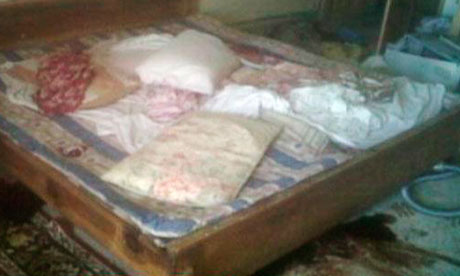
There’s a few things going on here, so let’s start with the most simple. “You made you bed, now you must lie in it die in it.” Anyone? No? (To be clear, I don’t know if this was OBL’s bed, or even if he was killed in this room).
Nonetheless, the blood on the floor tells us this bedroom is a site of ambush; the bed is an object of a stormed house. Yet, this image is not distinguishable in any meaningful way from all the other images of house raids in America’s 21st century wars.
THE VISUAL CULTURE OF BEDS
Contemporary concerns have been about sex (the discarded condoms of Tracey Emin’s My Bed proved her as honest as she is crass) and violence (or maybe Rauschenberg was just about disorder?)
Historically, the image of the bed has been co-opted for highly political purposes. And interestingly, the bed played a central role in the dissemination of images of Arabic regions round Europe in the 17th and 18th centuries.
Artists under patronage painted aristocracies, noble beasts, mythologies, and Christian narratives. The boudoir was rarely mentioned; acts of the bedroom hidden. For titillation, commissioned artists were sent abroad. Orientalist Art has little to do with the distant lands it “depicts” but most to do with the obsessions of artists and patrons with harems and the sexual behaviours of people of colour.*
Without wanting to over-simplify, Orientalist Art is – at both conscious and subconscious levels – the projection of suppressed sexual desire upon an “Other” group. The subject has little or no means to correct the misrepresentations. Furthermore, any corrections by the subject would disrupt the self-serving narratives of the distant audience.
Centuries of visual manipulations and stubborn visual usury between the West and the rest, with the bed as the visual anchor to the lazy indifference, are wrapped up in the unorthodox war photograph above. If the image does indeed depict the bed of Osama bin Laden (the personification of cultural antagonism, violent opposition, the most distant of “Others”) then, I at least, identify some irony therein.
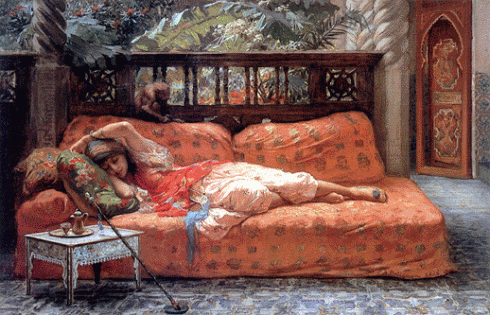
“The Siesta,” by Frederick Arthur Bridgman (1847-1928), oil on canvas, 11 ¼ by 17 inches, 1878, private collection, courtesy of the Spanierman Gallery, New York
One final thing. A bed is a place of rest, a grave is a final resting place. Western allies worried any grave would become an extremists’ pilgrimage site, so Osama bin Laden’s body was buried at sea. But have they avoided the problem? Might this Abbottabad mansion and this bedroom not become places of pilgrimage?
*Orientalist Art tends to refer to North Africa, but includes South Spain and the Middle East. The fetishisation of women of colour was also foisted upon Native people in North America and across the British colonies of the Southern Hemisphere.


The nine minutes of grainy video footage George Holliday captured of Los Angeles police beating Rodney King 20 years ago helped to spur dramatic reforms in a department that many felt operated with impunity. (George Holliday)
Twenty years ago yesterday, Rodney King got the living shit kicked out of him in Los Angeles.
Amazing as it may seem, those 9 minutes of grainy footage, shot by George Holliday on his clunky Sony Handycam, may never have existed.
At the time, Holliday obviously didn’t know the significance of what he was filming, nor that it would change the consciousness of Black America, the trajectory of the Los Angeles Police Department and race relations in the City of Angels.
This, from the Los Angeles Times:
The simple existence of the video was something unusual in itself. Relatively few people then had video cameras, Holliday did — and had the wherewithal to turn it on.
“It was just coincidence,” Holliday reflected in an interview a decade ago. “Or luck.”
Today, things are far different and the tape that so tainted the LAPD has a clear legacy in how officers think about their jobs. Police now work in a YouTube world in which cellphones double as cameras, news helicopters transmit close-up footage of unfolding police pursuits, and surveillance cameras capture arrests or shootings. Police officials are increasingly recording their officers.
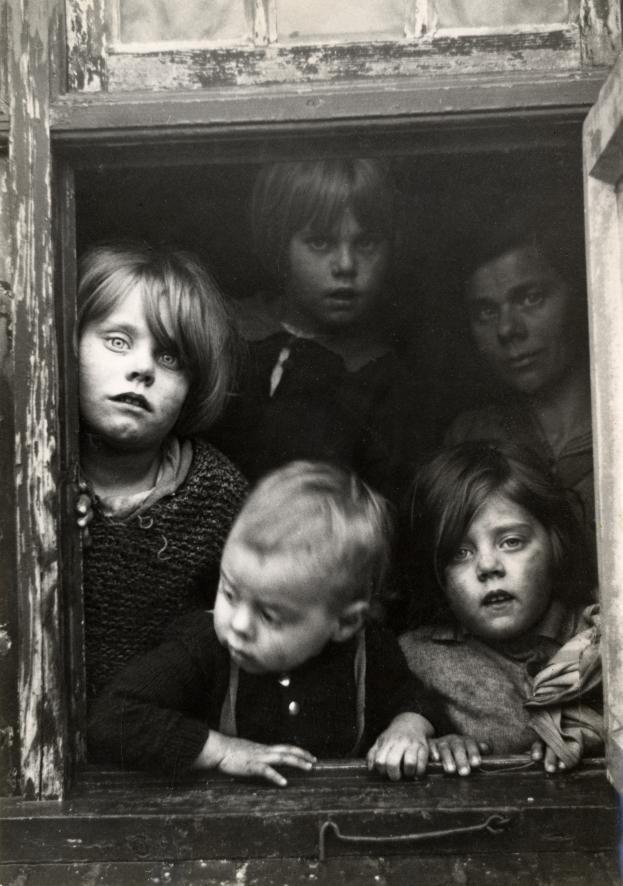
Children of the family Raaymakers, hit by the crisis, getting help thanks to an action of magazine Het Leven. Best, The Netherlands, 1936.
The National Archive in The Netherlands just published a 30 image set on the theme of poverty.
The strength of some of the images blew me away. (Click any image for a larger view) The set spans nationals and eras so this isn’t a photo essay, just a moment to reflect. Through history, photography has indulged the upper classes, but how has it treated the impoverished? I don’t have the answers, just a meandering of a visual train of thought.
Children with scars and with gazes that cut through time …

Irish tinkers: mother and child in front of improvised tent, 1946
… and children slowly erased by time.
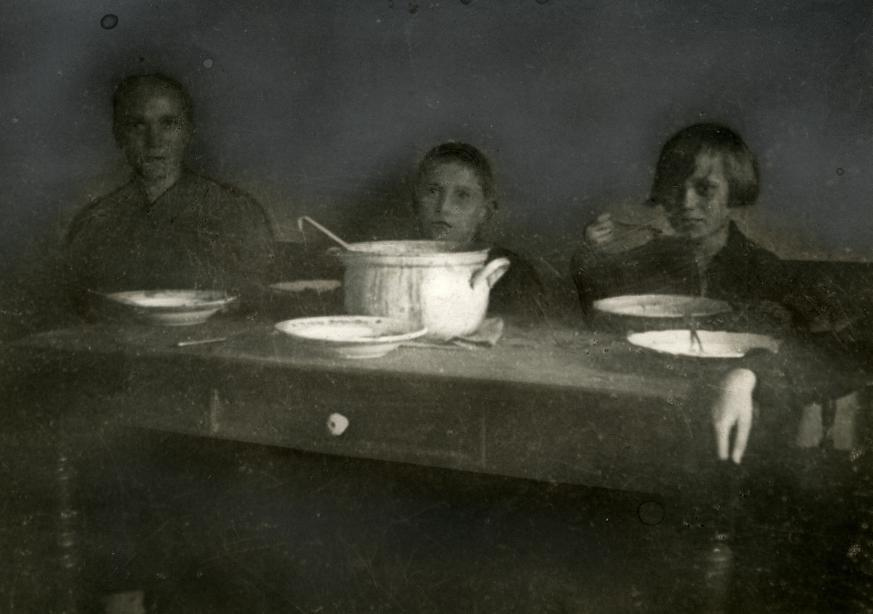
Poor German miners’ families eating at a soup kitchen, 1931
Jobs programs that have adults digging dirt like children digging beach sand …
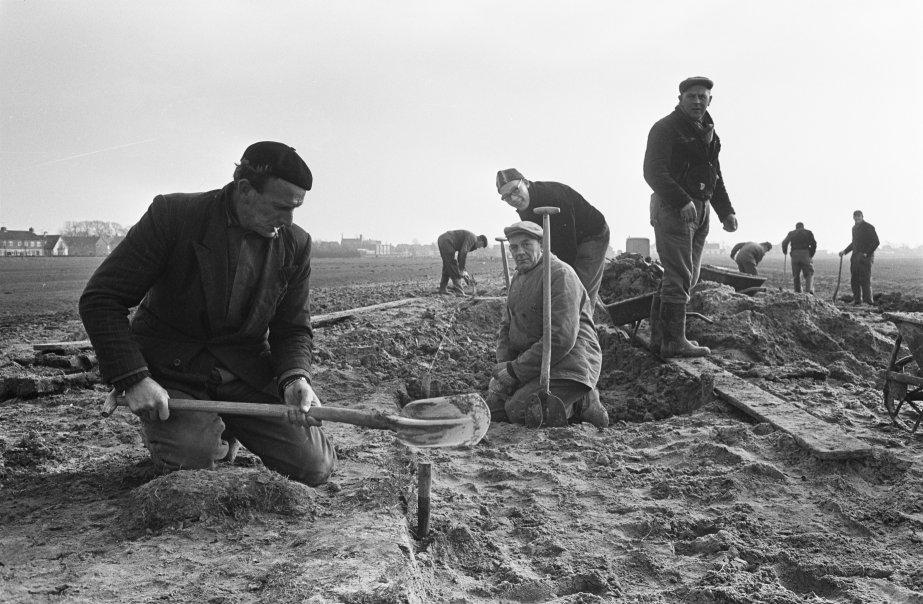
Unemployment relief program in Schagen, Netherlands, 1967
… then, poor people who have carted each other across cobbles …

Woman transported on a hand-cart, Amsterdam, 1934
… and those that sleep beneath them.
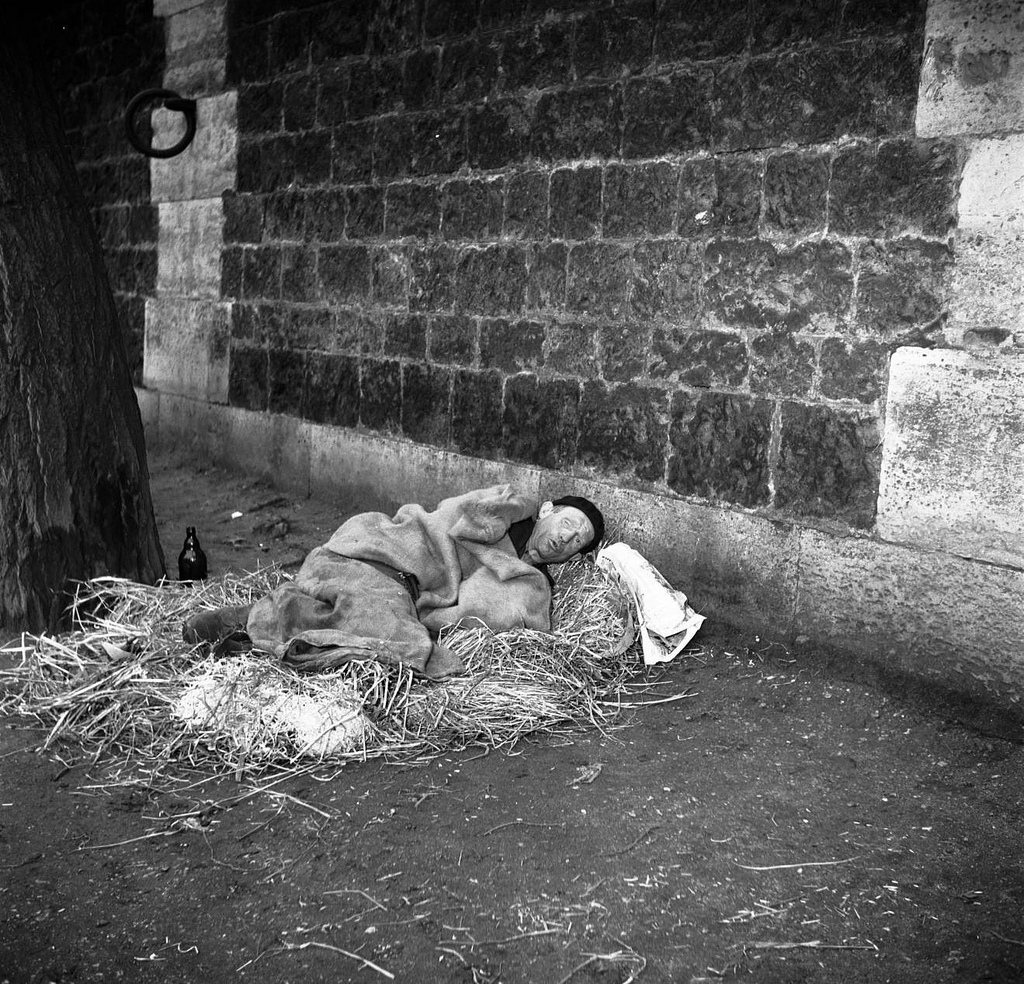
French man spending a night under a bridge, catches a glimpse of photographer Willem van de Poll, date unknown.
Men have begged for the charity of the richest …
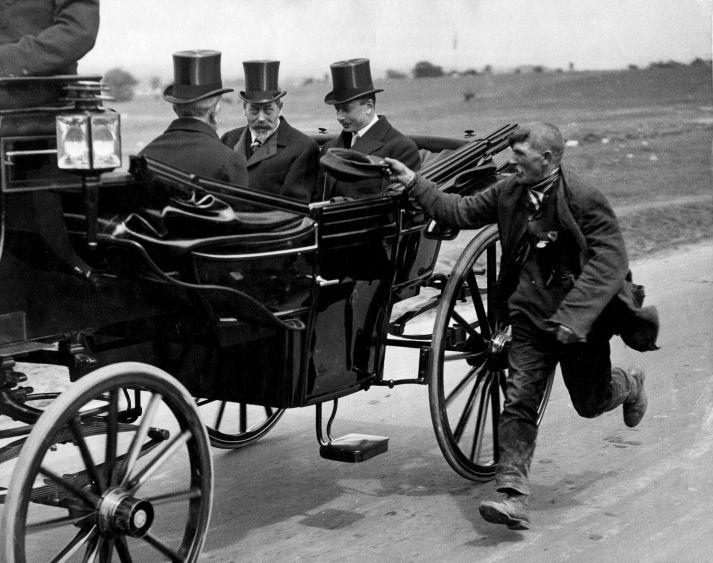
Man begs for money from George V (1865-1936), Epsom Downs, Derby Day, 1920.
…but usually received from the humblest.

Soup kitchen, Rotterdam, The Netherlands, 1917
Poor people have been asked to rent dentures …

Man bites down on available dentures for hire, United States, 1940.
… and they have been made into leaders …

Dutch tramp who became a politician, Amsterdam, 1921
… and in so much as the poor man is the worker, they’ve seen it all.
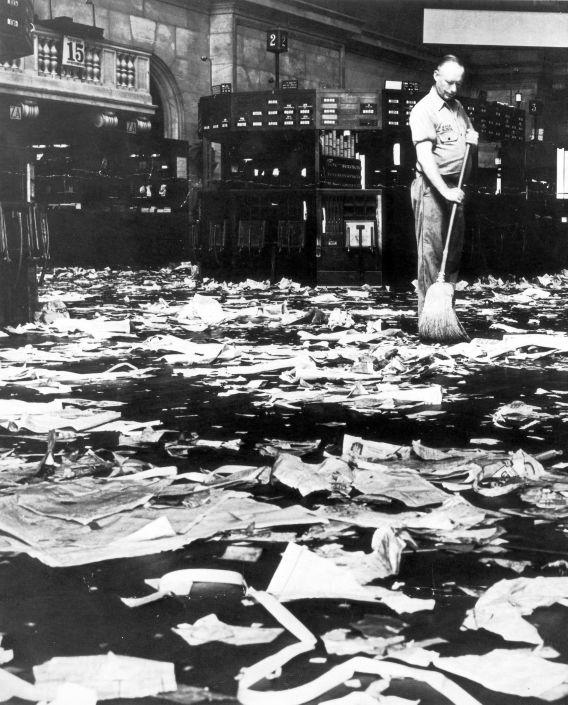
Worker sweeps the floor in the New York Stock Exchange following the Wall Street Crash, 1929.
More images can be seen within the Collectie Spaarnestad: www.spaarnestadphoto.nl
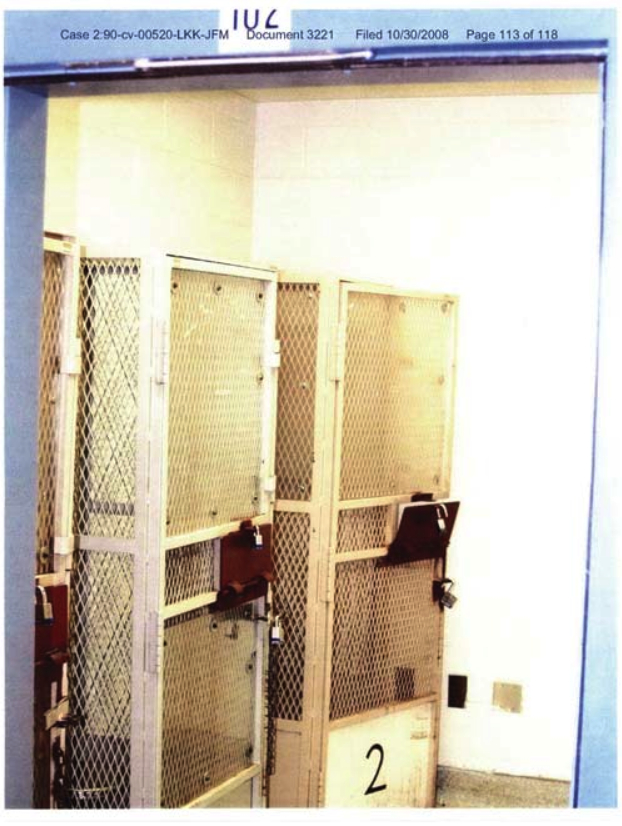
Governing Through Crime recently noted that photographs more than legalese may have swayed the opinion of Justice Breyer during December’s SCOTUS discussion of Schwarzenegger vs. Plata.
VIEW ALL PHOTOGRAPHS SUBMITTED HERE.
Breyer saw the photos in an amicus brief submitted by a coalition of religious group (PDF) in support of the plaintiff:
“It’s a big record. What I did was I – it refers to on-line evidence – I went and looked at the pictures, and the pictures are pretty horrendous to me. And I would say Page 10 of the religious group’s brief (PDF), for example, shows you one of them. And what [the religious groups] are saying is obvious. Just look at it. In conditions such as these, you cannot have mental health facilities that will stop people from killing themselves, and you cannot have medical facilities that will stop staph and tubercular infection.”
Schwarzenegger v. Plata is a federal class-action suit challenging health care conditions in the California prisons. In 2009, a California-based three-judge federal court found that massive overcrowding in the state’s prisons contributed to untreated mental illness, suicides and other preventable deaths of inmates. The overcrowding, the judges ruled, violated the Eighth Amendment rights of prisoners to be free from cruel and unusual punishment.
The three judge panel ordered the release of 35,000 – 45,000 prisoners to ease overcrowding and restore constitutional rights. Schwarzenegger and the CDCr authroities immediately appealed. SCOTUS are currently deciding if the three judge panel was within jurisdiction to order the mass release of prisoners; AND if overcrowding does directly cause poor medical and mental health-care.
Commentators have noted the apparent empathy of many Justices. It is common knowledge that California’s prison policy has been tumorous and it is no surprise it has come to the most drastic court ordered release of prisoners in US history to solve the problem. The Atlanta Post reports California Sheds Light On The Need for Criminal Justice Reform.

 Prison Photography