
You are currently browsing the category archive for the ‘Amateur’ category.

ESMA, Buenos Aires, Argentina © Pete Brook
You may have noticed that I switched out the banner image for Prison Photography. I didn’t want to say goodbye without mentioning again the photograph’s origin.
The original banner was a non-descriptive crop, abstracting the top of a stairwell.
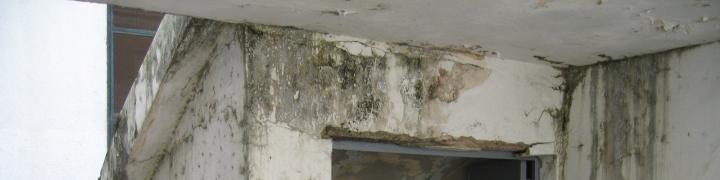
Exterior stairwell, ESMA, Buenos Aires, Argentina. © Pete Brook
ESMA & THE DIRTY WAR
The exterior stairwell led to the basement of the Naval School of Mechanics in Buenos Aires (Escuela de Mecánica de la Armada). In Argentina it is commonly known by its abbreviation ESMA.
ESMA, particularly its basement, was the main site of illegal detention and torture during the Dirty War (1976 to 1983). The Dirty War was a state-sponsored program of violence against Argentine citizenry carried out primarily by Jorge Rafael Videla‘s military government. There were hundreds more sites like it across the country. There were scores of illegal detention sites in Buenos Aires alone.
ESMA is now a museum and memorial.
MEMORY
The horrors of the Dirty War are still fresh in the collective memory and, as such, problems exist with its interpretation in contemporary Argentine society. The surveillance and by-night kidnappings affected every Argentine’s life. 30,000 persons were ‘disappeared’; they are known as the Desaparecidos.

Photomontage of Desaparecidos, Memory Museum, Cordoba, Argentina © Pete Brook
PHOTOGRAPHY
I am aware of a handful of photographers who have made central to their work the prisons and politics of the Dirty War.
I should like to write and post about these photographers in the coming months.
RESOURCES
For more info on the Desaparecidos; more on the establishment of the museum/memorial; more on the continuing peace & justice efforts; and more on the national archives.
Sin Olvido is a MUST VISIT. It is a very poignant archive of photographs and descriptions of 3,400 victims from the Dirty War.
UPDATED
Since going to press, University Behind Bars has changed its name to University Beyond Bars. The new website for UBB can be found at http://www.universitybeyondbars.org/.
FREEDOM THROUGH EDUCATION
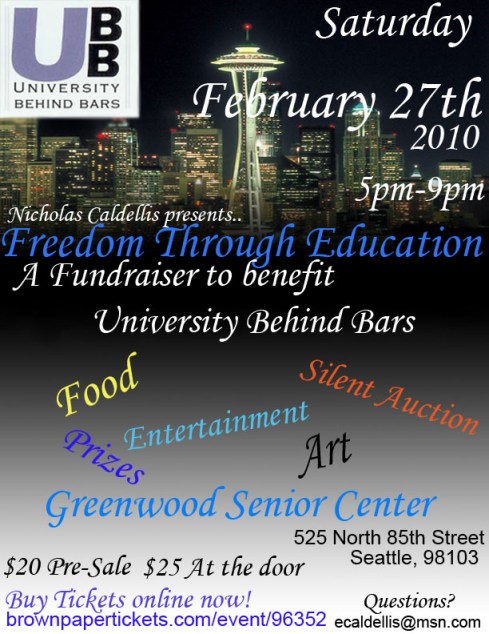
The Prisoners Education Network is hosting FREEDOM THROUGH EDUCATION, a fundraiser for its main program, University Behind Bars.
Greenwood Senior Center is the venue for an evening of music, fine foods and silent art auction. Many students from my art class have donated paintings and other from outside the class have made crafts for auction. Local families and a local church group have pooled resources to make this happen. If you want to know why so many different people are invested, I think it is because they share PEN’s values and mission.
Buy tickets at Brown Paper Tickets
Freedom Through Education on Facebook
BACKGROUND
The Prisoners Education Network (PEN) is five years old. I have been with PEN for nine months now. In this current quarter, the University Behind Bars (UBB) offered is widest selection of courses – including Art, Business Law, Child Development/Psychology, English Composition, Human Geography, Intro to Math, Music Theory and Sociology.
PEN is the only organisation in Washington State providing college level education and credits to prisoners.
PEN is currently expanding its UBB program to preserve its widened curriculum. All teachers are volunteers and 98% of donations go directly toward tuition fees and books. Our teachers are passionate professionals, but our students are the heart of the program. Via the correspondence course set-up, students receive credit from Ohio University. Beyond matters of credit, the students are building a shared community of learning within Washington State Reformatory at Monroe Correctional Complex.
This is the first big fundraiser of the year. It would be great to see you there, but if you can’t attend because you are in another state or on another continent, please consider donating to PEN via the website.
Thank You

Rendition. Photographer Unknown
Last week, Eliza Gregory at PhotoPhilanthropy got knee-deep in speculations about prison photography.

Eliza was spurred by NPR’s On the Media which “did a story about a series of images that the International Committee of the Red Cross made of the prisoners at Guantánamo Bay. The ICRC made pictures of the prisoners to send to their families, and allowed each prisoner to choose which particular image would be sent. Naturally, the images the prisoners collaborated in making are very different from the images we’ve seen of them in the news.”

Eliza contacted me and asked me to leave some comments.
I rounded off my comments with a question I think is very important: Could an American photographer complete a project with the access, familiarity and story-telling-verve as Mikhael Subotzky did in South Africa for his project Die Vier Hoeke?
Not wanting to funnel my diatribe down just one web avenue, I copy my comments here …
Eliza,
I’d like to talk about two issues that you point to in your post. First, the general absence of prison imagery in contemporary media and secondly the urge to judge the subjects of the imagery that does crop up.
I doubt highly that Guantanamo would’ve been closed if more photographs had come out of there. While there is no question visuals out of Gitmo were controlled stringently, the MoD had proven itself impermeable to even the most reasonable requests by human rights advocates and legal watchdogs.
The point you make about smiling detainees instantly changing ones perception could be applied to all prison populations. Phillippe Bazin, Luigi Gariglio and Dread Scott have each used straight portraiture to cause audiences think about the individual character of prisoners.
I recommend books by Douglas Hall Kent, Morrie Camhi, Bruce Jackson, Jane Evelyn Atwood and Ken Light. I recommend work by Carl de Keyzer, Joseph Rodriguez, Steve Liss and Andrew Lichtenstein for imagery of prisons beyond the press shots of tiered-cells and orange jump-suits.
More than any of these though I recommend photography of self-representation. I have speculated on it before, and it has been done by Deborah Luster in Louisiana, and by the inmates of Medellin prison, Bogota, Colombia.
All of these photographic interventions are inspiring but barely make it into the mindshare of media consumers. I believe the unforgiven monster who deserves no thought is the predominant version of “the prisoner” in the minds of most Americans and many others in the Western world.
Of course, the invisibility of prisons is a collective tactic. We are molly-coddled by zealous enforcement agencies to whom we’ve outsourced management of transgressors. We have no interest in dealing with the difficult issues surrounding mistakes, mental health, inequalities and human frailty … this is where the “lock ’em up” mentality comes from.
Prisons and prisoners are not scary places because they are threatening and violent, they are scary places because they are wasteful, boring, soul-sapping warehouses. This is the document we never see. America’s prisons are a human-rights abuse.
Photography will play its part, but it’ll take a monumental cultural and media shift to change sentencing and prison policies in the West.
In the meantime, It’d be interesting to see if a long-term project similar to Mikhael Subotzky’s could ever be completed in an American prison?

© Mikhael Subotzky, from the 'Die Vier Hoeke' series.

For a long time, in the early days of the war on Iraq, Abu Ghraib was a primary target for insurgents. Even before the photographs of torture were leaked, Abu Ghraib was mortared almost daily. Abu Ghraib held thousands of falsely accused men, the majority of whom were later released without charge, ceremony or apology.
Monica Haller‘s new book Riley and His Story is a collection of thoughts, diary entries and digital photographs from his tour of Iraq. For a period, Riley was a nurse in Abu Ghraib and the images from the medical tent are novel, uncensored, bloody.
Riley’s photographs from the hospital sits between snapshots from military vehicles, marines sat in paddling pools, goofy group shots, Al Franken (?) and decaying out-of-use planes.
This is the aesthetic we all know exists and we occasionally glimpse when there is interest, lawsuit or cultural re-use of military personnel snapshots in the media.
There must be millions of digital photos by American marines. Haller’s book is simultaneously a cleverly assembled piece of the wider dissemination of such imagery and an affirmation to the unexpected familiarity of such imagery.
A 21st century war is not a war without vernacular conflict photography.
Just as soldiers of WWI sent home words thus defining modern war poetry, so the soldiers of today bring home pixels and jpegs and define modern war imagery.
The singular prose, simile and letter-writings that painted a mind’s picture have been replaced by the multiple functionaries and fingers of digital observation.
As were the Abu Ghraib torture photographs, why shouldn’t we expect the next most iconic images of this century to be amateur snapshots? And why shouldn’t we be prepared for an equivalent violence in said iconic imagery?
It is curious that discussions about the lamentable loss of unembedded journalism have not always been balanced by discussion on the tumorous growth of ‘soldier-journalism’ (a term unsuitable, but an understandable extrapolation from the term ‘citizen-journalism’).
Whether you like it or not, the Canon PowerShot and its hand-held competitors own the future of war coverage.
Wilfred Owen and Siegfried Sassoon buffered the cruelty of war, but there are few artists now. (We are grateful to Haller for being such a thoughtful manager of Riley’s output.) Nothing is softened or made poetic/metaphorical. Laid bare. Perhaps, both the best and worst of scenarios we should expect is military censorship?
Monica Haller’s book is important not because it is Abu Ghraib and not because the images are snapshots made by American military personnel, but because it is a portent of an aesthetic already upon us. And we are in denial.
From here on in photography is ugly.


I found this project through Alec Soth on the Little Brown Mushrooms blog, via LensCulture.
A video interview with Haller is permanently available at LBM vimeo.
A sizeable preview pdf (over 100 pages) of Riley and His Story is available here.
Riley and His Story has a website. You can find out more about Monica Haller here, here and here.


I am late on this one, but I thought it so important that it worth a quick post.
Last month, Amy Stein posted Bedlam Exposed. Amy put up some disturbing images by Charlie Lord. He was one of several conscientious objectors who worked at Philadelphia State Hospital, Byberry, PA in lieu of military service.
Listen to Charlie Lord talk about his experience at the Philadelphia State Hospital.
Prison Photography has long determined that there is little difference between prisons and asylums. Asylums have been referred to as sanitariums and as hospitals, but it is necessary to take a quick leap past the label and view the level of care (and security) as well as the agency of those committed.
In photographic evidences we can look to the work of Jenn Ackerman (a prison functioning as a mental health unit) and Eugene Richards (a mental health unit functioning as a prison). These thoughts are just to sow the seeds and the [in]distinctions between prisons and mental health facilities will be something I’ll return to over the coming year.
Ackerman’s Trapped:
http://www.burnmagazine.org/essays/2009/05/jenn-ackerman-trapped-epf-finalist/
http://indepth.jennackerman.com/trapped/feature.html
http://bop.nppa.org/2009/still_photography/winners/?cat=NTP&place=1st
https://prisonphotography.wordpress.com/2009/07/10/jenn-ackerman-trapped-mental-illness-in-americas-prisons/
Richards’ Procession of Them:
http://motherjones.com/environment/2009/03/out-mind-out-sight
http://motherjones.com/photoessays/2009/03/out-mind
http://www.soros.org/initiatives/photography/events/procession_20060201
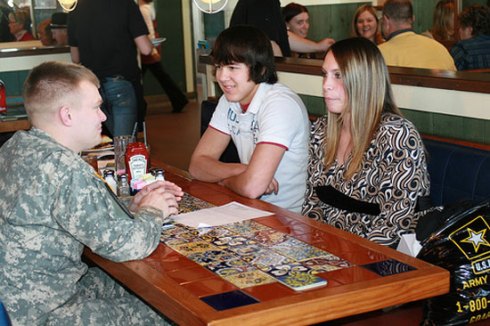
Alyse Emdur has begun a brilliant project Photograph a Recruiter that asks high school students to submit their own photos of military recruitment drives in schools.
In a modest way the project aims to offer students an alternative national stage to the one the which involves guns and death.
It is, perhaps, a more playful means to combat predatory army and navy recruitment practices … certainly more so than the raucous and confrontational pickets in Berkeley, California last year.
(Found via iheartphotograph)

2Double (day dooblay), a 21 year old rap kreyol artist, records a track in the Koze Kreyol studio in Port au Prince, Haiti, on July 18th, 2008. The rapper has had some recent success and local recognition but continues to live in the notorious Cite Soliel slum with his mother and 3 year old son. He says he hopes to use his music to get his family to a better environment. © David Zentz/Aurora Photos
Just two weeks ago 100Eyes launched a new issue Gade, Haiti. Who at that time would have knwon that the world’s attention would sear down upon that previously abused, cliched far away nation?
Today Andy Levin put out the following call:
“Shoot for 100Eyes: Gade, Haiti!
The situation in Haiti has brought a tremendous many talented photographers to Haiti, with many more on the way. We would like to find a way to broaden the picture of Haiti that is currently in the news, by combining work with the disaster area with work from the rest of the nation.
If you are going to Haiti and will be there in February, I am asking photographers to spread out around the country and to spend day or two photographing something other than the earthquake ravaged area, to be included in a special issue of 100Eyes on Haiti.
I am hopeful that photographers can use the same resourcefulness in getting around Haiti as they have in getting to the disaster area … and I know that there are many stories to be told beyond what we are currently seeing, many struggles that happen on a daily basis. There is beauty, there is laughter as well.
We believe that the effort made by photographers in doing this would more than make up for the relative small resources going into the project, by helping to create a broader picture of Haitian life, and to put the horrific, and important, images that are currently being taken in Port au Prince in context.
As part of the project we will be having Haitian children and students take pictures to show the events through their own eyes, an effort that was planned before the tragedy. In addition we ask that each photographer try and bring a compact digital camera and find a Haitian child to work with in whatever area of the country that you are working in.
Depending on the amount of work received we may have needs for volunteer editors and coordinators as well. For those more interested in a structured environment I am going be extending the 100Eyes Workshop in Haiti through the end of the month and possibly beyond.
For details on this please contact me through our workshop page for Haiti, here.”
If I was a photographer I’d be anxiously looking for an avenue to broaden the media coverage away from only disaster consumption. This seems like the best opportunity; Structured, purposeful and community based.
We have seen the terrifying images, now let’s get past them to action. If you’ve got money give it, if you’ve got a camera get involved.
DAVID ZENTZ
I picked the image above out from the selection at 100 Eyes. David Zentz has done two series on Haiti, Saut D’eau and 2Double.
David’s work at Verve, 100Eyes and Aurora Photos. David also has a blog, Your Moment of Zentz.

 Prison Photography