
You are currently browsing the category archive for the ‘Amateur’ category.
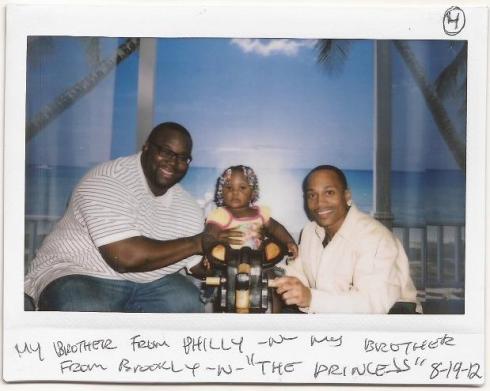
Image source: Growing Up Through Pictures (an unrelated program to Anathema Arts)
Prison arts organisation Anathema Arts is petitioning for a photo day program in the state of Illinois. Anathema Arts will provide the supplies necessary — the printer, photo paper, and digital camera. Anathema is at pains to state the program will not cost the taxpayers of Illinois.
“A photo can heal, promote positive thinking, maintain bonds, and enhance memories,” say Anathema Arts. “Photos of loved ones have long been used in psychology to reduce grief and pain, but just as they can provide comfort, the lack of current photos can cause negative consequences for both the incarcerated and their loved ones.”
As the majority of prisoners will be released back in to society it is in all of our interests to enact simple steps that maintain self-esteem among the incarcerated class. More importantly, the one factor that determines most a prisoner’s successful reentry into society is close family relationships during imprisonment. Photographs play their part in aiding those bonds.
“Friends and families of incarcerated people often do not have current pictures, and do not get to see how their son, daughter, friend, brother, or sister looks as their sentence passes over the years,” says Anathema Arts. “For those family members that can visit … portraits provide a positive focus during visits, and remind loved ones and prisoners of happier times.”
As I see it, the biggest potential problem with Anathema Arts’ proposition is how it is perceived. Might prison administrations be reluctant to accommodate the (sensible) suggestions of an arts organisation with stated sympathies for incarcerated peoples? Maybe, I’m problematising? Or maybe, I am not? After all, many members of the citizenry consider anything beyond punishment as being unwarranted or not needed in our prisons. Short version: prisons don’t want to appear soft and a photo portraiture program may be seen as fluffy and coddling.
But, surely, there can be no harm in allowing prisoners and families ready access to a recent photo portrait?!
A knee-jerk reaction would be to reject the FAMILY PHOTO -> BOND STRENGTHENED -> REDUCED ALIENATION -> SAFER SOCIETY theory of causation. I understand why some might think it a stretch but, let’s be honest, photography is often wrapped up in unexamined theory. So, why would we dismiss this well-meaning program specifically? Instead, let us consider the fact that prisoners are probably the demographic in America with least access to self-representation — they do not have the standing, nor the tools to create, share and replace images at will.
I’ve signed the petition because I think it’s not only a useful pilot program (that could be repeated in other prisons and other states) it is also a test to see what the Illinois Department of Corrections can accommodate. Is it flexible enough to host a volunteer-run photo program? It absolutely must be, for if it is not then what else can it not — will not — provide for those in its custody?
Go on. Sign up if you dare to imagine the possibilities.

THE VISUAL CULTURE OF PRISON RESISTANCE
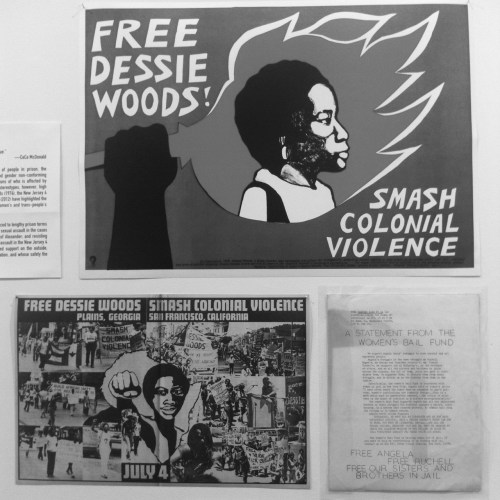
Liz Pelly‘s conversation with Josh MacPhee in The Media is a wonderful read. It coincided with MacPhee and his cohort’s incredible exhibition of prisoner made protest materials going all the way back to the early seventies.
MacPhee urges us to dismantle the idea that prisons are separate from outside society. Crucially, he’s not making, in the first instance, a moral point about how we’re all the same, prisoners and all. MacPhee makes an observation of the structural characteristics of the prison system.
“It’s getting harder and harder to hold up the pretense that prison is somehow distinct from the rest of society,” says MacPhee. “When there’s this many people going in and out all of the time, there’s no way that our lives out here don’t leak into there, and that their lives in there don’t leak out into the rest of society. The idea that these are completely separate realms needs to be dismantled.”
Of course, once the structural facts of the system are revealed, the moral point that we are all one-and-the-same, prisoners and all, is indisputable.
I contacted Pelly and asked if I could republish the conversation. It originally appeared as Inside/Out: On Prison Justice, Art of the Incarcerated, and Interference Archive’s New Show in Issue #44 of The Media (October 10, 2014). It is a privilege to feature Pelly and MacPhee’s interview in full here on the blog.
A LITTLE BACKGROUND
Between September 11th and November 16, 2014, Interference Archive exhibited, Self-Determination Inside/Out: Prison Movements Reshaping Society a look back at the visual and material culture of prisoner-led political movements.
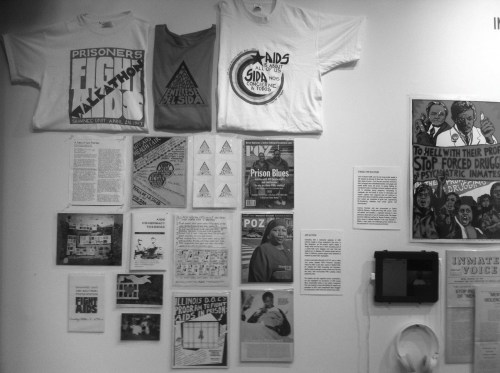
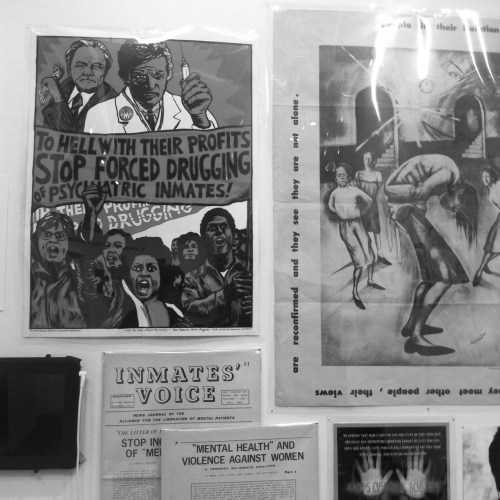
Organized by Molly Fair, Josh MacPhee, Anika Paris, Laura Whitehorn, and Ryan Wong, Self-Determination Inside/Out includes sections on the work of incarcerated AIDS educators, the experiences of women and queer prisoners, prison and control unit prisons. The exhibition features prison newsletters, pamphlets, video and audio interviews, prints, photography (!!!) and magazine covers — starting with materials created during the 1971 Attica Rebellion, a massive prisoner uprising in upstate New York, and concluding with work made by current political prisoners, the show highlights moments of self-organization within the prison industrial complex.
You can buy a booklet and a poster for the exhibition.
Interference Archive is a volunteer-run archive in Gowanus, Brooklyn, dedicated to preserving cultural ephemera related to social movements.

Inside/Out: On Prison Justice, Art of the Incarcerated, and Interference Archive’s New Show
Liz Pelly (LP): What initially inspired the creation of Interference Archive, which mostly houses ephemeral material like posters, t-shirts, and newsletters?
Josh MacPhee (JM): For the different people involved, there are different answers of course. For me, I grew up making this stuff through DIY music, cultural stuff, politics. Through the act of doing, I started collecting it. Flyers, t-shirts, buttons, the ephemera that gets produced by people who are organizing. It was a combination of wanting to understand the history of what I was doing and then at the same time, I was getting really interested in this idea of how people make art and culture in the context of trying to their lives. It’s distinct from art that’s produced purely in the realm of self expression, and the art that tends circulate within the contemporary art world.
This kind of material gets lost. It’s often not clearly authored. Institutions that deal with art don’t quite know what to do with it. Since it’s so political, places like history museums don’t know what to do with it either. It sort of falls through the cracks. But we can see during times like Occupy, or Tahrir Square in Egypt, or with the Maidan in the Ukraine, that this is the stuff of life, [created] when transformation starts to happen. When people have their arms shoulder deep into the constructions of representations of a new world, and the way they want things to be articulated.
For me, doing an archive was a way to say, “just because these moments come and go, and movements have ebbs and flows, doesn’t mean that once the peak has been reached that this material isn’t still valuable to us, to where we’ve come from and therefore where we are going.”
LP: That said, how do you think this sort of exhibit in particular shines light on the experiences of prisoners?
JM: There were five of us who organized this exhibition, and most of us have been engaged with issues around prisons in different ways, whether having been formerly incarcerated, or working with prison activism programs. As far as I know, nothing like this has ever been done before.
We live in a moment where over two million people are in prison. It’s getting harder and harder to hold up the pretense that prison is somehow distinct from the rest of society. When there’s this many people going in and out all of the time, there’s no way that our lives out here don’t leak into there, and that their lives in there don’t leak out into the rest of society. The idea that these are completely separate realms needs to be dismantled.
We thought it was important to marshal primary source material to show that people aren’t just objects of repression or study or someone else’s activism. But they have done immense amounts of organizing inside themselves. Often times that organizing takes place at the same time, or sometimes even ahead of, what people were doing on the outside. Some of the focus we have on organizing around AIDS and AIDS education in prison was really fascinating and important because it shows how people that had the least access to medical care were doing in some cases the most organizing in order to try to deal with a problem that at the time the government was not even acknowledging existed.
LP: Can you tell me more about your own experiences with prison reform activism?
JM: I first learned about how the prison system functions in the early 1990s. It just sort of blew my mind that there was a whole world of people who largely because of race and class were basically being warehoused. And that, at the time, it was completely absent from the radar of public In the 90s, the only thing discussed in relationship to prisons and criminal justice was this sort of “tough on crime” thing. There was no acknowledgment that a massive increase of the prison population going on, and that it wasn’t actually working. And that the system that decided who went in and out was so manifestly unjust, random often.
That sent me on a path of doing organizing around prison issues. I started in Ohio, and then did some work in Colorado, and then in Chicago. A lot of the organizing I did was around Control Unit Prisons, basically trying to stop solitary confinement. [Organizing around] these men and women who were spending twenty-three-and-a-half or twenty-four hours a day alone in their cells, and the psychological damage that causes and how it basically goes against international conventions of torture, yet it’s completely commonplace in this country.
LP: Over the past year, there has been lot of in the news about the racist criminal justice system. It’s an apt time for Self-Determination Inside/Out: Prison Movements Reshaping Society. But obviously there is a lot of history of racism in the criminal justice system that this brings to light. Were you inspired to put this together because of recent events, or has this exhibit been in the works longer?
JM: We worked on the exhibition for 6 months. As a space, as an institution, one of our goals is to take this material that’s perceived as marginal and present it in ways that will allow it to be in its own context, but also to actually show that it’s not marginal. Our primary audience is not people who already necessarily agree with everything that would be in this exhibition. We are conscious of, and trying to take advantage of, a moment.
The question becomes, how do we push [the discussion] farther? If we say mass incarceration is not okay, at what point is incarceration okay? If 2 million people in cages is not acceptable, is 1.9 million people in acceptable? Or 1.8? Once you start asking those questions it opens up the space to say, “this whole system is just absolutely corrupt.”
Mass incarceration accomplishes a number of things, none of which are its stated goals. It accomplishes deeply suppressing working class communities of color. That’s never been articulated as what the prison system is supposed to do. It’s just clear that that’s what it does. It clearly is completely ineffectual at actually dealing with crime.
LP: What are some underreported sides to the prison industrial complex that you hope this exhibit brings to light?
JM: The fastest growing portion of the prison population for years now has been women.
Increasingly there is a real gendered aspect of being able to look at how the criminal justice system works. Increasingly it’s used to enforce gender binaries. It’s a brutal system for queer and trans people that get sucked up into it. People are doing a lot of organizing around it now, but until recently, it was assumed if you were gender non-conforming, they have to choose where to put you, and then once they chose a men or a women’s prison, then almost immediately you’d get sent to solitary confinement. You’d do your sentence out in solitary confinement, in complete isolation, because the system is not prepared to deal with gender non-conformity. You are being punished because your very existence challenges the bureaucratic way the system works.
It’s really clear that women who refuse to be abused, who fight back against abusers, almost always get pulled into the criminal justice system. So we have things like Trayvon Martin being shot, and Zimmerman getting off. But any woman that stops an attack from an abuser is inevitably going to do time because that’s just absolutely taboo.

LP: What were the biggest challenges to getting this exhibit together?
JM: Each exhibition has unique challenges and obstacles, and then there are ones that are sort of similar across the board. For this exhibition, was just that cultural material produced by incarcerated people is hard to access. A lot of it is made in prison and then just never leaves prison.
In general, one of the challenges for all of the exhibitions, is that unless we do something that’s very focused, inevitably there’s so much stuff it’s hard to know when to say “okay we’ve got enough” or to know when to draw the lines. It’s hard to know when to accept that you’re never going to have all of the stuff that you wish you could, that you’re never going to be able to tell the whole story, that maybe even the idea that you’re going to tell some sort of master narrative is questionable in its own right.
When you’re representing things that are so deeply underrepresented, people get attached to wanting their part of the story told, because it’s been marginal or silenced for so long. It makes it really hard to make those choices, because you don’t want anyone else to continue to feel [that way].
We are collecting material from movements that are marginal. Even though they often have extremely deep impacts, rarely is that impact known or visible when they’re most active. It’s kind of like an extra kick in the face when your ideas become commonplace 10 or 20 years later and you’re still written out of the history even though you’re the ones who came up with the ideas.
LP: What do you hope, in general, visitors learn from Self-Determination: Inside/Out?
JM: On the one hand, I hope this contributes to a shift [towards] the idea that prisons are maybe not the answer to the problems that they claim to be. And that locking people in cages is not actually accomplishing what we’re being told it is.
On another level, that incarcerated people are not just objects. They’re loved ones and family members and neighbors and community members. The thing that primarily defines someone as a human being is not whether or not they’re in prison. That people that happen to find themselves in prison, many for reasons that are and then also at the same time many for doing reprehensible things, doesn’t make them not human. It doesn’t mean they don’t have the same desires, life goals, and relationships that everyone else has. And as such, the way that they conceive themselves and their world is part of, needs to be part of, any movement for social transformation.
THE PEOPLE
The Interference Archive is a collection of posters, flyers, publications, photographs, books, t-shirts, buttons, moving images, audio recordings, and other materials, made by participants of social movements throughout past decades. It is an archive “from below” — collectively run space, powered by people, and with open stacks accessible to all. The Interference Archive explores the relationship between cultural production and social movements. It provides public exhibitions, a study and social center, talks, screenings, publications, workshops, and an online presence, with an aim to preserve and honor histories and material culture that are often marginalized in mainstream institutions. It is at 131 8th Street, #4 , Brooklyn, NY 11215 (2 blocks from F/G/R trains at 4th Ave/9th Street).
Josh MacPhee is an artist, curator and activist living in Brooklyn, NY. MacPhee is one of the founder of the Just Seeds Artists’ Cooperative, which organizes, creates and distributes radical art. MacPhee is the author of Stencil Pirates: A Global Study of the Street Stencil, which is dedicated to stencil street art. He co-edited Realizing the Impossible: Art Against Authority, Reproduce and Revolt and the upcoming Paper Politics: Socially Engaged Printmaking Today. In 2001 he co-organized the Department of Space and Land Reclamation in Chicago with Emily Forman and Nato Thompson. In 2008 he co-curated the exhibition Signs of Change: Social Movement Cultures 1960’s to Now with Dara Greenwald.
Liz Pelly is a freelance writer and editor based in Brooklyn, NY. I lives and works at the all-ages collectively-run art space The Silent Barn, where she books (and sometimes plays) shows. She and her friends run the ad-free bi-weekly online newspaper The Media.
The Media is a webpaper covering alternative arts, culture, music, news, and grassroots activism. With contributors often embedded in the communities they cover, The Media aims to bridge the gap between underground presses and mainstream media. Crucially, it is AD-FREE and simply designed. “At a moment marked by short attention spans, decentralized click-bait articles, and newspapers in flux, rethinking the aesthetics of our news websites feels just as crucial as re-imagining their content,” says The Media. “We want our content to resonate on its own merit, free of frivolity and flash, and grounded by a homepage that’s striking in its radical simplicity.”

After stints at Haverford College, PA; Scripps, CA; and Rutgers, NJ, my first solo-curated effort Prison Obscura is all grown up and headed to New York.
It’ll be showing at Parsons The New School of Design February 5th – April 17th:
Specifically, it’s at the Sheila C. Johnson Design Center, located at 2 West 13th Street, New York, NY 10011.
On Thursday, February 5th at 5:45 p.m, I’ll be doing a curator’s talk. The opening reception follows 6:30–8:30 p.m. It’d be great to see you there.
Here’s the Parsons blurb:
The works in Prison Obscura vary from aerial views of prison complexes to intimate portraits of incarcerated individuals. Artist Josh Begley and musician Paul Rucker use imaging technology to depict the sheer size of the prison industrial complex, which houses 2.3 million Americans in more than 6000 prisons, jails and detention facilities at a cost of $70 billion per year; Steve Davis led workshops for incarcerated juvenile in Washington State to reveal their daily lives; Kristen S. Wilkins collaborates with female prisoners on portraits with the aim to compete against the mugshots used for both news and entertainment in mainstream media; Robert Gumpert presents a nine-year project pairing portraits and audio recordings of prisoners from San Francisco jails; Mark Strandquist uses imagery to provide a window into the histories, realities and desires of some incarcerated Americans; and Alyse Emdur illuminates moments of self-representations with collected portraits of prisoners and their families taken in prison visiting rooms as well as her own photographs of murals in situ on visiting room walls, and a mural by members of the Restorative Justice and Mural Arts Programs at the State Correctional Institution in Graterford, PA. Also, included are images presented as evidence during the landmark Brown v. Plata case, a class action lawsuit that which went all the way to the Supreme Court of the United States, where it was ruled that every prisoner in the California State prison system was suffering cruel and unusual punishment due to overcrowded facilities and the failure by the state to provide adequate physical and mental healthcare.
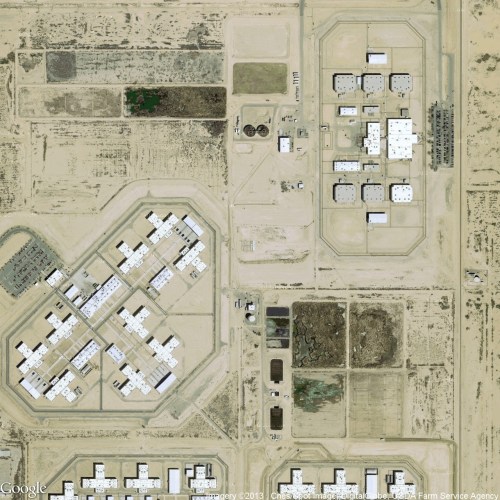
Parsons has scheduled a grip of programming while the show is on the walls:
Mid-day discussion with curator Pete Brook and Tim Raphael, Director, The Center for Migration and the Global City, Rutgers University-Newark.
Wednesday, February 4, 12:00–1:30 p.m.
Co-hosted with the Humanities Action Lab.
These Images Won’t Tell You What You Want: Collaborative Photography and Social Justice.
Friday, February 27, 6:00 p.m.
A talk by Mark Strandquist.
Windows from Prison
Saturday, February 28
A workshop led by Mark Strandquist. More information about participation will be available on the website.
Visualizing Carceral Space
Thursday, March 12, 6:00 p.m.
A talk by Josh Begley.
Please spread the word. Here’s a bunch of images for your use.
PARTNERS
At The New School, Prison Obscura connects to Humanities Action Lab (HAL) Global Dialogues on Incarceration, an interdisciplinary hub that brings together a range of university-wide, national, and global partnerships to foster public engagement on America’s prison system.
Prison Obscura is a traveling exhibition made possible with the support of the John B. Hurford ‘60 Center for the Arts and Humanities and Cantor Fitzgerald Gallery at Haverford College, Haverford, PA.


‘TRIUMPH’
For the Winter Issue of Actually People Quarterly (APQ), I interviewed college professor Nigel Boyle who played the beautiful game in circumstances that most would consider unlikely. Nigel explains, however, that football is a way of life among the Ugandan prison population who welcomed he and other educators with untold warmth.
The theme for the Winter APQ Issue was ‘Triumph.’ Nigel had a good game.
It’s great to publish the APQ article, in full, here on the blog. Thanks to my friends over at San Francisco’s Carville Annex for ongoing collaborations.
FOOTIE
Nigel Boyle is a bit like me. He’s English, he’s quite white, he can’t control his bigger smiles, and he’s a mad football fan. Earlier this year, before I visited Nigel’s hometown of Claremont, California, I contacted him because he had been teaching in his local prison. I wanted to know more about that.
I did not know he had taught in a prison in Uganda this summer, too. Nigel invited me to a soiree at his house. It was a reunion of the faculty, students and administrators involved in the Uganda prison teaching program as well as directors of partner organizations. I was made to feel very welcome.
Nigel supports Aston Villa, who play in claret and blue. They’re based in Birmingham, have existed since 1874, and were one of the 12 founding teams of the English Football League. I support Liverpool who play in red and, down the years, have won more trophies than Villa. Neither team haven’t won many titles in recent decades.
Nigel is one of those lucky people that has managed to merge his passion for a particular sport with his professional pursuits. He has taught seminars on the history and political economy of football and once delivered a conference paper titled “What World Cup and Champions League Soccer Teaches Us about Contemporary Europe.” Before he moved to California to teach at Pitzer College, Nigel taught at Duke and Oxford universities.
During his party, Nigel entered the kitchen clasping a photograph. In it, he was pictured with teeth and fists clenched, in mid-sprint in front of a crowd of onlookers. It looked like he had just kicked a ball. He explained that the onlookers were prisoners in the Luzira Upper Prison, in Uganda. Naturally, I had questions.
Q & A
Prison Photography (PP): Why were you in a Ugandan prison?
Nigel Boyle (NB): I was there as a volunteer with the Prison Education Project (PEP), a California program founded by my colleague Professor Renford Reese. PEP had been invited by a Ugandan academic, Arthur Sserwanga, who has been doing third-level education in Ugandan prisons.
PP: So football in prison?
NB: There are 10 “clubs” at the prison and they are all named after renowned European teams — Man United, Liverpool, Aston Villa, Leeds, Chelsea, Arsenal, Newcastle, Everton, Barcelona and Juventus.
PP: Really?
NB: Really. A league structure is an organizing principle inside. They all have long histories and fan clubs. They adhere to league codes of ethics and conduct. They have transfer windows!
PP: Why were you playing?
NB: I watched several games at the prison – tournaments between a game between the Luzira Upper Prison Team and another prison team (Murcheson Bay Prison) and one between the Luzira Upper Prison Team and the prison staff team. I got antsy as a spectator and put together a team of U.S. students and students from Makerere University. Games are the primary entertainment at the prison, 3,000 spectators. I was not sure when the game was going to happen which is why I was wearing my “teaching kit” not my Villa kit. We were playing the Arsenal club team.
PP: How did the game go?
NB: Arsenal started off by scoring early and then went easy on us as we had some inexperienced players on the team. But then we started to play a bit, got an equalizer and the crowd really got into it. They were supporting us mostly (apart from the Arsenal fans, of course). The crowd was most delighted with the “the girl” on our team, a U.S. student called Ashley. That she could actually play well led to roars of approval. As the old Muzungu* on the field I also drew some cheers when I showed I knew how to kick a ball.
PP: Was it tense?
NB: It was the friendliest “friendly” game I have ever played in. In fact all games at Luzira are played in a very gentlemanly fashion – the prison soccer association constitution demands it and sets explicit standards for player and fan behavior, above anything FIFA* can manage.
PP: What are your strengths and weaknesses as a player?
NB: I’m your basic Brummie* parks player. Good in the air, poor control, good passer, slow. I played at the back most of the game, with 10 minutes to go it was 3-3 and I moved up front.
PP: That’s when your moment of glory came?
NB: I scored with a sidefooted shot from 15 yards out, with only 8 minutes of the game to go. The crowd which was about 3,000 roared.
PP: A crowd of 3,000!?!?
NB: My childhood fantasy came true. Then I scored again. I was through on keeper, chasing down a clearance. We won the game. Being “interviewed” about my performance in this game only adds to the sense of my childhood dream coming true at the age of 53! After the game there were speeches (there always are after Luzira UP games). I thanked the Upper Prison Football Association, and it’s president-prisoner Opio Moses, whom I’m proud to call a friend.
PP: Will you ever play in front of a crowd that big again?
NB: Only if I get back to Luzira again, and I would love to do that.
PP: Are you at all tempted to retire on a high?
NB: I know guys in their 60s still playing pick-up soccer and I intend continuing as long as my knees hold out. But this is the story I will be telling my grandchildren.
PP: What’s football got to do with education?
NB: I’ve taught a course on comparative political economy through football (or soccer/futbol/fussball) eight times, at three institutions: Pitzer College, the University of Landau in Germany, and at California Rehabilitation Center, which is a prison in Norco. Is there a better lens for understanding contemporary globalization out there? Certainly not one that engages students the way the beautiful game does.
PP: How do Uganda prisons differ from those in the U.S.?
NB: U.S. prisons use vast human and financial resources to dehumanize prisoners and deny them the ability to function as social beings. I’m only familiar with Level 2, medium-security prisons in the U.S., but these are militarized holding pens.
Luzira Upper Prison is the top maximum security prison in Uganda, but staff carry no weapons, look prisoners in the eye, and treat prisoners as potential co-managers of the prison, not as human refuse. Resource starved Ugandan prisons allow prisoners to organize themselves into a civil society behind walls, and it’s through the football clubs and the Prison Football Association that prisoners have organized and bargained with prison staff.
Upper Prison Luzira was a colonial prison designed to incarcerate and punish men who threatened British law and order. In the last 20 years, this colonial shell has been allowed to sprout prisoner-led education (literacy through degree levels), and sports and cultural organization that provide a training in how to be a productive citizen. U.S. prisons talk about “rehabilitation” but appear to be designed to induce PTSD.
PP: Thanks Nigel.
NB: Thank you, Pete.
A GLOSSARY OF TERMS
Brummie = a person born in Birmingham, England.
Muzungu = Swahili word for white man.
FIFA = The International Federation of Football Associations, known most recently for its bloated coffers, back room deals, golden handshakes and rampant corruption.

I wrote about the Greenpoint Glass Selfie Window for Vantage, on Medium — All Of Us, Looking at You, Looking at You.
“Molly’s living room window — Greenpoint’s own ‘Selfie Window’—is a local landmark. Over the past year, a small patch of Brooklyn pavement has become a haven for impromptu portraits, in-jokes among friends and street performances.”
Follow @greenpointglass on Instagram — they’re one of my favourites.

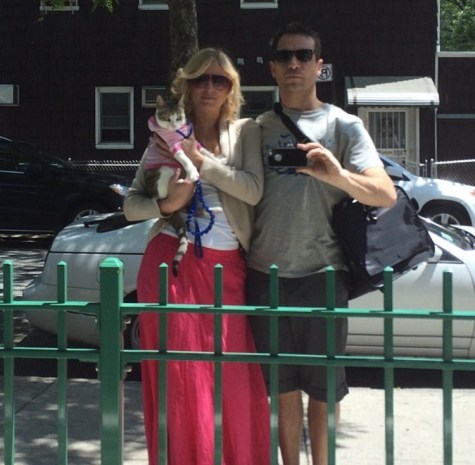
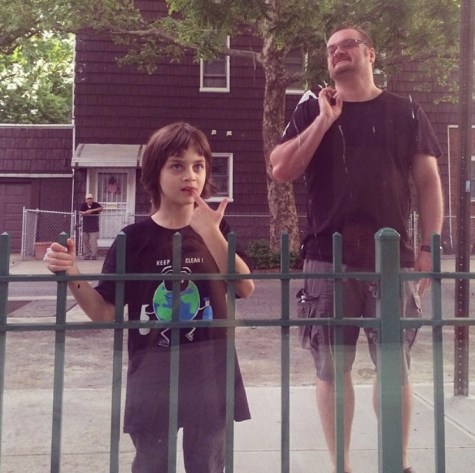




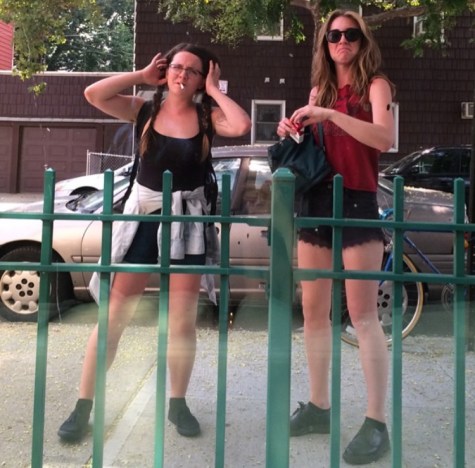

Photographer unknown. Group holding cages, C-Yard, Building 13, Administrative Segregation Unit, Mule Creek State Prison, August 1, 2008
The coalition activist groups Californians United for a Responsible Budget (CURB) are doing tremendous work at tracking was is said as compared to what is done by the Golden State’s politicians. Governor Jerry Brown has been particularly adept at appeasing the centrist and liberal leaning electorate without ever taking bold action to reduce California’s reliance on incarceration.
This morning, Gov. Brown announced an increase in spending on corrections at the state level. Not acceptable.
You may wonder why I focus on California so much. Well, aside of the fact it is my home state, California is often a bellwether for actions in other states. California was the first to enact Three-Strikes-And-You’re-Out Laws in the mid-nineties and it was the first to repeal them at the ballot in 2014.
California is a massive economy — bigger than most nations — and yet inequality in the Golden State has never been more stark. California tells itself it is a global leader. However, if that were true it would be spending less money on cages and more money on education, rehabilitation, and initiatives to build healthy communities.
Today’s announcement from the Governor’s office simply is not good enough. Here’s CURB’s response:
CURB PRESS RELEASE
California Governor Jerry Brown Backslides on Corrections Budget, No Substantial Reductions to the Prison Population Except Costly Expansion
Gov. Brown’s 2015-16 Budget, released this morning, defies comments earlier this week that the administration is committed to shrinking California’s over-sized prisons by increasing prison spending by 1.7%, bringing the total Corrections budget up to $12.676 billion.
“If the Governor believes that ‘we can’t pour more and more dollars down the rat hole of incarceration’ and has actively attributed the voice of the voters in this decision, then why is he increasing spending on corrections, planning for more prisoners rather than fewer and defying the demands of the Federal Court to further shrink the prison system?” asked Christina Tsao of Critical Resistance. The proposed increase of funding for corrections is partially due to 13 new reentry hubs.
California’s overwhelming passage of Prop. 47 was widely recognized as a mandate from voters to further reduce the prison population. County officials in Los Angeles have estimated an annual reduction of 2,500 in their jail population, however today’s budget predicts that in 2015-16 only 1,900 people will be released from state prison under the proposition. The budget highlights the release of people from prison as a result of the expansion of good-time credits (4,418) and elder parole (115). The budget does not outline any further plans to expand these efforts.
“Today’s budget shows the success of parole and sentencing reform measures in beginning to reduce crowding in California’s bloated prisons,” said Diana Zuñiga, Statewide Organizer for Californians United for a Responsible Budget. “Then why is Governor Brown still spending millions of dollars to open thousands of new prison beds, instead of implementing even more aggressive population reduction reforms?” asks Zuñiga. The budget anticipates that 2,376 new state prison beds will open in Feb. 2016 at 3 different locations.
“Today’s budget maintains California as #1 in poverty and #1 in prison spending. This is not an accident, “ said Vanessa Perez from Time for Change Foundation. “This morning Brown applauded the legislature on a balanced budget but we need to tear down the wall of poverty and invest more into vital programs and services that will lift the most vulnerable in our community out of poverty and stop wasting money on building new prisons walls. That is something that will be worthy of an applause”.
After years of cuts, today’s budget includes an increase in spending on K-12 and higher education. Education advocates, particularly in the UC system would like to see even further increases to prevent tuition hikes. “Higher educations in California has needed more funding for years. As we see tuition hikes happening for UC students across the state, here in San Diego they are building new prison beds at Donovan State Prison,” says Allyson Osorio a student working in External Affairs at UC San Diego. “We should support the students in California and stop wasting precious funding to increase incarceration.”
——
CURB Press Contact
Emily Harris, Statewide Coordinator, Californians United for a Responsible Budget
1322 Webster St. #210
Oakland, CA 94612
510-435-1176
emily@curbprisonspending.org

Art For Justice has a new exhibition opening in Philadelphia.
Free Library of Philadelphia, 1901 Vine Street, Philadelphia, PA 19103. (Between 19th and 20th Streets on the Benjamin Franklin Parkway)
Jan. 12 – Feb. 15, 2015

———
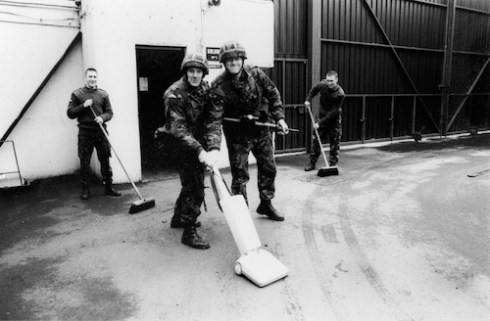
Stuart Griffiths was a kid when he went to Northern Ireland, in 1988, as a fresh recruit of the British Army. His first Christmas as an adult was spent on base. He dropped a tab of acid.
In the book Pigs’ Disco, Griffiths details his time serving for queen and country, his fear, boredom and struggle see what could possibly follow. I wrote about the body of work for Vantage, the new photography “collection’ published by Medium.
“At the turn of the nineties, Britain reveled in rave culture. From Bognor to Bangor, loved-up youth danced until dawn in clubs and beyond. A decade before cell phones, pill-popping kids were convening mass-raves in farmers’ fields and empty warehouses by word of mouth.
If there was one place you’d think this euphoric wave could not breach, it’d be the barracks of the British Army. But you’d be wrong. Pigs’ Disco details Griffiths’ drug addled misadventures from 1988 to 1993 while stationed, for the most part, in Northern Ireland as a paratrooper with Her Majesty’s finest.”
Read the full story: Tripping On Acid While In Her Majesty’s Service (Medium)
———




——–
The book Pigs’ Disco, by Stuart Griffiths is published by Ditto Press.


 Prison Photography