
You are currently browsing the category archive for the ‘Convergence’ category.
I am currently obsessed with Alex Webb and the way he piles everything on top of everything else. Working on a post last week, I was reminded of a commercial shoot I saw last year.

© Alex Webb/Magnum Photos. CUBA. Sancti Spiritus. 1993. Baseball fans.

@ Ben Baker. FedEx Board of Directors

Children Playing in the Ruins, Seville, 1933. 6 5/8 x 9 5/8" silver print. Circa, 1947 © Henri Cartier-Bresson.

Taliban Prisoners, Afghanistan, 2001. © Alan Chin
I have it on good authority that Alan Chin is one of the hardest working and spontaneous photojournalists in the business. He also caught this gem of a shot which for me sums up the shell-shock of war. These men may have been fighters, then prisoners, but they were/are also naive protectors of a regional social-order based upon the most closed of religious dogmas.
For all America’s imperialist crimes over the past decade, let’s not forget that the Taliban were brutal abusers of human rights, particularly women’s rights.
Is it not the case that the vast majority of men who fight do so because they are followers and not leaders? Heroism is passe; we are all victims of circumstance, not agents of change.
Image Sources; Chin, Cartier Bresson

© Jon Lowenstein/NOOR Images. From the series ' Tent City'. Image: LOJ020
This image by Jon Lowenstein of NOOR Images from his series Tent City reminded me of some pictures I featured last year when considering the context and readings of images of prison confrontations.

Training Exercise, Team Portrait. Photo Credit: I.M.T.T. 2004
Which in turn reminded me off a tight group of Somali Pirates by Jehad Nga.

Eight Somali pirates sat at the Kenya Ports Authority Port Police station in Mombasa, where they are being held after being handed over to the Kenyan authorities by the Royal Navy. The eight pirates were arrested, and three others killed, by sailors of HMS Cumberland, as they attempted to hijack a cargo ship off the Horn of Africa. The pirates will be charged in a Mombasa court. Credit: AP
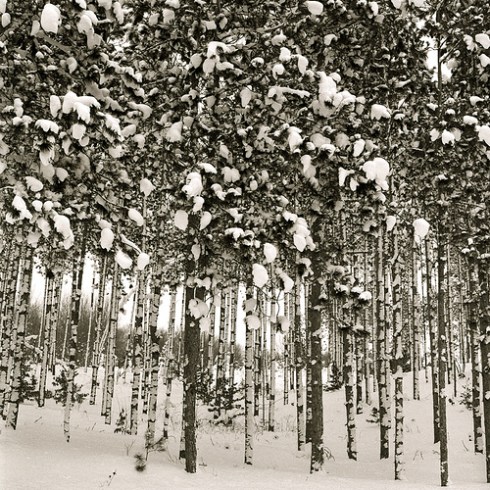
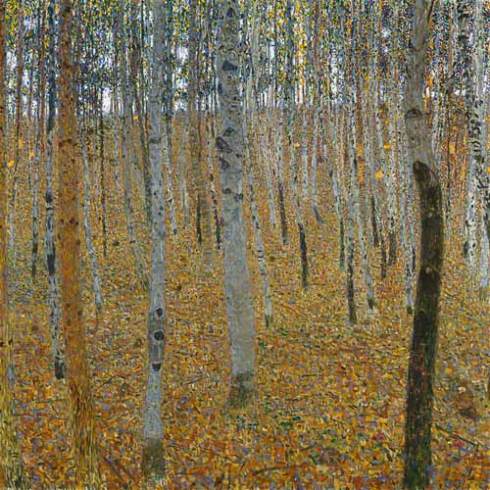

It is interesting that of all the Playboy covers over the years, the recent Marge Simpson cover mimics Darine Stern’s.
Darine was the first African American woman to feature on a Playboy cover.
Qiana Mestrich – whose blog I highly recommend – alerted us all to this fact and goes into more detail about Stern’s life and death.

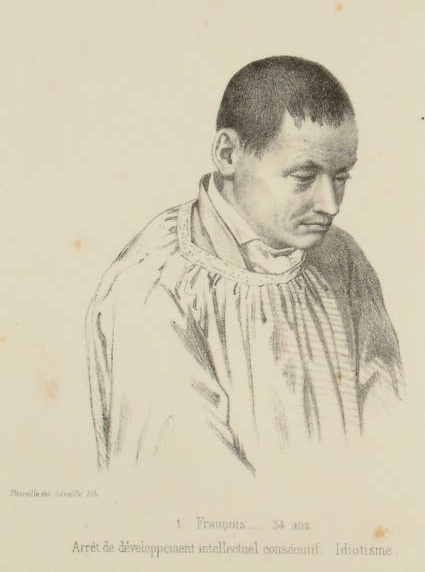
"Francois. 34 ans. Arret de Developpement intellectuel conscentif. Idiotisme." From ‘Traites des Degenerescences', by Morel (1857)

Green Hill, 2000 (C) Steve Davis
A couple of comments that have blown me away in the last 24 hours.
Convergence
From Patrick McInerney;
The similarity between Steve’s photographs and the scientific studies of psychiatric inmates the mid nineteenth century asylums is striking. (For a particularly good example see pictures of psychiatric inmates in Benedict Augustin Morel’s 1857 ‘Traites des Degenerescences: physiques, intellectuelles et morales de l’espèce Humaine’
And its interesting that they have a similar effect today as the early images did in the past, i.e. they encourage us to read the prisoner’s “true” character in their faces, with all the difficulty that incurs. It was obviously not Steve’s intent to mimic 19th c. scientists but maybe its quite understandable he feels that the style has become a bit jaded … it has after all been around for some time!
Steve was jaded not only by the limits of the portrait to communicate but also by the disconnected agendas viewer brought to his works, “People respond to these portraits for their own reasons. A lot of the reasons have nothing to do with prison justice. Some of them like pictures of handsome young boys; they like to see beautiful people, or vulnerable people, whatever. That started to blow my mind after a while.”
It is a serious issue within photography that we are all lazy viewers. The less curious and less open we are, the more likely we are to fall back on pleasing, self-affirming bias.
Memory
Three months ago I posted some images of the Prison Ship/Torture Museum, The Success

Wooden Coffin / Wooden Maiden / Iron Maiden?
Today, I received this;
I believe it was around 1944 that a prison ship, maybe it was The Success came to Cleveland Ohio at Lake Erie. I remember seeing the torture devices and one sticks in my mind to this day. I was told it was called the ‘Iron Maiden’, but your photos call it the ‘Wooden Coffin’.
Although I saw it as a child the memory stays with me to this day.
Age following age has propagated its own fascination with the macabre and majority-assigned human defect. From “scientific” research to childhood memory the will to understand difference has played out (and continues to play out) the shifting – and ultimately false – parameters of normal.

Samuel F. B. Morse's Daguerreotype Equipment, by Thomas Smillie, 1888, Smithsonian Institution Archives
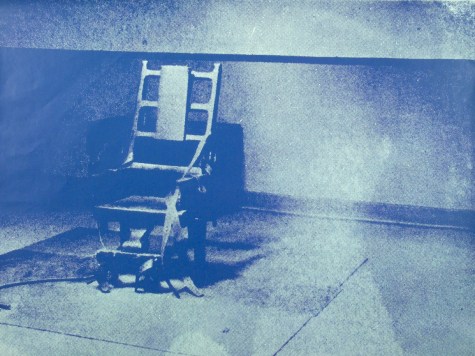
Little Electric Chair (Detail). Andy Warhol, 1965
Merry A. Foresta, Director Smithsonian Photography Initiative, informs,
When I saw the deathly familiar blue of Smillie’s cyanotype, I was thrown back to the electric hues of one of Warhol’s many electric chair prints.
From the rarest, unique image to the mass produced commodity. Both images of apparatus; both apparatus a steal on time and both definitively (institutionally) American.
The Smithsonian has operated Click! Photography Initiative for a couple of years now. They publish sporadically on The Bigger Picture Blog with a variety of essays about every imaginable application and interpretation of photographic culture in society. Contributors include high school kids to photography greats such as Robert Adams and a wealth of respected curators and educators including Wendy Ewald and Sandra Phillips. There’s even space for you if you wish to try you hand.
The project also nudged me back into the mind space and work of Bay Area heroine Carla Williams. Read her blog and your life will be better.
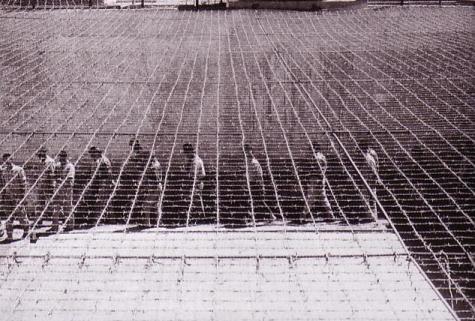
High Security Prison, Beit Lid, Israel, 1969. © Micha Bar Am
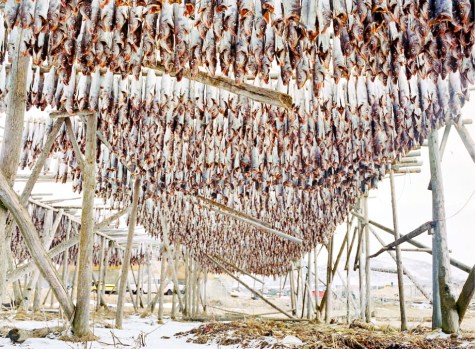
Hyse (from the Fish Work Norway series) © Corey Arnold 2009
Convergences Archive

 Prison Photography