
You are currently browsing the category archive for the ‘Documentary’ category.

The Global Post has just launched ENCARCELACION an investigative series about the correctional systems of Latin America that “have gone horribly wrong.”
We’ve seen the headlines of jailbreaks in Mexico, riots in Venezuelan prisons, and fires in Honduran jails, but often these stories seems a world away. The politics underpinning the strife in Latin American prisons is not my area of expertise but the importance of the stories is undeniable. It is interesting that the Global Post has used photography as an anchor to the front page.
After digging down into ENCARCELACION‘s trove of info, you may want to follow links to Prison Photography‘s irregular coverage of various aspects of life in Latin American prisons:
Gary Knight – Joao Pina – Jackie Dewe Matthews – Valerio Bispuri – Pedro Lobo – Vance Jacobs and Columbian prisoners – tourist photography in Bolivian prisons – prison tattoos (some from Central America) – Kate Orlinksky’s portraits of Mexican female prisoners – Fabio Cuttica at a Columbian prison beauty pageant – Patricia Aridjis in Mexico – even Cornell Capa was in Latin American prisons at one time.
– – – – –
Thanks to Theo Stroomer for the heads up.

This afternoon, I’ll be speaking to photography students at Evergreen State College, Olympia, WA. Instructor, Steve Davis has asked me to discuss PPOTR, regale some stories, recount my interviews.
Without doubt, Lloyd Degrane‘s story was one of the most remarkable. I have yet to edit the audio of Lloyd’s interview, but I did transcribe part of our conversation so it could be included in the Cruel & Unusual/PPOTR Newspaper. I’d like to share the text (below).
When Lloyd and I met in Chicago, he was preparing for Prison, the first ever exhibition of his prison photographs. It was at Gage Gallery (which coincidentally just showed Lori Waselchuk – another PPOTR interviewee). Gage put together an audio slideshow, which I also wanted to share (bottom).
THE BACKSTORY
Lloyd is a gentle, unassuming, older gent. He worked diligently for an entire decade (1990-2000) within three Illinois prisons – the Joliet Receiving Center, the Stateville Maximum Security Prison and Cook County Jail (the largest walled facility in the world with approximately 11,000 inmates). Degrane did this without any fuss or anything approximating self-promotion.
Before the authorities allowed him in with his camera, the Department of Corrections sent Degrane on a 600-mile round-trip to Menard Prison, a maximum-security prison in Southern Illinois. At Menard, Degrane was to just have a tour of the facilities. The warden instructed him not to take in his camera, and said that they he discuss with Degrane the proposed photography project after Degrane has taken the tour.
Due to an extraordinary experience during his prison visit, Degrane never met the warden. The extraordinary experience did, however, give Degrane a bargaining chip with which to win access to the Illinois prison system.
LLOYD’S FIRST DAY IN PRISON
I was led around Menard Prison by a guard that was just about to retire. You don’t get comfortable for some time. On the yard, you’re walking around brushing shoulders with murderers and rapists. I’d never been around people who had committed heinous crimes.
We walked into a big cell house holding several hundred inmates. As we got to the centre of the cell house a race riot broke out around us. I later found out is was African American inmates who wanted to retaliate against a white biker gang for killing one of their own several weeks before, and we were right in the middle of that retaliation. I remember yelling and threats being directed at the guard I was with. I was wearing a white shirt at the time and prisoners stopped and looked at me as if to ask, “What is this guy doing here?” I ran with the guard through a gauntlet of muscular black inmates. We made it to a cell and inside the cell was one of the oldest inmates I’d ever seen – over seventy years of age. And the guard just pushed me inside the cell. And the race riot went into high gear then. The first thing I saw was a white biker gang member being beaten by four or five black prisoners and the beating got closer and closer to the cell I was in. One of the black prisoners picked up the white biker and threw him against the bars. His head split open and he fell right at my feet. That was my initiation into maximum-security prison. I thought he was dead.
I heard over the loudspeaker system “CIVILIAN INSIDE” and I looked at the guard who was in the cell with me and he pointed at me and he said, “That’s you”. About five minutes later I heard the state police come into the cellblock with kind of this chant from the wizard of Oz. It was a chant to get everyone psyched up and strike fear into the heart of the rioting prisoners. They marched in with clubs and they were there to rescue me. They made a pathway through this insanity and extracted me from the cellblock along with the officer. They got me out of the cellblock back to the warden’s office where I picked up my camera and they just kind of pushed me out the back door.
I went to the nearest tavern and had a couple of shots of whisky. The adrenaline was just incredible, to the point where I couldn’t sit down. I’d nearly lost my life and I’d never had an experience like that before.
Later that day, I contacted the communications officer for the Illinois Department of Corrections. He knew what had happened. He said, “If you don’t talk to the media about what happened today then we’ll send you into Stateville Prison,” And so I didn’t say anything. Two weeks later I got notice from the warden at Stateville that it was okay to come in and start the project.

International Commission Tent, St. Paul’s Camp. © Ben Roberts
Ben Roberts‘ Occupied Spaces catalogues some of the communal and private spaces that were installed in the St. Paul’s and Finsbury Square camps. The traces of activity and inhabitance serve as a clear document of the utilisation of a limited space by a large number of permanent and temporary residents.
My colleague at Wired.com Jakob Schiller wrote about Occupied Spaces in November with his piece Pianos, Kitchens and Offices: Inside London’s Occupy Tents. It’s good to see this work progress into a book format.
Roberts says:
“On 15 October 2011, protestors representing the global Occupy movement set up a semi-permanent camp outside St. Paul’s Cathedral in central London. The aim of the protest was to encourage discourse and raise awareness of social and economic inequalities.”
“On 25 October, several UK newspapers and media outlets ran stories claiming that ‘thermal imaging’ proved that only 10% of the 250 tents in St. Paul’s Square were being inhabited overnight. I was immediately skeptical of these claims.”
Ben Roberts Occupied Spaces
210 x 288mm, 28pp 24 colour photographs Text by Naomi Colvin Digital indigo + riso print on uncoated recycled paper Elastic cord loose leaf document binding Bagged in clear self-seal polypropylene.
First edition.
You can buy the book HERE!
For further information contact: Harry Hardie harry@hereontheweb.co.uk +44 (0) 7813 431345

Last year, in the article Photographing the Prostitutes of Italy’s Backroads: Google Street View vs. Boots on the Ground, I compared the work of artists Mishka Henner and Paolo Patrizi both of whom were making images of prostitution on the back roads of Spain and Italy.
I argued that the photographs by Patrizi, due to their physical and emotional proximity had more relevance. Patrizi actually went to the roadside locations whereas Henner, making use of Google Street View, had not.
Around the same time, Joerg Colberg posted some thoughts about Henner’s No Man’s Land.
Shortly thereafter, Mishka Henner emailed me and mounted an impassioned defense of his work. Henner felt he had been “thrown to the cyber-lions.” Not wanting to see anyone with his or her nose bent, I offered Henner a platform on Prison Photography for right of reply.
CONVERSATION
PB: What was your issue with the commentary on No Man’s Land?
MH: There’s a section of the photo community judging No Man’s Land according to a pretty narrow set of criteria. So narrow they’re avoiding one of the elephants in the room, which is what role is left for the street photographer in the age of Google Street View? Comparing No Man’s Land to other projects on sex workers could be interesting but the way it’s done here is resulting in a pretty narrow discussion about whether it’s valid, ethical or just sensationalistic. I don’t see how that helps move documentary forwards. All the projects you mention, including mine, assert themselves as documents of a social reality. But in your discussion, this is secondary to how they make you feel and Colberg even argues Patrizi’s approach makes you care. My motivation isn’t to make you feel or to care – it’s to make you think.
MH: No Man’s Land uses existing cameras, online interest groups, and one of the subjects interwoven in the history of photography. And I think the ability to combine these elements says something about the cultural and technological age we live in. In some photographic circles, that’s the way it’s being discussed and I’m surprised Colberg and yourself have dismissed it in favour of more reactionary arguments that seem to hark back to what I see as a conservative and nostalgic view of the medium.
PB: Well, if preference for boots on the ground and a suspicion of a GSV project is reactionary, then okay. Why did you use GSV for No Man’s Land? Are you opposed to documentary work?
MH: This is documentary work, how can it not be? And what’s this suspicion of GSV? Would you have been suspicious of Eugene Atget walking the streets with his camera? I’m sure many were at the time but that suspicion seems ridiculous now. And your response is reactionary because it validates and dismisses work according to quite spurious and nebulous criteria. What does it matter if I released the shutter or not? A social reality has been captured by a remote device taking billions of pictures no one else ever looked at or collected in this way before. You’re only seeing this record because I’ve put it together. The project is about the scale of a social issue, not about trying to convince a viewer that they should have pity for individual subjects. Yet in these circles, the latter uncritically dwarfs the former as though it’s the only valid approach.
MH: Paolo Patrizi’s A Disquieting Intimacy is evidently an accomplished visual body of work, as is Txema Salvans’ The Waiting Game but to argue they offer a deeper insight into the plight of sex workers is, I think, generous to say the least.
MH: The assumption underlying much of the critiques of No Man’s Land (in particular Alan Chin’s) is that there’s no research and it’s a lazy, sensationalistic account of something fabricated. But what if I told you it was researched and took months to produce; what basis would there be then for dismissing it? Doesn’t research inform 90% of every documentary photographer’s work (it did mine, maybe I wasn’t doing it right)?
What’s left unsaid in these critiques is that No Man’s Land doesn’t fit a rather narrow and conservative view of what one community believes photography should be. The fact we’re drowning in images and that new visions of photography are coming to light are a scary prospect to that community, hence the reactionary and defensive responses. But there’s more to these responses than simply validating boots on the ground. You’re prioritising a particular way of seeing and rejecting another that happens to be absolutely contemporary.
PB: I think we can agree Patrizi is accomplished. I was deliberately lyrical in my description of his work and I meant it when I was personally moved by Patrizi’s work. That is a personal response.
MH: That’s fine, but what does Patrizi tell us that is missing from No Man’s Land? Is the isolation and loneliness of a feral roadside existence and the domestication of liminal spaces really that much more evident in one body of work than the other? Surprisingly – given your sympathy for Patrizi’s’ approach – even the women’s anonymity is matched in each project. No captions, no locations, no names, and no personal stories. Just a well-researched introductory text that refers in general terms to the women’s experiences. I think you’re viewing the work through rose-tinted spectacles.
PB: I can’t argue with your point about anonymity. There may be an element of gravitating toward [Patrizi’s] familiar methods. This might be because reading the images resultant of those methods is safe for the audience; they find it more easily accessible, possibly even instructive in how they should react?
MH: Working in documentary for many years, I can’t deny I aimed for these lofty aspirations. But I now consider the burden of sympathy expected from a narrow language of documentary to be a distracting filter in the expression of much more complex realities. Pity has a long and well-established aesthetic and I just don’t buy it anymore. In themselves the facts are terrible and I don’t need a sublime image to be convinced of that. In the context of representing street prostitution, striving for the sublime seems a far more perverse goal to me than using Street View and much more difficult to defend.
MH: Alan Chin’s comments surprised me because I wouldn’t expect such a knee-jerk reaction from an apparently concerned photographer. But his work is a type of documentary that I’m reacting against; a kind of parachute voyeurism soaked in a language of pity that reduces complex international and domestic scenarios into pornographic scenes of destruction and drama. It’s the very oxygen the dumb hegemonic narrative of terror thrives on and I reject it. Why you would pick his critique of my work is beyond me – we’re ships passing in the night.
PB: I quoted Chin because he and I were already been in discussion with others about the many photo-GSV projects. He represented a particularly strong opposition to all the GSV projects including No Man’s Land.
MH:No Man’s Land is disturbing, I agree. And it troubles and inspires me in equal measure that I can even make a body of work like it today. But it isn’t just about these women, it’s also about the visual technologies at our disposal and how by combining them with certain data sets (in this case, geographic locations logged and shared by men all around the world), an alternative form of documentary can emerge that makes use of all this new material to represent a current situation. It appeals to me because it doesn’t evoke what I think of as the tired devices of pity and the sublime to get its point across.
PB: It’s not that I don’t like No Man’s Land, but I prefer Patrizi’s A Disquieting Intimacy; it is close(r) and it is technically very competent work. There’s plenty of art/documentary photography that doesn’t impress me as much as Patrizi’s does. A clumsy photographer could’ve dealt with the topics of migration and the sex industry poorly. I don’t think Patrizi did.
MH: I don’t know what you mean by clumsy. If by clumsy you mean a photographer who shows us what they see as opposed to what they think others want to see then bring it on, I’d love to see more of that. No Man’s Land might seem cold and distant, it might even appear to be easy (it isn’t), but it’s rooted in an absolutely present condition. What you consider to be its weakness – its inability to get close to the photographic subject, its struggle to evoke pity – is what I consider to be its strength.
PB: The detachment is the problem for all concerned. People may be using your work as a scapegoat. This would be an accusation that I could, partly, aim at myself. Does your work reference the frustration of isolation and deadened imagination in a networked world?
MH: At first, I reacted strongly to your description of my work as anemic but now I think it’s a pretty good description of the work. And it’s an accurate word for describing what I think of as the technological experience today, our dependence on it and its consequences.
PB: Consequences?
MH: I know, like most working photographers, that for all the fantasies of a life spent outdoors, much of a photographer’s workload happens online. And if you’re a freelancer, the industry demands that you’re glued to the web. It’s not the way I’d like it to be; it just happens to be the world I’m living in. And anyone reading this online on your blog is likely to share that reality. So it seems natural and honest that as an artist, I have to explore that reality rather than deny its existence.
PB: For audiences to grasp that you’re dealing – with equal gravity – two very different concerns of photography (the subject and then also contemporary technologies) opens up a space for confusion. Not your problem necessarily, but possibly the root of the backlash among the audience.
MH: Well, it’s surprising to me that few critics have actually discussed the work in relation to the context in which it was produced, i.e. as a photo-book. If even the critics are judging photo-books and photographs by their appearance on their computer screens, then I rest my case.
PB: What difference does the book format make to your expected reactions to the body of work?
MH: For one thing the book takes the work away from the online realm and demands a different reading. That in itself transforms it and turns it into a permanent record. Otherwise I’d just leave the work on-screen. I recently produced a second volume and intend to release a third and then a fourth, continuing for as long as the material exists.
PB: On some levels, people’s reactions to your work seem strange. If people are so affronted, they should want to change society and not your images?
MH: Too often, I find that beautifully crafted images of tragedy and trauma have become the safe comfort zones to which our consciences retreat. It’s something people have come to expect and it doesn’t sit easily with me. When I think of No Man’s Land, I keep returning to Oscar Wilde’s preface to The Picture of Dorian Gray:
No artist has ethical sympathies.
An ethical sympathy in an artist is an unpardonable mannerism of style.
All art is at once surface and symbol.
Those who go beneath the surface do so at their peril.
Those who read the symbol do so at their peril.
It is the spectator, and not life, that art really mirrors.
Diversity of opinion about a work of art shows that the work is new, complex and vital.
When critics disagree the artist is in accord with himself.
– – – – – – – – – – – – –
No Man’s Land will be on show – from May 3rd until 27th – at Blue Sky Gallery, 122 NW 8th Avenue, Portland, OR 97209. Tuesday – Sunday, 12-5 pm.
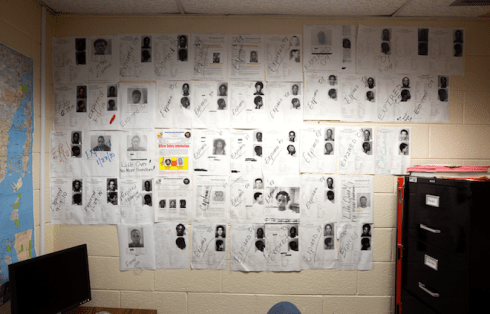
Referred to as the “Wall of Shame,” the mug shots here serve as a reminder to staff of the kids that have been killed on the street. Miami-Dade Regional Youth Detention Center, Miami, FL. © Richard Ross
These days, I contend that if photographers are to progress with their craft, they must be both excellent image-makers and energetic self-marketers.
I’ve known Richard Ross‘ work for a long time now so the former has never been in any doubt. Having seen the way his project Juvenile-In-Justice has been rolled out, it is clear he’s in full control of the latter too.
Ross has been featured on NPR and The TakeAway. The edit of his work in Harper’s Magazine is a finalist in the News and Documentary Photography category at the National Magazine Awards.
I wrote an article Uncompromising Photos Expose Juvenile Detention in America, published on Wired.com last week about Ross’ 5 years of photographing in juvenile detention facilities. (The article was well received and has led to a follow-up piece about the issue. Stay tuned). Ross was also a PPOTR interviewee.
Furthermore, the project will be presented as a traveling exhibition that will premiere at the Nevada Museum of Art, Reno, NV in August 2012. A photobook is also in the works with essays from Ira Glass and Bart Lubow.
After 40 years of photographing, one presumes that Ross has contacts and allies to help him “market” Juvenile-In-Justice and get it in front of the maximum number of eyeballs. The distribution of this work has been robust and effective – and it could hold some lessons for younger photographers.
I’m just thinking out loud here. My main purpose of this post was to share this five-minute feature on Ross’ juvenile detention work put together by PBS.

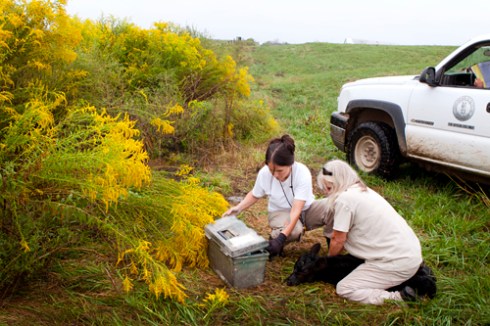
As soon as I saw Ashley Stinson‘s photographs, it was a priority for me to publish them. How many prison environments or programs can we confidently describe as wholesome?
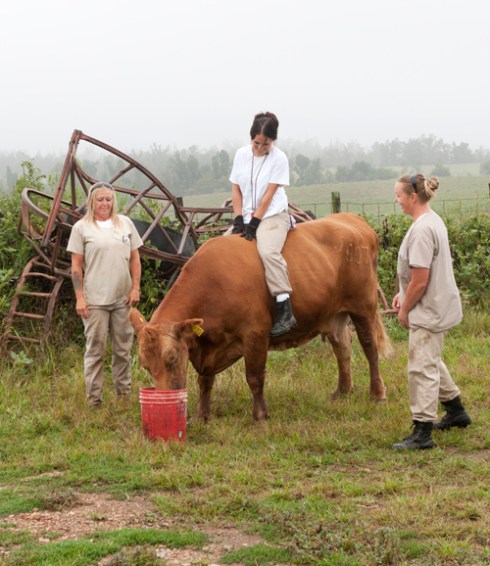
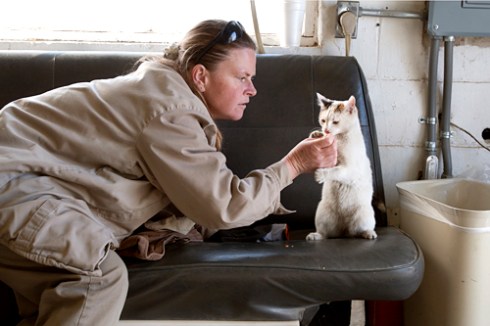
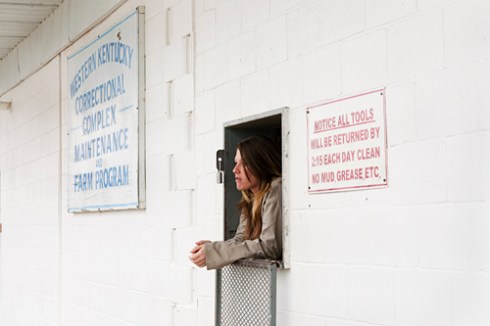
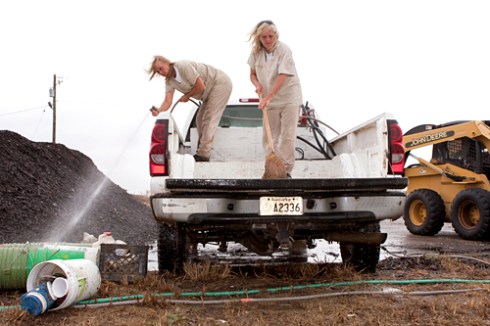
On the evidence, of Stinson’s images from Women’s Western Kentucky Correctional Facility in Fredonia, Kentucky, the female prisoners are given ample space and activity to forge their own purpose. Are these images sugar coating their experiences or faithfully depicting transformative hard-graft?
To close in on the truth, I asked Stinson a few questions. Scroll down for our Q&A.
What attracted you to the subject?
I wanted to start a project on female farmers around the Louisville, KY area because I continued to run into women who were pursuing it as profession and I thought it would be an interesting subject considering that it is historically a male dominated field.
A friend’s mother was a nurse at the prison while it was still an all male prison and she suggested that I look into the prison’s agriculture. So, what was initially a project about the surge in female farmers quickly turned into a project about this large-scale prison farming program.
Tell me about this seemingly unique program.
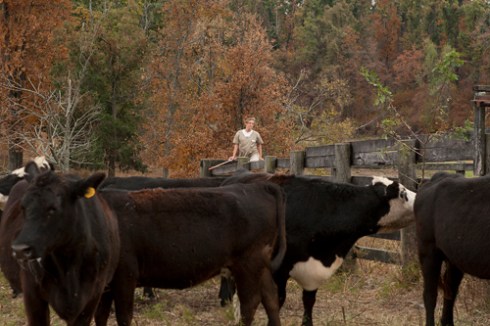
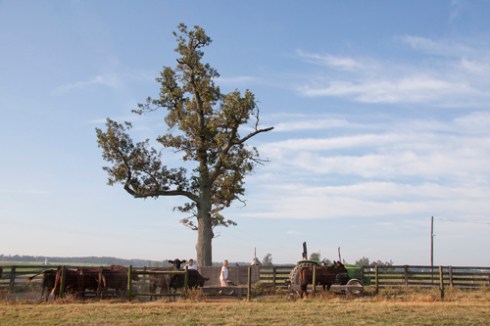
It currently has one of the largest farms in the nation run by female prisoners. It’s a fairly new program for the women; the prison was an all-male prison until a few years ago. The state is really proud of the work the women have done – they tend the crops, maintain the farm machinery, and take care of a large number of beef cattle. It’s a really positive program and I am reminded of that every time I travel to Fredonia to photograph.
What are these ladies locked up for?
Western Kentucky Correctional Facility is a minimum and medium security facility and to participate in the farming program the women have to be in the minimum security portion which naturally means that they have been convicted of lesser crimes. Mostly substance abuse or robbery with a few cases of manslaughter.



In your photographs, they seem like they’re enjoying themselves. Is this the case?
Absolutely! They certainly work hard but it is a fun atmosphere and I have never encountered a tense moment with these women. They are happy, healthy, and truly working on bettering themselves and I am trying to convey that through my photographs.
They have formed really solid friendships because farming can be incredibly dangerous and a lot of what they do requires looking out for one another and trusting co-workers. I believe that the biggest benefit of this program has been the relationships these women have formed. Not just with each other but also with animals that they have cared for, the crops that they tend and the employer/employee relationship they have with the farm management team.
I do not know the women’s backgrounds but I get the impression that these are whole new situations for them. They are held completely accountable for their daily tasks, and they can literally see the positive results of the hard work they are doing. The program taps into their ability to nurture and care for others which is such a positive experience. Also, it’s hard not to have fun when you are bottle-feeding a newborn calf or driving a huge tractor.
Beyond daily purpose and building self-esteem (which I take as a given in programs such as these) are these ladies hopefully they are acquiring skills that will sustain them in the job market when they’re released?
They are certainly acquiring a number of skills that could be applied to other jobs once their time has been served – car maintenance, welding, gardening, composting, etc. The farm managers are extremely experienced farmers, not police officers or trained guards, and I believe that creates a work dynamic that is much closer to what the women will find outside of prison if they decide to pursue a career in agriculture. Some of these women may continue farming in the future but they will ALL leave with a positive work experience and a sense of accomplishment which will serve them well when the re-enter the job market.
Who owns the farm? Who owns the products of the farm? Who eats the crops?
The state owns the farm. I am assuming the state or the prison “owns” the products of the farm. Most of the corn is used to feed the beef cattle and other crops are either used for food at this prison or the male prison in Eddyville. Extra veggies and fruit have been donated to the local food-bank and local churches.
Do the crops go into the prison system or onto the open market?
They have discussed selling surplus produce to the community in the future. A portion of the cattle stay on the farm to reproduce and the majority are sold at auction, with the money going back into the prison.
Is this project complete?
It is ongoing. I have clearance at the prison until August and then my next step will be to visit these women once they are paroled to take photos of them after incarceration so I may have some more photographs in the future.
View the work here.
Over the past decade, documentary filmmaker Edgar Barens has explored the many issues at play in the American criminal justice system.
For his most recent project Prison Terminal, Barens was granted unprecedented access to the Iowa State Penitentiary (ISP).
Prison Terminal is a moving cinema verité documentary that breaks through the walls of one of America’s oldest maximum security prisons to tell the story of the final months in the life of a terminally ill prisoner and the hospice volunteers, they themselves prisoners, who care for him.
The Iowa Department of Corrections allowed Barens round-the-clock access to the ISP hospice and almost uniquely – to my knowledge – a space for him to cobble together living quarters and a production studio in the prison’s basement.

Jack “Comrade” Hall. Hospice Patient, Iowa State Penitentiary.
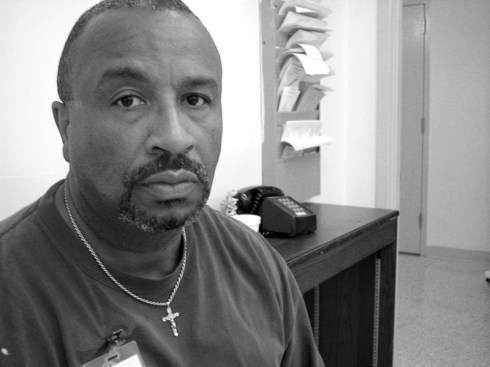
Bertram “Herky” Berkett. Inmate Hospice Volunteer
Prison Terminal is more than a documentary: it is a hub for information and context. You’ll need to spend some time with the biographies of those involved, a host of video shorts and general essays about the prison industrial complex.
Prior to working in Iowa, Barens also documented the hospice program at Angola Prison – a well photographed program probably best known through Lori Waselchuk’s Grace Before Dying.
These two hospice programs remain exceptional in America’s correctional landscape, but it is Barens’ hope that Prison Terminal will assist in making these services permanent throughout U.S. prisons, ensuring that inmates no longer have to die alone.

Charles “Woo” Watkins. Inmate Hospice Volunteer.

Larry “Big Papa”. Hospice Patient
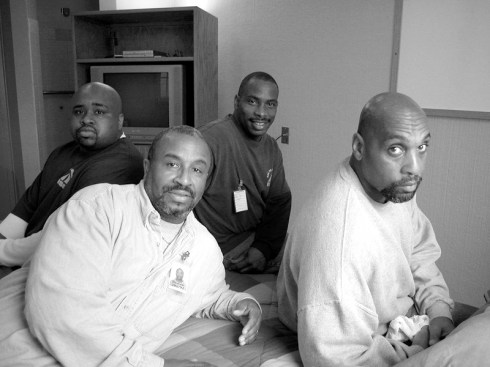
Inmate Hospice Volunteers (Front: Bertram Berkett, Michael Glover Back Row: Michael Williams, Charles Watkins.)
BIOGRAPHY
 Edgar Barens received his Bachelors degree and Masters of Fine Arts in Cinema and Photography from Southern Illinois University, where he concentrated on photography and film production. His body of work includes documentary films, experimental shorts, music videos and public service announcements, which have been screened at film festivals, conferences, broadcast internationally as well as distributed educationally.
You can view all Prison Terminal videos here.
Follow Prison Terminal on Twitter
All images © Edgar Barens
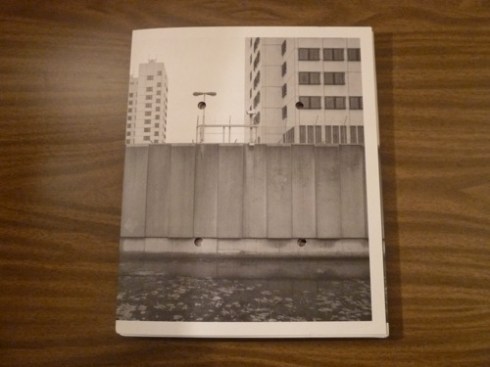
Nico Bick‘s work had been on my radar since Fotodok’s 2010 exhibition State of Prison. Between 2006 and 2009, Bick photographed the Bijlmerbajes prison in Amsterdam. In the past, Bick and I had played email tag, so it was nice to finally meet him last month in his native Netherlands and talk shop.
Q&A
Where were the inmates when you were taking your photographs?
Right behind me. It all looks very serene and quiet but there’s lots of noise behind me. I had to ask permission of each prisoner before photographing their cell.
Did the prisoners care about your artistic vision?
Not really. Obviously, those that refused permission to photograph their cell really weren’t interested. Some thought it was worthwhile. Most wondered, “Why take a picture of a prison?”
Yes, why? Are you an architectural photographer?
No. I do take pictures of space, but not architecture. I hardly ever do commissions for architects. I’m interested in the tension between public space and spaces more secluded. The prison embodies this tension.
In the Netherlands, prison is a public space. It’s not like in the U.S. where there exist private facilities. The government runs all prisons here, so in that regard they are a public space. The inside is not visible but it is owned by the state, funded by the public.
How did you get access?
Initially, I sent a letter to the director. But I never got a reply. I had a friend who said she might know someone who worked at Bijlmerbajes. It was a different path to try. I sent a letter to her, she dropped it on the right desk and someone called me (laughs).
This was only the first hurdle. During my work on P.I. I liaised with four different communication officers. All had a different approach in their willingness to cooperate in the project.
I won’t try to pronounce the prison’s name. Is the complex iconic?
The Bijlmerbajes? Yes, it is. Designed in the late 60’s and put into use in 1978, this prison is an architectural embodiment of the prevailing social-reformist ideas of that time. The architects tried to escaped the traditional ‘prison architectural design’.
Six towers, divided in units and connected by corridors, are constructed with respect to individual needs of ‘social’ comfort. The windows for instance featured no metal bars initially. However, the thick ‘unbreakable’ glass was found not resistant enough and had to be reinforced with metal bars.
Bijlmerbajes is not its official name. The name comes from the ‘Bijlmer’ part of Bijlmermeer which is a nearby neighbourhood (built at the same time as the prison) plus the word ‘bajes’ which is Dutch slang for ‘prison’. Bijlmermeer is well known for its high rises.
The official name of the prison is Penitentiaire Inrichting Over-Amstel – which is really difficult to pronounce!
Does its looming architecture represent “A prison” for the majority of Dutch people?
No, it does not. Situated near a rail road station it is often first looked upon as a social housing project. As usual, people do not look properly because with such a large perimeter wall and fence it is unquestionably a prison.
For years, there have been plans to move the prison to another location. Emphasis on plans. Nothing definitive has been decided. Possibly a move to the north but the ‘Not In My Back Yard’ crowd don’t want it. I was discussing this recently with a friend and he told me that in the U.S. town and cities welcome prisons because they provide jobs. This is not the case in the Netherlands; it’s not a deciding factor [on a prison’s location]. Dutch prisons are not considered as big jobs machines.
Bijlmerbajes was built as a “humane” prison. It is architecture along philosophical lines. Given the plans to replace it, do you think the next architectural solution for a prison will be driven by social ideals?
My feeling is that it will not. The replacement may not be as humane. Ideas today are not like the 60s and 70s. New prisons will have economic considerations within them. I won’t rule out that Dutch prisons may be privatized in the future. That’s the political climate we’re in.
How are prisons discussed in the Netherlands?
Generally, people talk about the legal system and not the prison system and they think that the legal system is okay; that the punishments handed out are correct and proportionate.
Unfortunately, there is – especially with that horrendous right wing cabinet we now have in the Netherlands – a discourse on how luxurious our prisons are. Of course, this is all perception.
Why have Dutch politics swung to the right?
In the Dutch parliament, 24 of the 150 seats are in the hands of the far right. So that’s about 15%. We feel the effects of the embrace of neo-liberalism in the 90’s by almost all political parties. As a result, votes shifted to the far right and left. The center is a wasteland. But bear in mind that the right-wing government in the Netherlands only has a majority of one seat in parliament.
Some people in the Netherlands think multiculturalism has failed?
Personally, I don’t think multiculturalism has failed. It is something that is here and it works. I see different types of people from all over the world around me everyday. I am aware of issues that immigration brings but [the far right leader] Wilders plays with feelings of fear and insecurity. People just need to give it time. Within a society that demands immediate solutions this is very difficult.
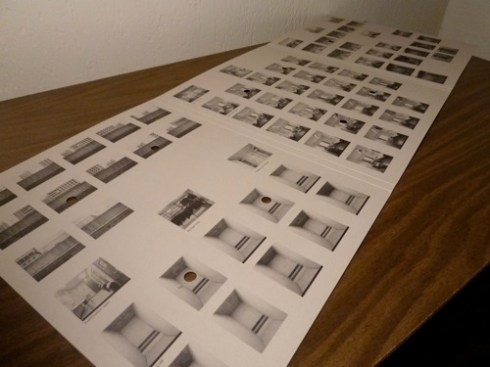


What does you book title P.I. refer to?
P.I. stands for Penitentiary Institution. I choose this title because the book is a metaphor for the universal notion of ‘prison’ and prison architecture in general.
How do you hope P.I. will influence discussion?
Besides the notion of a ‘hotel-like’ prison, another widespread stereotyped image of the prison is a dark, over-populated construction. With my book I try to nuance this opinion.
What is your audience for the book?
An audience with an interest in art and photography. Additionally, an audience interested in the social aspects of architecture, philosophy, ethics and cultural heritage. Obviously, with an edition limited to 400 copies my audience shall not be very large.
P.I. is not a bound book but a collection of sequenced offset prints. Why did you choose this book-portfolio design?
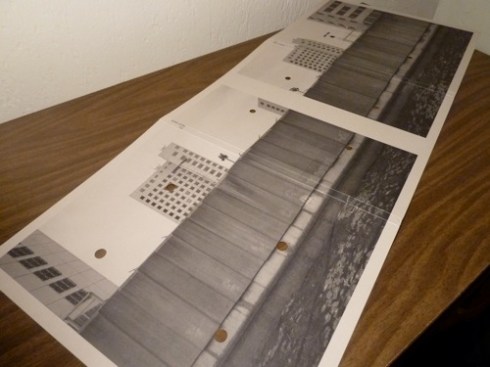
P.I. as a project contains more images then the ones printed as colour plates in the book. The photo index on the inside of the cover shows the series as a whole. It also shows what is available; images with no hierarchical ordering, just locations. Because the series consist of identically photographed interiors. Each series, each interior, is processed in the book as a separate set of pages. By taking this set of pages apart, you have an excellent way to compare the interiors with each other.
The publication concept of P.I. is that it is to be associated with a dossier. But at the same time – in terms of book typologies – it is to be associated with what I must define as the deconstructed book.
Deconstructed books are unbound, half bound, perforated or unfinished and, as such, emphasize the physical aspect of the book. It is this type of book that suits best my methodology and my description of a specific type of public space.
The graphic design of the book does not impose a narrative structure on the reader; by comparing the images, the story unravels. This kind of unfinished book, which even lacks ordering demands active readership.

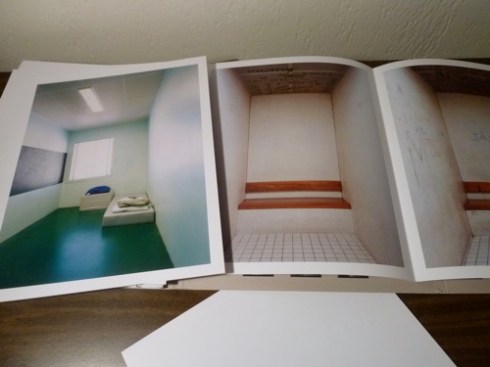

It seems like P.I. is both fine art project and historical document?
Yes. Fine art project first but an historical document too. In terms of art strategy I am primarily interested in studying the use of public spaces.
Tell me about order, numerics and sequence in the architecture of Bijlmerbajes.
Six towers are connected by the main corridor. A tower contains five units. There are 24 single cells within every unit. Every unit has its own control room (no longer in use). A tower has a separate top floor with three isolation cells and six air cells. Each tower has two communal yards, a large one and a smaller one. Every tower has its own control room – all of which are controlled by the main control room.
Upon entering the Bijlmerbajes one is placed temporarily in one of the holding cells.
Does your book represent a single tower?
Yes, although it is pieced together from photographs of cells and spaces from all the towers. It wasn’t possible to photograph a single tower in its entirety. There are 12 photographs of cells in P.I. to represent the 24 in a single unit.
You showed the work at the Fotodok exhibition State of Prison.
Raimond Wouda, curator for State of Prison wrote about my photography during as part of his year of reviews for Fotodok. To conclude the yearlong “residency”, he mounted an exhibition. He chose the subject of photography in prisons and my project was a starting point for the exhibit.
Has photography changed the public debate on prison issues?
It’s difficult to measure. I’m interested in the Bijlmerbajes in particular but I’m not a prison expert, nor do I aspire to be the “prison photographer of the Netherlands”. I looked at one prison in isolation.
After prison, where do you go?
I’m interested in Parliaments of the European Union – 28 national parliaments plus the two European parliaments in Bruxelles & Strasbourg. Again they are public spaces and simultaneously they are not. Parliaments have notions of democracy for the people and of being seen. Prisons and parliaments; both make access difficult.

BIOGRAPHY
Nico Bick (Arnhem, 1964) studied photography at the Royal Academy of Art in The Hague (1986-1991). Characteristic of his work is a preference for inconspicuous places that appear to be so familiar that nobody seems to notice them anymore. He specifically direct his view at spaces with a tangible tension between the public and the private domain. With patience and careful observation he creates highly detailed images, in the absence of its users, to focus the attention to both the space itself and the meaning of these places. Nico Bick lives and works in Amsterdam.
P.I.
Photographs Nico Bick
Text Frits Gierstberg
Design Joost Grootens
Published by Nico Bick, Amsterdam 2011.
ISBN 9789081428217
Edition: 400 copies with an English text on a supplementary sheet. Offset, folded, 64 pages, 32 colour photos, 24x30cm. 35 euro.
Special edition. 25 copies. Signed and numbered with an additional original photograph (C-print, 24x30cm). 160 euro
Available through Bick’s website.
MORE
At eyecurious
At Buffet
P.I. on Facebook
The Cruel and Unusual exhibition newspaper has a review of P.I. by Arno Haijtema in English translation. Purchase here. View here.

 Prison Photography