
You are currently browsing the category archive for the ‘Documentary’ category.
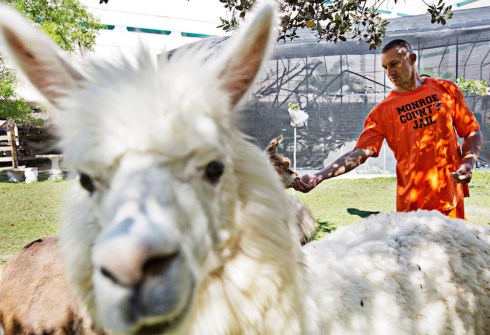
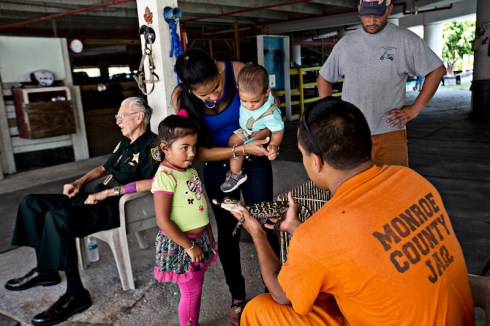
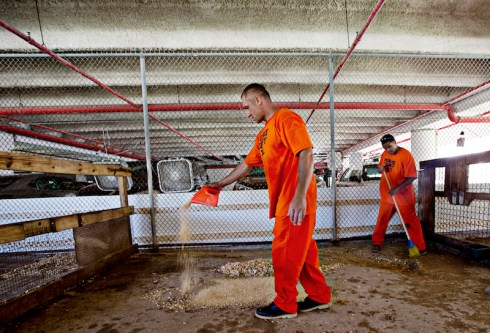
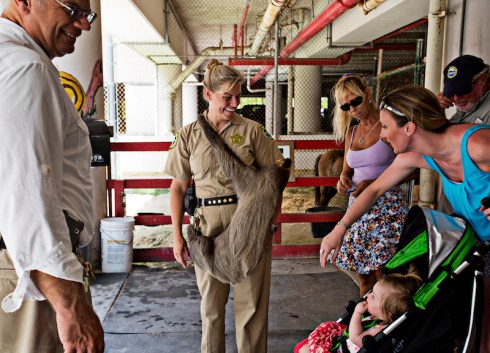
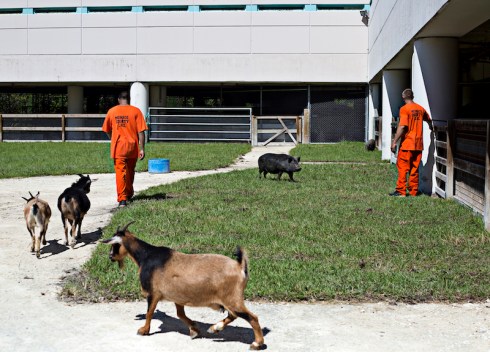
When Utah-based photographer Kim Raff was in Key West as an artist-in-residence, last year, she heard about an exotic animal farm in a jail just four miles from the iconic leisure-space Duval Street.
“It’s a pretty remarkable place,” says Raff who popped in to see what was happening on one of the two days each month the farm opens to the public.
“[My work] is not an investigative piece but just an uplifting slice of life inside a jail,” adds Raff.
I think we can be certain that petting zoos don’t hold the answer for the many rehabilitation and decarceration measures we’re needing, but there’s no doubt that for many prisoners, contact with animals bears positive results. Jailhouse cats, seeing-eye dog training programs, Puppies Behind Bars are the obvious examples. I’ve known prisoners to care for, and tame, birds. Jail birds.
There’s not many bright spots on the yard, so to speak, in America’s prison industrial complex and ones like these at the Monroe County Stock Island Detention Center are always well-covered by the media.
Tellingly, the farm is entirely volunteer-run. No taxpayers money goes toward it. So while we can clap Monroe County Sheriff for hosting the program we can as easily wag our finger at the predictably conservative attitudes of lawmen who refuse to help fund a program that has clear benefits for all.
Ultimately, as Raff puts it, here’s an example of a program that is “unconventional, interesting and actually working.”
–
Read Inside the Florida Jail that Doubles as an Exotic Animal Zoo to get Raff’s full account and see the images large.



–
Kim Raff is a documentary and editorial photographer based in Salt Lake City, UT. Connect with Raff on Twitter, Facebook, Instagram, Linked In and Tumblr.
–

Photographer/reporter Lili Holzer-Glier’s Inside the Massive Jail That Doubles as Chicago’s Largest Mental Health Facility marries meaningful and well-reported content and with hard-hitting images under a single byline.
It’s a day-in-the-life-ish of the mental health professionals and patients at Cook County Jail in Chicago, which is the largest walled institution in the United States. What stood out for me was the reason with which both patients and professionals speak and assess the situation. Even though their attitudes could be dismissed as those from a madhouse in the big house, these first-hand-responders are collected and clear in what the problems are and what the solutions might be. And, surprise! Incarceration is not a solution.
I was left to reflect on my own frantic dismay at the United States’ beyond broken mental health policies. But panic doesn’t help anyone. Reliable and committed health helps and this is the overriding takeaway from Holzer-Glier’s piece. The pictures reflect that too. There’s no outbreaks, no violence and no real “noise”. The patients are returning to a baseline and feeling listened to. It’s just a shame they have to be in a jail to receive that attention.
Holzer-Glier opens the piece with a volley of desperate facts.
“According to a May 2015 report by the National Alliance on Mental Illness,” writes Holzer-Glier, “Illinois cut $113.7 million in funding for mental health services between 2009 and 2012. Two state-operated inpatient facilities and six City of Chicago mental health clinics have shut down since 2009. The report goes on to detail that Governor Bruce Rauner’s 2016 budget proposal to slash $87 million of funding for mental health services could cause an estimated 16,533 adults to lose access to care.”
From the way the article reads, it seems Holzer-Glier spent one day (November 10th 2015) observing the in-take and processing. She follows social worker Elli Petacque-Montgomery and her team as they assess new arrivals at the jail.
“Acutely psychotic, violent, or suicidal arrestees [are put] in single cells away from other inmates. People who are psychotic are then sent to CERMAK, the jail’s division for physically ill and acutely mentally ill patients. Those with minor mental illness are sent to Division Two, Dorm Two, where they live in dormitory-style bunk beds…”
While the four prisoner-patients Holzer-Glier meets–Milton, Daniel, Tommy, and Andrew–have problems they aren’t totally bereft of hope. They’re in the bunks of Dorm Two. They provide key insight. Thankfully, Holzer-Glier doesn’t make a case for them, but rather allows them to make their own case. Their statements are transcribed.
They speak with gratitude about how the attention they receive from the medical staff is professional, encouraging and helpful. They have hope they can find stability but they don’t (or can’t) offer too many certain routes to stability. Some plan to leave Illinois when they get out. Some hope to find a good balance from meds that have proved helpful in the past. Another just plans on a steak and a hot bath “to get rid of the crazies.”
In each case, it’s clear they’ll need assistance beyond these jail walls. But will they have access to care? Ask the professionals. Holzer-Glier closes the piece with a series of statements from a clinical psychologist, a social worker, a guard, director of the care center and a corrections rehabilitation worker, all of whom work in Cook County Jail and interface with the mentally ill prisoner-patients. They all report that mental health institutions elsewhere have been closed at a incomprehensible rate and that the majority of people they interface with in the jail should be in a medical facility not a prison.
“You can’t just take a mentally ill person and lock them away. Society has already shown it doesn’t work,” says Printiss Jones, the Superintendent of CERMAK, the jail’s division for physically ill and acutely mentally ill. “Why would we do it here?”
And the piece ends.
Jones says, “Not one of these people should be here.”

In modernizing institutions, new laws to permit intimate partner visits for prisoners were established. Cosmin Bumbuţ visited every penitentiary in Romania and photographed the boudoirs.
We’re obsessed with sex as much as we’re shy to talk about it open and honestly. We’re fascinated by prisons, particularly fictionalized accounts of prisons (Oz, Animal Factory, Shawshank, Orange Is The New Black, The Green Mile, the list goes on-and-on) but often our fascination doesn’t extend far enough to talk openly about what our prisons actually are and how they’re a symptom of a divided, racist, unforgiving social order. We’ve still a lot to unpack around prisons. Around sex too, we’re picky about what and where we unpack. I say this to acknowledge the fact that this is an article about sex, and prisons, and sex in prisons and those are fiery catalysts to the imagination. Be honest, you’re here because of the headline and you’re wondering whether to read these 1,300 words or just scroll through the pictures.
Fortunately, for us, these pictures, made by Romanian photographer Cosmin Bumbuţ (who is also one half of Teleleu.eu), sate our outsider curiosity without dragging us into a debased voyeuristic quagmire.
The series, titled Camera Intima, is expertly shot with phenomenal manipulation of space and lenses to secure these angles. Despite some of these rooms being converted basement store-rooms, the photos are well-lit and flooding with joyous color and pattern. Perhaps you enter this photo essay — and these rooms — expecting cheap gags, but you exit with a rounded and informed perspective on a type of room designed to meet 21st century policy, to ensure dignity and to bolster family relationships.
“In 2007, Romania joined the European Union,” explains Bumbuţ. “The whole prison system went through major revamp and the biggest reform was to introduce the right to private visits.”


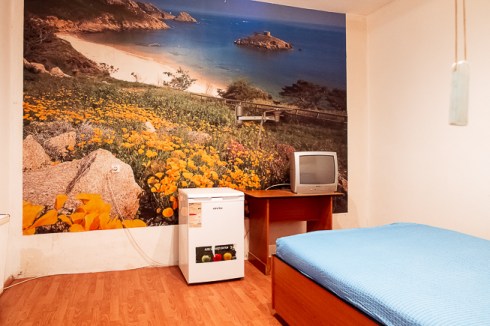
Simply put, the price for entry into Europe’s *modern* club was to allow previously-forgotten and despised convicts to get it on with their loved ones. Married prisoners and those in long term relationships have the right to one 2-hour private visit, every three months.
“Plus, if a prisoner gets married in detention he or she can spend 48 hours with the spouse in the special room and is allowed visits once a month in the first year of marriage,” explains Bumbuţ.
It’s obvious to say that these conjugal visit rooms are for sex. But it’s worth noting they are intended only for sex. In the United States, by comparison, conjugal visit trailers and designated rooms are set aside for the whole family. In these Romanian rooms, the only visitors are intimate partners but in the United States the purpose of family visits is broadened beyond just sex. Prisoners spend time with their children, siblings and parents; trailer visits are meant to strengthen family bonds throughout the entire clan. As such, US trailers have kitchens, dining and common areas.
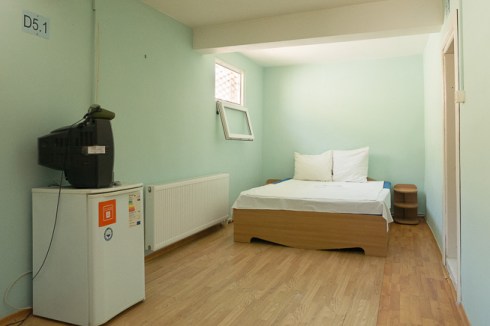
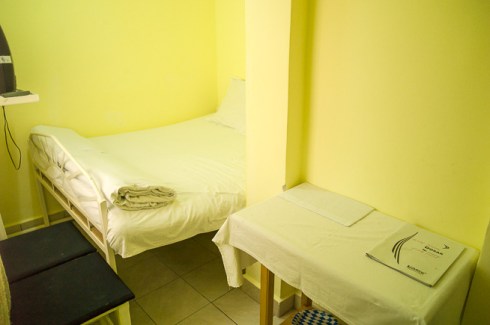
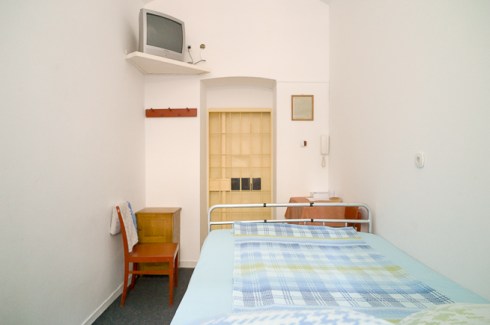
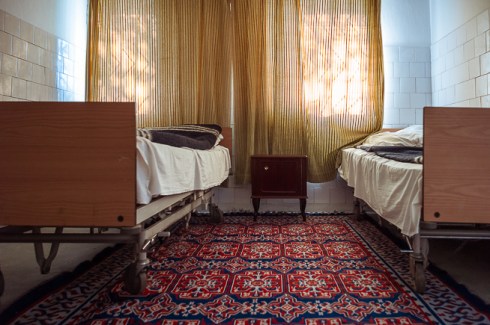
In Bumbuţ’s photos we see mostly, just the beds. For all their undeniably functional design for the carnal, these rooms are rather underwhelming. At its root, this photo essay could be of cheap motel rooms; they share the same essential elements — TV, mini-fridge, the occasional soft furnishing, nasty carpet and a sign or two reminding occupants of rules. The picture that these are prison rooms is Bumbuţ’s image of the cover page of the ‘Intimate Room’ handbook.

Between 2013 and 2014, Bumbuţ photographed the “private rooms” in all 40 Romanian penitentiaries. “I think I can boast of being the only civilian who entered all the Romanian prisons,” he says.
It wasn’t a project that came out of the blue. Back in 2009, he facilitated a photo workshop for women prisoners in Târgșor Penitentiary (more about that here). Soon after that he embarked on a multiyear project documenting life in the notorious Aiud Penitentiary. He witnessed a creaking and unsanitary lock-up trying to clean up and drag itself into the 21st century.
“In 2005, Aiud looked like a prison from the Communist era. Rooms were dirty and the walls unpainted, the cells were very small and crowded,” says Bumbuţ. “In 2008, it was renovated and the cells were expanded, the prisoners didn’t wear uniforms and were referred to as ‘Persons deprived of liberty’! Romanian prisons started to look like the ones from the American movies, with white walls and new metal shiny doors.”


Even though prisoners are still handcuffed, Bumbut has, since 2008, been prohibited from photographing cuffed prisoners. Now it’s about image as much as it is about policy. When Bumbuţ first made his request to the National Prison Administration to photograph the conjugal visit rooms, he received quick approval and thanks for his dedication and help to the prison administration programs. Bumbuţ became well practiced at working in prisons. He reduced his equipment to a camera, a lens, a spare SD card and a spare battery to get through security checks as quick as was possible (often not quick at all).
The photographer’s good-standing all changed upon the release of his book Bumbata, an anthology of his best photographs from four years of shooting in Aiud Penitentiary. (Bumbuţ and I had an extended conversation about Bumbata in 2013).
The book was considered to gritty and perhaps, even, too sympathetic to the prisoners. Either way, it was seen as a damaging depiction. From there-on out, Bumbuţ was light on his feet and diplomatic. His access was never withdrawn.


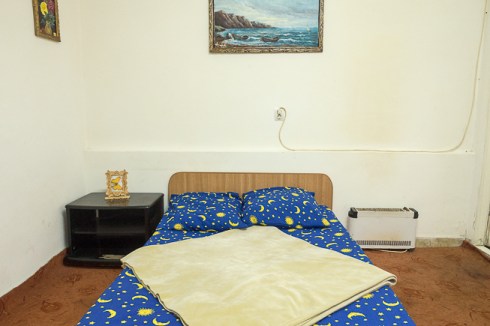
The pregnant pause within these rooms is what gives Camera Intima strength as an body of work. We look at the photographs and they ignite our imaginations about what goes on inside. When the door is open — and we and the photographer peer in — there’s nothing to see. What goes on behind closed doors will never be photographed. This tension is characteristic of good photographic series that insert themselves into the relationships of public/private space and personal/institutional power.
“Prisoners are allowed officially to have sex inside an institution, but they have to follow all the bureaucratic steps,” explains Bumbuţ, “to write a request, to wait for the approval, to obey the rules.”
Guards and the administration hold the promise of access to the rooms as a carrot to motivate prisoners toward good behavior.
“Only prisoners who behave in prison are allowed to have private visits,” says Bumbuţ. “Prisoners are more obedient when they have access to the intimate rooms.”

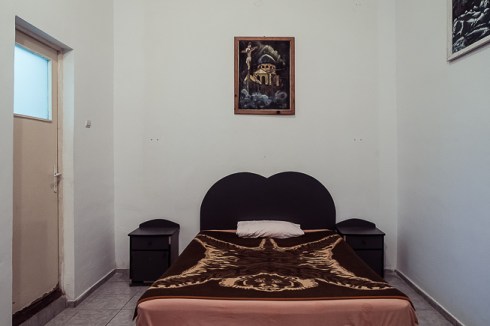

Similarly, in the U.S., conjugal visits are seen as a very effective way to maintain prisoners’ complicity, even docility. Not all U.S. prisoners enjoy regular time with their family or intimate partners. All conjugal visits are banned within the Federal system and while states are left to rule on their own prison policies, only four — California, Connecticut, New York and Washington — currently allow trailer visits. In 2014, both Mississippi and New Mexico summarily ended their conjugal visit programs.
Sometimes these decisions will be couched in language about security but more often than not the decision rests upon public opinion (outrage), the moral judgements of the administration in power and probably the bottom line. It’s cheaper to keep men and women locked in boxes than it is to provide programming.
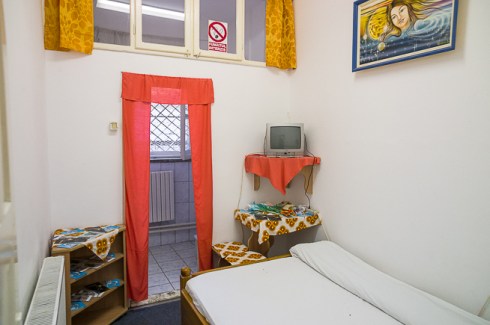
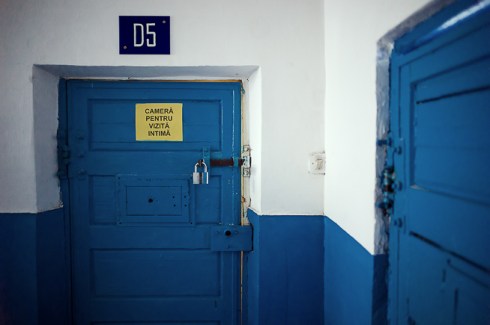
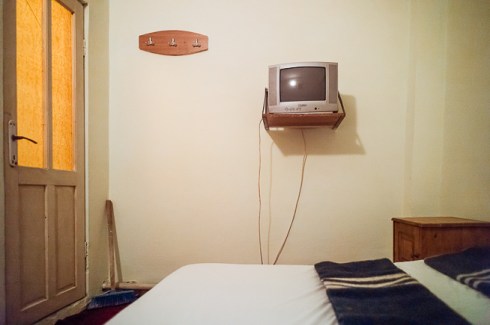
Back in Romania, it doesn’t matter what system or prison you’re in, your right to have conjugal visits is protected by law. And Bumbuţ was in many prisons when these visits took place. For a while he toyed with the idea of making portraits of prisoners and visitors.
“I even shot a couple before and after their private visit,” says Bumbuţ. “But when I looked at the portrait, I realised that it became too much about the couple and not about the intimate room.”
Bumbuţ wanted to spark our curiosity. He wanted to focus on the space and all the emotions, release, frustrations, love and contained freedom they embody.
Even though these rooms allow two humans to come together, they’re not places about individuals or individuality. They’re function spaces for the continuance of criminal justice policy. We know that given the choice, no-one would want to opt for these converted cells, cramped quarters or side-thought accommodations for their sexy time. No, Bumbuţ’s photographs are all about the denial of comfort and personal circumstance. These are compromise spaces. They’re about making do as much as they are about making out and they reveal carceral logic itself.
“So I decided to shoot the empty rooms.”
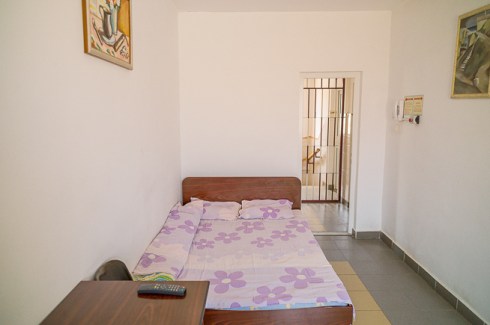
If you’re still with my these 1,300 words later, I’m glad you stayed the course and I hope I’ve convinced you that these images are more than visual one-liners. That, in fact, by photographing in every Romanian prison — 40 in total — Bumbuţ has created a unique, complete and priceless sociological survey. These four walls are the fulcrum between Romanian rule-of-law and the European Union compact; they’re the pivot of negotiation between prison and prisoner; and, of course, they’re containers for sexual expression between prisoners and loved ones. Ultimately, the rooms are the physical manifestation of contradiction.
“These are spaces for intimacy,” concludes Bumbuţ. “But, at the same time, the prison itself denies almost all desperately needed intimacy.”
In recent years, Cosmin Bumbuț and journalist Elena Stancu have traveled through Romania in an RV telling stories about today Romania, marginal communities and extraordinary people. They are Teleleu.eu. Follow Bumbuț and Stancu at the Teleleu.eu website and on Facebook, Twitter and Instagram.
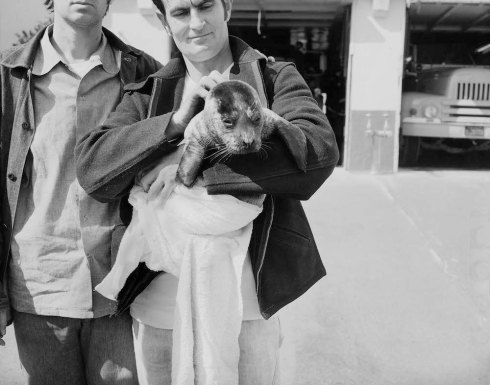
It is every artist, collector or photographer’s dream; the discovery of an archive of thousands of negatives. For artist and professor Nigel Poor, it became a reality. In late 2012, she was making a routine visit to Lt. Sam Robinson’s office in San Quentin State Prison. She’d just finished teaching her class in photo-history and collaborating on image interpretation project with her incarcerated students. Knowing her life in the medium, Robinson pulled out a bankers box.
“He lifted the lid,” recalls Poor. “Inside were hundreds of yellow envelopes that I recognized instantly as those which hold 4×5 photo negatives.”
Poor’s heart “exploded.” More than three years on, Poor has only just finished going through all the negs: she estimates there’s more than 10,000.

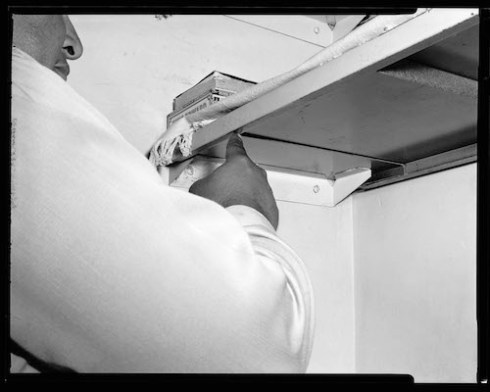
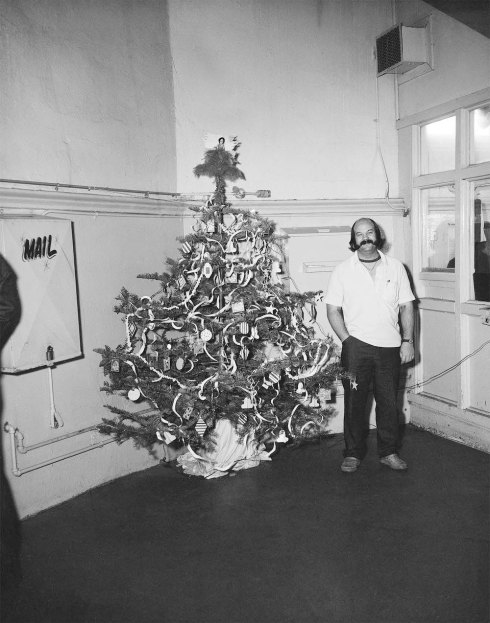
In the weeks, after the discovery, Poor took some negatives and scanned them. She showed the prints to Robinson to prove what she could do and he gave her permission to take the entire box. So far, she’s scanned about 600 of the 4×5 negs. There’s four or five other boxes still to scan and categorize.
I anticipate that there’s hundreds of similar archives gathering dust inside cupboards and administration buildings in prisons across the United States. Kudos to the San Quentin authority for empowering Poor to share the finds with a wider public. The archive ultimately belongs, in my opinion in a California State-run Museum.
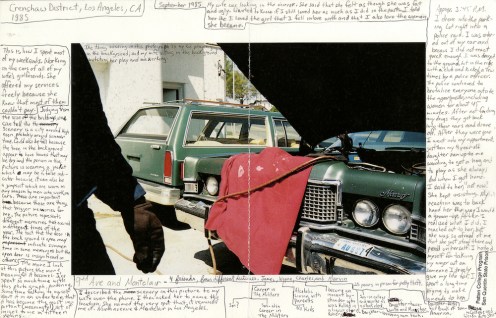


The other wonderful thing that has come out of this is that Poor is using the images as teaching aids. Just as she had done with iconic images from art history (see the William Eggleston, Lee Friedlander and David Hilliard images above), Poor asked her students to deconstruct, examine and interpret the newly-found images from the San Quentin archive. After she had scanned and printed them on card-stock with large white borders, Poor gave them to the men to interpret.
She has given the prisoners first go at interpreting San Quentin’s history. They are writing the latest stories of a very-storied institution.
Read my article about the archive discovery Rarely Seen Images of the Real San Quentin on the Marshall Project. The article was also cross-posted to The Atlantic — Unearthing San Quentin: Resurrected photos capture moments of daily life at the California prison.




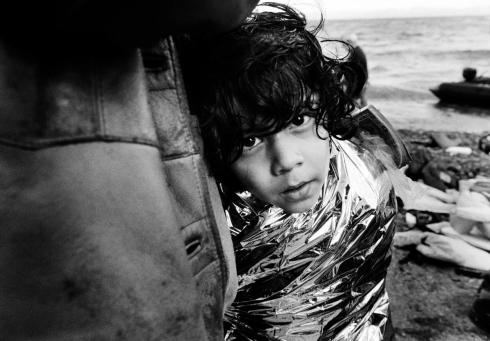
A boy from Afghanistan tries to keep warm after a cold and wet crossing from Turkey. Cases of hypothermia are on the increase as the weather deteriorates across the eastern Mediterranean.
In an image saturated world it’s difficult to define and measure the effects of photographs. We know advertising works, but those are images intended to sell us stuff. What if the purpose of a photograph is to “sell” us of a moral or political point? What if a photograph wants us to shift our emotional and practical response to far away events?
Giles Duley’s work Lesvos: Crossing To Safety made in Greece last October are intended, firstly, to bear witness and, secondly, to provoke action to help the hundreds of thousands of migrants. That’s why he didn’t simply make images and send them to the wires, but he courted the support of the United Nations so that he might extend the distribution of his images — and the refugees’ stories — far into global, humanitarian dialogue channels. (This UN-produced feature on Duley’s career and motivations is very thorough.)
Not content with only traditional distribution channels, Duley looked for alternative ways of launching his images into an unorthodox space; a Massive Attack gig.
“The scenes were overwhelming,” Duley said to the UNHCR. “In all the time I’ve worked, I’ve never seen such emotion and humanity laid so bare as I witnessed on the beaches of Lesvos. One of the first emails I sent was to the guys in Massive Attack. Seeing such events, I felt so powerless, I needed to do something. At that stage I had no idea how the collaboration would work, but I knew the band would want to act.”


Stills of Giles Duley’s photos on screen behind the stage of Massive Attack. Courtesy: Massive Attack.
A founding element of the era-defining Trip Hop genre, Massive Attack are known for taking forthright stances on political and governmental behaviours. Saturday Come Slow, their collaboration with released British Guantanamo detainees, Broomberg & Chanarin and Damon Albarn was poignant, crafted and clever, I thought.
Furthermore, as Alexis Petridis wrote for the Guardian, “Massive Attack have worked with the Stop the War coalition and visited refugee camps in Lebanon, while in 2011, Del Naja and Radiohead’s Thom Yorke threw a party for Occupy protesters who had taken over a UBS bank building in London.”
It’s not surprise Massive Attack are lending their support to Duley and shocking their euphoric crowds with thumping reality. Duley’s images loop throughout the gig, but they get their biggest showing at the close of the show, when the music ends and the band leaves the stage. For minutes — in silence — the crowd is shown a mammoth slideshow of Syrians and other migrants landing in boats, hungry, tired and terrified. A far cry from the revelry of a gig. But people stayed. This Channel 4News segment is well worth the watch:
History has taught us that photos can certainly alter the mood of entire populations. Practice has also taught us that earnest, targeted messaging can help photos land. I hope more artists can lend a hand to serve the messages of humanitarian photographers. Usually, professionals commission images to be made to meet their own messaging needs so it’s great to see artists, citizens and successful public figures provide space within their platforms to amplify photographer’s voice.
Included here are Giles Duley’s images from Lesvos, Greece, made in October 2015.

An overcrowded boat carrying Syrian refugees heads to shore. One Syrian man had fallen from the boat into cold water. He was later rescued by volunteer Spanish lifeguards. Despite the approach of winter and worsening weather, refugees are continuing to arrive on the island at a rate of more than 3,200 per day. As of mid-November, at least 64 people have drowned this year in 11 shipwrecks off Lesvos.

Boat after boat lands on the coast of Lesvos between Eftalou and Skala Sykaminia. Over 45 per cent of the 836,088 refugees and migrants who have arrived in Europe so far in 2015 have landed on this Greek island, which is separated from Turkey by a 10-kilometre channel.

An Afghan mother holds her child moments after landing on the beach near Skala Sykaminia. UNHCR and its partners work to prevent family separations and create safe areas for women and children who are particularly vulnerable.

An Afghan family of several generations disembark from an overcrowded boat. Almost 40 per cent of refugees currently arriving on Lesvos are from Afghanistan.
–
UNHCR is working around the clock with other agencies and aid groups, stockpiling and distributing winter aid items to keep vulnerable people, both in camps and urban settings, protected and warm. Donate money to the UNCHR (United Nations High Commission for Refugees) here.
• The distribution of winter survival kits including high thermal blankets, sleeping bags, winter clothes, heating stoves, and gas supplies.
• The provision of emergency shelters including family tents, refugee housing units and emergency reception facilities.
• Improvement of reception and transit centers and preparing and supporting families for winter conditions.
You can help make a difference. Donate money to the UNCHR (United Nations High Commission for Refugees) here.
–
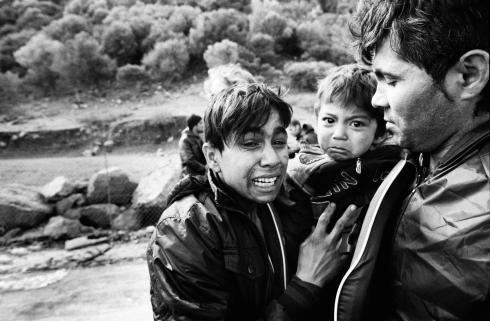
A relieved Afghan family, clearly still suffering from the trauma of a rough sea crossing at the hands of people smugglers, disembarks from a flimsy vessel onto a Lesvos beach.

An Afghan mother hugs her child and cries with relief after arriving on Lesvos.

Survivors struggle ashore after their boat has capsized. In the background a Spanish lifeguard, one of the many volunteers working on the beach, swims out to help other survivors.

A Syrian father, his two children now safely wrapped in thermal blankets, looks to the heavens in thanks after landing safely on the beach.
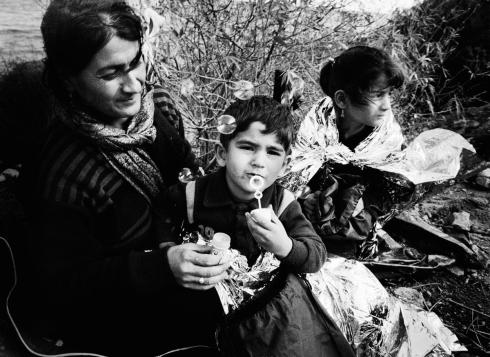
A young Afghan boy with his aunt. His mother is receiving emergency medical treatment after she collapsed upon landing. Since August UNHCR, in close cooperation with the Greek authorities and other humanitarian actors, has considerably stepped up its activities to respond to the increasing needs. This is even more imperative with the onset of winter.

Volunteers prepare to wrap a young girl in an emergency blanket to protect her from the cold wind.
–
Follow UNHCR on Instagram, Twitter and Facebook. Donate money to the UNCHR (United Nations High Commission for Refugees) here.
Read ‘War Survivor Focuses Lens on Refugees‘ about Duley’s work in Greece. Reacquaint yourself with the ‘Lesvos: Crossing to Safety‘ feature. Read a review ‘How Many Stories Can You Tell In One Second?‘ of Duley’s new book One Second of Light.
Connect with Giles Duley on Facebook, Twitter, Linked In and EW Agency.

The quiet violence of an arranged marriage – a bride is taken by her female relatives to her husband’s home on the outskirts of Kano on April 13, 2013.
Unfortunately, the majority of news stories coming out of Northern Nigeria in recent years have been about the Islamic terrorist group Boko Haram (whose name translates as “western education is forbidden”) but of course there’s much more complexity and tolerance within the society than Boko Haram’s perverse and hardline view of earthly existence. Centered in the city of Kano, there’s a small but significant contingent of hijab wearing ladies writing subversive romance novels.
These women, their lives, aspirations and works are the focus of a new–and somewhat unorthodox–photobook by Glenna Gordon who met dozens of authors. They write in Hausa, a Chadic language spoken by 50 million people, but their work rarely gets beyond the regions borders. Some translations of the novels appear in English for the first time in Gordon’s book. It is called Diagram of the Heart, published by Red Hook Editions and hits the shelves on February 11th.
–
I reviewed the book for Time Lightbox in a piece titled Anatomy of a Photobook: Diagram of the Heart, by Glenna Gordon.
“What if a photo of a woman writing a book was as important as a photo of a man fighting a war?” asks Gordon. “What would our foreign policy objectives be? How would we understand and conceptualize places and people we haven’t personally encountered? It often seems to me that fear is one of the driving forces behind the way America interacts with the rest of the world, especially the Muslim world. What if we filled those blank spaces onto which we project stereotypes with visualizations of the specific textures, colors and nuances of a life that is lived on terms different than our own?”
Read the piece in full: Anatomy of a Photobook: Diagram of the Heart, by Glenna Gordon
–
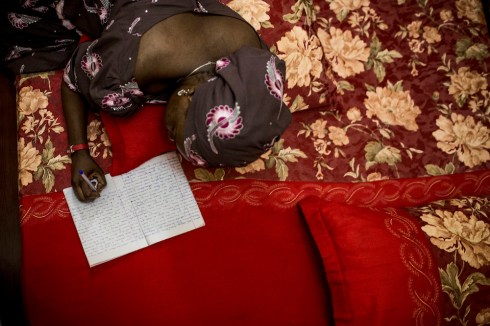
Khadija Gudaji works on her novel while laying in bed at her home in Kano, Northern Nigeria on September 29, 2013.
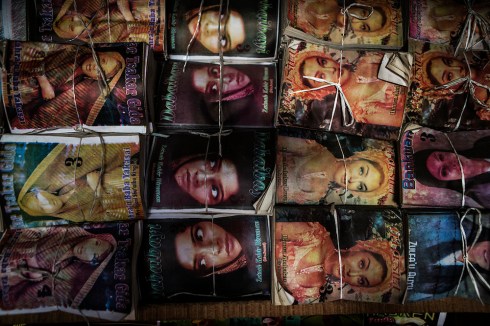
Books are tied up and packaged at the local market in Kano, Northern Nigeria on October 4, 2013. While Northern Nigeria is best known for Boko Haram, an Islamic terrorist group whose name means ‘Western Education is sinful,’ there’s a small but significant contingent of hijab wearing ladies writing subversive romance novels.

Rabi Tale, a popular novelist, in the courtyard of her office at the Ministry of Information on October 3 in Kano, Northern Nigeria. She is one of the few novelists who has a “day job” in an office. Many men allow their wives to write because they can do so without leaving the house.
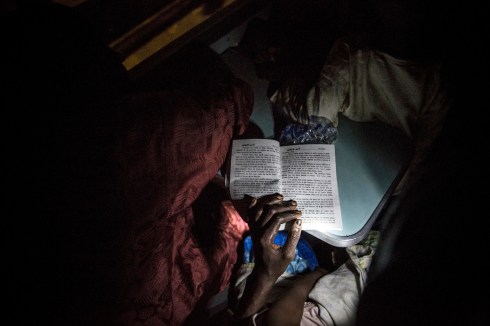
A woman reads a Hausa romance novel using the flashlight on her cell phone on a train crossing Nigeria on August 21, 2015.

The wedding Fatiah, or party, of Maryan Nazifi, in Dawakin Tofa, another small town outside of Kano on November 8, 2014. Most of the time, men and women live very separate lives in Northern Nigeria and marriages are the main point of interaction.

Ahmed Adama, age 35, had wanted to marry Jamaila Lawan, 22, for more than a year when he heard about the mass wedding program organized by the Hisbah, the Islamic morality police in Northern Nigeria, who also censor the novels. They pose for a portrait at their home in Kano, Northern Nigeria, on October 7, 2013.

A woman poses for a portrait at the Office of Enlightenment at the Hisbah, the Islamic morality police, on August 17, 2015.

Firdausy El-yakub reads a romance novel in her bedroom in Kano, Northern Nigeria on March 21, 2013. Her university has been on strike for weeks, so she spends most of her days reading and dreams of one day becoming a novelist too. Her father allows her to go to the market and buy new books often.
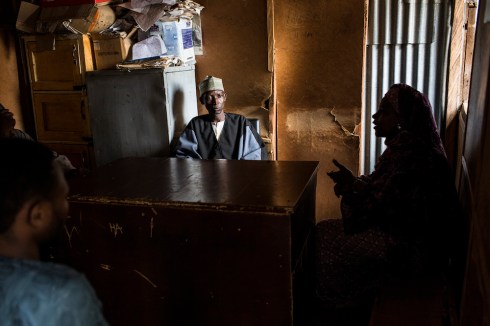
An officer of the Hisbah, the Islamic morality police, adjudicates a family dispute in Kano, Northern Nigeria, on August 17, 2015.
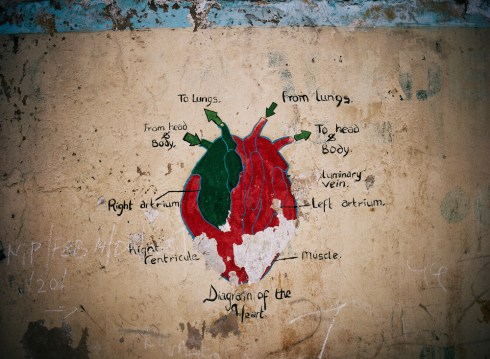
The diagram of a heart drawn on the outside of a school in Kano, Northern Nigeria on February 26, 2014.

Farida Ado, 27, is a romance novelist living in conflicted and rapidly Islamicizing Northern Nigeria. She’s one of a small but significant contingent of women in Northern Nigeria writing books called Littattafan soyayya, Hausa for “love literature.” She poses for a portrait at her home in Kano on April 15, 2013.

Liquidation Sale VII, 2000. Mitch Epstein New Orleans Museum of Art, Louisiana II, 2005. Mitch Epstein
–
After six months of media pantomime and make-America-proud electioneering, the U.S. presidential scrap finally kicked off last night. At last, we got to the beginning of the start of the business end of choosing the candidates who are to duke it out in November.
The Iowa Caucuses threw up some winners and some losers, but I was most interested in how the billionaire Trump bombed and how avowed Socialist Bernie Sanders went toe-to-toe with the SuperPAC-fuelled Hillary machine.
Strangely, early in the races, news commentary threw Trump and Sanders in together as outsiders and insurgents. They both represented challenges to political orthodoxy. Bernie adheres to the principles of leftie politics; he’s almost by-the-book socialist. A pure version of the left. (Whether Trump is the pure version of rightwing politics, I’ll leave to others to debate. He does seems to have taken conservatives’ hatred to it’s extreme.)
Presidential campaigns invariably come down to economics and 2016 has proved no different. The United States is more than seven years on from the Great Recession and yet still wealth disparity is at the forefront of political debate. Either we (oil) barrel our way out of economic malaise hoping that everyone wins a piece of the wealth-pie or we seek to tax the United States’ gradually growing economy to redistribute the wealth.
Iowa was fascinating because it was the first taste of how voters think about daring approaches to national fiscal management. Trump, an anti-establishment bully of capitalism, lost out in the Hawkeye State whereas Sanders, the optimistic, social program-loving senator held his own.
In this moment, we must remember that the term “The 1%” did not exist in public lexicon before the Occupy Movement. Sanders resonated because he faces the economic facts. We know the economic gap is larger than ever before. What’s this got to do with photography? Well, depicting economic forces and inequality is no easy task. Not one image can do it, but perhaps a collection can. No collection does it better than Myles Little’s 1%: Privilege in a Time of Global Inequality.
In a follow up to my article Photos of the 1% and the Interests They Protect and to mark the occasion of Lyttle’s exhibition making it to book, I have shared Geoff Dyer’s introductory essay on Vantage.
–
Geoff Dyer on Globalization, Inequality and Photography
This resilience [as read in Lange and Evans’ photographs] was easily incorporated into the ideology of ceaseless endeavour that continues to underpin the system of exploitation that condemned them to destitution in the first place. It’s just that now, instead of loading up your jalopy and heading for California, you take a second, badly paid job; The Grapes of Wrath has turned into Nickel and Dimed. The iconic photographs of the Great Depression, meanwhile, have acquired a kind of stonewashed glamour.
Read the piece in full: Geoff Dyer on Globalization, Inequality and Photography
–

Refugees arriving on Kos, Greece, in August 2015. Jörg Brüggemann—OSTKREUZ 

Untitled #5, from Hedge. 2010. Nina Berman—NOOR

Opéra de Monte-Carlo, Monte Carlo, Monaco. 2009. David Leventi

Untitled #IV, Mine Security, North Mara Gold Mine, Tanzania. 2011. David Chancellor
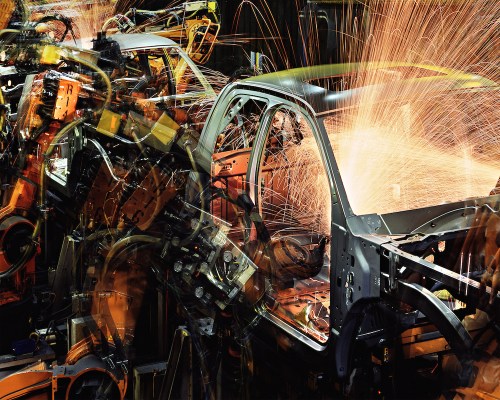
Chrysler 300. 2007. Floto+Warner 
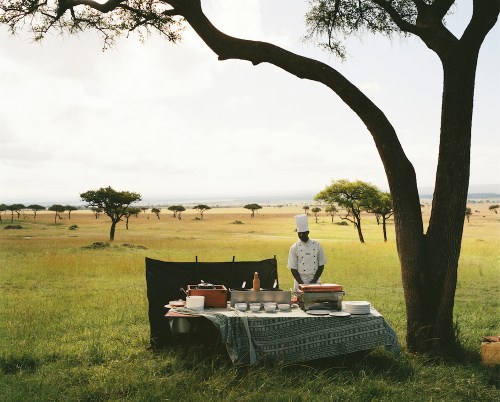
A chef from a nearby luxury lodge waits for his guests to arrive from a hot air balloon excursion before serving them champagne in the middle of the Maasai Mara National Reserve, Kenya. 2012. Guillaume Bonn—INSTITUTE

Tong, aged twenty-nine, poses for her wedding pictures at Princess Studio, a wedding photo studio in Shanghai, China. 2013. Guillaume Herbaut—INSTITUTE 

Jeff Koons, Stedelijk Museum, Amsterdam. 2012. Henk Wildschut

Cole Haan, Chicago, IL, 2013. Brian Ulrich

Looking East Over Unbuilt “Ascaya” Lots, Black Mountain Beyond, Henderson, NV. 2010. Michael Light

Rivoli Theater, Berkeley, CA, 2013. Opened as a cinema and performance space in 1925, closed in the nineteen-fifties. Subsequently used by various supermarkets. Yves Marchand and Romain Meffre 

A twenty-five-year-old British man in London undergoes surgery to reduce the size of his nose. 2011. Zed Nelson
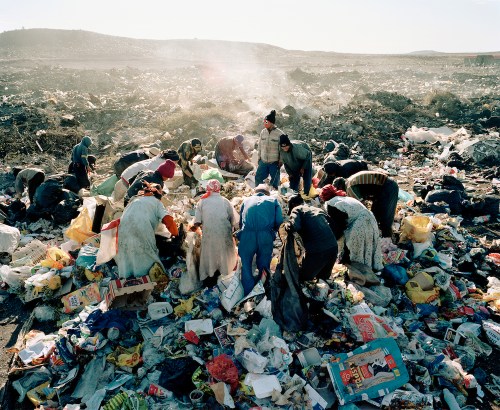
Residents, Vaalkoppies (Beaufort West Rubbish Dump), 2006. Mikhael Subotzky, courtesy Goodman Gallery
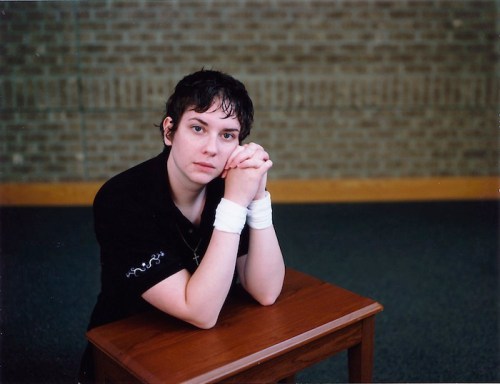
Photo: Kristen S. Wilkins, from the series Supplication
–
Bit of housekeeping folks! I need to let you know three things about Prison Obscura:
- Prison Obscura is going to Washington State.
- Prison Obscura is going to Oregon.
- Prison Obscura will be retired in June, 2016.
WASHINGTON
The exhibition opens at Evergreen State College in Olympia Washington this Thursday, January 16th, from 4pm-6pm. I’ll be there giving a curator’s talk.
Evergreen is hosting Prison Obscura as part of Kept Out/Kept In, a series of talks, shows and presentations examining carceral culture.
–

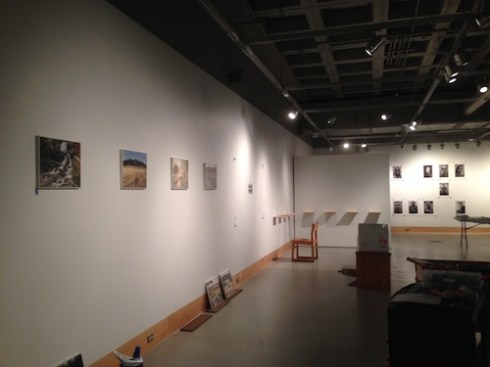
Prison Obscura Installation in progress, Evergreen State College.
The show is up January 14 – March 2 at Evergreen Gallery, Library 2204, Evergreen State College, 98505 (Google Map)
–
OREGON
Between April 1 – May 28, Prison Obscura is on show at Newspace Center for Photography in Portland, Oregon.
Mark your calendars waaaaaaay in advance for the opening reception 6-9pm on Friday, April 1st (no joke). I’ll be in Portland all weekend, giving a curator’s talk at the opening and then convening with others for events and panels.
1632 SE 10th Ave., Portland, OR 97214. (Google Map)
–
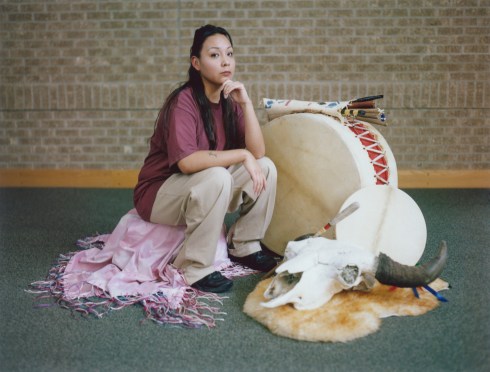
Supplication #4, Landscape. From the series ’Supplication.’ “The Pryor Mountains. It is so special to me because I am from Pryor and I miss home. Castlerock at sunset.” Photo: Kristen S. Wilkins.

Supplication #4, Landscape. From the series ’Supplication.’ “The Pryor Mountains. It is so special to me because I am from Pryor and I miss home. Castlerock at sunset.” Photo: Kristen S. Wilkins.
–
RETIRING ‘PRISON OBSCURA’
To say that the Cantor Fitzgerald Gallery at Haverford had never travelled a show before, they–namely Matthew Callinan–have done a magnificent and utterly-indispensible job in administering Prison Obscura over what will be seven venues.
I didn’t know exactly what was involved in traveling a show such as this and I’m so so grateful that Callinan had the support of his peers at Haverford College to produce an exhibition that could stretch beyond Philadelphia where it all began. We learnt together.
It’s been a great run. After Olympia and Portland though, it’s time to say goodbye. I celebrate Prison Obscura‘s unexpected and gratifying success, but I know that after 2-and-a-half years, it’s time to move energies on to other things. I need to step back and to think about what next, if anything, is appropriate for a prison-based exhibition.
There are massive amounts of vital work and organizing being done around prison activism, policing, power and community-empowerment. I’d like to learn more; take the time to hear and see. Observe and act more; perhaps talk and type less–for a while, at least.
No doubt, I’ll have more to say when Prison Obscura wraps up in Portland, the final show, toward the end of May. For now, I hope that if you are in the Pacific Northwest you’ll be able to check out the show and engage with the ideas its artists propose. Thanks to Alyse Emdur, Robert Gumpert, Steve Davis, Mark Strandquist, Kristen S. Wilkins, Josh Begley and Paul Rucker and the City of Philadelphia Mural Arts Program and the men of the Restorative Justice Project at Graterford Prison.
–

 Prison Photography