
You are currently browsing the category archive for the ‘Documentary’ category.
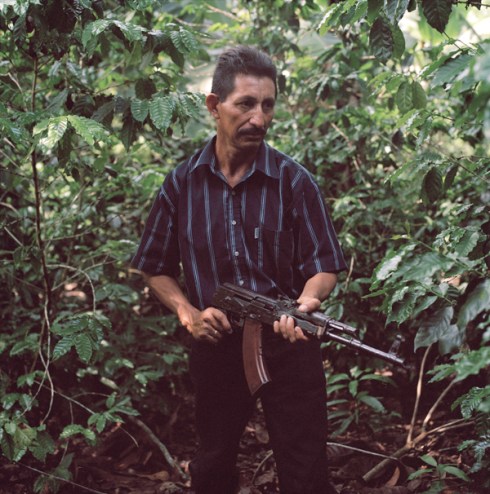
In 1979, after over a decade of struggle, the socialist Sandinista movement in Nicaragua overthrew the famously corrupt dictator, Anastasio Somoza. The Sandinistas quickly began the work of applying their social and ideological values in the hopes of creating a better Nicaragua. Amid the rhetoric of the cold war, the US had different ideas – it mobilised the Contras, a CIA financed, armed and trained clandestine rebel insurgency against the fledgling government.
Kevin Kunishi has just won the 2011 Blue Earth Alliance Award for his series Los Restos de la Revolución.
“This series consists of portraits of Sandinistas and their opposing Contra veterans, as well as artifacts and landscapes significant to that volatile era. Although these two sides held polarized political philosophies, both in their foundation and practice, their survivors are united by the burden of a war-torn history,” says Kunishi.
Powerful stuff.

Comstock, NY State Prison. © Stephen Tourlentes
Tom Griggs, the man at the helm at Fototazo has just published an interview with Stephen Tourlentes.
Aware of two earlier interviews with Tourlentes by Jess T. Dugan and myself, Griggs proposed he stitch information from those together with new questions and answers to fill the gaps and bring the reader up to date. The result is a very comprehensive, crowdsourced Q&A about Tourlentes’ photography and politics.
“[We must] find better ways to deal with poverty, education and human rights. The prison system in the US has grown at the expense of funding education, public health and investing long term in sustainable community initiatives that combat crime.”
“In my view we have an extremely complicated history in the US. Contradictions abound. Along with brilliant success and economic power we have built a prison system that holds 24% of the world prison population even though the US represents only 5% of the worlds population. In a country that holds it’s constitutional freedoms so dear we are the best in the world at locking people up.”
FOTOTAZO
Fototazo is a new philanthropic venture on the block. It raises funds to purchase equipment for young, emerging photographers from economically disadvantaged backgrounds from around the globe.
Fototazo will snag your interest with in-depth interviews and portfolios of new work by selected contemporary photographers. Hopefully, you’ll reciprocate with some spare change for the grants, the monies of which go to those building careers in photography and whose development is limited by an inability to purchase necessary equipment.
© Natalia Lopera
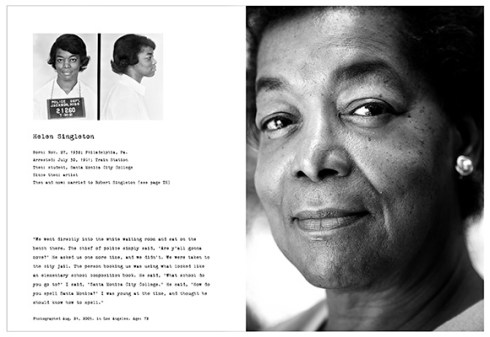
Born: November 27, 1932; Philadelphia; Arrested July 30, 1961; Train station, Jackson; Then: Student, Santa Monica City College; Since then: Arts administrator, now retired; Then and Now: Marrried to Robert Singleton; Photographed: August 24, 2005; Los Angeles. © Eric Etheridge
I’ve been meaning to write about Eric Etheridge’s project Breach of Peace for too long. This year marks the 50th anniversary of the Freedom Riders and their key 1961 victory for civil rights.
Today, the anniversary of Dr. Martin Luther Kings 1968 assassination, is an appropriate moment.
Firstly, a brief history of the Freedom Riders, as told by Etheridge:
In the spring and summer of 1961, several hundred Americans — blacks and whites, men and women — entered Southern bus and train stations to challenge the segregated waiting rooms, lunch counters and bathrooms. The Supreme Court had ruled that such segregation was illegal, and the Riders were trying to force the federal government to enforce that decision.
Though there were Freedom Rides across the South, Jackson soon became the campaign’s primary focus. More than 300 Riders were arrested there and quickly convicted of breach of peace — a law many Southern states and cities had put on the books for just such an occasion. The Riders then compounded their protest by refusing bail. “Flll the jails!” was their cry, and they soon did. Mississippi responded by transferring them to Parchman, the state’s infamous Delta prison farm, for the remainder of their time behind bars, usually about six weeks.
A few days after the last group of Riders were arrested in Jackson, on September 13, the Interstate Commerce Commission issued new regulations, mandating an end to segregation in all bus and train stations.
Etheridge’s book Breach of Peace: Portraits of the 1961 Mississippi Freedom Riders features his new portraits of 80 Riders and the mug shots of all 328 Riders arrested in Jackson that year, along with excerpts of interviews with the featured Riders. (See the Breach of Peace archives here)
The Mississippi Museum of Art is showing the mugshots of all 329 Riders arrested in Jackson as a giant, 54′ long mural, along with 20 of Etheridge’s portraits (March 19 – June 12). Free to the public.

Breach of Peace: Portraits of the 1961 Freedom Riders installation, Mississippi Museum of Art, March 2011
Etheridge’s work is a continuing multi-year effort. Through interviews and his camera, Etheridge gives his subject the opportunity to return to their political heroics. For those alive in the sixties, Etheridge’s work is an antidote to historical amnesia and for those who weren’t it’s an education.
KING’S GIFT TO HISTORY; A POLITICAL PHILOSOSPHY NOT TO BE FORGOTTEN, ALWAYS TO BE ACTED UPON
And so to King, whose politics are as relevant today as they were 43 years ago. As Jim Johnson reminds us, at the time of his assassination, King was in Memphis in solidarity with sanitation workers, who were striking the city not just for decent pay and working conditions but for recognition of their right to form a union. In light of the concerted, ongoing campaign by Republicans to subvert unions, it surely is plausible to wonder how far we remain from the promised land.
History is very important. Despite their self-label, progressives look back in time as readily as conservatives to pinpoint historical moments to justify their politics. Progressives look to the golden era of people power and the Peace Movement, conservatives hark back to the space-race and Reaganomics.
When history is at our backs, we must choose to leave it behind or let it propel us forward. In the case of the Civil Rights movement, its lessons should be forever in America’s conscience. The work toward social and economic equality is not yet complete, not by a long distance.
We have choices to make and a society to shape.
Which brings me to this potent image of the back of James Earl Ray, who was Dr. Martin Luther King’s assassin.
While hundreds of thousands were marching on the streets and millions across America swelled the turning political tides, James Earl Ray choose a different worldview.
Regardless of colour or creed, Martin Luther King’s promised land was for all … and for a better America. No doubt James Earl Ray was a troubled man but his rejection of America’s sea-change thrust him only in the direction of a dead-end.
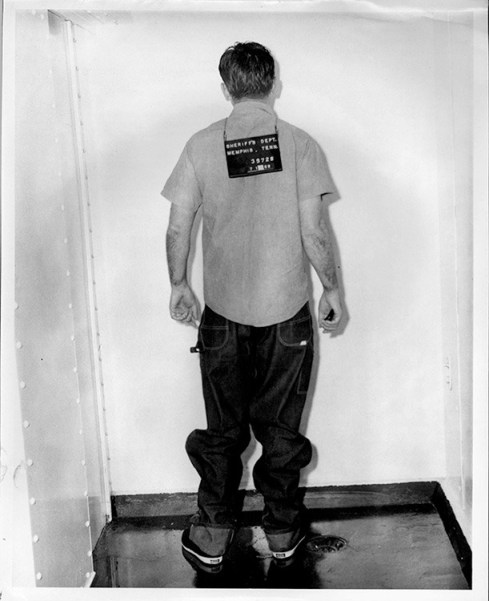
James Earl Ray facing the wall at Shelby County Jail. Photo by Gil Michael/Shelby County Sheriff’s Office
As Etheridge explains this is not an act of defiance. Shoved into a Shelby County Jail cell, Ray faces the reality upon him; the physical finality of confinement with nowhere to go. As he abandoned history, so history moved on without him.
TO END ON A GOOD NOTE
REMEMBER.
INSPIRATION, LOVE AND GOOD HEARTS ARE NOT FORGOTTEN BY HISTORY

Bob Gumpert‘s Locked and Found portraits are on show at HOST Gallery for the next month (April 7th – May 7th).
On the 13th April, there’s a panel discussion on three different projects made in, around and about jails and prisons, with Bob, Edmund Clark and Guardian writer Erwin James.
HOST’s blurb:
Robert Gumpert has been documenting the criminal justice system in San Francisco since 1994. We are delighted to bring his matchless archive of convicts, cops and courthouses to HOST gallery, where it will be exhibited for the first time in the UK.
Gumpert’s project began with an idea to photograph a homicide detective, but quickly expanded to cover numerous other aspects of the criminal justice system. After he exhibited the work in San Francisco in 2000, he thought that was the end of it, until he received a call from the sheriff’s office. California’s oldest jail was about to close, and for Gumpert, whose photographic roots were planted in the social activism of the 70s, this was a piece of history he felt compelled to document.
“‘Old Bruno’ was built in 1934 as an example of progressive incarceration, but it had become a toxic dump of a place where deputies and prisoners where expelled. Over the years the courts had ordered its closure and finally in August of 2006 everyone moved to the adjacent new Bruno. I documented the old jail, its closing and the opening of the new one,” says Gumpert, who then sought and received permission to continue his photographic quest across six county jails.
As his work progressed, so too did his attitude towards his subjects, the majority of whom were incarcerated men (he also photographed police officers and prison guards). From an ‘us and them’ relationship, his modus operandi evolved to one of participation, as Gumpert conducted audio interviews with everyone he photographed, in a kind of reciprocal exchange: a picture for a story.
Robert Gumpert has been working as a photographer since 1974, when he documented the coal miners’ strike in Harlan County, Kentucky. Since then he has worked on a series of long-term projects, including studies of the US criminal justice system and emergency health care in the United States.
For more information contact Anna Pfab on anna [at] foto8.com or 020 7253 2770.
HOST Gallery, 1-5 Honduras Street, EC1Y 0TH, London,UK
Paraphrasing the introduction to Domestic Slavery: The cold and stark photographs of ordinary-looking buildings in and around Paris by Raphael Dallaporta are combined with Ondine Millot’s texts to become chilling portraits of hidden agony. The texts describe what went on in these photographed buildings, confronting the viewer with stories of abuse and cruelty, forcing us to consider the idea that behind the façade of the ordinary can lie a discomforting reality. […] Domestic Slavery bears witness to the banality of everyday inhumanity.

Some of the stories in Domestic Slavery are harrowing, and in some cases not least because the abusers are women, or a collection of individuals from the same extended family. These are tales of evil made normal.
From Domestic Slavery:
“For four years Violette slept without a mattress on the tiled kitchen floor of an apartment in the 13th arrondissement in Paris. Her work timetable was carefully planned. In the morning, she got up at 4am to prepare breakfast for Sahondra, her employer, and her son; afterwards, she travelled into central Paris where, at 6am, she began work for a cleaning company run by Sahondra’s brother-in- law; at 10am she returned to Sahondra’s apartment where she did the housework and prepared lunch and dinner; at 4pm, she travelled to Massy-Palaiseau – about 20kms from Paris – where she cleaned the apartment of Mamy, Sahondra’s brother. When she returned to the 13th arrondissement around 10pm each day, there was more work: a pile of washing-up or ironing kept her busy until midnight, either at Sahondra’s or in her sister’s next-door apartment. For four years, during which time she was hardly fed, Violette worked 18 to 20 hours a day. She had left Madagascar aged 22 in the hope of earning enough money to feed her child, who she left behind. During the whole ordeal her four employers paid her nothing.”
“With the aid of the CCEM, the Committee Against Modern Slavery, she took her employers to court. Her case was heard in 1999 in Paris and it became the first-ever case of modern slavery dealt with in France under penal law. Her employers were ordered to pay Violette €22,900 in damages and interest; they were also fined and given suspended prison sentences.”
PHOTOGRAPHING SCENES OF UNLAWFUL ACTS
The type of sorrowful external view (long after the matter) employed by Dallaporta brought to mind Angela Strassheim‘s stake-out street shots of former crime-scenes for her series Evidence, of which I have written about previously. The two leave me feeling so differently however, I’d like to explore the reasons.
Both Dallaporta and Strassheim found their building-subjects due to information on public record following judicial process/trial. Neither photographer makes effort to show the architectures as extraordinary – because they are not. Yet, Dallaporta’s photography leaves me morose and confused about the human condition. I think it has something to do with closure – or lack of – in each of the projects.
Strassheim’s work leads the viewer through the crime. In the titles, she lists the weapons used. Strassheim shows us the traces of metals, that are traces of DNA, that are traces of blood, not only by being their but by using specialist forensic techniques. She literally reveals the marks of homicides.
Strassheim’s effort is two-fold in showing us the evidence but more crucially the conclusion of violence. It was bloody murder, but it was brief and it is over. Dallaporta’s works on the other hand don’t offer me an out. I am not mollified by the idea that this was a collection of one-off final acts. Often the buildings are only one of multiple sites of abuse.
I have no idea about the prevalence of domestic slavery in France, but I presume it is no different to other Western nations. If I need homicide figures I can find them, but if I want figures on illegal imprisonment and servitude I’m at a dead-end. Dallaporta’s work is an attack on our complacency.
In describing the bare details of each abuse, Dallaporta and Millot succeed in positioning domestic slavery as anywhere and everywhere; they present it as a national issue and as everyone’s problem. Domestic Slavery might just be the harshest indictment of absent community in our societies. Dallaporta’s work certainly plays on the unknown.
Inside of me, Domestic Slavery induces fear of the unknown. I can understand murder – it has been explained to me since I was a young child – but I do not understand modern slavery. Dallaporta’s work brings that to bear and, for me, that it is what makes Domestic Slavery so successful.
“I hold this slow and daily tampering with the mysteries of the brain to be immeasurably worse than any torture of the body”
– Charles Dickens, American Notes, (Harper & Brothers, 1842) p. 39
If we are to understand how and why prisons function in modern America, it is helpful to know their history. As many of you will be aware there was a time in Western societies when prisons were not the primary form of punishment; instead jails were used for short sentences for disturbing the peace, debt, being poor and as a means to hold people before trial.
Likewise, prisons have not always used solitary confinement. Solitary today is used to punish (sometimes minor) infractions within a prison or to isolate inmates during an investigation/following an incident. Its use differs institution to institution.
Needless to say, on any given day in America 20,000 people are held in solitary despite scientific proof it damages the psyche and regresses basic functioning.
With that in mind, the origins of the practice are pause for thought. In the above video, Sean Kelley, Program Director at Eastern State Penitentiary outlines the history of the famed prison in Philadelphia, and its evolution of the practice of solitary confinement.
PRODUCTION
‘The Invention of Solitary‘ was produced by Muralla Media Works headed up by Chris Bravo and Lindsey Schneider.
Bravo and Schneider are involved in several projects and as such I’d describe them both as media activists. They’ve produced advocacy video for incarcerated women and for the mentally ill in prisons. They were also videographers at the ‘Fighting Prisons’ panels at the 2010 US Social Forum.
Their largest current project is CONTROL, a feature-length documentary that tells the story of youth whose lives have been caught in the web of the criminal justice system. View the trailer.
With audio-visuals as their material, it is interesting that they also muse – through the SILENCE OPENS DOORS webzine on the history and philosophy of silence & noise.
Which brings us full circle – read the SILENCE OPENS DOORS blog post about The Invention of Solitary.
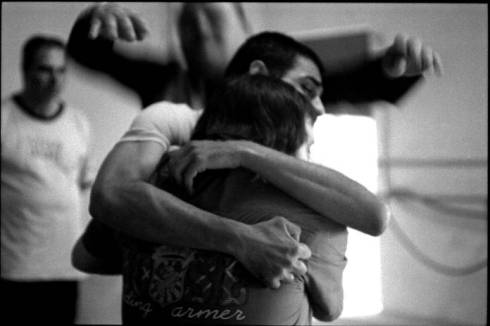
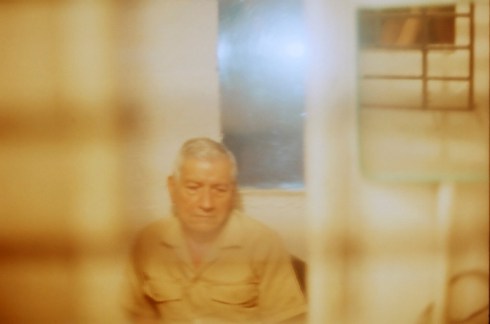
Between May 2007 and February 2008, Valentina Quintano documented O.P.G. Filippo Saporito (OPG), asylum for the criminally insane in Aversa, Italy. The series it titled ‘White Life Sentence‘ a term used by inmate-patients for indeterminate confinement.
O.P.G. Filippo Saporito (Google translation) serves the functions of both prison and mental health institution and as such has severe problems due to the often conflicting needs of two types of management. As recently as March 2011, sexual abuse crimes by staff have been reported in the Italian courts.
In the following interview with Valentina, she details her motives, the complex and unjust legal entrapment of many inmate-patients, their reactions to journalists and the ambient visual culture of OPG.
INTERVIEW
Why take on this subject?
A criminal mental asylum is an hybrid of two total institutions, it’s both a jail and a criminal asylum. It is a paradox to think that people in need of being cured are “helped” by being jailed. I wanted to bring light to the living conditions of the people whose recovery is made impossible in such institutions; they are just marginalized and hidden, as if the problem will disappear by pretending is not there. I aim to show something that most people don’t know about. In the 1980s, mental asylums in Italy closed but, oddly enough, criminal mental asylums continued to operate.
Who are the people in your photographs??
Most of the people jailed in such institutions are not considered dangerous anymore but there are no structures to host them and help them to be introduced back into society, so they are just left there. In many cases until they leave in a black bag. The legal situation is very complex.
Explain how it is complex.
Basically when prisoners enter OPG Filippo Saporito are assigned to a conviction time of 2, 5 or 10 years; a sentence considered a “security measure”. Those years are not exactly [defined as] a “conviction” and they can be added on top of a normal jail sentence too. Those sentences vary depending on the gravity of the crimes they committed. Once their scheduled sentence is over, they are judged by a psychiatrist and a judge to check if they are a social danger or not. If they are still considered dangerous their sentence gets a prorogue (usually six months) after which they will be judged again and so on.
The tricky bit is that in order to be released (and this procedure changes slightly from insitution to institution, but I will refer to what is the current practice at OPG Filippo Saporito) they need to find a structure, that can be a special house, or centre or families, which guarantee the surveillance on them for a one year freedom trial period, after which, if everything goes smooth, they will be definitely released.
What happens is that the number of inmates that would need this trial period outnumbers the number of places available in the above mentioned structures and very often the families can’t take under their charge the prisoners. Often, even if the person is not considered a danger anymore, if there’s no structure that can host them for the trial freedom period, their sentence are prolonged. The consequence is that 65% of the actual inmates are not considered dangerous anymore but are still held in OPG Filippo Saporito.


How many institutions such as this exist in Italy?
There are currently five criminal mental asylums In Italy. There’s a special section [for the mentally insane criminals] in another institution.
When I was working at OPG Filippo Saporito, it housed about 300 inmates. Of those, 65% were not considered a social danger anymore but they couldn’t be released for the lack of [social] structures in the community to take care of them.
What is the public attitude toward criminal mental asylums in Italy?
The Italian public knows very little about criminal mental asylums; most think that they have been closed together with the other mental asylums. They come on the news every now and than when the suicidal rate rises too high, a member of parliament goes and pay a visit inside, and denounces their inhuman conditions of life. It hits the papers for few days and then back to normal.
The prisoners have been amazing with me. They felt that for the amount of time I was spending there (I worked there for almost one year) I was not the normal journalist that comes, plays the voyeur for a few days and than disappears. At the end of the project almost everybody knew me and I knew most of their stories. Many times they have told me that with me they had the chance of talking about themselves, with someone really listening and not just handling them like paper files. [Listening] is a thing that the doctors should do, but the number of prisoners outnumbers the number of medical personal too much for it to be possible.

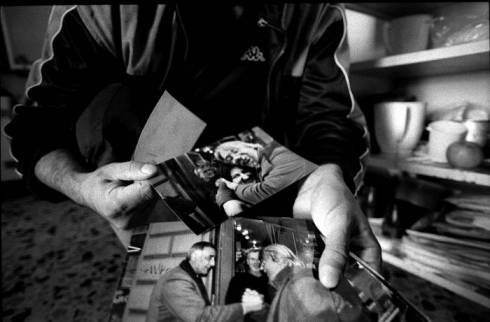
I gave them prints. The reactions I got were very different, some where happy, some others didn’t recognize themselves, not being used to see their image anymore, which was a very painful thing to witness.
Some prisoners do not recognise their faces?
They are mentally ill and the suicidal rate is very high so no sharp, flammable or explosive objects are allowed, nor things like shoestrings and so on. Generally, they are not allowed mirrors. The only image that some prisoners have of themselves is through old pictures; the perception of their own face and body is distorted.
“They lose track of what they used to be, because they have no guarantee that they will ever be allowed to become that person again.”
What’s more, in normal jails there is a photography service (I don’t know how it works exactly but I know that if you want to have a picture taken to send to your family you can somehow do it) but no-one considered that people in OPG Filippo Saporito might have the need for a photograph taken once in a while. For some people, the last time they saw their own face was years before.
The room interiors look very stark. Did any of the prisoners have other pictures or posters to use, hang and decorate spaces? Or, what is the visual culture of OPG Filippo Saporito?
Visual culture? Good luck with that! The average amount of space that each person has is so small that you don’t really have much wall to stick things on. In the most overcrowded sections, nothing was on the walls at all.
The sections which host people with more severe metal conditions are “decorated” with scribbles, and writing on the walls – which I consider screams more than decorations.
People that have bigger spaces usually have pictures from magazines (less porny that what I expected, to be honest) so landscapes, girls, some people a football team or a car, a postcard maybe, a couple of Christian crosses. The number of personal objects that inmates have is very small, which tells a lot about how this space works with the complete depersonalization of people.
The prisoners loose identity. They are trapped in a small space that, despite the amount of time they spend in it, they cannot identify it as belonging to them and so make no effort to decorate. They lose track of what they used to be, because they have no guarantee that they will ever be allowed to become that person again; they become faceless and with no identity and no ties with the outside world. Plus, most of them are severely sedated and/or depressed which doesn’t really stimulate any effort to make the place more welcoming.
Did the prisoners see your prints?
Quite a few asked me to have their picture taken in order to have something to send to their families and to see what they looked like. It was a tricky one for me, as I could not turn my reportage in working for them, so I had to be very careful to handle it and make no promises I couldn’t keep.
Prints were either sent to family or saved among their belongings. Someone chucked their portrait in the bin!
It’s very sad to see how is the inmates’ perception of possessions. They are not used to owning anything so the idea of possession almost disappears for them. Some people had a look at the picture and that was it, end of the use of the picture. They are deprived of the most basic elements that make a person an individual subjective human being.
Was it easy to share your prints?
It is not exactly that you bring a print with you and that’s it. Everything is extremely bureaucratic so I had to give pictures to the police attendants, who had to request the approval of the director and then they were given to another attendant that would have been in charge of delivery. Also, some staff considered giving people their pictures as inappropriate . More than once prisoners told me they never received the prints I had brought for them.


You said the prisoners appreciated and understood you presence. Do you know what they hoped your photography could do/might do?
For many reasons, most of them consider their condition of detention to be unfair. The biggest one is that their release is not time-based (not in a linear way, anyway, as I explained above) and that’s why they call their condition a life-sentence, even if not defined as such.
This condition of not knowing when they are going to be released (if ever) is source of great distress and, in my opinion, makes the recovery of a person impossible. What’s more, even if the law states that different crimes and different mental conditions are treated in different ways, the reality is that people with very serious conditions live close to people which are in better health, all under the same set of rules and in the same spaces. There are sections in which the surveillance is a little bit lower, for example when i was there they just had stated a section in which there were no police attendants but just nurses and medical personnel, but the difference between section to section vary very little.
Sometimes, for disciplinary reasons, people are moved to higher security sections and excluded from recreational activities, as a form of punishment, but this is of course off the records.
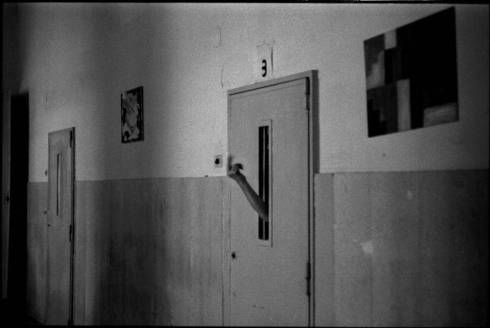
The jail is overcrowded, the number of inmates being almost twice as the one the jail was designed for. Food is very poor, and hygiene is too. [Available] medical and psychiatric assistance is ridiculous, and the police personnel are not specifically trained to cope with mental illness, which leads to a massive number of abuses and a complete lack of empathy towards the inmates.
The activities, which are considered to be treatment but in reality constitute just a form of entertainment, are restricted to a very small number of people (because there has to be one police attendant for every four inmates) and they are always the same inmates, the easier ones to cope with.
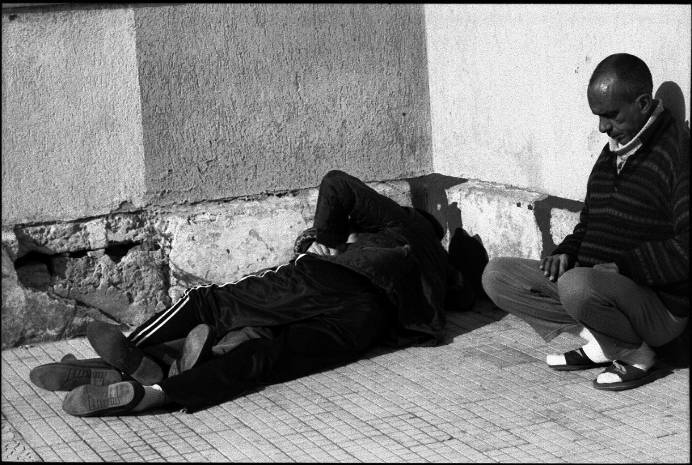
The prisoners are aware that the way in which they live is unknown to most of the population and only hits the news when a parliamentary inspection takes place. They hoped my presence was a way to get their voice out, and they hoped the approach I had compared to the other journalists (reporting from the “zoo” they live in without effecting change) would be different. So they were hoped at least I would be less biased that the average journalist.
I made clear to them all that I was no “big cat” and I could only do my best to bring their voice out, but also aware that having the reportage sold and diffused would have not been so easy, because the reality is that is sellable only when something in the news brings those places to attention again.
And then of course there is the personal element; there’s a girl hanging around, who knows your name and smiles at you, and she considers you a human being and not a case study or a patient, which for some people is something that they hadn’t had in long time.
Plus, a photographer is something that is “happening” that breaks the routine a little bit. I have to say, some of them were very hostile to journalists, and I can easily see why, for the way they handle the topic. It took time to gain their trust.
And something else too, one inmate saw me as a tie to the outside world; I was not a nurse, not a doctor, not a police officer, I was just a person talking to them for no other reason than talking to them, because I have spent days at times just talking about food or pets or places or my normal day or whatever. They thought I was out of my mind because I decided to go there on purpose instead of taking pictures of trees and beautiful landscapes!

Filippo Saporito strikes me as an eclectic complex. There is a training centre for clinical and psychiatric training?
If I am not wrong, yes, there is a training school that works together with the OPG but I don’t know much about it.
There is also a museum at the site, correct?
There is a very small museum in the [old] jail which hosts instruments that were previously used to deal with mental illness. But inmates are still there [in the asylum], still in the same medieval conditions. I wish the asylum was something in the past […] you can say it too is a museum, but a living horror museum.

BIOGRAPHY
Quintano is based in London, UK. She holds an MA (distinction) in Photojournalism and Documentary Photography from London College of Communication (December 2010) and received a Diploma in Photojournalism from The Danish School of Media and Journalism, Århus, Denmark (December 2009). Between July and November 2010, Quintano was Assignment Editor, Getty Images, London Office and is currently a Staff Photographer at the Italian monthly magazine, Progetto Campania. Quintano’s photography has appeared in the following books; Terre in Disordine, Minimum Fax (2009) and Enciclopedia della Canzone Napoletana, by Pietro Gargano, Magmata Edizioni (2006). Quintano’s work has appeared in many exhibitions, including Donne rEsistenti, Napoli, Italy (May 2008) and Rifiuto, at the Associazione La.Na., Napoli (July 2007)

 Prison Photography