
You are currently browsing the category archive for the ‘Documentary’ category.

Prisoners wash the floor of a cell with a rolled-up carpet. Joao Silva for The New York Times
The photojournalist community was shocked to hear that experienced war photographer Joao Silva, 44, was seriously injured after stepping on a land mine in Afghanistan. Nick Kristof describes Silva as “humble, uncomplaining, dogged — and always returns with spectacular images”
Joao Silva‘s website certainly displays a wealth of important stories. Alongside dispatches on Afghanistan, insurgency in Iraq, war in Lebanon, the war in Georgia, ethnic violence in Kenya and the siege of Sadir City is Silva’s 2005 dispatch from Malawi prisons.
The New York Times’ story, The Forgotten of Africa, Wasting Away in Jails Without Trial (Nov. 2005), by Michael Wines at the time was vital. As Chris Tapscott describes in Human Rights in African Prisons, the increase of 35% in Malawi’s prison population in the first four years of the millennium was one of the highest on the continent, second only to Ghana (38%).
As Wines describes, the result of overcrowding was an unsustainable system with inadequate nutrition, prisoners literally sleeping on top of each other, summary killings of prisoners deemed “incorrigible” and case files lost with the prisoner left to wallow.

Lackson Sikayayenera in his cell at Malua Prison, where he has been for six years. His case file has been lost. Joao Silva for The New York Times
At the same time, Wines acknowledges that Malawi’s prison conditions were not out of the ordinary for African prison standards and in many cases better than those in other countries. This is a position backed up by various chapters in Human Rights in African Prisons (ed. Jeremy Sarkin). Since 2005, the Malawi Prison Service has developed a sustainable approach incorporating farms to provide food and directed work for inmates. One of the largest issues for African prisons is that populations are left idle while they wait for trial, often for years.
Tapscott also notes that the Malawi Prison Service is one of the most amenable to outside inspections; the culture of oversight is not prioritised or even realised in many African nations.
From the same book, in his chapter on pre-trial detention in Africa, Martin Schonteich explains that across all nations poverty is one of the largest causes for prison overcrowding:
“In cases where pre-trial release is granted with conditions, it is again often indigent who have the greatest difficulty complying with such conditions. In many African countries, accused persons are granted bail provided they deposit a sum of money with the court. In a report on prisons in Malawi, the Special Rapporteur found that a reason for overcrowding was that ‘prisoners cannot pay bail or provide any surety.’ (ACHPR 2001c:34)”
It is worth noting the inequalities and vagaries of the bail system also plague the American criminal justice system too, and likely plenty of other Western nations. It is with some irony therefore that we might – based on Silva’s images – differentiate between prison systems. They may look incredibly different but the underlying structural shortcomings are shockingly familiar.
I wish Joao Silva all the best in his recovery (you can follow updates on the NYT Lens blog) and I am reminded that without photographers and a robust media, stories of hidden, disappeared and forgotten humans would not see the light of day … and that applies to every country of every continent.

The only food in the prison is nsima, com must leavened with beans or meat from the prison rabbit hutch. Joao Silva for The New York Times
MORE IMAGES HERE

“It’s More Expensive to Do Nothing explores the dark and often disregarded world of criminal justice, the revolving door of institutionalization, the complexities of remediation, and the programs that have worked to help nonviolent ex-offenders succeed as self-sufficient members of society.”
“The math is staggeringly simple: It will cost $75,000 year if a nonviolent offender returns to prison, whereas $5,000 a year will help that individual lead a productive life outside.”
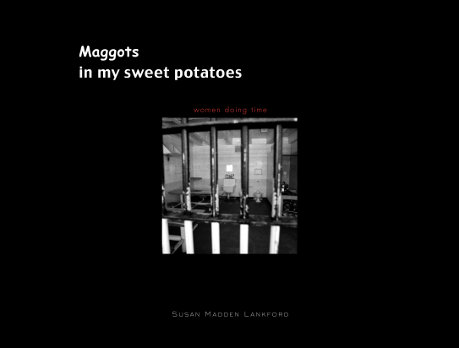
Book cover: Maggots in My Sweet Potatoes
In the early 1990s, photographer Susan Madden Lankford rented an old San Diego jail for commercial photography. She soon attracted the interest of the homeless in the area, who before long they began to befriend her, trust her intentions and to tell her about their world. She was making a living as a successful studio photographer but was not fulfilled.
“My life and my photography were full of plastic portraiture. Images of individuals wanting the ‘right image’ and not the one with real expression and life.”
She soon embarked on a three publication project looking at the underclass of her home city. downTown U.S.A.: A Personal Journey with the Homeless was her first book, soon followed by Maggots in My Sweet Potatoes about the incarceration of women and children. Lankford is soon to release a documentary film about the criminal justice system.

Inmate Behind Chain Link Fence. Las Colinas Detention Facility for Women in Santee, California. Photo by Susan Madden Lankford. Taken from the book, “Maggots in My Sweet Potatoes: Women Doing Time,” by Susan Madden Lankford, Humane Exposures Publishing. All Rights Reserved. Reprinted with permission.

The “Safety Cell” Used for Solitary Confinement. Las Colinas Detention Facility for Women in Santee, California. Photo by Susan Madden Lankford. Taken from the book, “Maggots in My Sweet Potatoes: Women Doing Time,” by Susan Madden Lankford, Humane Exposures Publishing. All Rights Reserved. Reprinted with permission.

This Is My Family. Las Colinas Detention Facility for Women in Santee, California. Photo by Susan Madden Lankford. Taken from the book, “Maggots in My Sweet Potatoes: Women Doing Time,” by Susan Madden Lankford, Humane Exposures Publishing. All Rights Reserved. Reprinted with permission.
BIOGRAPHY
Lankford studied with Ansel Adams and is a graduate of the Brooks Institute in San Diego. Maggots in My Sweet Potatoes won the following awards: Publishers Weekly – Best Books of the Year, Web Pick of the Week; ForeWord Magazine – Book of the Year, Silver Award – Social Science; ForeWord Magazine – Book of the Year, Bronze Award – Women’s Issues; Independent Publisher Book Awards – Gold Medal, Women’s Issues; 2008 DIY Book Festival – Grand Prize Best Book of the Year; 2009 Eric Hoffer Book Awards – Grand Prize. Lankford’s work is the basis for the new film, It’s More Expensive to Do Nothing releasing this fall 2010.
More on Lankford from the San Diego Union-Tribune here.
Five-part lecture given by Lankford can be viewed. First part here.
You can find out more about her projects at Humane Exposures and get updates on the Humane Exposures Blog.

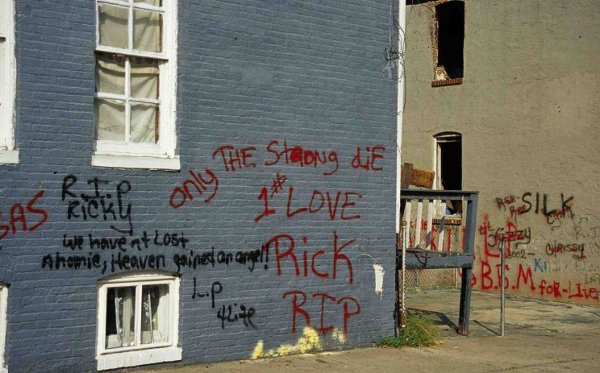
Peter Barry has been documenting the Rest In Peace tags in Baltimore for over ten years:
“In 1999 I started documenting these. I have lived in Baltimore Maryland twice, from 1969 to 1974, and 1985 to present. Statistics of Baltimore Maryland, since 1990, POPULATION DROP: 100,000, HOUSES DEMOLISHED: 50,000+, READING GRADE LEVEL: Low, HIV/AIDS: High, HEROIN ADDICTION: High, and a MURDER RATE of approximately 300 per year. It is this murder rate as manifest through the graffiti “R.I.P.” that I have been documenting since 1999.”
I wanted to post this and try to figure out how this tallies with Daniel Shea’s project Baltimore, which I featured earlier this year.
More on R.I.P. Baltimore here and here.


© Larry Wolfley
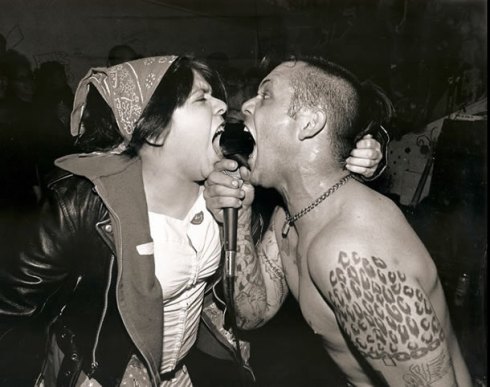
Last month, on a flight from Oakland to Seattle, I sat next to an energetic, punky, wide-eyed young lady. Her view of the world was full of naivete, optimism and anti-capitalism. She lived for music and she talked about the Gilman Club … a lot.
I lived in the SF Bay Area for several years but not being punk, garage, shed or synth-krunk I’d never heard of it. A week later I came across Larry Wolfley‘s photography. As well as photographing at underground shows and East Bay clubs, Wolfley has been a makeshift “house photographer” at the Gilman Club for 12 years.
Wolfley recently did an interview with Maximum Rock and Roll. He has a PhD in English Lit from Berkeley, he taught at The University of Nebraska-Lincoln in the seventies, abandoned academia, returned to Berkeley, became a carpenter, had a son, took photos, realised he knew nothing, resolved to teach himself photography, and decided street punks on Telegraph Avenue were a good topic. The homeless punks told Wolfley he had to go to the Gilman Club if he were to understand their culture. He’s been shooting punk and music gigs since.
Wolfley is more than twice the age than the majority of the crowd. All the kids know him, his Canon and his black beanie hat.
Just wanted to give a shout out to a local hero whose recognition has been a long time coming. Visit his website.

Source: http://www.artbusiness.com/1open/021210.html
American Suburb X republished an Art Voice interview with Bruce Jackson.
Bruce Jackson is one of the greats of prison photography, up there with Danny Lyon, Deborah Luster and Alan Pogue.

Jackson: “The people who are in penitentiaries are no different than the people outside, except that they’ve done a certain thing that got them classified as the kind of person that goes to the penitentiary. But they’re in a penitentiary, and being in a penitentiary does something to people. It puts you in a position. All the things that Foucault writes about—about power and what it does and the way it’s used—are there. Prison is a place where power rules. Prison is about power; if it were not, people would walk out the gate. You see it in the way people walk and in people’s faces and the way they present themselves.”

© Jordis Antonia Schlösser, from the series ‘City Behind Walls’
Without exception, the authorities of every prison I’ve visited have described their complex as its own contained city.
For German photographer, Jordis Antonia Schlösser the self-sufficiency and the false independence it imposed on Moabit prison, Berlin was her abiding impression:
“For me the prison is a city within the city. There are many of the same things inside that exist outside. There are workshops – gardening, tailoring, carpentry. There are services – a kitchen, a post office, a bank, a barber. What is lacking is entertainment – like cinemas, theaters, or concerts – but the inmates replace this with television, which almost all of them have in their cells, just like people on the outside in their apartments. I was surprised how similar the trappings of freedom and captivity look.”
Moabit prison is a pre-trial detention center for men. Here’s the 30 image essay. This is one of the better, less hurried and quieter photo studies of prison life I’ve come across.
“Arbeit Arbeit Arbeit” written on the blackboard behind the cloth-cutting prisoner, is an anachronistic visual detail that sent my mind of in all directions. Its inclusion must have been deliberate.

© Jordis Antonia Schlösser, from the series ‘City Behind Walls’

© Jordis Antonia Schlösser, from the series ‘City Behind Walls’

© Jordis Antonia Schlösser, from the series ‘City Behind Walls’
Jordis Antonia Schlösser
Jordis Antonia Schlösser (b. 1967, Goettingen) studied sociology and ethnology at the University of Cologne (1987-1988) and photography design under Prof. Arno Fischer at the technical college in Dortmund (1988-1996). She has been a member of OSTKREUZ since 1997. Schlösser lives in Berlin and Paris.
Her publications include GEO, GEO Spezial, Stern, National Geographic, DU, Merian, Spiegel, Lufthansa Magazin, Brigitte, High Life (British Airways Magazine), NZZ am Sonntag, Granta Magazine, Corriere della Sera Magazine, Marie Claire (It.), El Pais Semanal, et al.
Schlösser is the recipient of the Hansel-Mieth-Prize for ‘Before disappearance – Report from the Lower Rhine brown coal belt’ (2002); 2nd prize of the World Press Photo Award in the ‘Arts’ category (2001); 1st prize at the International Yann Geoffroy Competition for ‘Living on the dump’ (2000); DAAD Scholarship for the continuance of the work ‘Havanna between the times’ (1999); Honorable mention ‘Grand Prix Care International du Reportage Humanitaire’ (1999); Admission to the World Press Joop Swart Masterclass; Special prize at the UNESCO Courier/Nikon competition ‘Peace in everyday Life’ for ‘Havanna between the times’ (1998)
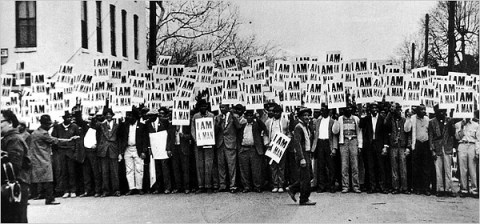
Two stories that broke this week demonstrate the levels to which everything is never as it seems.
The New York Observer describes links between Leslie Deak and funders of the controversial mosque, the CIA and U.S. military establishment have gone unacknowledged.
Meanwhile, The Commercial Appeal in Tennessee reports famed and revered Civil Rights Photographer Ernest Withers doubled as FBI informant to spy on civil rights movement.
Democracy now states, “Withers’s alleged involvement was revealed because the FBI forgot to redact his name in declassified records discussing his collaboration.”
Withers died in 2007.

Thanks to Stan for the tip off.

 Prison Photography