
You are currently browsing the category archive for the ‘Documentary’ category.
Carlan Tapp‘s project on the TVA Coal Ash Spill, December 2008, featured on BURN April, 2009. Click below.

THE COAL WAR

The Coal War, a “documentary about hope, change, and one unstoppable grandmother”, is looking for funding.
Chad Stevens heads a team of familiar names.
QUESTION OF POWER

Carlan Tapp’s Question of Power project began in 2005. It delivers photographic essays and “the voices of individuals, families, and communities affected by the mining, processing, burning, and storage of waste materials created by coal for the generation of electricity in America”.
MINING ON NATIVE AMERICAN LANDS
“Carlan is a descendant of the Wicocomico Tribe, Taptico family. His strong belief and respect for the earth and all creatures is the continual theme in his work.”
Carlan’s documentation of the mining activities and environmental destruction on Navajo land is startling. I particularly advise viewing the 42 images and captions of Coal Production. Mining kicks up toxic dust, pollutes the earth and water, causes respiratory problems in the local population and causes structural weakness in homes.
As a point of comparison, watch Aaron Huey’s TEDxDU presentation. Huey’s talk about the broken treaties, chronic poverty and human rights abuses wrought upon the Lakota people of Pine Ridge in the Black Hills area of South Dakota (a place he describes as “ground zero for Native issues in the US”) was well received – largely due to the fact he passionately presented a history we rarely hear. It is likely the legal and environmental rights of the Native Americans in Tapp’s coverage are under attack by similar forces.
Especially in light of the Gulf of Mexico disaster, we must ask the same questions of coal, oil and all non-renewables with regard our own consumption habits.
Carlan blogs here. He has been on the Gulf Coast since last month. Good write up by Elizabeth Avedon.

A couple of weeks ago I posted four Library of Congress photographs (attributed to Russell Lee) of Tule Lake internment camp .
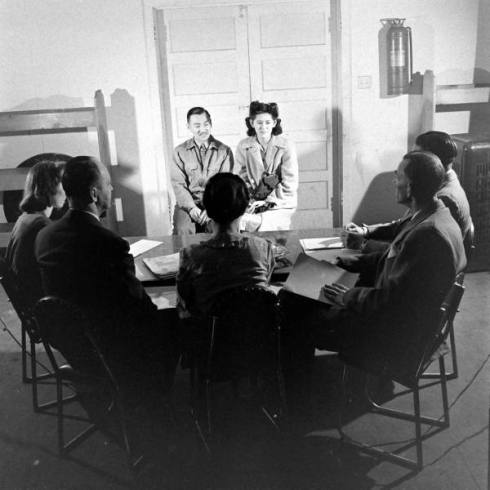
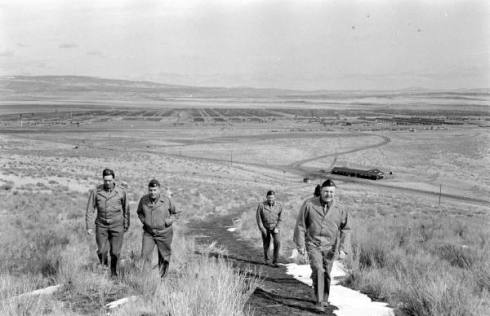
In follow up, I encourage you to check out the 200+ images of Tule Lake by Carl Mydans on the Google/LIFE archive. Mydans took these for a LIFE Magazine feature in 1944. [More down the page]


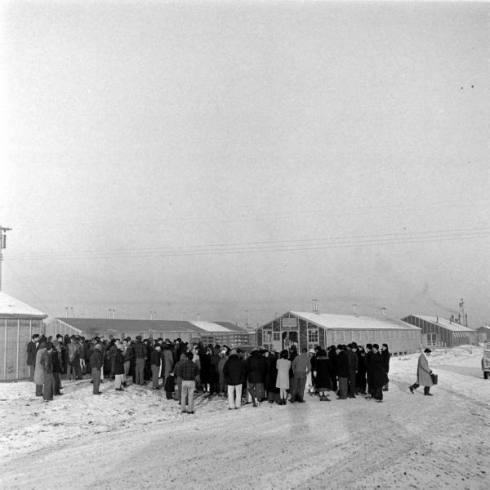
I am especially drawn to the photographs in which Mydans’ presence cannot be ignored – a blinding flash,or fixed stare. Are some of Mydans prints are attempts to be poetic? The scenarios for other prints seem invasive. [More, scroll down]
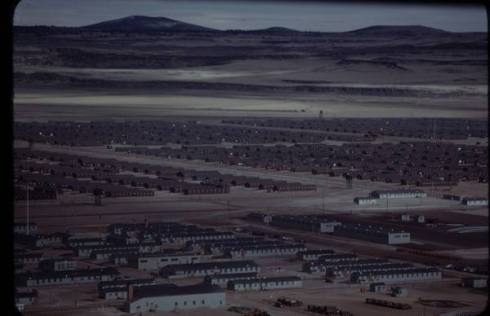


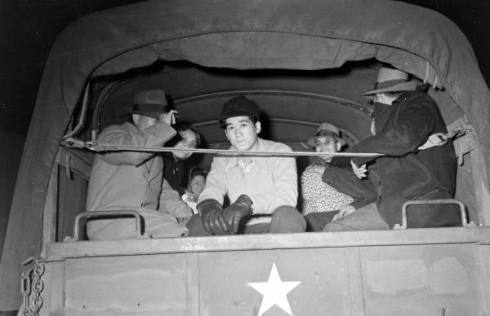


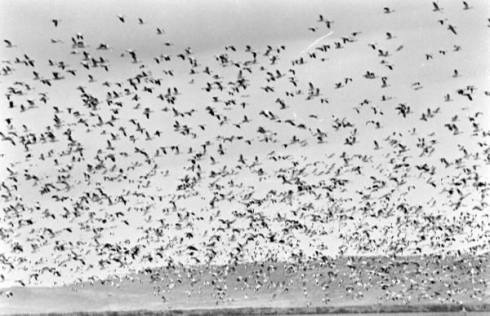


Mydans’ success was his portraits; his reportage of the interactions between internees and authorities appear to be staged. Maybe pictures were staged, or maybe authorities just fidgeted in front of the camera?



– – – – –
For more about Japanese-American Internment during WWII, refer to the Densho archive of video-recorded oral testimony paired with images and documents of the time. It is the most thorough archive I know of.
– – – – –
Found via International Center for Photography, FANS IN A FLASHBULB blog:
http://fansinaflashbulb.wordpress.com/2010/05/29/tule-lake-internment-camp/

Joerg has predicted this’ll be all over the photobioblogosphere, so I’ll oblige.
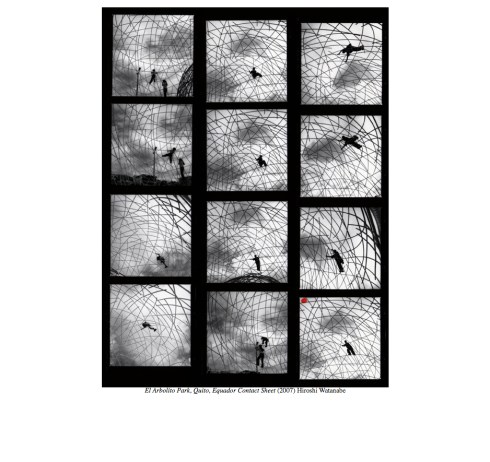
PROOF at the Edelman Gallery exhibits well known photographs with their original contact sheets.
Do I actually like the show or have I been instantly suckered by a seductive concept? I actually like the show; PROOF demystifies some of the lore about famous photography. We need to talk more about photography within the context of its manufacture.
My favourite? Hirshi Watanabe.
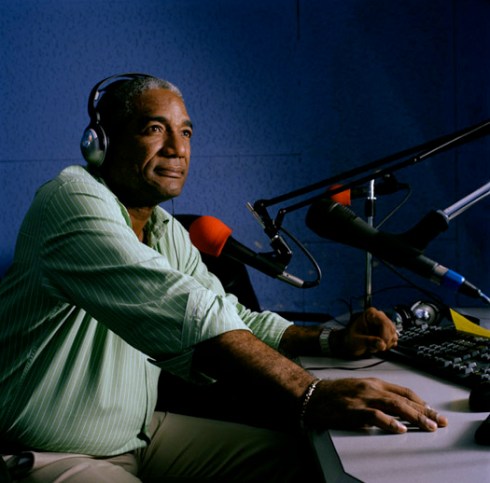
Two weeks ago, I participated in an OPEN-i webinar about Haiti imagery. Louis Quail, another of the panelists, committed eight days to photographing Haitians during the month of May.
I wanted to present Quail’s work here as his photographs are products of a quieter, more engaged process than a lot of the photojournalism created in the earthquake’s immediate aftermath.

The Haiti webinar is not posted yet, but a growing archive of OPEN-i webinars is available at its Vimeo channel.

New Orleans. In the collection of the Peter Sekear Estate.
Actually, Jacob Holdt was the new Peter Sekaer … we just never knew about Sekaer. Until now.
Sekaer
The New York Times reported today on Signs of Life at the High Museum of Art in Atlanta, a major survey of Peter Sekaer’s life and of his works. Sekaer died prematurely in 1950 at the age of 49, leaving stacks of unsorted photographs.
Curator, Julian Cox said of his work, “We wanted to uncover this hidden gem. Sekaer was like the passage of a meteor, very bright but fairly brief.”
Sekaer often took photographic trips with friend Walker Evans. Sekaer photographed high streets, impoverished neighbourhoods, markets and games. He photographed signs and billboards. From 1936-43 he worked on assignment for various government agencies including the FSA, the USHA and the REA. His task was to document the depressed country and thus Seaker photographed a lot of poor Americans.
Excepting the New Deal agencies, this focus and unexpected coverage was repeated 40 years later by another Dane.
Jacob Holdt‘s ongoing life’s work American Pictures* is equally committed to describing the hardships of the American South. Holdt met many people suffering in a discriminatory culture with discriminatory laws. (I wrote about Holdt following his autobiographical presentation at the 2009 New York Photography Festival.
Holdt (b.1947) is the geist of Sekaer.
It should be noted Holdt doesn’t call himself a photographer, rather a man who uses the camera as a tool in his activism. Sekaer was professional from 1936 onward.
DANISH INQUISITION
It would be foolish to attribute their curiosity and achievements to their Danish heritage, or to suggest that foreign eyes can see with more clarity the shortcomings of their host nation. Sekaer and Holdt likely were/are simply good people with a belief in stories to be told.
Sekaer was an anomaly for his time; an outspoken, moody Dane, with a German camera, asking folk about their lives. Sekaer’s daughter, Christina explains that it wasn’t just his eyes that made his photographs, Sekaer’s voice did too, “His accent helped people want to talk to him.”
Sixty years on, it’s nice to meet you Mr. Sekaer.
More images here.
Peter Sekaer (American, born Denmark, 1901–1950)
Born in Copenhagen, Denmark, in 1901, Peter Sekaer immigrated to the United States in 1918 at the age of seventeen. After successfully operating a printing business in New York City producing posters, advertisements and window displays, he enrolled in the Art Students League in 1929 to study painting. He soon became involved in the New York art scene, befriending, among others, the artist Ben Shahn and the photographer Walker Evans.
By 1934 Sekaer had left painting behind to study photography with Berenice Abbott at the New School for Social Research. Through his friendship with Walker Evans he secured contracts from 1936 to 1943 to work on assignment as a photographer for various government agencies that were created as part of President Roosevelt’s New Deal program. In 1945 Sekaer started his own commercial photography business, shooting advertisements and human interest stories for magazines.
In 1950, at age forty-nine, Sekaer suffered a fatal heart attack. His life’s work has been preserved by his wife, Elisabeth Sekaer Rothschild, and their younger daughter, Christina Sekaer.

'Family Shelling Pecans, Austin, Texas', 1939. G Peter Sekaer. Collection of the High Art Museum, Atlanta. Purchased with funds from Robert Yellowlees.
Signs of Life: Photographs by Peter Sekaer is the first major exhibition dedicated to the work of the Danish-born American photographer Peter Sekaer. Organized by the High, the exhibition runs June 5, 2010 through January 11, 2011. High Museum of Art, 1280 Peachtree Street, N.E. Atlanta, Georgia 30309.
– – –
*Conflating Holdt and Sekaer further, a 1999 exhibition at the Addison Gallery of American Art was titled ‘Peter Sekaer: American Pictures’. I don’t know if the curators knew of Holdt’s body of work.
I wanted to trace the physical and psychic contours of the world of these young people to see what they might reveal. Juvies is not only a document, but also a query about perception. Do we know who these young people are and what we are doing to them?
Ara Oshagan
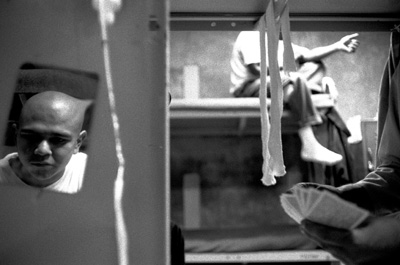
The Open Society Documentary Photography Project launches Moving Walls 17 exhibit today. Ara Oshagan, one of the seven award recipients, alerted me to the New York launch and his inclusion, Juvies: A Collaborative Portrait of Juvenile Offenders.
Juvies is collaborative because often his images are accompanied by the handwritten texts of incarcerated young people. Frequently the writings focus on emotional ties, problems with self esteem, the powerlessness against a system. It makes sense then that many of Oshagan’s photographs are visually-fractured, detached.
Compositions of door-frames, window reflections, outside corridors and gestures to action the other side of barriers describe very literally the immediate limitations these young people face daily. Oshagan’s work is not to politicise, but to describe (as best that is possible in the manipulating medium of photography.)
Oshagan explains, “I did not meet any angry or tattoo-ridden kids decked out in the clothes and accessories that could mark them as members of the city’s gang culture. Rather, I found a group of ordinary young men and women who had signed up for a video production class. When I spoke to them, they were deferential. For them, candy was the “contraband” article they had brought to class. Some of the kids were interested in photography and told me about how they strove to learn white balance. I listened to one of the kids play Beethoven’s “Moonlight Sonata” on [a keyboard]. And somehow I had come full circle: I had played that exact same piece to my own son the night before. Suddenly, the distance between the inside and the outside seemed to vanish into thin air, a vast gulf turned into an imperceptible chimera.”


PHOTOGRAPHING INSIDE
Before accompanying filmmaker friend, Leslie Neale* into Los Angeles County Juvenile Hall, Oshagan wasn’t an activist or particularly interested in prison reform. Oshagan admits the exposure to the system and young lives within was disorienting. From Oshagan’s artist statement:
“I was in a privileged place that allowed the perceptions that existed in my head to be confronted by the realities I was witnessing in the closed and misunderstood world of incarceration. What I was seeing was also raising issues that would not give me peace.”
“I can understand why Mayra might get life in prison for shooting her girlfriend from point blank range. But how could a combination of relatively minor charges result in the same life sentence for Duc, an 18-year-old who, despite having no prior convictions, was convicted in a shooting crime that resulted in no injuries and in which he did not pull the trigger? And why did Peter – a 17-year-old piano prodigy and poet – get 12 years in adult prison for a first time assault and breaking and entering offense? Why is the justice system so harsh on kids who clearly have potential?”
PHOTOGRAPHING OUTSIDE
In addition to the walls, the guards, the other incarcerated people, the yards, the bunk beds, Oshagan also photographed families and communities left behind as well as the courts and victims. Sadly, I cannot present these images here but consider them essential in Oshagan’s “layered photographic narrative”.
These young people cannot be ignored. Our actions, just as theirs have ramifications both sides of the walls.
Two weeks ago the Supreme Court of the United States of America changed law, ruling life imprisonment without parole (LWOP) for a non-capital offense by a juvenile was to be removed from the books. Get past the fact that such harsh punishment was illogic and cruel and one soon arrives at the maddening circumstances of some of Oshagan’s subjects, Duc.
High school student Duc was arrested for driving a car from which a gun was shot. Although no one was injured, Duc was not a member of a gang, had no priors and was 16 years old, he received a sentence of 35 years to life
Again, to quote Oshagan, “Do we know who these young people are and what we are doing to them?”

* Oshagan did the B-Roll for Neale’s documentary film Juvies, whose own words about the juvenile detention system are worth taking in.
BIOGRAPHY
Born into a family of writers, Ara Oshagan studied literature and physics, but found his true passion in photography. A self-taught photographer, his work revolves around the intertwining themes of identity, community, and aftermath.
Aftermath is the main impetus for his first project, iwitness, which combines portraits of survivors of the Armenian genocide of 1915 with their oral histories. Issues of aftermath and identity also took Oshagan to the Nagorno-Karabakh region in the South Caucasus, where he documented and explored the post-war state of limbo experienced by Armenians in that mountainous and unrecognized region. This journey resulted in a project that won an award from the Santa Fe Project Competition in 2001, and will be published by powerHouse Books in 2010 as Father Land, a book featuring Oshagan’s photographs and an essay by his father.
Oshagan has also explored his identity as member of the Armenian diaspora community in Los Angeles. This project, Traces of Identity, was supported by the California Council for the Humanities and exhibited at the Los Angeles Municipal Art Gallery in 2004 and the Downey Museum of Art in 2005. Oshagan’s work is in the permanent collections of the Southeast Museum of Photography, the Downey Museum of Art, and the Museum of Modern Art in Armenia.
MOVING WALLS 17
Also supported by the Open Society Documentary Photography Project are Jan Banning, Mari Bastashevski, Christian Holst, Lori Waselchuk & Saiful Huq Omi and The Chacipe Youth Photography Project.
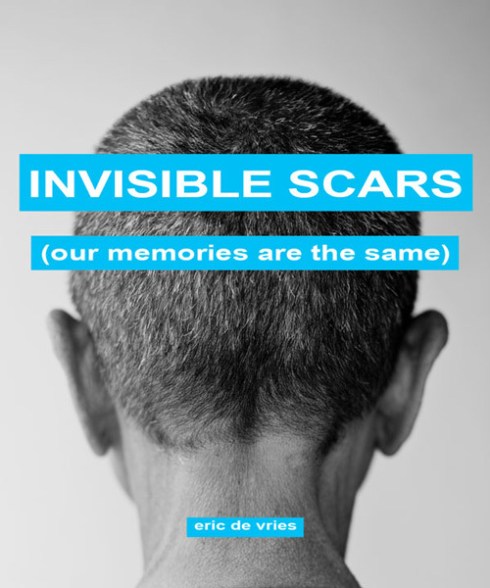
Invisible Scars is a portrait series of “the older generation in Cambodia that represents survivors of the Khmer Rouge regime in the 70s. Most of this group were forced to leave their village to undertake slave labour in the ricefields … The ones that survived returned to their homelands after the Khmer Rouge period in 1979. Some talk about what happened 35 years ago, others close their eyes or even turn away and continue what they were doing, taking care of their grandchildren.”
I am well aware of several photographers having dealt with the torture camps and prisons of Khmer Rouge ruled Cambodia (not least those of Nhem Ein, official prison photographer for the Tuol Sleng prison). I will return to these practitioners and history in time, but for now I’ll just alert you to this one project by Eric de Vries.
Thanks to Bob for the tip off.

 Prison Photography