
You are currently browsing the category archive for the ‘Documentary’ category.
THE CORRIDOR
Solutions. Prison reform debate rages around solutions. Even when everyone at a given table agrees on the problem, the propose solutions can differ widely. There are many, they overlap and they are often interdependent.
(For the record, here’s a sampler of my long list of forward steps we could take: Release old and infirm prisoners; sentence children as children, do away with the death penalty, scale back on LWOP (life Without Parole), implement radical and retroactive sentencing reductions for all drugs offenses and non-violent offenses, eradicate solitary confinement, treat addiction with hospitals not prisons, fund services for youth and families to avoid the use of custody later in life, drawdown the bail system, issue an amnesty for outstanding warrants for non-violent misdemeanors, ban the box, make criminal record expungement available as a right, scale back sentencing guidelines to that of the European average, make prisons smaller, provide prisoners nutritious food, subject all staff to yearly self-care and mental health checks, reinstitute Pell Grants for access to college for prisoners, continue all voluntary work programs but provide more than cents on the dollar wages, increase the number of family days and trailer visits, and PROVIDE EDUCATION)
What last solution, what education looks like differs hugely. Some prisoners need parenting classes, some only want practical training (welding, HVAC, electrical, plumbing etc). Other prisoners want business training. Then there are some that want liberal arts college classes.
A staggering number of prisoners need a GED.
The Corridor portrays the nation’s first high school custom built inside an adult jail. The film follows one semester inside the experimental Five Keys Charter School in San Francisco.

In the film, we’ll meet students, teachers and staff. Referred to as the “crown jewel” of the SF Sheriff Department, enrollment in Five Keys Charter School is all but mandatory for incarcerated people who never received a high school diploma.
The problems for mandated GED programs are well known among prison and jail educators — it can be very difficult to engage a class of students with a high school curriculum when they did not respond to high school on the first round. This in-built tension makes any GED project in a prison or jail that more difficult as compared to other programs (with voluntary sign-up). Therefore, Five Keys represents a genuine innovation approaches to criminal justice.
Custodial staff maintain safety in a jail that houses members from a reported 22 active gangs. Meanwhile teachers follow a strict policy of not knowing their students’ criminal charges (in my experience, both common sense and common policy).
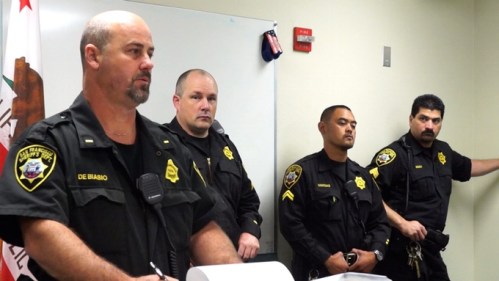
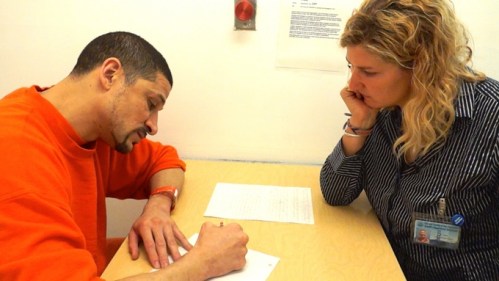
The Corridor follows lessons, learning, challenges and graduation in a school that won the 2014 award for best charter school in Northern California.
Filmmakers Annelise Wunderlich and Richard O’Connell began shooting in May 2013 and made over 100 hours of material. It took them over two years to negotiate access. Former Sheriff Michael Hennessey was the man who gave the green-light.
“Hennessey built his reputation on creating programs that go beyond what is mandated by law,” says Wunderlich and O’Connell. “He has said that what he enjoyed most about being the sheriff was to make and experiment with policy. His legacy lives on with the current staff.”
Wunderlich and O’Connell want to create “an immersive portrait that focuses on the inner workings of the school and the programs, capturing along the way conflicts, dilemmas and breakthroughs that arise in the course of carrying out its mission.”
They aren’t trying to make an argument for one type of custodial approach or another. They are interested in observing how education (in this particular case) is shoehorned into a criminal justice system to satisfy some of the system’s objectives — lowered recidivism, empowerment, self-realisation, reductions in violence.
I wish them luck.
Unbelievably, Five Keys has barely been replicated elsewhere. This is despite its measured achievements and despite growing research that education-based jail programs are the most effective way to reduce recidivism.
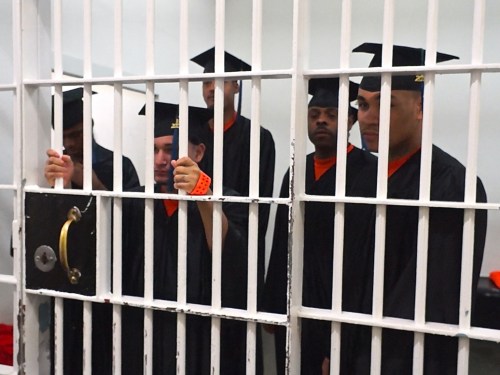
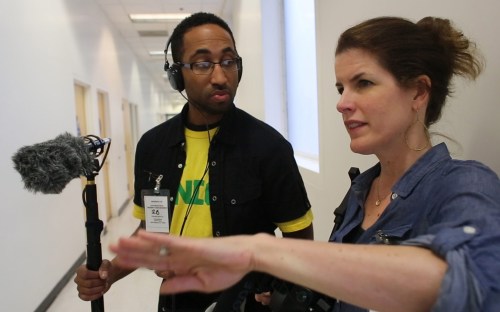
FILMMAKER’S PRESENTATION
If you are in the San Francisco Bay Area, Annelise Wunderlich will be speaking next Tuesday, 16th June at Bay Area Video Arts Coalition (BVAC).
“This edition of Storytelling Across Media,” reads the BVAC blurb, “brings together three innovative Bay Area media makers who will speak to the power storytelling holds for those “behind bars”. Although each panelist comes from a different artistic background (performance, documentary film, and fine art photography) they all share a commitment to helping incarcerated or formerly incarcerated individuals tell their stories and put their voices out in the world, whether through dance, film, or radio.”
Tuesday, June 16
6:30pm
BAVC
2727 Mariposa Street, 2nd Floor
San Francisco, CA 94110
Tickets are $10 for BAVC Members, $15 general. Seating is limited. Buy tickets here.
My pal Nigel Poor will also be speaking.
LINKS
Successful Kickstarter page with updates

FIRST EXPOSURES
In a necessarily generic statement about the project, San Francisco’s teen photography program First Exposures says its online exhibition Communication “explores how the photograph communicates meaning and the different ways in which that meaning can be interpreted based on context.” That’s a broad way of saying that their activities are rooted in developing visual literacy AND photography skills. The teenage image-makers have use antique processes, and made exquisite corpses, biographical images and studies of work and family.
In a city that is currently quite-very hard to love, I think it is absolutely essential to find things in San Francisco that are pure and you can admire. As a writer, I think it is important — everywhere and always — to recognise voices that emerge not out of market needs but out of community needs. These are the two reasons at the top of a long list as to why I am applauding both the First Exposures program and the products of its young participants.
Everything that the pros are doing these kids are doing.
– If you like A Piece Of Cake, First Exposures has its Exquisite Corpse.
– If you like Anna Atkins and Lochman & Ciurej, First Exposures has it’s own Cyanotypes.
– If you like the self exposition and exchange in work by Jeremy Deller or, say, Bayete Ross Smith and Hank Willis Thomas in Question Bridge, First Exposures has Letters To A Stranger.
– If you like Arnold Newman, you’ll dig First Exposures’ response to his work Zoomed In.
– If you like LaToya Ruby Frazier‘s depictions of family and Paul Graham‘s depictions of labour, then First Exposures has Work/Family for you.
– If you are into the collaborative portraiture of Anthony Luvera, Wendy Ewald or Eric Gottesman, you’ll love First Exposures’ Portrait/Self-Portrait.
The kids stay in the picture!
Recognition, too, to the unnamed staff and volunteers who facilitate these youth photography program. In San Francisco and elsewhere.
ELSEWHERE
Literacy and personal development through photography is a familiar notion. Programs for youth include The In-Sight Photography Project, Vermont; Leave Out ViolencE (LOVE), Nova Scotia; Street Level Media, Chicago; Picture Me at the MoCP, Chicago; Youth in Focus, Seattle: Focus on Youth, Portland; Critical Exposure, Washington DC; Eye on the Third Ward, Houston; and AS220 Youth in Providence, Rhode Island.
Incredibly, Young New Yorkers (YNY) actually uses photography (as well as video, illustration and design) as intervention in the cogs of the youth justice system.
“The criminal court gives eligible defendants the option to participate in Young New Yorkers rather than do jail time, community service and have a lifelong criminal record. The curriculum is uniquely tailored to develop the emotional and behavioral skills of the young participants while facilitating responsible and creative self-expression,” says YNY.
Also in New York, is JustArts Photography Program (formerly the Red Hook Photo Project). The exhibition Perspectives featured the photographs of teens from Red Hook, Brooklyn. The JustArts Photography Program (more here and here) is run through the Red Hook Community Justice Center (RHCJC).
I encourage you to find programs in your local area and contribute.
MORE?
Please feel free to name other programs in the comments that I’ve not included here.

I was interviewed by ACLU recently: Prisons Are Man-Made … They Can Be Unmade.
The Q&A focuses around the exhibition Prison Obscura and you’ll notice a return to many of my favourite talking points. Still, the work never ends, and I know that ACLU will push out — to an expanded audience — my argument that we should all be more active and conscientious consumers of prison imagery. My thanks to Matthew Harwood for the questions.

I had a quick chat with Sébastien van Malleghem about why he is crowdfunding a photobook following his three years photographing prisons in Belgium.
It’s over at Vantage: Making Photos Inside To Bring The Stories Out
In short, this:
“The book is, for me, the closure of the story. Photographs must end on paper. That’s how the medium exists — in print. On paper, with full context, you can touch the pictures, understand the whole story. Things fade away on the Internet. Clicked, Like, then something else. Good photos in a book stick to your head. The largest part of my photo story will be exclusive to the book.”


Photo: Meghann Riepenhoff
I’m one of five jurors for this years annual juried show at SF Camerawork. Y’all should enter. Here’s the blurb …
CALL FOR ENTRIES: HEAT
This summer, SF Camerawork teams up with LensCulture to host our Annual Juried Exhibition. The theme this year is HEAT.
HEAT registers the volatility and restlessness that comes with long hot summers: violent crime rates increase, leases expire and people seek new homes, global weather changes signal an alarm, and warm summer days bring adults and children alike into the streets, parks, and beaches.
SF Camerawork invites artists to submit work that responds to HEAT: the social, political, and climatic conditions of rapidly changing environments. Following the lead of social and political advocates around the world, SF Camerawork asks artists working at all levels in photography to participate.
Art is politics. Particularly in the realistic forms of photography and filmmaking, what gets assigned, shown or sold reflects political considerations. […] Politics is in the air. All you need to do to get the message is breathe. – Danny Lyon.

Photo: David Butow
DETAILS
Deadline: Monday, June 15, 2015, 5pm PST.
Notification: Finalists will be contacted on July 1st.
Exhibition Dates: July 23 – August 22, 2015.
Opening Reception: Thursday, July 23, 6-8pm.
Application Fee: $50 application fee for up to 15 images.
ENTER NOW ON LENSCULTURE AND CREATE AN ACCOUNT TO UPLOAD YOUR APPLICATION
AWARDS/BENEFITS
EXHIBITION AT SF CAMERAWORK: 2-5 finalists will have a 4-week exhibition at SF Camerawork.
LIVE ONLINE REVIEW SESSION: Finalists will receive a one-on-one review with a juror through this innovative platform hosted by LensCulture.
20 JUROR SELECTIONS FEATURED: 20 juror selections will be exhibited on interactive screens at SF Camerawork as part of the exhibition.
FEATURE ARTICLE ON LENSCULTURE: Finalists will be featured in an article on LensCulture.
ONE YEAR MEMBERSHIP: All entrants will receive a one-year membership to SF Camerawork.
HEAT 2015 JURY
Pete Brook, Writer and Curator, Founder: Prison Photography
Jim Casper, Editor and Publisher, LensCulture
Seth Curcio, Associate Director, Pier 24 Photography
Janet Delaney, Artist and Educator
Heather Snider, Executive Director, SF Camerawork
QUESTIONS?
Please email info@sfcamerawork with “Call for Entries” in the subject line.
SF CAMERAWORK
Founded in 1974, SF Camerawork‘s mission is to encourage and support emerging artists to explore new directions and ideas in the photographic arts. Through exhibitions, publications, and educational programs, we strive to create an engaging platform for artistic exploration as well as community involvement and inquiry.
SF Camerawork is a membership-based organization.
1011 Market St., 2nd Floor
San Francisco, CA 94103
Gallery hours: 12:00 – 6:00 pm
Tuesday – Saturday (also by appointment)
415.487.1011
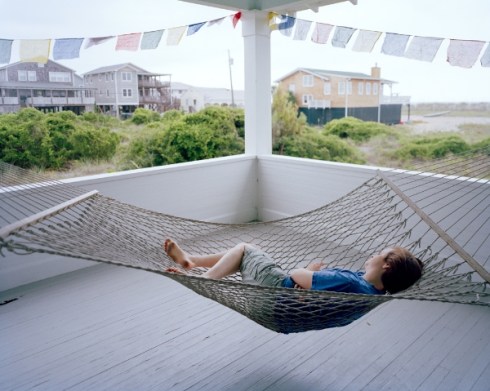
Photo: McNair Evans
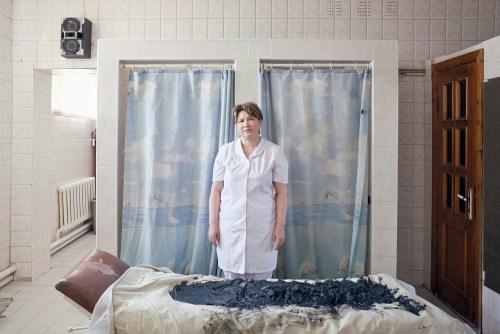
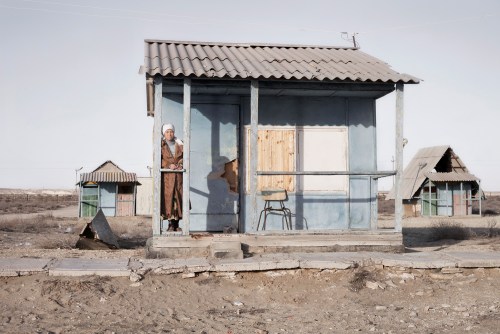
My piece For These Post-Soviet Nations, Big Oil Offers Hope and Fear
about Mila Teshaieva’s Promising Waters pubbed on WIRED this week.
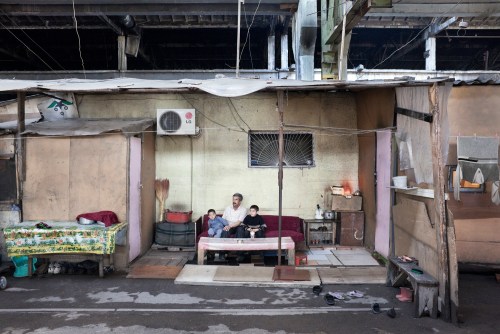
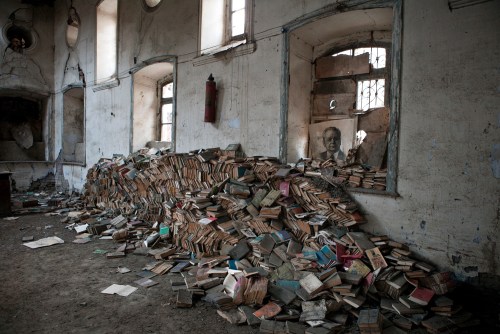
Promising Waters documents changes Kazakhstan, Turkmenistan or Azerbaijan — three countries that touch the Caspian Sea and were for 70 years part of the Soviet Union.
“They are going through total reinvention—the new world, new society, and new futures pushed to rise with the help with oil and gas resources from the Caspian Sea,” says Teshaieva. “This idea of ‘new’ gives particular promises to people.”
Read the full piece and see more here.




THE WHAT
If you’re in New York this Thursday and can spare the time, please think about joining four photo practitioners and I for Everyday Incarceration – Visualizing the Legacy of Mass Incarceration, a panel discussion about images of prisons and the associated social issues. We’ll be tackling the core question: Who gets to tell the story of a locked up nation?
THE LINE UP
Zara Katz and the Department of Visual Journalism at the CUNY J-School have done a great job of putting together a panel with diverse perspectives and practices – one documentary storyteller using video; one photographer who’s eye on the issues stretches back decades; one lawyer using software code and images to engage audiences and empower prisoners; and one former correctional officer turned campaigner armed with his photos from the job. Check the bios below!
THE PORTRAIT STUDIO
After the panel, we invite you to sit for a portrait and to tell us your experience with incarceration. The photos will appear on @EverydayIncarceration, a collaborative Instagram feed.
THE DETAILS
The panel takes place in Room 308 of the CUNY Graduate School of Journalism, at 219 W. 40th Street, NY 10018.
6:30-9:30pm on Thursday, May 14th.
The event is free but an RSVP is very appreciated. Do that at – cunyphotowire@journalism.cuny.edu or at the event page on the Facebook.
THE PANELISTS
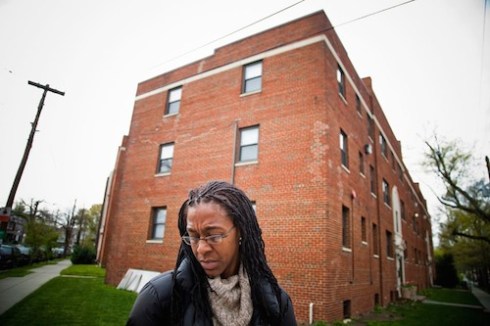
Lashonia Etheridge-Bay, a 39 year-old woman who was granted parole in 2011 after spending 18 years in prison. Bulisova’s series Time Zone follows Etheridge-Bay’s return to society. Photo: Gabriela Bulisova.
Gabriela Bulisova is a documentary photographer and multimedia artist based in Washington, D.C. Over the past five years, she focused her attention on underreported and overlooked stories regarding incarceration and reentry, especially the impact on families. Bulisova has received numerous recognitions and awards, including The National Press Photographers Association’s Short Grant and Open Society Institute’s Moving Walls 18. In 2005, she was awarded the degree of Master of Fine Arts in Photography and Digital Imaging from the Maryland Institute College of Art (MICA) in Baltimore. She teaches graduate and undergraduate courses in photojournalism at the Corcoran School of Arts and Design in Washington D.C. and is a member of Women Photojournalists of Washington.

Michael is 17 and has ADHD, Attention Deficit Hyper Activity Disorder. He is on Ritalin. He is under house arrest and wears an electronic monitoring device. He was arrested for possession of a knife and violating probation. He is living in a hotel room with the rest of his family, 7 people in total. San Jose, California 1999. Photo: Joseph Rodriguez.
Joseph Rodriguez was born and raised in Brooklyn. His four-decade photography career examines incarceration, gangs, police and reentry, as well as families, communities and cultures across the globe. After being incarcerated at Rikers Island as a minor in the late-60s, Rodriguez turned to photography as a guide in his life. In 1985 he graduated from the International Center of Photography in New York. He went on to work for Black Star photo agency, and has published work in multiple top-tier outlets including National Geographic and The New York Times Magazine. He has received numerous awards and grants including New York Foundation for the Arts, Open Society Institute, National Endowment for the Arts, to name a few. Rodriguez currently teaches at New York University and as a visiting artist at national and international universities.

Photo: Lorenzo Steele.
Lorenzo Steele Jr. is a former New York City Correction officer (1987-1999) who mostly worked in the juvenile units at Rikers Island. He was regularly the photographer at events and celebrations with his fellow officers. In 1996, Steele began bringing his camera to the prison to document his experience there. That included daily violence and abuse of inmates and correctional officers. The deep emotional and physiological impact of his experience at Rikers compelled Steele to start a visual arts education program where he shares his photographs and prison experience with middle school and high school students.

Image courtesy of Nikki Zeichner/Growing Up Through Pictures
Nikki Zeichner began exploring multimedia storytelling with the Museum of the American Prison, a project that she initiated in 2012 to offer mainstream audiences a way to understand personal and experiential details of incarceration in the U.S. Her interest in telling stories about incarceration grew out of her experiences working as a criminal defense attorney in New York City and regularly visiting with clients held in federal and state pretrial detention facilities in lower Manhattan and Brooklyn. Nikki recently completed a Master’s degree in Integrated Digital Media from NYU’s Engineering School and is spending 2015 in San Francisco designing civic tech tools for a small, post-bankrupt municipality in Northern California. She remains in regular contact with the incarcerated individuals she worked with creatively on museum projects.
NO BARS, NO GUARDS, NO LOCKS
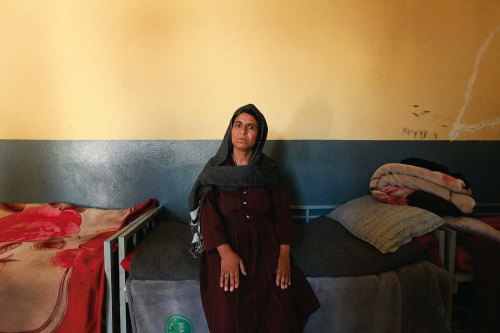
Tattered lace curtains, taped family photos, patterned carpets, plastic flowers and snappy fabrics. Gabriela Maj’s portraits from the series Almond Garden have all the chirpy, easy-to-patronize details of portraiture from a former Soviet controlled region. Lost you already? Think of Sergey Poteryaev’s portraits, Rafal Milach’s Winners in Belarus, Olya Ivanova’s portraits of young girls in rural Russia or anything by Sasha Rudensky. More directly consider the backdrops photographed by Lucia Ganieva.
(As much as I hate top-loading an article with links to a host of other photographers, I must because before we can understand how special and different Maj’s work is, we must appreciate the en vogue photo practices from which it emerges and above which it must rise.)

For the moderately trained eye, Maj’s work is obviously anchored within a super-region that still carries the visual culture of its immediate past. No matter how hard former Soviet countries try, nor how quick they build, photographers still seem to be able to isolate the details that’ll whiplash people back in time. The problem I outline here is twice as tricky because we, in the west, think that all changes in the former USSR since the end of the Cold War must at least be headed in the right direction.
The framework I am trying to set up here, basically, is that in which Soviets — and all those formerly-ruled by them — are ‘Othered’ and misunderstood by most viewers looking at photographs made in the region. I offer a word of caution before you step into Maj’s portraits. The stories burdened by the women in Maj’s Almond Garden are devastating and the worst thing we can do with Maj’s work is to lump it in with all that work of the knackered Russian empire.

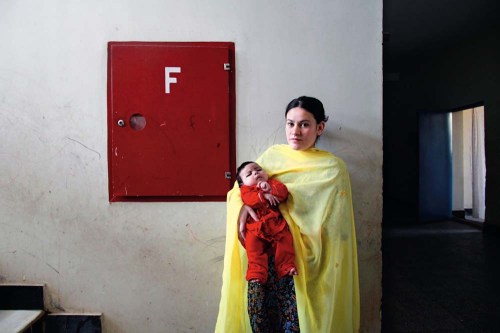


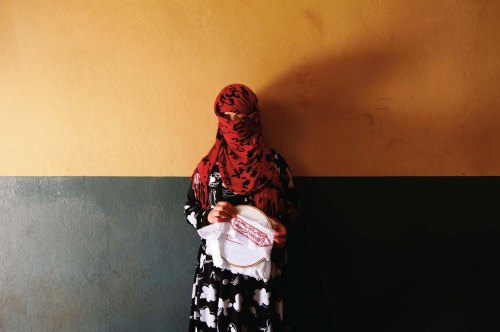
Over the course of four years (2010 – 2014), Polish Canadian photographer Gabriela Maj travelled throughout Afghanistan to collect portraits and stories from inside the country’s women’s prisons. She visited with many of her subjects on multiple occasions.
Maj actually believes that being of Polish origin helped her to gain relatively unhampered access. Poland and Afghanistan shared a history of Soviet oppression.
It also helped being a woman. In fact, her mode and ability of movement revealed the so very twisted logic of a prison system that brutalised women.
“As a solitary female photographer, accompanied only by an Afghan interpreter, I was frequently left alone in the prisons once our guard escort tired of monitoring me. My sense was that unaccompanied by any security, a woman, albeit a foreign one, was not considered a threat,” she writes in an essay featured in the book. “Being overlooked in this way became a strategy that ultimately exposed the context within which I was working, one where women’s narratives were considered irrelevant to the power dynamics that ran the country.”
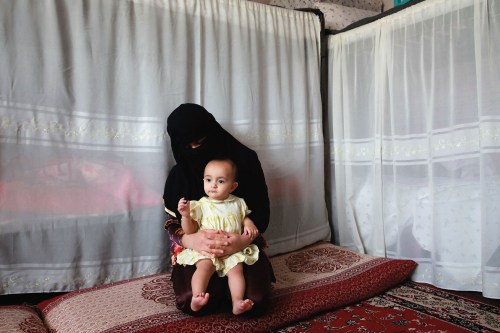
Maj went the extra mile and then some. The least we can do it get there with her. The majority of the prisoners Maj documented were incarcerated for what are known in Afghanistan as “moral crimes,” a term used to condemn those who’ve had sex outside of marriage, or run away from any number of abuses — forced marriages, being sold into prostitution, domestic slavery, physical violence generally conducted by their husbands, and rape and involuntary pregnancy.
Indeed, the portraits are powerful but it is the relentless injustice of the testimonies of the women that delivers the power and absolute necessity of Almond Garden. Maj has changed the names of the women to protect their privacy. She goes a step further and moves the stories to the back of the book.
“Separating the portraits from the stories has allowed for a record of the experiences of this group without any one woman being defined by the crime she was accused of,” explains the press release.
Each entry leads with the offense that the woman is accused with, her age and the length of her sentence.
I haven’t been so effected by a project pairing portraits of women with their transcribed words since, strange as it might be to offer, Malcolm Venville’s The Women of Casa X, which features portraits of aging sex-workers in Mexico. But, then again, perhaps not so strange? Both the women in Melville’s work and the prisoners in Maj’s work have been categorized, judged, ostracized and maligned by dominant patriarchal culture. In both cases, if the photographer hadn’t shown up, these stories would be buried (which is the culture’s intent, right?)
“Often times rejected by their families, these women’s situations can become grave after they are released,” says the Almond Garden‘s blurb. “Without the protection of their relatives that spurned them, they are often in very real danger of being killed or tortured unless they are able to seek refuge in a women’s shelter.”
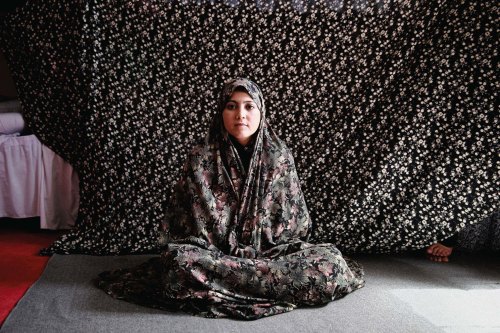
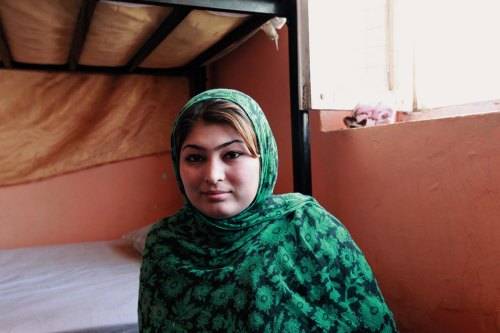
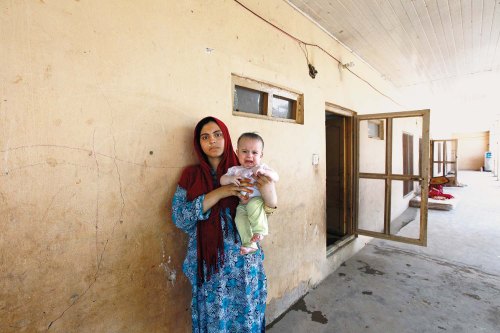
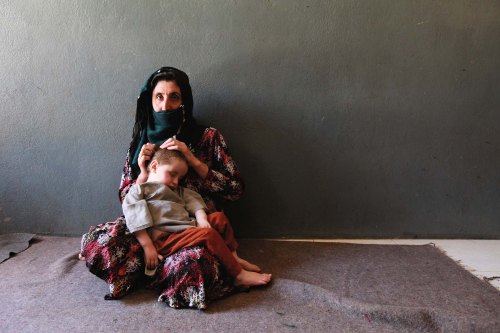
It is bittersweet to think of these tortured moments in prison might be, for some women, where emotional and physical trauma exists least. That said, there is no psychological treatment or therapy available within the prisons Maj visited.
The title of the book Almond Garden is a play and is incongruous. It is the English translation of Badam Bagh, the name of Afghanistan’s most notorious penitentiary for women, located on the outskirts of Kabul.
Almond Garden publishers, Daylight Books, say that Maj’s project is the “largest record documenting the experiences of incarcerated women in Afghanistan produced to date.”
It’s stunning. It works in waves as all good photography should. I’ve been drawing important lessons from Almond Garden each time I’ve returned to it. Aesthetically, it’s as good as Michal Chelbin’s Swans and Sailboats, portraits from Ukraine and Russia. Ethically, I think it surpasses it as Chelbin is evasive about the details of her access.
BOOK TOUR, NOW!
Maj is currently on book tour.
Los Angeles tonight! If you’re in San Francisco, hit up one of her two events next week. On May 5th, at Modern Times Bookstore, or on May 6th at The Women’s Building.
BUY THE BOOK
Here, for $45.00.
DATES ON THE ALMOND GARDEN BOOK TOUR
May 1st, Exhibition and book signing with Daylight Books at the Leica Gallery in West Hollywood, CA.
May 5th, Presentation and book signing at Modern Times Bookstore in San Francisco, CA.
May 6th, Presentation and book signing at the Women’s Building,7:30-9:00, San Francisco, CA.
May 9th, Presentation and book signing at Apostrophe Books, 5:00-7:00pm, Long Beach, CA.
May 22nd, Presentation and book signing hosted by the Vermont Professional Photographers Association and the Peace and Justice Center, 6;00-8:00, Burlington, VT.
July 31st, Exhibition opening and book signing at Daylight Project Space , Hillsborough, NC.
August 8th, Book signing at Author’s Night 2015, East Hampton, NY.

 Prison Photography