
You are currently browsing the category archive for the ‘Fine Art’ category.

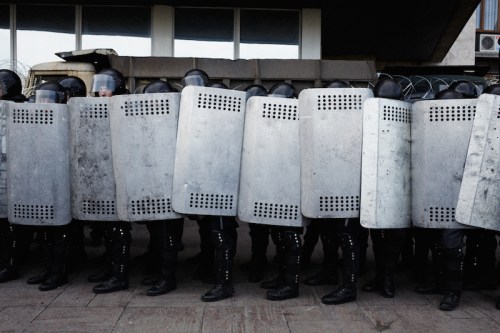
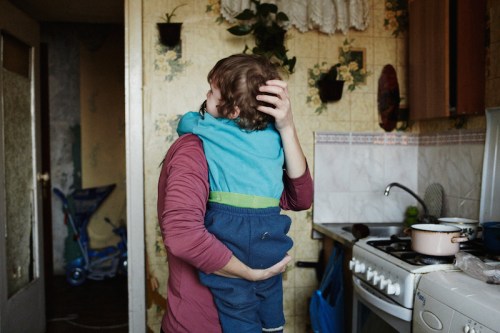
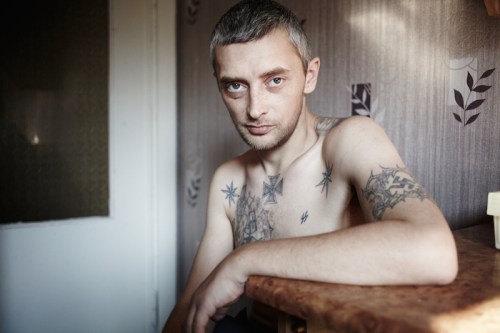
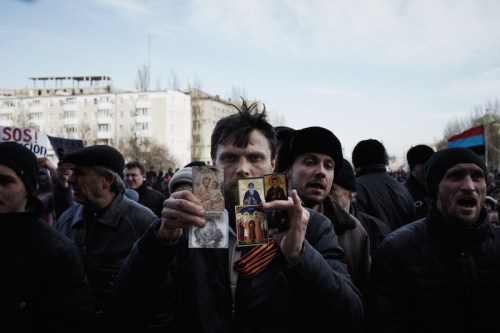
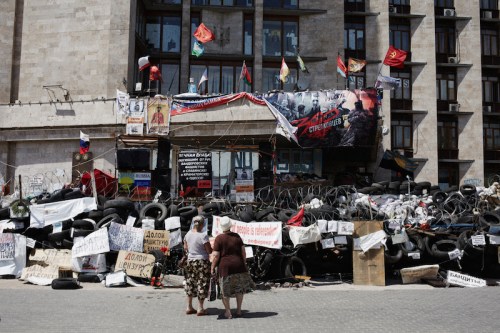
I wrote a piece about Chris Nunn‘s photographs in Ukraine, for Vantage.
Read Accidentally Photographing War In Ukraine.
Nunn, an Englishman, has been hopping flights to Ukraine since 2006 — first with a Ukrainian a girl he dated at uni, and later to trace his roots.
In early 2013 and without a jot of the language he went in search of a connection to the country and its people.
To quote me:
“He had no idea that he was about to be wrapped up in a regional conflict that would draw the world’s attention. His photography became less a personal journey and more an accidental documentary of a nation in steady decline toward war.”
Nunn even ended up in camp with Ukrainian Army conscripts. His mix of portraits and environmental shots is quite poignant. I received an email from Nunn this morning:
“Donetsk. I had no idea at the time that I’d probably never be able to return there, as a normal civilian, [when I made the photos]. Maybe, now, only possibly with special press permission? It’s a mix of good and bad memories … which is true for Ukraine, in general, I think.”
Who knows what to think? With ceasefires crumbling, who knows what comes next?



THE VISUAL CULTURE OF PRISON RESISTANCE
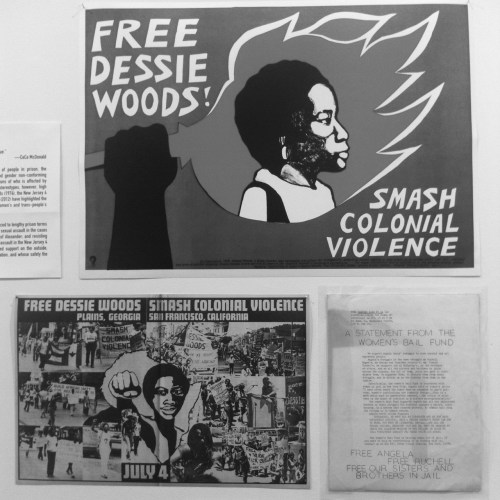
Liz Pelly‘s conversation with Josh MacPhee in The Media is a wonderful read. It coincided with MacPhee and his cohort’s incredible exhibition of prisoner made protest materials going all the way back to the early seventies.
MacPhee urges us to dismantle the idea that prisons are separate from outside society. Crucially, he’s not making, in the first instance, a moral point about how we’re all the same, prisoners and all. MacPhee makes an observation of the structural characteristics of the prison system.
“It’s getting harder and harder to hold up the pretense that prison is somehow distinct from the rest of society,” says MacPhee. “When there’s this many people going in and out all of the time, there’s no way that our lives out here don’t leak into there, and that their lives in there don’t leak out into the rest of society. The idea that these are completely separate realms needs to be dismantled.”
Of course, once the structural facts of the system are revealed, the moral point that we are all one-and-the-same, prisoners and all, is indisputable.
I contacted Pelly and asked if I could republish the conversation. It originally appeared as Inside/Out: On Prison Justice, Art of the Incarcerated, and Interference Archive’s New Show in Issue #44 of The Media (October 10, 2014). It is a privilege to feature Pelly and MacPhee’s interview in full here on the blog.
A LITTLE BACKGROUND
Between September 11th and November 16, 2014, Interference Archive exhibited, Self-Determination Inside/Out: Prison Movements Reshaping Society a look back at the visual and material culture of prisoner-led political movements.
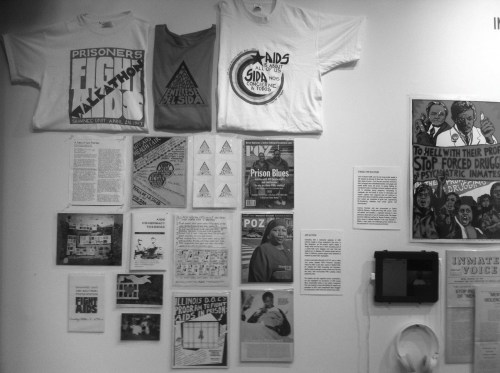
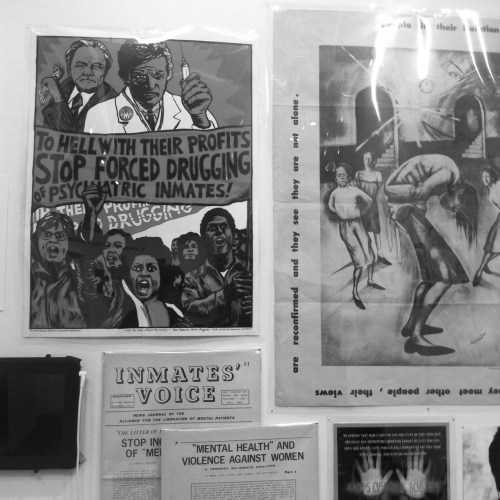
Organized by Molly Fair, Josh MacPhee, Anika Paris, Laura Whitehorn, and Ryan Wong, Self-Determination Inside/Out includes sections on the work of incarcerated AIDS educators, the experiences of women and queer prisoners, prison and control unit prisons. The exhibition features prison newsletters, pamphlets, video and audio interviews, prints, photography (!!!) and magazine covers — starting with materials created during the 1971 Attica Rebellion, a massive prisoner uprising in upstate New York, and concluding with work made by current political prisoners, the show highlights moments of self-organization within the prison industrial complex.
You can buy a booklet and a poster for the exhibition.
Interference Archive is a volunteer-run archive in Gowanus, Brooklyn, dedicated to preserving cultural ephemera related to social movements.

Inside/Out: On Prison Justice, Art of the Incarcerated, and Interference Archive’s New Show
Liz Pelly (LP): What initially inspired the creation of Interference Archive, which mostly houses ephemeral material like posters, t-shirts, and newsletters?
Josh MacPhee (JM): For the different people involved, there are different answers of course. For me, I grew up making this stuff through DIY music, cultural stuff, politics. Through the act of doing, I started collecting it. Flyers, t-shirts, buttons, the ephemera that gets produced by people who are organizing. It was a combination of wanting to understand the history of what I was doing and then at the same time, I was getting really interested in this idea of how people make art and culture in the context of trying to their lives. It’s distinct from art that’s produced purely in the realm of self expression, and the art that tends circulate within the contemporary art world.
This kind of material gets lost. It’s often not clearly authored. Institutions that deal with art don’t quite know what to do with it. Since it’s so political, places like history museums don’t know what to do with it either. It sort of falls through the cracks. But we can see during times like Occupy, or Tahrir Square in Egypt, or with the Maidan in the Ukraine, that this is the stuff of life, [created] when transformation starts to happen. When people have their arms shoulder deep into the constructions of representations of a new world, and the way they want things to be articulated.
For me, doing an archive was a way to say, “just because these moments come and go, and movements have ebbs and flows, doesn’t mean that once the peak has been reached that this material isn’t still valuable to us, to where we’ve come from and therefore where we are going.”
LP: That said, how do you think this sort of exhibit in particular shines light on the experiences of prisoners?
JM: There were five of us who organized this exhibition, and most of us have been engaged with issues around prisons in different ways, whether having been formerly incarcerated, or working with prison activism programs. As far as I know, nothing like this has ever been done before.
We live in a moment where over two million people are in prison. It’s getting harder and harder to hold up the pretense that prison is somehow distinct from the rest of society. When there’s this many people going in and out all of the time, there’s no way that our lives out here don’t leak into there, and that their lives in there don’t leak out into the rest of society. The idea that these are completely separate realms needs to be dismantled.
We thought it was important to marshal primary source material to show that people aren’t just objects of repression or study or someone else’s activism. But they have done immense amounts of organizing inside themselves. Often times that organizing takes place at the same time, or sometimes even ahead of, what people were doing on the outside. Some of the focus we have on organizing around AIDS and AIDS education in prison was really fascinating and important because it shows how people that had the least access to medical care were doing in some cases the most organizing in order to try to deal with a problem that at the time the government was not even acknowledging existed.
LP: Can you tell me more about your own experiences with prison reform activism?
JM: I first learned about how the prison system functions in the early 1990s. It just sort of blew my mind that there was a whole world of people who largely because of race and class were basically being warehoused. And that, at the time, it was completely absent from the radar of public In the 90s, the only thing discussed in relationship to prisons and criminal justice was this sort of “tough on crime” thing. There was no acknowledgment that a massive increase of the prison population going on, and that it wasn’t actually working. And that the system that decided who went in and out was so manifestly unjust, random often.
That sent me on a path of doing organizing around prison issues. I started in Ohio, and then did some work in Colorado, and then in Chicago. A lot of the organizing I did was around Control Unit Prisons, basically trying to stop solitary confinement. [Organizing around] these men and women who were spending twenty-three-and-a-half or twenty-four hours a day alone in their cells, and the psychological damage that causes and how it basically goes against international conventions of torture, yet it’s completely commonplace in this country.
LP: Over the past year, there has been lot of in the news about the racist criminal justice system. It’s an apt time for Self-Determination Inside/Out: Prison Movements Reshaping Society. But obviously there is a lot of history of racism in the criminal justice system that this brings to light. Were you inspired to put this together because of recent events, or has this exhibit been in the works longer?
JM: We worked on the exhibition for 6 months. As a space, as an institution, one of our goals is to take this material that’s perceived as marginal and present it in ways that will allow it to be in its own context, but also to actually show that it’s not marginal. Our primary audience is not people who already necessarily agree with everything that would be in this exhibition. We are conscious of, and trying to take advantage of, a moment.
The question becomes, how do we push [the discussion] farther? If we say mass incarceration is not okay, at what point is incarceration okay? If 2 million people in cages is not acceptable, is 1.9 million people in acceptable? Or 1.8? Once you start asking those questions it opens up the space to say, “this whole system is just absolutely corrupt.”
Mass incarceration accomplishes a number of things, none of which are its stated goals. It accomplishes deeply suppressing working class communities of color. That’s never been articulated as what the prison system is supposed to do. It’s just clear that that’s what it does. It clearly is completely ineffectual at actually dealing with crime.
LP: What are some underreported sides to the prison industrial complex that you hope this exhibit brings to light?
JM: The fastest growing portion of the prison population for years now has been women.
Increasingly there is a real gendered aspect of being able to look at how the criminal justice system works. Increasingly it’s used to enforce gender binaries. It’s a brutal system for queer and trans people that get sucked up into it. People are doing a lot of organizing around it now, but until recently, it was assumed if you were gender non-conforming, they have to choose where to put you, and then once they chose a men or a women’s prison, then almost immediately you’d get sent to solitary confinement. You’d do your sentence out in solitary confinement, in complete isolation, because the system is not prepared to deal with gender non-conformity. You are being punished because your very existence challenges the bureaucratic way the system works.
It’s really clear that women who refuse to be abused, who fight back against abusers, almost always get pulled into the criminal justice system. So we have things like Trayvon Martin being shot, and Zimmerman getting off. But any woman that stops an attack from an abuser is inevitably going to do time because that’s just absolutely taboo.

LP: What were the biggest challenges to getting this exhibit together?
JM: Each exhibition has unique challenges and obstacles, and then there are ones that are sort of similar across the board. For this exhibition, was just that cultural material produced by incarcerated people is hard to access. A lot of it is made in prison and then just never leaves prison.
In general, one of the challenges for all of the exhibitions, is that unless we do something that’s very focused, inevitably there’s so much stuff it’s hard to know when to say “okay we’ve got enough” or to know when to draw the lines. It’s hard to know when to accept that you’re never going to have all of the stuff that you wish you could, that you’re never going to be able to tell the whole story, that maybe even the idea that you’re going to tell some sort of master narrative is questionable in its own right.
When you’re representing things that are so deeply underrepresented, people get attached to wanting their part of the story told, because it’s been marginal or silenced for so long. It makes it really hard to make those choices, because you don’t want anyone else to continue to feel [that way].
We are collecting material from movements that are marginal. Even though they often have extremely deep impacts, rarely is that impact known or visible when they’re most active. It’s kind of like an extra kick in the face when your ideas become commonplace 10 or 20 years later and you’re still written out of the history even though you’re the ones who came up with the ideas.
LP: What do you hope, in general, visitors learn from Self-Determination: Inside/Out?
JM: On the one hand, I hope this contributes to a shift [towards] the idea that prisons are maybe not the answer to the problems that they claim to be. And that locking people in cages is not actually accomplishing what we’re being told it is.
On another level, that incarcerated people are not just objects. They’re loved ones and family members and neighbors and community members. The thing that primarily defines someone as a human being is not whether or not they’re in prison. That people that happen to find themselves in prison, many for reasons that are and then also at the same time many for doing reprehensible things, doesn’t make them not human. It doesn’t mean they don’t have the same desires, life goals, and relationships that everyone else has. And as such, the way that they conceive themselves and their world is part of, needs to be part of, any movement for social transformation.
THE PEOPLE
The Interference Archive is a collection of posters, flyers, publications, photographs, books, t-shirts, buttons, moving images, audio recordings, and other materials, made by participants of social movements throughout past decades. It is an archive “from below” — collectively run space, powered by people, and with open stacks accessible to all. The Interference Archive explores the relationship between cultural production and social movements. It provides public exhibitions, a study and social center, talks, screenings, publications, workshops, and an online presence, with an aim to preserve and honor histories and material culture that are often marginalized in mainstream institutions. It is at 131 8th Street, #4 , Brooklyn, NY 11215 (2 blocks from F/G/R trains at 4th Ave/9th Street).
Josh MacPhee is an artist, curator and activist living in Brooklyn, NY. MacPhee is one of the founder of the Just Seeds Artists’ Cooperative, which organizes, creates and distributes radical art. MacPhee is the author of Stencil Pirates: A Global Study of the Street Stencil, which is dedicated to stencil street art. He co-edited Realizing the Impossible: Art Against Authority, Reproduce and Revolt and the upcoming Paper Politics: Socially Engaged Printmaking Today. In 2001 he co-organized the Department of Space and Land Reclamation in Chicago with Emily Forman and Nato Thompson. In 2008 he co-curated the exhibition Signs of Change: Social Movement Cultures 1960’s to Now with Dara Greenwald.
Liz Pelly is a freelance writer and editor based in Brooklyn, NY. I lives and works at the all-ages collectively-run art space The Silent Barn, where she books (and sometimes plays) shows. She and her friends run the ad-free bi-weekly online newspaper The Media.
The Media is a webpaper covering alternative arts, culture, music, news, and grassroots activism. With contributors often embedded in the communities they cover, The Media aims to bridge the gap between underground presses and mainstream media. Crucially, it is AD-FREE and simply designed. “At a moment marked by short attention spans, decentralized click-bait articles, and newspapers in flux, rethinking the aesthetics of our news websites feels just as crucial as re-imagining their content,” says The Media. “We want our content to resonate on its own merit, free of frivolity and flash, and grounded by a homepage that’s striking in its radical simplicity.”

Binh Danh. ‘The Transamerica Pyramid, 2014 Daguerreotype, Unique (in camera exposure). Plate: 10 x 8 inches / Frame: 14.75 x 12.5 inches
BINH DANH
A recent move makes San Francisco my new hometown. As is my wont, I’m out and about trying to figure what’s happening here in the city. Late last year, I saw Binh Danh’s exhibition This, Then, Is San Francisco at Haines Gallery.
A few things struck me.
– First, the sky blues and sepias of make the work just lovely to view.
– Second, there seems to be an increasing nostalgia toward the city of San Francisco right now which is reflected in art-makers and photographers trying to preserve a view of the city – be that in books, stubborn alternative processes, comparative views of the city as it once was, or flat-out direct denunciations of money-driven change.
– Third, the scenes captured by Danh cannot be random and in fact some of them look quite political.
I got Danh on the blower to ask him about how and why the work was made.
Scroll down for our Q&A.
Click any image to see it larger.
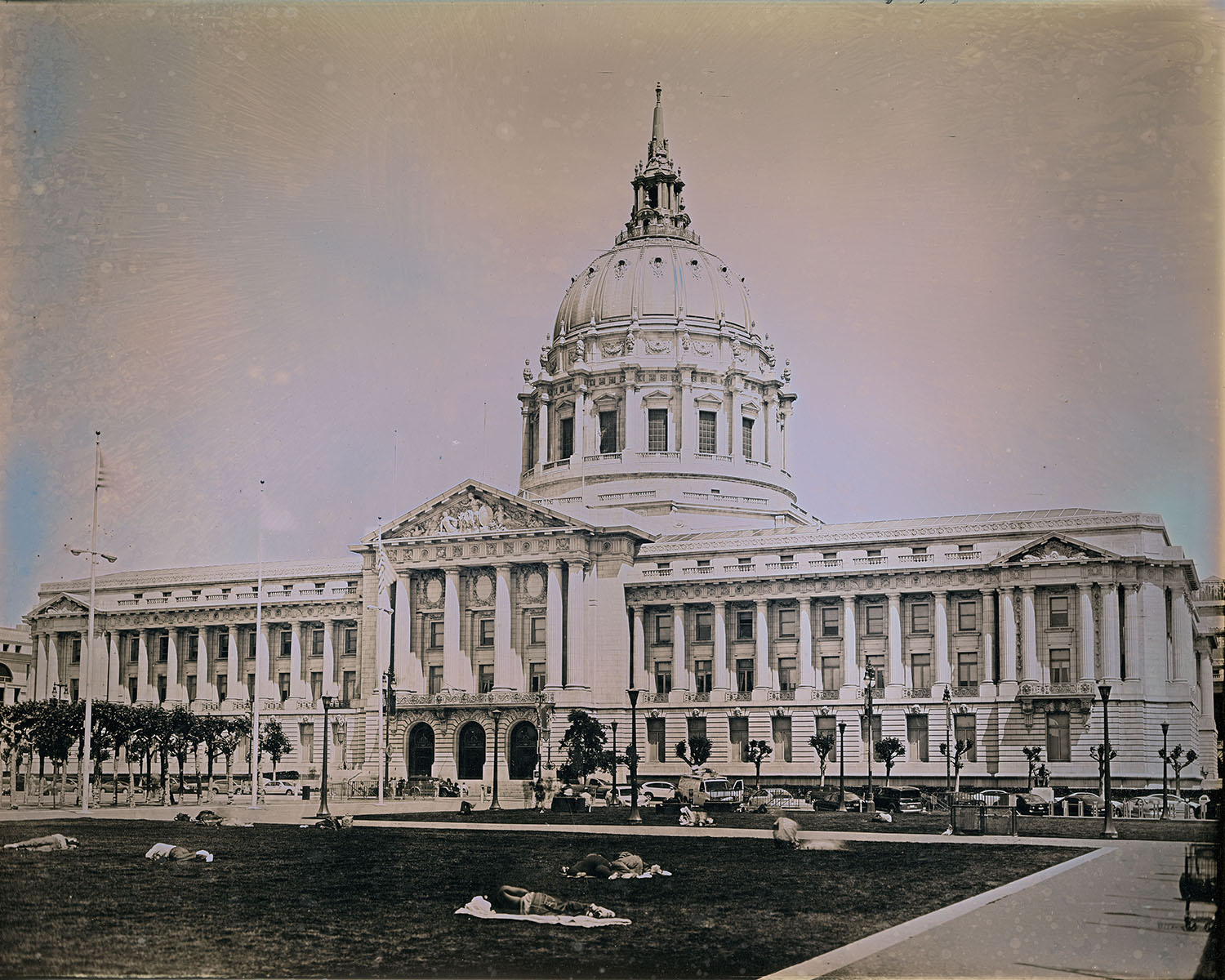
Binh Danh. ‘San Francisco City Hall, 2014’ Daguerreotype, Unique (in camera exposure). Plate: 8 x 10 inches / Frame: 12.75 x 14.5 inches
Q&A
Prison Photography (PP): At first glimpse, the work seems as if it is about process and the joy of the surface. Does This, Then, Is San Francisco have the same level of political engagement typical in your other work?
Binh Danh (BD): You’re somewhat right. Of course, being an artists there’s always the joy of the image. But if you look deeply, there’s also some political messages. There’s pictures of gatherings and protest in front of City Hall.
PP: I saw the image of the rally held by mothers whose family members had been killed but their murderers never found.
BD: And even the photo of the city hall — on the lawn where people are sleeping, they look like dead bodies. Because of the medium, it looks like a civil war photograph.
PP: And the body shapes are identical.
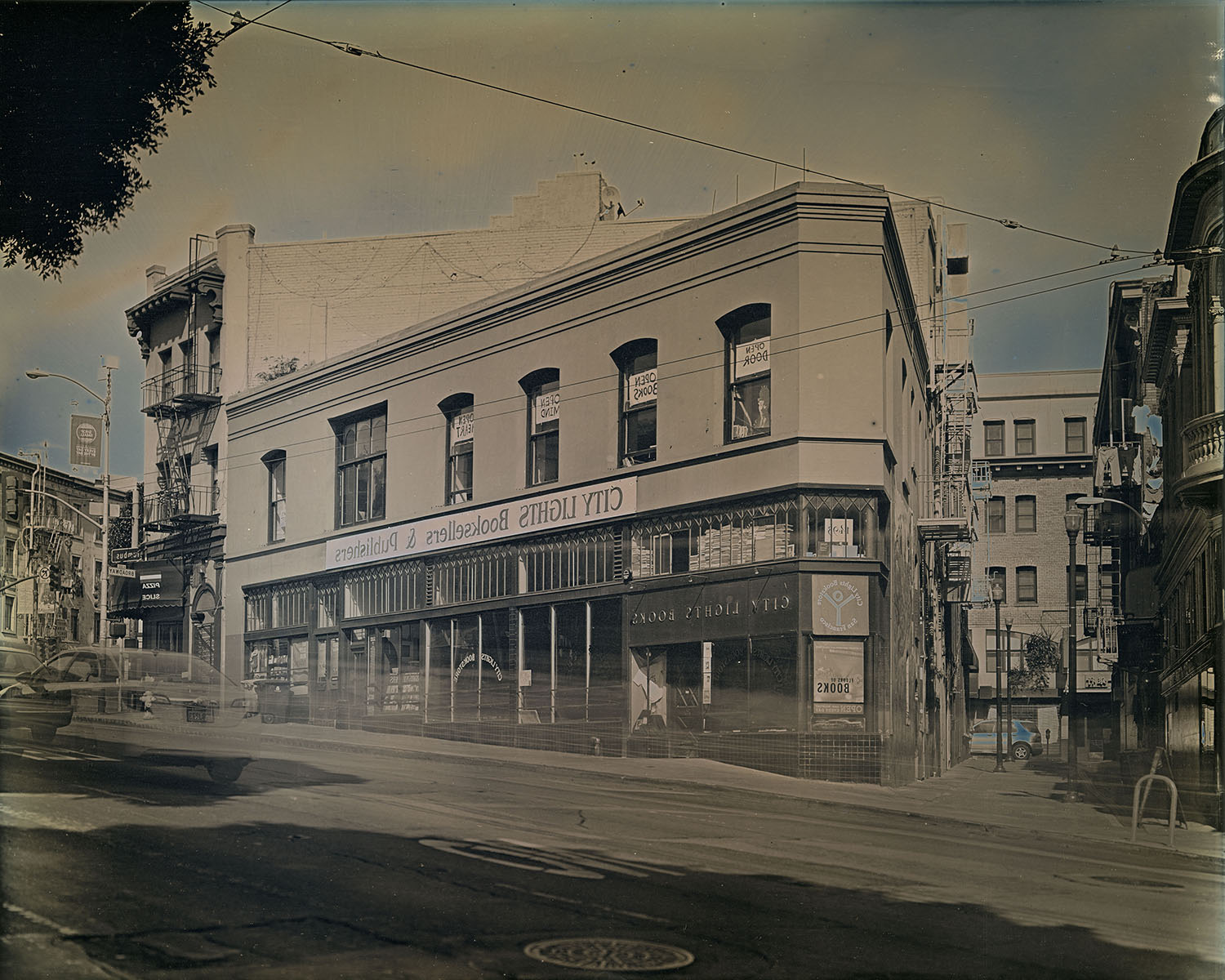
Binh Danh. ‘City Lights Booksellers and Publishers, 2014’ Daguerreotype, Unique (in camera exposure). Plate: 8 x 10 inches / Frame: 12.75 x 14.5 inches

Binh Danh. ‘Hoa Phat, Little Saigon, Larkin Street, 2014’ Daguerreotype, Unique (in camera exposure). Plate: 8 x 10 inches / Frame: 12.75 x 14.5 inches
BD: I am alluding to these political spaces of the city.
PP: Did you grow up in San Francisco?
BD: No. I grew up in San Jose. For me, San Francisco was the place we went to for school trips. Even in adulthood, I see the city as a tourist. Each time I go there it is new. Every inch of the city is photogenic. And that goes way back. I enjoy the fact that This, Then, Is San Francisco is in conversation with those images from the nineteenth century when the city was being built.
PP: How does this relate to your previous work about Yosemite? It seems to make more immediate sense to use daguerreotypes to photograph Yosemite — what with the archives of Carleton Watkins and Edward Curtis. Their works were very political and tied to the myth of manifest destiny and ultimately controlling of the West.
BD: Both Carleton Watkins and Edweard Muybridge photographed San Francisco AND Yosemite. I’m walking in those giants’ footsteps. For me, San Francisco is the gateway to California – going as far back as the Gold Rush when people arrived, stocked up and then travelled on to the Sierra Mountains. Everything in Northern California flows toward San Francisco and into the Bay.
PP: One could conceptualize San Francisco as being at the foot of an elongated Yosemite Valley?! The Pacific Ocean is the terminus of the Sierra Mountains watershed.

Binh Danh. ‘Panoramic View from Corona Heights Park, 2014’ Daguerreotype, Unique (in camera exposure). Plates: 25.75 x 13.5 inches
BD: But also looking forward. San Francisco is tied to innovation, accelerated movement, change and speed. It always has been. Of course, now, those things are associated so closely with Silicon Valley and the South Bay.
PP: But for the purposes of the international community, San Francisco is the epicenter of that.
BD: I wanted to document San Francisco in this moment of change. I didn’t realize Haines Gallery wanted to do a show. They felt I had enough work. But the project is not complete; it’s ongoing. I expect in 30 or 40 years I’ll go back to some of the same streets to stand in the same locations and make the same pictures with daguerreotypes.

Binh Danh. ‘Rigo 23’s Truth Mural U.N. Plaza at the Civic Center, 2014’ Daguerreotype, Unique (in camera exposure). Plate: 8 x 10 inches / Frame: 12.75 x 14.5inches
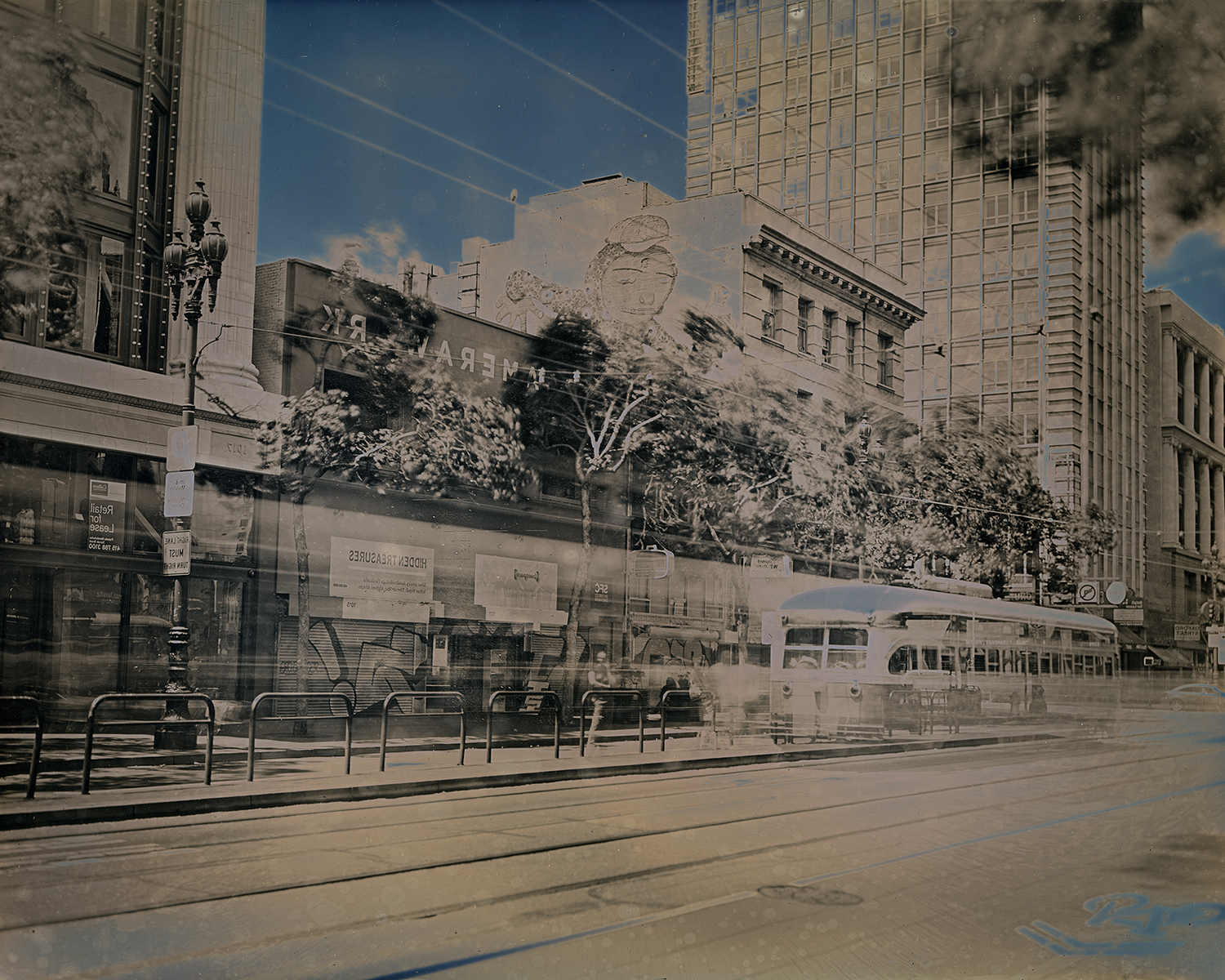
Binh Danh. ‘San Francisco Camerawork, 2014’ Daguerreotype, Unique (in camera exposure). Plate: 8 x 10 inches / Frame: 12.75 x 14.5 inches
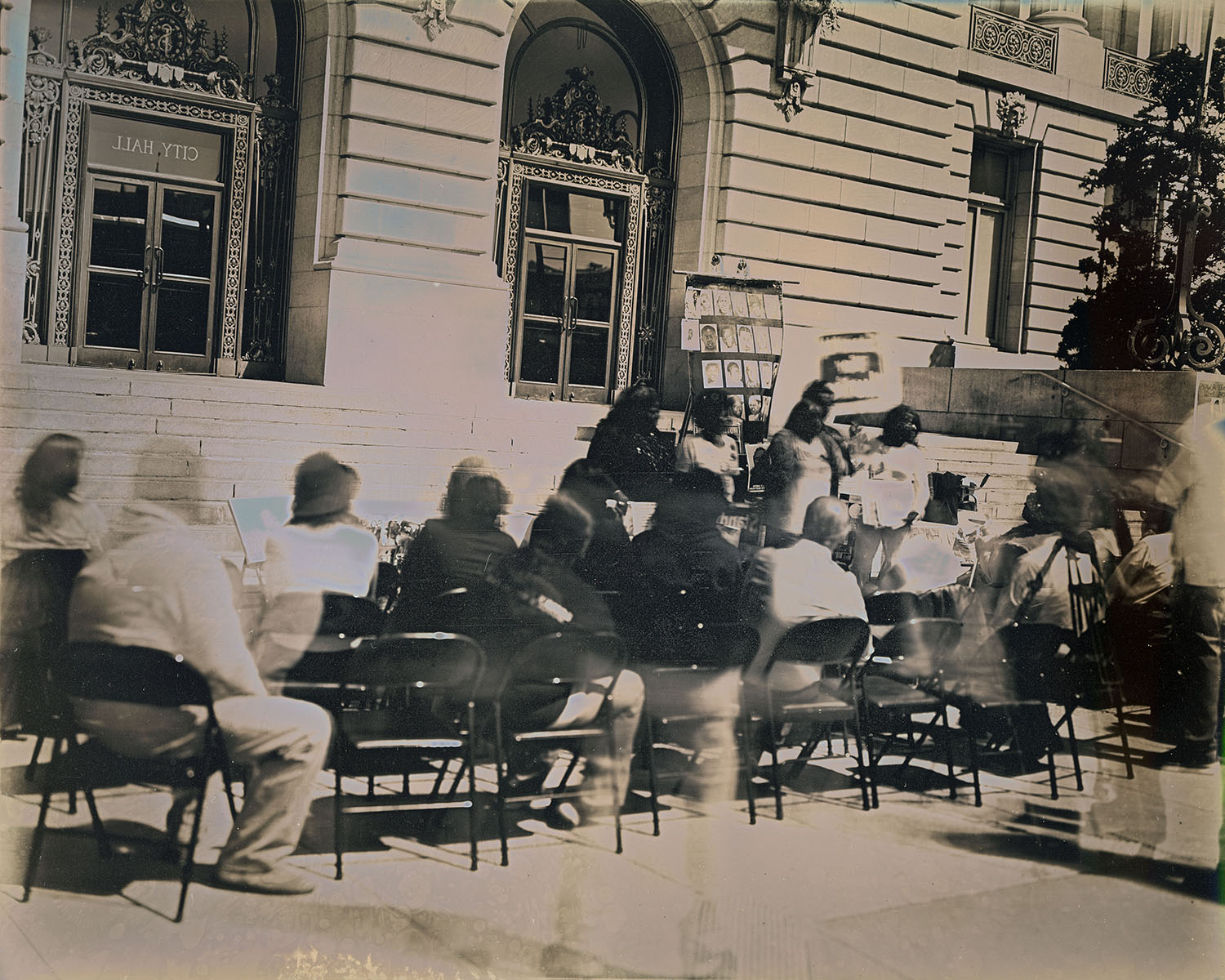
Binh Danh. ‘San Francisco City Hall (Mother’s Day 2014) Rally for Black Youths Whose Killers Have Never Been Found by the San Francisco Police Department, 2014’ Daguerreotype, Unique (in camera exposure). Plate: 8 x 10 inches / Frame: 12.75 x 14.5 inches
PP: Why daguerreotypes?
BD: The daguerreotype results in a reverse image. So, the cityscape is familiar but it’s odd. I like the uncanny.
PP: The reversal makes the viewer look a little harder, which is I think what all photographers want go their images?!
PP: There’s no shortage of spots in the city. How did you choose sites? I’d like to ask, specifically, about the TRUTH mural.
BD: When you do work with a commercial gallery, they are trying to sell work they are trying to move work. So, a lot of the more iconic San Francisco scenes are a little more successful in that [marketable] way. Some of the quieter scenes that might make there way into a future show or book.
I’m happy Haines picked the TRUTH mural piece. Rigo23 did that piece and what I like about that mural is that it faces city hall and confronts power.
PP: It was made in 2002 to commemorate the 2001 quashed conviction of Robert H. King, one of the Angola 3, after 32 years of incarceration, 29 of which were spent in solitary confinement. It was also a rally call for the cases of Albert Woodfox and Herman Wallace (who died in 2014) who remained locked up.
BD: In my picture, the farmers market is ongoing in the foreground, so if you want, there’s connections to the central valley to be made. And to ethnic communities. I’m not sure if the viewer will pick that up but that’s the thing I think about when I’m making the work.
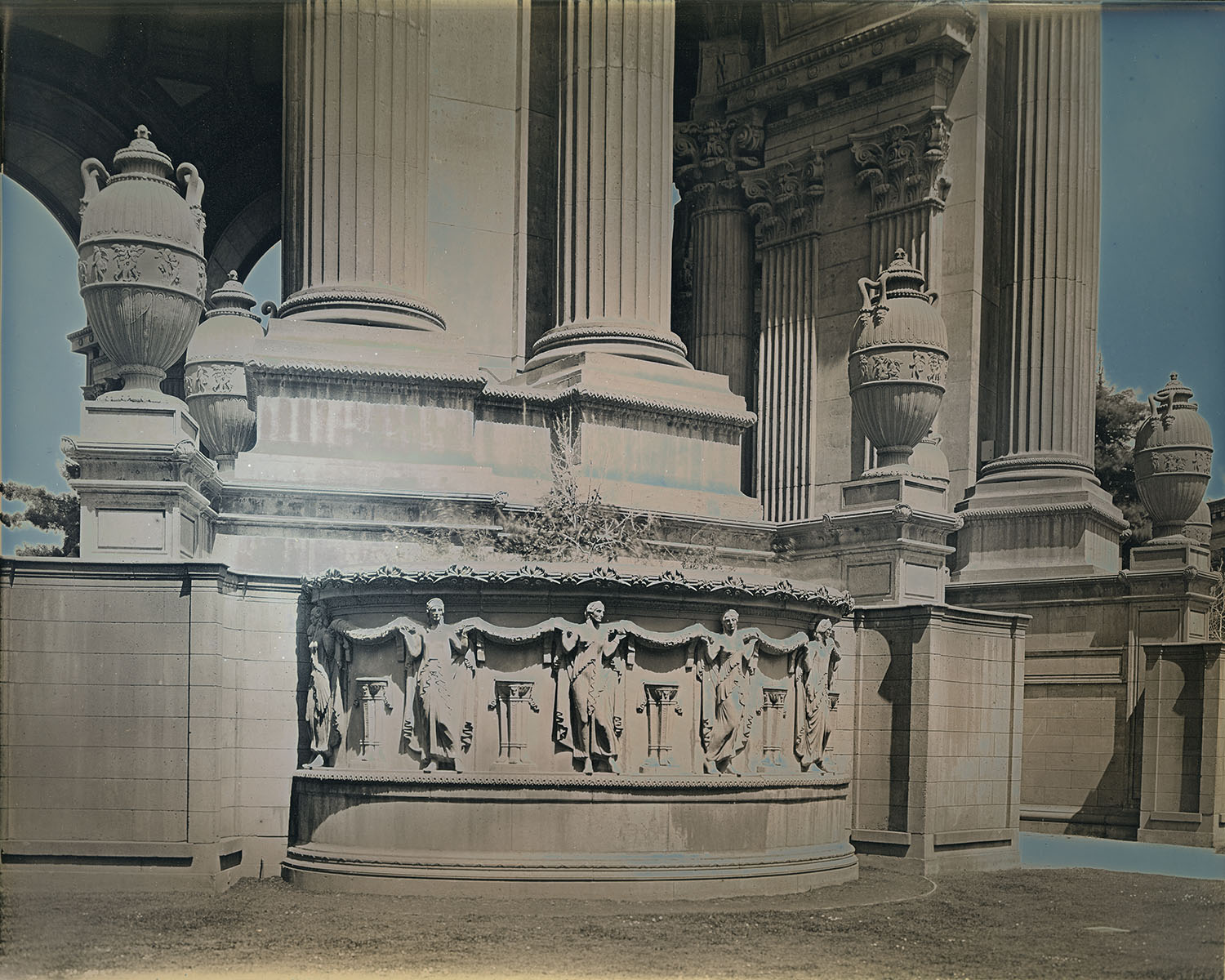
Binh Danh. ‘The Palace of Fine Arts, 2014’ Daguerreotype, Unique (in camera exposure). Plate: 8 x 10 inches / Frame: 12.75 x 14.5 inches

Binh Danh. ‘The Women’s Building, 18th Street, 2014’ Daguerreotype, Unique (in camera exposure). Plate: 8 x 10 inches / Frame: 12.75 x 14.5 inches
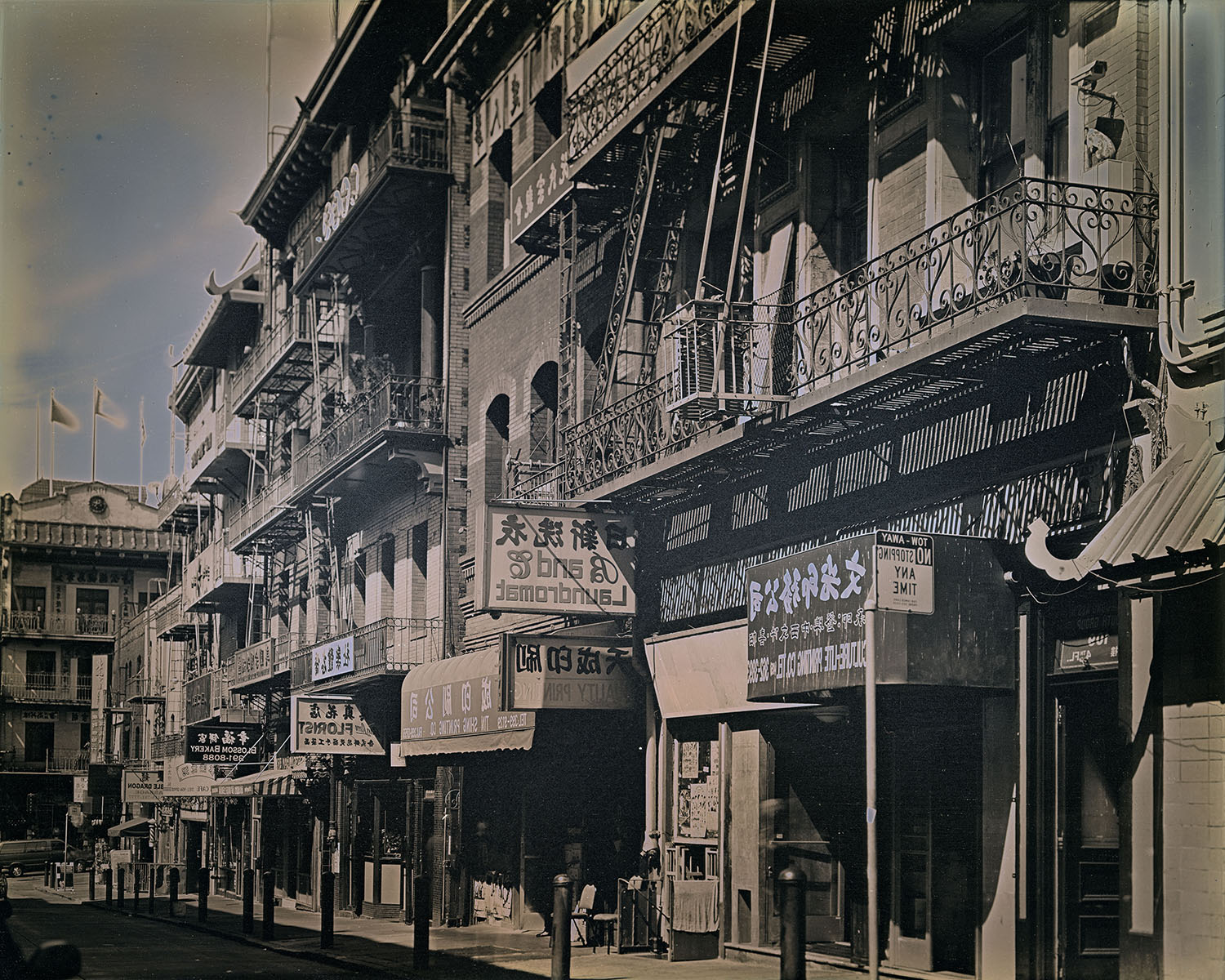
Binh Danh. ‘B and C Laundromat Barbary Coast Trail, Chinatown, 2014’ Daguerreotype, Unique (in camera exposure). Plate: 8 x 10 inches / Frame: 12.75 x 14.5 inches
PP: Do you have a favored image?
BD: The city hall image is my favorite image. I photographed a lot. I made all the images over the summer. I must have made 300 exposures and then I narrowed that down to 50 plates and the gallery selected 20.
PP: 300?!
BD: Not everything turns out, you know. I’d make 10 in a day and maybe one would hold a standard that I’m happy to share. Everyday I was driving from San Jose and up to the city making photographs.
BD: Almost all the people I encountered don’t understand the process, so to us it is a very foreign process. I think we take photography for granted so I hope I can help people think about image-making more. Maybe people will stop snapping away and take it slow?
PP: How did you learn the process?
BD: I learned just on my own. I found a 19th century manuscript and kept practicing and experimenting. Perfecting over the years. I began in 2001. Gave up and returned to it in 2009. Through the years I’ve made slow progress. I own the equipment, I make everything from scratch. I coat the copper plate in my studio and buff it. I’ve a van in which process on location. Back then, the daguerreotype was hard to do outside of the studio. That’s why most daguerreotypes are portraits. Cityscapes were rare — then and now.
PP: Thanks, Binh
BD: Thank You, Pete.
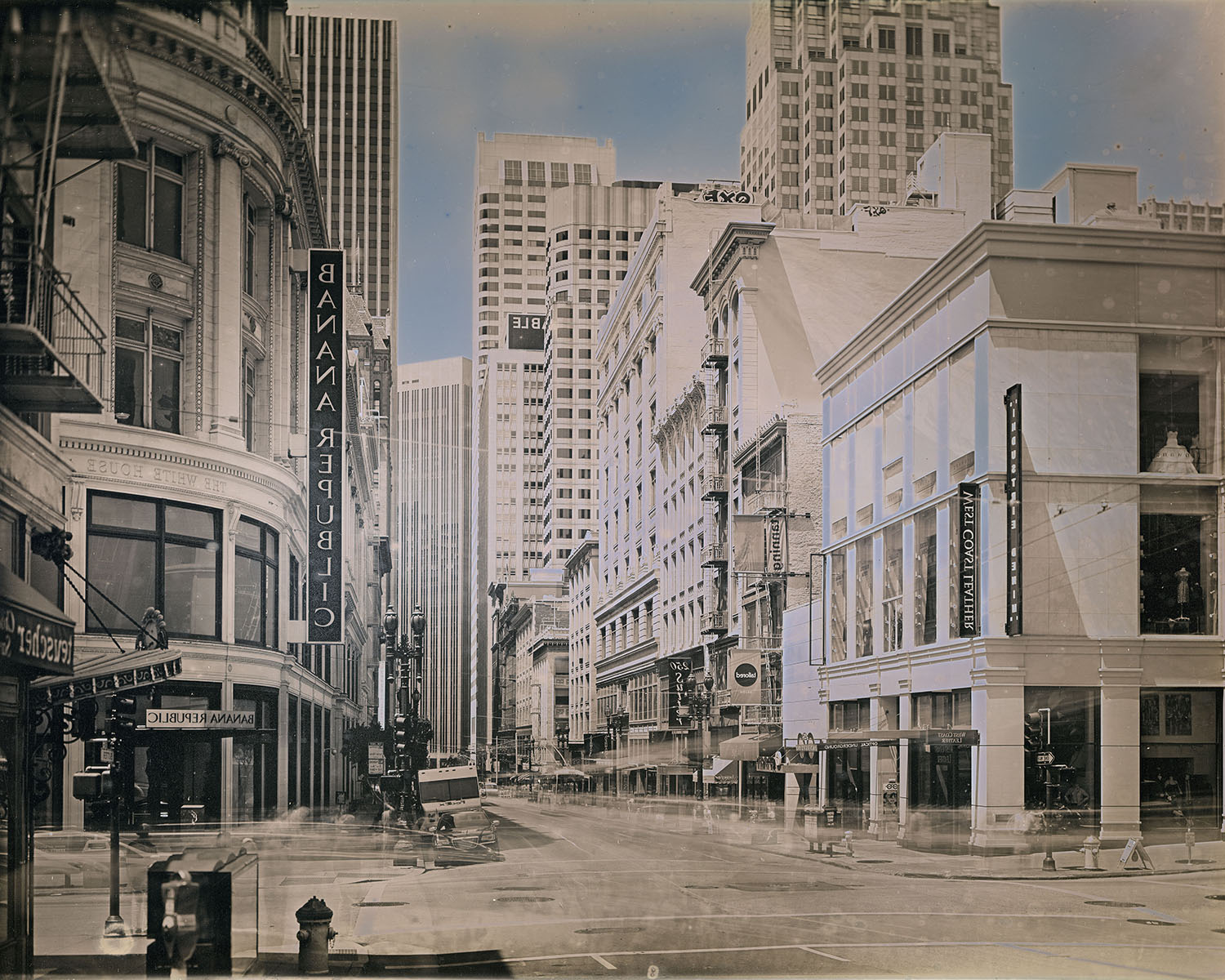
Binh Danh. ‘Sutter and Grant Streets, 2014’ Daguerreotype, Unique (in camera exposure). Plate: 8 x 10 inches / Frame: 12.75 x 14.5 inches
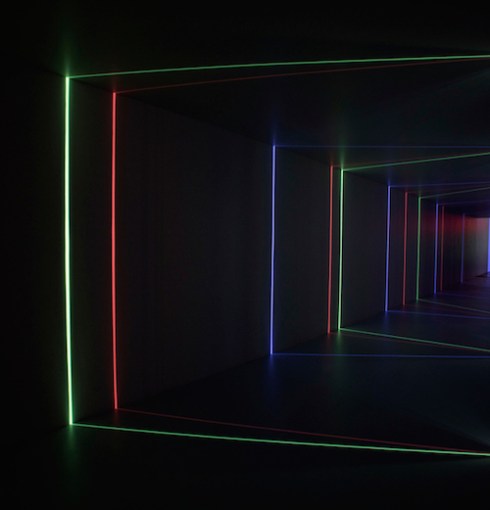
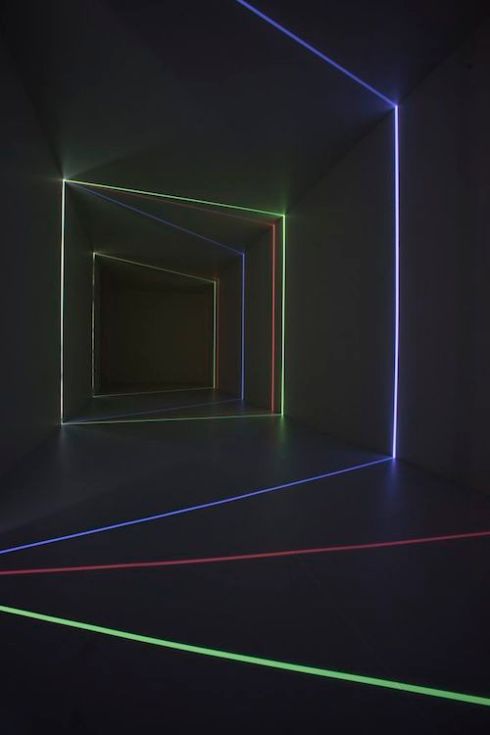
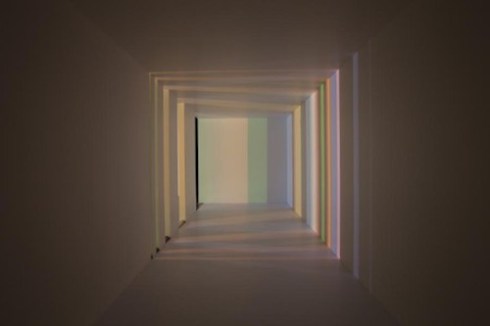
Two years ago, I walked out of Chris Fraser’s In Passing, installed in Portland’s Disjecta gallery, and resolved that it was the finest contemporary art I’d seen in the town. In Passing drew your attention to colour, light and line. The sensory experience, for me, put Chris Fraser slap-bang-wallop between Bridget Riley and James Turrell. In Passing was a strict coda delivered to fondle the eyeballs.
What was you ask? I was simply an enclosed corridor around three walls of the gallery. Into the walls, at random moments were slits that ran from floor to corridor ceiling, on the inside-wall. Three bulbs — one R, one G, and one B — hanging from the roof beams dangled in the centre of the gallery and dispersed low level light to all corners of the room. So enclosed was the corridor, that the low level light sliced the darkness in thin rainbow strips. At one end of the corridor the gaps became larger and light as a result became more diffuse and reflected off the walls in a palette closer white light.
Why I a wittering on about this so long after the fact? Well, next week, SF Camerawork opens with Revolving Doors, which is effectively a site specific camera obscura installation.
Note: All images here are of In Passing. Still a week out, I haven’t the foggiest what Revolving Doors looks like.
Fraser says that gallery goers can manipulate the walk in sculpture:
“Visitors will rearrange the space as they move through it, altering the architecture for future patrons,” says Fraser.
They’ll do that by altering the maze-like configuration that mimics the internal mechanisms of a camera.
“The structure and its design stand as a metaphor for the rapid demographic changes in SF Camerawork’s immediate Mid-Market neighborhood,” says SF Camerwork press release.
“The rich and well connected are moving in,” explains Fraser. “The poor and disenfranchised are being kicked out. A city must change to remain vital. But this transition seems particularly cruel. My hope is to highlight this disparity through an architectural intervention.”
Honesty and captivating beauty with a political edge, it seems. If Revolving Doors is even fractionally as accomplished as In Passing it’ll be one absolutely not to miss.
Revolving Doors is on view February 5 – March 21, 2015. The opening reception is this coming Thursday, February 5, 2015, 6-8pm


After stints at Haverford College, PA; Scripps, CA; and Rutgers, NJ, my first solo-curated effort Prison Obscura is all grown up and headed to New York.
It’ll be showing at Parsons The New School of Design February 5th – April 17th:
Specifically, it’s at the Sheila C. Johnson Design Center, located at 2 West 13th Street, New York, NY 10011.
On Thursday, February 5th at 5:45 p.m, I’ll be doing a curator’s talk. The opening reception follows 6:30–8:30 p.m. It’d be great to see you there.
Here’s the Parsons blurb:
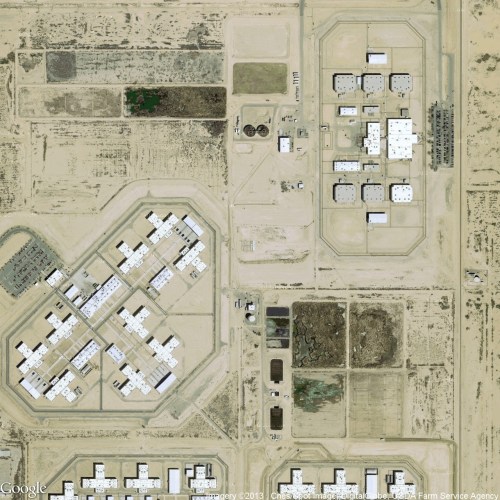
The works in Prison Obscura vary from aerial views of prison complexes to intimate portraits of incarcerated individuals. Artist Josh Begley and musician Paul Rucker use imaging technology to depict the sheer size of the prison industrial complex, which houses 2.3 million Americans in more than 6000 prisons, jails and detention facilities at a cost of $70 billion per year; Steve Davis led workshops for incarcerated juvenile in Washington State to reveal their daily lives; Kristen S. Wilkins collaborates with female prisoners on portraits with the aim to compete against the mugshots used for both news and entertainment in mainstream media; Robert Gumpert presents a nine-year project pairing portraits and audio recordings of prisoners from San Francisco jails; Mark Strandquist uses imagery to provide a window into the histories, realities and desires of some incarcerated Americans; and Alyse Emdur illuminates moments of self-representations with collected portraits of prisoners and their families taken in prison visiting rooms as well as her own photographs of murals in situ on visiting room walls, and a mural by members of the Restorative Justice and Mural Arts Programs at the State Correctional Institution in Graterford, PA. Also, included are images presented as evidence during the landmark Brown v. Plata case, a class action lawsuit that which went all the way to the Supreme Court of the United States, where it was ruled that every prisoner in the California State prison system was suffering cruel and unusual punishment due to overcrowded facilities and the failure by the state to provide adequate physical and mental healthcare.
Parsons has scheduled a grip of programming while the show is on the walls:
Mid-day discussion with curator Pete Brook and Tim Raphael, Director, The Center for Migration and the Global City, Rutgers University-Newark.
Wednesday, February 4, 12:00–1:30 p.m.
Co-hosted with the Humanities Action Lab.
These Images Won’t Tell You What You Want: Collaborative Photography and Social Justice.
Friday, February 27, 6:00 p.m.
A talk by Mark Strandquist.
Windows from Prison
Saturday, February 28
A workshop led by Mark Strandquist. More information about participation will be available on the website.
Visualizing Carceral Space
Thursday, March 12, 6:00 p.m.
A talk by Josh Begley.
Please spread the word. Here’s a bunch of images for your use.
PARTNERS
At The New School, Prison Obscura connects to Humanities Action Lab (HAL) Global Dialogues on Incarceration, an interdisciplinary hub that brings together a range of university-wide, national, and global partnerships to foster public engagement on America’s prison system.
Prison Obscura is a traveling exhibition made possible with the support of the John B. Hurford ‘60 Center for the Arts and Humanities and Cantor Fitzgerald Gallery at Haverford College, Haverford, PA.


Mom Were OK, Mississippi Gulf Coast, Mid September, 2005 © Copyright of Zoe Strauss
STRAUSS AT HAVERFORD
If you’re in the Philly area and you’ve got any sense, you’ll be making your way to Haverford College tomorrow for the opening of Sea Change, by Zoe Strauss.
Strauss will be there too. Talking and everything.
Friday, January 23rd.
Do it.
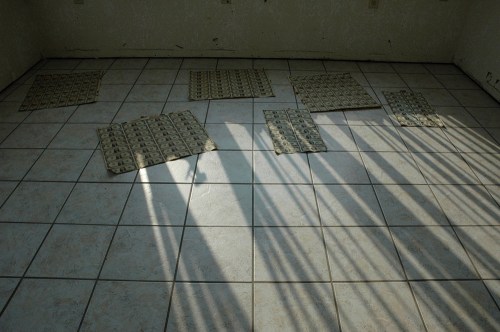
Drying Money, Mississippi Gulf Coast, Mid September, 2005 © Copyright of Zoe Strauss
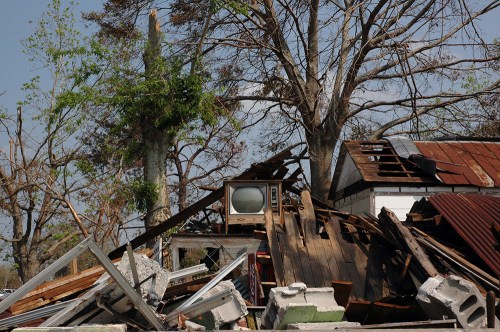
TV on Second Floor, Mississippi Gulf Coast, Mid September, 2005 © Copyright of Zoe Strauss

This is my hometown, Toms River, NJ, 2012. © Zoe Strauss.
PRESS BLURB
In Sea Change, Strauss traces the landscape of post-climate change America. In photographs, vinyl prints, and projected images, Strauss treads the extended aftermath of three ecological disasters: Hurricane Katrina in the Mississippi Gulf Coast (2005); the BP Deepwater Horizon oil spill in Southern Louisiana (2010); and Hurricane Sandy in Toms River, NJ, and Staten Island, NY (2012). Lush and leveled landscapes; graffiti pleas and words of encouragement—Strauss’s camera captures lives decimated and dusting off: the fast and slow tragedies of global warming, the damage we can repair, and the damage we can’t.
THOUGHTS
I had no idea Strauss was working on a survey of disasterscapes in America. Following her 10 years of photographing in Philadelphia and celebrating the colours and characters of her beloved home city — and then presenting her photographs annually beneath Interstate 95 — it makes sense that Strauss would gravitate to the realest of struggles for real people at a time when real (climate) change is unleashing real events.
Sandy, Katrina and the Deepwater Horizon catastrophes left millions of Americans floundering, thousands dead, communities torn from the ground. In the immediate aftermath of such events, attention focuses on the official and governmental responses, but Strauss is more interested in the long tail of disasters and of informal vernacular responses. Strauss seems hell-bent on reminding us that after the camera crews leave, there’s still generations of rebuilding to be done (especially ecologically).
In Sea Change we see Strauss’ usual dark humor and restless documentation of the frayed edges of our nation. She’s holding up a mirror to the inconvenient messiness that we like to think we can deal with quickly and efficiently, but Strauss’ world is in a state of constant entropy, and it’s the invisible, the workers, the poor, the animal kingdom and the dissenters that lose out most when the shit hits the fan.
We all know that we’ve permanently altered our planet’s climate systems; we all know we’re on the hook. But we also know we can look anywhere-else, any time we want. And we know we don’t have to live on the Gulf Coast, or in the path of hurricanes. And we know that when things go south, we can turn our heads to the news and make a distant appraisal about whether the clean-up is happening quick enough or not, or watch some talking heads, or wag our finger at some government official.
Strauss’ victory in all her work — and particularly in Sea Change — is that she marries the visuals in her inquiries and her work so that they sync with her experience of the world. She is keeping herself honest through her photography. Perhaps Strauss can keep us honest too?
Foundational to Strauss’ work too is a deep respect. Zoe is irreverent, for sure, but she is also respectful of people. Entropy is going to happen; change is constant. People are going to win and people are going to lose, amidst change. That’s life. The degree to which people’s fortunes differ … and the degree to which people win and lose … and the degrees to which those statuses are kept permanent, that’s not just “life” though. It’s for us to decide how disaster will effect our collective in the long term. It’s for us to decide on the most equitable distribution of resources when many have literally been swept away.
When people fall down, we help them up. Rebuilding is everyone’s business. In Strauss’ world, love is the response to entropy and its disruptions.
NUMBERS
Running: January 23–March 6, 2015
Reception and opening talk with the artist: Friday, January 23, 4:30–7:30pm
PAPER
The exhibition is accompanied by a publication designed by Random Embassy, Philadelphia, featuring essays by artist Zoe Strauss; The New Yorker contributing writer Mattathias Schwartz; Helen K. White, PhD, Assistant Professor of Chemistry at Haverford College; and a poem by Thomas Devaney, MFA, PEW Fellow and Visiting Assistant Professor of Poetry, Haverford College.
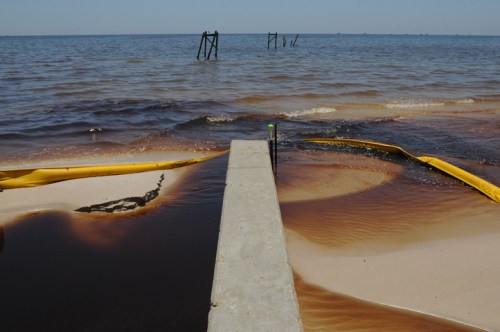
Oiled Water Coming Inland, Waveland, Mississippi, Early July, 2010 © Copyright of Zoe Strauss
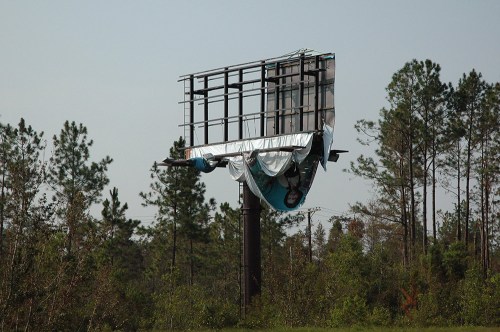
Billboard, Mississippi Gulf Coast, Mid September, 2005 © Copyright of Zoe Strauss
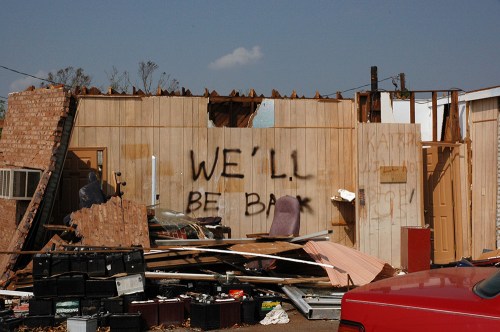
We’ll Be Back, Mississippi Gulf Coast, Mid September, 2005 © Copyright of Zoe Strauss
ANY QUESTIONS?
Contact (my mate) Matthew Seamus Callinan, Associate Director, Cantor Fitzgerald Gallery and Campus Exhibitions
mcallina@haverford.edu
Cantor Fitzgerald Gallery, Haverford College, 370 Lancaster Avenue, Haverford, PA 19041
Tel: 610 896 1287

Don’t Forget Us, Mississippi Gulf Coast, July 2010 © Copyright of Zoe Strauss

A CARTOONIST GOES TO JAIL
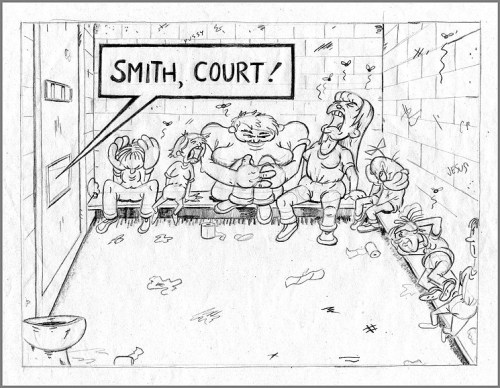
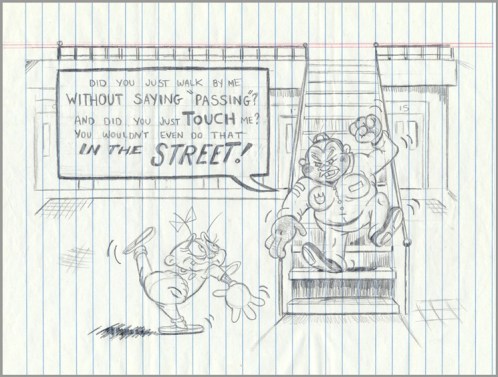
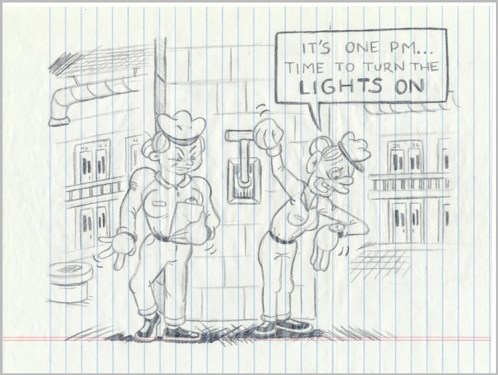
In June 2014, Los Angeles-based cartoonist Elana Pritchard was arrested for violating a court order. When she bailed out on July 3, she had little-to-no money and an overworked public defender. Her prospects didn’t look great.
“I knew I’d have to serve time for my violation,” Pritchard wrote for LA Weekly. “That’s when my mentor, animator-director Ralph Bakshi, advised me to *document my exploits*.”
Pritchard was jailed in the Los Angeles County jail system for two months. First, she spent 5-weeks at Century Regional Detention Facility (CRDF) in Lynwood, and closed out her remaining 3-weeks at Twin Towers Correctional Facility in downtown L.A.
ACCESS, OBSERVING & DRAWING
As you know, I deal with photographic imagery mostly, but I am always eager to point out creative efforts in other mediums that illuminate critical criminal justice issues more efficiently, powerfully and intelligently than photography. Pritchard’s cartoons from jail are honest, wry and direct.
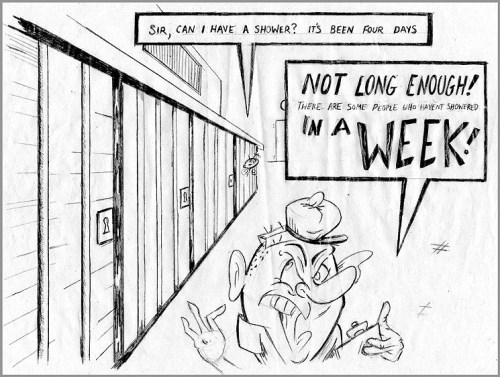
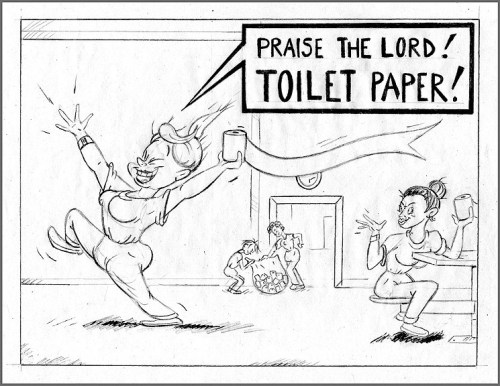
“Armed with nothing more than a golf pencil and whatever paper I could get my hands on, I drew the strange world into which I’d been dropped,” says Pritchard. This was the draughtsperson’s equivalent of a two-month photojournalist embed!
They get to the root of those daily indignities that establish power-relations between guards and prisoners. Simultaneously, those power-relations ratchet up tensions for everyone in the jail.
As you look through these cartoons, I ask you to wonder is the “strange world” Pritchard reveals — of cold showers, dirty laundry, confiscated belongings, midnight cell-counts, competitions over basic sanitary products, food scarcity, sly put-downs and much more — one that we can accept, or one that we can ignore?
The unreasonable claustrophobia of the jail is made visceral in Pritchard’s drawings. I’d argue she conveys the experience of jail far better than many photographers can and have.
————
I discovered the comics at the Prison Arts Coalition blog and hastily made inquiries as to whether I could repost the cartoons and Pritchard’s commentary here. Gratefully, I was given permission.
Scroll down, here, to read Pritchard’s reaction to the cartoons’ publication in LA Weekly. I also recommend you read the original LA Weekly article in which Pritchard explains the context for each image.
————

“I Wanted To Remind Us We Were People”
I couldn’t be more pleased with the response to my cartoons from Los Angeles jail system. People from all over the world have written to me expressing their support for what I have done and their contempt for inhumane practices for incarcerated peoples everywhere.
I have been in communication with the LA County Sheriff’s department and they have told me that due to these comics they have issued a new policy that all inmates must be given showers within 24 hours of entering the jail. We are scheduled to meet to discuss further improvements. And throughout all of this it seems the original, humble message of these comics is sticking: that we were people.
Even though we had a barcode on our wrist with a number and were called “bodies” by the staff, we were still people.


Many people in jail are still on trial and haven’t even been found guilty or innocent yet. Many people made mistakes that you or I have made before in private, only they got caught. There were mothers in there that missed their children. There were kind people in there that cared about the arts and cared about each other.
I drew these comics to make us all laugh and remind us that even though there was a whole group of of people with badges and better clothes than we had telling us we didn’t matter … we DID matter and we WERE PEOPLE.
In that the comics were successful, and for that I am proud.
—————-
All images were first published in the LA Weekly, 2015.




ELANA PRITCHARD
Elana Pritchard is a cartoonist in Los Angeles. Before she landed in jail she worked as an animator on Ralph Bakshi’s film, Last Days of Coney Island.
She is currently raising money on Kickstarter to complete her animation, The Circus.
You can follow Pritchard on Twitter at @elanapritchard.
PERMISSIONS
All images were first published in the LA Weekly, 2015.


Honore Feliciano de Souza is the current head of the Agoudas community and the direct heir of Chacha I (1754–1848), who was one of the foremost middle-men in the slave trade between the Kingdom of Dahomey and the Europeans, early 19th century. To honor their ancestor, the family seemingly runs a sort of memorial in Singbomey, where Chacha I is buried in the family cemetery. According to Honore Feliciano’s unlikely opinion, “the Chacha was not involved in such a slave trade as this. At the time when the Kingdom of Dahomey was killing people, he preferred to take them to Brazil to make them work. He was in fact saving people and that is the reason why today there is some admiration for him,” he says. “Nowadays, no one would want to be a Chacha. Being Chacha is facing many hardships. I haven’t chosen to be one. On October 1995, everyone gathered here and I was appointed Chacha VIII, I cried that day. It’s a life-long mandate.” © Nicola Lo Calzo. From the series Tchamba.
LEGACIES AND TRACES OF COLONIALISM
Culture is a complex thing, especially when it is emergent from centuries of violence, oppression and bondage. The Atlantic slave trade moved millions of bodies and reordered the geographies of peoples and their customs. There are as many histories as there were individuals who lived and suffered, were bought and sold.
Photographer Nicola Lo Calzo has waded deep into this history for his ongoing, serialised project Cham. For five years, he has investigated slavery’s legacy in Africa, the Caribbean, the Americas and Europe.
“From the destruction and the uprooting imposed by the Europeans, to the conquered and deported peoples, the history of slavery is inseparable from the odyssey of Western colonialism,” says Lo Calzo. “But it is also the history of resistance to slavery.”
Elements of resistance are visible in the myriad of visual cultures and traditions upon which Lo Calzo has turned his lens. There no longer exists clear icons or customs that are squarely of a single experience or people. Over the centuries, and at different moments, descendants of slaves across the Atlantic region have won freedom, moved and settled, mixed, revived ancient traditions, and reclaimed symbols of the slavery era. Everything, visual culture included, is in constant flux.
“I’m interested in exploring through photography how and why these groups re-appropriate their slavery past, the ways and manners by which they are transferring this memory to the next generation, as well as its impact on modern societies,” says Lo Calzo.
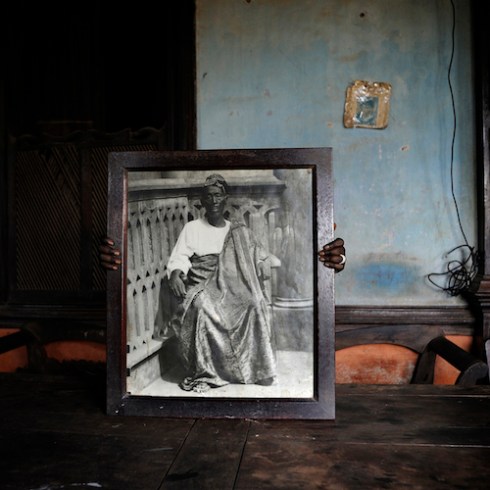
The founder of the David Akplogan Godonou Dossou family was a wealthy merchant of Gouns ethnicity, coming from Porto Novo. “Akplogan” referred to his function as cult minister under King Toffa. According to Mirabelle G. D., great great granddaughter of the founder, “at the peak of the French domination, he decided to change his name and give up voodoo”. Like most of the city’s rich merchants, he owned “mede”, literally “chosen people”, a dozen of domestic slaves, according to his descendant’s testimony. In this picture shot in the nineteen-twenties, at the height of his economic power, he is seen sitting in the main courtyard of his property. Porto Novo, Benin. © Nicola Lo Calzo. From the series Tchamba.

In Buryan, Death embodies also the spirit of the slaves’ master, who is the founder of their community, Don Francisco Felix de Souza, known as the Chacha I. This double figure of the “Death-Master” is the protector of the hierarchy within the community, while becoming the oppressor of those who would violate it. Buryan perpetuates its original signification in confirming and consolidating the hierarchy and casts among the members of the community: the De Souza of servile ascent on one hand, and the De Souza of direct lineage on the other. Oiudah Beach, Benin. © Nicola Lo Calzo. From the series Tchamba.

Sitting in the center of the picture, Conforte, aged 30, now lives in this house built by her great-grandfather David Godonou Dossou, in the early 19th century. Like the majority of the merchant families, he owned Médé, literally meaning “chosen people,” a dozen of them according to her. These slaves were employed for domestic tasks; construction works in the family concession and in the palm oil plantations. This house is one of the highest examples of Afro-Brazilian architecture in West Africa. “Everyone wanted to abandon our ancestral property as we lacked resources and personnel,” says Mirabelle G. D., the great great granddaughter of the founder. “We’ve been brave enough not to let the house crumble down. The UNESCO has asked for the house to be maintained but we are still waiting for all the heirs’ approval.” Porto Novo, Benin. © Nicola Lo Calzo. From the series Tchamba.
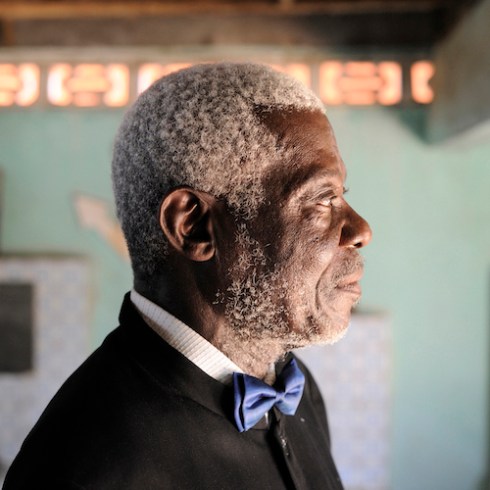
Clement is a member of this family originally from Marseille, France. His ancestor, Olivier de Montaguere, was the nineteenth steward of the French Fort for Louis XVI. He arrived in Ouidah in 1776. He brought with him his wife and their three children, Joseph, Nicolas and Jean Baptiste and organized the slave trade with the French West Indies, He disappeared during one of his trips to the Caribbean and he is never returned to Ouidah said Clement Olivier of Montaguere. Their descendants still live today in the old compound of their ancestor. Unlike many other local families, they have no voodoo altars in their homes, and while claiming their European origins, they strictly observe the catholic religion. Today, in the family cemetery (where I got the pictures), the oldest tomb is to Nicolas Olivier de Montaguere’s. According to the tradition, Nicolas grew up with the king of Dahomey Agonglo (1789–1797). After his adolescence spent in Abomey with the king, he returned to Ouidah in his father’s family home when he continued to deal palm oil . Nicolas and Joseph’s descendants still live in the old compound of their ancestors. They have maintained a position of prestige in the society, and historically occupy important positions in the public administration. Ouidah, Benin. © Nicola Lo Calzo. From the series Tchamba.
Cham is made up of multiple chapters. Mas was made in French Antillas in collaboration with the Mas groups of Guadaloupe. Ayiti was shot in Haiti. The series Tchamba explores memory and experience in the African nations of Senegal, Ghana, Togo and Benin.
COMPLEXITY AND CONTRADICTION
During his work, Lo Calzo has encountered Creoles, descendants of revolutionaries, Voodoo practitioners and black resistance revivalists. Lineages and connections to past slavery are unique. Each generation that passes churns the mix. Lo Calzo, who resides in Paris, likes to use the French word ‘metissage’ when discussing the Cham. Metissage is a positive and politically-conscious term that celebrates diversity and the mix of race in culture.
“With all forms of creation and miscegenation, born as a result of the clash between the oppressed groups and the dominant system, the memory of slavery should be read and interpreted within this hybrid and metis universe,” says Lo Calzo. “It is characterized by ambiguity, mixture, juxtaposition and contradiction. I wish to make visible the connections — and also the contradictions — between these forgotten memories still living through the Atlantic world.”
To note the assimilation of colonial festivals, costume and figureheads is a potential political minefield. Yet, Lo Calzo is not celebrating the vestiges of Western colonizers. Rather, he is merely documenting them as fact. Sympathy toward, and faithfulness to, his subjects stories is Lo Calzo’s modus operandi. The African Yoruba and Nago communities in Benin and Togo have suffered especially, Lo Calzo has observed. So too, the Creole families of slave descendants in Guadaloupe.
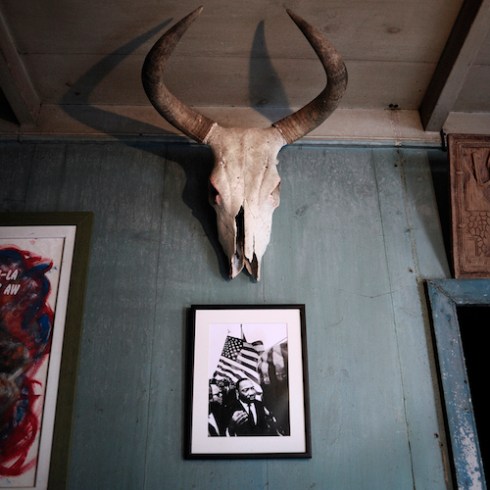
Every evening after 6 pm, the group members meet each other in front of the headquarters, the old Fritz family store and they discuss politics, business, religion, and the next actions of the militant group. Pointe à Pitre. © Nicola Lo Calzo. From the series Mas.

The role of the rebel, the resistant, the “Slave maroon” is staged through a particular technical and musical choice. The masks are chosen very simply and made from natural materials. The aim of these technical choices is to result in a direct incarnation of history in the individual’s body, who can claim their multiple origins and reaffirm their putting down of roots in the Guadelupian ground. The body is then becoming a direct carrier for the Caribbean identity and history, which scalds and wounds are expressed in the flesh, through the corporeal moves, through the sounds of the chains and whips. Voukoum headquarters, Basse Terre. © Nicola Lo Calzo. From the series Mas.

Fritz Duncan is the group’s head as well as its religious leader. “After several years of thinking and of rejection by the other groups “a mas,” I created the group “An Bout a-y” (literally “at the end”), to pay tribute to the ancestors,” he says. The group claims to be part of the animist religion and it doesn’t participate in the Carnival. For this group, the Mas are a link between the world of the living and the dead enslaved ancestors. The group is part of the secessionist party LKP. Bas de Bourg, Basse Terre. © Nicola Lo Calzo. From the series Mas.
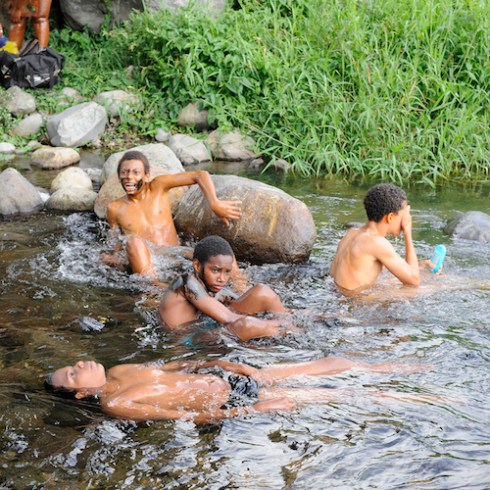
In the group’s symbolism, the bathing in the sea or river concludes the “charge” on «Mardi Gras», the last day of the Carnival in the catholic calendar. It is an emblematic moment that allows the members firstly to purge themselves from the “mas” to reclaim their individual identity, and secondly, to be reconciled with the “treacherous” sea and to reaffirm their relationship to the island’s history: the place of the bathing is just beneath the Fort Delgrès, a hotbed of the resistance to slavery. Basse Terre. © Nicola Lo Calzo. From the series Mas.

Marcellus, alias Jean Jacques Dessalines with Adrien Jean Saint Vil, alias Charlotin Marcadieu, “Movement for the Success of the Image of the Heroes of the Independence.” Croix-des-Bouquets. © Nicola Lo Calzo. From the series Mas.
ACKNOWLEDGING DIFFERENCE, HONOURING SAMENESS
Cham emerges from Lo Calzo’s interest in the concept of ‘Otherness,’ which is defined as that which is alien and divergent from prescribed social norm or identity. ‘Otherness’ is the identification, definition and social categorization often of a supposedly inferior group — and, usually, to oppressive ends — by a dominant group.
“Colonialism is connected with the ideological construction of racism and the invention of the ‘Other,’” says Lo Calzo, whose reflections upon physical ability, race, gender, sexuality and ‘Otherness’ have been consistent throughout all of Lo Calzo’s photography series such as Morgante, The Promising Baby, and The Other Family.
Whenever Lo Calzo travels he partners with local anthropologists, historians or associations. Recently, he worked with the Joan Mitchell Center in New Orleans and this month (August) he is photographing in French Guyana and Suriname with the help of La Tete dans les Images. Such allies are important as many of his subjects — especially those who live in societies with racial tensions — are reluctant or unable to speak about slavery. Still, Lo Calzo brings a respectful curiosity to the topic and presses the points.
“To think about ones own enslaved ancestry can pose identity, social and existential problems,” he says. “Who I am? Where do I come from? How can I integrate my family past in my present? What can I do to transmit this memory to the next generation? Why does society still looks at me through the outdated racial categories? What I can do to change it?”
The success of the Cham rests upon its breadth and the way Lo Calzo mirrors the complexity, and sometimes ambiguity, of history in his photographs. This complexity though does ask a lot of the audience. His greatest challenge is to tear down entrenched Eurocentric and Americentric attitudes which prohibit nuanced understanding of groups’ and nations’ uniqueness.
“We act and think through predefined categories of thought, without realizing these categories are daughters of colonialism and are no longer suitable for reading and interpreting the modern world,” explains Lo Calzo. “For example, in the western imagination, Haiti is a country of misery, a ‘neverland,’ a country without history. This dogma is obviously a falsehood created by the colonialist propaganda and integrated deeply into Western thought.”
Lo Calzo forecasts he’ll be making photographs for one more year to complete his complex statement. The entire project will be exhibited internationally in 2016, accompanied by book. The contribution is forever timely.
“The memory of slavery is a delicate subject,” says Lo Calzo. “The wounds of slavery are alive and present.”
——

In the water basin, a spirit named Lovana appears in the guise of a fish. The faithful come to pray around the basin, on Tuesdays and Fridays. A big party takes place there on September 5, the eve of the pilgrimage in Bord-de-Mer de Lemonade, to honour the Voodoo deity St. Philomena, also called “Lasyrenn” (the Mermaid). Today in Haiti, most of the Voodoo sacred places are located in the countryside, especially on the ruins of ancient colonial estates, which are thus affected by these community identity practices. © Nicola Lo Calzo. From the series Ayiti.
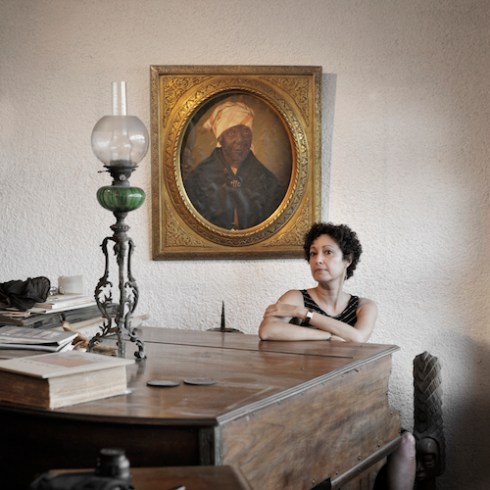
Modeste (in the framed picture) was deported as a slave from Ethiopia to Haiti, in 1781, to the land of Francis Testas, a sugar grower in the south of Santo Domingo. Testas last wishes read, ‘I order that all my negroes here with me, are free, are fed and maintained at my expense, until they have chosen if they want or not to return to the city of Jeremie […] July 13, 1795, seven and a half in the morning, Philadelphia.’ After five years of research between the United States, France and Haiti, and despite some opposition of her parents, Lorraine Manuel Steed was able to reconstruct the life of her ancestor Martha Adelaide Modeste, an African slave.” © Nicola Lo Calzo. From the series Ayiti.

Preparation of the Mas-a-kongo déportaisyon, Voukoum group The phenomenon of the reinterpretation of the past and the African origin is clearly present in the case of the Mas-a-Kongo. This mask consists of coating the body and the face with a mixture of sugarcane syrup and soot collected in the chimneys of the sugar factories. Once again here, the elements have lost a part of their original meaning (referring to the cult of the bear or the savage man in the Indo-European carnival), to assume a new symbolism derived from the local context. Indeed, the Congo Mask is presented as symbolizing the African origin of the Caribbean people, because of its exacerbated black color. On the other hand, this image reflects of very occidental and colonial vision of the African savage. Nevertheless, this “Congo mask”, with its ambiguous origins, is considered the strongest symbol of the Antillean people’s Negro origins. Petit-Paris district, Basse Terre. © Nicola Lo Calzo. From the series Ayiti.
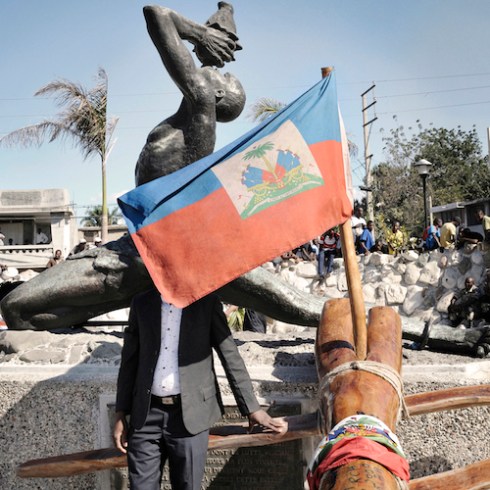
The fugitive slave — or maroon — occupies a central place in the Haitian universe. He is the ancestor of the fathers of the nation. The maroon is the assurance of an uninterrupted genealogy, despite many ups and downs experienced by the young nation, since its birth in 1804. It is survival, resistance and refusal to abdicate. It is Haiti and vice versa, the incarnation of the Haitian Revolution. © Nicola Lo Calzo. From the series Ayiti.
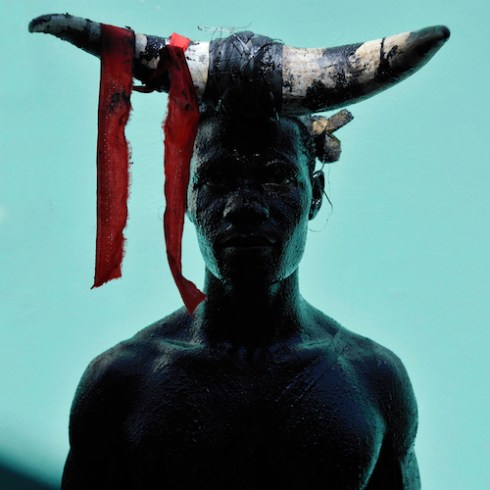
Theodore Taondreau is the manager of this group. The role of the rebel-resistant, the “maroon” is staged through a technical choice and a specific music. In the case of the “whipper” or “rope launcher”, the mask consists in coating the body and face with a syrup pack (sugar cane syrup) mixture, normally collected in stacks at sugar factories. Again, these elements have lost some of their original meaning (in reference to the cult of the bear or the wild man in the Indo-European carnival) to endorse a new symbolic meaning linked to the local context. Indeed, the “whipper” symbolizes the African origin of the Haitian people because of his exacerbated black colour. © Nicola Lo Calzo. From the series Ayiti.
——-
Follow Nicola Lo Calzo on Twitter and Facebook.
——-
Cross-posted to Medium on January 6th, 2015.

 Prison Photography