You are currently browsing the category archive for the ‘Fine Art’ category.

PHOTOS OF NORWAY’S PRISONS: CONTEXT
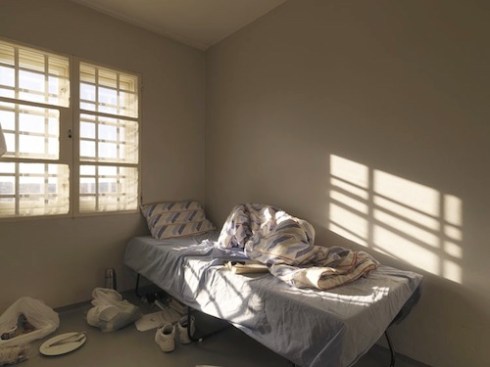
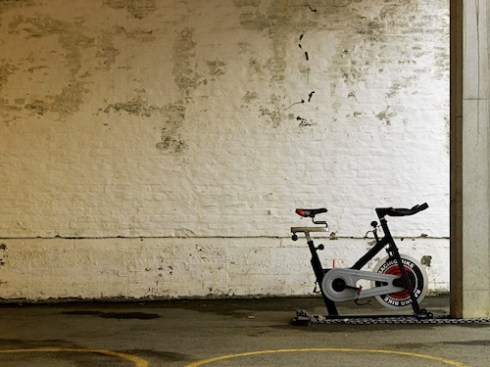
Almost without exception, photographs of prisons in Norway featured in international media over the past two years have appeared below a headline featuring the word “luxury” or in simplified articles about the relative comfort of Norwegian prisons. The implication? That no criminals should live in safe, clean, environments and that rehabilitation is folly at best and an insulting waste of taxpayers money at worst.
I’d like to recommend a different take. Six of Fin Serck-Hanssen‘s photographs from Normalising Judgement appear throughout this post.
Serck-Hannsen’s view is neither expressly bleak nor expressly sugary. These drab prisons are nothing to get overly-emotive about and as such probably reflect fairly the predictable life in highly-managed institutions that try to redirect the most antisocial adult behaviours. As you click through to the links included herein, please refer back to Serck-Hanssen’s Normalising Judgement to challenge the “rosy” picture that may have been painted of Norway’s prisons in international media.
Completed in 2008, Serck-Hanssen’s Normalising Judgement pre-dates Breivik’s massacre. The Norwegian Ministry of Justice and Public Security was drafting a white paper, and invited Serck-Hanssen to document multiple prisons. As long as privacy was safeguarded and security was not put at risk, Serck-Hanssen was able to work freely throughout the prisons.
Serck-Hanssen told Mono blog, “In my view, Norwegians in general have the idea that prisons are very human institutions. I wanted to find out how much truth there was in this assumption.”
BREIVIK, MEDIA, ATTITUDES AT HOME AND ABROAD
When mass-murderer Anders Breivik was sentenced to 21 years in prison by a Norwegian court, it wasn’t at all clear to me how the verdict related to my efforts here at Prison Photography. The court ruled he was sane, yet I am quite happy to describe his ideas as repulsive and his actions as deranged. His offensive gestures and attitudes played out in the court reflected his right-wing islamophobic motives for the murder of 77 innocents on Utoya Island in July 2011.
Breivik has entered the select company of infamous and clearly unhinged murderers that history unfortunately seems to remember. Here at Prison Photography, my concerns are for the majority of American prisoners who are non-violent, poorly-educated, warehoused and given few opportunities to rehabilitate should they find themselves subject to the unusually long sentences the U.S. hands down. Breivik has zero in common with these men, women and children.
Somewhat surprisingly, there is commentary that is spurred by ideas and images about Breivik’s case and that relates to American prisons. Said commentary revolves around the issue of prison conditions. Namely, it centres on the divergent expectations of people in different nations on conditions for convicted criminals.
Even preceding Breivik’s horrendous crimes, there was a characterisation of Norwegian prisons as being “luxury” (the same characterisation/accusation has been aimed at the prisons of other European nations – Austria springs to mind). Sometimes, the term “humane” was used; a welcome alternative given that the term “luxury” often carries an inferred suspicion and jealousy.
In the week following the Utoya Island massacre, innumerable news sources ran stories about how Breivik would potentially serve his sentence in a “cushy” or “super-lux” or, closer to the truth, “progressive” prison.
As it is the highest security facility in the country, it was understandable that international media assumed that Breivik would be held in Norway’s recently constructed (2010) Halden Fengsel Prison. He is actually being held in Ila Prison, near Oslo (details; 14 photos; and the psychology of solitary).
CIVILITY OF PROCESS: CIVILITY OF PRISONS
Repeated slideshows often feigned dismay and disgust, or intended to stoke up anger. But it was an anger engineered for international audiences, not Norwegians. Norway was busy mourning, getting to grips with introspection and formalising the logistics to carry out one of the most high profile cases in its legal history. This isn’t to say that Norwegians didn’t feel anger, but they also knew they had to meet Breivik’s unparalleled assault with a dignified and civil response.

In the U.S., a country that routinely hands down the death penalty and Life Without Parole, Breivik’s sentence of 21 years seems comparatively tiny, even foolish.* Most American citizens would balk at the notion. And yet, when the verdict was passed, most Norwegian celebrated the fact that Norwegian law had handed down it’s most severe punishment and that the civility of the judicial system had remained in tact throughout despite the extreme heinous nature of Breivik’s crime (I only consumed news-stories on this event in the UK, so narratives may have differed elsewhere).
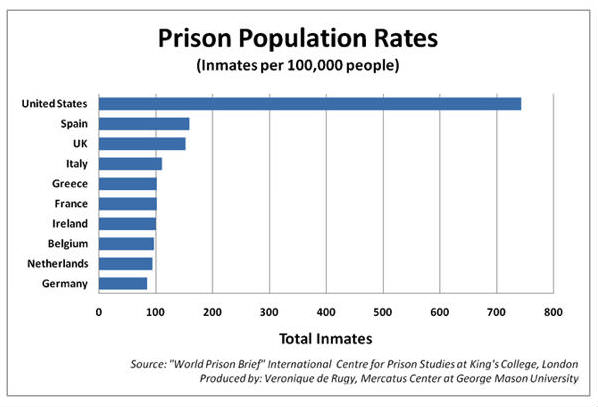
If societies are to learn and move forward from such horrendous events then they need something to rally around. In Norway, the humane and sensible legal system, in the response to acts of utter criminality, was an obvious ‘something.’ Americans can never rally around the death of someone sentenced to execution. Even in non-capital offenses, how proud can any U.S. citizen be of a legal system that has sentenced tens of millions to broken prison systems and is responsible for 2.3 million prisoners on any given day?
Prison (or the electric chair) shouldn’t be considered the final chapter. Prison should be considered an early chapter toward mending a broken individual and society’s shortcomings that led a given individual to transgress. Prison conditions are key in successfully rehabilitating individuals and successfully relieving society of future crime and the associated financial costs.
Dylan Matthews explains on the Washington Post’s Wonk Blog that Making prison worse doesn’t reduce crime. It increases it:
It turns out there’s a pretty extensive literature on the effects of harsh prison conditions. One finding that is growing more and more accepted is that harsh sentences, if anything, increase recidivism. […] Gerald Gaes and Scott Camp found that higher security levels increase recidivism by about 31 percent. Lawrence Bench and Terry Allen randomly assigned prisoners to medium and maximum security sectors of a prison and found that prisoners in maximum security were no less likely to commit in-prison offenses. […] Geographic isolation increases recidivism. A study from Rafael Di Tella and Ernesto Schargrodsky found that people who are sentenced to house arrest with ankle monitors reoffend at a much lower rate than those sentence to traditional prison. And a wide array of studies have found that in-prison education programs reduce recidivism while improving quality of life. The findings on the effects of prison conditions on recidivism, in short, are a matter of scholarly consensus.
No prison is a cake walk. All prisoners deserve to be safe. I’d argue all prisoners should be as meaningfully engaged in rehabilitative activities and subject to civil attitudes as is possible. But, I also understand why the idea of retribution for some extends to a desire to see prisoners wallow in poor conditions. I hope I’ve made the case here that Norwegian prison are not luxury and that furthermore shouldn’t be the exception. Better prison conditions means less crime in the future. Better prison conditions means improved individuals.


* The maximum sentence possible under Norwegian law is 21 years, although in special circumstances, and Breivik’s certainly one, judges may extend the sentence as it nears an end.
– – –
All images Fin Serck-Hanssen. Get the book Normalizing Judgement here. Via here & now mono blog. Thanks to Robert Gumpert for the tip.
UPDATED: SEPT 4TH 2012. 9AM BST
A week after this blog post went to press, the Prison Reform Trust reported that 77 of the 131 prisons in England and Wales held more inmates than stated capacity.
London’s HMP Wandsworth, which is one of the the three prisons in Elphick’s photographs, is the seventh most overcrowded prison in the UK with 1,191 men being held in a facility only designed for 730 men. Wandsworth operates at 163% capacity.
In total, UK prisons hold 7,300 persons more than they were designed for.
– – – – – –

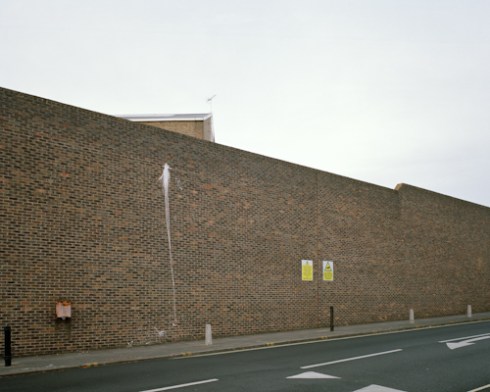
Hugh Elphick is a young British photographer who, in early 2011, took a cool and curious look at London prisons for his undergraduate photography BFA. The series is Inside.
“I wanted to produce images which intrigued more than shocked,” says Elphick. “I discovered how much prisons actually blend into their surroundings and used this blurring the boundaries, with some of the angles I shot.”
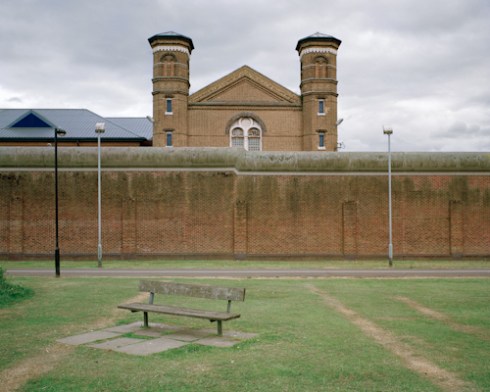
In the series of six photos, Elphick shows us the red-brick exteriors of three prisons – Pentonville, Wandsworth and Wormwood Scrubs. Elphick was working close to Wormwood Scrubs and began to wonder about human rights, the acceptability of the prison system, and if prisons work.
“In England, it is not a commonly known fact [that the UK has the second highest rate of incarceration after the U.S. among industrialised nations] and that it is not something that most people worry about,” says Elphick. “It could be argued that there is more concern that prison sentences are not long enough or that there are moral disparities in sentencing. However, this is not to say that there are not a large proportion of people who see the wider picture.”
Elphick’s focus specifically is about the age of these *famous* Victorian prisons. The Victorian era is steeped in imagery of inequality, squalor and hardship for the working classes. For Elphick, there are points of comparison between the class-stratified 19th century and the inequalities of the modern era and especially today in a time of austerity and cuts in services.
“Victorian architecture offers an allegoric association with harsh systems and possibly with periods such as the late 70 early 80’s economic downturn. Such institutional auras, I believe, explore some of the dilemmas and imbalances of our society,” says Elphick. “These prisons show how little progression there has been in the prison system due to confused government policies.”
Much like the approach of German photographer Christiane Feser, Elphick’s interest is in how these large, alien institutions interact visually with nearby residential communities. Unlike in the U.S., the economic fortunes of the nearby communities in the UK are not tied directly to or dependent upon the operation of a prison. These UK prisons are part of the urban puzzle but quite opposite to the prison-towns of central Wyoming or eastern Washington, which come to rely on jobs as traditional agriculture and industry wane. There is not the same attrition and competition in the job market in central London. Prisons in the UK are not perceived of as big business, partly because by comparison to the bloated U.S. prison system, it isn’t.
In fact, Elphick argues that prisons have almost become mundane in UK cities. He writes in his artist statement:
“The fragmentary nature of London’s development, and its destruction in WW2, have meant a breadth of architectural forms have spread into areas surrounding the prisons. The prisons no longer stand as the monolithic symbols of suffering they once did, and have melted into the architecture of our city. They are taken for granted, dismissed”
This is a peculiar paradox to deal with in images; subjects hidden in plain sight.
“I set out to make a graphic and symmetrical set of images and fortunately there were features which allowed me to do this and at the same time inject some curiosity such as the splash of paint, bench or repaired hole,” says Elphick. “The walls are rigid and literal boundaries which can be translated metaphorically and ironically in many ways to question the justice system and inequalities in society.”
– – – –
Inside was exhibited in the three-person show Behind Bars at One & A Half Gallery, London in September, 2011.




I recently visited the International Center for Photography (ICP). I was encouraged to see a photo from Abu Ghraib alongside one of Robert Capa’s Normandy landing photos and Margaret Bourke-White’s photographs from a liberated Nazi concentration camp. All were featured in the enjoyable and current A Short History of Photography exhibition, showcasing works acquired during the tenure of outgoing Director Willis “Buzz” Hartshorn.
Just as Capa and Bourke-White’s photographs are iconic of the WWII conflict, the Abu Ghraib digital photos are iconic and the images of America’s War On Iraq.
Both Capa and Bourke-White, in these instances, were photographers in the thick of it, in the moment, to deliver important news of the day to corners of the globe. Of course, the rise of citizen journalism has put pay to the idea that roving career photographers are now the first to a scene of international significance.
Without doubt the Abu Ghraib images – given their historical and cultural significance and dissemination – are rightfully in the ICP collection. That is not the issue; my questions were about the label:
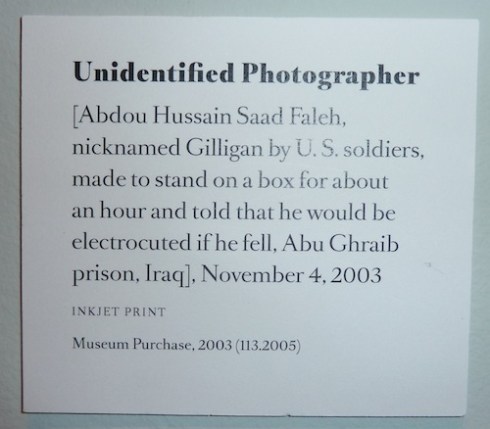
Unidentified Photographer: [Abdou Hussain Saad Faleh, nicknamed Gilligan by U.S. soldiers, made to stand on a box for about an hour and told that he would be electrocuted if he fell, Abu Ghraib prison, Iraq], November 4, 2003. INKJET PRINT. Museum Purchase, 2003 (113.2005)
Museum purchase? Who would be a recipient of payment for the image? I suspected it might be a case of language and not action. Ever interested by provenance and the accession of items into museum collections, I emailed ICP the following questions:
– Is “Museum Purchase” just a standard note you attach to works or did ICP actually hand over money to someone or some body for the image?
– Did ICP print it off the internet?
– When deciding to acquire it into the collection, what decisions were made about the file, the printing, the paper, the ink?
Kindly, Brian Wallis, the Deputy Director/Chief Curator at ICP responded:
The Abu Ghraib photograph now included in the “A Short History of Photography” was originally printed for the ICP exhibition “Inconvenient Evidence: Iraqi Prison Photographs from Abu Ghraib” (Sept. 17-Nov. 28, 2004).
At the time, only about twenty JPEGs were available, either on the Internet or from files supplied by the New Yorker.* We printed all images then available for the exhibition. They were printed on a standard Epson office printer, on standard 8½” x 11″. office paper, and pinned directly to the wall in the exhibition, in part to emphasize the ephemerality and informational nature of the pictures.
They were printed directly from the web with the understanding that these photographs, taken by U.S. government personnel, were in the public domain. We did not pay for them. The credit line in the current exhibition describes them as “museum purchase” in part because there is no other official museum description for how we obtained them; one could say we purchased the supplies used to print them.
So, no money exchanged hands. A relief of sorts. What one would expect.
I suppose ultimately, I have to give ICP some recognition for its 2004 reflex response to the pressing visual culture issue of the day; for presenting a set of images that for all intents and purposes falls outside of the normal acquisition avenues of major institutions.
ICP’s home-brew solution to show the Abu Ghraib, non-rarefied, non-editioned and thoroughly contemporary set of images is against the grain of many other museums chasing gate receipts through edutainment.

Left: Photo of allied forces landing on Normandy beaches, by Robert Capa; right: Photo of torture at Abu Ghraib, by unknown photographer.
– – – – – – – –
*Seymour Hirsch, who wrote Torture at Abu Ghraib (May, 2004) for the New Yorker, also provide the text for ICP’s Inconvenient Evidence exhibition – the catalogue for which you can download as a PDF
– – – – – – – –
All images: Pete Brook and taken without permission.

David Adler has been collecting prisoner made portraiture since 2006.
Adler’s work is very similar to Alyse Emdur‘s Prison Landscapes (readers will know Emdur is a favourite of mine.) But in fact, Adler and Emdur approach the visual culture and the act of collecting the photos very differently. I’ll be publishing an interview with Adler shortly, but to summarise, Emdur is thinking about social justice whereas Adler is thinking about the economics of the system. Both consider the painted backdrops as significant contributions to American artistic production.
Adler thinks of his work as a theoretically infinite, open-source project, that anyone could take on. Conversely, Emdur considers her presentations as collaboration with each of her subjects.
More to come.
Meanwhile, if you’re in NYC, Adler’s exhibition Prisoner Fantasies: Photos from the Inside is showing at the Clocktower Gallery in Lower Manhattan, until the end of August. Also, you can read a brief interview with Adler, by Harry Cheadle for VICE.

[Yes, the visual similarity between this post and the last was intentional.]

I Heart Gordon Stettinius’ humour. Especially in light of the horrendous Olympian portraits, this work seems like a good time to reflect on why and how we make (bad) portraits.
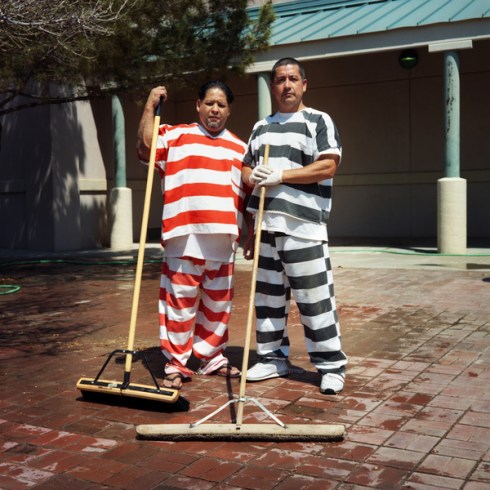
Tommy and Joe. © Roger Kisby
Roger Kisby, a NYC-based photographer and a friend of a friend, and I chatted briefly during my recent trip to New York. He mentioned he had photographed some prisoners.
It wasn’t your typical situation. Roger decided to get out from under his contract work and leap into the unknown with a road trip. It was intended to test his skills, hone his techniques, and grow his portfolio.
Judging by the results – showcased today on The Awl – Roger succeeded. I like the diversity of personalities in the edit and I like the fact a prisoner double portrait slips seemlessly into the selection too. On this American holiday, it seems a fitting bunch of Americans – of all shapes and stripes (excuse the pun) – to reflect upon. Prisoners are us.
QUICK Q&A
Some photographers are shy about approaching strangers to make portraits. Was this ever a problem for you? Was this any different when approaching inmates?
To some degree, I am always nervous about asking a stranger for his or her portrait. If there wasn’t that element of getting over my fear I don’t think I’d get as much satisfaction as I do when I get a good portrait. It helped that I had a quick pitch about my road trip project. Most people were receptive to it and those that weren’t simply said no and that was that. Even with the ones that said no I still had good conversations. That was the point of the project; for me to engage with people along my trip.
In this case with Tommy and Joe, I was driving out of Marfa, TX when I saw them. I remember distinctly having a conversation with myself about whether I should turn around. I didn’t know if I was legally allowed to take photos of prisoners. I didn’t know how the inmates would react. I didn’t know if it was safe. Ultimately, I realized it would have bugged me for the rest of the trip if I didn’t at least try.
What were they doing?
As I walked up they were doing some grounds-keeping in front of the courthouse. They had someone monitoring them but it wasn’t a guard. Or at least he didn’t seem like one to me. It all seemed very relaxed except for the chains around their ankles.
What do you think they thought about having their picture made?
I wasn’t sure who to ask so I directed my question to all three. The monitor gave permission and the inmates were very much into the idea. I went back to my car grabbed my camera and set up. I tried to work quickly to not take up too much of their time which in retrospect seems silly now; they obviously had time and were happy to do the photos. Honestly I think I was just nervous.
Did you get any of their story?
A little. Tommy had 9 months left for possession. Joe mentioned something about being deported and had 6 months left on an 8 month sentence. One thing I loved was they both asked me if I could send copies of the photo to their moms and gave me their addresses. Which I am doing.
– – –
Roger Kisby is an editorial and portrait photographer who lives in Brooklyn. You can see more road trip photos at his Tumblr and on Instagram. You can also follow him on twitter.
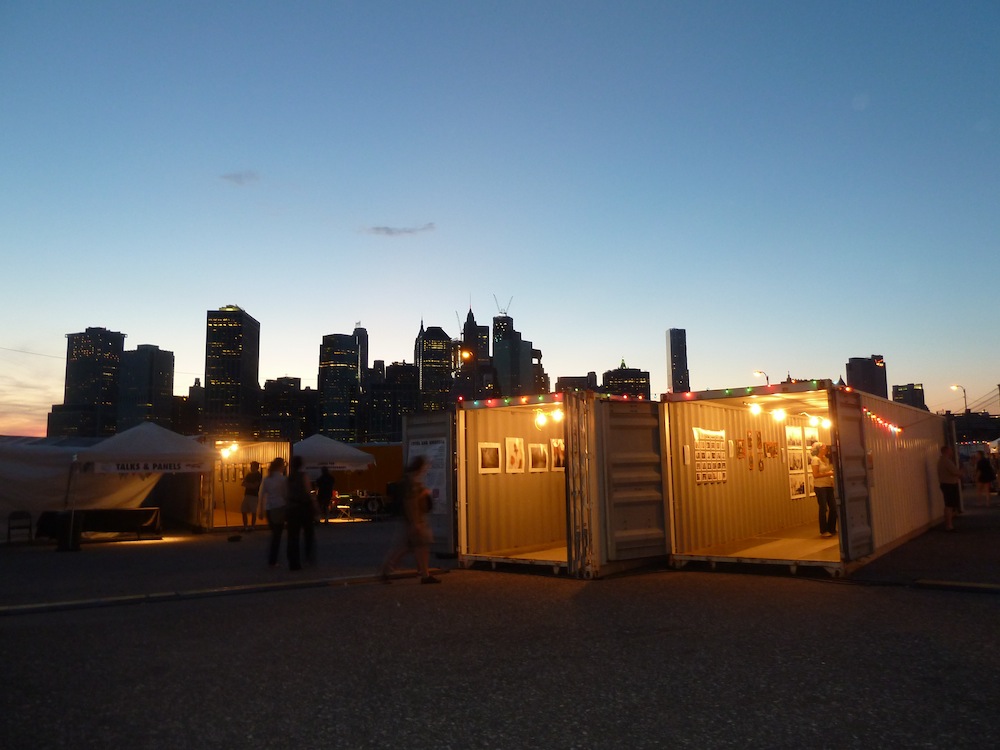
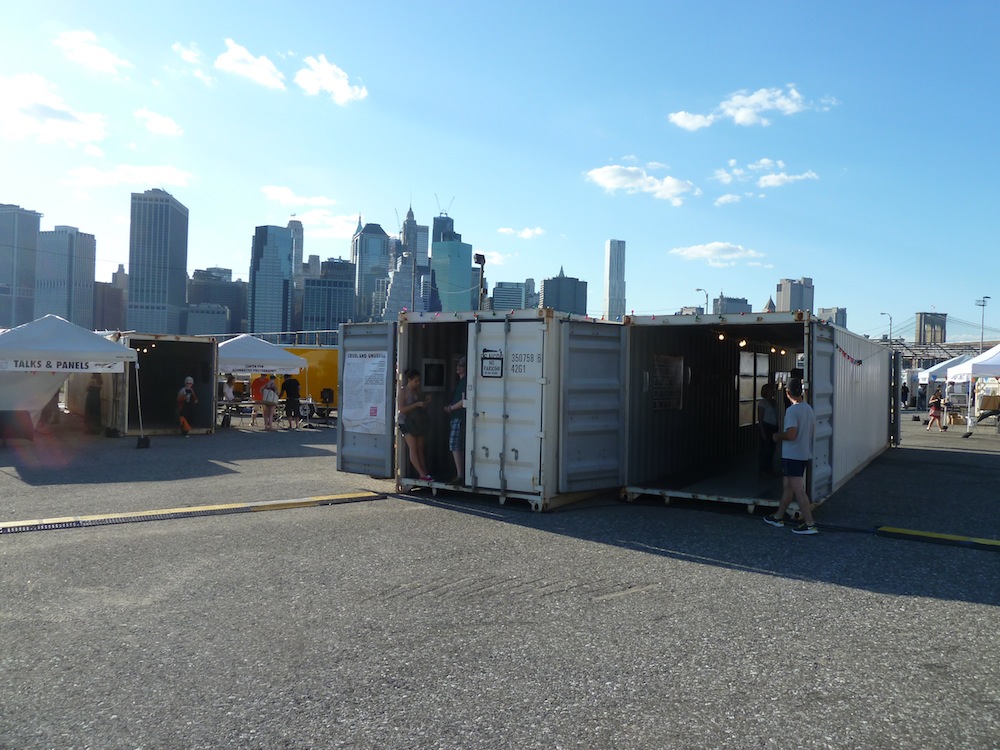
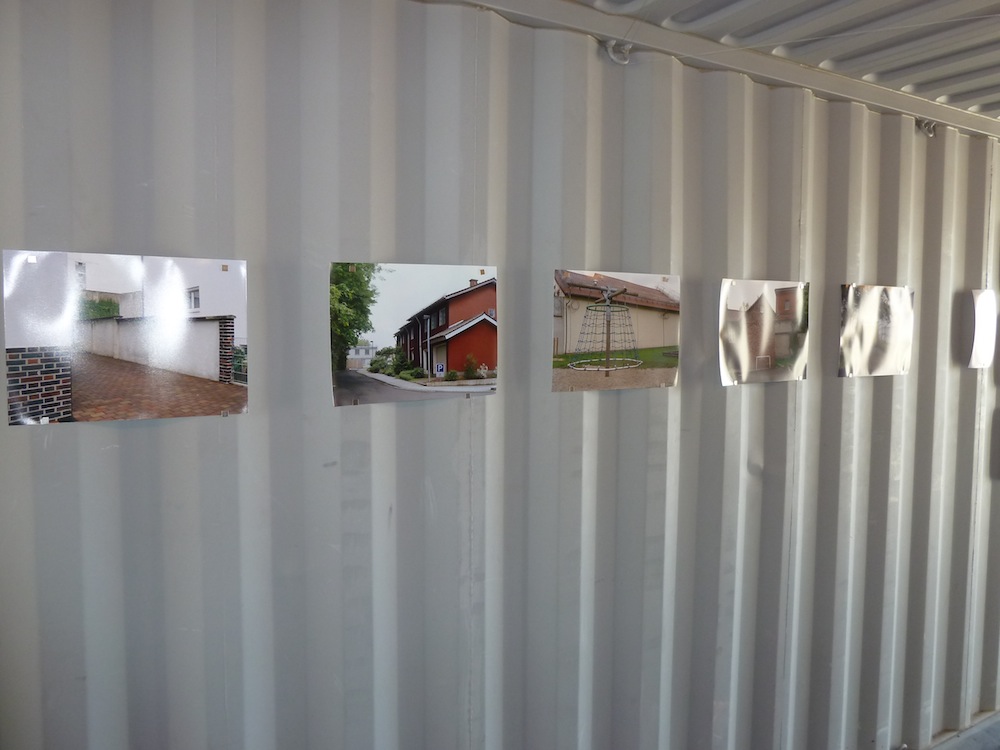
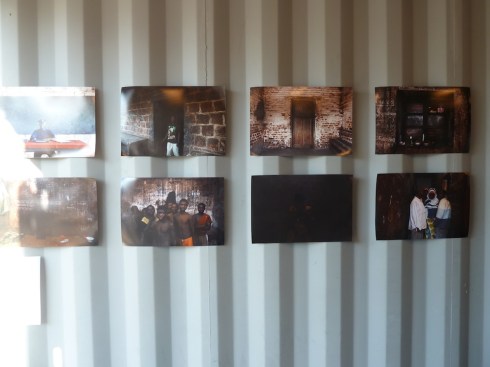
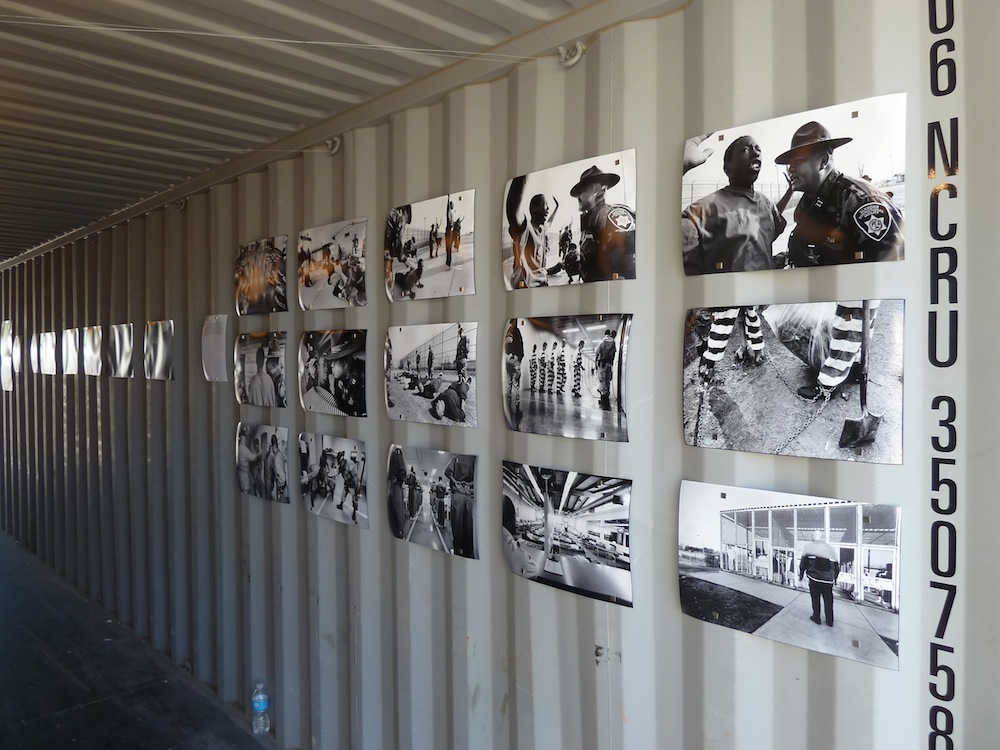
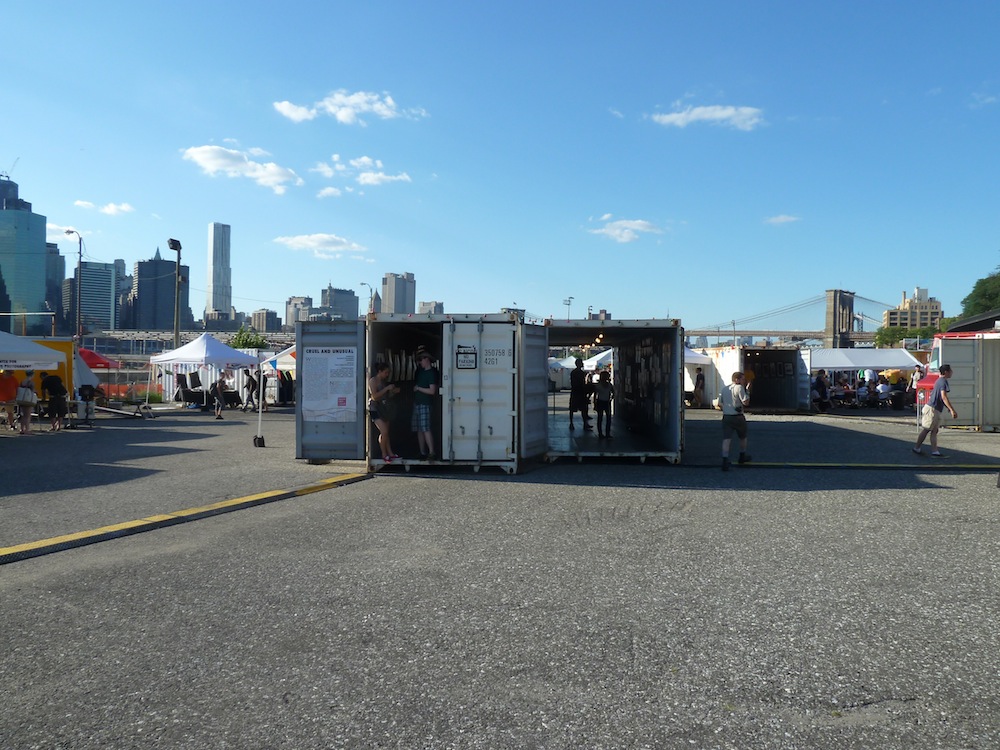
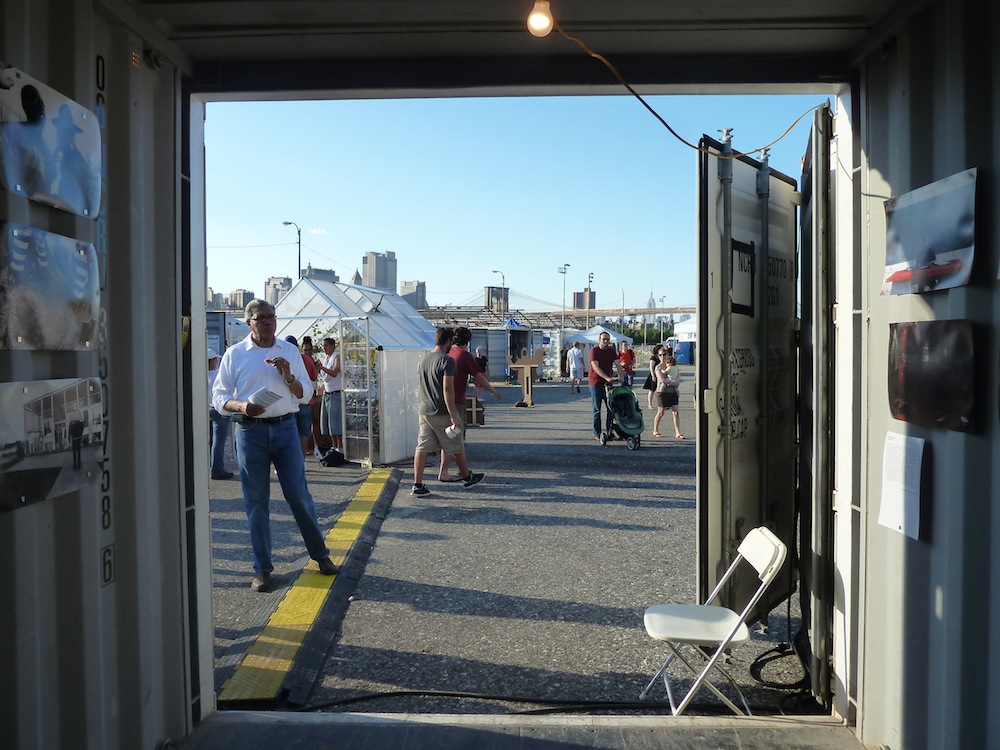
This is a super quick post and a bit of an image dump (I’ve been asked for installation shots.)
We are half way through Photoville and my thoughts are not coalesced yet. Of the event so far, highlights have been Josh Lehrer’s Becoming Visible: portraits of homeless, transgendered teens; Sim Chi Yin’s Rat Tribe for which he transformed the container to mimic a basement Beijing dwelling; and Russell Frederick’s Dying Breed: Photos of Bedford Stuyvesant.
More to find and more to percolate.
As I reported last week, we got off to a slow start. Customs and FedEx conspired to give us all anxiety-disorders by only releasing the artwork at 8am Friday morning. Huge playdits to organisers Sam and Laura for hounding FedEx while I sailed through Wednesday and Thursday with a C’est la vie attitude. Customs never said what the problem was but we presume it was Jane Lindsay’s bottle caps filled with resin.
We had 6 hours for install and it ended up taking 8; I was still sweating about and showing off my chest-wig as the public moseyed through that first (Friday) evening.
Further thanks have to go to Wally, Trevor and Lee for hanging the work of the 11 named photographers across one and a half containers – Alyse Emdur, Amy Elkins, Araminta de Clermont, Brenda Ann Kenneally, Christiane Feser, Jane Lindsay, Natalie Mohadjer, Deborah Luster, Lizzie Sadin, Yana Payusova and Lori Waselchuk.
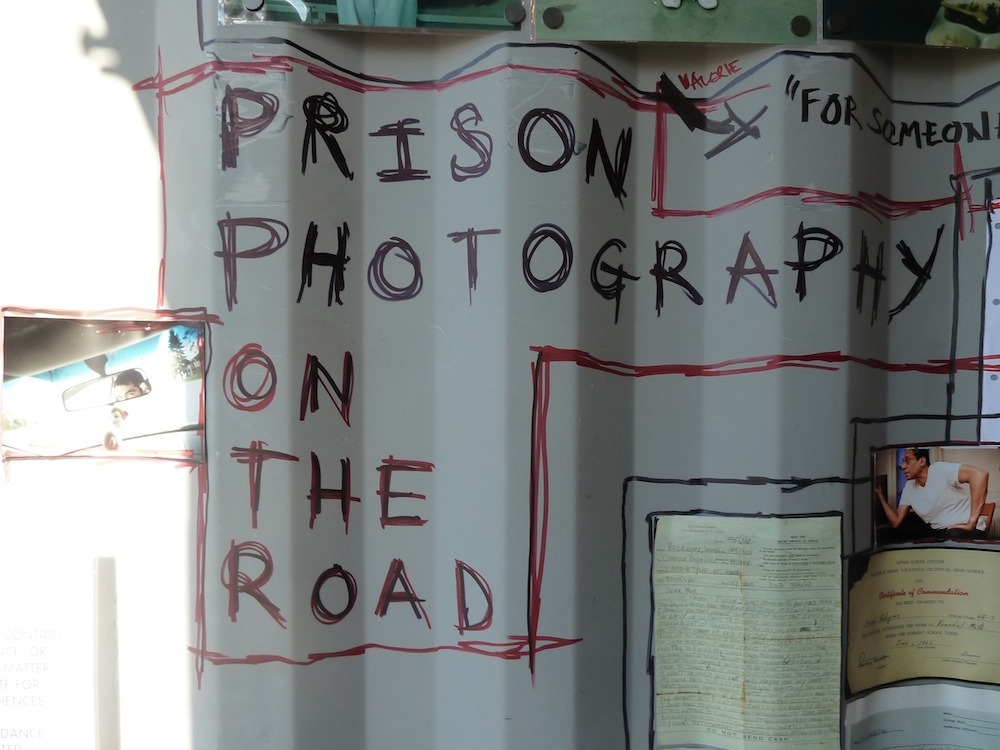
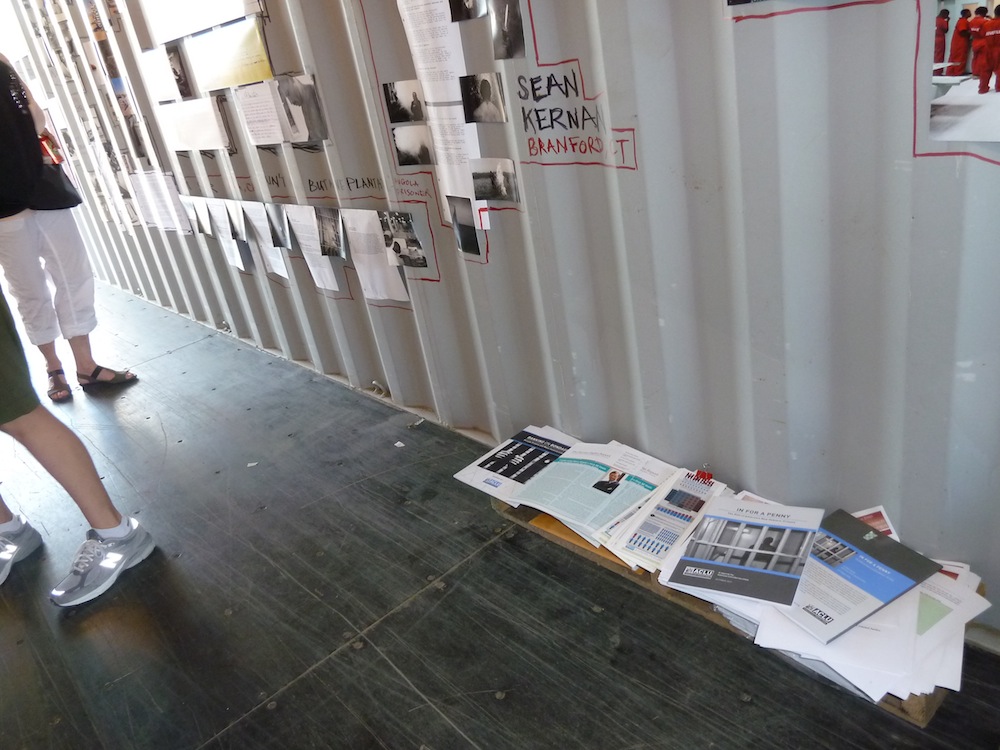
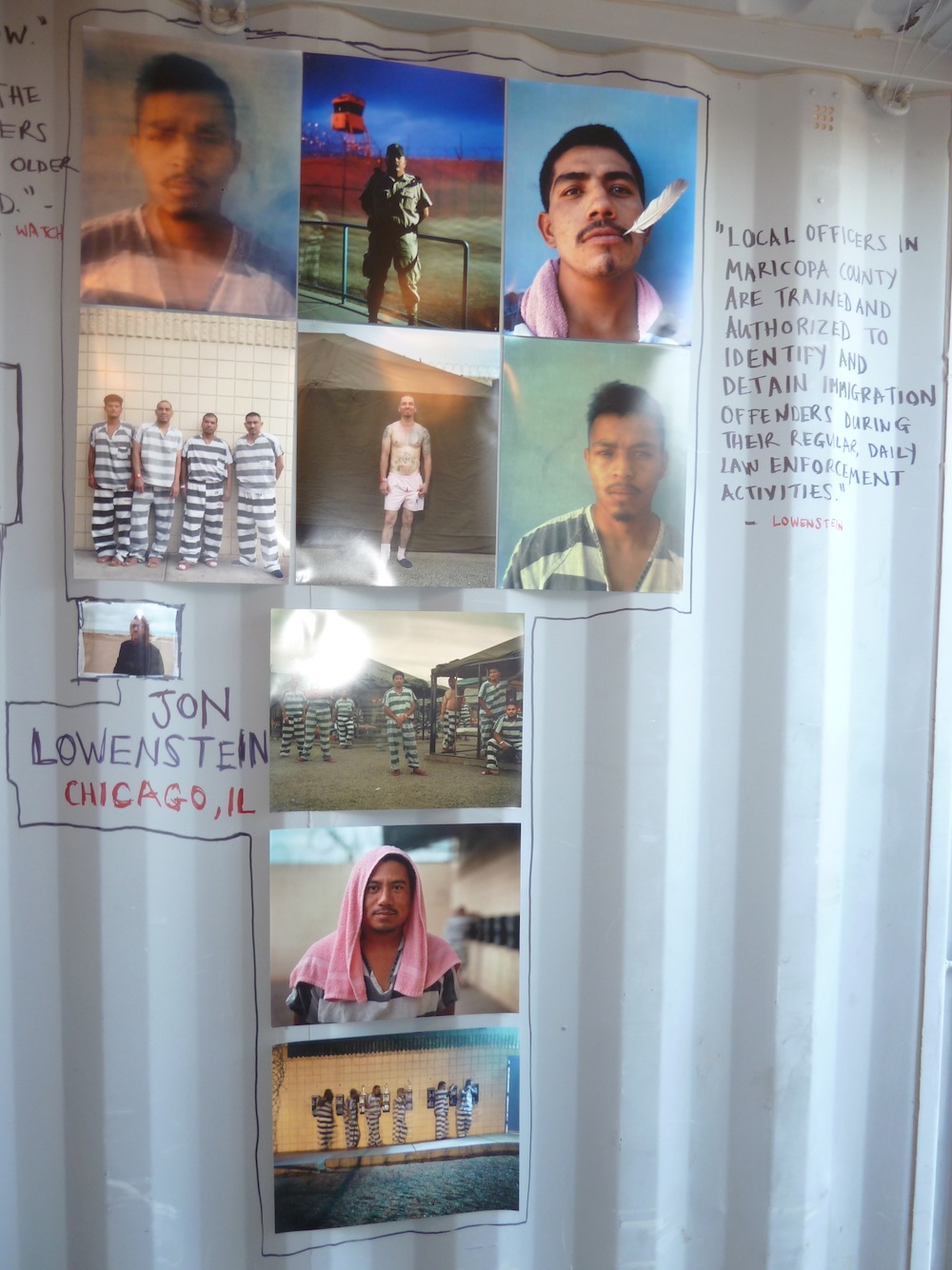
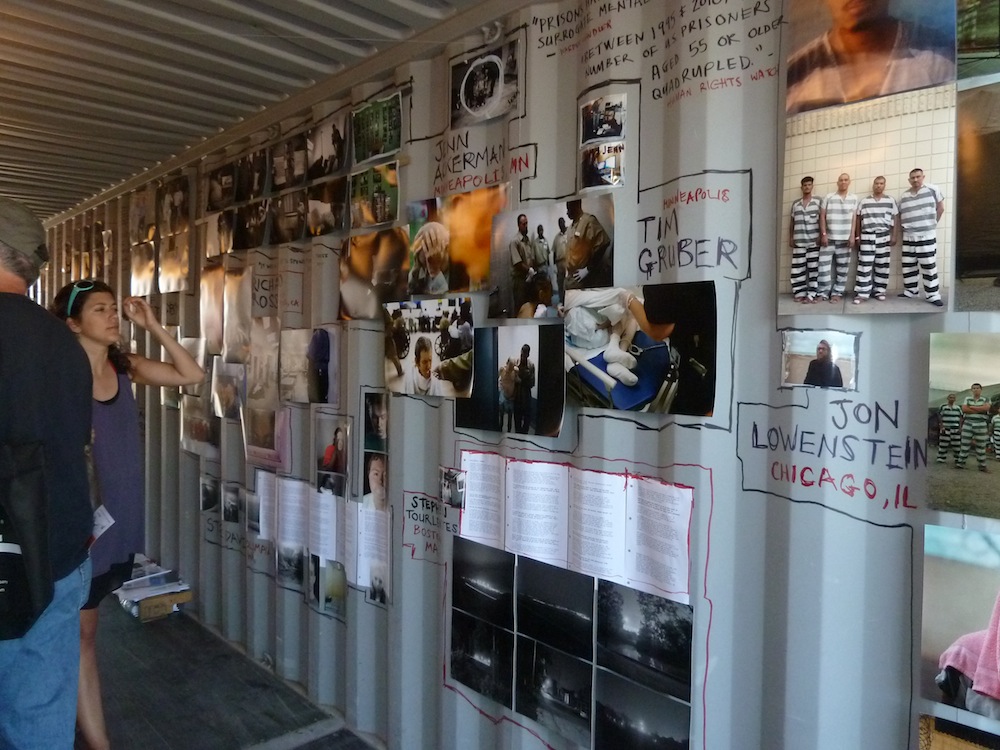
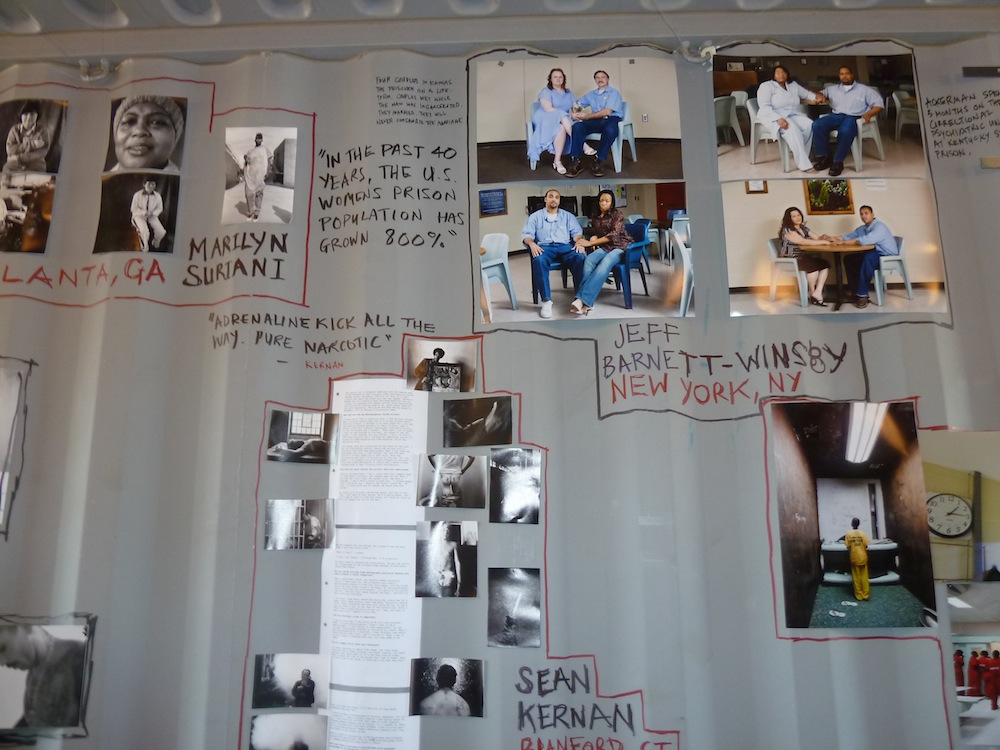
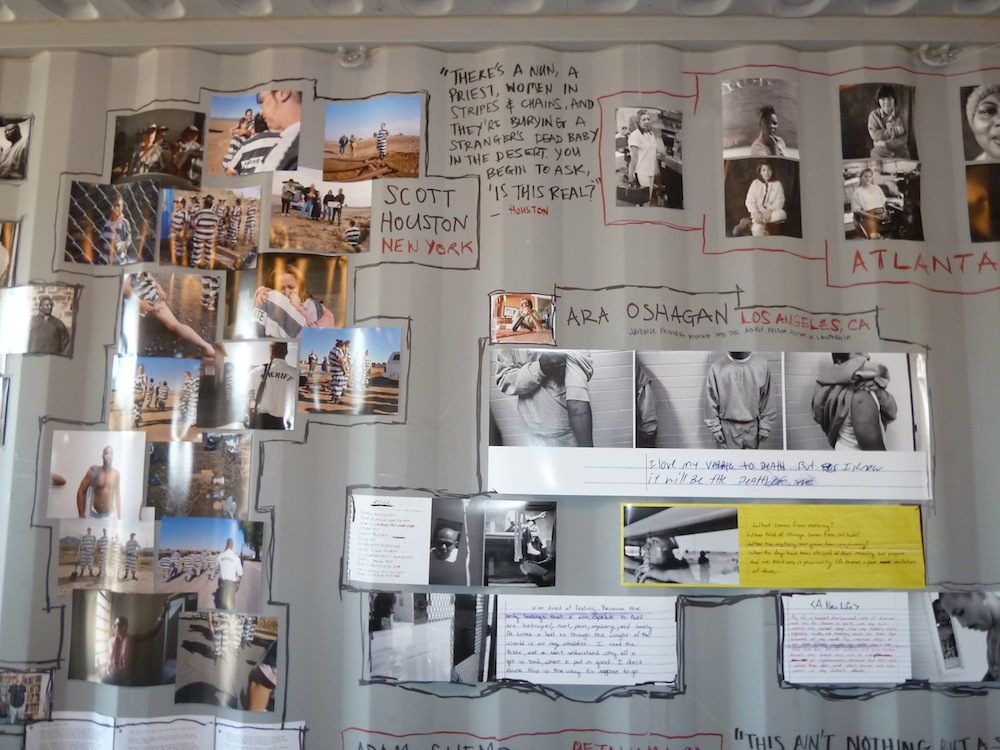
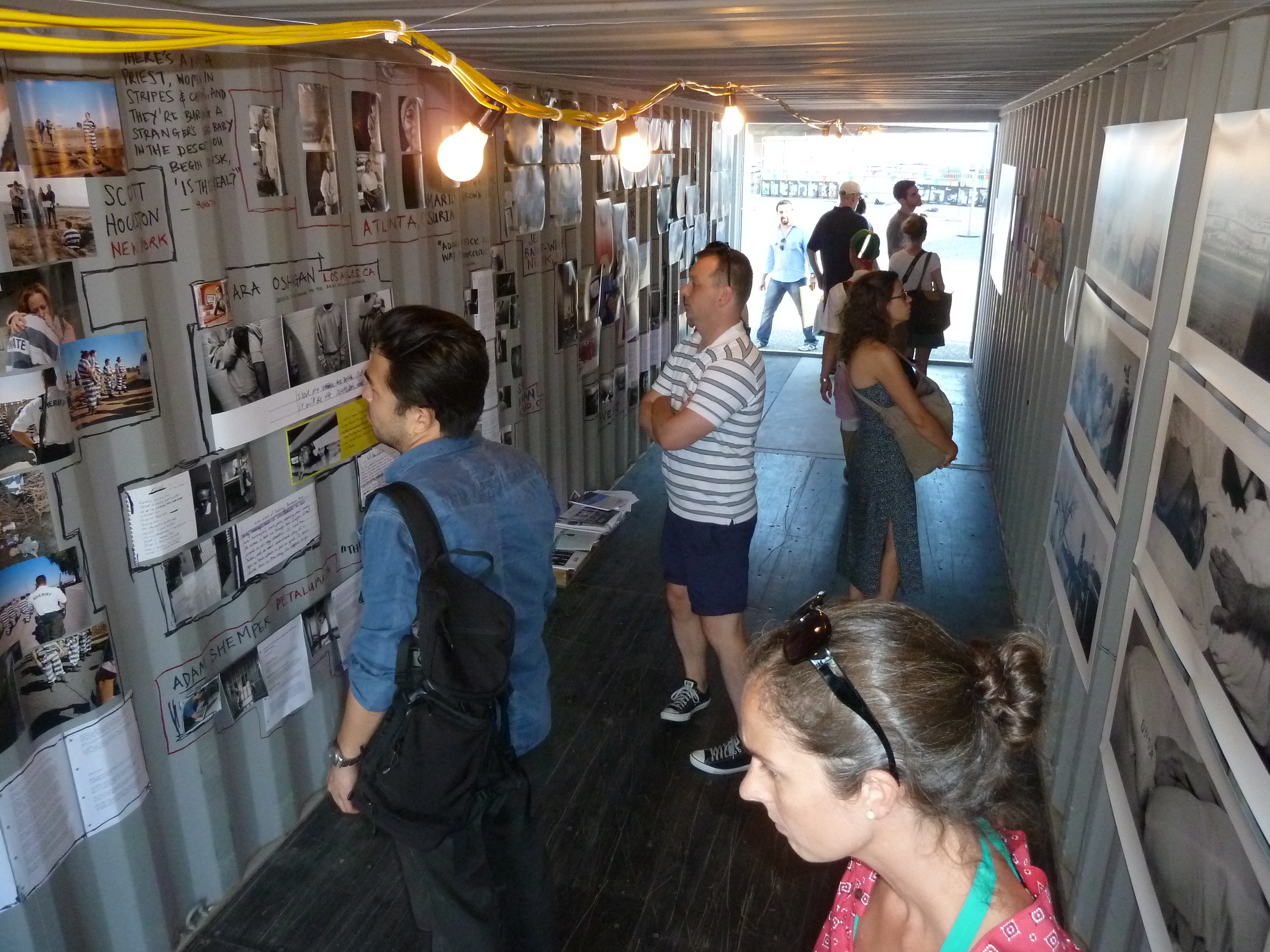
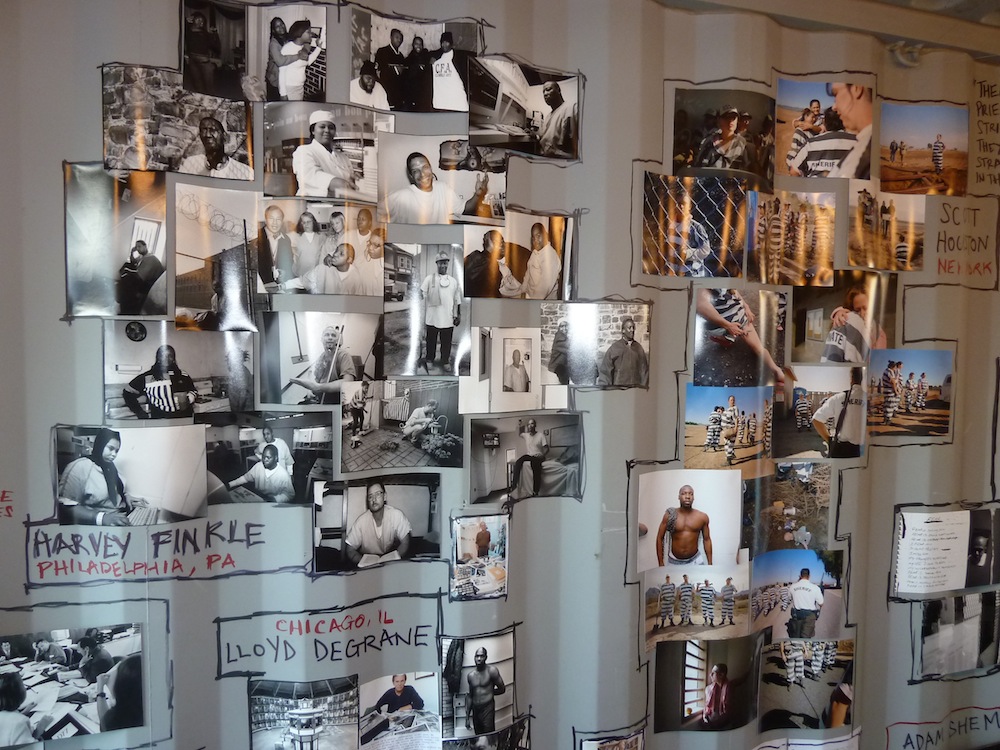
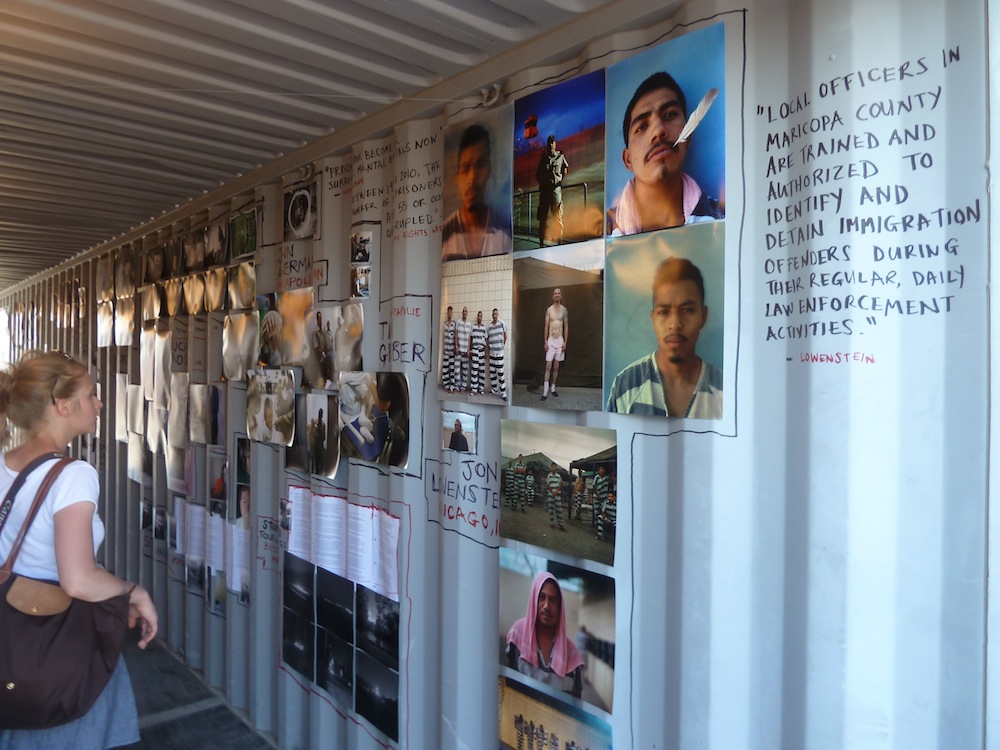
I took care of the other half a container; the PPOTR wall. I scrawled quotes and stats freely on the corrugated surface. Whenever I had downtime last weekend, I’d return to the container and scribble some more.
The PPOTR wall contains images by 17 photographers – Jenn Ackerman, Jeff Barnett-Winsby, Steve Davis, Lloyd Degrane, Harvey Finkle, Tim Gruber, Scott Houston, Sean Kernan, Jon Lowenstein, Ara Oshagan, Joseph Rodriguez, Richard Ross, Adam Shemper, Marilyn Suriani, Stephen Tourlentes, and Sye Williams.
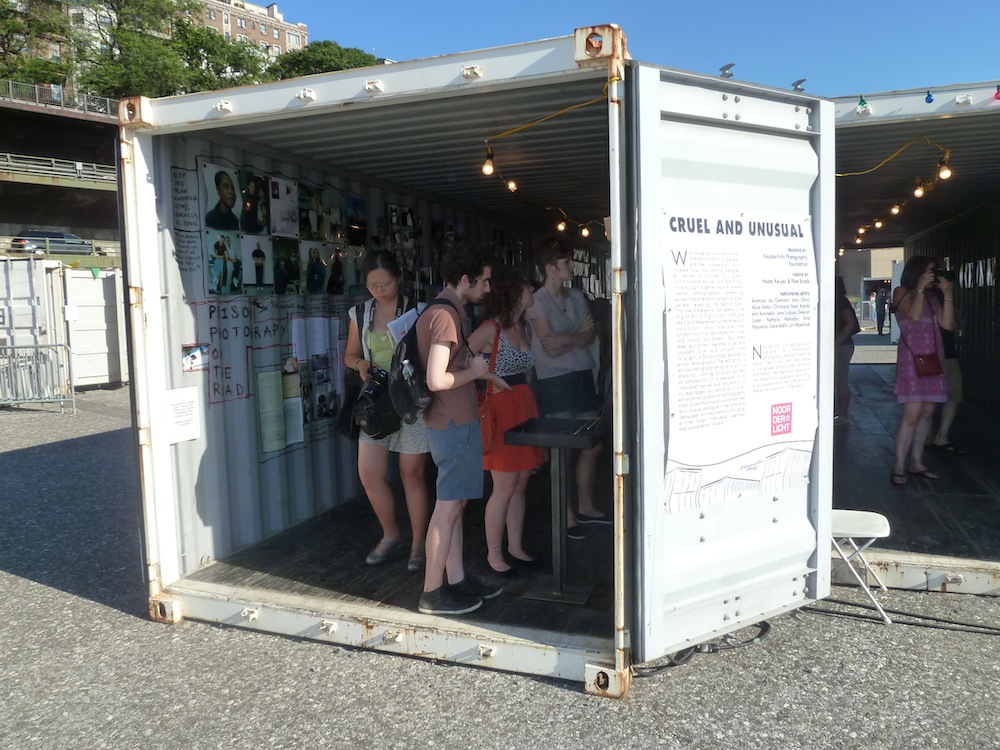
I’d like to Thank Deborah Luster, Yana Payusova and Lori Waslechuk for joining me for Saturday’s panel discussion. They were happy to share stories from their experiences shooting in Russian and Louisianan prisons and they parried my challenge as regards the utility of this type of photography with varied and solid positions.
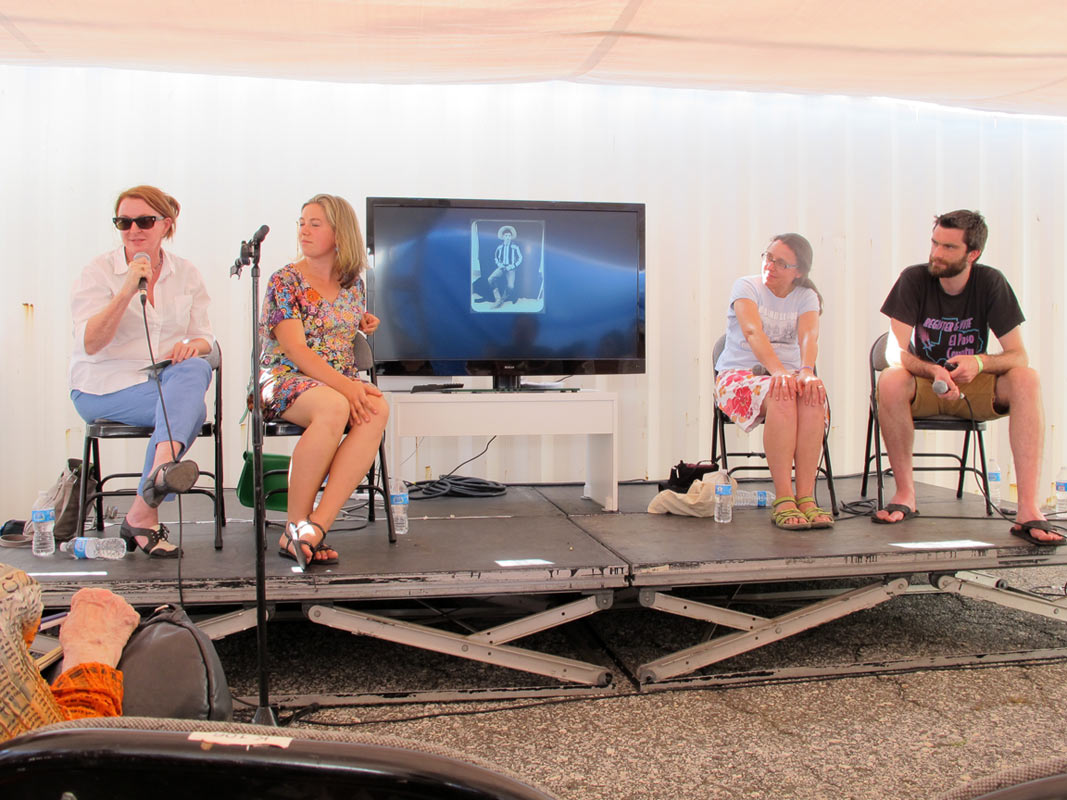
Left to right: Deborah Luster, Yana Payusova, Lori Waslechuk, me. Credit: Graham MacIndoe
Did I mention the massive thunderstorms on Friday afternoon with forks of light cracking down on the skyscrapers of Manhattan? It was great. Then there was the party that was on, wasn’t on, on again. I went for felafel, came back, had a cheeky wine. Hung out with Bryan Formhals and Michael Shaw.
On Saturday evening, Susan Meiselas raised a glass to the Magnum Emergency Fund fellows. Wyatt Gallery was there, as were Amy, Yukiko, Lauren from the Open Society Institute’s Documentary Photography Project. I saw Peter Van Agtmael later and I’m banking on him for better installation shots. Also had the opportunity to finally talk to Chandra McCormick. I had tried to speak with Chandra during PPOTR. She and her partner Keith Calhoun photographed in Angola Prison before it became common to do so.
Photoville is a relaxed place to bump into people you want to bump into. The general vibe is that it is accessible, fun, pedestrian and at the same time maintains a high standard of work. Photoville is off to a good, solid, smile-making start.
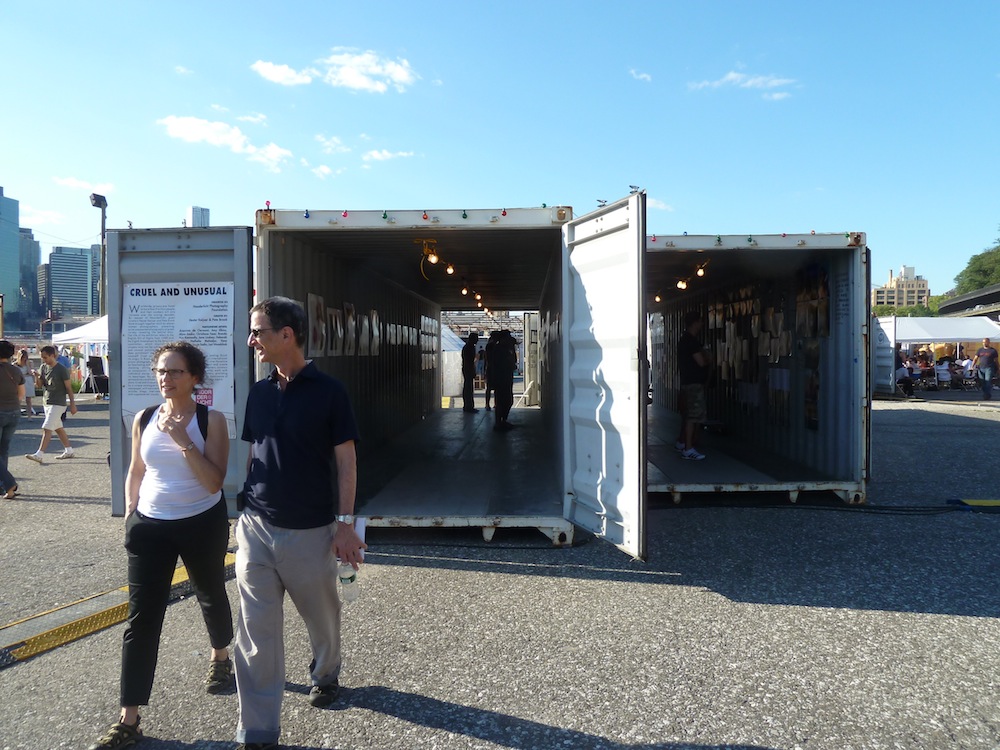
I suppose the only other news is that I delayed my return flight so I remain here in NYC. The arrangements I made for deinstall fell through, so I’ve decided to take care of it myself.
In the meantime, I’m sprinting (or biking) around the city hobnobbing with people, making interviews and panicking about how journo-blogger disclosures should be written in an age of small and borderline incestuous photo-maker-media-networks.
I’ll add to that worry of over-familiarity more at the PDN The Curator Remix party this evening.
Tomorrow, very much looking forward to Lorie Novak’s panel discussion “Community Collaborations” as I’m wrestling with ideas and best practices for potential photography workshops in prison. I also plan to be at the Daylight Photographs Not Taken panel discussion.
Enjoy the pics.
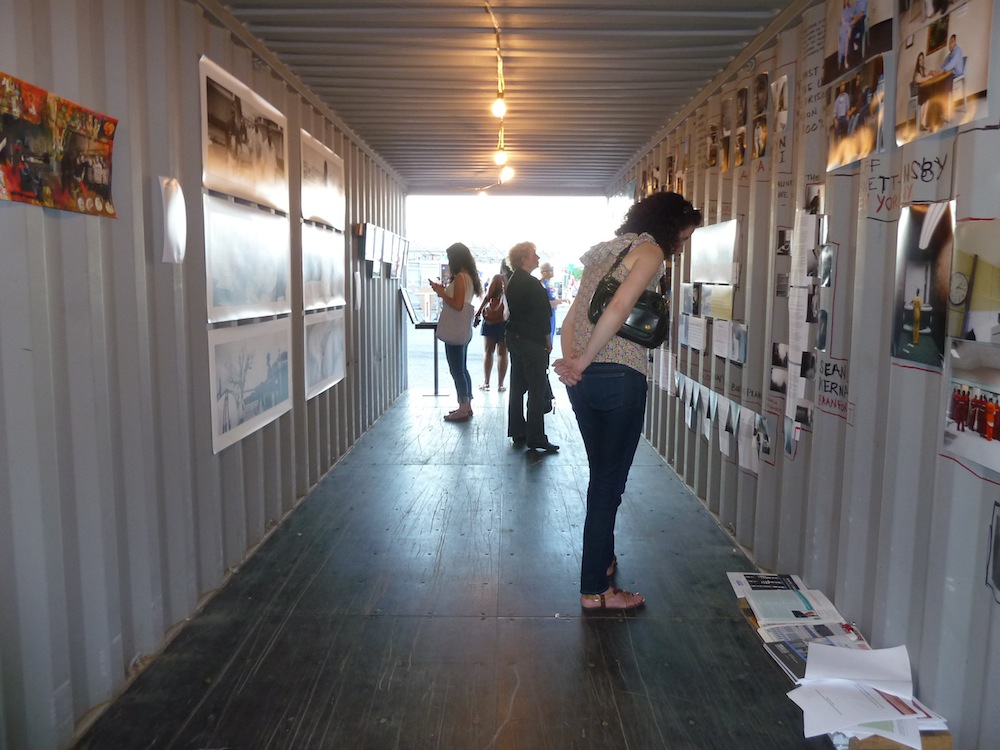
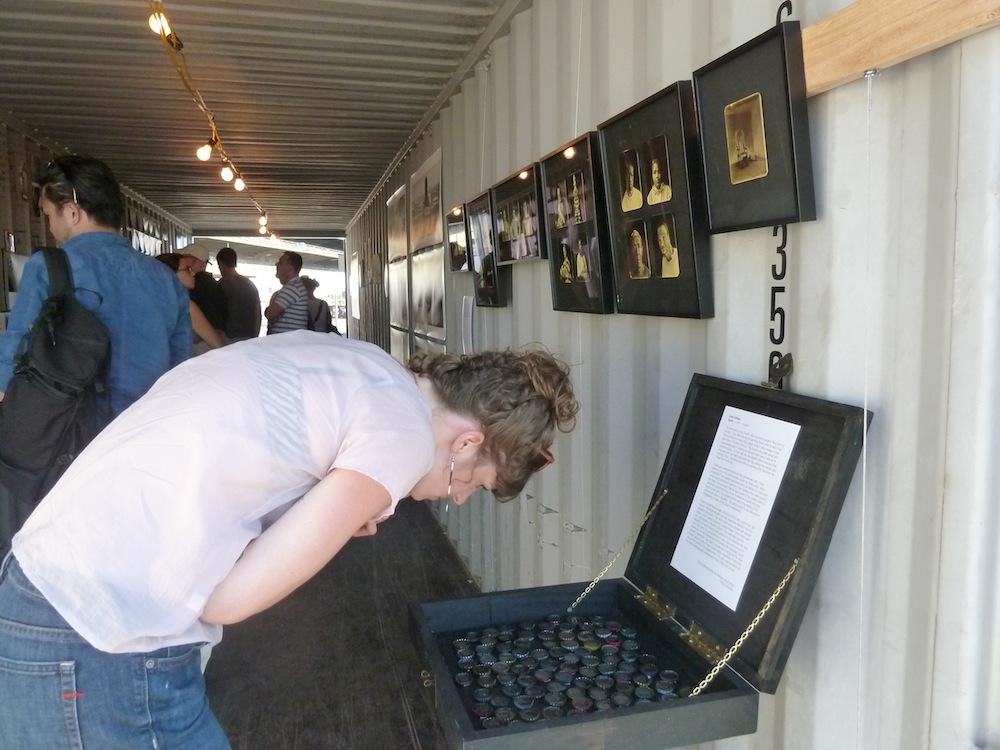
Jane Lindsay’s bottle caps. (That’s Lou Reed’s NYPH pedestal).
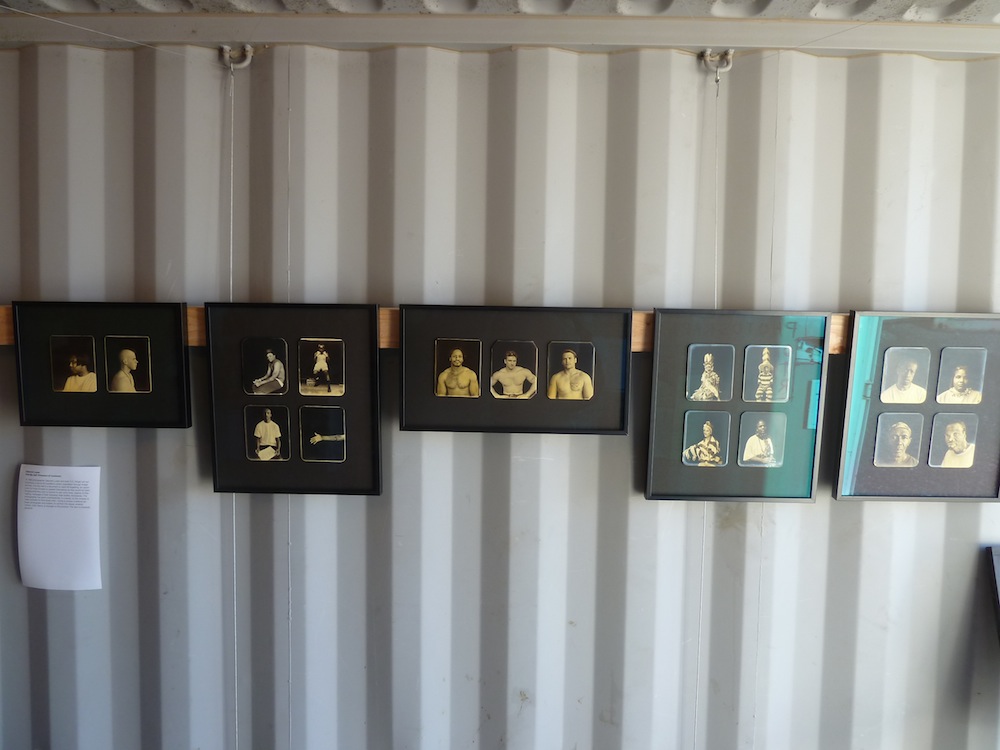
Deborah Luster’s One Big Self
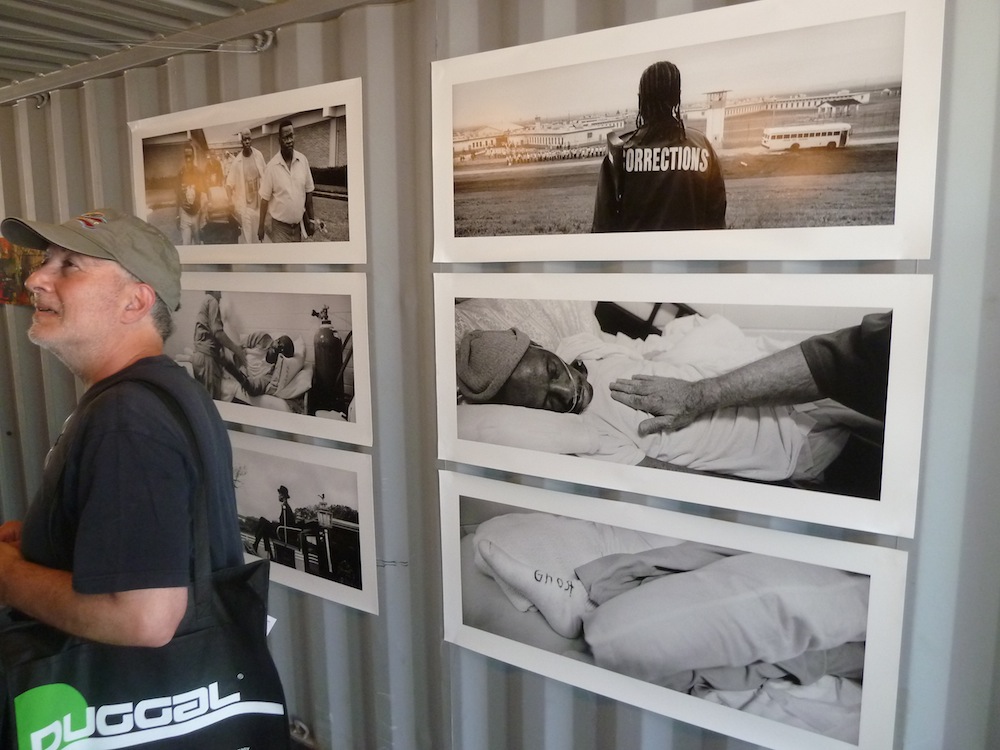
Lori Waselchuk’s Grace Before Dying
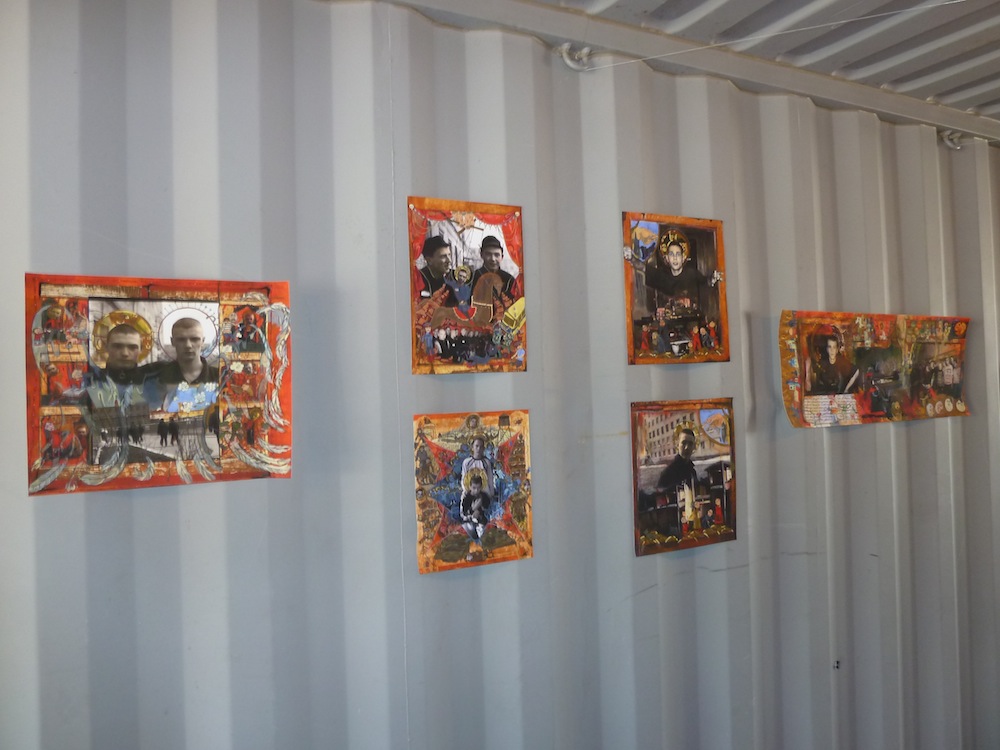
Yana Payusova’s Prisons
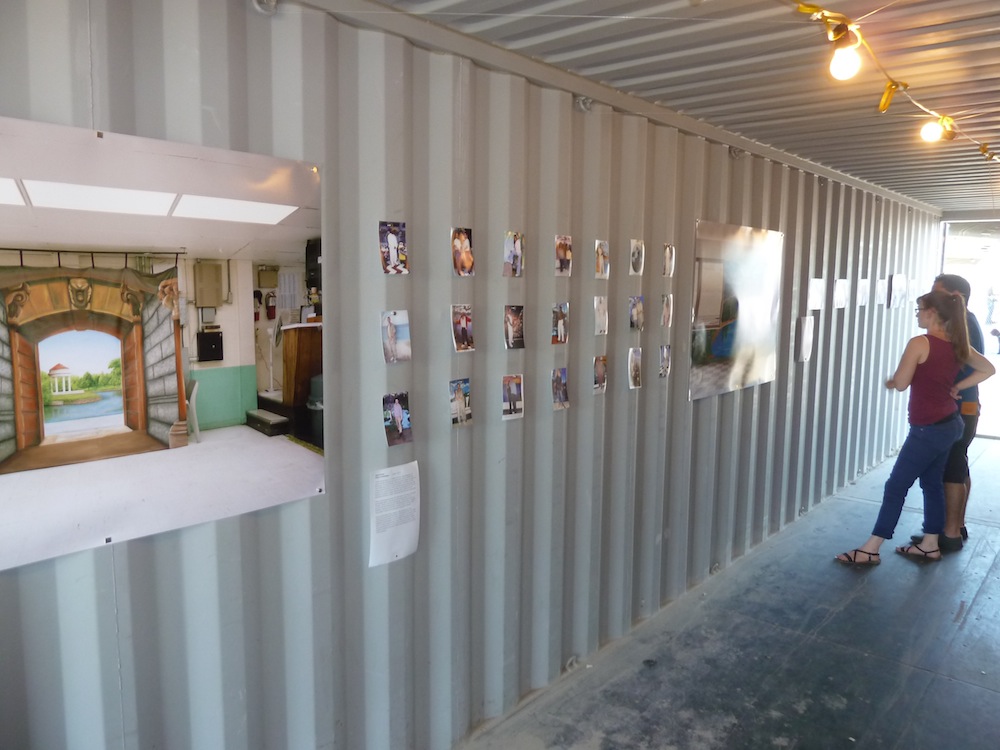
Alyse Emdur’s Prison Landscapes
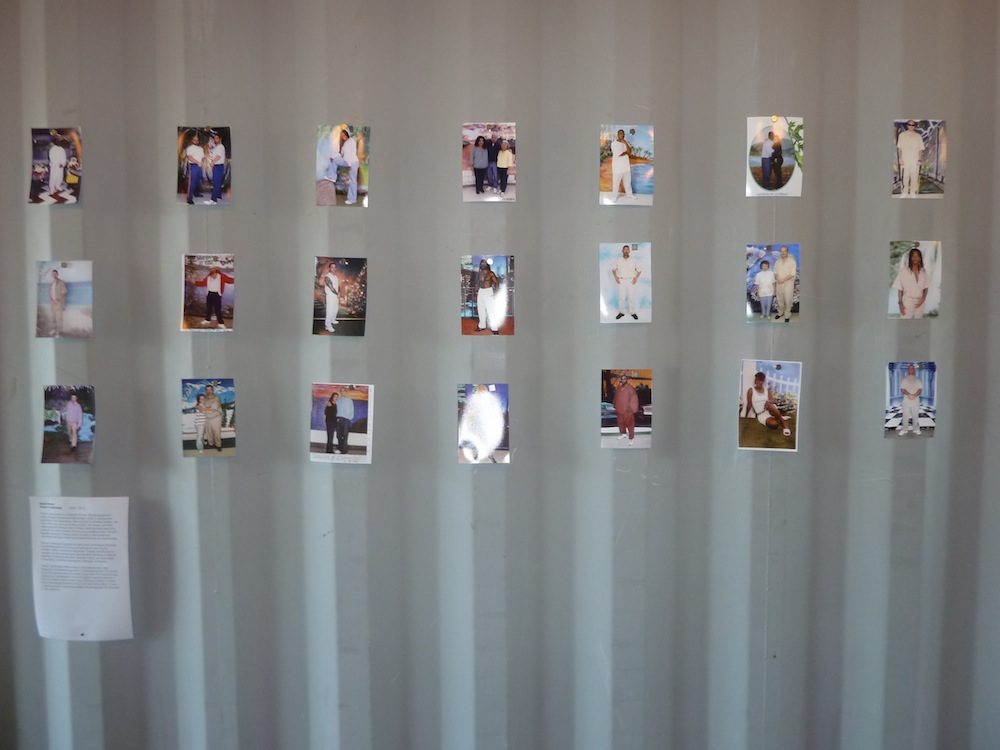
Alyse Emdur’s Prison Landscapes
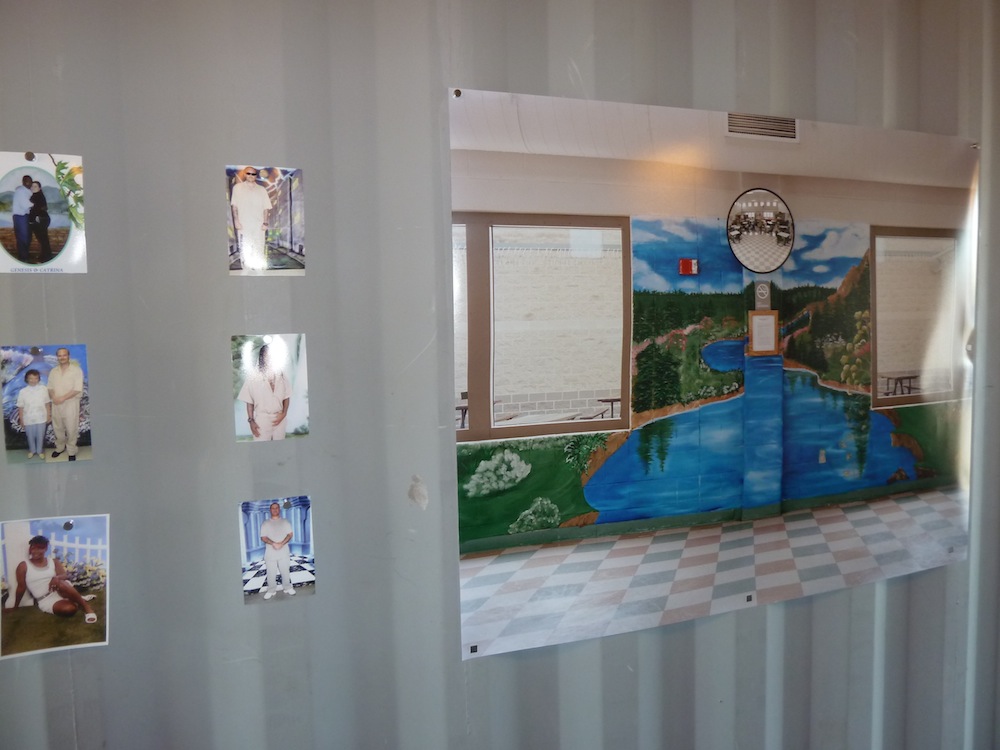
Alyse Emdur’s Prison Landscapes
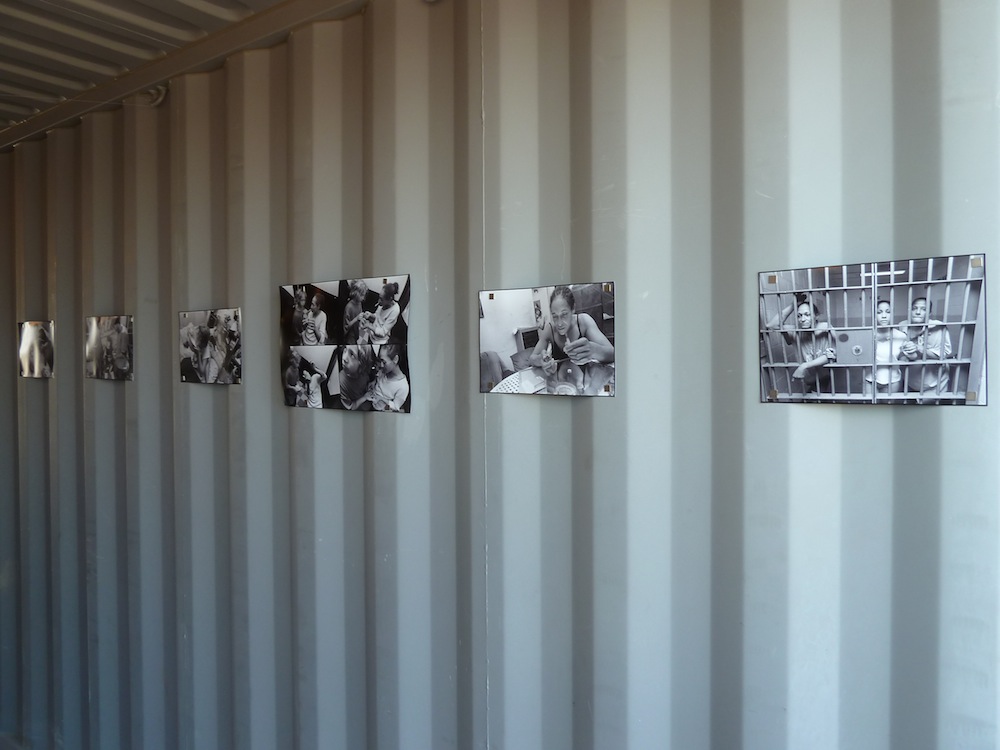
Brenda Ann Kenneally’s Andy and Tata
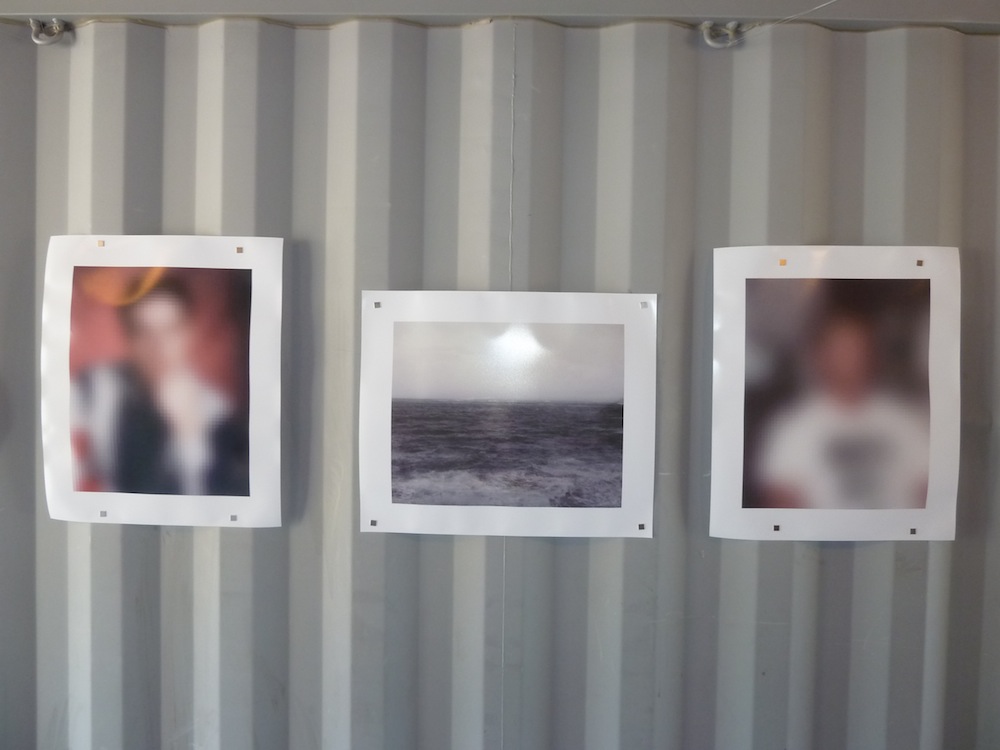
Amy Elkins
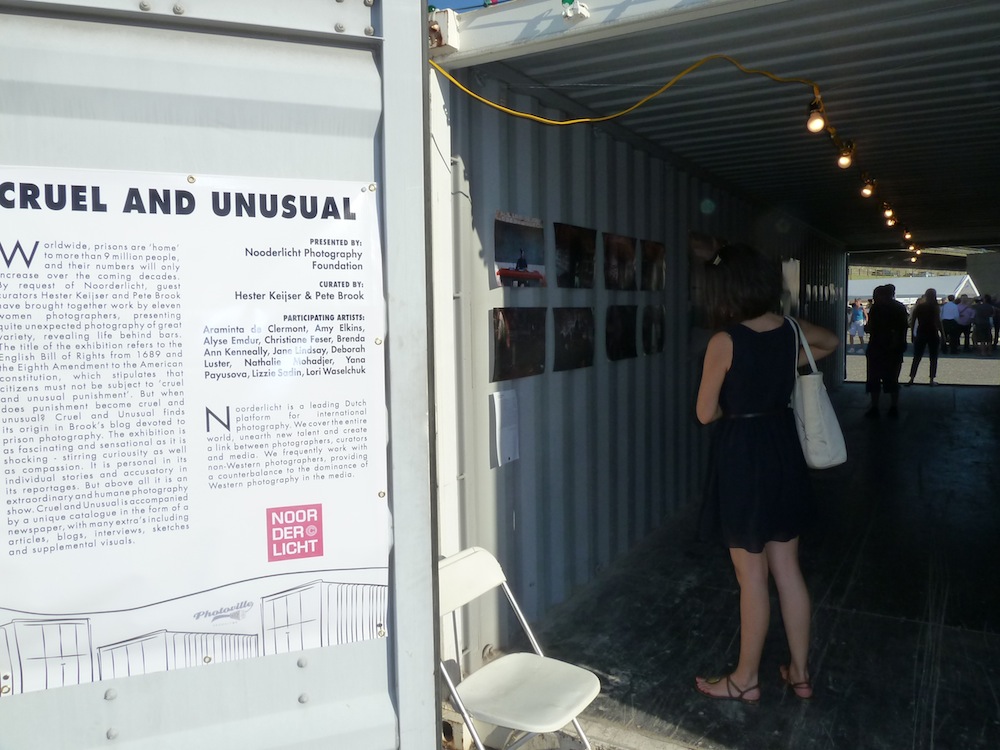

 Prison Photography