
You are currently browsing the category archive for the ‘Fine Art’ category.

If you are in NYC and you’re quick on your feet you might just make it to Zwelethu Mthethwa’s artist’s talk tonight. Followed by a reception and book signing at Museum of Contemporary Diasporan Arts in Brooklyn (begins at 6.30pm).
Mthethewa’s work will be on view at The Studio Museum in Harlem until October.
AFRO-PESSIMISM
Afro-Pessimism is a term introduced by Okwui Enwezor (for the essay of Mthethwa’s monograph) in an attempt to describe what Zwelethu Mthethwa’s art is not.
I had dozens of working titles for this blog post each one reflecting an approach (and/or quote) by Mthethwa which described his process, his collaboration with the sitter, the waves of culture in which we exist, whether poverty in photography is a problem for the practitioner or audience, etc, etc. These topics are too huge for a title of course, fortunately there’s plenty of wonderful online videos and chances to hear Mthethwa talk about his art:
Aperture (who are publishing his first monograph) has a four-part interview, Zwelethu Mthethwa: In Conversation with Okwui Enwezor.
The Mail & Guardian has a narrated slideshow, “I hope when people look at these images they are honest and open to learning new things.”
Dazed and Confused visited Mthethwa in his studio, which is a fascinating look at his work space. A great painter as well as a great photographer!
ESSAY
For the SFMoMA ‘Is Photography Over Symposium’, Okwui Enwezor leans on Mthethwa’s work to ask, “How do diverse cultural practices engage with the legacy of photography?”:
“Before foreclosing the effectiveness of photography or to ask whether we have reached the end of photography, we should address the diverse manifestations of photography in societies in transition where its powerful effects of seeing is constantly battling different logics and apparatuses of opacity. All through the years of apartheid, photography was at the center of this battle between transparency and opacity, thus lending the medium a far more discursive possibility than it would have enjoyed as purely an instrument of art. One can in fact, argue, pace Georges Didi-Huberman, that in the context of apartheid photography was an instrument of cogito.”
“In South Africa, for the critics of documentary realism or anthropological realism, especially black artists such as Mthethwa, documentary realism was always at the ready to link the iconic and the impoverished with little recourse to examining its spectral effects on social lives. Because of this, documentary realism generated an iconographic landscape that trafficked in simplifications, in which moral truths were posited without the benefit of proven ethical engagement.”
From what I can gather Georges Didi-Huberman’s thesis is that images are killed, denied their truth, narrative or violence within the dominant art historical canon that has elevated the image to art. The image becomes cogito – an object of thought – not an object pertaining to reality or even to action.
Mthethwa’s images are against such failings; they are attempts at transparency, honesty. Mthethwa talks in the interviews about his ethical and slow engagement with his subjects.
Afro-Pessimism is on the decline.
BIOGRAPHY
Zwelethu Mthethwa (born in Durban, KwaZulu-Natal, South Africa, 1960) received his BFA from the Michaelis School of Fine Art, University of Cape Town, a then–whites-only university he entered under special ministerial consent. He received his master’s degree while on a Fulbright Scholarship to the Rochester Institute of Technology. Mthethwa has had over thirty-five international solo exhibitions and has been featured in numerous group shows, including the 2005 Venice Biennale and Snap Judgments at the International Center of Photography, New York. Mthethwa is represented by Jack Shainman Gallery, New York. He lives in Cape Town, South Africa.

Mari Bastashevski photographs the rooms of victims of kidnap. “Abduction as a concealment tactic became prevalent in 2000 during the second Russian-Chechen conflict. The practice continues today. The rooms are preserved by family members who don’t know the fate of their loved ones,” says Bastashevski.
It’s no surprise that since her Open Society Grant and subsequent exhibition in New York and Washington D.C., Bastashevski should have become the trendiest thing in art-documentary. (The New Yorker, Lens Blog, ThePhotographyPost)
I’m not being flippant here; I think her work is remarkable and I also think it is successful in translating the bleakness of the situation for abductees and the families left behind (not all photography can elevate an issue in this same way).
‘File 126: Disappearing in the Caucasus’ has all the right ingredients to hook the Western audience; the cachet of post-Cold-War politics; the same cold-exoticism of photographers such as Carl de Keyzer or Bieke Depoorter; the details of anaesthetised domestic interiors; and fundamentally, hundreds of profoundly tragic and must-be-heard stories about political terror.
Russian-born Bastashevski read the case files before she began visiting families. Human rights organizations in the Russian North Caucasus have spent years documenting the abductions of young people, which they attribute to the state security forces conducting a brutal counter-insurgency campaign[ …] Some stories verged on madness, like the genteel lady who was certain, after five years, that her sons were still alive in a secret prison in the forest, if only she could reach them. (Source)
DIFFERENT CONTINENT, SAME CRIME
One of the reasons I am so interested in Bastashevski’s work is that it mirrors the work – intellectually and in terms of its activism – of those photographers exploring and documenting the legacies and memories of the Disappeared in Argentina. (“Those photographers” I have written about before here, here, here and here).
– – – – – – – – – – – – – –
Image Caption: On June 10th, 2009 a group of military officials conducted a special, counter-terrorism, operation in Nazran, Ingushetia. In a course of the night, the men seized out of bed and dragged away a 23 year old Albakov Batyr. For two weeks Batyr remained missing. On June 13th., 2009, after two weeks of silence and uncertainty Batyrs mother saw her son on television. Literally torn to pieces, with arms barely connected to the torso, his body was dressed into insurgency clothing and was displayed covered in bullet holes. The TV network announced Batyr as one of the most wanted terrorist leaderer, killed during a spec. operation in the mountains. © Mari Bastashevski
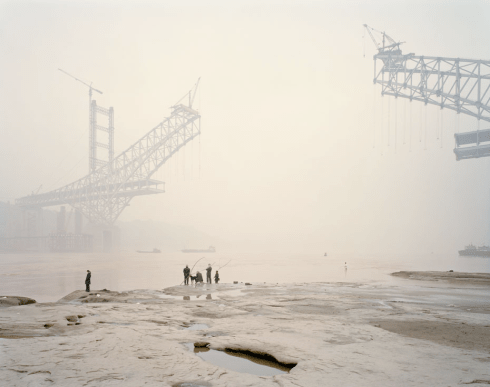
2009 winner, Nadav Kander is on the jury for this years Prix Pictet.
That means two of the eight jurors I knew of. The other six are new to me:
The Prix Pictet Growth will judged by an internationally recognised panel of experts led by Professor Sir David King, Director of the Smith School of Enterprise and Environment at the University of Oxford. Other members of the judging panel include Shahidul Alam, Photographer, Curator and Founder of the Drik Agency in Bangladesh; Peter Aspden, Arts Writer for the Financial Times; Michael Fried, Art Historian and Critic; Loa Haagen Pictet, Pictet & Cie’s art consultant; Nadav Kander, Winner of the second Prix Pictet; Christine Loh, CEO of Civic Exchange, Hong Kong; and Fumio Nanjo, Director of the Mori Art Museum, Tokyo.

Still from Marilyn Minter’s video ‘Green Pink Caviar’
In San Francisco, Andy Pilara has opened the largest gallery space for photography in the country. It’s called Pier 24 … guess where it’s located?!
Although you can get background info from The San Francisco Chronicle or The New Yorker, I’ll point you in the direction of blogger Jin Zhu‘s debriefing for it ponders both the art and the economy of art distribution.
“If you want to see [Eggleston’s] Peaches photo, go to Pier 24 immediately! The American contemporary room is a color lover’s paradise!”
“The place left me with a bittersweet feeling as a side effect of too much exposure to $$$$. You can work at your aesthetic language and photograph for 20 years, but in the end, the people who end up bringing your work to the public in an affordable, appealing way are the super rich guys.”
The motives of arts patrons are wide and varied (exposure, public statement, benevolence, pride, market influence) (?) so I won’t speculate. I will visit when I am in San Francisco next month, though.
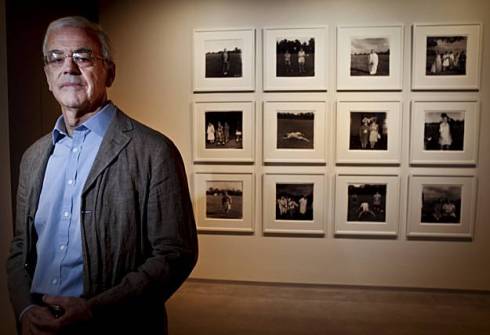
Photo: Russell Yip / The Chronicle
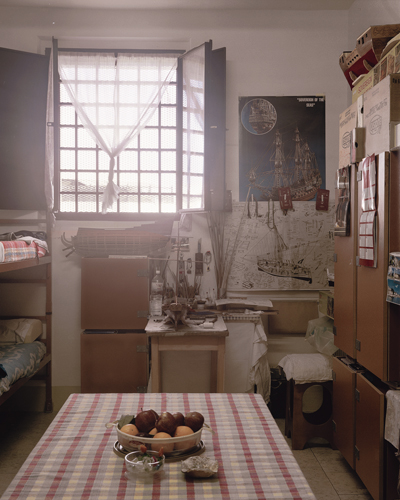
These pictures are presumably in Italy? Is this one prison or did you visit several?
This was seven different prisons in Sardinia and Sicily. Being from Sardinia it was a lot easier to get permission to photograph. I also knew someone in Sicily. But saying “easier” doesn’t mean it was easy. It took a year and a half to get my permission. Two of the seven prisons are juvenile facilities.
Why did you arrive at this subject?
Two things. Firstly, I was doing my BA in photography at the London College of Printing and I started photographing [London] prison walls in my second year. I have never done anything with those images; I never even scanned them. But they made me curious and for my final project I wanted to go inside. So, I sent letters to prisons here in London, but it was very hard to get permission. Being Italian, I resorted to try in Italy.
Secondly, the main thing that inspired me was Envoi a poem by Octavio Paz:
Imprisoned by four walls
(To the north, the crystal of non-knowledge
a landscape to be invented
to the south, reflective memory
to the east, the mirror
to the west, stone and the song of silence)
I wrote messages, but received no reply
It is absolutely beautiful, so simple.
What does Envoi translate as?
Envoi? It is a bit of a mystery. I was reading a book by Henri Lefebvre, The Production of Space, and on the very first page there is Paz’s poem. Now, Octavio Paz was Mexican, Henri Lefebvre is French, but I have never found this poem in Spanish of French. So, only the English version, yet the title is in French. Envoi means to “send out” and in French it is also used in a way that means not to just send out a letter, but to send out emotion … communicating emotion to other people.
This project was based around this poem. It is a poem that describes the four directions – north, south, east, west and these are the four walls. They describe the life of a prisoner.
But your photographs are of Sicilian and Sardinian prisons and yet your explanation seems to describe something more universal – something based in emotion, not in geography.
Precisely. I did not say where these prisons were on my website. It doesn’t matter where they are. It is about the idea of a reinvented life within four walls. Obviously, it doesn’t apply to every prisoner. If you only have a six-month sentence your cell is less important, but if you have a life sentence then I feel that experience is applicable to this poem.
Right, and within your images of cell interiors we can see details. Are you interested in individual objects? Do you want them to act as substitute for the inhabitant? For this is a common ploy – I am thinking of work by Jeff Barnett-Winsby and Jürgen Chill.
Yes and no. Let me jump to one of your other questions. You asked if it was my decision not to photograph inmates. Yes, it was deliberate, and beyond the fact it would be difficult to get permission. Again, based on this poem, I didn’t feel I needed to show these people.
I didn’t want to show a face. I thought it was enough to see their belongings and witness their presence that way.
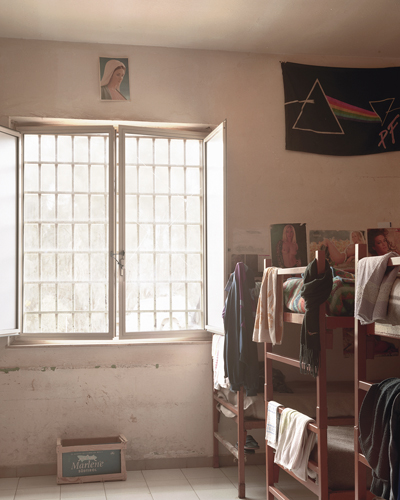
What was the reaction of the inmates and staff at the prisons?
The staff didn’t understand why I wanted to photograph at the prison. They make jokes and suggest I should go to the beach to photograph, as it was “more beautiful down there.” That’s fine, they have a job and support their family and they’re happy that way.
The inmates were very enthusiastic. I mean, it’s a different day. A day different to all the other ones; to have a photographer come into your cell.
I was continually escorted except for at two open-prisons where I was free to go anywhere I wanted. Whenever I saw a cell I wanted to photograph, I had to ask permission from the inmate, not the guard. That made me understand that it was his house. I had to ask him, just as I’d ask you if I knocked on your door. Sometimes we’d have coffee. Some of the guys gave me recipes about how to make certain types of pastas. It was a very strong experience.
Do you know if any of the guys have seen your work – did you provide prints or may they have been released and looked it up online?
I grew up in an area of Cagliari that wasn’t the best so I knew some of the guys inside. Some of them were surprised to see me there; I was not so surprised to see them there.
As far as I know they are still in. There was another guy who was famous in the area for being involved in the mafia. He was on a life sentence. I expect not many have seen the work. Really though, I have no idea if they have looked at the pictures or not.
Is photography an adequate tool for communicating stories about prisons?
Yes it is, but you need to be very careful. You could make things a lot more dramatic. For example, I could have chosen a 24mm lens, got very close-up, shown rotten teeth of inmates … I could make it dramatic.
But, my position was a central position. Really, I know nothing [about prisons]. I didn’t, I can’t, stand on any side. I try to be neutral.

Tell me about your use of light.
I used long exposures. I wanted the light to flow from the windows. The light behaves as a one-way system; in the same way Octavio Paz’s poem spoke of writing messages but receiving no reply. In prison, communications are always interrupted; they become one-way communications.
At times “your” prisons seems quite spiritual? Was religion ever an undertone for your work? These could by cells that monks live in.
I’ve never thought of the spiritual aspect of the images. However in terms of environment, the ascetic life of a monk and the imprisonment of an inmate are not too different – only one is a choice, and the other not. Two of the prisons in Envoi used to be convents.


Pursuing that notion of religious visual cues – this isn’t a typical prison as we expect (in the US at least). Instead of barbed-wire, these prisons have rounded arches, some have vaulted ceilings. Some of the detail evokes ecclesiastical spaces.
The entrance with the rounded arch is the entrance to female section of the prison. This is in Sicily, which doesn’t have enough female prisoners to warrant a designated female facility. There were perhaps forty of fifty female inmates in this section.
I was actually quite intimidated by this gate – it was very heavy and very loud. It really gave the sense of being incarcerated.
How did you work while in a state of intimidation?
The first day I got in I took no photographs. I didn’t know where to start; immediately I felt like I’d got in too deep. Over time I got excited, I got focused. In Italy we have a saying that all things – good and bad – are felt in the stomach first. It’s the centre point of the body; everything important is felt there. I took these images after feeling emotion from the stomach.
How many times did you go to these prisons?
I went to Italy twice – both times for a month. I visited some prisons only once, others eight or ten times. I visited the prison in Cagliari, my hometown the most.
Did you do any research before the project? Did you look at other photography done in prisons?
Lucinda Devlin’s Omega Suites was a huge inspiration. Her work is beautiful.
Another project I like is Ghetto by Broomberg and Chanarin, although they completed it since Envoi (which was done in 2003). Broomberg and Chanarin photographed in South Africa and in Central and South America, not just in prisons but other institutions.
Yes, I have looked at their work before. My conclusion was that they now have the luxury of reputation, time and money to take a very slow approach to their photography. That is how I explain their remarkable results.
I think they deserve all the recognition they get. Their work is astounding. I was in a show last year, which also had their work. Their prints are amazing.

Tell us about your exhibition of Envoi?
It was a bit problematic. Firstly, I think they [The Ministry of Justice] gave me permission to photograph in order to get rid of me.
After the project, I wanted help to organise an exhibition. The exhibition I had in Sardinia was great but it was also a compromise.
The Ministry of Justice didn’t provide me money but they involved the town hall and private galleries and it became good publicity for them.
I used them and they used me for their own interests. They never understood my concept. They kept advertising the show as a one about Sardinian and Sicilian prisons and I kept telling them it was about a broader concept.
In the exhibition I used labels beneath the images to identify each prison.
[At the opening] I didn’t want to give a speech but they forced me. The Ministry of Justice didn’t really know what to say either but they had to say something; it is politics.

What are your politics on prisons now?
This was the first and only experience I have of prisons. I made my own personal interpretation of prison, but I don’t really know what happens inside. I want to take the position that this exists and is part of our society. Now in America, as you’ve said, there are the most prisons in the western world, and that is something relevant, but the way I looked at it from the start was that I was not going to make a judgement. I was curious about this place. It is a place we’d not want to experience but [about which] we’re all curious. My father was a cop and he worked in the anti-narcotics division for many years. He’d go to interview people inside jail. As a teenager, I always wanted to join him.
Do you aim to inspire curiosity?
The show was quite successful. Somehow people were reading what I was reading. I could see the majority of people reacting as I expected which doesn’t happen with my other projects! [Laughs] Generally, I was happy with the comments.
I did hear many people at the exhibition say, “It [prison] is not as bad as I expected.”
How did you respond to those readings? Did you challenge your audience?
No. I mean they didn’t see what I saw and they didn’t hear the doors slamming. Every step you take, there’d be another door closing at your back, one after another. It took a long time to get through the prisons.
Do you consider your images a literal description of the space. Is that enough?
No, no, certainly not and it is not enough. “This is the concept of prison and it is in these 20 pictures?” No, no, no, no. [laughs]. It is one piece of truth in an infinite world.
What are you working on now?
I am working on observations of tidal movements, the change in landscape. It is a study of seaside societies and the way they relate to coastline. I have visited Norfolk a lot – it’s amazing. In Italy you have the sea, the beach – it is always there, you don’t have these movements.
In Norfolk and other places, I take two pictures; one at low tide, then I wait six hours and take one at high tide.
Soon, I’ll be taking up a residency in Holland – the BADGAST residency – and I’ll look at Dutch sea society. Then, maybe Canada. Nova Scotia has the largest tidal movements in the world – as large as 52 feet!
Thank you Danilo.
Thanks Pete.
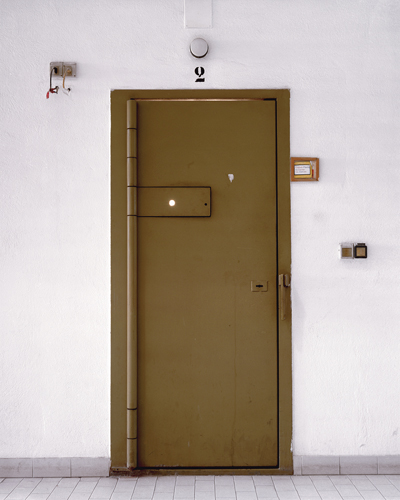
To see more of Envoi and Danilo’s other portfolios visit http://www.danilomurru.com/
ALL IMAGES © DANILO MURRU

Nina Cleveland, 1999
Tom Jones (b.1964; resides Madison, WI) is a Ho Chunk Native American. All of his projects represent some aspect of the Ho Chunk tribe, but the series not to be missed is The Ho Chunk People.
Jones: “Historically it has been outsiders who have taken these photographs of Native Americans. We have generally been represented with beads and feathers; this example can be seen through the extraordinary photographic portrayals of Edward Curtis. While this is an aspect of our life, the emphasis of my current body of work is focused on the members of my tribe and the environments in which they live, giving a name and face to the individuals and their way of life in our own time. […] I am ever mindful of my responsibility to the tribe and to carry on a sense of pride about who and what we are as a people.”
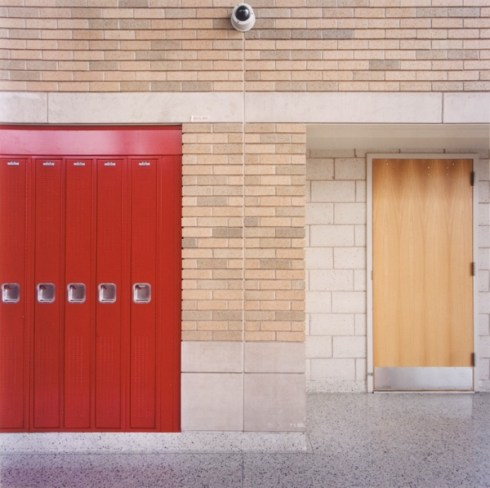
Scott Fortino‘s book Institutional: Photographs of Jails, Schools, and other Chicago Buildings (2005) is important because it hit the shelves two years prior to Richard Ross’ Architecture of Authority (2007).*
People tend to think of Richard Ross’ Architecture of Authority as being the authoritative (pun unintended) photographic statement on use of identical spatial psychologies across the breadth of contemporary institutions. Perhaps Fortino can, and should, disrupt that position.
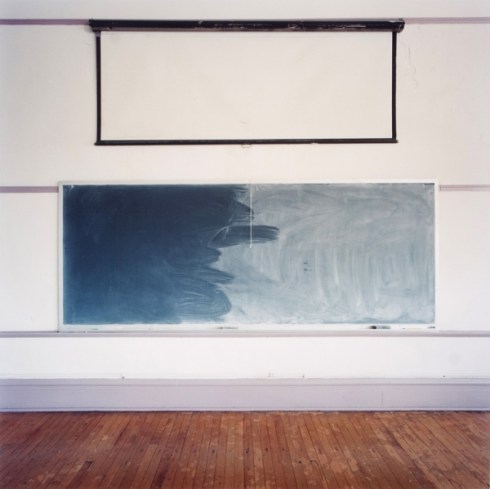

Patently, the publishing date of a book doesn’t close the argument, but I think it is apt to call these two photographers contemporaries in every sense of the word.
There are differences between Fortino and Ross’ work. Fortino’s work looks exclusively at Chicago institutions, whereas Ross – powered by a Guggenheim grant – took his survey international.
Fortino has an unusual bio, working as a photographer and police patrolman. Ross, on the other hand, is a professor in photography for the University of California, Santa Barbara. Interestingly, Ross, the son of a policeman is open about his father’s influence on his work.
I’d really like to see Fortino sat down giving a commentary on his work, just as Ross has here. Better still, I’d love to see Fortino and Ross at the same table!
– – – –
Scott Fortino’s Institutional portfolio, and more here from the Museum of Contemporary Photography Chicago.

BIO
Scott Fortino is a photographer who also works as a patrolman with the Chicago Police Department. His photographs are in the permanent collections of the LaSalle Bank of Chicago, the Museum of Contemporary Photography in Chicago, and numerous private collections.
* The synopsis provided for Institutional: Photographs of Jails, Schools, and other Chicago Buildings by UC Press, for me, misses the mark completely. Fortino’s work isn’t about the “subtle warmth and depth” of these spaces but of the disciplinary form written in the materials, demarcation and use of these spaces.
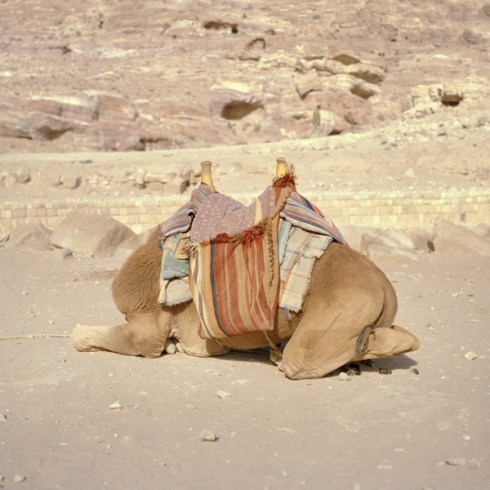
Irina Rozovsky has done a really good job at confusing me with her series One to Nothing. Intrigued by the palette, I found myself cycling through the edit over and over again, each time conjuring a new narrative in my mind.

 Prison Photography