
You are currently browsing the category archive for the ‘Fine Art’ category.

"New Orleans, Louisiana," 1965, by Leonard Freed. © Leonard Freed / Magnum Photos, Inc. Courtesy the J. Paul Getty Museum, Los Angeles.
Kristina Feliciano interviewed Brett Abbott, curator of photography at the Getty, about their summer show Engaged Observers
Abbott succeeds in saying not a lot (it is a brief interview). Abbott lists the exhibit’s famous photographers and recounts the Getty mantra on commitment financial muscle to support acquire documentary photography.
That said, his analysis of Leonard Freed’s image (below) is pause for thought.
KF. What are some of your personal favorites of the photos on view in the show?
BA: Leonard Freed’s picture of two men passing one another on the street in Washington D.C.: Freed’s protagonists face off, their noses nearly touching on the two dimensional surface of the print. The older white gentleman occupies a commanding presence in the center of the photograph, but it is the African American on the right who is in focus. Within the context of Freed’s larger project on racial tension in America in the 1960s, they can be seen as representing basic and opposing forces of the civil rights movement: white and black, the old generation and the new, center stage and marginalized, present and future. Indeed, the two play out this dialectic beneath a balcony clearly marked as belonging to the house where Lincoln died.
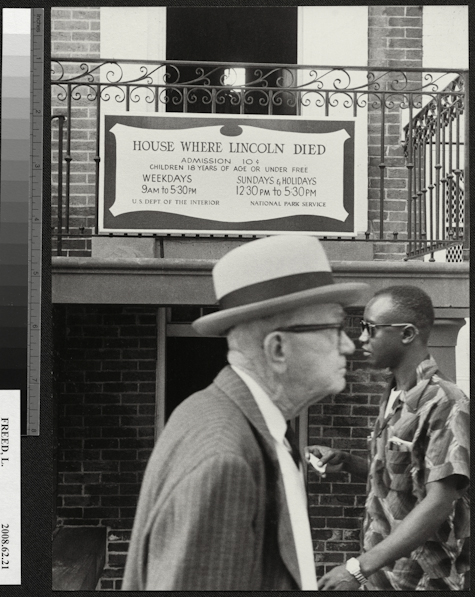
"Washington, D.C., 1963" Leonard Freed (American, 1929 – 2006) © Leonard Freed / Magnum Photos, Inc. Courtesy of The J. Paul Getty Museum, Los Angeles
BLACK AND WHITE IN AMERICA
Leonard Freed observed race in America throughout the sixties; this work eventually taking him to the prisons of Louisiana. Before we get to that, here’s how Magnum describes Freed’s best known work:
In 1962 Leonard Freed went to Berlin to shoot the wall being erected. There he saw an African American soldier standing in front of the wall and it struck him; that at home in the US, African Americans were struggling for civil rights, and here in Germany an African American soldier was ready to defend the USA. This prompted a lengthy examination by Freed of the plight of the African Americans at home in the United States. Freed traveled to New York, Washington, D.C. and all throughout the South, capturing images of a segregated and racially-entrenched society. The photos taken at that time were then published in 1968 in “Black in White America“.
The images below are from prisons within the same state, Louisiana.
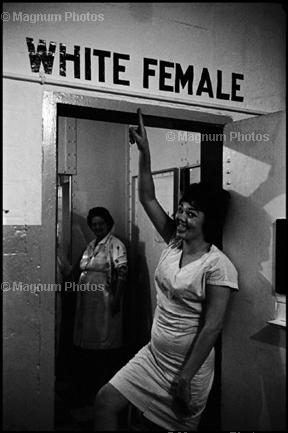
New Orleans, Louisiana. 1963. City prison. Image Reference: NYC21690 © Leonard Freed/Magnum Photos
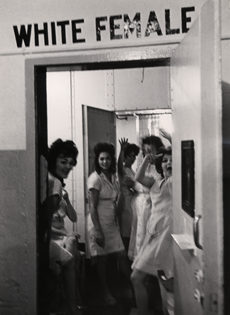
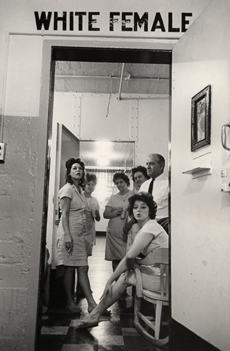
Freed’s documents of the New Orlean’s City Prison are galling. The mood and theatre played out by these women (inmates? nurses? orderlies?) in the “white female quarters” as compared to the claustrophobia and groping along the “colored tier” is confusing, appalling.
I am at pains to know what scene Freed is capturing here in the “white female” section.
The screengrab (below) is taken from the first of two online videos – here and here – in which Freed talks about contact sheets; money and its’ substitute; motivations; and of course, race.
Freed discusses his experience on the “colored tier” from 4:36 to 6:00.

Screengrab. Source: http://www.youtube.com/watch?v=SDVJlmE18zY
The attitude of the guards is beyond disgusting, “If we desegregate this place there will be blood. Mixing white men with animals. Can’t make us do that.”
If we take Freed at his word, and there is no reason not to, the portrait he paints of Angola was a place where Black men were willingly left to stew; a place where overcrowding was used as a disciplinary tactic, and a place in which racism was the unifying policy. Foul, totally foul.
YESTERYEAR / TODAY
That Freed should have visited a prison in the South as part of his survey on race in America was logical, for perhaps in prisons – more than anywhere else – the least tolerant and most simple interpretations on race existed.
Even today, prisons perpetuate cycles of poverty in minority groups. Furthermore, prison facilities only harden the tensions and misgivings between different racial groups of the prison population.
Freed went to Louisiana, but prisons across the South during the sixties were much of a muchness; they were borne from the same structures that had informed slavery. Robert Perkinson is perhaps the best historian to map this institutional-metamorphoses. In it’s basic premise, his recent book Texas Tough, can apply to prison management not only in Texas, but right across the South.
I highly recommend Marie Gottschalk’s review of Perkinson’s book which summarises his key positions, and is shocking enough in and of itself.
– – – – – – – – – – – –
ENGAGED OBSERVERS
PhotoInduced just reviewed Engaged Observers.
NPR ran a gallery pertaining specifically to the Engaged Observers exhibition.
FREED
Bruce Silverstein and Lee Gallery present Freed’s works online.
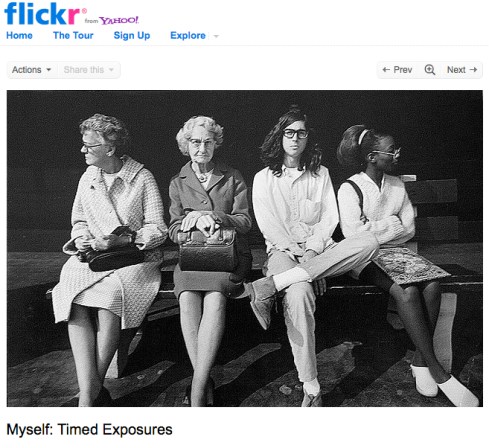
I was surprised to find that Mike Mandel has posted some photographs on Flickr. I thought legends stayed away from “the democratisation of the image.” And yet, Mandel has chanced his arm.
Incredibly, ten images from ‘Evidence‘ are even posted (All rights reserved).*
I was really taken by his mischievous ‘Myself: Timed Exposures’ (1971):
“In Myself: Timed Exposures I attached my 35 mm camera to a tripod and walked out into public space looking for situations to insert myself and create a picture. Once I found a likely opportunity I would set up the camera, release the self-timer on the shutter, and walk into the frame. The mechanical timer would noisily unwind for ten full seconds, allowing the world to change its complexion in front of my static lens. People, strangers to me, would be jarred for a moment from their routine and their perceived public isolation. I was standing uncomfortably close next to them, an abandoned camera buzzing a few feet away. I might say something or nothing at all. And suddenly, ‘click’, the machine had made its own “decisive moment” and only the film would know what latent treasure it owned.”

* ‘Evidence’, in my humble opinion, is one of the best photobooks ever produced.

Frida (forsythia), 35″x35″, c-print
As much as I respect the portraiture genre within photography, it just isn’t my thing. Perhaps I am not confident enough sifting the very good from the good? Nevertheless, I was really taken by Meera Margaret Singh‘s work – there is something very gripping about her series Harbinger. One of the subjects is her mother, others are strangers.
“Previously when I had worked with strangers, the awkwardness sometimes fueled the work. Now I’m being a bit more discriminate about whom I photograph and at what stage in our encounter.” (Source: Nymphoto interview, 04/02/09)
Happy Birthday America.
Precisely because “The Land of the Free” is a term now inseparable from rhetoric and politicking from any and all quarters, I’ll keep this brief.
America, like every nation on this earth, is and continues to be a work in progress. “Freedom” is a relative term, and if photographers in America do some things well, one of them is to remind us that by law (until very recently) some were freer than others.
I am always happy to promote socially-conscious photography that deals with racial injustices of the past and our need to address those injustices still. Furthermore, there are many good photographers who are working on inequalities today, based not in law, but in attitudes. Again, we are all works in progress, right?
WENDEL WHITE
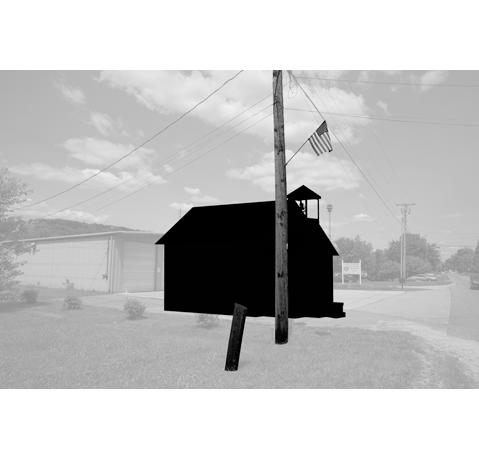
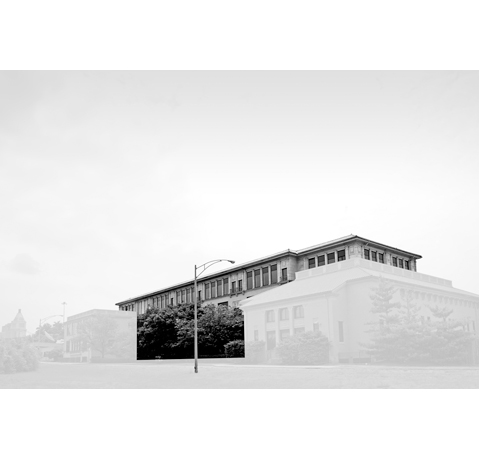
Wendel White‘s Schools For The Colored depicts the landscape and architecture of historically segregated schools in northern states.

Texas Prison Rodeo, Huntsville, 1964. © Garry Winogrand
In 1964, with the support of a Guggenheim fellowship, Garry Winogrand traveled over four months to fourteen states and recorded an America in transition.
The result was WINOGRAND 1964. Here’s a review by Ned Higgins.
– – – – – –
AmericanSuburbX has republished Carl Chiarenza‘s “Standing on the Corner – Reflections Upon Garry Winogrand’s Photographic Gaze – Mirror of Self or World? Pt. I” (1991) originally in IMAGE Magazine: Journal of Photography and Motion Pictures of the International Museum of Photography at George Eastman House, Volume 34, Number 3–4, Fall–Winter, 1991.
Including this statement: “The 1964 Guggenheim Fellowship was awarded to Winogrand to provide him with time to make “photographic studies of American life.” This fact inevitably recalls Robert Frank’s Guggenheim odyssey of a decade earlier. Something to think about—one wants to make comparisons. One wishes there were a Winogrand book comparable to Frank’s The Americans. But there is no such book.”
Think on.

Richard Renaldi has translated Freddy Langer’s review of Allison Davies’ Outerland which ran in The Frankfurter Allgemeine Zeitung, July 1, 2010. Richard and his partner Seth Boyd founded Charles Lane Press which published Outerland.
Renaldi: “The story Allison Davies tells us in Outerland is derived from those end-time allegories that have supplied modern American art with dramatic material for novels, movies, and ballads sad and cruel. It may well be a story fueled by fear of weapons of mass destruction after the terrorist attacks of September 11. Or a meditation on an impending climate catastrophe. But Outerland goes deeper. It asks the question: On the first day after the end of mankind, what will remain?”
This isn’t the first time Outerland has gotten some love. Joerg Colberg, theHulin, WIPNYC and James Danziger have all reviewed it. It’s fair to presume the book is a stonking good, memorable object.

I enjoy reading interviews, but I enjoy more listening to a photographer speak while their photographs scroll.
I also love being able to mount a knowledge of British photography of the second half of the 20th century; an activity that is not quite the fabrication of nostalgia, but I’ll admit it is close (I was born in the eighties … just).

ONE BIG SELF
I have told many people in person that Deborah Luster’s One Big Self is the most impressive prison photography endeavour to date. I have been slow to state as such on this forum because the scope, details and inspiration of the project are so overwhelming.
Every portrait deserves an essay, but that obviously is not possible. Rather than delay any further, my aim here is to present many of Luster’s portraits, describe the bare facts, and provide some further resources to understand the work.
THE FACTS
Completed between 1998 and 2003.
Portraits taken in many different prisons – mens and womens facilities; minimum to maximum security throughout Louisiana; and with different levels of supervision.
Tens of thousands of portraits taken.
Luster estimates she gave away 25,000 portraits to prisoners over the course of the project.
Luster worked fast – 10 to 15 portraits per hour. At a point working in sheer volume became the only reasonable way to respond to the size of the prison population with which she was engaged.


BACKSTORY
Luster got involved in this longitudinal study through a chance request. Luster’s emotional standing at the time of beginning was – is – atypical and unexpected.
Luster’s mother was murdered in 1988; “Although I was interested in photography prior to that time, I didn’t study or practice it. I began photographing in response to her murder.”
Luster did not deliberately go in search of the subject. In 1998, she was driving near Lake Providence, Louisiana when she came upon East Carroll State Prison Farm. She literally knocked on the front gate. There and then Warden Dixon gave her sanction to begin the endeavour.



VIDEO & AUDIO
SFMoMA has done us a great service in recording and publishing the following video shorts.
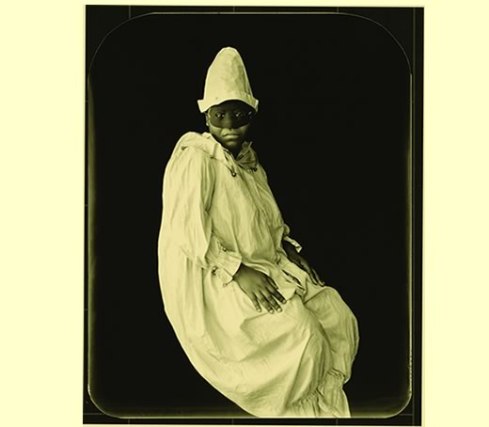
In four videos, Luster describes the ORIGINS of the project, elements of ACCIDENTAL PERFORMANCE, printing on ALUMINIUM PLATES, and comments on INDIVIDUAL WORKS.
Remarkable tales.


RESOURCES
Deborah Luster is represented by Catherine Edelman Gallery, who present the best online selection of her portraits.
Good background information is provided by Doug McCash of the New Orleans Times Picayune; David Winton Bell Gallery at Brown; and Grace Glueck of the New York Times.
In 2000, One Big Self was exhibited at the Center for Documentary Studies at Duke, providing an overview and gallery of the project.
INTERVIEW
The best in-print interview with Luster is included in recent publication, PRISON/CULTURE (City Lights), which I reviewed two months ago.
THE BOOK: ONE BIG SELF
The book is at a premium now and you’ll struggle to find it for under a $100. It is published by Twin Palm Press.

IMAGE/WORDS
Luster collaborated with writer/poet C.D. Wright. Luster’s images and Wright’s poetry are a great complement to one another. Listen to Wright read her poetry from the project.
A PROJECT ONGOING
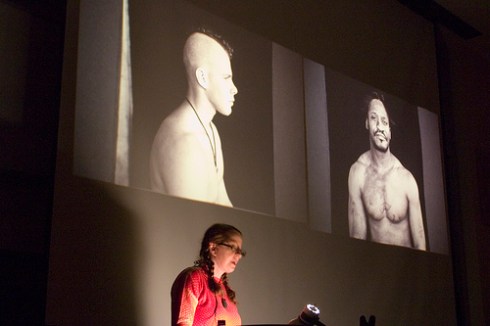
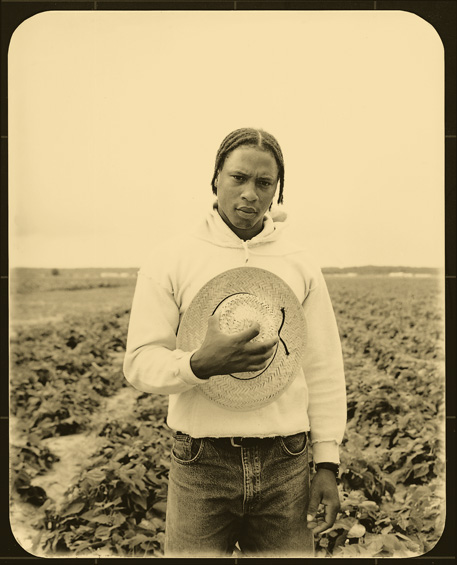
Despite the passage of seven years since the projects official closure, Luster’s career continues to be defined by her ground-breaking, genre-defining project. Her lectures are vital in that she describes the many facets of the project – from security arrangements, to gear (she generally worked with digital), to processing (she made use of tintype imitation technique printing onto small metal sheets), to the specifics of exhibition.
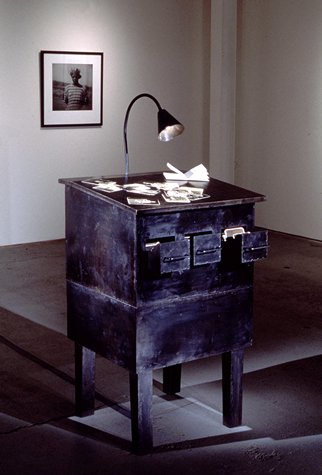
The image below shows a steel cabinet and lamp (containing 288 silver-emulsion aluminum plates) as it was displayed at the San Francisco Museum of Modern Art and other institutions. Luster wanted to create a tangible viewing experience in which the audience were required to handle the archive of human life in the same way the state of Louisiana organised and disciplined the bodies under its supervision.
In the video (below) Luster talks us through the senses and noises of the exhibit design.

 Prison Photography