
You are currently browsing the category archive for the ‘Fine Art’ category.

Joshua, Angola State Prison, Louisiana 2002 © Alec Soth
Alec Soth shot to notoriety before I dipped my toes in photography appreciation. He also terminated his treasured blog before I could jump aboard.
I missed the early boat on Soth’s work and have always felt quite maudlin about that. Really there is no need for my malaise; Soth has travailed the papers, the cameras and the blogs as widely as he has the American Interstates. He has left a busy legacy of interviews.
The sheer number of interviews contributed further to my sense of awe – they amassed to an unscalable mountain of words that needed to be noticed because, as Soth continually insists, photographs cannot tell stories.
During his trips making Sleeping by the Mississippi, Soth asked many of his subjects “What is your dream?” He ended up not using the responses for the book, but held onto the scraps of paper on which folk had written their dreams.

Fort Jefferson Memorial Cross, Wickliffe, Kentucky 2002 © Alec Soth
Of all the responses, the man who stands second from left in the Kentucky prison work crew (above) had Soth’s favourite dream. He said, “I want to operate and own a pilot school”. Soth liked how the dream was “both specific and grand”.
I know this because Soth mentions it in this fantastic presentation and discussion with Andrei Codrescu at the Walker Art Center, Minneapolis. If you have an hour and seventeen minutes to spare this weekend watch and listen to it.
If not, bookmark any one of these interviews and read at some point in the next year.
Soth with Michael David Murphy
http://www.youtube.com/watch?v=R7PpxTHqYWI
Soth on Assignments
http://www.youtube.com/watch?v=GrNUoZ1ye6Y
Soth on Portraits
http://www.youtube.com/watch?v=Yvgg6bLhJE4
Soth with Ben Sloat
http://www.bigredandshiny.com/cgi-bin/BRS.cgi?section=article&issue=119&article=20091016133834289803794155
Soth with Aaron Schuman
http://www.seesawmagazine.com/soth_pages/soth_interview.html
Soth with Carrie Thompson
http://blog.magnumphotos.com/2007/11/interview_alec_soth_on_dog_days_bogota.html
Soth with Daniel Shea
http://toomuchchocolate.org/?p=1067
Daniel Shea on Soth
http://dsheaphoto.net/blog/?p=700
Soth with Anthony LaSala
http://www.pdnonline.com/pdn/esearch/article_display.jsp?vnu_content_id=1002235383
Soth with Paul Schmelzer
http://blogs.walkerart.org/visualarts/2006/05/01/the-binoculographer/
Soth with James Miller
http://www.americansuburbx.com/2009/07/interview-presience-and-poetry-james.html
Soth with Conor Risch
http://www.pdnonline.com/pdn/content_display/photo-news/photojournalism/e3i260af0867f21cdd31a1211bb5ab07a85
Soth with Jeff Severns Guntzel
http://www.citypages.com/2008-01-23/feature/freeze-frame/
Soth with Roger Rochards
http://www.digitalfilmmaker.net/photo/alecsoth/2004.html
Soth with Joerg Colberg
http://www.jmcolberg.com/weblog/2006/08/a_conversation_with_alec_soth.html
Soth with Paul Laster
http://artkrush.com/105630
Soth with Jen Bekman
http://www.photoeye.com/magazine/archives/fullsize.cfm?Issue=fall_2007&IssueID=080815010312-d1c9488974b54b24866088a30b84ccf8#magtop
Soth with Minnesota Public Radio
http://www.publicradio.org/tools/media/player/news/features/2005/06/15_newsroom_sothportraits
Minnesota Public Radio without Soth
http://minnesota.publicradio.org/features/2008/06/04_soth2/index.shtml
Hilarie M. Sheets on Soth
http://www.nytimes.com/2009/08/02/arts/design/02shee.html
and Rob Haggart on Soth’s back
http://www.aphotoeditor.com/2008/07/09/whats-up-with-alec-soth/
Yasmina Reggad interviews Soth with an exchange of images
http://thedignityofmovemenoftheiceberg.wordpress.com/
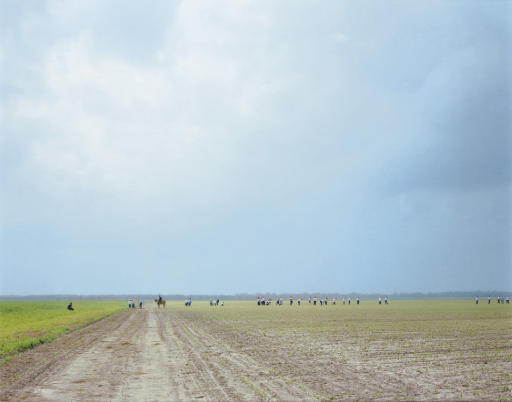
The Farm, Angola State Prison, Louisiana 2002 © Alec Soth
In the same discussion with Andrei Codrescu Soth confessed to avoiding too much research before he goes to a place; he doesn’t want to burden himself with the knowledge. He also expressed surprise and delight at coming across the histories of places and institutions he’d not consciously sought out … and of those he mentioned prisons.
I was going to add some analysis to these pictures but now that I have exorcised my fear of the massive cult, enjoyment and coverage of Soth, I think I’ll just drop him a line and ask him about incarceration in America. Stay tuned.
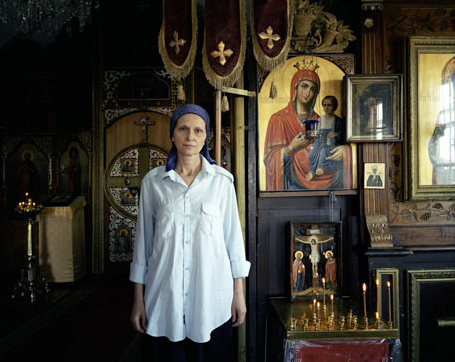
© Guia Besana
To the prison-nerds, I apologise for the move away from humanity’s failings, wastage and cages with this mild intrusion into things fine art, but I’ve got to say This Photo That consistently puts up great work.
Most recently Guia Besana, whose work reminded me of Melania Comoretto.
Wendy Watriss, co-director of Fotofest, really digs Chinese photography. In 2008, Fotofest set up camp in China reaching out for the sakes of diversity, discovery and commerce.
Today, Fotofest announced its International Discoveries II. They include Alejandro Cartagena, Wei Bi, Minstrel Kuik Ching Chieh, Christine Laptuta, Rizwan Mirza, Takeshi Shikama, Kurt Tong, MiMi Youn, and Vee Speers (although Peter Marshall points out Speers isn’t that “new”).
The most comprehensive information available remains the Fotofest Press Release (PDF)
The most tantalising prospect for me personally is Wei Bi. Partly because of his project and partly because there’s nothing out on the web about him.
I skanked this screenshot of the Fotofest website. Sorry FF!

Wei Bi, Untitled, 2008
Here’s the blurb: “Issues of justice are embedded in Chinese artist Wei Bi’s re-staging of his 80–day experience in a Chinese prison — a sentence received for making a photograph. His large black and white photographs are minimal, showing a surreal relationship between near expressionless guards and disoriented prisoners. Despite the constructed nature of his work, Mr. Wei insists his “photography is not aimed to reveal, but to record, recording the existence of my life.” Wei Bi’s work was “discovered” at the Guangzhou 2009 Photo Biennial in Guangzhou, China.”
How can we not be drawn to this work? He was imprisoned for his photography! Potentially, it is a narrative against adversity in which creativity triumphs.
If anyone reading this makes it to the exhibition please get in touch and tell me what you think of Bi’s prison photographs.

Past and present ruminations about what is and isn’t a photograph have been a source of frustration for me. For one, people can draw whatever lines they wish to determine the point at which manipulation tricks out a photograph and thus qualifies it as photo-illustration. And for another, as Errol Morris keeps banging on about, ALL photography is lies (and manipulation).
These debates are not about truth. Interventions – power relations, habit, photographic custom, complicity among subjects, props, political agendas (and framing), cropping, tweaking of exposure levels before and after development, digital alterations – mean that photography can never be, will never be truthful.
People forget that often it is the ingenious tricks that have spurred the largest wonder among viewing public – think Oscar Rejlander’s Two Ways of Life, Spirit Photography and – in a different sense – Ansel Adams’ Zone System.
It is therefore, with some relief that an artist like Azzarella comes along using photo-manipulation as the tactic and purpose for his work.
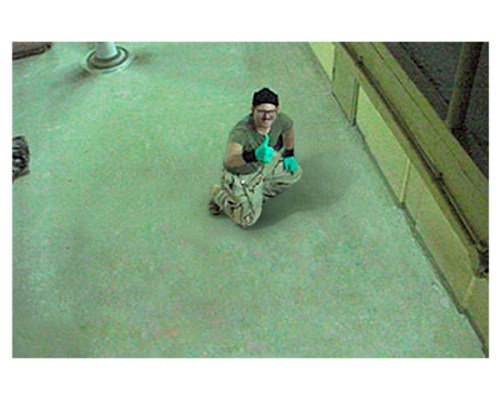

Last week, I questioned Anton Kratochvil’s Homage to Abu Ghraib, mainly because I think it makes little contribution to the discourse on the political aesthetics of Abu Ghraib. The blurry references to torture in Kratochvil’s images are in response only to a personal, conscious and willing point of view. I understand that Kratochvil’s work was an exercise in self-therapy but that shouldn’t stop me comparing it to Azzarella’s broader concerns about more general and unconscious reactions to well-circulated images.
If I w re to wr t th s sent nce wi h lette s m ss ng, you can still read it. The human brain is a wonderful instrument drawing on past experience to quickly filter out the non-possibilities. Just as the brain instantaneously deciphers gaps in text so it does with gaps in images.
With every passing hour the Spectacle suffuses itself further. It isn’t so much us reading images but images reading us. Our involuntary responses to images are predictable, predicted, precoded. The redacted action of violence in Azzarella’s pictures plays second fiddle to the original image, for it is the original image we drooled over and devoured.
The hooded detainee, dead student, wailing child or falling soldier needn’t even be present; our internal, emotional feedback spun by these images will forever be the same. We fill in the gaps and short circuit to prescribed disgust, sadness and politics, thus confirming our prevailing bias.
Azzarella’s works expose the fraud in us all … and our cheapened, robotic response to image.

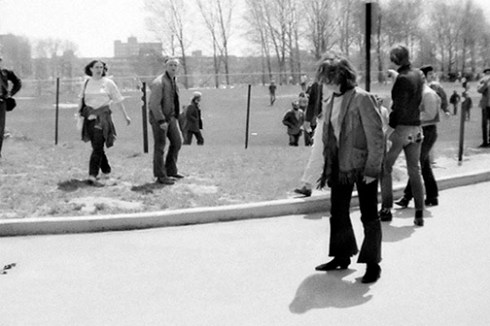
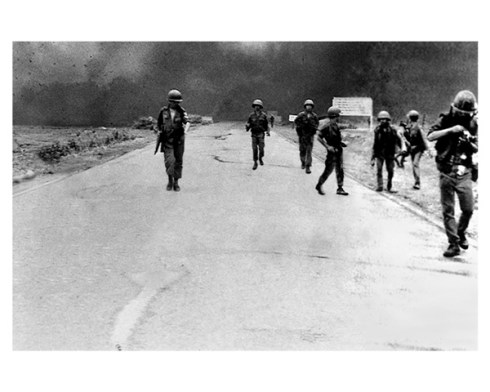
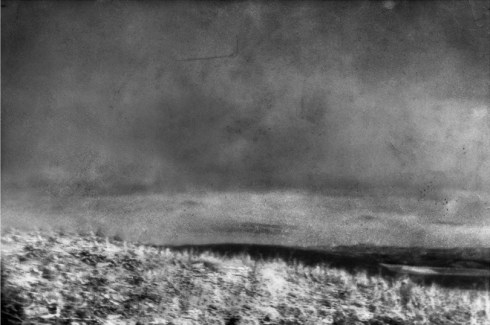
ALL IMAGES © JOSH AZZARELLA. FROM TOP TO BOTTOM: UNTITLED #13 (AHSF); UNTITLED (SSG FREDERICK); UNTITLED #24 (GREEN GLOVES); UNTITLED #35 (CAFETERIA); UNTITLED #39 (265); UNTITLED #20 TRANG BANG; UNTITLED #43 (PAR115311).
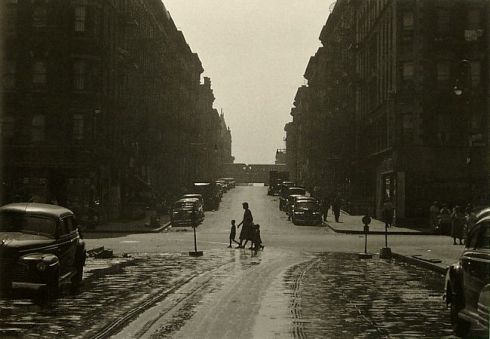
Roy DeCarava’s life and work has been noted by every source that should be seen to care following his recent passing.
There’s no doubt, DeCarava was a photographic great, a pioneer and a fine craftsman … but he had barely registered on my own personal radar. Until I found the story below courtesy of Dawoud Bey, I did not intend to comment upon DeCarava’s death. It would be inappropriate: I didn’t know about his work when he lived, why should I put on a show of knowing when he died?
Bey says:
Dawoud goes on:
I guess the lesson – for all things – is that one should only comment if the comment is vital, relevant and fair.
Thanks for sharing Dawoud.
___________________________________________________
Elsewhere, from a 1996 NPR interview, it was fascinating to hear DeCarava’s matter-of-fact memory and experience of serving in the US Army, “In those days there were two US Army’s. One Black, one White.”
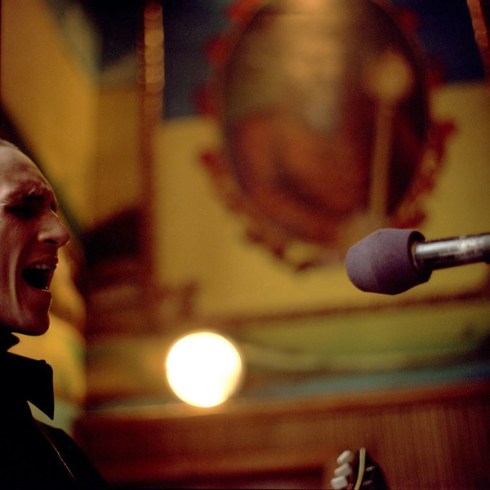
It sounds asinine to describe a prison as beautiful. Perhaps, the warm tones of the theatre-house in Kharkiv’s penal colony are a lure. But, I don’t want to budge on this; Maslov’s images are sumptuous.
Let us not forget though, the photographic series, however beautiful, is the product of specific circumstances. The more we know about these circumstances the better equipped we are to understand them and their content. Last week, Sasha and I talked over Skype about the details of the project.
How did you arrive upon the subject?
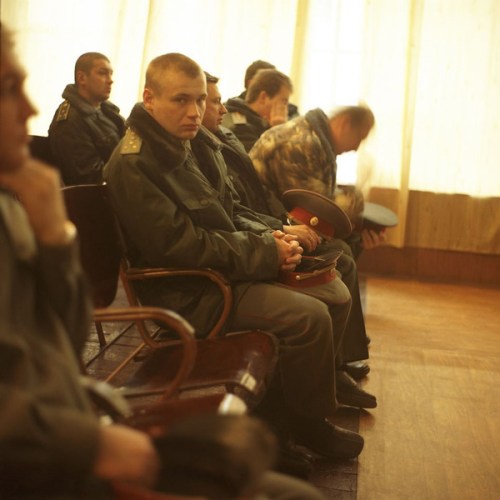
I had a couple of friends who had been running a theatre class in a prison in Kharkiv, Ukraine. I thought it was a great subject so I went along. Theatre performers aren’t what you expect to see in a prison. Being an actor is a ridiculous notion for criminals; you’re basically putting yourself in the position of the fool. The prison was maximum security so they were in there for serious crimes. At the beginning it was … kind of creepy, but then I got used to it.
I wanted to shoot with film. Initially, the warden said I’d have to use digital equipment, but I explained it was essential I used film and showed him some of my images. In the end, he permitted it.
It looks like you were you there for the final performances. How long had they been rehearsing and how many times did you visit?
They’d been working on the play for 9 months. I went in three times, but most of the shots from the project were taken on the day of the main performance.
What message did you hope to communicate with the project?
I go into all projects very open, without really knowing what it’s going to be like and if I will actually have anything at all in the end; what can I see? What can I tell? I think this is best.


Some of your subjects seem uncomfortable with the camera?
Yes. It is understandable as cameras aren’t something they are used to. Some don’t want to be seen for obvious reasons. Those acting in the troupe were more open to being photographed. I felt like during the new experience for them with this theatre they opened new horizons, but generally in prison the feeling is that the camera is not your friend.
I actually tried to shoot in two prisons, they other being a women’s prison but nothing came out of that project. The women acted very differently around the camera. Every time they saw the camera they’d change something. They’d usually smile. They would present themselves for the camera. The women always smiled. Once, I caught a glance of a female prisoners glaring at a male guard. It was a real wolf glare. I lifted the camera, but instantly she saw me and changed her look. Her eyes became those of kittens.
Perhaps this desire to perform or adapt for the camera by female prisoners is something you could work with in the future? Deborah Luster worked with the females in the Louisiana prison system making portraits of them in full theatrical costumes.
Yes, it would be interesting to shoot there again. But also, people aren’t totally truthful. They can’t talk about things that are difficult. I wasn’t allowed in their cells. The experience changed me. Not massively, but it did make me look at things a little differently.

In Ukraine can one assume certain things about the prison population? I ask this because in America’s medium security prisons where men can be serving long to life sentences, some may not be there because they are violent offenders. It is the non-violent men who are warehoused who seem to lose most through harsh sentencing. Does this mix of offender-types occur in Ukraine?
I cannot say. Of course, I never asked. One inmate did say to me, “You don’t have to pretend to respect me. You know I am in here because of something terrible I did.” But, I wasn’t pretending to respect anyone. These people were new for me, if you don’t consider the place where the [project] took place you are not able to form any prejudice.
Do you know what percentage of the men would eventually be released?
No, but I know some were due to be released very soon. One actor was due to be released one day before of the performance, but he preferred to stay for another week so that he could perform the show.
Right before show began I took a shot of a woman in the audience. I will never forget this moment. Later I found out she was a mother of one of the inmates in the troupe. She had come to tell him that his brother had died on the outside. She waited until after he’d finished the show because she didn’t want to ruin his performance. It was only afterward when I found this out I understood why she did not smile during the show.
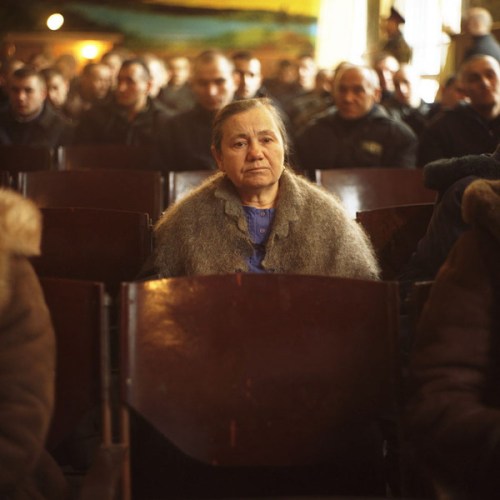
And how was the show?
The dramatics were amazing to see. Many of the men struggled over and above their usual habits to get the lines out. The play was The House that Swift Built, which is a fiction about a house full of ridiculous items and fantastic people. Jonathan Swift tells unbelievable stories and plays practical jokes, the nature of existence in and outside the house is questioned. The players have the potential to transform their lives. Of course it was interesting to see this done by prisoners.
Still, many of the lines were delivered with arrogance. Even in soft conversation, the actors came across as brash. They are used to being in a defensive position so there was always a strange arrogance … or little aggression.
Did the inmates see your prints?
Yes, I sent prints to the prison. If there was a shot with two prisoners in it, I’d send two copies. I don’t know how they divided all the works among the guys but I know they got them.
Did you ever have to secure model release forms?
[Laughs] No. I only had to agree on the project with the warden. The fact my friends had been there a while also made my case easier. The warden was forward thinking by Ukrainian standards. He was interested in the publicity it would gain for his prison.
What are the general thoughts of prisons among the Ukrainian public?
That they are places you shouldn’t go. Prisons are tough everywhere. After you get out, you just have a new set of complexes.
How do former-prisoners fare in Ukraine? For example, ex-prisoners in the US have to petition to gain their right to vote back. How does it compare?
Ukrainian prisoners can vote in prison. But, more generally, prison is forever a stain on your character. Human rights violations occur in prisons all the time – stabbings, abuses of power by the guards. You hear about these things on the news. But these instances are just pieces of sand on the beach. It could be a much larger problem. Perhaps it is but we don’t hear about it.
Well, it is an amazing glimpse for us all to get at an arts program inside a Ukrainian prison. What equipment did you use?
I shot with a Kiev 6S, a 6×6 medium format camera. It is bulky and heavy. I really liked working with it but I was always very visible to the prisoners with this thing in my hands. And the sound that it makes is beyond any politeness.
What comes next?
I have two things on. I have just got back from Donbass, a region in Eastern Ukraine where I was doing a story on coal miners. It was an amazing experience, because for 20 years nothing has changed there except dramatic decline of population. There are small towns that lived off coal mines in Soviet period, but many mines were shut down or there are places where 5-6 thousands people worked and now there are 50-70 miners. It’s sad and fascinating area. The story will be out in a few weeks. I am also working on a show of photographic portraits for a gallery in Ukraine.
How do you pick your subjects?
I do what I think is important. I don’t plan too far ahead. I’ll be interested to see what happens in the near future with the industry.
You heard this month about Christopher Anderson saying, “The death of journalism is bad for society, but we’ll be better off with less photojournalism. I won’t miss the self-important, self-congratulatory, hypocritical part of photojournalism at all. The industry has been a fraud for some time.”
I didn’t but he could be right. There are trends in photography. When the trends change, there seems to be two types of response. The first is to chase and feed the trend. The second is – in the uncertainty – to stick to what is valuable to you, and that will usually be something you like. The best work will always come form that second approach. And as for the market; the market is like the ocean. It can change three or four times a day. There’s no use in trying to predict that.
True. Thanks Sasha
Thank You.
Sasha Maslov has shown this work before at Vewd and at his Lightstalkers profile.


Okay, Jeff Barnett-Winsby did not aide and abet anyone.
He was, however, indelibly tied to a fugitive pair of lovers – one an inmate, the other a prison volunteer. Winsby had done a couple of photo series at Lansing Correctional Center, Michigan. He knew – and photographed – both John Manard and Toby Young before Young drove a van out the prison with a dog-crate in the back. Manard was in the dog-crate. They were on the run for twelve days until the authorities caught up with them in Tennessee.
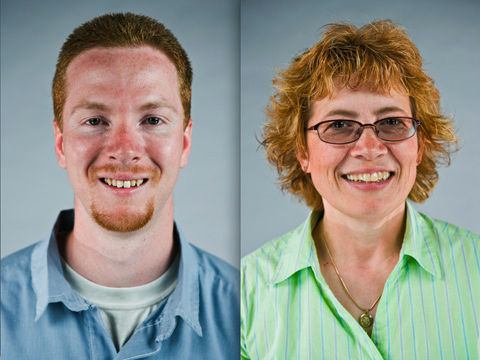
All the details about the police hunt and climactic high speed car chase, car crash and return to custody can be found here.
Toby was the founder and coordinator of the Safe Harbour Program, and John Manard, a dog-handler and Young’s escort within the prison. She was vulnerable, he was hopeful, they were close. Manard did most of the planning. “By the time he brought me in to what he was doing, I was in love with him and I couldn’t say no,” Young said. “I was not in a safe and sane place in my life, but I still could’ve said no, but I didn’t.” It seems like a straight up case of manipulation; a true power imbalance.
This tale is like something out of a movie. Jeff has muttered things about making a movie. We’ll see. At the very least, we can all look forward to his book Mark West & Molly Rose published J&L Books. Mark West and Molly Rose were Manard and Young’s aliases.
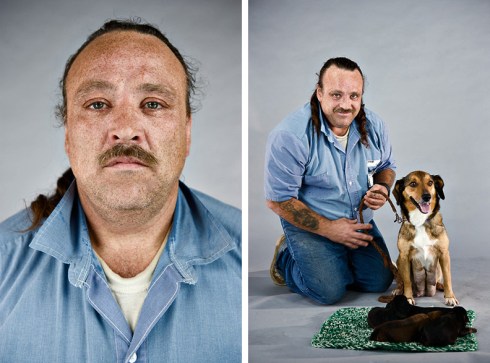
Barnett-Winsby dissects events as he experienced them over at Feature Shoot:
Barnett-Winsby’s gloss portraiture is pretty atypical of prisoner representations. It’s very giving.
The accompanying images of prisoners and their dogs work as a foil to the straight portraits. Instantly, our response to the inmate changes. Barnett-Winsby plays on visual dissonance. He exposes our inbuilt prejudice and softness toward animals: “If someone loves an animal they can’t be violent, right?”
As well as Safe Harbor, Barnett-Winsby also photographed the objects in single occupancy cells for his project Marks of Intention (below).
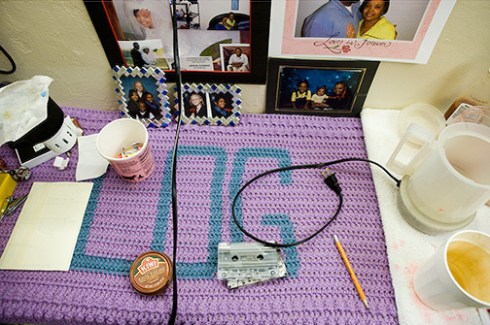
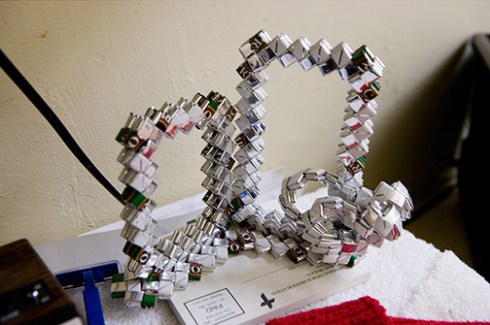

Barnett-Winsby has collapsed Safe Harbour and Marks of Intention along with images from the Mark West and Molly Rose story; it is a wide-reaching anthology of the Lansing facility and two lives that temporarily escaped its control.
You could say Barnett-Winsby had luck photographers only dream about when hunting for a good story.
Mark West and Molly Rose is published by J&L Books. The owner of J&L Books Jason Fulford was recently interviewed at Too Much Chocolate as was Jeff Barnett-Winsby.

© Anton Kratochvil, from the series 'Homage to Abu Ghraib' (2006)
It may not be wise to question a photography project that was conceived of, and produced, in honour of the photographer’s father who was tortured in Stalinist labour camps.
But, is not Anton Kratochvil’s Homage to Abu Ghraib obsolete?
Kratochvil spoke at this weeks photo expo.
We can presume that everyone who saw and then virally-forwarded these images knew already about Abu Ghraib. I can’t imagine that this series converted new recruits into the anti-war mindset or lured them into new emotional responses to the horrors of the War On Iraq or of Saddam’s primary prison/death-house.
Saddam Hussein’s ordered rushed and final hour executions of some opponents and turned others loose. Then the American Military moved in. Kratochvil’s images contain disconcerting echoes of US abuses at Abu Ghraib, but those echoes are insufficient, even unnecessary, in the context of the original images.
Only the personal catharsis and healing this series may or may not have provided Kratochvil could stand as basis for a discussion of worth here. And that, still, does not alter my personal opinion that this “homage” is misplaced at best, derisory at worst.
More here

 Prison Photography