
You are currently browsing the category archive for the ‘Fine Art’ category.
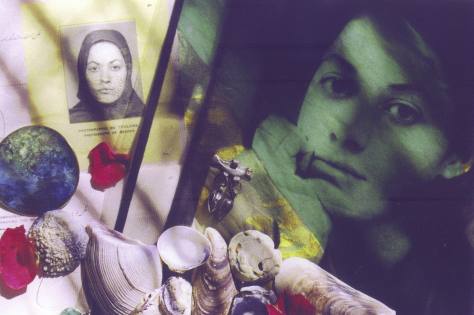
© Rana Javadi. (This image is not in the show, but the artist is.)
Photoquai‘s mission : to highlight and make known, artists whose work is previously unexhibited or little known in Europe, to foster exchanges and the exchanging of views on the world.
The 2009 Photoquai biennial is directed by Anahita Ghabaian Etehadieh, an Iranian gallerist and founder of the Silk Road Gallery, Tehran – the only space in Iran dedicated to exhibiting photography.
Photoquai shows the work of 50 contemporary photographers from around the world, unknown or little known photographic talents in European terms, who come from Latin America, North America, Asia, Oceania, Africa and the Near and Middle East.

© Nomusa Makhubu
Presumably, Photoquai will propel debates about diversity and representation. I desperately wanted to write something important about Photoquai.
It is a photo-festival hell-bent on avoiding the usual names and well-worn paths of sight and (re)appreciation. But …
As part of my due diligence (sat on my arse, browsing the web, dipping into sources) I was stopped in my tracks by Colin Pantall’s “rant”:
The idle, rapid-fire online viewing of photography has it’s knock on effects to writing about photography. Both are debased. I am as guilty as the next person.
So why should you listen to my opinion when I’ve not left my desk in the hour since I became aware of PhotoQuai? Read the following reviews from people who actually went and stood in front of the prints.
Jon Levy of Foto8 gives a pretty anemic description of his preview tour, but is ultimately thankful that new events are still blossoming despite the “undoubtedly harsh” climate for photojournalism.
Diane Smyth at 1854, the BJP blog, first has an overview of Photoquai. Smyth then provides a description of an “unusual exhibition in the Pavillon des Sessions at the Louvre. Portrait croises pairs a selection of 40 images from the Musee du Quai Branly’s extensive archive with indigenous sculptures and artworks from around the world.” Personally, the curatorial premise of this exhibit seems problematic – mainly because the pairings would seem to devalue the original meanings and conditions of production, if not strip them completely.
Marc Feustel of eyecurious loved the ambition but was “pretty disappointed” by the quality throughout. He felt guilty for criticising a small, brave, new-festival-on-the-block but couldn’t forgive the “photographers who should be tried for Photoshop crimes against photography.”
If you look through Jim Casper’s LensCulture gallery, you’ll sympathise with Feustel’s point.
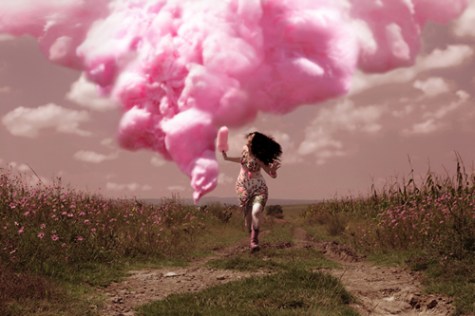
© Daniela Edburg
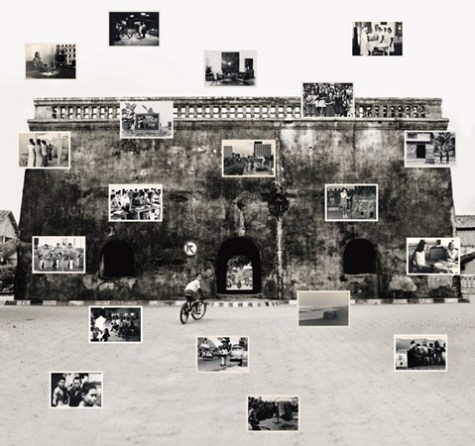
© Nadiah Bamadhaj
Conclusions:
Iranian photography gets special attention on the 30 year anniversary of the revolution, and the approximate 20 year anniversary of the end of the Iran/Iraq war.
Afghanistan photography inevitably remains within the implications of its ban during Taliban rule.
Only a few well-known names are knocking about, noticeably Abbas Kowsari.
Pablo Hare is the darling so far.
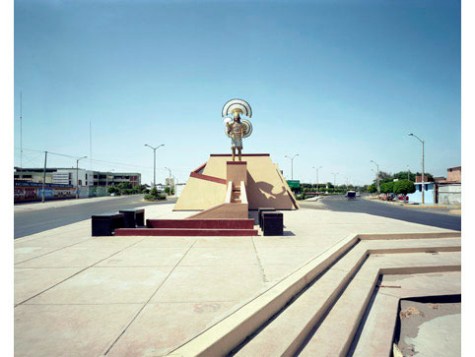
© Pablo Hare
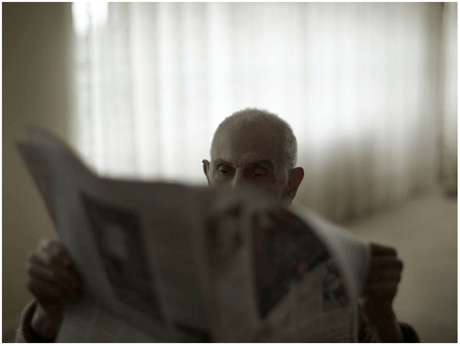
Philip Toledano‘s Days With My Father has got some coverage recently, and rightly so. There is a perfect balance and appropriate tone throughout the series which is inescapable. Aline Smithson included it in Photographing Family – her well reasoned Too Much Chocolate piece about the imperative of family to photographers.
It is even more remarkable because it is such a departure from his cynical but pointed political work America The Gift Shop.

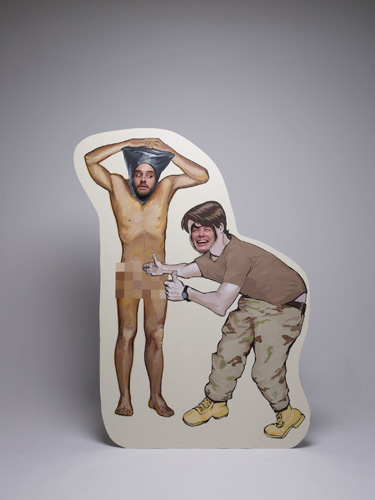
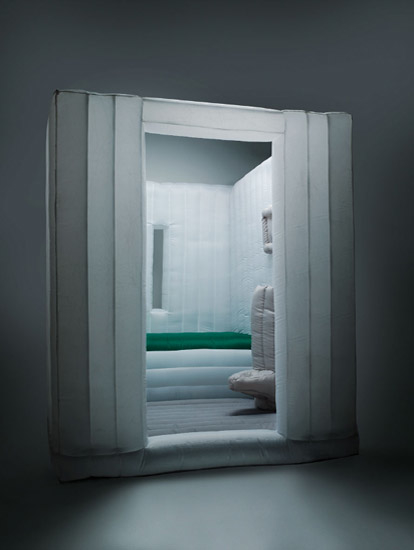
In a Decemebr, 2008 interview with Joerg, Toledano explained that for the really complex stuff he had to turn to China:
“Only the inflatable Guantanamo Bay prison cell and the Abu Ghraib bobblehead were made in China. The rest was made in America. To find Chinese manufacturers, I Googled ‘bouncy castle manufacturers, China’ or ‘bobblehead manufacturers, China’ and then emailed a few companies. It was really simple. And then, for the bobblehead, for instance, I sent the manufacturer the actual photo from Abu Ghraib, and they’d email me photos of progress, with me commenting along the way. The whole project, from start to finish, probably took me about six to eight months, all told. That’s the amazing thing about the web – ANYTHING is possible now.”
© Michael Jang
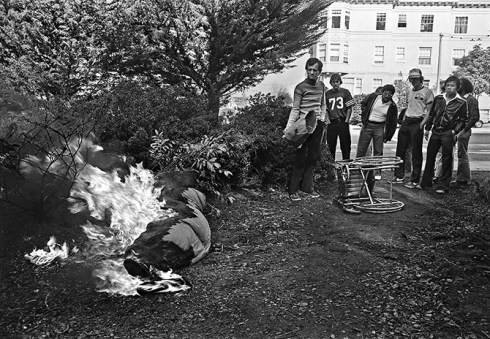
As far as I know, Michael Jang has not taken a photograph inside a prison … but he has been to many other altered sites.
My good friends Brendan Seibel (words) and Keith Axline (photos) did the real deal this week with an interview and gallery over at Raw File.
Blake followed a train of thought set up by Bryan this week about photography’s late-bloomers. Jang might have words of encouragement along the same lines. He hasn’t exactly had the typical career track; he was exhibiting at a high school seven years ago.
And photographs can change:
Put [a photo] away and let it age like a fine wine. … Some of the work I question, like the Beverly Hilton or the Jangs, if it would have been good when it first came out, or appreciated. I think maybe not. I think maybe you need to age 30 years so that we can look back on it.
Jang comes across as a man who has as few answers as the rest of us:
In the ’70s you could pick a subject: freaks, twins, brothers and sisters, and you’d be the first one to get it. Everyone’s done everything now. You’ve got dead body parts — we’ve done everything. So how do you carve out a niche for yourself now as a photographer? Is it more about the best person who can market themselves? The best schmoozer? The person who can make the connections? It’s a whole new ball game. I don’t know what I would do now.
Times were raw and opportune back then:
In the ’70s I happened to get a guy who committed suicide in Golden Gate Park. I knew I had the only pictures — I sold that stuff to the 11 o’clock news. But now it’s like, “send it to us for free” and you go, “yeah, I can get my name on there.” That kind of sucks for photographers making a living, right? It’s just so diluted now.
And, Jang’s response to the uncertainty? Keep shooting.
My daughter had friends that were in a band in high school and I said, “Oh man, can I shoot this?” and she said, “No! … Oh please? … No!” So what happened is they played the band shell in Golden Gate Park one day on a Saturday. Look, that’s fair game. They’re out in public. So I go there and I’m laying back; I don’t want to embarrass my kid. Eventually I start shooting and one kid kind of comes up and he starts talking to me and I end up telling him that I shot The Ramones. And that was it.
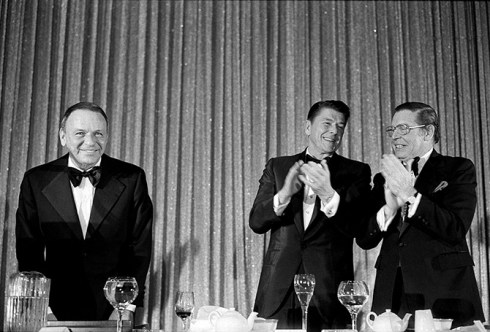
© Michael Jang
Jang also photographed around Preston, ID where Napoleon Dynamite was filmed.
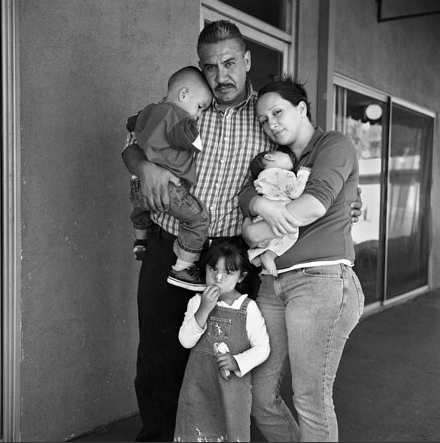
© Joseph Rodriguez. "Jorge Carbajal, 41 years old comes to Walden House for parenting classes and to help his wife Elizabeth and their kids. Here they are all together for their first family portrait in years. He quit his job with the airline KLM which had him traveling all over the world. Jorge says, "I had to help my wife who has a drug addiction problem and I did not want to see my kids wind up in the system." He is a rare individual as he was the only regular father/husband that I got to know who came regularly to meetings." Joseph Rodriguez
Joseph is featured on Lens Blog today. The audio interview he provides for the piece titled Social Worker with a Camera will blow you away. Joseph totally exposes himself. Says it all. Spend four minutes.
Reentry is the third part of a long-term trilogy. First came East Side Stories (1998) about gang life, and later Juvenile (2004) about incarceration. “Gangs on the street is an extension of prison,” said Mr. Rodriguez. Reentry looks at those trying to escape the cycle of drugs, crime and institutional abuse. Many portraits were taken at Walden House which helps families with their immediate and medium term needs.
I have mentioned Joseph’s work before here and here. I got a copy of his book Juvenile in the mail this week so expect more to come …
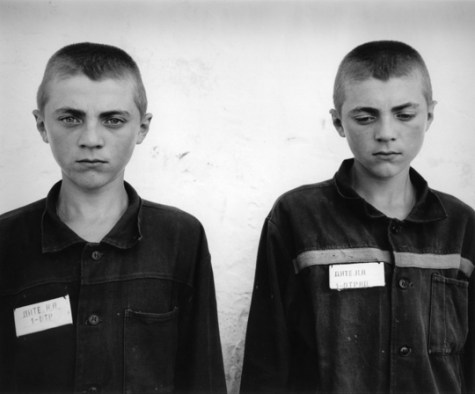
Untitled, Juvenile Prison Alexin, Russia 2003
Ingar Krauss traveled to places in the former Soviet Union, and made portraits of children the same ages, but living in state-run orphanages, juvenile prisons and camps. Many of these kids are not criminals but these “childhood institutions” are the only places society can find for them. (Jim Casper, LensCulture)
A couple of stand-out quotes from Krauss (also from LensCulture):
I recognized that I am especially interested in those children who already have a biography — orphans or criminal children. They have already a story to tell. They seem to be responsible in a way which is not childlike.
and
Looking at those pictures they seem always to ask: Why me? And in fact this is usually the first question they are asking when I am choosing from 200 orphans in an orphanage, this one or these two. And all I can answer them is that I recognized them, that I feel I know them. Not personally, of course, because I don’t know their stories the moment I decide who I would like to photograph, but in a fundamental way I think I know them.
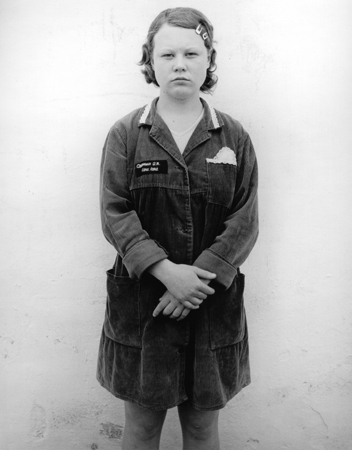
Untitled, Juvenile Prison Rjazan, Russia 2003

Untitled, Juvenile Prison Alexin, Russia 2003
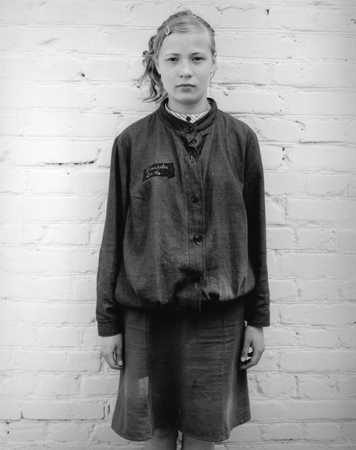
Untitled, Juvenile Prison Rjazan, Russia 2003
Ingar Krauss has also trained his lens on seasonal workers and economic migrants in Europe. His work from different series is collected in the book Ingar Krauss: Portraits.
Adam Broomberg and Oliver Chanarin
‘Unconcerned but not Indifferent’ Foto8 (March 2008)
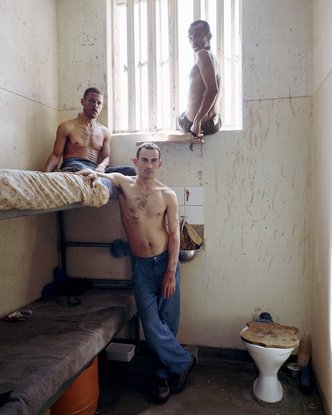
Timmy (center), with Peter (left) and Frederick, Pollsmoor Maximum Security Prison, South Africa (c-type print, 12" x 16", 2003)

Dion, 41, General in the 28s describing his imaginary uniform, Pollsmoor Maximum Security Prison, South Africa (c-type print, 12" x 16", 2003)
If two ends of the spectrum were identified this week during the debate about race and how it is (mis)treated by photographic practice we could see them as the moronic fashion world practitioners and then everybody else – “everybody else” being social documentarians, new-media image-makers, old-school bang-bang-club photographers and fine art practitioners. This second larger group is where most thoughtful folk place their energies.
Bizarrely there are a couple of guys who run the length of this spectrum. Adam Broomberg and Oliver Chanarin used to be the creative directors of Benetton’s controversial Colors Magazine AND they travel through Africa and Central America taking photographs of people in institutions.
Broomberg and Chanarin have also pissed a lot of people off. They are that good.
We all remember Steven Mayes’s departure speech from the World Press Photo, but Broomberg and Chanarin beat him to his oft-repeated remarks that photographers repeat motifs and collectively thicken the pen around photojournalism’s self-drawn caricature.
A full year prior to Mayes’ rallying call for new imagery (genuine, everyday Black culture; affluent drug use and users; and real sex), Broomberg and Chanarin were throwing punches low and hard at photojournalism’s conceit. They quoted Brecht; ‘The tremendous development of photojournalism has contributed practically nothing to the revelation of the truth about conditions in this world. On the contrary photography, in the hands of the bourgeoisie, has become a terrible weapon against the truth.’
In turn, Broomberg and Chanarin relied on Sontag and Barthes;
‘Since its inception photojournalism has traded in images of human suffering. If one of its motivations for representing tragedy has been to change the world then it has been unsuccessful. Instead the profession has turned us into voyeurs, passively consuming these images, sharing in the moment without feeling implicated or responsible for what we are seeing. Roland Barthes summed up the analgesic effect of looking at images of horror when he wrote “someone has shuddered for us; reflected for us, judged for us; the photographer has left us nothing – except a simple right of intellectual acquiescence”.’
They provide a pat description of the “obscene feeling” jury process in which there is no text, caption or context. Judgement is dependent only on the aesthetics of the image: “We are asked to judge whether, for example, a photograph of a child suffocating to death in a mudslide is sufficiently beautiful to win a prize.” After this Broomberg and Chanarin explain the means by which the panel narrowed down the 81,000 images to five winners, suggesting with some contempt that Hetherington’s Exhausted Soldier was a predictable result.
Before I go any further, I should say that Tim Hetherington voiced a stirring rebuttal to Broomberg and Chanarin’s derision.
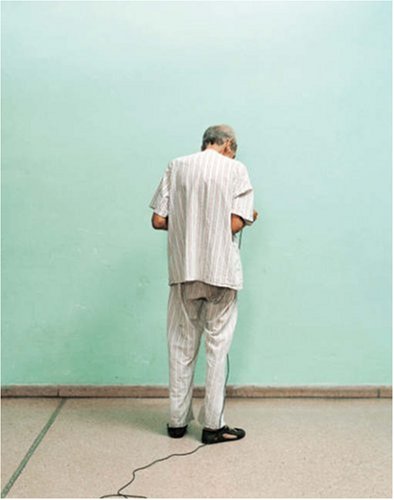
Self-Portrait by Mario, Ren Vallejo Psychiatric Hospital, Cuba. (c-type print 12" x 16", 2033)
So what? They’re a grumpy duo with a pocket full of common critical theory? Yes … and no. They go further. To my observations they apply what they preach. I have coined the term Slow Photography for this piece because they lug about a 4×5 camera and as well as standing over the top of their medium format to hold a conversation, they’ll usually stick around for a week or three.
They’ve described the relationships they build with their subjects as very important. Lucky for them they have the leisure to hang around you are saying?! Fair point, but they use their time well.
With Ghetto, they went to Pollsmoor Maximum Security Prison in South Africa and made portraits of male, female and transgendered inmates. They went to Ren Vallejo Psychiatric Hospital, Cuba also. In total they went to twelve rare communities, methodically photographing and asking the same questions: “Who is in power here? Where do you go to be alone, to make love, to be with friends? What are your hopes and dreams?”
I love that question, “Who’s in power here?”
Broomberg and Chanarin simultaneously reference old slower photo-processes and question the sped-up practices of 21st century photojournalism. Charlotte Cotton, Curator of Photographs at the V&A, has observed, “The sense of activity being slowed for the camera references nineteenth century photography both in terms of process and style. It also serves to detach their photographs from the conventions of photojournalism.”
And if we needed any more proof that these two geezers are on top of their game, lets look how they dealt with the two major conflicts of the beginning of the 21st century.
They got quiet with wartime scratches and scrawls, but have received none of the plaudits Peter Van Agtmael, Tim Hetherington, Roger Ballen or bubble chamber photography have.
The Red House documented the prison and torture center run by Saddam Hussein’s Baath party in Sulaymaniyah, Iraki Kurdistan, 330 kilometres from Baghdad.

The Red House

The Red House
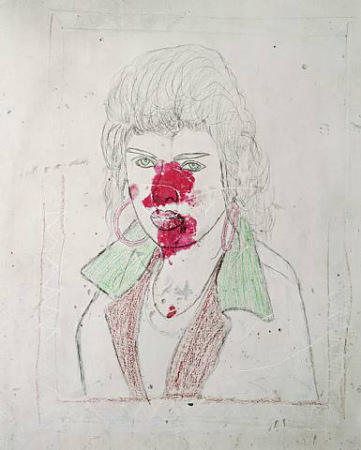
The Red House
And, then when they were “privileged” enough to merit an embedded assignment with the British military in Afghanistan they thumbed their noses at any notion of photojournalism. Instead they took 70 metres of photo sensitive paper and unrolled sections to expose it to light and that became the record of each day and their time in conflict.
Each roll was given its title based on the occurrence of an event, death or absence of death during that day. Below is the work from the day of a prison escape.

The Jail Break, June 13th 2008. 76.2 x 600cm, c-type
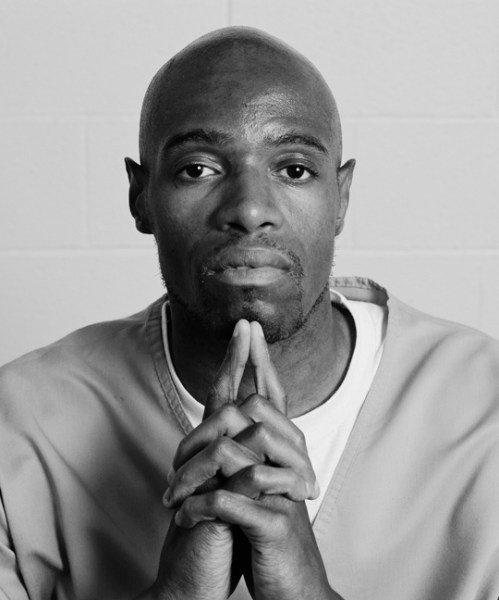
Dread Scott‘s 2004 Lockdown pairs portraits with audio statements from the prisoners. The stories intend to represent the two million-plus inmates in American prisons. Dread’s belief is that America is defined by its criminal justice system and its incarcerated masses. This is not a position I would query.
Ostensibly, Lockdown is a less confrontational work than his renowned What is the Proper Way to Display the U.S. Flag? (1988) but the strength of the polemic, from which it stems, is no less.
Dread has drawn strong support as well as well-publicised contempt for his art and politics. Even the most respected progressive voices in politics, theory and photography have paused to question the coherence of his work. Dread, I trust, would expect no less than strong reaction to his work.
Among other identifiers, Dread is an avowed Maoist. He has stated, “This is a world where a tiny handful controls the great wealth and knowledge humanity as a whole has created.” In America more than any other ‘developed’ nation this statement applies. Dread’s political statement must be taken as delivered and used as the departure point for this work.
For our interview, I wanted to focus on Dread’s efforts and successes in accessing prisons, drawing testimony and mounting the piece. And to find out why these efforts were necessary.
Q & A
PP: How many prisons/jails did you visit while making Lockdown?
DS: I visited one prison and I went to another where I was turned away at the last minute. I also worked with some youth who had been in the system, but were not locked up at the time I photographed and interviewed them. This is also true of one adult ex-con I worked with.
PP: How many portraits are in the series?
DS: There are eleven that I show. Obviously I took more, but there are eleven that are good. I also would like to expand the project but I have no plans to do this at the moment.
PP: Did you choose the sitters or did they choose you?
DS: In most cases the prison chose them and told them that a photographer wanted to do a project involving prisoners. Then once I met with them I discussed more about the project and most of them wanted to be part of it.
PP: Were there prisoners who were simply not eligible for participation in Lockdown? If so, for what reasons?
DS: I wanted to get a somewhat broad sampling of the prison population. In many respects this was achieved, but because I was unable to work on the project as extensively as I would have liked, some types of prisoners aren’t in the project. For example, I didn’t get to any women’s facilities, any jails and I was not to visit any prisoners on Death Row.
PP: Did you ever photograph a prisoner having had no prior contact or discussion?
DS: Generally this is how the project was done – I would be introduced to them and photograph them in the same day.
PP: Who controlled the length of time you had to introduce your project to, and work with, each of the sitters?
DS: Ultimately, it was the prison that controlled the hours of the visit and how many I would be allowed. But once that was set, I could spend as much or as little time with any one prisoner.

PP: How did you organize yourself and your subjects during the projects as a whole? What forms did the communication take before, during and after the sitting for the photograph?
DS: With rare exception, I wasn’t able to communicate with the prisoners before the photography/interview session. The sessions were very intensive. I generally wasn’t able to spend more than an hour with each prisoner. Often I only had about 40 minutes so the work was done quickly. I would start by discussing what I was trying to do with the project and let them know that I wasn’t working with the prison and in fact that I was a revolutionary and I felt that the whole system was worthless. Which is not what the project was about but I wanted them to know where I was coming from. If after knowing more about me and the project they wanted to participate, we would move forward.
Generally, I would then photograph them and then I would interview them, which in many ways was just a conversation. As a preface to the interview I would say something like “It’s clear that the main requirement to get into jail today is that you be poor and Black or Latino. Who is in jail? I need to learn your story and want to tell it. Many people don’t know. And those that do know, people like you and your family aren’t talking about it enough. I need the truth. What happened? How did you end up here? I want to put faces on the slaves of these prisons, which are like modern day slave ships that don’t float.” Then we did the interview. As for more communication after the session, unfortunately the prison that I was working with made this impossible. I sent photographs of all the prisoners to them and I wrote again thanking them for participating. I never heard back from anyone. What I later learned when I met one of the prisoners when he was on the outside, he said that neither he nor anyone else ever got any photo or letter from me.
PP: How do you deal with impartiality?
DS: I am not impartial. I think that this is an unjust society and has exploitation woven into it’s very fabric – a society where a tiny handful control the wealth and knowledge that humanity as a whole has created. The imprisonment of two million+ people shines a lot of light on the society as a whole. I wanted to bring to light the people that are latterly hidden from society broadly and make a work that presented portraits of these hidden people and brought of out the insights they have about the society that imprisons them. Because these people and there ideas are written out of the popular discourse in society, I think that this project can reveal a lot about the society as a whole. The prisoners express their individual views and don’t necessarily share all of mine, but through the work as a whole, an audience has the opportunity to grapple with a lot about the foundations of this society and see and meet people who have a lot to say about it.
PP: What reasons did each of the inmates have for taking part? Were their reasons opinions that you also held or had previously held?
DS: Many of the prisoners initially met me because it was a break from their daily routine. Some were intrigued by the change and chance to work with some sort of photographer. Most didn’t know much about the project prior to meeting me. But once they met me they mostly decided to participate because they wanted to have both their individual story put out in the world, but also they saw this as a chance to be part of a broader conversation about a country that imprisons over two million people. There was also a small minority who were looking for some angle to shorten their time or hoped I was a vehicle to communicate with people outside.
PP: Did you take many pictures of the same sitter? Did the inmates of each portrait have a say in which print you chose for exhibition?
DS: Yes, I generally took about 20 pictures of each person. Sometimes a few more and occasionally less. Because the prison prevented me from communicating with them, they weren’t able to have any input into the portrait that I used.

PP: James Clifford has said, “Represented voices can be powerful indices of a living people – more so even than photographs, which, however realistic and contemporary, always evoke a certain irreducible past tense.” How important to this piece are the audio tracks; the ‘represented voices’ of the inmates?
The audio is essential. It is as much part of the project as the photographs and I will not exhibit the work without the audio. One thing that I wanted to do with Lockdown is bring the faces, voices and ideas of those who are hidden behind bars in the gallery and museum setting. People throughout society need to see who is imprisoned and know what insights they have in the world. So there is an important level of the ideas. But there is also a question of voice. It is very specific and allows the audience to encounter the prisoners in a much more real and complex way.
PP: Did each inmate prepare a statement or do you edit audio in post-production from single unrehearsed dialogues?
DS: The audio is carefully edited from much longer interviews. The interviews typically were about 30-40 minutes. And the audio in the work uses about 3-6 minute excerpts.
PP: How do you describe the relationship between the collected raw data (first-hand spoken testimony; photographic documentation; a unique name/identity) and the cultural frame you set it in (gallery, public space, political statement)?
DS: The portraits and interviews form the basis for the work but the art, once it is exhibited is just that – art. The art would be inconceivable without the photos and interviews, but they have been selected & edited and assembled to be a coherent work of art.
PP: Does your artistic voice compete with the oral testimonies/voices of the men you photograph?
DS: While the testimonies of the individuals are important as an individual expressions, Lockdown is the opinionated view of its author. I am not mischaracterizing any of the individual stories, but I have put them within the overall meditation on a society that imprisons over two million people that is Lockdown. So my voice dominates on a certain level. The work is really the collective voices and photograph, not the individual stories. It is made up of individuals, but I think that the whole adds up to more than the sum of the parts. It is because of this, the way the work is structured overall, that it is not a “documentary” where one person’s story is next to their photograph and it is about all of the individuals. It is about what they, through the work as a whole, address as a group.
PP: About your work, you have said, “the continuum of history is a recurring theme in many of my works” and therefore inviting comparisons between past and present events. Do you use artistic devices, photographic or otherwise, to assist the viewers with these comparisons?
DS: Yes, but I don’t see the continuum of history as being so foregrounded in this work. Some of my projects will have a lynching paired with police brutality or an electric chair. This isn’t so much the case with this work. Though I did decide to make the portraits black and white which roots somewhat in the past and situates the theme of the work as being tied to a longer history as well as roots the project in a certain photographic tradition.
PP: Are you following a photographic tradition? If so, which elements of past photographic works inform Lockdown. If not, where then should people find their visual cues for reading the photographs?
DS: In making this work, I really appreciated Danny Lyons’ Conversations with the Dead. My project is different but it is on this continuum. Also, Avedon’s In the American West. Again, I’m doing something different. I think Avedon is exoticizing his subjects a bit, but they are really great portraits and he does reveal things about the people he shoots that many outside of the culture don’t know about. Meat packers and guys on oil rigs aren’t often part of Chelsea conversations. Also, Roy DeCarava’s influenced this work. Particularly how he respected many of the people he photographed. As the project is not just a photo project, I drew on other artistic traditions. Actually the text and image work from the 80s has informed me on works like this. I just use audio text rather than written. What I am doing is new, but it wouldn’t exist without these influences.
_______________________________________________________________
Dread Scott works in a range of media including installation, photography, screen printing, video and performance. Dread first received national attention as a student at the School of the Art Institute of Chicago. In 1989, President Bush Sr. declared his installation What is the Proper Way to Display a U.S. Flag? “disgraceful,” and the entire US Senate denounced the work when they passed legislation to “protect the flag.” As part of the popular effort opposing compulsory patriotism, he, along with three other protesters, burned flags on the steps of the US Capitol. This resulted in a Supreme Court case and a landmark decision.
In 1992, Dread was a fellow at the Whitney Independent Study Program. In 1995, he was awarded a Mid Atlantic\National Endowment for the Arts Regional Fellowship in Photography. In 2000, he participated in the Institute on the Arts and Civic Dialogue directed by Anna Deavere Smith at Harvard University. He has been awarded a Mid Atlantic/NEA Regional Fellowship in Photography, a New York Foundation for the Arts Fellowship in Sculpture (2001) and Fellowship in Performance Art/Multi-disciplinary Art (2005), and a Creative Capital Foundation grant. In 2000 he participated in the Institute on the Arts and Civic Dialogue directed by Anna Deavere Smith at Harvard University. That year he also worked on a Special Edition Fellowship at the Lower East Side Printshop.
His work has been exhibited at the Whitney Museum of American Art, the New Museum of Contemporary Art, Robert Miller Gallery in New York, Brooklyn Museum, the Aldrich Contemporary Art Museum and the DeBeyerd Center for Contemporary Art in the Netherlands. His public sculptures have been installed at Socrates Sculpture Park in Queens, New York and Franconia Sculpture Park in Minnesota.
In 2008, the Museum of Contemporary African Disporan Art in Brooklyn, NY hosted Dread Scott: Welcome to America.
This interview provides more extensive coverage of Dread Scott’s oeuvre and politics.

I just keep coming back to Edmund Clark‘s work. And his book isn’t even out yet. It doesn’t help when venerable folk like Jim Casper and Colin Pantall are spending time and energy on his efforts – most recently from Guantanamo.
(BTW, Pantall has been posing some really good questions and posting some really good photography these past few weeks.)
Anyway, upon returning to Pantall’s site I picked up this quote by Clark:
It seems to touch upon many of my frustrations with photography from Guantanamo. Many inventive photographers will find manouveurs to draw out a novel image at Camps Delta, X-Ray, Iguana and others. Of course it is worth remembering that the majority of photos coming out of Gitmo will be consumed by the masses through media served by newswire coverage relying on long lens images of faceless orange boiler suits.
Clark has widened the scope of Guantanamo imagery by following the detainees to their homes and picking up on the underwhelming details of their “free” lives. The sterility and parallels between incarceration and home are sometimes frightening.
With Pantall’s permission I reissue Clark’s words here. Pantall interviewed Clark for the British Journal of Photography. (Underlining for emphasis is mine)
My last book was called Still Life/Killing Time and was about a prison in Britain. I’m interested in the themes of confinement and entrapment. Guantanamo Bay stands out as a symbol of confinement and my imagery is about the symbolism of that confinement. The starting point was going out with detainees who had been released and seeing how they were surviving. These people had been in prison for years, had never been charged but still had this massive label of being the worst of the worst stuck on them. I was interested in what their personal spaces said about them and if they were any traces of what they had experienced in Guantanamo.
Access was very difficult but started with their lawyers and slowly progressed to the point where I could photograph their homes. Once this was done, the second part was getting into Guantanamo itself. I applied to the Pentagon and made it clear I wanted to photograph both the American Naval Base side and the prison side. It took me 6 months to get clearance and then it was another 2 months before I went. Once I was there I was fortunate enough to get paired up with Carol Rosenberg, a journalist from the Miami Herald who had been reporting on Guantanamo since it opened as a prison. She knew how to deal with the Guantanamo media team (who were new in their jobs) and how to get past their obstruction.
I spent 8 days there in total, including 4 days on the naval base. It was like so many expatriate places, more American than America itself. It was interesting to look at the schools, the shops, the restaurants. It was like a little bit of America in Cuba, with reflections both of America and of entrapment; models of old refugee camps, a shrine to the Virgin Mary where she almost seems to be imprisoned, A Ronald MacDonald statue surrounded by fencing and wire. It looks like he’s banged up.
I don’t have any images of the detainees except for one – which shows a guard reflected in the cell window. But that’s not what my work is about. There is a lot of long lens imagery of Guantanamo showing the prisoners in their orange boiler suits, but I don’t know what that’s telling me. My work is about the spaces and what they evoke and how they relate to the spaces people live in once they have been released.
The work is about memory and control and dragging the work out of Guantanamo into where people are living now. I’m doing that through the edit of the 3 different spaces I photographed: the homes, the American Naval Base and the prison. When I got back, I started to edit the pictures in sequence as a narrative, but then I began to mix them up so you’re never quite sure where you are. I juxtaposed images, put one things together so one image sets off ideas that enriches the idea of what it is both to have been in Guantanamo, but also to have that experience inside you.
There are also strange details that I’m not sure off, such as the picture of the Duress button. We were told this was in an exercise room but we think it was one of the interrogation rooms and this was a panic button for the guards. Another picture shows a row of Ensure jars with a plastic tube next to it. Ensure is an energy drink they used to force feed hunger striking prisoners and the Americans had it on display to show their ‘duty of care’.
The detainees brought home and kept the strangest of things, a red cross calendar with the days ticked off. Only the best behaved prisoners would get this because there was a strategy of total disorientation. When prisoners first arrived they had no idea of where they were, what day it was or what time it was.
Then I looked at other bits of people’s homes, especially windows because in Guantanamo they have no windows with a view. There are no views. Being released and being able to choose what to look at, to have a view, is quite a thing. Sometimes people chose not to have a view.
I’m working with Omar Deghayes on an edit of all the letters he received at Guantanamo. When people received letters, they didn’t get the original, they got photocopies or scans of every page, even blank pages, including the front and back of the envelope, each page bearing a document number and a Guantanamo stamp.

All Images © Edmund Clark

 Prison Photography