
You are currently browsing the category archive for the ‘Fine Art’ category.
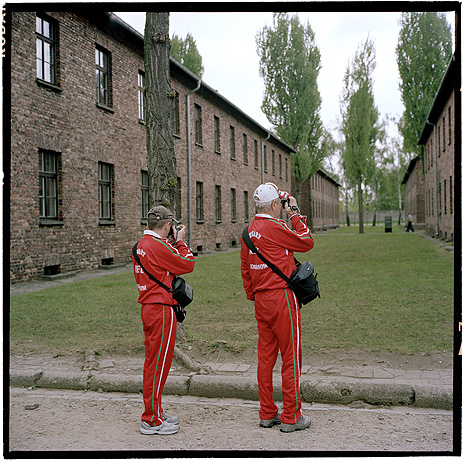
At the 2009 World Press Photo Awards, it was the work of Roger Cremers‘ tourist behaviours at Auschwitz-Birkenau that caught my eye.
In a photography climate that frequently pours cynicism and scorn on global tourism, Cremers is on tricky ground. He can thank Martin Parr for making his path a little more tricky. How do we not dismiss Cremers’ work as stating the obvious?
Cremers does not reduce his tourists to unthinking crowds. Instead, he isolates his subjects; they’re in their own thoughts, their own photo-trance and their own space. There is no throng at Auschwitz and nor is there in Cremers’ images … except for the tightly-packed shuttle bus.


Many of the prisons and concentration camps of the Third Reich have since been incorporated into the culture & heritage industry. Auschwitz receives 750,000/year and Dachau 900,000/year (Young, 1993). In the fifteen years since, one would expect figures to have risen.
Lennon & Foley’s excellent book Dark Tourism argues these sites ‘constitute attractions and they cannot simply be classified as “Genocide Monuments” since a monument in this context conveys a different meaning’. Furthermore, ‘these sites present major problems in interpretation … major problems for the language utilized in interpretation to adequately convey the horrors of the camps. Consequently, historical records and visual representation is extensively used.’


Used not only by the site curators, but created by the visitors for later return. I am not comfortable saying that visitors to Auschwitz consume in the same way tourists do at other sites. I believe the subjects of Cremers photographs are creating their own visual memories of the site AND I believe Auschwitz visitors do so with a consciously different sensibility than at other sites.
I visited Auschwitz in 2000. Words were redundant, the scale of the crime overwhelming and agog meditation my modus operandi. It would be cognizant of the average visitor – knowing they may never return to the site – and unable to muster words, to muster a few images.

Recommended: the Guardian Photo Editor’s summary of the World Press Photo Awards, 2009
Spurred by the wonderful news over at The Impossible Project that Polaroid Film is getting a second chance, I delved (via its “friends” links) into Polanoid.net. Whereupon, I found this small and particular photo-series by Lars.blumen.

Hohenschönhausen. Credit: lars.blumen
The Hohenschönhausen Memorial in Berlin is an active community/museum organization that fosters education and understanding with regards political imprisonment. The refreshingly transparent website even concedes crucial gaps in knowledge. “The history of the Berlin-Hohenschönhausen prison site has not yet been researched in sufficient detail. There is, as yet, no general overview detailing the social background of the prisoners, nor the reasons for their imprisonment, nor their length of stay. In fact, we do not even know exactly how many prisoners were kept here over the years.”
I am given the impression a precious sense of purpose & justice drives this shared project. Elsewhere on the site, their call for research is inspiring.

Hohenschönhausen. Credit: lars.blumen
The reason this set fascinated me so much was that it seemed so immediately incongruous. It is wonderful incongruity. With Polaroid one expects sanctified family portraits (60s, 70s) or blurred disco memories (80s, 90s). Polaroid of the 21st century has been largely an indulgent affair. Lars.blumen has given us a rare treat. He ‘captured’ the most infamous site of Soviet Secret Police interrogation and detention within 10 single polaroid frames.

Hohenschönhausen. Credit: lars.blumen
Lars.blumen’s project, done without fanfare nor nostalgia, uses the visual vocabulary of the past. Just to make things interesting, the prison (at he time of Polaroid) would never have been observed, nor documented, in this same manner.
The polaroids are remarkable for what they aren’t. They aren’t actual images from the era of the Stasi. And this era is that to which now all energy – as a Memorial – is focussed. The photos are a requiem for the stories and faces of the prisoners never recorded. I think this is why the Hohenschönhausen Memorial has such an emphasis on documenting oral testimony and experiences of prisoners.

Hohenschönhausen. Credit: lars.blumen
No people, no prisoners, no players in these scenes. The hardware of the site and the illusion of time passed. Understated.

Hohenschönhausen. Credit: lars.blumen
The texture reminds me of old family portraits in front of the brick of Yorkshire and Merseyside. In front of churches and on door steps.

Hohenschönhausen. Credit: lars.blumen
Outside are cameras, inside is bureaucracy. Still lured by Polaroid nostalgia, the sinister reality of the images creeps up slowly. The minimalist composition of the Frankfurt school is at use here, but Lars.blumen uses a medium that predates the movement. It’s all very disconcerting.
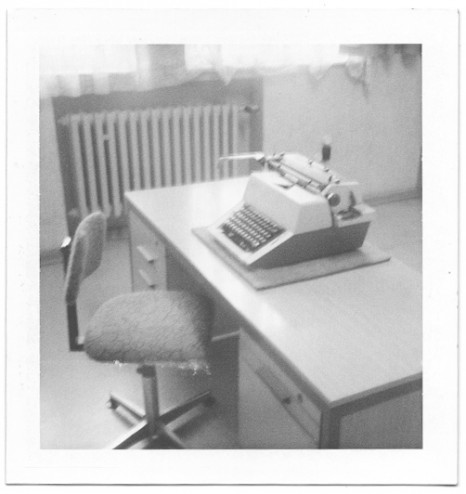
Hohenschönhausen. Credit: lars.blumen
Why do I respect these images? Because they are unique and, even to some degree, challenging. I cannot celebrate these images because of their history – they have no history. I cannot celebrate a familiar style – they are recuperations of contemporary German photography. They are idiosyncratic one-offs.

Hohenschönhausen. Credit: lars.blumen
Is it really this intentional? I wonder now if Lars.blumen just had a reel of Polaroid film to burn and that day he happened to be at the Hohenschönhausen Memorial?
If anyone cane help me with Lars.blumen’s identity I’d be grateful!
Official Blurb: The site of the main remand prison for people detained by the former East German Ministry of State Security (MfS), or ‘Stasi’, has been a Memorial since 1994 and, from 2000 on, has been an independent Foundation under public law. The Berlin state government has assigned the Foundation, without charge. The Foundation’s work is supported by an annual contribution from the Federal Government and the Berlin state government.
The Memorial’s charter specifically entrusts it with the task of researching the history of the Hohenschönhausen prison between 1945 and 1989, supplying information via exhibitions, events and publications, and encouraging a critical awareness of the methods and consequences of political persecution and suppression in the communist dictatorship. The former Stasi remand prison is also intended to provide an insight into the workings of the GDR’s political justice system.
Since the vast majority of the buildings, equipment and furniture and fittings have survived intact, the Memorial provides a very authentic picture of prison conditions in the GDR. The Memorial’s location in Germany’s capital city makes it the key site in Germany for victims of communist tyranny.
One last thing. May I recommend you spend time with the lovingly assembled staff portrait gallery at the Impossible Project.
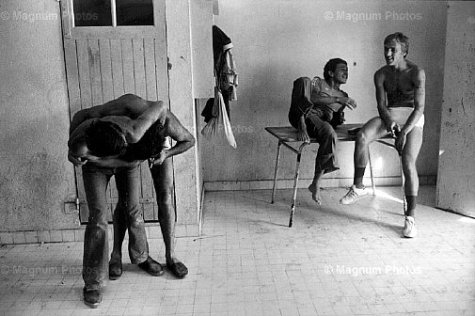
Jean Gaumy, Prisoners' horseplay. St Martin de Ré. Prison. France. 1978
Preamble: Jean Gaumy puts the fear of God into me. As an art historian, I am supposed to know how to describe and relate his ouevre. Quite honestly, the thought of discussing his work paralyses me. He embodies almost all attributes I respect in fine artists. What words build on his thoughtful photography?
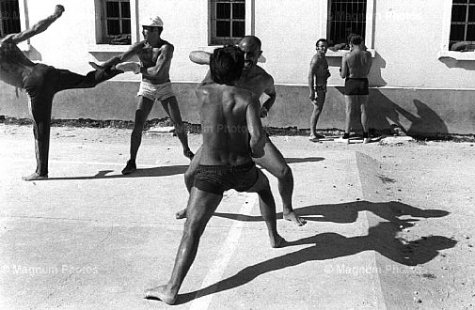
Jean Gaumy. Sports training of prisonners in the walking court. St-Martin-de-Ré. La Citadelle. Prison. 1976
Gaumy’s intellectual curiosity in his subjects – which translates as respect – was an atypical regard for prisoners during the 70s. At that time, he was one of the few photographers paying attention to criminal justice systems. He was the first photojournalist allowed inside French prisons. Les Incarcérés established Gaumy’s reputation as a thoughtful artist who revealed to society its lesser known undertakings.
Sure enough, Danny Lyon was working in Huntsville, Texas in the early 70’s but he was an inheritor of civil rights awareness and his project Conversations with the Dead has always been discussed in political terms first. Perhaps it is an unfair comparison of two great artists working in two different penal systems; perhaps it was easier for Gaumy in France to be neutral and curious. Gaumy operated without the spectre of racism and violence as existed in the South, in Texas and on death row.
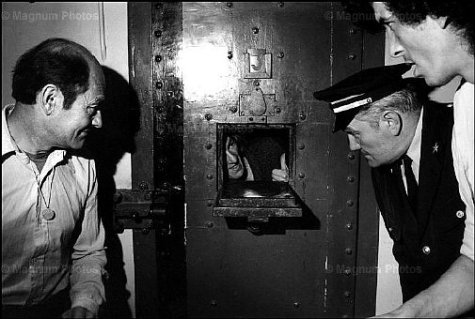
Jean Gaumy. Seine-Maritime. Rouen. Prison. France. 1979. Cell-door grating: the old system for serving meals and delivering mail to convicts.
The impression that Gaumy actually cares for his subjects may be a confusion with the possibility he just understood them. A great many of his pictures are so unique (and one presumes a long-time-making) it can be said without doubt he knew his subjects. They knew him well enough to either ignore the camera or look directly at it to communicate clear messages. Let me explain: when a camera first enters an environment it steals the attention and comfort of most subjects. At this point a great many images are of subjects reacting directly to the camera’s novel presence, and of subjects calculating the nature of their relationship to the camera and operator. For this to pass the camera must be around long enough for it to ‘become invisible’. Thereafter, when the subject addresses the camera directly, it is purposeful – with a message – a not as a reflex reaction.
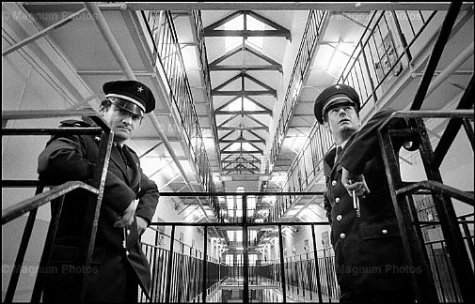
Jean Gaumy, Maison d'arrêt. Caen, France, 1976. Surveillance in the Passageway.
His work is that which enriches the viewer the longer they spend with it. These are not platitudes. Over the course of several years, with craftsmanlike rigour and repeated visits to many institutions, Gaumy pieced together a body of work (ultimately for his 1983 book, Les Incarcérés) that held a mirror to the multitude of attitudes and realities of prison life.

Jean Gaumy. Convict in his Cell, St-Martin-de-Ré. La Citadelle. Prison. 1976
Rather than taking a position or preferring the stories of one group over another Gaumy flits about the different prisons and – through (as I suspect) thorough editing – presents prisons as predictable places that are occasionally enlivened by quirks of human behaviour. Gaumy’s photography shows the machismo of a minority of inmates only after it has shown the solitude of some, the collective boredom of others, the routine awareness of guards and the bureaucratic tasks of the prison itself. There are no stereotypes in Gaumy’s work, and there a very few visual clichés.

Jean Gaumy, St-Martin-de-Ré. Prison. La Citadelle. France. 1976. Administrative procedure for the release of a prisoner.
Gaumy’s craft is the manner in which he casts an even hand over all objects and subjects. His studies of guards at their most relaxed and animated are as interesting as that of the lounging inmate reading his paper (as if a photographer stands in his cell every day). Well perhaps Gaumy did stand in his cell every day … for a period. Such is the familiarity of Gaumy’s portraits some could be mistaken for subjects in their own houses. Now is this Gaumy’s fabrication, or were the institutions of St. Martin-de-Ré; Maison d’arrêt, Caen; Seine-Maritime, Rouen; Ile-de-France, Seine-et-Marne, Melun; and the Calvados, Basse Normandie really as calm as he depicts? There is no violence, barely even tension among the inmate or guard populations.

Jean Gaumy. Transit lock chamber between the walking courts and the cells. St-Martin-de-Ré. Prison. La Citadelle. 1976

Jean Gaumy. Tattooed Prisoner. 1978. Charente Maritime region. Poitou Charentes department. Village of Saint Martin de Ré. La Citadelle. Prison. Saint-Martin de Ré was the departure point for prisoners who were sent to the Cayenne prison in French Guyana. The last shipment of convicts was in 1938.
The only suggestions of violence power Gaumy portrays are the immediate exertions of the weightlifter and, alternatively, the viewers semantically-derived understanding of violence as exhibited in tattoos.
Gaumy makes four individual studies of tattoos. It is hard to comprehend whether Gaumy was original in this. Today we are saturated with images of the tattoo, to the extent that street graffiti, body art and gallery hangings are one and the same; not a year passes without a photojournalist embedding themselves among gangs (either within or without prison) to study the pervasiveness of ink and brevity. Maybe I am biased, but I like to think of Gaumy’s interest in the tattoos of social transgressors, as an artist pioneering a genre in its infancy.
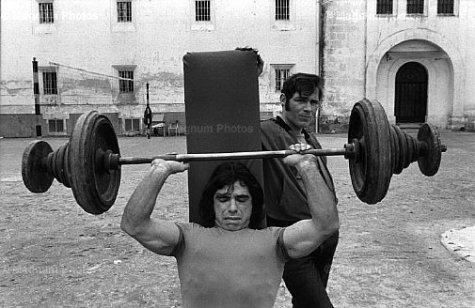
Jean Gaumy. Sports training of prisonners in the walking court. City of Caen. Prison. 1976.

Jean Gaumy. Coming on watch of warders' team. Ile-de-France. Seine-et-Marne. Melun. Prison. 1978
Gaumy kept adding the layers. Unwilling to present only the palatable human side – and seemingly unable to present the darker side of prison life – Gaumy changed his viewpoint. At times his lens was that of a fine artist concerned with shadow and form, at others his eye was that of a faux-Precisionist prompted by the reductive lines of prison architecture. Only Gaumy’s work differed from Charles Sheeler’s et al because of the presence of people – ants; dots; inhabitants. Gaumy’s work, inclusive of crowds, repeats the affections of Lowry. Gaumy’s act of recording is a testament to the physical imprisonment of these French men as Lowry’s was a testament to the social imprisonment of Salford’s working class.

A Street Scene in Clitheroe, L.S. Lowry.
As I write, another (probably meaningless) similarity between the two men springs to mind. Lowry was always drawn to the sea, particularly England’s Northeast coast and the North Sea. He returned to it into his old age. Gaumy late in his career has grappled with the enormity of the oceans. I could hypothesise both artist’s careful handling of mankind derives from an ever-present haunting of that which is larger than mankind. To appreciate the awesome scale of the sea is to wonder at the fragility of man. Ask a surfer … or a fisherman.
Gaumy also manages to reconcile – If one presumes them at opposite ends of the same spectrum – the human scale and the systemic scale of prisons. Couldn’t the three pictures below be by that of a different hand, and yet don’t they make perfect sense grouped together?

Jean Gaumy. "Bonne Nouvelle" prison ("Good news" prison). 2nd section. Walking court. Seine-Maritime. Rouen. Prison. 1979
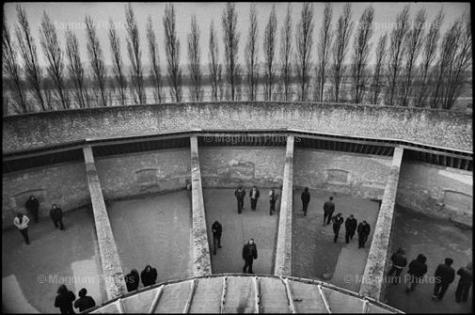
Jean Gaumy. Walking Courts, Caen. Maison d'arrêt. 1976

Jean Gaumy. "Bonne Nouvelle" prison ("Good news" prison). 2nd section. Walking court. Seine-Maritime. Rouen. Prison. 1979
Gaumy got close in and later retreated right back. Even if this is considered a privilege of a photographer with free passage through the walls of a prison, it does not guarantee good execution. My favourite image is the church service attended by a congregation of boxed men. Gaumy lays bare the crude and incongruous use of discipline and religion, and in doing mocks the scene. The viewer can’t fail but be in agreement with Gaumy; the interaction is absurd and directly contradicts the extraordinary ordinariness of Gaumy’s other scenes.

Jean Gaumy Mass in the chapel. The prisoners are isolated in individual compartments. Caen. Maison d'arrêt. 1976
Gaumy, it seems, didn’t want to extricate himself from the action, nor from the space and time spent on the series. Unwilling to let himself nor the craft of photography off the hook, Gaumy includes three studies of the anthropometric photography room. This is not a Surrealist maneouver, but it does point toward the Postmodernist insistence that the practitioner is an inevitable part of the work. Gaumy never intended to be an objective viewer but rather an active participant (he only ever took photographs with the prisoners consent) and the images below are an open admission of photography’s classifying, even disciplining, function. The camera … the metre-rule … the artificial light … the document … the knowledge … the authority.

Jean Gaumy. Anthropometric photography of a convict at his arrival in prison. Basse Normandie. Calvados. Caen. Prison. 1976

Jean Gaumy. Anthropometric photography of a convict at his arrival in prison. Basse Normandie. Calvados. Caen. Prison. 1976
Without doubt, Gaumy was fortunate to have a wild-haired caricature sitting for this particular anthropometric observation. The docile subject is the perfect compliment to the act of observation and documentation. The treatment of this prisoner is akin to expedition-photography that attempted to measure the anatomical dimensions of colonised peoples and thus provide scientific evidence for Western genetic superiority. This appreciation is the perfect close to a series throughout which Gaumy balances his artistic aims, social purpose, photography’s interferences and the loaded history of Modern taxonomic praxis. Gaumy dismantles assumed norms and hierarchies of social order and allows the viewer to meditate on the subtleties of carceral systems.
I escaped my paralysis, jolted by the news that last week Jean Gaumy was awarded the Peintre de la Marine (Painter of the Fleet) by the French Ministry of Defence. Gaumy is only the fifth photographer to join the select circle, which is composed of only 40 members.
For a full biography and portfolio please visit the pages of Magnum Photo Agency.
The folkology (keyword tags) within the Magnum archive are inconsistent. Different sets of Gaumy’s images turn up for different searches. Here is another isolated set for St-Martin-de-Ré. La Citadelle also from 1976. I would encourage readers to search at length Gaumy’s work throughout the different institutions with permutations on keyword searches.
Chris Jordan was low on my list of priorities but this timely post by Mike Kelley at Change.org (a blog as impressive for its readers’ comments as it is for the straight forward presentation of Jordan’s work) compelled me to bump it up and champion the depressingly and unfathomable figures that arise when one simply runs the numbers.

Chris Jordan. Prison Uniforms, 2007. 10x23 feet in six vertical panels. Depicts 2.3 million folded prison uniforms, equal to the number of Americans incarcerated in 2005. The U.S. has the largest prison population of any country in the world.
In reading Change.org’s straight forward commentary on America’s broken criminal justice system, I signed up for Change.org and read a few of their older posts. In doing so I was presented with the catalyst to comment on Obama’s momentous inauguration without repeating the media-lovefest that has surrounded the 44th’s swearing in. This post will cover Jordan’s astounding artwork, Obama’s astounding tasks-at-hand and where they politically overlap.

Chris Jordan. Prison Uniforms, 2007. Partial zoom.
Chris Jordan has spent his time making larger and larger photographic constructions to communicate the scale at which American society wastes its resources, its environmental future and its grasp on logic. In his effort to catalogue the linear and thoughtless waste of the US, he has progressed from crushed automobiles, to cell phone chargers, to polystyrene cups to American prisoners.
Jordan is a bright guy, now consumed by his photography (which to be quite frank is eco-hip and brilliantly executed). He talks passionately about a sea-change in our cultural consumption. He specialises in highlighting “the behaviours that we all engage in unconsciously on a collective level … the actions we are in denial about and the ones that operate below our daily awareness … like when you’re mean to you wife because you’re mad about something else or when you drink too much at a party because you’re nervous.” Jordan is no prophet, he just sees the necessary u-turn we must all make in our habits and thoughts to move toward sustainable existence.

Chris Jordan. Prison Uniforms, 2007. 10x23 feet in six vertical panels. Detail at half actual size.
I like to think the strength of Jordan’s visual framework that deals with soda cans to the landfill as it does with prisoners to the cell blocks is deliberate. As hard as it is to acknowledge, the majority of Americans have turned their back on a seven-figure-minority as if it were worth no more thought than discarded packaging. Mass imprisonment is the result of widespread apathy, denial and unpinnable responsibility. How unconscionable is this situation? We are all responsible. Barack Obama talked very little about criminal justice and prison policy during his electioneering. This is not surprising as helping the invisible incarcerated masses is on the electorate’s mind as much as the whereabouts of their last twinkie wrapper. But, Obama also made it very clear that this was the time for personal responsibility and accountability.
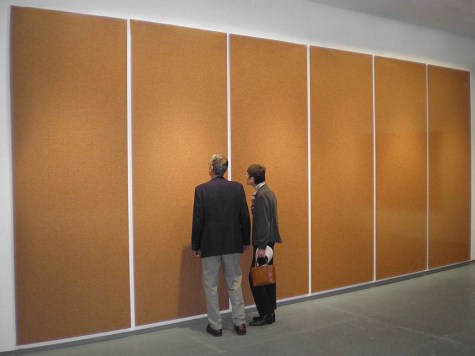
Chris Jordan. Prison Uniforms, 2007. Installed at the Von Lintel Gallery, NY, June 2007.
So after a week of photography gallery after gallery, the militarised eye vs. the personal touch, Gigapan-assisted user-generated snooping, faux controversy, minor mishaps, cult worship, sentimental clap-trap, unending debate, media catfights, nerdcore details, celeb fluff and even UFO’s isn’t it time we adopt the same realism that Obama trusted in for his inaugural speech?
A wonderful article from the Wall Street Journal lays out the realism and “the audacity of hope behind bars”. (Via Change.org). Angola prisoner, Mr. Dennis served up some REALISM: “He’s got his hands full: Two wars, the economy is going in the tank and the health-care costs are skyrocketing – I’d be surprised if he has time to brush his teeth in the next four years.” While another prisoner took care of the HOPE: “If the men here can have hope, then why can’t the rest of the country?”
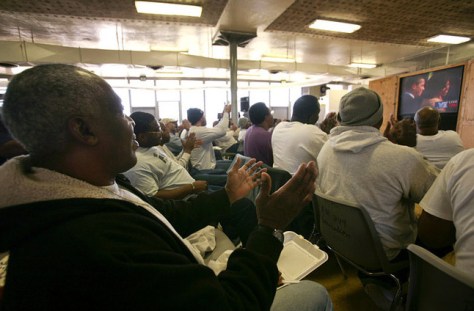
Prisoners at Louisiana State Penitentiary ("Angola") were given the day off to watch Barack Obama inaugurated as America's 44th president.
So how does this all connect? Jordan and Obama share the same call to think, with serious intent, about the things invisible to us. Both call us to consider the reality of our society and accept our shared responsibility for its faults, weaknesses and injustices. Both men challenge conventional wisdom; the logic that just because we didn’t turn the key nor bring down the gavel, we are not complicit – by our silence – in America’s mass incarceration.
What can you do? You can start by signing this petition immediately and by using web2.0 to access Obama’s administration as his team reached you during the election.
If you’d like to know more about Chris Jordan you could do worse than starting with this interview, this interview and this interview.
Update: Prison Photography collated a Directory of Photographic & Visual Resources for Guantanamo in May 2009.
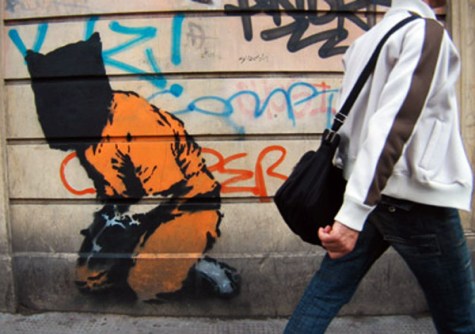
Guantanamo Prisoner, Political Graffiti. Banksy
Anyone who says the recent media tour of Guantanamo isn’t a public relations exercise by the lame duck has not had their eyes open. Global media were given a tour of camps 4, 5 and 6 at Gitmo and all the footage was screened and vetted before release.
Video: Here is the Guardian’s three minute offering. With any hope Obama will put this illegal operation out of action in 2009.
Artistic legacy of Guantanamo

Guantanamo Protesters outside the US Embassy, London
Meanwhile, we can think of the potency that the orange jump-suit has gained. It’s another icon of the Bush presidency. With regard it’s establishment and its bare-faced operations, Guantanamo was far outside of the public’s imagination. Our culture stomached the guilt and under the Bush administration it was never likely Guantanamo prison would be brought back into line with international law. Activist and non-activist art protested Guantanamo by subverting the camp’s own visual vocabulary.

UHC Collective. "This is Camp X-Ray". Art Installation, Manchester, 2003. Guards with replica guns were on duty 24 hrs and followed a regime copied from media reports.
Back on my home turf in Manchester, UHC, a notoriously bold and inventive art collective, scaled up a version of Camp X-Ray on an unused lot in Withington. It was complete with guard towers, fake guns and orders and activity that replicated the media’s reports of Guantanamo, Cuba. See other UHC Projects here, and read the BBC report here.

Road to Guantanamo (2006). A Michael Winterbottom Film, Spanish Release
And while we are not focusing entirely on photography, slightly off topic with video, I cannot recommend Road to Guantanamo highly enough. The film tells the ridiculous story of three young British-Pakistanis who were in the wrong place at the wrong time (southern Afghanistan, November 2003), and ended up in Guantanamo for 2 years. Your jaw will not leave the floor.
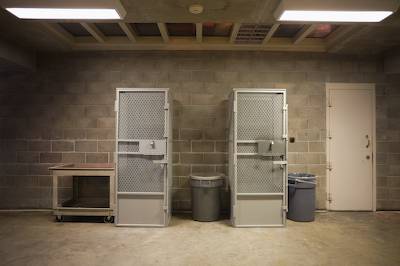
Holding cells, general population area, Security Housing Unit, Pelican Bay State Prison, Crescent City, California. Richard Ross
In this response to Richard Ross’ Architecture of Authority I’d like to discuss two pictures – the first, Interview room, Abu Ghraib prison (“hard site”), Abu Ghraib, Iraq and the second, the Detainee housing unit, Camp Remembrance, new Abu Ghraib Prison, Iraq.
There is rich discussion to be had with Richard Ross’ Architecture of Authority. Political footings jockey with ethical inertia, jockey with instructional histories, jockey with considerations of the soul. Readings thick and fast. No less, these meta-narratives are deformed by one’s own emotional interruptions. One recollects perhaps passages and interrogations through border controls, transport hubs, reception rooms and state corridors. One recalls school, streets and flaking paint.
Random knowledge bombards the equation, – Raves at Ansthruther’s decommissioned nuclear command centre during university days; A deliberate detour made during honeymoon to locate Pelican Bay maximum security prison; An introduction at San Francisco International.
My good friend, and Hesitating co-conspirator, Keith Axline recently featured Richard Ross in a Wired gallery. Keith explained to me that it is Ross’ ability to rattle shutter and catch the necessary shot every time that impressed him most. Ross’ manipulations are in spite of the unpredictable (and sometimes unexpected) access to the different sites. Ross prevails with perseverance; “No never really means no;” and aggressive networking (Ross’ chances of accessing Abu Ghraib depending largely on the trust and recommendations of military personnel he liaised with for his Guantanamo work).
Ross gets the shot he needs, even when he has only a limited number of exposures, and a limited amount of time. More surprising, Ross achieves this with almost perfect tonal harmony throughout the collection of prints. This said, Ross’ technical prowess is not my concern here, rather the gaps and routes between the images he has assembled. Ross consistently presents isolation, the viewer consistently seeks human incidence.
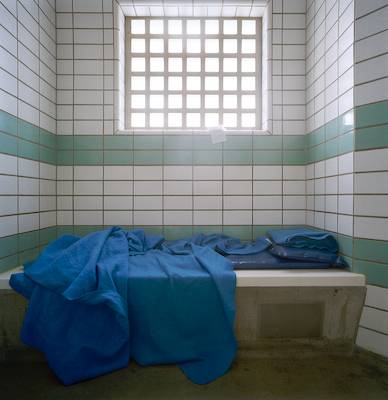
Holding cells, Metropolitan Police, Collingwood Road, Hillingdon, London. Richard Ross
One is compelled when looking at Richard Ross’ starkly depicted environments to search out the signs of life. On a few occasions one is rewarded, a curious tourist looks back at us from atop Syria’s Craq de Chevalier Crusader Fort; a heart shaped paperweight and polystyrene cup sit on the judge’s bench in Santa Barbara’s superior court; an open bag, that will travel home with its owner, sits at the foot of a movie executive’s desk. The loose blanket left in the cell at Hillingdon Road Jail presses us to fleetingly wonder if the person who unfolded and used the blanket in the cell earlier, will be back in the cell later, possibly to use the blanket once more.
The praying figure in Istanbul’s Blue mosque is representative of the building’s purpose. He is a motif of religious expression. The security guard at Topkapi is frozen rigid behind the glass, which serves to separate him from the viewer and present him as a part of the larger observing machinery. How different the shot would be if the guard stared straight down the camera lens? I imagine Ross made a few exposures in which the man did face the camera, but Ross prefers to keep attention on the environment. It is temperate and logical for Ross to choose an image in which the guard looks like a wax model – like a construction.
The austerity of The Architecture of Authority as a collection is hard to deal with. The geographical and institutional reach of the project is impressive. Inconceivably, across this wide subject matter Ross seems to have control in all the locations. Ross distills the form of each site and presents that bare form as the key to understanding the sites function.

Segregation Cells, Camp Remembrance, new Abu Ghraib prison, Abu Ghraib, Iraq. Richard Ross
To my mind, Ross has control in all the locations bar two. The old Abu Ghraib “Hardsite” and the new Abu Ghraib prison. In both forms, Abu Ghraib was a site of photographic desperation for Ross – he was forced briefly to compromise the overall tonality of his project.
The interrogation room is disordered. This room was not designed for interrogation purposes by the American military. It has inconvenient features such as two windows (one barred and boarded), an electrical box, a dusty fire extinguisher, exposed wires, a fallen map, makeshift furniture and used soda cans. There is also a plugged-in laptop, unidentified hold-all bags and what appear to be loose wire on the floor. There is a can or tub of something half-concealed behind the nearest chair. It seems to get more ridiculous the closer you look. There are two camp beds, one folded against the wall with a bag of belongings at the foot. What filled the bookcase? Why did Ross’ guides show him here? Is this an interrogation room? It looks like a sparse room for visiting guests. Is every room at the old Abu Ghraib, de facto, an interrogation room?

Interview room, Abu Ghraib prison ("hard site"), Abu Ghraib, Iraq. Richard Ross
There has been much made of the juxtapositions between photos presented in the Architecture of Authority book and exhibitions; between schools and prisons; between barracks and mental asylums. It is Ross’ right and responsibility to guide his audience in ways of seeing. But there is enough information, memory and rituals of communication embedded in any of Ross’ individual images to warrant singular assessment.
Humans in Ross’ pictures never threatens to steal attention for very long. The narrative of the building or structure dominates the narrative of the individual. There are moments when Ross’ photographs effortlessly adopt the surveillance philosophies of each object – bank, London tube station, hotel phone booths, or the confessional. This is part the photographers skill but also the unavoidable disclosure upon sight of the modes of each disciplining, single-purpose site.
Some sites are more difficult to read than others. Ross was in new Abu Ghraib as a guest, he had a guide. The fact he included a second image counter to his over all vision reveals, not unsurprisingly, that Ross would take what he could get from his tour of new Abu Ghraib, also.
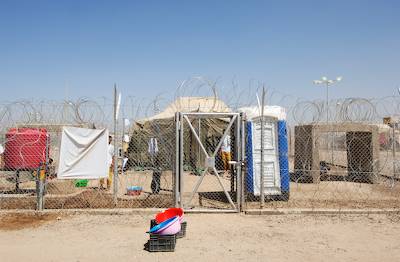
Detainee housing unit, Camp Remembrance, new Abu Ghraib prison, Abu Ghraib, Iraq. Richard Ross
Detainee housing unit, Camp Remembrance, new Abu Ghraib prison, Abu Ghraib, Iraq is a fierce image. It is at first glance still and linear but under a paper-thin surface it is simmering with tension. There are four detainees in this image. In Ross’ depopulated world, that is akin to a cacophonous arena crowd. The two clearly visible men are curiously peering at Ross’ activities and make a mockery of Ross’ attempt to mimic the prison’s personless eye of surveillance. A third man sits in the shade to the right of the image reading and otherwise oblivious. A fourth man sits on the left side of the image obscured by a water tank.
The sheepish glance of one detainee and the craned neck of the other come to dominate this image the longer one looks at it. The man at the door of the tent has no shoes on. Has he just emerged in response to the photographer’s presence? These two men brilliantly illuminate the unnatural and inflexible relationships that exist across and through chain link and barbed wire. They are merely curious at this point and do not gesture or ask anything of Ross, at least not in this exposure. They have been briefly distracted from house-keeping routines by another human that is as foreign to them as any other. Proximity means nothing here for Ross and his inadvertent subjects.
The most remarkable thing about Detainee housing unit, Camp Remembrance, new Abu Ghraib prison, Abu Ghraib, Iraq is not the clarity with which Ross communicates the apparatus of power, but rather how that drains human interaction of meaning or purpose. Does this mean I’d like to see more people in Ross’ photography? Absolutely not, there are plenty of documentary photographers who are trying to convey the spectrum of human existence, and it is not Ross’ charge. It just means that upon the appearance of non-typical images the audience’s attention is gripped. The two anomalous images from Abu Ghraib draw to attention Ross’ otherwise effortless manipulation of his audience. Ross shapes and prepares his viewer for a cold interaction. His manipulation of the audience’s eye is fitting for a project that studies dominance over subjects and imposed order of authorities.
Further investigation: Good text interview. Better audio interview. Best video presentations
When intellectual withdrawal sets in, I stem the tide and sate the need at a handful of reliable dispensaries. It would seem that two weeks ago, three of my favourite cartophiles (not a word) jumped on the same bandwagon boat. The boldest at-sea-heist of the modern era had just taken place, and it seemed the misfortunes and misadventures on petrochemical distribution routes were top of everyone’s agenda. Spurred by a AP photo in the New York Times (below), the indubitable Brian Finoki focused on the inseparable threads of the pirate clique, theorising that without their vessel, the posse of pirates had only each other to stay afloat in the hard concrete prison yards of Mombasa.

Eight Somali pirates sat at the Kenya Ports Authority Port Police station in Mombasa, where they are being held after being handed over to the Kenyan authorities by the Royal Navy. The eight pirates were arrested, and three others killed, by sailors of HMS Cumberland, as they attempted to hijack a cargo ship off the Horn of Africa. The pirates will be charged in a Mombasa court. Credit: AP
BLDGBLOG was twisting its melon, highlighting improv google map action along with the official sounds coming out of the International Maritime Bureau and its Live Piracy Report. Meanwhile, InfraNet Lab could only conclude that piracy was the opportunist’s career of choice given the current absence of government in Somalia.
I need my own bent on this and so refer you to Jehad Nga‘s phenomenal Pirates Inc. Somalia photo essay depicting pirates under lock and key in Boosaaso Jail & Mandhera Prison, Somalia. Nga is no slouch – he has (largely self-funded) returned to Somalia repeatedly over the past three years. It is incredibly dangerous to work within Somalia. It is more dangerous, in some regards, than in Iraq or Afghanistan where journalists can rely on isolated cordoned-safe-green-military zones and when at large, can work embedded with Western forces. But Nga is no stranger to Iraq either; as foto8 reminds us, “Nga has worked widely in Iraq on assignment for the New York Times. His image of blindfolded Iraqi prisoners arrested by US forces was used as the main publicity shot for the Oscar-winning documentary, Taxi to the Dark Side“.

Pirates imprisoned in Boosaaso's main jail. Photo: Jehad Nga for The New York Times
I would like Nga’s images and words to represent themselves. Words: here’s an indepth interview, from September 2008, with Nga about the situation in Somalia. Images: I have accompanied Nga’s (dare I say it) Carravagioesque prints with his own website commentary about the project:
Nga: Looking over that Somaliland naval map I noticed that the Gulf of Aden (the narrow band of ocean that separates Somalia and Yemen) and the Somali cost line were littered with upward of 100 little skull and cross bone flags. Black flags to denote ships that were successfully taken by pirates and gray for ships that were attacked by pirates but managed to escape. Most of these flags are black.

(Clockwise from Top Left) Mohamed Mahamoud Mohamed; Abdi Rashid Ismael Abdullahi; Farah Ismael Eid; and Abdullahi Mahamoud Mohamed, are each serving 15 years for a piracy conviction. "Believe me, a lot of our money has gone straight into the government's pockets," Farah Ismael Eid said. His pirate team typically divvied up the loot this way: 20 percent for their bosses, 20 percent for future missions, 20 percent for the gunmen on the ship, and 20 percent for government officials. Photo: Jehad Nga for The New York Times
Housed in the Mandhera Prison in Somaliland are 719 inmates 5 of whom are serving 15 yrs sentences handed down to them for their involvement in Somalia’s thriving pirate industry.

Photo: Jehad Nga
The autonomous region of Somaliland is doing their part to combat the growing influx of pirates in the gulf and coastal areas. Utilizing the small fleet of gunboats and navy personnel, they patrol their waters and on occasion escorts’ ships coming in from Yemen. Somalia, in stark contrast to Somaliland, still suffers from the turmoil that has put the country on the map for many people for the last 17 yrs, when the country made a dramatic turn from relative stability to brutal civil war in 1991.

Prisoners. Photo: Jehad Nga
Pensive and quiet the 5 men sat surrounded by prison guards and told their stories of how and why, before one by one they were ushered away and led back to their various cells shared amongst the general population of criminals in the eight block prison set miles out into the arid desert.
In recent months the port town of Boosaaso has also made a name for itself as the kidnap capital of Africa. Previously known best for being the main hub for human smuggling for Somalis eager to flee to nearby Yemen and usually coasting them their lives. With piracy on the rise and stakes getting higher, it is rumored that the money trails lead to some top government officials in the area – due to the large sums of money pirates now demand in return for a seized vessel.

Inside the Prison. Photo: Jehad Nga
Traveling through Boosaaso it is necessary and commonplace to hire a security details consisting upward of 10 local militia to be a deterrent for anyone hoping to cash in on captured a western journalist that, in the past year, has proven to fetch a good price. Maneuvering through Boosaaso we traveled with our rented army toward Boosaaso‘s main jail where currently 100 captured pirates sit out their long sentences or await trial.
In Boosaaso, if the kidnappers don’t find you the extreme heat always finds a way. In an open and shadeless courtyard, two facing jail blocks contain hundreds of prisoners literally caged to bake in the sun. The heat so heavy against your back. It was not only the hope of better pictures that tempted me to enter these filthy concrete boxes, but also escape from the looming mid day sun heavy over head.
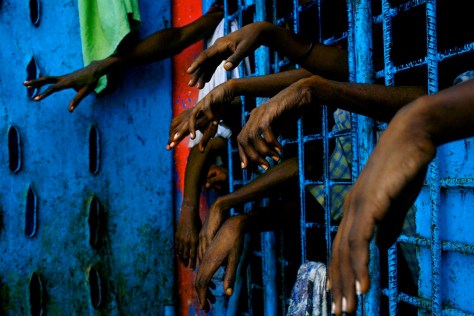
"Pirates, pirates, pirates," said Gure Ahmed, a Canadian-Somali inmate of the jail. "This jail is full of pirates. This whole city is pirates." Photo: Jehad Nga for The New York Times
As I approached the iron bars of the blocks movement is heard and then and as came closer murmurs grew into rumbles and further until the deafening sounds of hundreds of inmates came crashing against me like a wave of anger and despair. [They] stretched their arms through the bars inviting us to listen to their stories of how they were dying in this place. Of how each of them was suffering from one disease or another.

Inmates of Boosaaso Jail. Photo: Jehad Nga
Beyond the out reached hands just eyes and parts of their faces could be made out inside the lightless rooms. Figures moving in and out of the small amount of light streaming in from the between the blue painted bars.
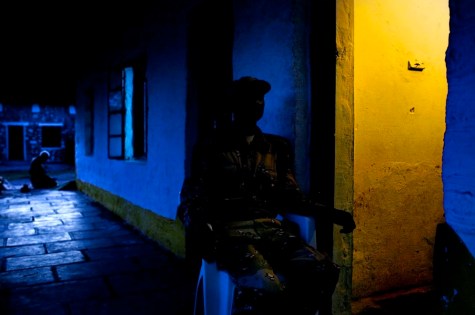
A prison guard inside Mandhera Prison. Photo: Jehad Nga for The New York Times
As pirates are proud of their catch so are the guards of these jails. They know that their numbers will remain consistent as long as Pirate season persists in the Somali waters. No slow down is the trend in expected as little international help has been organized, and with numbers of active pirates in these waters continuing to grow even that help seems, in some ways, futile.
View Jehad Nga’s other work at his website
View his New York Times photo essay here
Read an interview with a pirate here
Herman Krieger – stalwart of the Oregon photography community and Eugene resident – is a self-made specialist in the art of captioning. However, more than his quirky words, I appreciate the great lengths he goes to in order to document sites of the prison industrial complex.

View from Boise Gun Club, New Idaho State Prison. Herman Krieger
Krieger described the circumstances of the series, “The idea of making a photo essay on prisons and their settings came after driving from Tucson to Phoenix. The view of the prison in Florence, Arizona struck me as an odd thing in the middle of the landscape. At that time I was only looking at churches for the series, Churches ad hoc“.

With Lifetime Mortgage, Vacaville, California. Herman Krieger
“I then made some photos of prisons in Oregon and California. Others were made during a trip by car from Oregon to New York. I would have made a longer series, but I was too often hassled by prison guards who noticed me pointing a camera at a prison. They claimed that it was illegal to take a photo of the public building from a public road, and threatened to confiscate my film”, explained Krieger.

Room Without a View, Pelican Bay, California. Herman Krieger
Pelican Bay was opened in 1989 and constructed purposefully to hold the most violent offenders, usually gang members. Along with Corcoran State Prison, in the late 1980s, Pelican Bay ushered in a new era of Supermax facilities in California. They are remote (Pelican Bay is just miles from the Oregon border) and they are expansive. Their distant locations prohibit regular visits from inmates’ family members – a detail probably not lost on the CDCR authorities who sought to transfer, contain and stifle the aggressions of Californian urban areas.
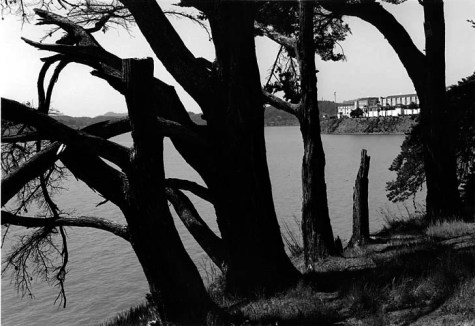
Bayside View, San Quentin, California. Herman Krieger
Having lived in San Francisco for three years, the policies, activities, controversies and executions at San Quentin State Prison were always well reported in the Bay Area press. One of the most frustrating repetitions of the San Quentin coverage was the journalist’s compulsion – regardless of the story – to remind readers of the huge land value of San Quentin and the opportunities for real estate on San Quentin Point.

Open for Tourists, Old State Prison, Wyoming. Herman Krieger.

Over the Hill, New State Prison, Wyoming. Herman Krieger
America is a large country. It should be no surprise that prisons are built in isolated areas – it makes economic sense to build on non-agricultural hinterlands and it makes strategic sense to purpose build facilities on flat open ground. More significantly, to locate these “people warehousing units” out of society’s view, allows convenient cultural and political ignorance for the authorities & citizens that sentenced men and women to America’s new breed of prison.
Krieger’s photographs summarise the key intrigues and detachment “we” feel as those excluded from prison operation and experience. Krieger, in some of his other images, gets closer to the prison walls and yet I deliberately featured these six prints precisely because of their disconnect. What terms, other than those of distance and exclusion, can we legitimately use in dialogue about contemporary prisons?

 Prison Photography