
You are currently browsing the category archive for the ‘Historical’ category.

This recent release piques my interest:
Killed: Rejected Images of the Farm Security Administration prints 130 tri-toned black-and-white images scanned from negatives in the collection of the Library of Congress. Wiliam E. Jones’s book is the first to deal exclusively with the 35mm negatives that FSA director Roy Stryker killed with a hole punch during the early years of the project (1935-39). The book brings to light destroyed or defaced photographs by Walker Evans, Ben Shahn, John Vachon, and others; it also includes two essays by Jones discussing the images and possible reasons for their suppression.
You can search through the 175,000 Farm Security Administration/Office of War Information Black-and-White Negatives and pick out the punched prints yourself. Here’s some off just the first page.


In July, Foto8 reviewed the Punctured, a 5 minute film by the book’s author William E. Jones:
It was not so long ago that photographers and editors editing film would use a hole punch to indicate a selected frame, clipping a small half circle out of the edge of the frame by the sprocket holes where the frame number and film info had been burned into the emulsion during manufacturing. Stryker was more ruthless with his hole punch, “killing” the work of his photographers by punching a hole directly through the negative image. Unsurprisingly, the photographers objected to this practice, which Stryker ended in 1939. Many of the punched negatives survive in the US Library of Congress FSA archives.
Punctured, Jones explained, is about the “Interface between image making and power… what images authority gives us and what we do with them.” Jones’ effort is to unsettle those relationships and to this end Punctured is articulate in its explorations of the way that archives are constructed, of the FSA archive specifically as the product of Stryker’s judgments …
OTHER PUNCHY CONTRIBUTIONS
This all leaves me thinking of Lisa Oppenheim‘s Killed Negatives: After Walker Evans.

Lisa Oppenheim, from the project Killed Negatives: After Walker Evans
Carefully Aimed Darts points out the Etienne Chambaud also made use of the defaced FSA negs for the show A Brief History of the Twentieth Century

Installation shot, Etienne Chambaud: Personne, 2008
If only for the similarity between precision-cut and precision-painted holes I am left thinking of John Baldessari:

John Baldessari. Hitch-hiker (Splattered Blue) 1995. Courtesy Marian Goodman Gallery, New York © John Baldessari. Colour photograph, acrylic, maquette

Leventi, David - Stateville, Joliet, IL
Following my recent post of David Leventi‘s work, a reader contacted me to alert me of the potential (and presumably happenstance) development of Stateville Correctional Center, Joliet, Illinois as an art object.
Consistently through the representations of Stateville is the description of the roundhouse as one of the last remaining prisons in America adhering to the Panopticon model developed by Jeremy Bentham.
Let us be clear, the Panopticon is an outdated and abusive model for corrections; it relies on a small number controlling a large number through the threat of constant supervision. Modern correctional management must look beyond disciplinary techniques based upon spatial arrangement and look toward truly transformative (educational) engagement with prison populations.
Still one can only speculate that the roundhouse prison is of interest to artists primarily because of its “purity” of form as understood – and communicated – through the formal qualities of composition within the photographic print.
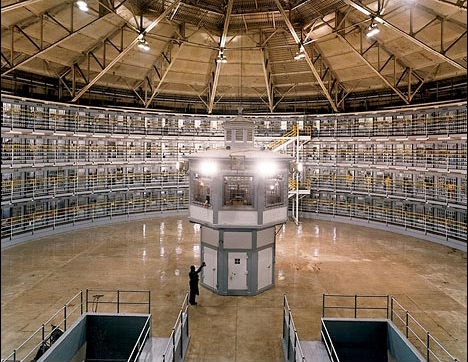
USA. Illinois. 2002. Stateville Prison. F house. There were originally four circular cell houses radiating around a central mess hall. The buildings were based on Jeremy Bentham's 1787 design for the panopticon prison house. The first round house was completed in 1919, the other three were finished in 1927. F house is the last remaining panopticon cell house. It's used for segregating inmates from the general prison population and for holding inmates who are awaiting trial or transfer. -Doug DuBois & Jim Goldberg.
In 2002, Doug Dubois, along with Jim Goldberg, went to Stateville Correctional Centre, and took a picture (above) of the prison’s interior. The New York Times later published the photograph.
A while later, Dubois found out that Andreas Gursky had too gone to Stateville, apparently inspired by Doug and Jim’s photograph and took a picture himself (below). Gursky has admitted in his career he finds ideas for images in newspapers and other popular media. Gursky’s image put in context here, at the Brooklyn Rail.
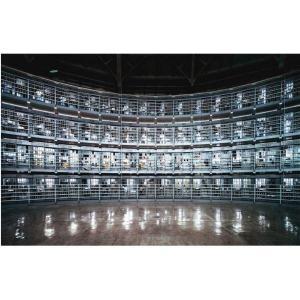
Andreas Gursky, “Stateville, Illinois” (2002), C-print mounted on Plexiglas in artist’s frame. Courtesy Matthew Marks Gallery, New York.
So, this raises questions. Has Stateville prison inadvertently become a tease, and a subject for curious photographic artists?
Do the individual activities of artists have a bearing on one another? Should these images exist within the same discourse? Do photographic attentions of the 21st century have any relation to the need and stresses of current correctional politics in Illinois?
Does the ascendancy of Stateville onto gallery walls effect any significant – or measurable – impression of Stateville prison within public consciousness?
Or are Dubois, Goldberg, Gursky and Leventi just continuing an intrigue which has continued throughout the decades?
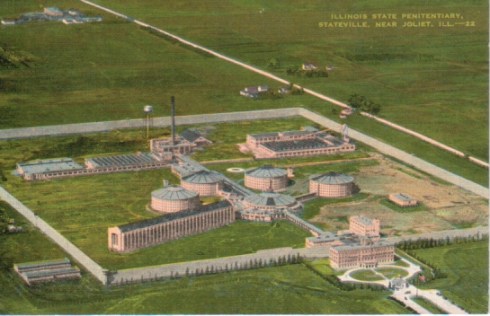
Postcard: Stateville Penitentiary, near Joliet, Illinois (ca. 1930s).
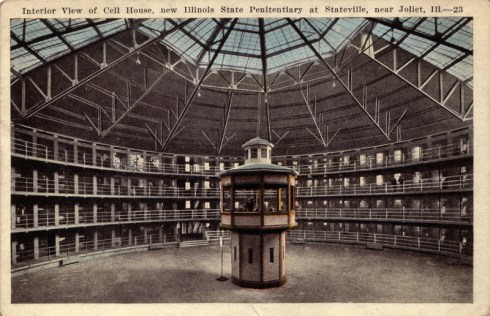
Postcard of an American panopticon: "Interior view of cell house, new Illinois State Penitentiary at Stateville, near Joliet, Ill." Source: Scanned from the postcard collection of Alex Wellerstein. (Copyright expired.)
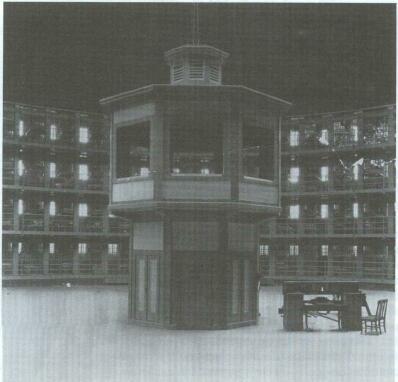
Photo of guard tower in round house at Stateville. Courtesy of Illinois State Historical Library. The second state prison was authorized at Joliet in 1857. It was built by convict laborers. That 135-year-old Joliet prison still houses more than 1,100 inmates. Meanwhile, Stateville. prison, also in the Joliet area, opened for business in 1917.

Inmates at Stateville Penitentiary in 1957. (Sun-Times News Group file photo)

Prison guard in a security tower, Stateville Penitentiary, Joliet, Illinois, USA. © Underwood Photo Archives / SuperStock
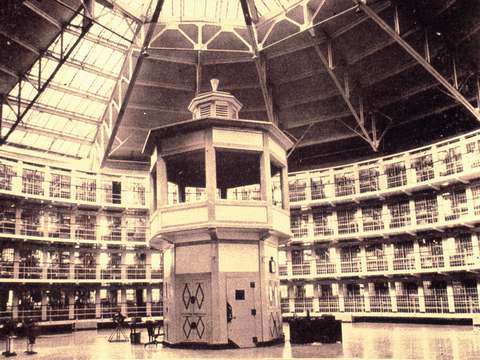
Panoptic guard tower at Stateville Prison, Stateville Prison (US Bureau of Prisons, 1949, p. 70), 1940s
At this years Les Rencontres d’Arles Photographie Festival the official photographs of the French prison inspectorate make up an exhibition entitled Behind the Walls of Cliche.
The independent French prison inspectorate (contrôleur général des lieux de privation de liberté) is nominated for six years and during that time he cannot receive any instruction from any authority; he can be neither removed nor renewed; and he cannot be prosecuted for his opinions he formulates or for the actions he carries out in his functions.
Currently, the director is Jean-Marie Delarue (here’s an interview with him about the state of French prisons).
Delarue’s team take photographs as documentation as they tour France’s prison system and it is these images that are currently on show at Rencontres d’Arles.
To my mind, this is a truly unique exhibit. I know not of any other arts festival that has put front-and-centre the administrative photography of a working independent or government agency overseeing prisons.
BLURB FROM LES RENCONTRES D’ARLES SITE
Sixty thousand detainees in French prisons: surely the problem can’t be all that hard to solve!
The Rencontres, in their own way, are part of the media, and this exhibition based on the report of France’s Inspector General of Prisons, Jean Marie Delarue, shows just how the world of French gaols, far from being an aid to social reintegration is, rather, an insult to the human condition. This is a call to look beyond the standard ideas about prison.
The exhibition also demonstrates the limitations of photography, which cannot convey the nuances of everyday unhappiness in prison. In a photo a TV set, a workshop and a library seem to offer possibilities which in fact are non-existent for most prisoners, and certainly not available on a regular basis. The rules of hygiene and safety are flouted every day, the psychological stresses are chronic, and the laws regarding the minimum wage and access are broken by the state itself. None of this is visible in a photo.
Pictures of a new prison seem to suggest a solution; but the image doesn’t tell you that new prisons have a higher suicide rate than old, dilapidated ones. Three people in a cell is something you can see; but what you don’t see is that one inmate standing means two lying down, because there’s nowhere to sit. And with prisoners spending 22–24 hours a day in their cells, it’s easy to imagine their physical and psychological state.
This is definitely not photojournalism, but rather an alarm signal regarding one of democracy’s least well known instruments.
François Hébel, exhibition curator
Excerpt from Law no. 2007-1545 of 30 October 2007:
’The Inspector General of Prisons is an independent authority whose duty it is, without prejudice to the prerogatives attributed by the law to the judiciary or jurisdictional authorities, to monitor the conditions of incarceration and transfer of persons legally deprived of their freedom, so as to ensure respect for their fundamental rights.
Within his field of responsibility, he takes no orders from any authority… He cannot be relieved of his duties before his term has expired… The authorities in charge of places of imprisonment cannot oppose a visit by the Inspector General except for grave, imperative reasons relating to national defence. The Inspector General may demand from those authorities all information and documentation required by the carrying-out of his mission. In the course of his visits he may speak, under circumstances guaranteeing the confidentiality of what is said, with any person whose participation he sees as necessary.
At the end of each visit the Inspector General makes known to the relevant ministers his observations regarding the state, organisation and functioning of the site visited, and the condition of those imprisoned there… Each year the Inspector General submits a report to the President of the Republic and to Parliament. This report is made public.’
The 2009 report is published by Dalloz.
PREVIOUSLY ON PRISON PHOTOGRAPHY
I’ve noted French prison photography before. From Jean Gaumy, the first photojournalist in the French prison system to contemporary artist Mathieu Pernot; from the archives of Henri Manuel to portraitist Phillipe Bazin; and to the recent exhibition Impossible Photography – artistic survey of French prisons.
– – –
Of course, if you want to get really involved check out Melinda Hawtin’s French Prison Photography graduate work.
France even has its own National Museum of Prisons!
– – –
Thanks to Yann Thompson for the tip!
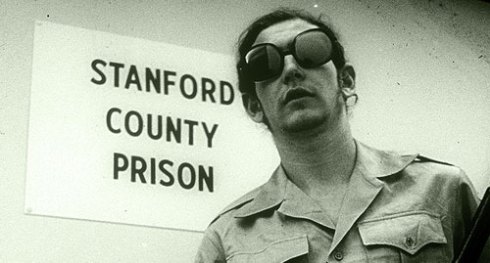
39 years ago today, Philip Zimbardo and his psychology students embarked on The Stanford Prison Experiment and demonstrated that we are all capable of psychological and physical violence upon other humans in conducive institutional environments.
The fabricated prison in the basement of the Stanford University Psychology Department became grim reality when the volunteers – randomly selected as either ‘prisoners’ or ‘guards’ – played out their parts with authoritarian abuse and complete submission, respectively.
The experiment was abandoned after six days. It was intended to last two weeks.
Everything you could ever want to know about the original experiment and its legacy can be found here.

Claude Hankins
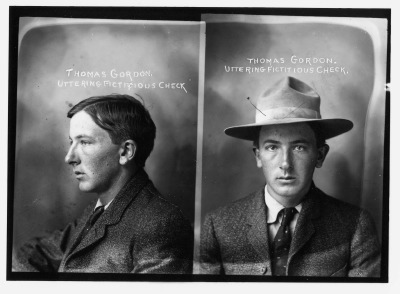
Thomas Gordon
Without question, the mugshot is a dominant “genre” in American photography. Least Wanted, aka Mark Michaelson, has released a book of his collected mugshots, Danny Lyon is fascinated by them, I’ve been seduced from time to time.
Arne Svenson is another artist who has put together mugshots (this time from the 19th century) to make a book. Svenson is a portraitist and his art is more complex when his collected mugshots and his headshots of forensic dummies & sock monkeys are considered alongside one another.
PRISONERS
“Svenson’s first book entitled Prisoners came about after the discovery of a collection of turn of the century glass plate negatives from Northern California recording convicted criminals as classic frontal and profile mug shots. He lovingly printed these negatives, bringing the subjects alive, and painstakingly researched each of their stories.” (Source)
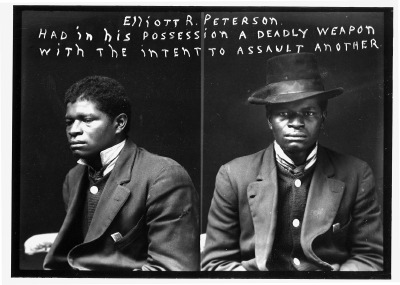
Elliott Peterson

W.M. Heron
FORENSIC DUMMIES
Svenson spent four years traveling around the country to coroner’s offices and law enforcement agencies photographing forensic identification aids in a classic portraiture style. Twin Palms Publications will publish a book of this work, entitled Unspeaking Likeness, in 2010.

© Arne Svenson
SOCK MONKEYS
Unsurprisingly, the public and the market love Svenson’s 200 Sock Monkey portraits.
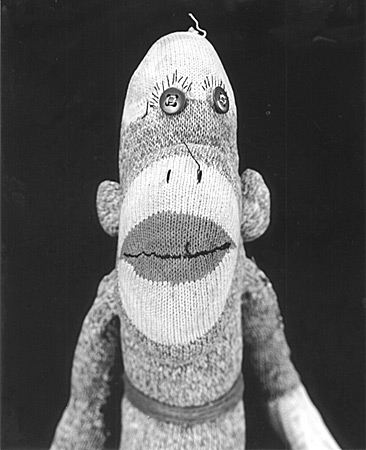
Sock Monkey #1761, 2001, Gelatin Silver Print. © Arne Svenson
See more at Jan Kesner Gallery
I never realised powerhouse was so prolific.

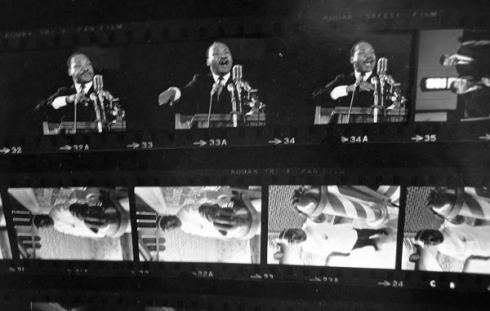
‘Digging into the strata of junk, he found more black-and-white mounted photos, some of them under a broken-down convertible that was one of several cars abandoned in the warehouse. He found the young Jesse Jackson preaching, Dizzy Gillespie playing his trumpet, and four black men—photographers apparently, from the cameras on display—sitting on the concrete front steps of the South Side Community Art Center. […] There was a box filled with negatives in labeled envelopes. There were negatives of Dr. Martin Luther King Jr., negatives of Abbie Hoffman, negatives of Lyndon Johnson. Next to this box was another one that was full of invoices; their letterhead said HOWARD SIMMONS.’ (Story)
(via)
Talk to anyone about American documentary photography, they’ll probably mention Danny Lyon. Talk to anyone about prison documentary photography and they’ll definitely mention Danny Lyon.
In terms of US prison journalism, Lyon was the first photographer to a) give a shit, b) gain significant access, and c) distribute journalist images far and wide.
I had read Nicole Pasulka’s interview with Danny Lyon when it was published for The Morning News in December, 2008. I have since begun reading Like a Thief’s Dream (currently 100 pages deep). As in many cases, it takes an AmericanSuburbX reissue to press the issue.

Renton in his cell, Walls Unit, Huntsville, Texas, 1968. © Danny Lyon
I have a few things to say about the chapters I’ve read so far, but those thoughts need more brewing. While I mash those brain-hops, I’d like to draw your attentions to Lyon’s comments about prisons in America:
“You really need a friend, or family member inside a prison, to appreciate what we are doing. America has two million people inside of her prisons. Only China, a dictatorship, tops us in this growth industry. I like to think of the words of Fredrick Douglas “Be neither a slave nor a master.” All of us, outside of prisons, are the masters.“
“Prisons should be turned into bowling alleys, schools, and daycare centers, or demolished. We could probably do better with 90 percent of the inmates being released. Communities should deal with offenders on a local level. Review panels should meet with all of the 200,000 prisoners doing life sentences. Many of these people are harmless and aged, and should be released. I would like to see review panels sent into all the prisons, to meet with inmates face to face. Most should be released.“
“When I was working in the Texas prisons (1960s and 70s) there were 12,500 men and women inside and no executions. Today there are 200,000 in Texas and they kill prisoners all the time. Prisons are now everywhere, a major employer in upstate New York. Simply put, everything about prison is worse.”
“The best way to change yourself is to go outside your world into the world of others. It’s a big world out there. The worst thing about New York City is that all the young people that gather there are extremely like-minded. Creative people are comfortable there, but they are preaching to the choir. I always wanted to move Brooklyn to Missouri. Everyone would benefit.” (Source)
I couldn’t – and have not – ever put it better myself.
– – – – – – – –
Buy a signed copy of the book Like a Thief’s Dream at Danny Lyon’s website, Black Beauty.

Postcard sent by the author to Renton in prison in the early 1980s

 Prison Photography