
You are currently browsing the category archive for the ‘Institutional’ category.
Well, well, well. All sorts of commentary on the importance of photographs surrounding the assassination of Osama bin Laden and President Obama’s announcement in the East Room with reenactment of his speech for the still cameras.
From the White House Situation Room (now with added memes) and Reuters’ bloody gallery (WARNING: Graphic images of corpses) to whether we deserve or need to see bin Laden’s bullet-riddled head. Then there’s Senator Scott Brown’s faux-pas over a hoax photograph. Not to mention the reported different versions of the actual event.
For all the best articles click on the links over on Raw File Blog’s twitter feed, where I’ve been compiling them all day.
There’s still one photo – to be precise its caption – that is bothering me. And it’s this one:

White House photographer, Pete Souza, captioned the image thus: “President Barack Obama and Vice President Joe Biden, along with members of the national security team, receive an update on the mission against Osama bin Laden in the Situation Room of the White House, May 1, 2011.”
Except everywhere I’ve seen it used, the inference is that the White House team are watching a live feed of the raid on bin Laden’s compound.
They might be, but I want a SOURCE.
It seems to me this image may have been interpreted as one thing at an early stage and because it the narrative tied to the body language is so seductive, no-one has chosen to question it.
I think the reading of the image is massively altered depending on whether you think they’re watching murders in progress or whether they are, for example, waiting nervously for the screen to boot up.
Ryan Singel for Wired.com’s Epicenter blog went as far to say the White House “officials watching what one presumes is the livestream of the Navy Seal raid on Osama’s hideout in Pakistan.”
For all the hullabaloo about this image, no-one is actually sure about what is on THAT screen.
So, does anyone have a solid source saying that they are viewing a live feed of the operation?
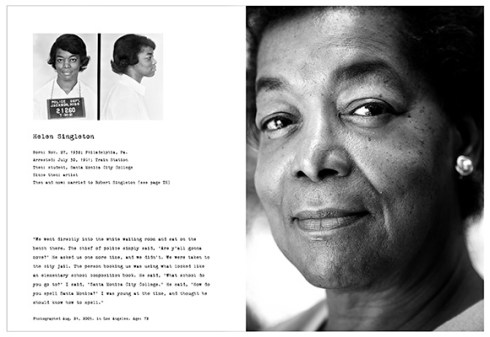
Born: November 27, 1932; Philadelphia; Arrested July 30, 1961; Train station, Jackson; Then: Student, Santa Monica City College; Since then: Arts administrator, now retired; Then and Now: Marrried to Robert Singleton; Photographed: August 24, 2005; Los Angeles. © Eric Etheridge
I’ve been meaning to write about Eric Etheridge’s project Breach of Peace for too long. This year marks the 50th anniversary of the Freedom Riders and their key 1961 victory for civil rights.
Today, the anniversary of Dr. Martin Luther Kings 1968 assassination, is an appropriate moment.
Firstly, a brief history of the Freedom Riders, as told by Etheridge:
In the spring and summer of 1961, several hundred Americans — blacks and whites, men and women — entered Southern bus and train stations to challenge the segregated waiting rooms, lunch counters and bathrooms. The Supreme Court had ruled that such segregation was illegal, and the Riders were trying to force the federal government to enforce that decision.
Though there were Freedom Rides across the South, Jackson soon became the campaign’s primary focus. More than 300 Riders were arrested there and quickly convicted of breach of peace — a law many Southern states and cities had put on the books for just such an occasion. The Riders then compounded their protest by refusing bail. “Flll the jails!” was their cry, and they soon did. Mississippi responded by transferring them to Parchman, the state’s infamous Delta prison farm, for the remainder of their time behind bars, usually about six weeks.
A few days after the last group of Riders were arrested in Jackson, on September 13, the Interstate Commerce Commission issued new regulations, mandating an end to segregation in all bus and train stations.
Etheridge’s book Breach of Peace: Portraits of the 1961 Mississippi Freedom Riders features his new portraits of 80 Riders and the mug shots of all 328 Riders arrested in Jackson that year, along with excerpts of interviews with the featured Riders. (See the Breach of Peace archives here)
The Mississippi Museum of Art is showing the mugshots of all 329 Riders arrested in Jackson as a giant, 54′ long mural, along with 20 of Etheridge’s portraits (March 19 – June 12). Free to the public.

Breach of Peace: Portraits of the 1961 Freedom Riders installation, Mississippi Museum of Art, March 2011
Etheridge’s work is a continuing multi-year effort. Through interviews and his camera, Etheridge gives his subject the opportunity to return to their political heroics. For those alive in the sixties, Etheridge’s work is an antidote to historical amnesia and for those who weren’t it’s an education.
KING’S GIFT TO HISTORY; A POLITICAL PHILOSOSPHY NOT TO BE FORGOTTEN, ALWAYS TO BE ACTED UPON
And so to King, whose politics are as relevant today as they were 43 years ago. As Jim Johnson reminds us, at the time of his assassination, King was in Memphis in solidarity with sanitation workers, who were striking the city not just for decent pay and working conditions but for recognition of their right to form a union. In light of the concerted, ongoing campaign by Republicans to subvert unions, it surely is plausible to wonder how far we remain from the promised land.
History is very important. Despite their self-label, progressives look back in time as readily as conservatives to pinpoint historical moments to justify their politics. Progressives look to the golden era of people power and the Peace Movement, conservatives hark back to the space-race and Reaganomics.
When history is at our backs, we must choose to leave it behind or let it propel us forward. In the case of the Civil Rights movement, its lessons should be forever in America’s conscience. The work toward social and economic equality is not yet complete, not by a long distance.
We have choices to make and a society to shape.
Which brings me to this potent image of the back of James Earl Ray, who was Dr. Martin Luther King’s assassin.
While hundreds of thousands were marching on the streets and millions across America swelled the turning political tides, James Earl Ray choose a different worldview.
Regardless of colour or creed, Martin Luther King’s promised land was for all … and for a better America. No doubt James Earl Ray was a troubled man but his rejection of America’s sea-change thrust him only in the direction of a dead-end.
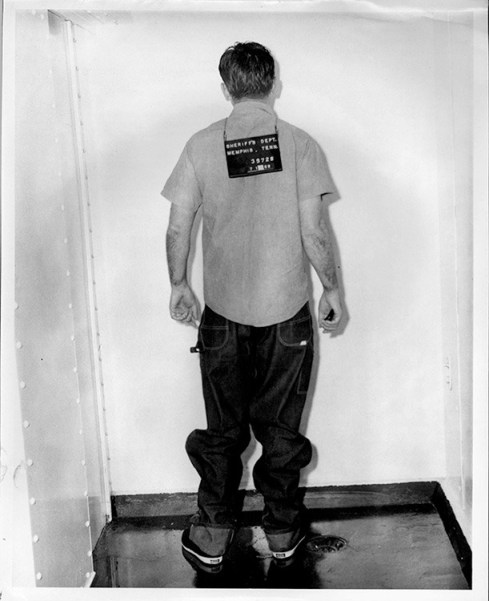
James Earl Ray facing the wall at Shelby County Jail. Photo by Gil Michael/Shelby County Sheriff’s Office
As Etheridge explains this is not an act of defiance. Shoved into a Shelby County Jail cell, Ray faces the reality upon him; the physical finality of confinement with nowhere to go. As he abandoned history, so history moved on without him.
TO END ON A GOOD NOTE
REMEMBER.
INSPIRATION, LOVE AND GOOD HEARTS ARE NOT FORGOTTEN BY HISTORY
Following up on my post about Julie Green’s The Last Supper, I think it is necessary to make an overview of the photography and painting projects that consider America’s death penalty by meals of depicting last meals and last meal requests.
Celia A. Shapiro
Shapiro’s recreations of last meals in lurid colour are possibly the best known within this subject matter. She made the series Last Supper in 2001. Of Shapiro’s work, critic Fred Ritchin said it proves the US only executes poor people. Ritchin’s position might be true, but as Julie Green reminded me most inmates, particularly in Southern states are limited to food from the prison kitchen and usually to a budget of $20. States that rarely employ the death penalty offer a generous $50 or no limit at all.
In all their garishness, Shapiro’s works are reminiscent of Martin Parr’s work. Parr too photographed the food of the poor; fish and chips, cupcakes, bangers and mash and trays of tea. Whatever Parr claims about objectivity there is a snide judgement in his work. Indeed it is his strength that his pictures show us the true absurdity of many of our dietary mores.
Shapiro’s work disgusts me. It disgust me in a good way. It angers me. Each of Shapiro’s images represent a life extinguished … gassed, cooked, fried. It’s hard to stomach. Good art evokes strong response.

John William Rook, age 27, executed by North Carolina, 9/19/86. © Celia A. Shapiro
James Reynolds
James Reynolds‘ Last Suppers was well received in 2009 but the interest in his birds-eye view still-lives seemed short-lived. I suspect they were appreciated more for their unorthodox view of a infrequently seen subject and for their role as conversation starter, than they were as lasting pieces of art.
The visual discipline of the institutional orange trays of containing in most cases a bizarre allocations of food, fairly reflects the irrationality of a state killing a citizen.
There is something maddening and suffocating about Reynolds’ ordered still-lifes. The demarcated space of the foodstuffs reminds me of aeroplane meals. For the executed it all comes down to a tightly presented meal, and this is meal is absurd.

© James Reynolds
Jonathon Kambouris
Jonathon Kambouris‘ efforts with The Last Meals Project is roughly contemporary with Reynolds (completed over 2009/2010). Judging by the shadows to the chicken legs, cups of coffee, Kambouris places food items ontop of a blown-up mugshot of a (infamous) inmate mugshot and makes the photograph from directly above, looking down.
Kambouris is tying his desire for a debate about the death penalty to the most renowned and media-coveted men and women. I am not convinced this is a good tactic as (whipped up) emotions about serial killers is not the place to begin a rational discussion on the symbolic foolishness of the death penalty. I think a better place to start a progressive debate – at least within the framework of art – would be Taryn Simon’s The Innocents or the painter Dan Bolick’s Resurrected. The existence of innocence on America’s death rows is a powerful argument working in favour of death penalty abolition.
One footnote to add is my astonishment at Kambouris’ statement at Feature Shoot: “In 2010 this photo essay traveled to Singapore to be shown in the Singapore Fringe Festival: Art and the Law. Ironically, Singapore has an extremely strict death penalty stance and I was informed that it is part of school curriculum to watch an execution take place.” Kids spectating murder? Can that be true?
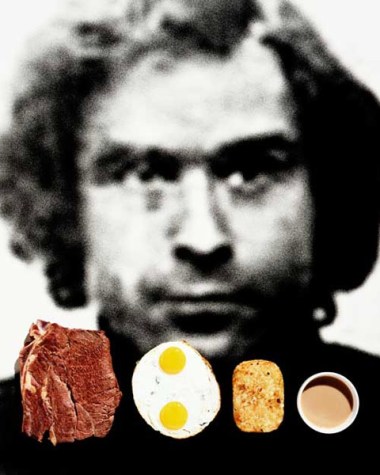
Name: Ted Bundy; Last meal: Steak, eggs, hash browns, coffee; Sentence: Death by electric chair; Executed: January 24, 1989, 7:16am; State: Florida. © Jonathon Kambouris
Mat Collishaw
Mat Collishaw goes all Flemish Master on his last meals. Except it isn’t the girl with the pearl earring chomping down on that lettuce it was Karla Faye Tucker a few hours before she was lethally injected by the State of Texas in 1988. Flemish still lives were part allegories of life, death and cycles of nature but frequently used items of trade as story telling devices. Knowledgable viewers would identify flowers or precious metals from across the globe brought by the Dutch merchants that dominated sea-trade in the 16th and 17th centuries.
In the age of supermarkets and year round strawberries, the global food trade and who runs is of little significance. The inference in Collisaw’s work is that America trades in sublime murder.
Found via Art Most Fierce.

Karla Faye Tucker (2010). C-Print, 73 x 60 com (29 x 24 inches) © Mat Collishaw
Jacquelyn C. Black
Black’s … last meal … (Courage Press, 2003) is a curious little publication. It is clearly an act of conscience. The studio photography is very literal without the interpretation we see in other artists’ works. I cannot be sure Black’s prints have ever gone on exhibition. Black pairs images of last meals with text of last statements.
When one is looking at photography in order to draw critical conclusion, it is often the absence if photography (or more precisely, the presence of something unexpected) that can provide the Eureka! moment. I am somewhat desensitised to the issue of state violence; I suspect the emotive response Black and her peers expect of the viewer, I do not deliver. It was therefore, an absent image and text in its place that caught my attention and really drove home the spiteful retribution of execution:
ASKED THAT HIS FINAL MEAL BE GIVEN TO A HOMELESS PERSON
(REQUEST DENIED)
… last meal … includes valuable auxiliary material – on the history of capital punishments; on statements made in landmark legislation; and on US death penalty statistics. Black also lists political resources for anti-death penalty activism.

Name: Anthony Ray Westley
Executed:May 13, 1997
Education: 8 years
Occupation: Laborer
© Jacquelyn C. Black
Barbara Caveng & Ralf Grömminger
Glowing like fast food menu boards but with the deliberateness of illustrations in a noodle bar, Grömminger’s photographs mounted in lightboxes for Caveng’s Final Meals installation are a bit pop. Any illusion of vitality is deflated by the procedural details of the eater’s execution.

Detail from ‘Final Meals’, installation by Barbara Caveng, 2000. Backlit boxes: Steelcases (40 x 40 x 18cm) with a pane on one side to pull, showing the execution protocol. Two audiostations with final statements. Meals photographed by Ralf Grömminger
Kate MacDonald
“The leftover table scraps relate the humanity of the condemned to our own ordinary experience,” says Kate MacDonald of her painted Last Meals series. That’s a bit poetic for me. More powerful is the fact these plates are empty. The remnants of sauce and chicken bone are primordial and bloody. Just as these items were devoured, so too will be the body that consumed them. Despite the polystyrene cup and plastic cutlery there is something very animalistic about MacDonald’s oil paintings.
Last Meals featured in the Texas Moratorium Network’s exhibit Justice For All? Artists Reflect on the Death Penalty, in which MacDonald and peers considered the injustices embedded within the death penalty; “Mental health and lack of advocacy, racial discrimination, poverty, and at the issue’s most basic argument, the possible innocence of the executed.”
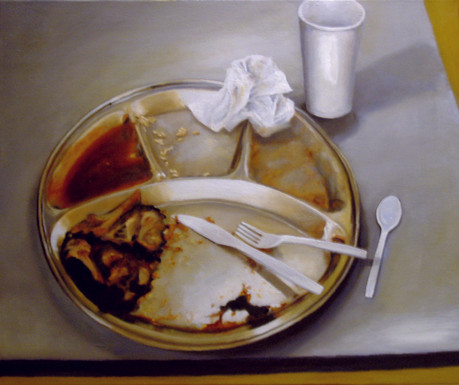
The last meal of Ruben Cantu, believed to be wrongfully convicted and executed in Texas. (24 x 20 inches), oil on canvas. © Kate MacDonald
As of May 2009, there had been 1165 U.S. state-sanctioned executions since 1976.
– – – – – – – – – – – – – – –
UPDATE: August 19th 2012
Two more projects.
Helen Grace Ventura Thompson
Ventura Thompson’s website. Her work in The Guardian. My thoughts.

© Helen Grace Ventura Thompson
and
Julia Ziegler-Haynes
Ziegler-Haynes’ website. Her work.

© Julia Ziegler-Haynes
– – – – – – – – – – – – – – –
UPDATE: December 14th, 2012
Henry Hargreaves
Hargreaves‘ No Seconds is a series of 10 stark photographs that re-create last meals alongside the name, age and conviction of the murdered individual. See more of his work on Raw File, Wired.com

© Henry Hargreaves
– – – – – – – – – – – – – – –
UPDATE: January 29th, 2013
Patrick Guns
For My Last Meals, 2007-2009, Guns asked 54 chefs to interpret 54 last meals.
“From this list of last meals, I asked renowned chefs to choose a meal according to their affinity for cooking and to recreate these last wills without any fear of asserting their own Humanism. As a tribute to a deceased man, their creations are more concerned about Man than about the Cook,” writes Guns.
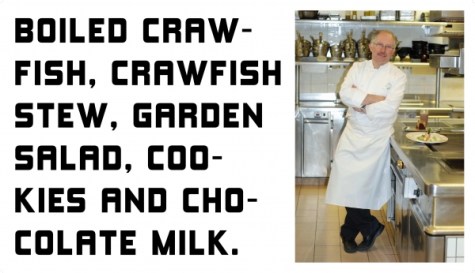
© Patrick Guns
– – – – – – – – – – – – – – –
If you have any other projects that need adding to the list, please get in touch.
– – – – – – – – – – – – – – –

Cast of One Flew Over the Cuckoo’s Nest posing for their photograph on location at the Oregon State Hospital, Salem, Oregon, 1974. © MaryEllen Mark.
MARY ELLEN MARK
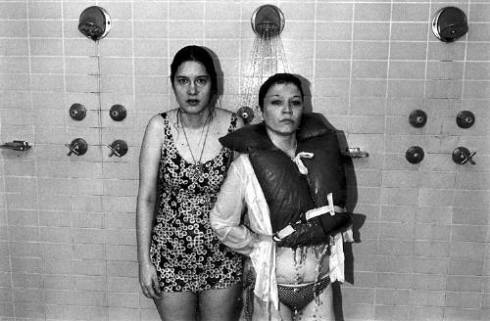
Mary Ellen Mark first went to Oregon State Hospital (OSH), Salem, OR in 1974 to photograph the cast and set of Milos Forman‘s 1975 adaptation of Ken Kesey’s novel One Flew Over the Cuckoo’s Nest. (Mark often shot on film sets).
During the filming, Mark met the women of Ward 81. She promised to return and after over a year of negotiations with the hospital authorities and families of residents she was allowed to live on Ward 81 with writer Karen Folger for 36 days. American Suburb X has republished Folger’s essay for Mark’s book giving a familiar and surprising account of the routines and dreams of the women on Ward 81.
Mark’s book was a breakthrough. Granted, photographs of Oregon State Hospital existed previously, but Mark’s work was a pioneer intimate portrait of an American group outside of the dream, outside of the reality. LIFE magazine had covered an OSH camping trip before. Oregon Historic Photograph Collections have 14 images of OSH.

Horsing around. © Marl Ellen Mark, 1974
© Marl Ellen Mark, 1974

Mary Frances Peeking from Tub, 1976. © Mary Ellen Mark.
Mark’s Ward 81 was a personal call to action; she cared deeply about the residents and wanted to use photography to describe their lives. Mark contends in all interviews I have read that the treatment of patients was good and fair.
Prison Photography has touched upon institutions developing an “art” persona overtime through the work of several art photographer, specifically Stateville Prison, Joliet, Illinois. The architectural form of Stateville can be pinned as the common fascination that drew art photographers Gursky, Dubois, Goldberg and Leventi.
Alternatively, the preoccupations at Oregon State Hospital are varied. In some cases, the emergence of a new story to be told and in others an homage to past photographic action at the institution.
DAVID MAISEL
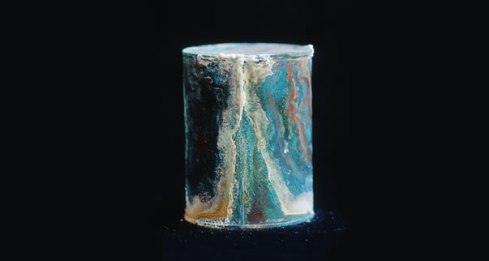
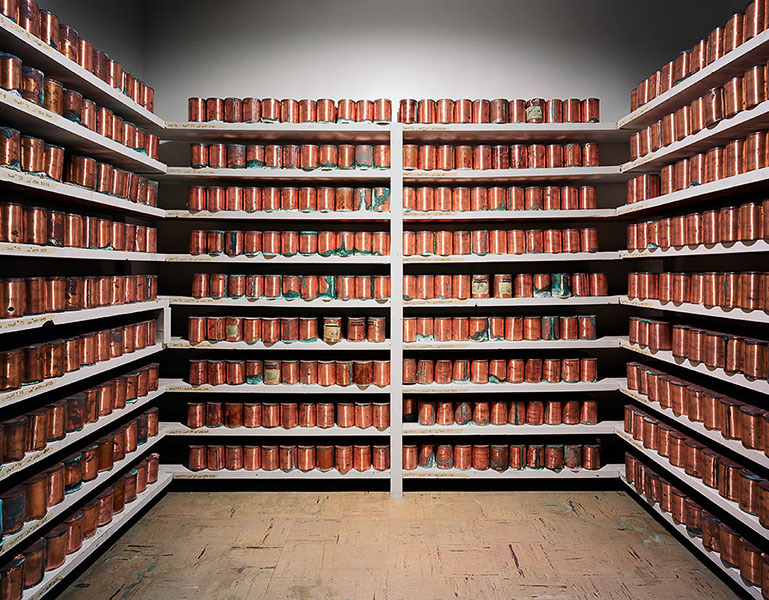
David Maisel‘s Library of Dust is a meditation on the cremains of former OSH patients. Until 2004, the urns were locked in a basement and not public knowledge. The patients died at the hospital between 1883 (the year the facility opened, when it was called the Oregon State Insane Asylum) and the 1970’s; their bodies have remained unclaimed by their families.
Over a period of twenty years the basement in which the urns were locked flooded repeatedly. Studio360 describes well the chemical reactions ongoing between the copper, elements within the ashes and substances afixed by flood water. Maisel’s studies are a “yearbook of the socially dispossessed.”
The Oregonian newspaper won the 2006 Pulitzer for Editorial Writing in its coverage of the forgotten remains and the sad scandal of silence. The story caught the attention of the nation and Maisel’s work toured the country to wide acclaim. Maisel talks about his work here and BLDGBLOG has the best text as entry point to the multiple layers in Library of Dust.
© David Maisel

© David Maisel
The Mental Health Association of Oregon summarises Maisel’s work well:
The tale behind the canisters is indeed deeply disturbing. They hold the remains of 5,121 people who languished in the psychiatric hospital in — many of them for their entire adult lives — for reasons that nowadays might require nothing more than a Zoloft prescription and some couch time. The patients’ conditions listed in hospital records include “worries about sex” and “worries about money” — “things everyone walks around with today,” Maisel says. When these patients died, their relatives either had no money for a burial or no interest in claiming the bodies.
Maisel positions the work within the taboos of “craziness”, “death” but also links Library of Dust to his earlier mineralogical studies. Interestingly, Maisel’s title was first uttered by a custodian of another state institution. Maisel explains:
On my first visit to the hospital, I am escorted to a decaying outbuilding, where a dusty room lined with simple pine shelves is lined three-deep with thousands of copper canisters.
Prisoners from the local penitentiary are brought in to clean the adjacent hallway, crematorium, and autopsy room. A young male prisoner in a blue uniform, with his feet planted firmly outside the doorway, leans his upper body into the room, scans the cremated remains, and whispers in a low tone, “The library of dust.” The title and thematic structure of the project result from this encounter.
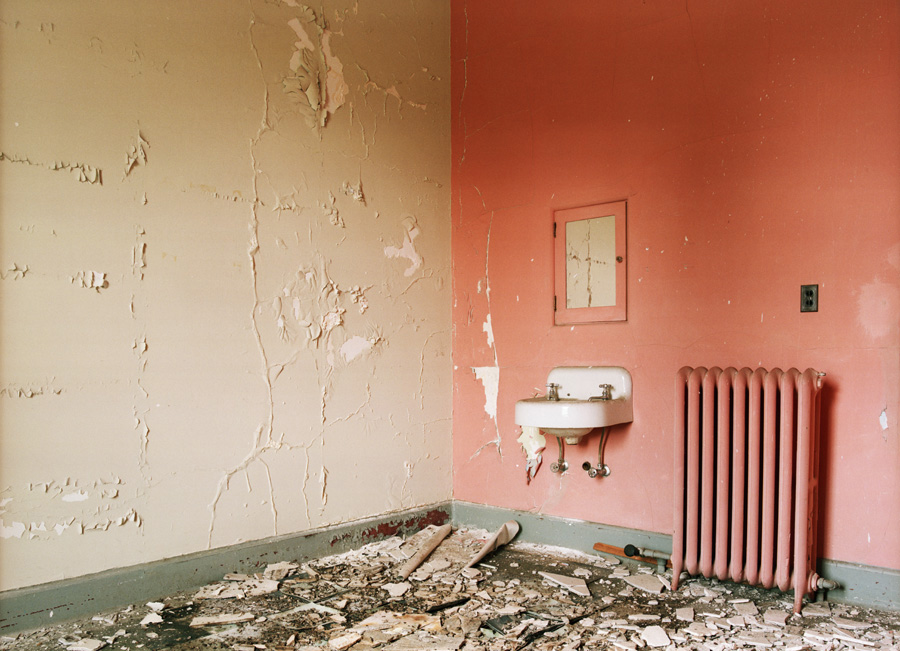
While on site, Maisel also made some interior studies of the decaying fabric of the building. The series is Asylum. OSH was shuttered in 2005 and demolition began in 2008. A new facility is slated for completion in 2012.
Asylum 2. Doctor’s Office, Ward 66, Abandoned portion of J Building. © David Maisel.

Asylum 3. © David Maisel

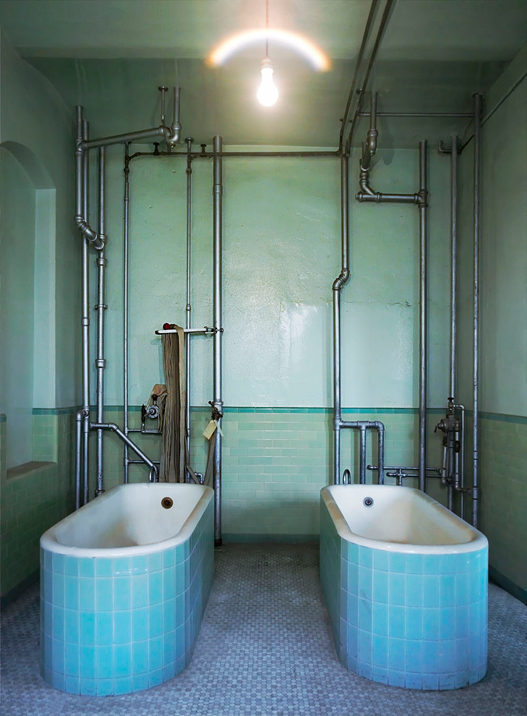
Asylum 7. Tubs, Ward 7, Abandoned portion of J Building. © David Maisel
Maisel’s studies of the interior are less complex or politicised as the poetics of Library of Dust. Nevertheless, bare these images in mind as you read on.
CHRISTOPHER PAYNE
Between 2002 and 2008, Chrsitopher Payne took on the largest photographic survey to date of America’s decaying psychiatric hospitals. For Asylum, Payne visited scores of old facilities and OSH was among them.
Interestingly Payne, photographed the storage room of cremains but didn’t extrapolate the stories into a memorial of politics as Maisel expertly did. And once, again the steep sided tiled bath tubs make a reappearance.
Oliver Sacks wrote the essay for Payne’s book. It is a ranging historical narrative of palatial institutions that could provide the best and the worst of care, but in most cases rarely prepared the patient for release back into society, “most residents were long-term.” The essay is accompanied by some wonderful historic postcards and generally Sacks tries to push us away from a narrative of “snake pits” and “hells of chaos” when thinking of psychiatric hospitals.
On Payne’s work, Sacks’ description is exactly how it appears, “[Payne’s photographs] pay tribute to a sort of public architecture that no longer exists. They focus both on the monumental and the mundane, the grand facades and the peeling paint.”
© Christopher Payne

© Christopher Payne
Peeling paint and broken down fixtures is a preoccupation of many a photographer. Architectural enthusiasts, disaster journalists and fine art photogs have all conspired to bring us the genre of “ruin porn” which continues to baffle and frustrate as much as it engages (but that discussion is for another time).
BILL DIODATO
This inquiry began when Bill Diodato contacted me with news of his book release. c/o Ward 81 is a conscious revisit to OSH; a closing of the circle of photographic practice put into motion by Mary Ellen Mark 30 years previous. Indeed, Mark provides the foreword:
‘It’s painful for me to look at these pictures. They evoke feelings of life and death. I can hear the sounds of women running through hallways and someone shouting, “Meds, meds, come and get your meds.” I can hear the crying of a woman being locked down in restraints. I can hear the music of the jukebox at the once-a-week dance with the women of Ward 81 and the men of Wards 82 and 83. Bill’s book brings me back to the haunted cell in which I slept in a deserted ward right next to Ward 81. I swear I heard people walking above me all night. This was so puzzling because the floor was not occupied. Bill’s images confirm the feeling that I always had—that Ward 81 was and still is inhabited by many ghosts. ‘ (Source)
Diodato states that this book is about the “demise of institutional services’ and it’s effect on women.” When Diodato visited both he and Warden Marvin Fickle knew he would be the last person to document the infamous closed-off Ward 81.
c/o Ward 81 is more focused than Payne’s one stop of many on his tour US psychiatric hospitals and it is more intentional than Maisel’s context-giving shots that rightly or wrongly have formed the backdrop to Library of Dust. Diodato is paying homage to the cultural impact of golden-age documentary photography as much as the site itself.
“The physical crumbling and decaying cells, represent the end of old, corrupt, poorly-run asylums and bring about a sense of closure for the women of Ward 81,” explained Diodato by email. But I can’t help think that’s a superimposition of idea upon the images. Mark’s refuted allegations poor treatment of patients in some interviews, yet talks of “hauntings” in the book intro quoted above. OSH did become known for substandard mental health care provision, but was it a constant of the institution, over all its years?
In addition to being a requiem to the occupants, residents and survivors of OSH, Diodato’s images are a requiem to public awareness.
The silenced and invisible lives of the population within OSH and similar facilities is a shameful past. Diodato’s images represent for me a breakdown in social responsibility for one another. How else can we explain OSH’s unclaimed remains for over 5,000 individuals? Families wrote their relatives out of family history just as the old asylums of the 19th and 20th century allowed the public to erase patients from the social fabric.

© Bill Diodato
© Bill Diodato

© Bill Diodato
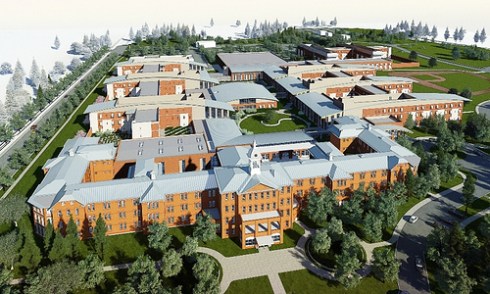
Oregon State Hospital was demolished in 2008. A new era and a new regime of treatment and control is to be established upon completion of the new proposed complex (below). What – if any – will be the photographer’s interaction with the new $458 million complex and its residents?
FURTHER READING
“Mary Ellen Mark – 25 Years” (1990) Pt. I and “Mary Ellen Mark – 25 Years” (1990) Pt. II
Interview: Mary Ellen Mark on Photography (Oregonian)
Interview: The Unfiltered Lens of Mary Ellen Mark

Mona Dancing with a Man, 1976. © Mary Ellen Mark.
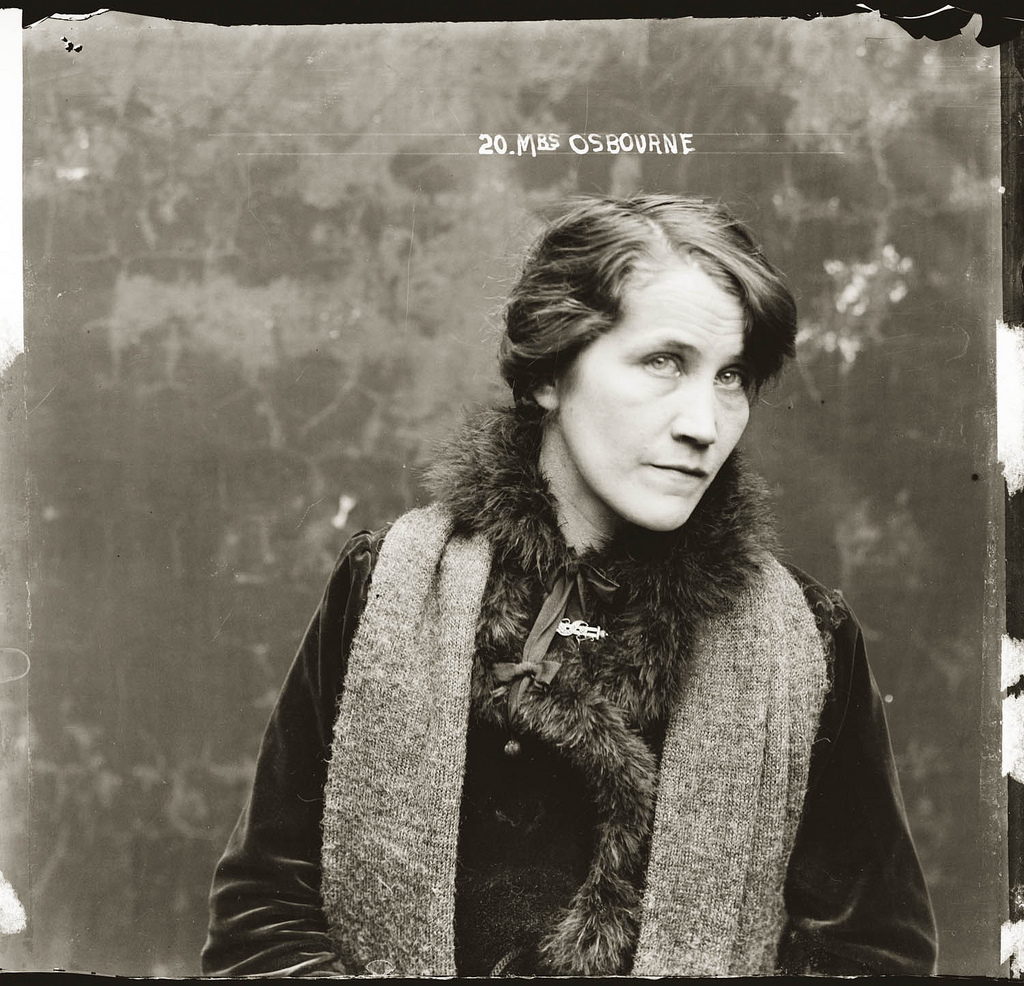
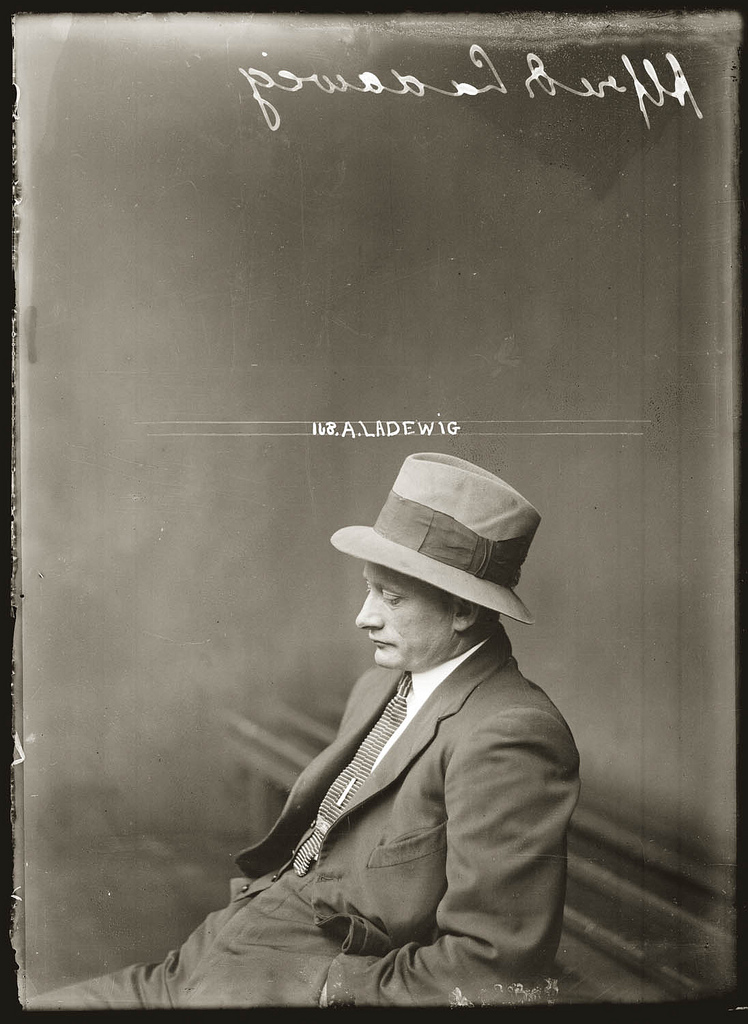
Rina and Ali, the boombastic team at KALW Informant, alerted me to a set of portraits from 1920’s Australia of individuals categorised as criminals.
These are portraits, not mugshots. Luminous, cathartic, full of weight. They’re the pre-August Sander, pre-Richard Avedon, pre-Irving Penn masterpieces of an anonymous police photographer.


PREVIOUSLY ON PRISON PHOTOGRAPHY
The collection is very similar to a set of mugshots from the archives of the Louisiana Division/City Archives in New Orleans.
______________________________________________
All images from the Historic Houses Trust website and the New South Wales Police Archives, Sydney.

Mrs. Reagan sitting on Santa Claus (Mr. T) lap after reviewing White House Chrismas Decorations with the press. 12/12/83.
Source: White House photo via Reagan Library, # C18929-22.
Kirk Crippens contacted me a few months back to tell me about his work at San Quentin. He’s working on a documentary on the SQ Insight Garden Project.
He’s also working on Hidden Population, a personal project of unorthodox portraiture.

I suspect for Crippens, the ‘back of the head approach’ is a novel workaround of DoC legal restrictions on identifiable depictions of men in its custody. As applied to a US prison population, Crippens’ work is original and rather beguiling; how many of his subjects are aware of the camera’s glare? Does the notion of victimhood surface here? How often does the bowed head recur? It is very difficult to imply penitence in prison portraiture without relying on cliche. The doo-rags, beanie-hats, neck hair, peeping tattoos and ubiquitous blue cotton mean these images fluctuate between personal and abstract.
For such a simple idea, Crippens could go a long way with it. It is still a work in progress so I just want to bring your attention to it right now. Hopefully, I’ll get Kirk on PP soon to discuss it at length.
BACKS OF HEADS
To compose images of the back of the subjects’ heads is the same approach adopted by Eric de Vries for ‘Invisible Scars’ – portraits of the Khmer Rouge labour camps, Cambodia. In terms of political context, the two sets of subjects are constellations apart , but I thought the shared technique was worth noting.
CRIPPENS
In 2010, Kirk Crippens achieved significant success with Foreclosure, USA. He had three solo exhibitions of his and nine group shows throughout 2010. Crippens was named in Photolucida’s Critical Mass Top 50 for 2010. Foreclosure, USA also won the Blue Earth Prize For Best Project Photography at the PhotoAlliance 2010 Our World Portfolio Review. Crippens was recently nominated for the 2011 – 2013 Eureka Fellowship Program, a project of the Fleishhacker Foundation.

© Sebastian Meyer. Source: http://sebmeyer.wordpress.com/2010/10/01/an-old-photo-i-found/
When reading the New York Times’ New York City Police Photograph Irises of Suspects a couple of days ago I was reminded of Sebastian Meyer‘s Guardian video dispatch from Afghanistan.
AFGHANISTAN
In the accompanying article, Jon Boone explains that in Afghanistan,
The US army now has [biometrics] information on 800,000 people, while another database developed by the country’s interior ministry has records on 250,000 people.
It is the sort of operation that would horrify civil liberties campaigners in the west, but there has been little public debate in Afghanistan. […] US soldiers have been collecting huge amounts of biometric data, with little oversight from the Afghan government.
It allows us to understand population shifts and movements, who wasn’t there before and who might be a potential threat just because they are new to that area,” said Craig Osborne, the colonel in charge of Task Force Biometrics.
The Afghanistan government has plans to introduce a biometric ID card by 2013; an attempt to thwart insurgency but it is also thought ID cards will reduce Afghanistan’s rampant voter fraud.
BIG APPLE
Back in New York, the NYPD is keeping track of prisoners and suspects for when they are transported or appear in court:
Authorities are using a hand-held scanning device that can check a prisoner’s identity in seconds when the suspect is presented in court, said Paul J. Browne, the department’s chief spokesman.
Officials began photographing the irises of suspects arrested for any reason on Monday [Nov. 15th] at Manhattan Central Booking and expect to expand the program to all five boroughs by early December, Mr. Browne said.
Mr. Browne said a legal review by the department had concluded that legislative authorization was not necessary. “Our legal review determined that these are photographs and should be treated the same as mug shots, which are destroyed when arrests are sealed,” he said.
[My bolding. Source]
WHERE IS THIS GOING?
It is clear that the US is gathering vast quantities of biometric data at transport hubs, immigration offices, police stations, conflict zones. Am I foolish to think that all this information might not one day be consolidated?
Not even considering Chomskyite accusations of US Imperialism based on military violence, could we not consider silos of biometric data (with global reach) as the foundation par excellence to empire in the networked 21st and 22nd centuries? As an invisible but intractable abundance of strategic knowledge and power?
I accept these questions probably mirror the fears of every era in which people first learn and then come to terms with new technologies that impinge upon the assumptions of the age regarding privacy and civil liberty. But still.
MORE
More from Federal Jack here.
Freelance photographer, Sebastian Meyer has a blog. The image above was sourced from this blog post. On his website, I recommend ‘How to buy a gun in London’

 Prison Photography