
You are currently browsing the category archive for the ‘Institutional’ category.

Carandiru, Sao Paulo, SP, Brazil – 2003 © Pedro Lobo
Four South American penitentiaries feature in Pedro Lobo‘s series Espacos Aprisionados/ Imprisoned Spaces; Itaguy, Bon Pastor and Bela Vista prisons in Medellin, Columbia and the infamous Brazilian prison Carandiru in Sao Paulo.
Pedro Lobo has posted an edit of prison images on his website (27 images). A larger selection can be found at Lobo’s Photoshelter gallery (86 images). Selected works are also posted to Lightstalkers (13 of 30).
I think his images from Carandiru – which he shot shortly after its 2002 closure and demolition – are the most cohesive as a group, and it is a selection of those I include here.

Carandiru, Sao Paulo, SP, Brazil – 2003 © Pedro Lobo
Lobo adopts a common approach to prison interiors as he does to the vernacular architecture of slums and to adapted religious spaces. Lobo is interested in the strain between the inhabitants control over the space, and the control of the space over its inhabitant. Read in the details, it is – strangely – a very compelling tension.
Lobo: Brazilian inmates call their cells “barracos” (barracks, tents, shacks) the same word used for their houses in the “favelas”, where most of them come from. As in my previous work, I tried to show their efforts to make their living quarters as dignified as their meager resources allowed for.
In this prison, inmates were allowed intimate visits twice a month and made all efforts to clean and decorate their cells prior to these encounters. The art work on walls and doors are reflections of order and chaos – creativity in adversity – and revealing of their desire for freedom, material residues of the only allowed forms of self-expression. It is sad to know that all vanished when the buildings were demolished.
These images reflect the responsibility with which I use my work. They are not about crime, or criminals, poverty, or misery, but about human beings who found, or placed, themselves in extremely adverse situations and decided not to give up the struggle for a dignified existence. (Source)

Carandiru, Sao Paulo, SP, Brazil – 2003 © Pedro Lobo
In some cases the interiors are bare and contemplative; images 2 and 3 could be the cells of religious devotees. In other cases (image 1) the intrigue is in the particulars. Look closer. What’s behind the curtain?
Especially because Carandiru no longer stands (it has, like so many former prisons, become a museum) Lobo’s pictures should be treasured. Don’t be surprised if these images reemerge, possibly in the form of a book, and probably tied into his wider body of work.
PEDRO LOBO
Pedro Lobo (Rio de Janeiro, 1954) is a Brazilian photographer currently living in Portugal.
He has exhibited his work in Brazil, Denmark, Germany, Colombia and in the United States. He has photographed slums, favelas and prisons. His images of known as Carandiru (later demolished) in Sao Paulo were shown in the exhibition “Imprisoned spaces/Espaços aprisionados” at Blue Sky Gallery, in Portland, Oregon, in 2005.
His first one-man show in Portugal was “Favelas: Architecture of Survival“ at Museu Municipal Prof. Joaquim Vermelho in Estremoz.
He has taken part in other exhibitions such as REtalhar2007 in Centro Cultural do Banco do Brasil in Rio de Janeiro and “Via BR 040 – Serra Cerrado”, with Miguel Rio Branco, Elder Rocha, etc in Plataforma Contemporânea of the Museu Imperial of Petropolis, in 2004 and 2005.
Pedro Lobo, a Fulbright Scholar, studied photography at the school of the Boston Museum of Fine Arts with Elaine O’Neil and Bill Burke and at New York’s International Center of Photography (ICP). From 1978 to 1985 he worked for the Brazilian Landmark Commission (Fundação Pró-Memória) as a photographer and researcher. In 2008, he was awarded the first prize at Tops Festival in China.
Sometimes the simplest ideas are the best. With the aid of inmate Renata Abramson (pictured in sceengrab below), Detective Kim Bogucki and Photographer/Film Director Kathlyn Horan co-founded The IF Project and asked ladies at the Washington Corrections Center for Women a single simple question:
“If there was something someone could have said or done that would have changed the path that led you here, what would it have been?”
Simply, the filmed testimonies (also here) and over 300 essays give the public an open line on the difficult lives these ladies have lived.
The lazy definition of ‘choice’ that everybody falls back on to justify punishments meted out upon the disadvantaged in our society – “they chose to do their crime, they do the time” – is exposed by these ladies’ stories. Many of them had no choice, at least not choice that would be obvious to an unloved teenager without any support, example or love.
I also know that The IF Project has expanded into men’s prisons in Washington State. Wonderful news.
IF you wouldn’t have noticed, the lady in the top image is cutting out the Washington Department of Corrections uniform badge.
IF you do anything today, spare 13 minutes for The IF Project trailer.
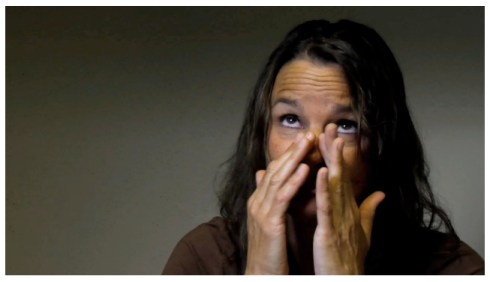
The IF Project Trailer, Screengrab

Lance Duncan picks okra during a harvest session Friday, August 20, 2010 at the organic garden created by inmates and staff at the Travis County Crorrectional Complex in Del Valle. Duncan was enthusiastic about the garden and said he has been involved with organic vegetable gardening for a couple of years and plans to grow an organic vegetable garden after his release.
Photo by Larry Kolvoord. AUSTIN AMERICAN-STATESMAN
Organic gardens, indeed gardens of any sort, are not uncommon now in prisons of every state. They are, however, used sparingly at only the lowest security facilities. Rikers Island has a program, as do prisons in Washington State. Keep your eye out for more.
Before this post by The Austin American Statesman, I wasn’t aware of the program at Travis County Jail, Texas. Incidentally, Travis County also welcomed Billy Bragg and the JAIL GUITAR DOORS initiative at this years SXSW, which donates guitars to correctional facilities.

This recent release piques my interest:
Killed: Rejected Images of the Farm Security Administration prints 130 tri-toned black-and-white images scanned from negatives in the collection of the Library of Congress. Wiliam E. Jones’s book is the first to deal exclusively with the 35mm negatives that FSA director Roy Stryker killed with a hole punch during the early years of the project (1935-39). The book brings to light destroyed or defaced photographs by Walker Evans, Ben Shahn, John Vachon, and others; it also includes two essays by Jones discussing the images and possible reasons for their suppression.
You can search through the 175,000 Farm Security Administration/Office of War Information Black-and-White Negatives and pick out the punched prints yourself. Here’s some off just the first page.


In July, Foto8 reviewed the Punctured, a 5 minute film by the book’s author William E. Jones:
It was not so long ago that photographers and editors editing film would use a hole punch to indicate a selected frame, clipping a small half circle out of the edge of the frame by the sprocket holes where the frame number and film info had been burned into the emulsion during manufacturing. Stryker was more ruthless with his hole punch, “killing” the work of his photographers by punching a hole directly through the negative image. Unsurprisingly, the photographers objected to this practice, which Stryker ended in 1939. Many of the punched negatives survive in the US Library of Congress FSA archives.
Punctured, Jones explained, is about the “Interface between image making and power… what images authority gives us and what we do with them.” Jones’ effort is to unsettle those relationships and to this end Punctured is articulate in its explorations of the way that archives are constructed, of the FSA archive specifically as the product of Stryker’s judgments …
OTHER PUNCHY CONTRIBUTIONS
This all leaves me thinking of Lisa Oppenheim‘s Killed Negatives: After Walker Evans.

Lisa Oppenheim, from the project Killed Negatives: After Walker Evans
Carefully Aimed Darts points out the Etienne Chambaud also made use of the defaced FSA negs for the show A Brief History of the Twentieth Century

Installation shot, Etienne Chambaud: Personne, 2008
If only for the similarity between precision-cut and precision-painted holes I am left thinking of John Baldessari:

John Baldessari. Hitch-hiker (Splattered Blue) 1995. Courtesy Marian Goodman Gallery, New York © John Baldessari. Colour photograph, acrylic, maquette
This is worrying.
Los Angeles Jail guards at the Pitchess Detention Center, Castiac, CA have a new weapon in their armory. The 7 1/2-foot-tall ‘Assault Intervention Device’ emits an invisible 5-inch-square beam that causes an “unbearable sensation”.

The device is manufactured by Raytheon, an 80 year old multibillion dollar surveillance, radar and missile specialist with a catalogue of space-war technologies. Compared to Raytheon’s sprawling, global and stratospheric innovations, the ‘Assault Intervention Device’ is small, contained and personal.
Cmdr. Bob Osborne of the LA County Sheriff’s Technology Exploration Program, one of several deputies who tested (see video) the ‘Assault Intervention Device’, described the experience, “I equate it to opening an oven door and feeling that blast of hot air, except instead of being all over me, it’s more focused.”
The device – controlled by a joystick & computer monitor and with a 100 foot range – will be mounted near the ceiling in a unit at Pitchess housing about 65 inmates.
NBC Los Angeles reports, “The energy traveling at the speed of light penetrates the skin up to 1/64 of an inch deep. […] ‘Assault Intervention Device’ is being evaluated for a period of six months by the National Institute of Justice for use in jails nationwide.”
The statistics for violence at Pitchess are quite shocking – 257 inmate-on-inmate assaults occurred in the first half of the 2010.
Pitchess, a facility with 3,700 inmates, is a large facility with riots (some very recently) and obviously needs to counter the culture of violence. I just wonder whether shooting brawling inmates with lasers is the right way to go about it?
– – –
I have looked at highly sophisticated technologies before and how their imaging can affect our understanding of prison life, tension, engagement.
How would images of prisoners reeling from a ‘Assault Intervention Device’ laserbeam influence public opinion about this new fan-dangled correctional management tool? The deputies who’ve tested it say it’s unbearable and can only be endured for three seconds maximum, yet everyone knows that tasers are often repeatedly discharged upon stubborn, adrenaline-fuelled (sometimes drugged up) targets.
Again, very worrying.
At this years Les Rencontres d’Arles Photographie Festival the official photographs of the French prison inspectorate make up an exhibition entitled Behind the Walls of Cliche.
The independent French prison inspectorate (contrôleur général des lieux de privation de liberté) is nominated for six years and during that time he cannot receive any instruction from any authority; he can be neither removed nor renewed; and he cannot be prosecuted for his opinions he formulates or for the actions he carries out in his functions.
Currently, the director is Jean-Marie Delarue (here’s an interview with him about the state of French prisons).
Delarue’s team take photographs as documentation as they tour France’s prison system and it is these images that are currently on show at Rencontres d’Arles.
To my mind, this is a truly unique exhibit. I know not of any other arts festival that has put front-and-centre the administrative photography of a working independent or government agency overseeing prisons.
BLURB FROM LES RENCONTRES D’ARLES SITE
Sixty thousand detainees in French prisons: surely the problem can’t be all that hard to solve!
The Rencontres, in their own way, are part of the media, and this exhibition based on the report of France’s Inspector General of Prisons, Jean Marie Delarue, shows just how the world of French gaols, far from being an aid to social reintegration is, rather, an insult to the human condition. This is a call to look beyond the standard ideas about prison.
The exhibition also demonstrates the limitations of photography, which cannot convey the nuances of everyday unhappiness in prison. In a photo a TV set, a workshop and a library seem to offer possibilities which in fact are non-existent for most prisoners, and certainly not available on a regular basis. The rules of hygiene and safety are flouted every day, the psychological stresses are chronic, and the laws regarding the minimum wage and access are broken by the state itself. None of this is visible in a photo.
Pictures of a new prison seem to suggest a solution; but the image doesn’t tell you that new prisons have a higher suicide rate than old, dilapidated ones. Three people in a cell is something you can see; but what you don’t see is that one inmate standing means two lying down, because there’s nowhere to sit. And with prisoners spending 22–24 hours a day in their cells, it’s easy to imagine their physical and psychological state.
This is definitely not photojournalism, but rather an alarm signal regarding one of democracy’s least well known instruments.
François Hébel, exhibition curator
Excerpt from Law no. 2007-1545 of 30 October 2007:
’The Inspector General of Prisons is an independent authority whose duty it is, without prejudice to the prerogatives attributed by the law to the judiciary or jurisdictional authorities, to monitor the conditions of incarceration and transfer of persons legally deprived of their freedom, so as to ensure respect for their fundamental rights.
Within his field of responsibility, he takes no orders from any authority… He cannot be relieved of his duties before his term has expired… The authorities in charge of places of imprisonment cannot oppose a visit by the Inspector General except for grave, imperative reasons relating to national defence. The Inspector General may demand from those authorities all information and documentation required by the carrying-out of his mission. In the course of his visits he may speak, under circumstances guaranteeing the confidentiality of what is said, with any person whose participation he sees as necessary.
At the end of each visit the Inspector General makes known to the relevant ministers his observations regarding the state, organisation and functioning of the site visited, and the condition of those imprisoned there… Each year the Inspector General submits a report to the President of the Republic and to Parliament. This report is made public.’
The 2009 report is published by Dalloz.
PREVIOUSLY ON PRISON PHOTOGRAPHY
I’ve noted French prison photography before. From Jean Gaumy, the first photojournalist in the French prison system to contemporary artist Mathieu Pernot; from the archives of Henri Manuel to portraitist Phillipe Bazin; and to the recent exhibition Impossible Photography – artistic survey of French prisons.
– – –
Of course, if you want to get really involved check out Melinda Hawtin’s French Prison Photography graduate work.
France even has its own National Museum of Prisons!
– – –
Thanks to Yann Thompson for the tip!

Cutting a chair and stool. © Gary Walrath. Taken with Pentax ME super.
Two years ago, I found Gary Walrath‘s set of photos from a 1970s Logging Show at Oregon State Prison. They are so unique they don’t really fit into any recognisable discussion … still.
I have also repeatedly tried to contact Gary about the background to the series. No luck. So, I simply provide a couple of images, a link and some bemusement at the spectacle of axes and chainsaws within prison walls.
Gary is a busy amateur photographer and a seven times chainsaw World Champion, in the Un-limited Hotsaw Class. His weapon? The Iron Horse.
‘The Iron Horse – 90 hp 500cc Husqvarna Motorcycle Engine. Running Oregon 1/2 pitch chain on a 36″ custom made guide bar. The drive sprocket is 16 tooth. Over 8,000 RPM in the cut.’ (Source)
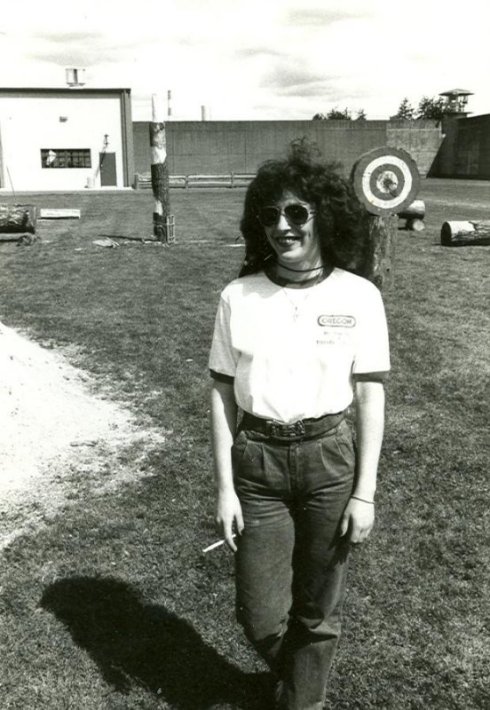
Ronda (she drove the prisoners nuts). © Gary Walrath. Taken with Pentax ME super.

Claude Hankins
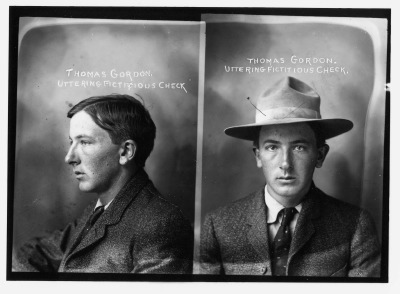
Thomas Gordon
Without question, the mugshot is a dominant “genre” in American photography. Least Wanted, aka Mark Michaelson, has released a book of his collected mugshots, Danny Lyon is fascinated by them, I’ve been seduced from time to time.
Arne Svenson is another artist who has put together mugshots (this time from the 19th century) to make a book. Svenson is a portraitist and his art is more complex when his collected mugshots and his headshots of forensic dummies & sock monkeys are considered alongside one another.
PRISONERS
“Svenson’s first book entitled Prisoners came about after the discovery of a collection of turn of the century glass plate negatives from Northern California recording convicted criminals as classic frontal and profile mug shots. He lovingly printed these negatives, bringing the subjects alive, and painstakingly researched each of their stories.” (Source)
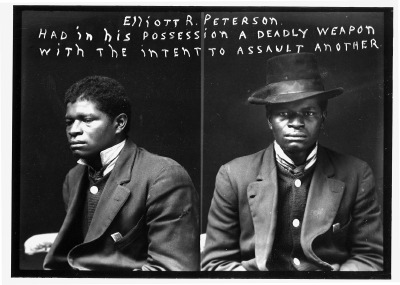
Elliott Peterson

W.M. Heron
FORENSIC DUMMIES
Svenson spent four years traveling around the country to coroner’s offices and law enforcement agencies photographing forensic identification aids in a classic portraiture style. Twin Palms Publications will publish a book of this work, entitled Unspeaking Likeness, in 2010.

© Arne Svenson
SOCK MONKEYS
Unsurprisingly, the public and the market love Svenson’s 200 Sock Monkey portraits.
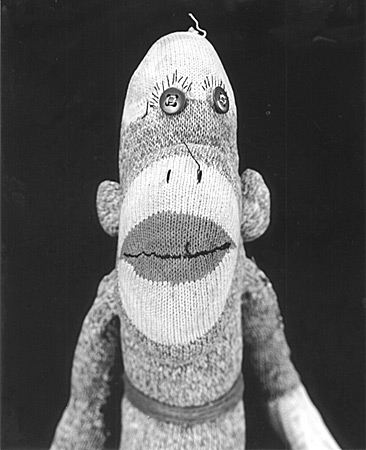
Sock Monkey #1761, 2001, Gelatin Silver Print. © Arne Svenson
See more at Jan Kesner Gallery

 Prison Photography