
You are currently browsing the category archive for the ‘Institutional’ category.
Last week the Daylight/CDS Photography Award winners were announced. Sarah Sudhoff’s latest project stood out. Whether it is deep enough or lasting or I can’t say, but it stood out.
Sudhoff: “At the Hour of Our Death takes as its starting point [Phillipe] Aries’s observation that “death’s invisibility enhances its terror”. These large-scale color photographs capture and fully illuminate swatches of bedding, carpet and upholstery marked with the signs of the passing of human life. The fabrics which are first removed by a trauma scene clean up crew, are relocated to a warehouse before being incinerated. It is in the warehouse that I photograph these fragments stained with bodily fluids. I tack each swatch to the wall and use the crew’s floodlights to illuminate the scene.”
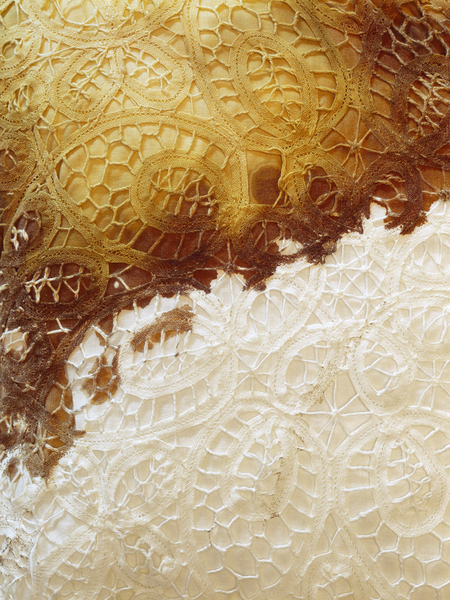
Illness, Female, 60 years old. Archival Pigment Print, 2010. 40 x 30 inches
Other series in Sudhoff’s portfolio are worth a look, notably Repository which is a self-portrayal project about Sudhoff’s cervical cancer in 2005.
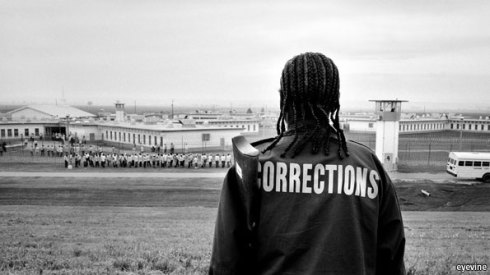
© Eyevine / Lori Waselchuk
Last weeks article, Rough Justice in America, by The Economist repeats many truths of America’s broken prison system we know already, here summarised:
“The system has three big flaws, say criminologists. First, it puts too many people away for too long. Second, it criminalises acts that need not be criminalised. Third, it is unpredictable. Many laws, especially federal ones, are so vaguely written that people cannot easily tell whether they have broken them.”
As expected the arguments made against mass incarceration here are on based on financial sustainability and fortunately such thinking is melding with the notion of social sustainability. The stories of George Norris and Michelle Collette form the anchor to the piece which posits that “Never in the civilised world have so many been locked up for so little.”
LORI WASELCHUK
I recognise the photographs as those of Lori Waselchuk whose work Grace Before Dying from the Angola Prison Hospice should not be missed. For it, Waselchuk won a Soros Documentary Photography Grant (2007), a Photolucida Critical Mass Top50 (2008). Here’s a great interview with her by Nicole Pasulka of the Morning News.
– – – –
Thanks to Joerg for the link

I have not and will not ever go through 90,000 pages of wikileaked documents covering US military operations (January 2004-December2009). But, if the Guardian tells me its legitimate and important, I’ll begin with that understanding.
What then, when Mother Jones – more precisely Adam Weinstein – comes along and tells me not to believe Assange’s hype?
Adam Weinstein at Mother Jones dismisses the import of the Afghan War Logs on wikileaks:
“In truth, there’s not much there. I know, because I’ve seen many of these reports before – at least, thousands of similar ones from Iraq, when I was a contractor there last year. I haven’t been through everything yet, but most of what you see on WikiLeaks are military SIGACTS (significant activity reports). These are theoretically accessible by anyone in Iraq, Afghanistan, or the Tampa, Florida-based US Central Command—soldiers and contractors—who have access to the military’s most basic intranet for sensitive data, the Secret Internet Protocol Router Network (SIPRNet). Literally thousands of people in hundreds of locations could read them, and any one of them could be the source for WikiLeaks’ data.”
My question: Just because it is easy for service personnel or contractors to view the material doesn’t change the significance this leak has for the general public in its capacity to form a view of the war based on new material, does it? Weinstein counters again, “By and large, like most of the stunts pulled by Assange, this one’s long on light and short on heat, nothing we didn’t already know if you were paying attention to our wars.”
Weinstein does make the valid point that the lives of Afghan collaborators are now at risk, as their names are not redacted from the material.
Ultimately though, I fear the coverage of the leak may develop into a character dissection of Assange and “discussion” of the relative merits of new-journalism; the former will dominate and the latter could be fruitful but will probably miss the point.
I am in support of wikileaks, but mainly because I am opposed to the war. I don’t feel our media does a good enough job at getting to the realities of war for the American news consumer. We saw just last week that the mainstream media ceased using the word torture for water-boarding almost overnight. That linguistic culture shift suggests to me that the mainstream media are as subject to political pressures as any individual … so, why shouldn’t we have wikileaks mix it up? And why shouldn’t we think about the flows of information: or the definition of free media: or tactics are served when information is kept classified, hidden?

On 26th July 2010, Comrade Duch, the chief executioner of the Khmer Rouge will finally face justice. A verdict is due to be passed down in the trial of Duch who is charged with war crimes and crimes against humanity for his part in the deaths of up to 12,000 Cambodians.
Duch’s trial would not be possible if photographer Nic Dunlop had not tracked him down in 1999. The story is told in Nic’s book The Lost Executioner.
Dunlop says, “It’s a strange thing to think that a chance encounter eleven years ago in a remote village has led to a multi-million dollar trial involving dozens of legal experts, academics, victims, perpetrators and journalists. But it is disappointing that only one man has been tried for these crimes in more than 30 years.’
(via)
Was it an inside act of rebellion?
I have absolutely no grounds on which to make an accusation, which is why I phrase it as a question.
But just looking at the foolish doctoring of images, especially the helicopter cockpit image, I wonder if the culprit intended to be caught? The color of the photoshopped image is just ludicrous, literally unbelievable, unless that is Martin Parr’s Gulf of Mexico!
To me, the reworking seems suspiciously blatant. Who is the “contract photographer” doing these pig-eared photoshoppings? And, is he/she a saboteur?

Original. © BP p.l.c.
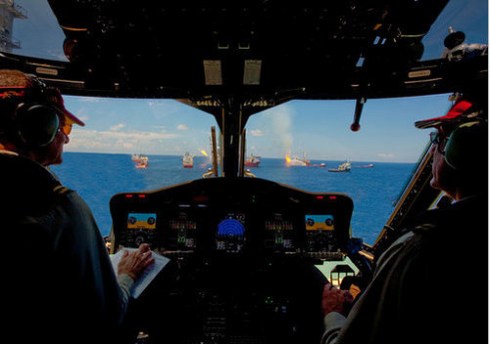
Botched photoshop. © BP p.l.c.
INTERNET MEME
Rather joyously, this image has become a meme. See the comments in the original and excellent Gawker article!
Talk to anyone about American documentary photography, they’ll probably mention Danny Lyon. Talk to anyone about prison documentary photography and they’ll definitely mention Danny Lyon.
In terms of US prison journalism, Lyon was the first photographer to a) give a shit, b) gain significant access, and c) distribute journalist images far and wide.
I had read Nicole Pasulka’s interview with Danny Lyon when it was published for The Morning News in December, 2008. I have since begun reading Like a Thief’s Dream (currently 100 pages deep). As in many cases, it takes an AmericanSuburbX reissue to press the issue.

Renton in his cell, Walls Unit, Huntsville, Texas, 1968. © Danny Lyon
I have a few things to say about the chapters I’ve read so far, but those thoughts need more brewing. While I mash those brain-hops, I’d like to draw your attentions to Lyon’s comments about prisons in America:
“You really need a friend, or family member inside a prison, to appreciate what we are doing. America has two million people inside of her prisons. Only China, a dictatorship, tops us in this growth industry. I like to think of the words of Fredrick Douglas “Be neither a slave nor a master.” All of us, outside of prisons, are the masters.“
“Prisons should be turned into bowling alleys, schools, and daycare centers, or demolished. We could probably do better with 90 percent of the inmates being released. Communities should deal with offenders on a local level. Review panels should meet with all of the 200,000 prisoners doing life sentences. Many of these people are harmless and aged, and should be released. I would like to see review panels sent into all the prisons, to meet with inmates face to face. Most should be released.“
“When I was working in the Texas prisons (1960s and 70s) there were 12,500 men and women inside and no executions. Today there are 200,000 in Texas and they kill prisoners all the time. Prisons are now everywhere, a major employer in upstate New York. Simply put, everything about prison is worse.”
“The best way to change yourself is to go outside your world into the world of others. It’s a big world out there. The worst thing about New York City is that all the young people that gather there are extremely like-minded. Creative people are comfortable there, but they are preaching to the choir. I always wanted to move Brooklyn to Missouri. Everyone would benefit.” (Source)
I couldn’t – and have not – ever put it better myself.
– – – – – – – –
Buy a signed copy of the book Like a Thief’s Dream at Danny Lyon’s website, Black Beauty.

Postcard sent by the author to Renton in prison in the early 1980s

A bathroom inside the Maze Prison, near Lisburn, Northern Ireland, on Tuesday, April. 11, 2006.
Andrew McConnell‘s work The Last Colony from the Western Sahara has gained some traction recently, promoted at DVAFOTO and backed up by TPP.
McConnell is from Northern Ireland so I was not too surprised upon looking through his portfolio to find a series on the Maze prison.
I’ve seen a few projects from Maze Prison – the most well-known being that of Donovan Wylie – and yet a few of McConnell’s images really stood out.
STATEMENT
McConnell: “HM Maze Prison, also known as Long Kesh and the H-Blocks, held some of the most dangerous men in Europe during its 30 year operation. The prison closed in September 2000 after 428 prisoners had been released under the Good Friday Agreement. There are now plans to turn the abandoned site into a national football stadium.”
The bathroom image (above) is admittedly more powerful to me, having seen the bloodied-knuckle washing scenes in Steve McQueen’s powerful debut film Hunger.
Also, admittedly the image of the football (below) is more loaded given the now-defunct plans to convert the site into a national stadium.
In January 2009 plans to build the £300 million multi-purpose stadium were officially axed with politicians saying plans to start the construction of the stadium wouldn’t be reconsidered for another 3 to 4 years. (Source)

An old football lies in the exercise yard of the Maze Prison, July 18, 2006.
I had been under the impression every structure at the Maze had been demolished but apparently not:
Discussion is still ongoing as to the listed status of sections of the old prison. The hospital and part of the H-Blocks are currently listed buildings, and would remain as part of the proposed site redevelopment as a “conflict transformation centre” with support from republicans such as Martin McGuinness and opposition from unionists like Nigel Dodds who are against erecting a memorial to those who died during the hunger strike. (Source)
Which ties nicely back into the crucial question about McConnell’s photographs of the site. Are these photographs of memory, for memory, for memorial? What audience do they serve?
It seems to me that politics and emotions vary so wildly, that when a photographer (so soon after decommission) takes on a contested site such as this, his/her photographs are open to many different interpretations. The Maze and its history are fascinating, discussion-worthy topics, but is it the case here that the images are nothing more than notable ‘urban exploration‘?
Donovan Wylie dodged this suspicion by documenting over a five-year period the slow demolition of The Maze. Wylie has talked about wanting to create an archive of this transitional moment. However, if a photographer’s series is too brief (either within its own boundaries or by comparison to another practitioner’s series) then how is it justified or explained?
I don’t want to be dismissive here, as I think this is a problem many political-documentary photographers face – namely, their work may not adequately reflect or contain the disputed political landscape it references.
Perhaps we should read McConnell’s The Maze as undefinable and undecided, just as the former prison site remains?

The Cages of the Maze Prison, Northern Ireland, July 18, 2006.
Biography
Andrew McConnell was born in Northern Ireland in 1977 and began his career as a press photographer covering the closing stages of the conflict in his homeland and the transition to peace. He later worked in Asia and moved to Africa in 2007 to document the issues and stories of that continent which are widely overlooked by the international media.
His images have appeared appeared internationally in publications such as National Geographic Magazine, Newsweek, Time magazine, The New York Times, The Guardian, FT Magazine, L’Express, Vanity Fair (Italy), the Sunday Times Magazine, and Internazionale.

© Thomas Hawk
Thomas Hawk’s images are being used by police to pursue Oakland looters:
“I recognized several of the photographs that the Oakland PD had released as my own photos that I’d taken the night of the riots and had posted to my own Flickr account. I was never contacted by the Oakland PD regarding their use or distribution by Oakland PD. It’s interesting to see law enforcement taking photos by citizen media and using them this way.”
Under Creative Commons (which these images were) there is no problem with anyone, including police, “to copy, distribute and transmit the work” provided they attach attribution. Unfortunately, the Oakland Police Department didn’t name Hawk as the photographer, seemingly passing the images off as their own.
Here’s the San Francisco Chronicle article in which Hawk found his photographs.
(via)

 Prison Photography