
You are currently browsing the category archive for the ‘Institutional’ category.

Diaz’s left arm had an 11-by-7 inch chemical burn from the lethal drugs. By the time the autopsy began, the superficial skin had sloughed off, revealing white subcutaneous skin. (Source: New Republic)
Yesterday, The New Republic published for the first time a set of photographs of a chemically burnt corpse. The body was that of Angel Diaz, a man executed by the state of Florida in December of 2006.
As author of the piece, Ben Crair explains, “The execution team pushed IV catheters straight through the veins in both his arms and into the underlying tissue.”
Diaz sustained horrendous surface and subcutaneous chemical burns.
“As a result,” Crair continues, “Diaz required two full doses of the lethal drugs, and an execution scheduled to take only 10 to 15 minutes lasted 34. It was one of the worst botches since states began using lethal injection in the 1980s, and Jeb Bush, then the governor of Florida, responded with a moratorium on executions.”
The photographs were made by a Florida medical examiner during Diaz’s autopsy. Crair discovered the photographs in the case file of Ian Lightbourne, a Florida death-row prisoner whose lawyers submitted them as evidence that lethal injection poses an unconstitutional risk of cruel and unusual punishment. While the details of Diaz’s botched execution have been known since 2006, this is the first time visual evidence of the injuries sustained from the lethal injection has been presented publicly.
I’d like to tell you that such images are anomalous, but sadly that is not the case.
I, myself, have seen a set of images of a burnt corpse post execution. The victim in that case was executed in the electric chair. Similarly, in that case, the images were in the possession of a lawyer (who had acquired them through family of the executed) and used in court in argument against the electric chair as cruel and unusual punishment.*1
May I suggest that the photographs of Angel Diaz’ corpse, and all those images like them, be accessioned into the Library of Congress?
If the Library of Congress’ mandate is to preserve those things that are central to American culture; central to the American conscience, dear to this nation’s body politic and truly reflective of our culture, then I hold there is no better collection of images than these.
Between 1890 and 2010, the U.S. has executed 8,776 people. Of those, Austin Sarat, author of Gruesome Spectacles: Botched Executions and America’s Death Penalty says 276 went wrong in some way. Of all the methods used, lethal injection had the highest rate of botched executions — about 7%.
Photographs of a botched execution are as American as apple pie.
Whether an execution is considered officially “botched” or not, the torture imposed on a body in the minutes before death is unconscionable. Crair pursued the story and the publication of the images, rightly so, in the aftermath of the recent botched execution of Clayton Lockett in Oklahoma.
“The execution team struggled for 51 minutes to find a vein for IV access,” writes Crair, “eventually aiming for the femoral vein deep in Lockett’s groin. Something went wrong: Oklahoma first said the vein had “blown,” then “exploded,” and eventually just “collapsed,” all of which would be unusual for the thick femoral vein if an IV had been inserted correctly. Whatever it was, the drugs saturated the surrounding tissue rather than flowing into his bloodstream. The director of corrections called off the execution, at which point the lethal injection became a life-saving operation. But it was too late for Lockett. Ten minutes later, and a full hour-and-forty-seven minutes after Lockett entered the death chamber, a doctor pronounced him dead.”
CLOSING THE BLINDS
The single detail about the Oklahoma debacle that really stuck in my mind was the state’s decision — upon realising the execution was being botched — to drop the blinds.
The gallery of spectators including press, victim’s family and prisoner’s family lost their privileged view.
In that instance when the blinds dropped, the scene switched from that of official, public enactment of justice to the messy, sick, complicit torture of a human. In that instance, the barbarity of the state revealed itself fully. And the state was ashamed. The public were no longer allowed to see.
The notion — indeed the internal logic of the state — that viewing one type of execution is acceptable and another is not is astounding. By virtue of its actions during Lockett’s botched execution, the state has distinguished between what types of torture (execution) it is acceptable to see. Quick, quiet, seemingly painless = good. Noisy, drawn out, demonstratively torturous = not good.
The distinctions are petty. All executions are cruel and unusual.
At this point, I can only presume those who still support the death penalty are those who subscribe to some pathological eye-for-an-eye illogic. Wake up! The state shouldn’t be involved in murdering people. Especially when we have seen 1 in 10 people locked up for life or on death row for capital offenses later exonerated due to DNA evidence or prosecutorial misconduct. The state shouldn’t be involved in murdering innocent people.
*1 People are under the misconception that the electric chair zaps a person and kills them instantly. This is not the case. Electricity takes the paths of least resistance which is outside of the body. Therefore, tens of thousands of volts serve only to burn the points at which they are attached, namely the lower leg and the skull. Death by electric chair is in fact just boiling the victims brain for 7 seconds. Boiling the brain alive.
In recent months, there’s been a number of interesting — and in some cases, urgent — photo stories coming out of prisons worldwide, that I’d like to draw you attention to.
ANDREW BURTON

Anthony Alvarez, left, 82, eats breakfast with Phillip Burdick, a fellow prisoner and member of the Gold Coats program at California Men’s Colony prison in December. Mr. Alvarez said he has been incarcerated for 42 years for a series of burglaries, possession of illegal firearms and escapes from county jail. He eventually got a life sentence due to three-strikes laws. Shown is Mr. Alvarez’s first day being assisted by the Gold Coats; he largely needs help with mobility. Mr. Alvarez tries to work out for a few minutes every other day. Mr. Burdick, 62, has been volunteering with the Gold Coats for more than 18 years and is the longest-serving member of the program. Mr. Burdick has served 37 years on a 7-years-to-life sentence for first-degree murder.
Andrew Burton‘s photographs of aging prisoners for the Wall Street Journal have been well-received. With one of the largest state prison populations, a history of long sentencing laws and inadequate healthcare, the old men and women have the odds stacked against them for a comfortable day-to-day living.
The percentage of prisoners 55 or older in the U.S. increased by more than 500% between 1990 and 2009.
Burton’s photos focus on the Gold Coats program at California Men’s Colony, in San Luis Obispo, which pairs younger, willing prisoners with older prisoners suffering dementia and terminal illness. In 1991, California Medical Facility created the first prison hospice program in the nation to deal with the AIDS crisis, and the hospice is now used for elderly prisoners who are terminally ill.
Great photos. Burton is realistic about the situation but seems clearly impressed with efforts there.
However, here’s some context. Ever since California’s medical prison system was deemed cruel and unusual and it was brought under federal receivership, the state has been making efforts to deliver specific facilities for health care. The largest was to open the California Health Care Facility in Stockton, CA. It is the largest medical prison in the world. At a cost of $840M it was supposed to solve many issues and provide care for 1,800 prisoners. Nothing is so straightforward. Since opening in July, 2013, it has been beset by waste, mismanagement and miscommunication between the prison and medical staffs.
Watch this space. Hopefully vast, vast improvements will ensue.
[Todd Heisler has photographed at the California Men’s Colony too.]
ANDREA WISE

Erika Roberts, 26, of Hartford is a factory worker, a dancer, a teaching artist, a worshiper, a mother of three, and a felon.
Photographer Andrea Wise soon realised that when lives are intertwined with the criminal justice system nothing is straightforward. From the millions of effected formerly-incarcerated millions, Wise’s Freedom Bound manages to tell the story of Erika Roberts on very humanising terms. And with touching photographs.
“Her story is both a simpler one – a quiet story of a young family just trying to do the best they can – and a more complex and nuanced story about life in poor urban communities where people grow up in and around trauma, where criminal activity and incarceration are commonplace, and where Erika’s story isn’t all that uncommon,” says Wise.
Freedom Bound explores Erika’s quiet determination and struggle to break the cycle of incarceration.
“Erika strives for more from life, for her children, and for her community,” writes Wise.
ANIBAL MARTEL

In 2012, Anibal Martel photographed inside Lurigancho Prison, the largest and most overcrowded prison in Peru.
“According to the National Penitentiary Institute of Peru (January 2012) Lurigancho has a capacity limit of 3,204 prisoners but it actually holds 6,713 with a ratio of one police officer to 100 inmates,” says Martel.
“With corruption, tuberculosis and drug dependency together with its appalling management by the state, the prison gained a reputation as one of the most dangerous prisons in the world,” Martel continues. “Today, Lurigancho is fighting to survive thanks to the internal organization of some prisoners and their work. These prisoners have managed to create a small, internal infrastructure that allows them to feed themselves and live a more dignified life.”
ERIC GOURLAN
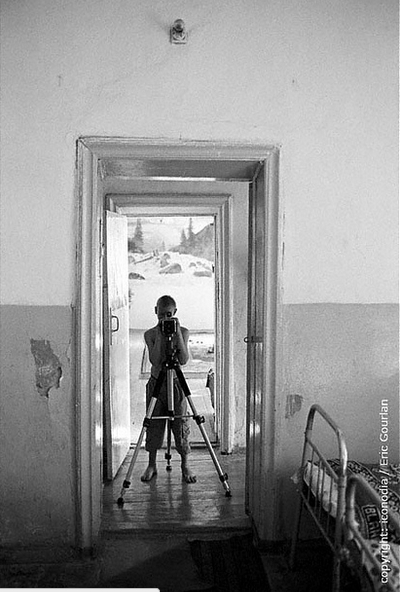
French photographer Eric Gourlan voluntarily spent a month inside Kyrgyrzstan’s prison and documented life in two men’s prisons, one women’s jail, and a juvenile detention centre — all in the capital Bishkek.
Gourlan has published on Flickr photographs from the juvenile facility in Bishkek, Kyrgryzstan.
There’s a great interview with Gourlan on the Institute for War and Peace Reporting website. Gourlan explains that he gained access through valuable partnerships with State Service for Execution of Punishment (GSIN), the United States Agency for International Development, Freedom House, the OSCE Center in Bishkek, the GSIN Public Oversight Council and the Kyrgyz NGO Egel — a long list which gives us an idea of the importance of partners for this type of work.
“I would really like to commend the openness of [prison] officials in Kyrgyzstan – I could go almost everywhere I wanted,” says Gourlan. “The only thing was that in the first two days, I was accompanied by guards until everyone got used to me. But then I was given more freedom and practically could move around on my own. On some occasions, I ate with prisoners.”
Gourlan met some hardened criminals but also met people who’ve been victims of overly-punitive sentences.
“One woman told me that she had been in a very difficult financial situation and somebody asked her to transport 30 grams of heroin from point A to point B for 100 [US] dollars. She was caught and given 12 years in prison. She had never used drugs before, never sold them, and never got her 100 dollars, but she has been locked up for 12 years,” explains Gourlan. “Obviously I do not know if those stories I was told were true or not. But that was not why I embarked on this project.”
Eric Gourlan’s project was backed by Freedom House, the OSCE Centre in Bishkek, a local NGO called Egl, and the prison service in Kyrgyzstan.
More photos on l’Oeil de la Photographie and this video on Freedom House, a group in support of human rights in Kyrgyzstan.
ISABELLE SEROUART
Isabelle Serouart‘s rare photographs from within a prison in Madagascar were published by SoPhot. The images are small and embedded, but I also found this footage Serouart made of female prisoners singing.
“In a very confidential way record of women song in a jail in Madagascar,” says Serouart. “To sing is a way for her to survive together.”
DAVID RYDER
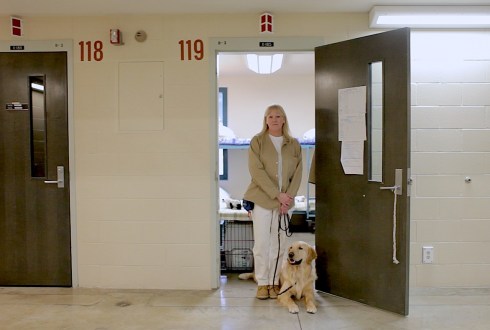
David Ryder, for The Wall Street Journal, made a video about the Prison Pet Partnership at the Washington Corrections Center for Women in Gig Harbor, Washington is an interesting watch.
“The program allows inmates to learn job and life skills while providing kennel and grooming services to clients from the surrounding community,” says Ryder. “In addition, unruly dogs from other programs (who might otherwise be put to sleep) are able to have a second chance by entering the prison’s training program.”
This is a win-win for the women, the dogs, the prison administrators and the media. Despite prisons being a continual source of distress and latent abuse, the press always needs new angles — depressing stories don’t have the readership coming back. A human interest story about (wo)man’s best friend and redemption plays well, and we’ve seen them before. Here’s a couple more similar project in Florida and Colorado.
Another thing that makes me slightly uncomfortable with the story is that simultaneously, just over an hour south, detained immigrants were on hunger strike for their confinement in solitary and slow progress of their cases. Now I know, the state prison system and U.S. Immigration & Customs Enforcement are different authorities, but if we’re to look at lock-up in Washington State, I’d suggest we factor in ALL types of prisons and prisoners. ICE facilities remain the most inviisble.
The full WSJ story, to accompany Ryder’s video, by Joel Millman and with photos by Stuart Isett, you can see here (behind a paywall).
As an aside, the most interesting photography project on prison dog’s programs remains Jeff Barnett-Winsby’s Mark West & Molly Rose. After Barnett-Winsby had photographed the prisoner (Manard) and the program administrator absconded from the Safe Harbor Program and escaped from Lansing Prison, KS and went on the lam for 11 days. A weird tale of fact and fiction, manipulation and unsaid knowns. The investigating police acquired Barnett-Winsby’s photos because he had made the most recent images of Manard’s tattoos. Yet Manard had drawn false tattoos for the shoot predicting their use later following his escape. Twists and turns. No photographer can ever plan or predict such a bizarre story, or implication in it.
MAE RYAN
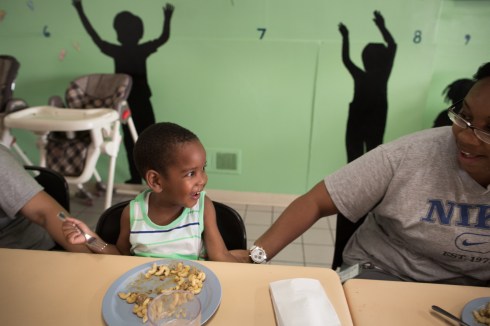
A child plays with his mother at the cafeteria inside The Community Prisoner Mother Program in Pomona, California. Mothers and their children live in open barracks shared with two other mother-child family pairs.
Mae Ryan‘s series on the Community Prisoner Mother Program in Pomona, California was one of the last assignment’s she made before moving from KPCC to The Guardian. And it is stand out.
Pregnant in Prison offers a look at a select group of minimum security prisoners who may live with their young children until the child turns seven years old. Mothers live with their children in rooms shared with other prisoners. During the day, children are enrolled in the on-site preschool and Kindergarten and mothers take rehabilitation and other classes.
In 2011 and 2012, 233 female prisoners gave birth while serving time in the California prison system. So, this program applies to only a tiny fraction of women suffering California’s prison system. It is a welcome, forward-thinking program. Psychological studies are unanimous that close bonds between mother and baby, from the earliest hours, are vital in sparking healthy cognitive and social behaviours. Why wouldn’t we allow incarcerated mothers the ability to raise their own children?
In terms of such residential programs, most (and there are only a handful) allow mothers and babies to be together until the baby is 2 or 3 years of age. Pomona is exceptional.
Let me be clear though, I don’t want to see more prisons with this type of program; I want to see less prisons with lesser need for these types of programs. I want to see community supervision instead of incarceration and if prisons must be used, then for them to be bursting with positive programs designed around the women’s needs. That said, the Community Prisoner Mother Program has many elements to inform better care.
ANONYMOUS GREEK PRISONER
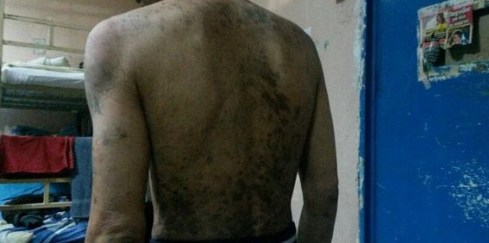
An expose by a Greek Prisoner registered on American news consumers’ radar when Medium published the piece Greece’s Biggest Prison Is Boiling by Yiannis Baboulias. The photographs accompanying the piece were taken by a prisoner and were then published repeatedly through the Twitter account @kolastirio.
He also got his footage out:
The expose caused outrage.
Baboulias writes, “People suffering from HIV, tuberculosis, psoriasis, cancer and other serious diseases, are discarded like trash in common rooms where hygiene is an unknown term. Spaces designed to hold 60 people, now hold more than 200. Reports say that some of these diseases have already started spreading amongst the inmates, making the prison a threat to public health in the general area. As inmates report, when the staff realises someone is close to death, he is quickly transported to a hospital, so his death won’t be recorded in the prison’s logs.”
Given that the infrastructure of Greece is collapsing in the wake of it economic meltdown, how surprising is this neglect? Hospitals are having budgets cut by 25% so what chance have the prisons and prisoners in the grapple for resources?
In an update, Baboulias says that the prisoner that leaked the photos and video has been prosecuted and faced trial.
VALERIO BISPURI

Valerio Bispuri has photographed in 74 prisons in South America, over a period of a decade. I was grateful to find a short interview with him as part of Fotografia’s ‘Prison Week‘
“It was clear to me that would have required a great time commitment when I realized that permissions to photograph in the prison were going to take months to obtain,” says Bispuri. “In a few cases I’ve had to wait for years.”
Women’s prisons are rarely any better.
“There certainly is anger in female prisons as well, which sometimes turns into violent attacks. Moreover, in most prisons, female inmates are denied the “intimate visit”, that is the possibility to have sexual intercourse with their husband or partner, which is instead granted to those male inmates who behave properly,” explains Bispuri.
The work has had some effect. Following an exhibition of Bispuri’s photographs, in Buenos Aires in 2009, in collaboration with Amnesty International and the Argentine Government, Mendoza Prison’s Pavilion N5 was closed down.
“Life conditions there were tragic,” says Bispuri.
Bispuri’s series Encerrados describes how hellish many of the facilities. He has had a knife held to his neck and infected fluids thrown at him as protest to being photographed. Still, Bispuri is sympathetic to the resolve of many prisoners.
Also, featured during prison week were photographers Stephen Tourlentes, Sergei Vasiliev and Amy Elkins.
AMY ELKINS

Amy Elkins recently won the Aperture Portfolio Prize for her projects Parting Words and Black Is The Day, Black Is The Night. Congratulations to her. I’ve written and thought extensively about both projects (for Huffington Post and for Daylight Digital, respectively) and in the wider context of Elkins’ approach.
Hope you appreciate these works and find something you like. Sorry this post is effectively an illustrated barrage of links, but we should be grateful there’s so much work being published! Let me know what you think of it all.
Update 05.11.2014: The Eventbrite registration page has been closed after 80 sign-ups. But, there’s space for walk-ins and allcomers. We don’t want to turn anyone away!
Email info@asocialpractice.com to extend your interest. Thanks.
A BIG PUBLIC CHAT
Next Friday, May 16th, as part of the Open Engagement conference, I’ll be part of a conversation about photography based art and social practice.

The Photo-Based Social Practice panel and group brainstorming is at the Aperture Gallery in New York, 10am – 12 noon.
Moderator Eliza Gregory along with panelists Gemma-Rose Turnbull, Mark Strandquist, Wendy Ewald and I will be discussing socially engaged, transdisciplinary, and expanded practices in contemporary photography.
Highfalutin, huh? Not really. The language is big, but the query is simple. Can photography build community and empower subjects? How can photography be nice?
It’s free, but preregistration is required. Do that HERE (6th option on the list).
We’re only going to do the briefest of introductions to our work before breaking into groups to tackle a host of questions that deal with audience, relevance and good design. It only makes sense that we collaborate to tackle answers to these issues.

We hope that the panel will follow nicely on from December’s Collaboration: Revisiting the History of Photography event that crowdsourced a new timeline of photo-history by focusing on projects with communities and groups as creators. I love the ideas involved in that.
While the Collaboration: Revisiting the History of Photography event gave new recognition to old projects and while it presented a new timeline and framework, it didn’t tackle best practices. From the projects it unearthed we can surmise the nature of some socially responsible projects, methodologies and motivations. In our discussion next week we hope to extend the conversation further and start to define common language, and potentially best practices, for socially engaged photography projects.
Please join us and help us along!
LOCATION, DATE, TIME
Aperture Gallery and Bookstore
547 West 27th Street, New York
10:00 am – 12:00 pm, Friday, May 16th.
FREE WITH REGISTRATION
NEW VENTURE! ‘PHOTOGRAPHY AS A SOCIAL PRACTICE’
Now is a good time to mention a joint venture recently started by my fellow panelists, Eliza Gregory, Gemma-Rose Turnbull and Mark Strandquist.
Photography As A Social Practice is a website for reference tools, teaching tools, and conversation about the intersection of social practice and photography. I’ll be contributing every so often and chatting on the phone about content. You can suggest resources by emailing info[at]asocialpractice[dot]com
SPONSORS
The panel is offered in conjunction with the Magnum Foundation and the Aperture Foundation who combined to publish Documentary, Expanded, the Spring Issue (#214) of Aperture Magazine as part of the Photography, Expanded initiative. Support also comes from the Open Society Documentary Photography Project, The School of Journalism and Communication (University of Queensland) and Portland State University‘s Art and Social Practice Program.
OPEN ENGAGEMENT, 2014
The Photo-Based Social Practice panel is part of Open Engagement, an international conference that sets out to explore various perspectives on art and social practice, and expand the dialogue around socially engaged art-making. This year, the conference addresses the theme of Life/Work. It is 2 days of programming (Sat, May 17 – Sun, May 18) at the Queens Museum, plus 1 day of pre-conference events on Fri 16th at different locations around the New York boroughs.

Yesterday, I listened to Margaret Winter, Associate Director of the ACLU National Prison Project, describe the “living nightmare” on Mississippi’s death row in 2002. Her words were visceral and painted an image, but of course no images exist.
On that death row, cells had no power. Men languished in “perpetual twilight without enough light to read.” Radios were silent. Summer temperatures soared to a life-threatening 120 degrees fahrenheit. Year-round, mosquitos from the surrounding swamps filled the cell-tiers at dawn and dusk. No toilets worked. The stench was unbearable. Every sense was under constant assault. Prisoners’ shrieks, sobs and babbling filled the air. Suicides and self-harm were routine and the prison officers maintained order with the deployment of pepper spray. The majority of the prisoners had severe mental illness, and of those that arrived in the unit sane, few were lucky to have the strength of mind to remain so.
If an individual treats an animal this way, they’re punished by law and yet in America our law sends people to wallow in such conditions and worse.
Attorney Winter explained that court-orders often provide legal professionals access into prisons that the media has been denied access for years, even decades. Class action litigation alongside advocacy and responsible reporting all contribute to a reliable view of prisons for the tax-paying public. That such deplorable conditions could exist in America in the 21st century surely makes the case for robust and independent monitoring of America’s prisons.
Winter and ACLU only became aware of the abuse after they received letters from dozens of men on death row. As I listened to Winter’s account, I thought back to a day earlier when I’d asked the same audience to consider not only what images they see of prisons, but also the images they do not see.
OKLAHOMA
Right now, Oklahoma is making a case-study of itself. Under the orders of new Dept. of Corrections Director Robert Patton, Oklahoma prisons now allow journalists to enter only with pen and paper. Apparently, the OK DOC has been “slammed” by over a dozen media requests. Slammed!?!? How low is the bar? No cameras or audio recording devices inside Oklahoma prisons.
Unsurprisingly, Patton cites security reasons. Who are we to argue? What do we, the uninformed public know about security? The tone is patronising. A healthy relationship between the press which serves the public and the administrations in control of our tax funded institutions would make me feel safer. This stinks.
The Tulsa World reports that Patton believes that the requirement to search the camera equipment diverts staff resources and time. He also fears images of sensitive security equipment wouldn’t end up in photos or videos.
“It is very staff intensive to process this type of equipment in and out of a facility. More importantly, we need to ensure that any security function not be recorded or filmed in a way that may jeopardize the safety of our facilities,” says DOC spokesman Jerry Massie.
All of this smacks of an institution stretched, stressed and flailing. And indeed it is. The Oklahoma prison system is overcrowded. To add to the pressure, OK has the lowest levels of staffing of any state. Moral is low and pay is lower. Oklahoma has created a tumorous prison machine that does not rehabilitate but just churns up prisoners and staff and spits them out the other side.
No one is doubting Patton’s job is tough, but making adversaries of the press is not any type of solution. If anything he should be using the press more to expose the fractured department and broken lives he’s having to manage.
Unfortunately, some panicked lawmakers in Oklahoma think more private prison contracts are the solution. Private prisons use under-qualified staff, warehouse prisoners for longer, cut corners, and treat humans as commodity. They are based on efficiency models. Trying to make prisons more efficient IS the problem. Patton and Oklahoma’s only solution is to rely on incarceration less. Patton must establish community supervision programs for those prosecuted by law — they are cheaper and more effective.
I urge Patton not to listen to calls for extended privatisation and to put human needs ahead of budget needs. If he doesn’t, he’ll exacerbate the problem and fail the people of Oklahoma to whom he is (theoretically, at least) in service. By banning cameras and story-telling equipment, Patton will only succeed in alienating Oklahomans further.
This Tulsa World editorial hits the nail on the head: “This is no way to treat taxpayers who pony up a half-billion dollars annually to keep their prisons operating.”
FIRST HAND ACCOUNT
If I cannot convince you, perhaps a concerned Oklahoman might? I recently received this email from the loved one of a man imprisoned in Oklahoma.
“I’m aware that a camera inside, in the hands of a loved one, a visitor, is never going to happen. But journalism? Journalism is a must. I recently sent my loved one an article in print. It was about a prizewinning author who is incarcerated for life. The prison mail-guard and the contraband review board withheld that piece. Destroyed it. When I pressed, the reason given was that it contained a photographic image of a prisoner!
Photography is powerful. I imagine what my partner would capture if I could give him a camera — the haunted and defeated look in the eyes, the conditions inside the giant quonset hut housing 66 men in 33 bunk-beds.
Oklahoma has one of the highest incarceration rates in the country, and one of the highest uses of for-profit prisons. And now no one can take a photo inside? Dangerous stuff.”
This source asked to remain anonymous in order to protect her partner from any punitive response by the DOC.
Image: Seniors Walking Across America.
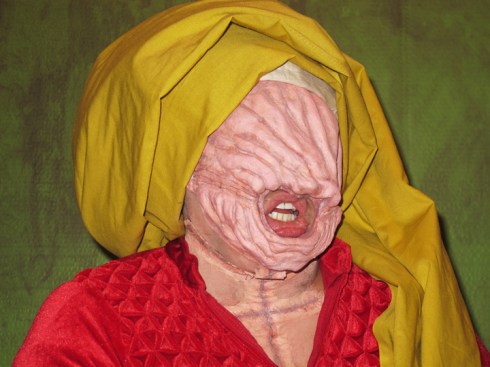
Kansas, MO and Brooklyn, NY based artist Jaimie Warren is the recipient of the 2014 Baum Award for an Emerging American Photographer. This is a curious selection for many reasons — all of them good.
Firstly, I wasn’t aware of Warren’s practice; even though she has a Wikipedia page and a long history with VICE, I had not come across Warren’s work before. I am glad I did.
Secondly, her work is wacky. The meanings of her images are elusive and you’ve got work hard with them. As many photographic artists do, Warren plays with ideas of fantasy, fun, performance and artifice, but she does so in much more aggressive, brazen way. These are not the cool, clinical images of studio assemblages we see from many young (MFA-bearing) image-makers.


I really, really enjoy Warren’s disfigured portraits and tableaus. They’re pop, they’re a bit grotesque, they cinch perfectly into the shock-visuals of audiences habituated to the Tumblr-driven flow of images. Warren’s work is Peewee Herman meets Carnivale meets that bonkers Halloween party you went to in 1997.
Thirdly, it is great to see an award go to a photographer who isn’t just a photographer. For all the intelligent image detournement in her work, Warren is not operating from a fine art ivory tower. Quite the opposite. Central to Warren’s work is constant collaboration with communities. Her main vehicle for making art is the non-profit community arts initiative Whoop Dee Doo.
Whoop Dee Doo works with communities “to create unique and memorable events that challenge the everyday art venue or community event.” Everything from concept to end product is intended to fit the needs of host communities, and all acts are “truly inclusive endeavors that celebrate differences and unabashed self-expression.”
Probably the best and quickest way to get a handle on the art and performances is to view the Whoop Dee Doo Vimeo Channel.
Whoop Dee Doo has worked with youth programs including Caldera Arts (Portland/Sisters, OR), Operation Breakthrough (Kansas City), the Boys & Girls Club (Kansas City), Big Brother/Big Sister (Kansas City), Girls, Inc. (Omaha, NE), Experimental Station’s Blackstone Bicycle youth Program (Chicago, IL), Urgent, Inc. and the Rites of Passage Program (Miami, FL), Muse 360 and 901 arts (Baltimore, MD), as well as college interns at the University of Central Missouri, Pacific Northwest College of Art, the Kansas City Art Institute, the University of Chicago, Maryland Institute College of Art, Rockhurst University, and the Pennsylvania Academy of Fine Arts.
Impressive.

Jaimie Warren, Self-portrait as Bulls fan in La Jeunesse de Bacchus by William-Adolphe Bouguereau/Michael Jordan basketball painting by dosysod of the Independents, 2012.

Jaimie Warren, Self-portrait as Nun with some of my Mother’s Favorite Famous People in the Forerunners of Christ with Saints and Martyrs of the Fiesole San Domenico Altarpiece by Fra Angelic, 2014.
From looking over the portfolios, I reckon the folky-rainbow-eclecticism of Warren and her collaborators’ work reflects something close to common feeling. What else could there by except fun, wild variance and complexity when the hands of dozens go into making something?
Breaking down stereotypes and barriers between age, gender, culture and sub-culture is one of Whoop Dee Doo‘s main objectives. The group is open to designing performances and workshops “between unlikely pairings of community members that ultimately blossom into exceptional and meaningful interactions.”
A lot of the time, the use and outcomes of awards can be hard to pin down, but I can’t imagine it’ll be too long before Warren is putting the $10,000 to use making more happenings with communities. Because she always has. Let the merriment continue.


BAUM AWARD
The Baum Award for An Emerging American Photographer is a project established out of the conviction that photography is a powerfully influential medium with the capacity to emotionally connect with audiences in ways that words cannot. This ability to reach people on a visceral level can transform awareness to understanding and lead interest into action – fundamental aspects of a healthy and vital society.
Click here to see previous Baum Award winners.
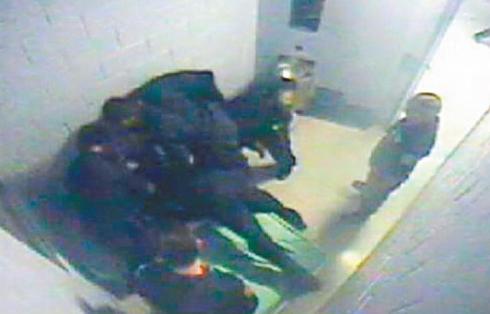
May 4th, 2009. 9:19pm: Guards pushed down on Messier’s back, pressing his chest toward his knees, “suitcasing” him, a dangerous tactic banned in prisons. Image courtesy of Boston Globe.
The title of this post makes it sound like I’ll be making a habit of recording these stories of abuse. I will not — there are too many.
The title of this post is also the slightest of variations on the title of a post I published yesterday. Again, I want to reiterate that episodes of abuse (particularly behind closed prison gates) are not irregular. I simply don’t have the time to catalogue them all.
This week, two particularly glaring cases of state violence inside prisons were reported. The first is a return to a 2009 murder by Massachusetts prison guards. The second, a prison doctor in California sterilising female prisoners without consent.
GUARDS RESTRAIN PRISONER, STAND NEXT TO HIM WHILE HE DIES
The murder of Joshua Messier is a murder that, in terms of legal language, is no longer. Guards killed Messier with rough restraint techniques. The medical examiner called it homicide, but later changed that verdict saying Messier’s initial violent outburst (due to his schizophrenic attack) meant he was to blame for his own death.
Prison guards put Messier into restraints and “suitcased” him meaning two officers put all their weight on Messier’s back while he was in a kneeling position. It is illegal control technique because of the risk of suffocation. Messier never moved when he came out of restraint. The guards stood idly around for 10 minutes. Messier stopped breathing, his face turned blue and he died in front of them. It took a nurse to notice something wrong before medical aid and CPR was delivered but by that time it was to late.
Multiple shocking aspects stack up in this case. Bridgewater State Hospital is the only facility in Massachusetts designated to hold mentally-ill patients, and yet no guards have specialised psychiatric training. Bridgewater imprisons mentally-ill men with behavioural issues alongside convicted violent criminals. Messier, like others mentally-ill in Bridgewater, had not been charged with a crime — he had assaulted staff in a hospital during a earlier schizophrenic episode and was placed in prison as a result.
Criminal charges should be brought against the officers involved. For the sake of justice and for the sake of trust in a system that seems, right now, to care more about covering its own ass than protecting the vulnerable.
Excellent reporting by the Boston Globe:
Yet, nearly five years after his death, no one at Bridgewater State Hospital has been prosecuted or even punished, and all but one of the guards still works for the Department of Correction. Officially, the department maintains that no excessive force was used and that everything the guards and nurses did that night was “done in accordance with standard procedure.”
My thoughts to Joshua Messier’s family.
FEMALE PRISONERS IN CALIFORNIA STERILISED WITHOUT CONSENT
For those who pay particular attention to the invisible abuse behind American prison walls, the story of Dr. Joseph Heinrich’s abuse of California female prisoners will not be entirely new. In July, Corey G. Johnson, reporting for the Center for Investigative Reporting broke the story that California Department of Corrections (CDC) doctor Heinrich and his staff had carried out at least 132 unauthorised tube ligation (tube-tying) procedures.
Between 2006 and 2010, doctors under contract with the CDC, sterilized women without the required state oversight and approval. These vulnerable women were basically misinformed or bullied into sterilisation. The women were signed up for the surgery while they were pregnant and housed at either the California Institution for Women in Corona or Valley State Prison for Women in Chowchilla, which is now a men’s prison.
Based on information in state documents and interviews, Johnson suggested in July that perhaps there were 100 or more similar cases — and victims — dating back to the late 1990s.

Female patients have accused Dr. James Heinrich, shown in 2007 at Valley State Prison, not just of trying to dictate their reproductive decisions, but also of unsanitary practices and botched surgeries that injured them and their infants. Credit: National Geographic. Source: Fresno Bee.
Johnson returned this week reporting on Heinrich’s history of unsanitary practice and a catalogue of complaints against him, including but not limited to, eating popcorn during examination of patients.
Heinrich arranged an unusually high number of other sterilization procedures including hysterectomies, removal of ovaries and endometrial ablations. In total, 378 procedures at Valley State Prison between 2006 and 2012. These figures alarmed federal authorities, which are now in oversight of the entire medical care system in California prisons.
In 2006 alone, Heinrich arranged for 23 inmates to have their tubes tied – the most ever for a California women’s prison in a single year since sterilization records began being kept in 1997.
Despite his history of accusations of unsanitary practices and botched surgeries that injured women and their infants, Heinrich was not only hired by the prison system, but also kept on after the federal receiver was appointed to bring to the prison’s medical system into compliance with constitutional rights. Johnson reports:
“Heinrich retired from Valley State Prison for Women in 2011 after six years, during which his total annual pay reached a high of nearly $237,000. Federal authorities rehired Heinrich as a contract physician, and he continued treating inmates at Valley State though December 2012. Since then, he has not worked at the prison.”
I repeatedly complain that events behind prison walls go unnoticed and that abuses go unreported. Corollary to that is the fact that abusive staff seem to be able to act with impunity, for years, as compared to practitioners on the outside. I do not know what the solutions would be. But I have a suggestion that would be a move in the right direction: Give tax-payers the right to visit prisons and “oversee” their tax dollars at work.
Ralph Nader (a long-time proponent for sensible discussion on U.S. prisons) wrote last month, that American tax-payers should be allowed access to the prisons. This is not a ridiculous suggestion. Prisons are safe places to visit. Public visitation would not only keep authorities accountable, but would tackle stereotypes among the public, educate the public and by virtue of more porous movement improve transparency and procedures. Some prisons, such as San Quentin in California, regularly gives public tours to media professionals, academics, students and law enforcement cadets. Nader’s proposal was based upon the practices of independent monitors in U.K. prisons.
Of course, it would be wholly inappropriate to sit in on a doctors visit inside or outside of prison. Prison hospitals are within walls within walls. Rogue doctors must not find protection inside already unsafe institutions. The California Department of Corrections must be held accountable for the extended hire of Heinrich, a man who one patient says treated her “like a cow.” The details provided by others formerly under his care are shocking. Heinrich is currently under official federal investigation, the details of which are unknown.
Okay, the title to this post makes it sound like I’ll be making a habit of recording these stories of abuse. I will not. That isn’t because these episodes aren’t regular (unfortunately, they are quite regular), it is because I don’t have the time most weeks to adequately collect the many stories of misconduct from across this America.
So, why this week? Well, I came across two particularly disgusting and glaring examples of abuse. In both cases, they are presented with great clarity. The first is courtroom video footage. The second is a diaristic, written account.
COURTROOM BEATING
Above, we see a video from September 2012, in which Denver Sheriff Deputy Brad Lovingier slams a handcuffed prisoner into wall. Face first. Totally unprovoked.
Following the judge’s ruling, the defendant Anthony Waller requested clarification. At which point he is grabbed, from behind, by the handcuffs secured by behind his back, spun around, and flung into the wall. Waller falls to his knees after the impact and is then dragged out of the courtroom and into a holding cell. In the video Lovingier can be heard saying, “You don’t turn on me,” as the only explanation for his actions.
Madness. Ordinarily, a citizen guilty of such an assault would face a 6-month jail term. Lovingier was suspended for 30 days. And he’s appealing that.
SOLITARY CELL FOR GOOD SAMARITAN
The story is as simple as its logic is baffling and its behaviours are brutal.
Man witnesses a bike accident. Calls 9-1-1. Is handcuffed by police for unknown reasons. Taken to jail. Asks legitimate questions. Faces retribution from deputies. Stripped. Thrown in a shit-stained solitary cell.
You just have to read it to believe it: Good Samaritan Backfire or How I Ended Up in Solitary After Calling 911 for Help.
This kid — Paretz Partensky — is a young, educated, white, computer programmer. His abuse is likely no different (it might be less egregious?) than abuse meted out to people in San Francisco far more vulnerable than he. But Partensky gets on hot-new-story-telling-platform Medium and tells the story of his 12 hours of detention.
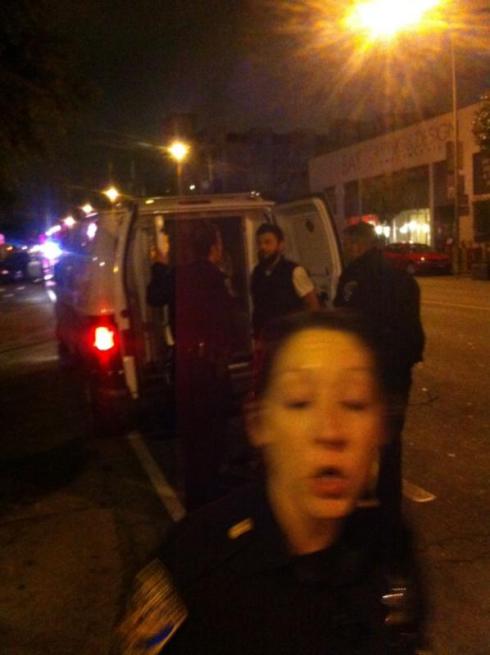
Officer Durkin, in the foreground, is telling Ben that he cannot take this photo. According to Attorney Krages, you are allowed to take photos in public places. http://www.krages.com/ThePhotographersRight.pdf Officer Durkin’s reprimand is in violation of Ben’s rights.
Partensky’s account is nuanced — he provides necessary details; he gives benefit of doubt to most of the characters involved; he tries to put himself in the position of others throughout the ordeal; he is aware of his white privilege; he ponders what different outcomes may have arisen had he and others interacted differently. In short, it is a compelling read.
Let’s not be churlish and say this is a young, comfy, SF-coder-class entrepreneur using an online platform to have a whinge. Let’s be civic and responsible and say no-one should be subject to arbitrary and vengeful treatment from law enforcement. Let us not allow our uncomfortable relationship to racial and income inequality, nor our relationship to white privilege be an excuse to dismiss Partensky’s story. Let us be shocked. Let us be angry. Let us thank Partensky for bringing his account to light.
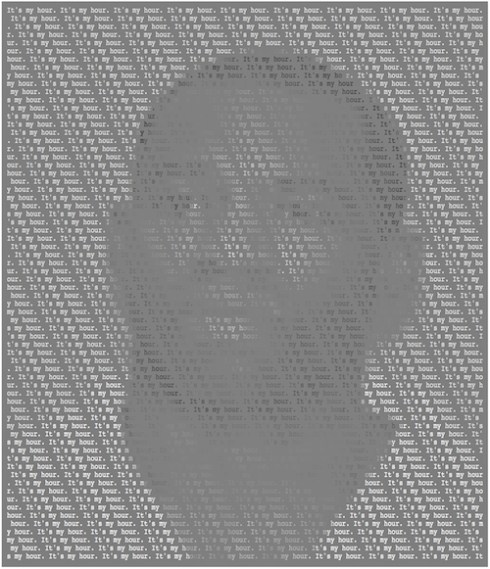
Amy Elkins‘ latest body of work Parting Words is a visual representation of every execution in the state of Texas since the ban on capital punishment was overturned in 1976.
Parting Words was just featured on the Huffington Post, for which I wrote a few hundred words. That didn’t seem enough, so I asked Amy some questions about the project to gain a fuller picture.
Q&A
Prison Photography (PP): You made Black is the Day, Black is the Night (BITDBITN). Now Parting Words. Both are about the harshest imprisonments and sentences in America. Do overlaps between the projects exist? Are the overlaps visible? If so, is the overlap in your personal politics, in the project, or in both?
Amy Elkins (AE): I started the two projects in 2009 and am still wrapping up final details with each. Black is the Day, Black is the Night came first. Through the execution of the first man I wrote with for that project, I stumbled into Parting Words.
Parting Words has taken me a few years to complete and, even now, it remains a work in progress — currently the project has 506 images but it is updated yearly, growing with each execution.
The research behind it all, especially while writing to men on death row (two of which were executed during our time of correspondence) made reading and pulling quotes from the roster of those who had been executed in the state of Texas a dark, taxing experience. Not only was I reading through all of their statements, but detouring into description after description of violent crimes that land one on death row. Honestly, it felt too heavy at times.
PP: What was the impulse then?
AE: I was intrigued that the state of Texas documented and kept such a tidy online archive for anyone to explore. As a photographer (like many, doubling as a voyeur) I already had my own connection to the subject matter through BITDBITN, and I suppose I allowed my obsessive side to surface in order to create a visual archive. It was an important story to tell.


PP: What are your thoughts on American prisons and the criminal justice system?
AE: Over several years of correspondence with five men serving death row sentences and two men serving life sentences who went in as juveniles, I have learned a great deal from the inside about what it is like to exist in the conditions of maximum security and death row units; what those units provide; and what they deny.
A system that uses long-term solitary confinement and capital punishment is broken. Housing someone in infinite isolation has been proven to be hugely damaging to one’s psychological and physical state. This type of isolation breeds behavioral and emotional imbalances that are bound to cause most to remain in a perpetual state of anxiety, depression and anger. Which means they are set up for failure. There is absolutely no way to rehabilitate in such conditions. But clearly rehabilitation isn’t what they have in mind.
I have written with one man in particular who has served 20 years in solitary confinement as part of a Life Without Parole (LWOP) sentence for a non-murder related crime he committed aged 16. He has written about going years talking through concrete walls without ever seeing the men he holds daily conversations with. He spends nearly 23 hours a day in a small cell by himself and when he is let out, he is shackled and permitted to exercise in a slightly larger room by himself for an hour. How he’s gone 20 years in these conditions and not gone completely mad is mind blowing.
That said, most men that I wrote with serving death row sentences were in fairly similar conditions, some having served onward of 16 years in solitary confinement while waiting for their execution. Two of the men I have written with have been executed and through the experience of writing letters to them and in some cases reaching out to family members leading up to such events, I have seen how capital punishment seems to create a continuous cycle of violence, pain and loss within our society. It leaves not one open wound, but several. If there’s closure for anyone, it’s temporary. And unfortunately the loss that the victims family originally endured remains. But now there is a new set of mourners in the mix. The system seems so incredibly flawed and barbaric.
PP: Do archives for last words exist for those killed in other states?
AE: I have yet to come across an archive as in-depth and publicly accessible as the one compiled by the state of Texas.


PP: Are you afraid of death?
AE: I think I’m more afraid of the physical pain associated with dying.
PP: Where do we go when our time is up?
AE: Sounds cheesy, but I think we stick around and linger in some capacity with those who love us the most.
PP: Given the images “read” very differently if the viewer is close or far away, what’s the ideal size for these works?
AE: Ideally I would like to show these images on a smaller scale but include all of them. This forces an intimacy that I want, where the viewer has to get close to each image in order to experience the depth of the project.
PP: Anything else you’d like to add?
AE: In both projects, I always remained neutral. I refrained from projecting my own feelings into whether I felt those I worked with or made work about were guilty of the crimes for which they had been convicted. Making BITDBITN, I was more interested in hearing stories from those within prison systems in America, about the psychological state they might be in while in such conditions, while potentially facing their own death. I was interested in discussing with them what it was like to be removed from the world most of us take for granted, to lose memory by being removed from the source of memory, to not always have a strong sense of self-identity. I felt I hadn’t enough information to warrant my own judgment, and so, if I had projected any, neither project would have manifested.
PP: Thanks, Amy.
AE: Thank you, Pete.

ELKINS ELSEWHERE
In December 2013, Daylight Digital published a presentation of Black Is The Day, Black Is The Night with an accompanying essay by yours truly. The 1,500 words were built upon a conversation Elkins and I began in late 2011.

 Prison Photography