
You are currently browsing the category archive for the ‘Non-Prison’ category.

© Paolo Patrizi, from the series Migration
This week, I wrote two pieces for Wired on Google Street View. The first was a gallery of the various projects spawned by GSV, and the second was a piece about authorship and the repetition of nine scenes in two of the most well known GSV projects (Jon Rafman’s Nine Eyes and Michael Wolf’s A Series of Unfortunate Events and FY.)
Anecdotally, the photo-thinkers out there are converging on Doug Rickard’s A New American Picture as the most robust work. A close contender though is the relatively new No Man’s Land by Mishka Henner.
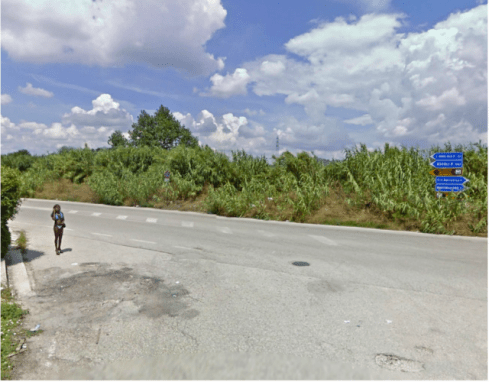
© Mishka Henner
No Man’s Land (more images here) is a disturbingly large selection of GSV screen-grabs of (presumably) prostitutes awaiting customers on the back roads of Italy. Henner says:
I came across communities using Street View to trade information on where to find sex workers. I thought that was the subject to work with. Much of my work is really about photography and this subject tapped into so many aspects of it; The fact the women’s faces are blurred by the software, that they look at the car with the same curiosity that we have when looking at them, and finally, that the liminal spaces they occupy are in the countryside or on the edge of our cities – it all has such great symbolism for our time. And that’s aside from the fact these women have occupied a central place in the history of documentary photography.
But for traditionalists, No Man’s Land is a long way from the spirit of documentary photography. Of Henner’s work and of all GSV series generally, the ever-outspoken Alan Chin says:
“Google Street Views is a navigational tool, an educational resource, and sure, it can reveal a lot about a place and a scene at a given moment in time. But if you, the artist, are really so interested, then go there and take some pictures yourself. This is about as interesting as cutting out adverts from magazines that have some connection and then presenting your edit as a work of art. Post-modern post-structuralist post-whatever denizens of of the art world and academia love this shit. Which is well and good for the university-press industry. But it has little to do with actual reporting and actual documentary work in the field.”
Well, just last week, I came across Paolo Patrizi documentary photographer that actually took himself to those byways.
For Migration, Patrizi has keenly researched where these women have come from and where, if anywhere, they may be going. From the project statement:
“The phenomenon of foreign women, who line the roadsides of Italy, has become a notorious fact of Italian life. These women work in sub-human conditions; they are sent out without any hope of regularizing their legal status and can be easily transferred into criminal networks. […] For nearly twenty years the women of Benin City, a town in the state of Edo in the south-central part of Nigeria, have been going to Italy to work in the sex trade and every year successful ones have been recruiting younger girls to follow them. […] Most migrant women, including those who end up in the sex industry, have made a clear decision to leave home and take their chances overseas. […] Working abroad is therefore often seen as the best strategy for escaping poverty. The success of many Italos, as these women are called, is evident in Edo. For many girls prostitution in Italy has become an entirely acceptable trade and the legend of their success makes the fight against sex traffickers all the more difficult.”
Patrizi is interviewed on the Dead Porcupine blog and talks about the unchanging situation, the pain experienced by the women, their reactions to him, and the destruction of woodland by authorities in attempts to literally expose the illicit encounters. It’s a must read.
The images in Migrations are inescapably bleak; therein lies their power.
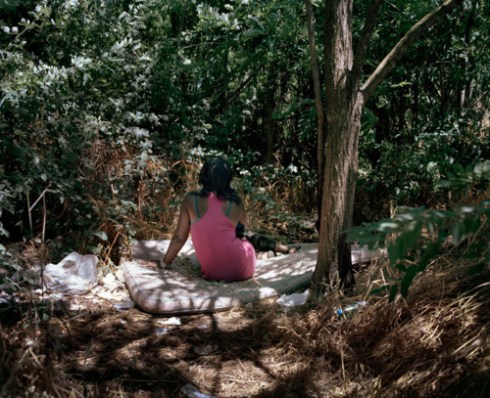
© Paolo Patrizi

© Paolo Patrizi

© Paolo Patrizi

© Paolo Patrizi
Patrizi’s Migration induces a visceral shock; images of the littered make-shift sex-camps turn the stomach. When human fluids are dumped, it is not usual that humans continue to function in and around them. These workstead pits of dirt, tarps and abuse are shrines to the shortcomings of globalisation and the social safety net.
By contrast, Henner’s work allows us to keep a safe distance. He even saves us the trouble of finding these scenes on our own computer screens; we’re detached one step beyond. We are cheap consumers.
Patrizi’s photography with its clear evidence of his boots on the ground don’t allow us to share Henner and Google’s amoral and disinterested eye.
On Henner’s virtual tour, we cruise, at 50mph. We don’t stop, we don’t get out the car and we don’t get too close. We might as well be in another country … which of course we are. Patrizi’s work walks us by hand to the edge of the soiled mattresses and piles of discarded condoms.
Patrizi’s images counter the washed out colours, the flattening effect of wide-angle lenses, and the perpendicular viewpoint of GSV. Instead, they involve texture, depth, legitimate colour, details and different focal points along different sight-lines. In other words, Patrizi’s Migration engages the senses and the basics of human experience. Patrizi’s photographs return us to the shocking fact that that these women are human and not just bit-parts in the difficult social narratives of contemporary society. Works full of threat, fear, flesh and blood.
By comparison, Henner’s screen-grabs are anaemic.
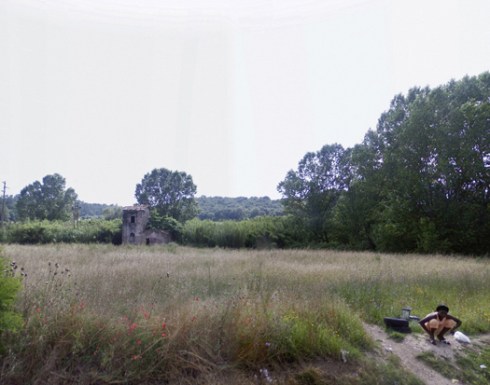
Via del Ponte Pisano, Rome, Italy. © Mishka Henner
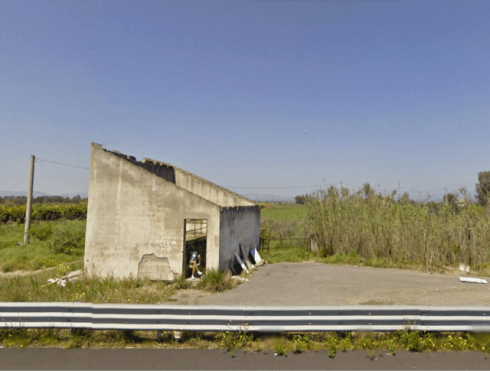
© Mishka Henner

Carretera de Ganda, Oliva, Spain. © Mishka Henner

© Mishka Henner
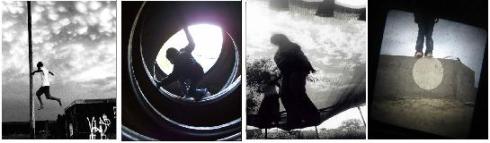
Founded in 2005 by by Emily Schiffer, a Magnum Foundation Emergency Fund grantee, My Viewpoint on South Dakota’s Cheyenne River Reservation, is a youth photography initiative “invested in young people’s inherent visual curiosity.” The images from Seeing is Fun are captivating.
The program has students (ages 6-20) apprentice with professional photographers, working in both analog and digital photography and printing their images in an onsite darkroom
My Viewpoint is run through the Sioux YMCA in Dupree, SD, and in partnership with Daylight Community Arts Foundation.
From the Daylight Magazine blog:
Shipping and Receiving: Photographs and Letters Between Venice, CA and Dupree, SD
August 6–September 30, 2011
Venice Arts Gallery in Venice, California
Opening Reception: Saturday, August 6, 5-8 p.m.
This exhibit features the photographs taken by students in the My Viewpoint photography program, and highlights a collaborative photographic exchange between the youth in the My Viewpoint program and youth at Venice Arts, conducted over 2010 and 2011.
Children of the Cheyenne River
July 23–September 4, 2011
Fovea Exhibitions in Beacon, New York
Opening Reception: Saturday, July 23, 5–7 p.m.
Artist Reception & Talk with Emily Schiffer: Second Saturday August 13, 5–9 p.m.
This exhibit is comprised of medium format black & white photographs of the students in the My Viewpoint photography program by the program’s founder Emily Schiffer, accompanied by a narrative text that explores Schiffer’s perspective on her evolving relationship with them, as well as photographs and text from the students.


Lorenzo Meloni‘s series Amal begins by quoting a 21 year-old Palestinian, “In my short life, I’ve seen nothing that makes me hope for peace; I’ve only seen destruction, death, pain. In my life, I’ve only seen the sea once.”
Amal contains a variety of styles and weaves the viewer through multiple emotions in a short space of time. It’s confusing … in a good way. That depth fits with the complex politics of the region.
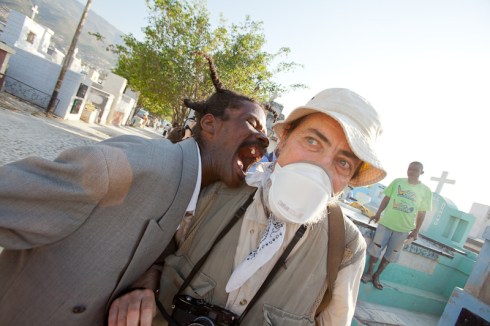
Bruce Gilden’s street shooting methods polarise opinion. His “ambush tactics” (for want of a better phrase) are, for some, the exercise of any photographer’s right in public space, for others he just goes about stuff in a rude way.
Anyway, here’s a TMZ-style photo exclusive of Gilden in front of the camera and not behind it. Gilden the ambushed; not Gilden the ambusher.
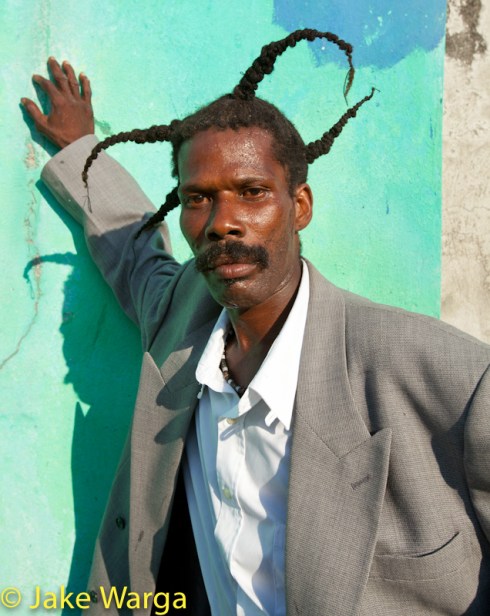
Journalist Jake Warga made these photographs in April. Warga was not part of Gilden’s entourage. We can presume that Gilden, at this time, was shooting Haiti: 15 Months Later.
I was critical of Gilden in the aftermath of the Haiti earthquake suggesting his images were little more than a digitised freak-show.
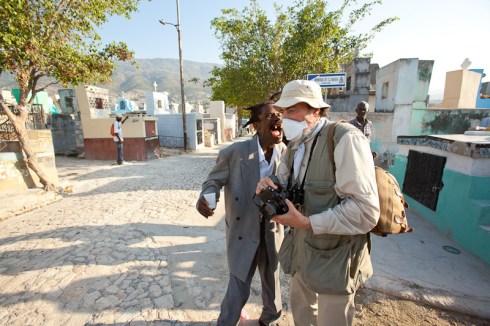
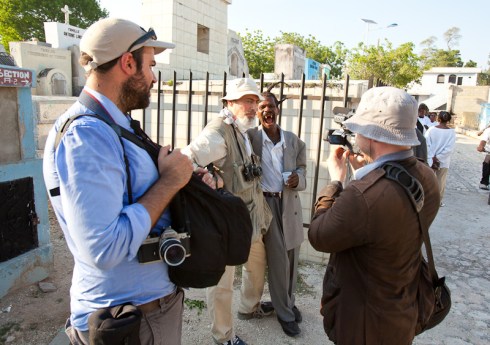
Warga was not surprised the Haitian, who he described as “drunk out of his mind on cheap wine” was attracted to the documentary film crew following Gilden through the graveyard with their photo accoutrements.
“He wanted his photo taken,” says Warga, “I try not to be seduced by spectacle but it was the only way he’d leave me alone. In turn, he gravitated towards Gilden’s cameras, joining the circus of gazes already in Bruce’s orbit.”
The bizarre nature of this interaction can be put down to a mixture of grief, inebriation, intrusion, Gilden’s personal theatre, and the scene acted out by the Haitian man. And all this in a cemetery.
This is probably just another day at the office for Gilden who makes a habit of hanging out with violent persons.
Confusing layers here no doubt, but for me, the take away is Gilden’s flitting averted eyes (top image). As if part of some karmic return, this Haitian man getting up in Gilden’s grill can be read as a metaphor; as a spectre, and brief embodiment, of Gilden’s many victims down the years.
The tables are turned and it looks briefly unsettling doesn’t it?


Identity Paranoia by Bartek (Bart) Pogoda and Silvia Sencekova has very little to do with the many single images of people in masks or photographs of people with s#%t over their heads.
The skill is in doubling and sometimes tripling the gaze within the pictures. The longer you spend with these photographs the more subtle they reveal themselves.
Not to forget this is a love story. The two masked loners eventual meet one another, leading us only to presume that they really do need the masks and aren’t wearing them for our amusement.
Creepy faces attached to bedenimed euro-bodies wouldn’t be in any of my recipes for photo-appeal, but Pogoda and Sencekova have changed my mind on that.
Oh, and it’s FUNNY, I think.
LINKS
More BIG images here on his blog.
Silvia Sencekova takes pictures of beds and flying dogs.


Sometimes it’s associated with a British band, and sometimes it associated with people who are banned.


It’s about pills, madness and control. It’s about healing.

It’s about awesome fashions and it’s about bad accessories.


It’s about poor decisions by presidents.

It’s about corporate control and corporate profits.


It’s about death to ours and death to theirs.


Sometimes, it’s about imperialism.

It’s about religious freedom and freedom of religion.


It’s about fake sportspersons and real sportspersons.
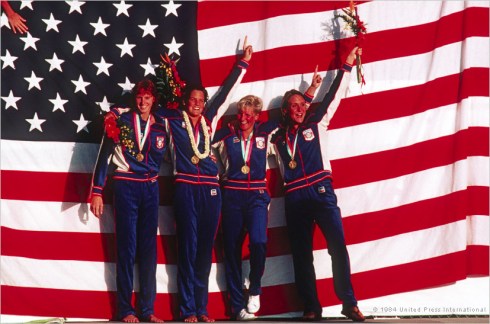

It’s about God and it’s about children.

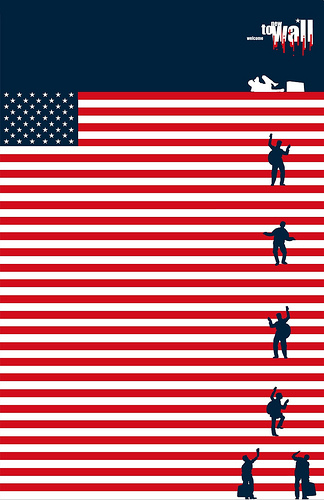
It’s about we the people, not them the people.

It’s about bigotry and it’s about a permanent underclass.


It’s about cold beer, cupcakes and weed.

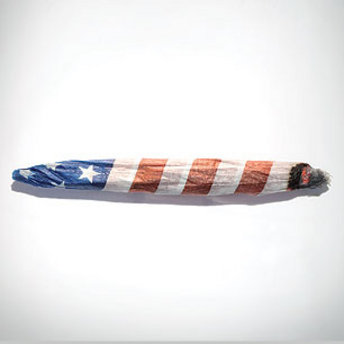
Images sources: Rolling Stones lips; Prison bars, from Teen in Jail; American flag of pills, by Talia Marisa; Heels, Fashion Munster; Spectacles, Linda Lovelock wears American flag sunglasses during the 2010 Tax Day Tea Party April 15, 2010 in Pleasanton, California. Tea Parties were held across the United States to denounce tax day. More than a thousand people attended the Tax Day Tea Party at the Alameda County Fairgrounds. (April 14, 2010 – Photo by Justin Sullivan/Getty Images North America); Bush family; Corporation flag; ISBN flag, via Adbusters; Coffin at night, Sudanese men look at the flag-draped coffin of U.S. diplomat John Granville, 33, who worked for the USAID, as it is received by U.S. officials in Khartoum, Jan. 3, 2008. (AP); US flag bomb graphic, via Daily Bleed; Imperialism flag, Christian cross, on eBay; Star-spangled burqa; Rocky Balboa shorts; Olympic winners, via Astropix (Teammates in the USA women’s 4 x 100 meter relay swim team stop in front of a giant American flag to wave to fans after winning the gold medal and setting a world record in the finals of the event during the 1984 Olympics in Los Angeles. From left are Jenna Johnson, Dara Torres, Carrie Steinseifer, and Nancy Hogshead.); Child’s drawing, via Fire Andrea Mitchell; School class photo, via Valley Community Newspaper (The Girl Scouts who meet for troop activities at Martin Luther King Jr. Elementary School had an American flag flown over the nation’s capitol on Dec. 6 to honor the school. Photo Credit: Unknown); Immigration wall graphic, by Luis Boix; “Does my fag offend you?” bumper sticker; Immigrant labour graphic, by La Mustia; Supermarket beers, via Corks and Kegs; Cupcakes, The Cupcake blog; Spliff, from Rolling Stone via The War on Drugs is a War on Me.


On this blog last week, I raised questions about the viability of the Leica Oskar Barnack Award jury process. The 2011 winner Jan Grarup is a colleague with one of the five jurors, Stanley Greene.
Grarup and Greene, with seven other photographers, co-founded the NOOR Images Agency, based in Amsterdam, The Netherlands in September 2007.
I emailed the offices of both the Leica Oskar Barnack Award and NOOR Images with the following questions:
Do you see this as a conflict of interest?
Did you foresee this as a problem before judging began?
Was Stanley Greene exempt from voting on entries by fellow NOOR photographers?
I am interested to know the jury process and if Leica Oskar Barnack Award believes it needs to defend itself against ethical questions.
The questions were designed to be relatively open and non-accusatory while getting at each bodies’ staked and defendable positions.
TINA WIESNER ON BEHALF OF THE LEICA OSKAR BARNACK AWARD
Leica Camera AG invited 5 jury members for the 2011 judging of the Leica Oskar Barnack Award / Newcomer Award.
The jury voted “unanimously” for the winner. There was no conflict of interest.
Please note that we received more than 2000 entries, representing photographers from 89 countries, many of them independent or working for renowned agencies. During the judging process, the jury concentrates on the editing of the series of 10 – 12 images and the information given about the story behind.
CLAUDIA HINTERSEER ON BEHALF OF NOOR IMAGES
One of our photographers was invited to be on the jury and another NOOR photographer was allowed to enter work according to the Leica Oskar Barnack entry rules.
The Leica Oskar Barnack organization has judging rules in place and a secretary to oversee these are being abided to. Like most other international photography competitions, their judging rules includes a clause that at crucial moments jury members have to announce specific working and/or personal relationships where there tends to be a conflict of interest. I know that Stanley Greene has made no secret of the fact that he, Jan Grarup and seven other photographers (and myself) founded a photography collective several years ago. Taking into account the professionalism of the other jury members of this year’s LOB competition, and trusting the fact that the Leica Oskar Barnack secretary does his/her duty, I trust that the multi-membered jury’s decision was made on the basis of the outstanding quality of Jan Grarup’s work, rather than on the basis of one jury member’s particular business interest.
In his career, Jan Grarup has been honored with some of the most prestigious awards from the photography industry and human rights organizations, including: World Press Photo, UNICEF, W. Eugene Smith Foundation for Humanistic Photography, POYi and NPPA.
Looking at other international photography contests you will be amazed how often jury members are professionally or – as is very common in our industry – personally (on the basis of friendships) related to photographers whose work is rewarded.
A few things:
I am still unclear as to whether Wiesner’s “unanimously” means Greene voted or abstained on Grarup’s work; whether his vote was important or not to Grarup’s win.
Hinterseer’s argument is a little more convincing than Wiesner’s, mainly because she explains the mechanics of the jury process.
Grarup’s past awards have no relevance to this issue.
Hinterseer softens the blow by saying pretty much that this sort of thing happens all the time. And it is this last point that I think is the take away. I’ve not given it any thought in the past. Let’s change that.
I took a quick look at the judging process at the World Press Photo and noted Stephen Mayes, managing director of VII Photo. I thought it a pretty safe bet that a VII Photo photographer won something at WPP. Sure enough, Ed Kashi won the Contemporary Issues: 2nd Prize Singles.
No judgement on Kashi, Mayes or VII; I’ve just used them to illustrate Hinterseer’s point. Besides, the labyrinthine WPP jury process probably rinses out much direct influence.
So, I’ll conclude with two questions. 1) Is this situation – as suggested – really unavoidable? 2) If so, what are we to make of this web of casual association and sanctioned incest when it comes to industry awards?
Aired on BBC last month, Adam Curtis‘ All Watched Over By Machines of Loving Grace continues his knack of unnerving the viewer with hypnotising visuals and narratives that knits science, tech, neuropsychology to corporate and political ideologies. His use of music is also tragicomic.
Curtis is on top of his game. The BBC blog on his work and his own blog are good places to start, but this is the most user friendly place to get all his short-films documentaries.
All Watched Over By Machines of Loving Grace
All Watched Over By Machines of Loving Grace examines our collective hopes for the liberating experience of computer technology, networks and new modes of interaction.
Early network and internet engineers believed that our desires to free ourselves of government control, top-down authority and a globe modeled on the requirements of nation states, could be achieved by an embedded non-hierarchical network of communication.
Episode 2 focuses on ecosystems and how software developers have evoked myths of natural equilibrium to sell the idea that all forms of (computer-based) connectedness are inherently beneficial. I couldn’t help think of the persistent argument that “the internet is democratic”. It is not democratic, and yet the argument recurs time and time again – particularly as it applies to blogging and near-free publishing tools.
There are large corporate powers that dominate the internet; it’s no democracy. In terms of market penetration and information gathering – the multi-national tech companies dwarf the extraction and industrial manufacturing giants of the past. Through data they wield massive power. One power structure has been replaced by another.
Unfortunately, Curtis’ conclusion is that the unfulfilled promises of technology have led to cultural nihilism, in which we’ve convinced ourselves we are isolated machines and our only purpose it is to carry genetic data AND as such we’ve abandoned the idea of community. Bleak.
While you’re at it you should watch The Power of Nightmares: The Rise of the Politics of Fear. It is a wonderful and cogent explication of the shared history between fundamental Islamist thought and U.S. Neoconservatism.

 Prison Photography