
You are currently browsing the category archive for the ‘Opinion’ category.
My call on Friday for more information on Civil War era prisons bore an unexpected rich harvest. A single reply but an absolutely riveting one.
Imagined Prisons responded with this:
These images are fascinating and haunting, and the idea of the modern prison as “a permanent abstraction of earlier jails” is a compelling one.
As for the carceral spaces – makeshift and otherwise – of the Civil War, some authorities have cited Lincoln’s suspension of habeas corpus rights as a precedent for the Bush Administration’s policies in today’s war prisons. E.E. Hale’s classic short novella, “The Man without a Country,” written in response to Lincoln’s controversial move, tells the story of a man sentenced to spend the rest of his life aboard U.S. Navy ships, in the extralegal zone outside the boundaries of the nation-state.
You might also be interested in this poem by Herman Melville, from the 1866 volume “Battle-Pieces, and Aspects of the War”:
In the Prison Pen
Listless he eyes the palisades
And sentries in the glare;
‘Tis barren as a pelican-beach–
But his world is ended there.
Nothing to do; and vacant hands
Bring on the idiot-pain;
He tries to think–to recollect,
But the blur is on his brain.
Around him swarm the plaining ghosts
Like those on Virgil’s shore–
A wilderness of faces dim,
And pale ones gashed and hoar.
A smiting sun. No shed, no tree;
He totters to his lair–
A den that sick hands dug in earth
Ere famine wasted there,
Or, dropping in his place, he swoons,
Walled in by throngs that press,
Till forth from the throngs they bear him dead–
Dead in his meagreness.
Imagined Prisons is the accompanying website for the book The Prison and the American Imagination, by Caleb Smith, which will appear from Yale University Press in September of 2009.

The Prison and the American Imagination, by Caleb Smith. Yale University Press, September 2009
The book examines the history of the U.S. prison system and its imaginative life in nineteenth – and twentieth – century culture. Caleb Smith argues that the dehumanization inherent in captivity has always been at the heart of American civil society.
Imagined Prisons is a forum for conversation about the book and the questions it raises;
What a significant new resource with which to reassess the prison within America’s cultural landscape. Prison Photography, too, is attempting (admittedly ham-handedly on occasion) to define the current representation/consumption of prison imagery within our society.
May I suggest that books such as Caleb Smith’s and sites such as mine exist because sites of incarceration – “dark places” – have been over-zealously operated by controlling minorities and not adequately discussed by the at-large majority?
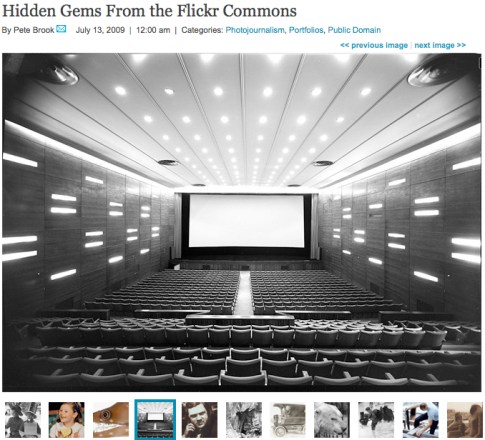
Sunday night/Monday morning (depending on your seaboard) was the point in which my first professionally recognized byline hit the internets.
The piece, Hidden Gems From the Flickr Commons, is a walk through my Wired’s personal favourites. The crux of my pitch to Wired was that we all need to get out from under the mass-consumed images of the FSA/OWI archives.

Wired’s new blog Raw File deals specifically with photography and is marshaled by a close friend Keith Axline. Keith held out a hand and gave me a finite amount of time to grab hold. I’m glad I didn’t pass up the opportunity.
There’ll be more to come in the future. And I’ll probably force it down your necks again. If you’ve seen me relentlessly plug Raw File material these past few weeks on my Twitter stream, you now know why.

Top Image: Screenshot
Middle Image: Canthigaster rostrata, Inflated (Caribbean Sharp-Nose Puffer), Belize Larval-Fish Group 2005, National Museum of Natural History, Smithsonian Institute Collection. Fujifilm FinePix S3 Pro 12.3-megapixel camera with a 105-millimeter f/2.8D AF Micro-Nikkor lens and dual Nikon SB28 flash units. (Source)
Bottom Image: Polar bear (Ursus maritimus) in cage at Lincoln Park Zoo. 1900. Original size and material: 4×5 inch glass negative. Field Museum Collection – Digital Identifier: Z80007 (Source)

Jenn Ackerman
Larry Chandler, Warden of Kentucky State Reformatory, La Grange, KY
Jenn Ackerman

This year, more than 700,000 people will be released from prisons and jails in the U.S. and more than half of them suffer from some form of mental illness. (Source)
A few months ago I wrote to Jenn Ackerman, praised her Trapped project and of course offered to promote it. I wanted to get at her stories behind the images – namely do an interview. Jenn, however, is as good a promoter as she is a photographer.
The list of questions I wrote out while eating my chili-verde burrito on Wednesday are made largely redundant by her blog post “Trapped: Questions Answered”. Her photography and multimedia is so strong that it also speaks for itself. There is a painful truth in her work; more questions than answers.
I have plenty material to give you a thorough summary of Jenn’s work.


Firstly, allow me to give a run down of the current situation of mental health care provision in America’s prisons and jails.
A 2006 report by the U.S. Department of Justice shows that the number of Americans with mental illnesses incarcerated in the nation’s prisons and jails is disproportionately high. Almost 555,000 people with mental illness are incarcerated while fewer than 55,000 are being treated in designated mental health hospitals. That is inadequate provision.
555,000 represents, at the very least, 16% of inmate populations of state and local jails. I would contend the figure is higher – well above 20% – but this is only my personal belief.
If these numbers are not shocking enough, one must consider the pressures the prison system – in and of itself – exerts on the mental health well-being of those incarcerated by consequence of the increased reliance on solitary confinement to control populations, unqualified staff (especially in private prisons), overcrowding, institutional violence, lack of volunteer programming and engagement (in remote facilities) and the inadequate/unconstitutional general health care provided in states such as Ohio and California. California Department of Corrections has been the subject of a high profile federal lawsuit for the short comings to provide suitable care. (Incidentally, the $1.9b figure quoted in the linked article used to be $6b, until Schwarzenegger rejected it … and there is a serious threat it will be nothing if California cannot sort out its budget disaster).
In prison systems with such endemic problems, it is those who have no way to advocate for themselves who suffer most. Jails have effectively become America’s defacto mental institutions; they house a larger volume of mentally ill people than all other programs combined.
Against this backdrop, Ackerman went to work.

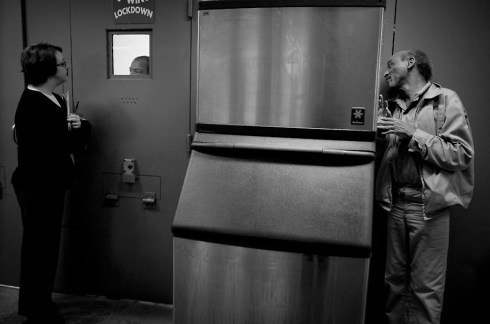
Prison Photography is keen to unveil the means by which photographers, anyone, can gain access to prisons to engage with the “invisibles” of society. In that spirit I quote Jenn;
How did you get access to this story?
I had done a lot of research and had decided on the story I wanted to tell when going to talk to the warden. I always feel that a an in-person visit is more beneficial. — I can better express my passion and excitement for this story. I had called a couple of prisons days before I called the Kentucky State Reformatory and to no surprise they didn’t respond to my messages. But then I came across a wing that was dedicated to mental illness in a prison. Warden Chandler answered on the second ring. This caught me off guard but got it together enough to tell him what I wanted to do. He said I had a lot of work to do before I could start on the project but that he might be interested. I sent a proposal days later and asked to come visit the reformatory to talk to him in person.
How did the warden and officials respond to the project?
I didn’t know how they would respond at first. But I also knew that the warden and everyone involved wanted this story to be told. I was very honest with everyone from the beginning. I told them that I knew that they were doing something to acknowledge mental illness in prisons which hasn’t happened in every state but that I also knew that the program was not perfect. I told them that was going to be my approach. So from the beginning they knew that I was not going to make them look bad but also wasn’t trying to say that they have the final answer to this issue. But I visited the warden the day before I published it on my site to get his reaction. He loved it and thanked me for creating an honest portrayal of the mental illness in prisons. I told him that was the best compliment I could ever get.
There can be no doubt that Jenn was lucky to find Warden Chandler who was so sympathetic to her objective and realised the importance of the project.


Jenn has explained that she spent a total of 10 weeks on the project, including 10 days of still and video shooting. Her time commitment is reflected in the comprehensive coverage. Trapped is a dark bubbling cloud of stories and troubling images that are weft with human emotion, the occasional reprieve but predominantly the collision of lives – lives that orbit tormented psyches that a punitive world of reinforced doors & service hatches cannot soothe.
Jenn’s commitment is epic. Besides the Trapped feature film, Jenn breaks the project into a series of presentations. Firstly, the In Their Corner short about the inmate watch. Secondly, In Their Minds a series of seven film shorts allowing individual inmates camera time to represent themselves. Trapped is segmented into six photography galleries; each one a captivating photo-essay in its own right. I cannot over-emphasise the sensitive depth with which Jenn has documented the incidents on the Correctional Psychiatric Treatment Unit (CPTU) at the Kentucky State Reformatory. Jenn also provides an extended essay about her own response to the CPTU environment.
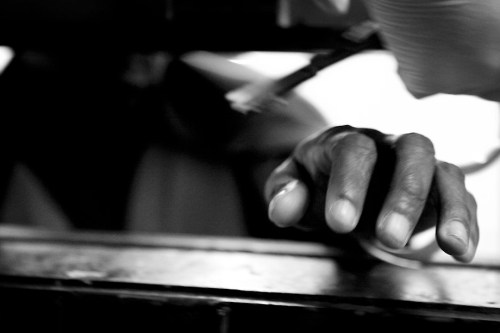

Jenn interviews for 25 minutes at Multimedia shooter. The audio is wobbly and distorted but the information is valuable. Check out from 21 mins. onward to learn of the administration’s response.
Trapped: Mental Illness Inside America’s Prisons has deservedly received acclaim from burn magazine, 100 Eyes, Verve Photo, the White House News Photographers Association (honorable mention), Inge Morath Foundation and CPoY. Jenn recently won an internship at the New York Times.
Jenn credits her students for much of her inspiration. Check out Jenn’s class website for more details.
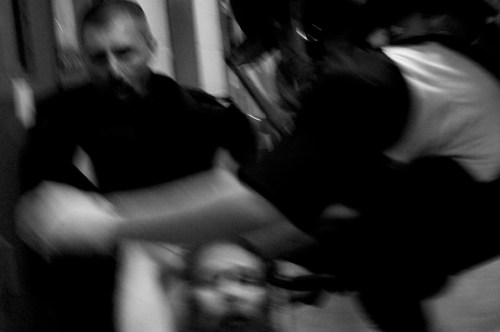

I took some flak for questioning America’s Day of Independence celebrations. I suggested that flag-waving is sometimes an empty exercise and distracts society from scrutiny of serious problems.
To support the point, I stated some positions:
America is the only Western nation in the world to execute human beings.
America has 1 in 30 adults locked up in prisons (4 times the amount of any other Western state).
America’s middle class has fled to the banality of the suburbs and hung its public school systems out to dry.
America has 50 million medically uninsured people, including 11 million children.
America has embraced the privatisation of prisons and stockholders profit from the incarceration of men, women and children.
America’s drug war is in fact a war on the lower classes, who are predominantly minority groups.
As if on cue, these three things have fallen into my lap in the intervening 72 hours.
Schools
The Economist reports on the US’ private school sector; a sector totally unaffected by the recession. Amanda Uhry of Manhattan Private Schools Advisors speaks brutality and unabashedly about the robustness of the private school sector. It’s success is based on fear, individualism, constant educational benchmarks set from the earliest of grade levels, and a severe lack of imagination; “America has fallen far, far behind other nations in providing public education”.
Prisons
I hope most Americans would prefer not to be number one in this country-by-country comparison.

And, just in case you’re wondering, the US is 4th most frequent executioner of its citizens. The other countries making up the top five are the often vilified and demonised China, Iran, Saudi Arabia and Pakistan.
Hospitals
My family in the UK is an average bunch. Nevertheless, three of the five of us have required major surgery (all three more than once). The NHS provided – in every case – timely and impeccable care. Taxes aren’t a burden, they are peace of mind.
As John Pilger puts it, “The way the National Health Service is represented in the United States is truly scandalous. That word ‘Socialist’ is pulled out; it’s kind of infantile almost. Well, if Socialist is taking away the fear of being denied health care, then yes it is.”
The illicit manufacture of tools by prisoner piqued Marc Steinmetz‘s curiosity. He called around German prisons to inquire if they were still in possession of particularly ingenious contraband tools and escape devices.
Santa Fu, Celle, Wolfenbuttel and Ludwigsburg prisons all welcomed Steinmetz to view their collections. (The historical objects of Stammheim and Hohenasperg prisons were part of the Ludwigsburg collection.)
Steinmetz’s photographs were used in a German magazine editorial, but I have seen similar series of object types displayed as fine art.
When photographers set up objects (food, seeds, dead birds, insects, fish, etc) it is usually to draw extended attention to common characteristics and impose drama upon ‘the ordinary’. Against a white backdrop and removed form the clutter of daily life, it is intended that these objects can (if only briefly) transcend their functional purpose and be appreciated within the discourses of beauty and/or high art.
Steimetz wanted to highlight the ingenuity and intelligent design of these objects, and I’d like to do the same.
I have included some weapons here and omitted others. I deliberately omitted crude weapons for this post as they are hardly novel … anything with any weight becomes a dangerous weapon, right? On the other hand, I included guns and rifles as I never thought they could be manufactured from scratch. I was particularly impressed by the electrical items.
Below are Prison Photography‘s pick of the bunch with Steinmetz’s own captions. Thereafter is a brief Q & A with Steinmetz.

DOUBLE-BARRELED PISTOL This gun was found along with other homemade firearms in the cell of two Celle prison inmates on November 15, 1984. The weapons had been made in the prison’s metal workshop. They were loaded with pieces of steel and match-heads.

TATTOOING NEEDLE made from a toothbrush handle, a ball pen and an electric motor; confiscated in ‘Santa Fu’ prison in Hamburg, Germany. Tattooing instruments are a popular and common source of income among inmates but are banned as ‘illegal objects’ due to the danger of infection (Aids, Hepatitis, etc.).
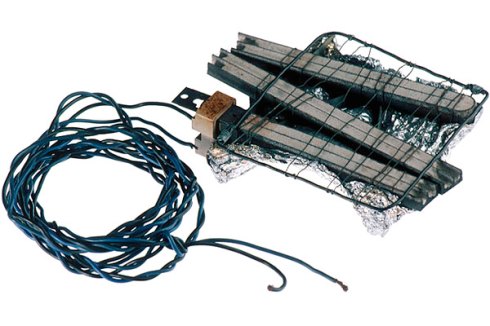
STOVE / GRILL / TOASTER An inmate of Ludwigsburg prison, Germany, botched together this multi-purpose tool from wire, a broken heating rod and some tin foil. It was found in his cell and confiscated sometime in the mid-eighties.
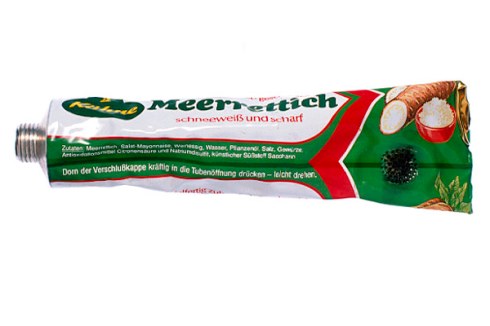
HASH PIPE fashioned from an empty horseradish tube; confiscated in ‘Santa Fu’ prison in Hamburg, Germany. Bongs are the most common of all forbidden items in prisons. The range of materials they are made of mirrors the inmates’ great imagination. And their prior needs.

RADIO TRANSMITTER / BUG made of radio recorder parts by an inmate of Wolfenbüttel prison, Germany (battery is missing). Prisoners occasionally manage to install gizmos like this one in guard-rooms to be prepared for upcoming cell searches. Also suitable as a means of cell-to-cell communication among inmates. A standard radio serves as a receiver.

IMMERSION HEATER made from razor blades; found in a cell in ‘Santa Fu’ jail in Hamburg, Germany. Jailbirds use these tools to distil alcoholic beverages forbidden in prisons. Your typical inmate’s moonshine still includes a plastic can containing fermented fruit mash or juice, an immersion coil of some sort, a rubber hose, and a plastic receptacle for the booze.

RADIO RECEIVER Sometime in the seventies an inmate of Ludwigsburg prison, Germany, built this radio on the sly and hid it inside an encyclopedia. It was probably commissioned by another inmate who had no electronic expertise himself.
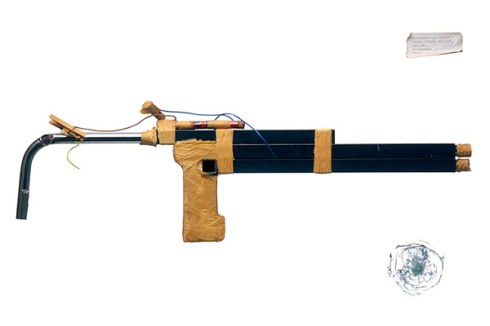
SHOTGUN made from iron bedposts; charge made of pieces of lead from curtain tape and match-heads, to be ignited by AA batteries and a broken light bulb. On May 21, 1984 two inmates of a prison in Celle, Germany, took a jailer as a hostage, showed off their fire power by letting go at a pane of bullet-proof glass, and escaped by car.
________________________________________________________
Q & A
When did you complete this project and why did you take on this subject?
I shot the whole project in April and May 1999. I had read a magazine article about a prisoner in Berlin who had whittled a key to his cell from a toilet seat. Unfortunately, prison officials in Berlin weren’t cooperative, so I wasn’t allowed to take a picture of that key for ‘security reasons’. (Can you believe that?).
But it nevertheless provided the key to the story and got me interested. Süddeutsche Zeitung Magazine editors [provided a catalyst] too – they bought the story.
The objects range in date from the 70s through to the mid 90s and from multiple German prisons. How and where did you source the objects?
Prisons often have a collection of items which were secured from inmates’ cells or after attempts at escape.
I did my research exclusively by phone and located a handful of prisons which seemed worth a visit. I decided then and there which objects to photograph.
Much of your previous photography has been about complex scientific experimentation and grand research. Was this project a departure?
Not at all. I have always been interested in the uncommon or even bizarre.
What about the objects is of interest to you?
Ingenuity of improvisation. Intelligence. Purposefulness.
In my work, not everything depends on meticulous planning, but to a great extent on chance and my ability to improvise. Therefore I can relate to these escape tools. I admire their no-nonsense design, their simplicity. Even if their escape attempts fail, these guys cross boundaries in that they find uses for things other than what they were made for.
What do your photographs of the objects add to the stories objects?
To me, they communicate intelligence and the flexibility of the human mind under adverse conditions. I wanted to share my surprise: ‘What the … ?’
Did this project inform or reflect your understanding of German prisons, prison history and/or current prison politics?
Not really. I wasn’t interested in the political or social aspects of the subject matter. It was an interesting experience, though, to get to peek inside these facilities even though I had no contact with any of the inmates.
To compensate for that and to communicate credibility, I tried to collect as much information about the objects as I could. I felt they should be preserved the same way that archaeological artifacts are.
What are you working on now?
Currently, I am working on an independent project which is called ‘Toter Winkel’. I am still searching for an international title which works both in German and English, even though I focus exclusively on Germany.
I started wondering about what cars have done to our cities. I ended up doing night shots of elevated roads with a 4×5″ field camera. It’s hard to believe what monstrosities have been erected for the sake of misconceived mobility!
But this is more of a long-term fine art project than an editorial piece. Fieldwork is completed, but post-production will take a few more months, I’m afraid.
Thank you, Marc
________________________________________________________
Marc Steinmetz is a photographer specialising in Science and Technology stories. Prison Photography recommends his work on Plasticination, Karakarum – The Archaeology of Genghis Kahn’s Empire and his series on Drinking Water. An extended interview with Marc, is here.

DUMMY PISTOL from blackened cardboard; found on June 23, 1988, in an inmate’s cell in Stammheim prison, Germany, after a fellow prisoner tipped off the jailers. The dummy was hidden in an empty milk pack and was most probably intended to be used for taking hostages in an escape attempt.
________________________________________________________
All images © Marc Steinmetz.
I originally came across Steinmetz’s work at Accidental Mysteries – a blog I highly recommend for its polished curatorial eye of surprising, inventive and humourous human interventions.

Cornell Capa, to some extent, lived in the shadow of his older brother Robert. I guess, it is easy for complacent men to adore the still and fallen martyr than to keep apace with a passionate and piqued practitioner. Cornell’s and Robert’s legends are one; Cornell ceaselessly fought his brother’s corner authenticity debate surrounding The Falling Soldier.
Cornell’s indebtedness to his brother was fateful and self-imposed:
Disappointingly, it is only in extended surveys of Cornell Capa’s career that mention of his fifties photojournalism in Central and Southern America arises. Otherwise, Cornell is celebrated for his political journalism and particularly his campaign coverage of Adlai E. Stevenson, Jack and Bobby Kennedy. Cornell’s photographs from Latin America are often neglected, even demoted.

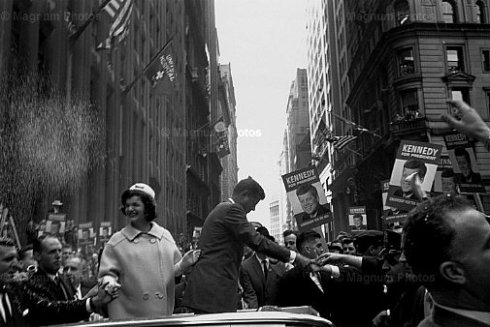
The Kennedys were the foci of American progressive attitudes, and so, in the sixties, Cornell documented the concerned politician. Cornell was (not in a negative way) passive and the sixties were not formative. It was in the fifties that he actively worked to define the persona, the ideal: ‘The Concerned Photographer’.
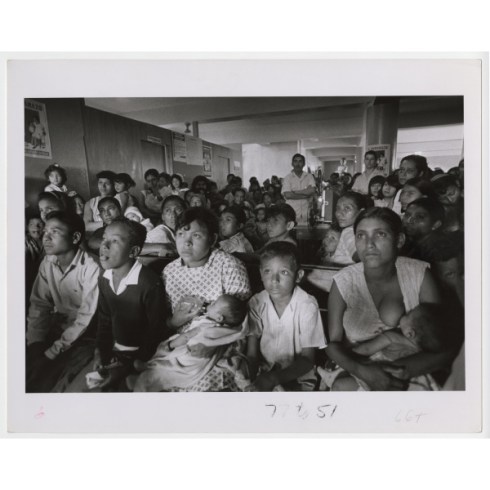
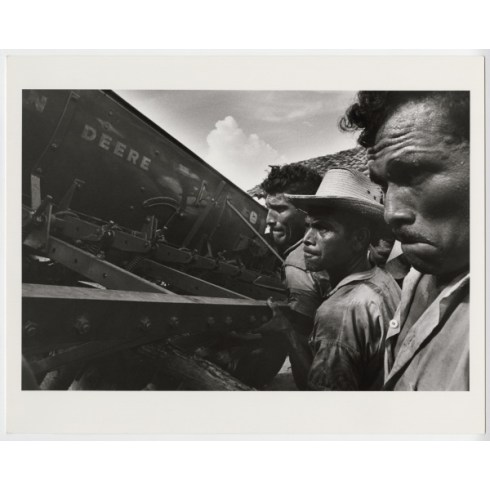
Cornell’s work in Latin America:
In 1956, Cornell was in Nicaragua reporting on the assassination of President Anastasio Somoza García. Somoza was shot by a young Nicaraguan poet; the murder only disrupting slightly the Somoza dynasty that lasted until the revolution of 1979 (that’s where Susan Meiselas picks up).
In the aftermath of the assassination over 1,000 “dissidents” were rounded up. The murder was used as an excuse and means to suppress many, despite the act being that of one man.


I have no knowledge of what happened to these men after Cornell photographed them and I am sure you haven’t the patience for speculative-art-historio-speak.
I do wonder … if having witnessed revolution, early democracies, military juntas, coups, communism, social movements, grand narratives and oppression in various forms, if Cornell picked his subjects with discernment back in the United States.
As early as 1954 Cornell was working on a story for Life about the education of developmentally disabled children and young adults. Up and to that point in time, the subject had been regarded by most American magazines as taboo. The feature was a breakthrough.
In 1966, in memorial to his brother, Robert, and out of his “professed growing anxiety about the diminishing relevance of photojournalism in light of the increasing presence of film footage on television news” Cornell founded the Fund for Concerned Photography. In 1974, this ideal found a bricks and mortar home on 5th Ave & 94th Street in New York: The International Center for Photography.

This institutional limbo that eventually gave rise to one of the world’s most important photography organisations was not a quiet period for Cornell. In 1972, he was commissioned to Attica, NY, to document visually the conditions of the prison. Capa presented his evidence to the McKay report (PDF, Part 1, pages 8-14) the body investigating the cause of the unrest. Cornell narrates his personal observations while showing his photographs to the commission.


At a time when, the photojournalist community seems to have crises of confidence and purpose at an alarming rate, it would be wise to embrace his spirit in full recognition his slow accumulation of remarkable accomplishments.
Rest In Peace, Cornell.

PHOTO CREDITS.
Robert F. Kennedy campaigning in Elmira, New York, September 1964. Accession#: CI.9685
New York City. 1960. Senator John F. KENNEDY and his wife, Jackie, campaigning for the presidency. NYC19480 (CAC1960014 W00020/XX). Copyright Cornell Capa C/Magnum Photos
Three men pushing John Deere machine, Honduras, 1970-73. Accession#: CI.3746
Watching family planning instructional film at Las Crucitas clinic, Tegucigalpa, Honduras], 1970-73. Accession#: CI.8544
Political dissidents arrested after the assassination of Nicaraguan dictator, Anastasio Somoza, Managua, Nicaragua, September 1956. The LIFE Magazine Collection. Accession#: 2009.20.13
NICARAGUA. Managua. 1956. Some of the one thousand political dissidents who were arrested after the assassination of Nicaraguan dictator Anastasio Somoza. NYC19539 (CAC1956012 W00004/09). Copyright Cornell Capa/Magnum Photos
Prisoners escorted from one area to another, Attica Correctional Facility, Attica, New York, March 1972 (printed 2008). Accession#: CI.9693
Two men walking around prison courtyard, Attica Correctional Facility, Attica, New York, March 1972. Accession#: CI.9689
Inmates playing chess from prison cells, Attica Correctional Facility, Attica, New York, March 1972. Accession#: CI.9688
Man on scooter carrying coffin, northeastern Brazil, 1962. Accession#: CI.8921
All photos courtesy of The Robert Capa and Cornell Capa Archive, Promised Gift of Cornell Capa, International Center of Photography. (Except for ‘The Concerned Photographer’ book cover; the Jack Kennedy photograph; & the second Nicaragua prison photograph.)
Once, as a 15 year old, I sat naked on the edge of the bath covered in piss and vomit after drinking myself silly. Apparently, I told my mum – who was wracked with worry – to “chill out”. I delivered this line with assurance proving how far gone I was; how unable I was to see my pathetic situation and how unable I was to connect with reality.
I don’t remember any of the actual episode (I was too blotto) but the shame and necessary reparations afterward meant I have constructed a memory which feels as visceral as any Proustian recall.
Sergey Maximishin‘s photograph, Sobering Up Station, puts a pit in my stomach.

Sobering-up station, St.-Petersburg, January, 2003. (c) Sergey Maximishin
Sites of incarceration are sites of tragedy. They exist because of the saddening (sometimes necessary) control of pathetic, violent, misunderstood, abusive or abused individuals.
Prisons and jails are architectures of failed human interaction and the friable psychologies of man. Where many folk are fearful of those behind bars, I am generally pitiful.
How many of you have behaved like the “classic drunk”? How many of you have even remembered your foolish confidence? How many of you have still insisted (even down to your underwear) that there’s something to do, other than sleep it off?
Sobering Up Station is a document of failed interaction, of brilliant human inadequacies and of all the unavoidable mess that exists (one way and at one time or another) in all of our lives.
Maximishin – Bio: Born in 1964. Grew up in Kerch, the Crimea. Moved to Leningrad in 1982. Served in the Soviet army as a photographer the Soviet Military Force Group on Cuba from 1985 to 1987. Graduated from Leningrad Politechnical Institute in 1991 with a B.A. in Physics. Worked in the laboratory of scientific and technical expertise in the Hermitage Museum. Graduated from St-Petersburg Faculty of photojournalism in 1998. From 1999-2003 was a staff photographer for the “Izvestia” newspaper. Since 2003, has worked for German agency “Focus”.

 Prison Photography