
You are currently browsing the category archive for the ‘Opinion’ category.

© Adam Shemper
Photographer: Adam Shemper
Title: ‘In the Wheat Fields, Louisiana State Penitentiary, Angola, Louisiana’
Year: 2000
Print: 9″x9″, B&W on archival paper.
Print PLUS, self-published book, postcard and mixtape – $325 – $BUY NOW
– – – – – – – – – – – – – – – – –
Another incredibly beautiful and difficult image has been made available for purchase to funders of my Prison Photography on the Road proposed road-trip. This time by photographer and psychotherapist Adam Shemper.
I first discovered Shemper’s work in the Mother Jones feature, Portraits of Invisible Men: A photographer’s year at Angola Prison. Shemper describes how he responded to the frequent question for inmates, “What are you doing here?”
I answered that I’d come to make their largely invisible world visible to the outside. I said I wanted … to reconnect them in a way to a world they had lost. I talked of the prison-industrial complex and the deep-rooted inequalities of the Southern criminal justice system. (Almost 80 percent of the inmates at Angola are African-American and 85 percent of the approximately 5,100 prisoners are serving life sentences.) But as I spoke of injustice, it was obvious I wasn’t telling them anything they didn’t know from their daily lives.
Eventually I stopped trying to explain what I was doing. I simply kept taking pictures.
Chaperoned by a prison official at all times, I visited dormitories, cellblocks, and even the prison hospice. I photographed prisoners laboring in the mattress and broom factories, the license plate plant, the laundry, and in fields of turnips, collard greens and wheat.
BIOGRAPHY
Shemper was born in Hattiesburg, Mississippi. His images and words have appeared in Time, Mother Jones, Double Take Magazine, The Oxford American, Salon.com, and The San Francisco Chronicle, San Jose Mercury News, The Daily Yomiuri Shimbun (Japan) and The Bund (Shanghai). Selected images from his Sardis Lake series were included in the International Center of Photography’s exhibition, Only Skin Deep: Changing Visions of the American Self (2003). He lives in Sonoma County, California.

Undocumented Mexican Immigrants, Tent City © Jon Lowenstein
CLICK FOR LARGER VIEW
Photographer and NOOR Images co-founder Jon Lowenstein has offered a print at the $1,000 level for the one lucky person who donates to my Kickstarter campaign, Prison Photography on the Road.
It’s an image from Sheriff Joe Arpaio infamous “Tent City” in Maricopa County Arizona. I’ve commented on this facility before (here and here) and across the political spectrum this facility has been questioned or condemned as deplorable. Here’s my best round of information on immigration prisons.
As early as 1997, Amnesty International published a report on Arpaio’s jails which found that Tent City is “not an adequate or humane alternative to housing inmates in suitable . . . jail facilities.” And as recently as 2009, Tent City has been criticized by groups contending that there are violations of human and constitutional rights.
Photographer: Jon Lowenstein.
Title: Undocumented Mexican Immigrants – Tent City.
Year: 2009.
Print: 11″x 14″ coloor print, on Hannemuehle archival paper.
Signed.
Print, PLUS, self-published book, postcard and mixtape. – $1,000 – BUY NOW
– – – – – – – – – – – – – – – – – –
VISUALS
Bag News Salon : Jon Lowenstein’s Haiti
Getty Images Grants for Editorial Photography Jon Lowenstein, September, 2007
BIOGRAPHY
Lowenstein specializes in long-term, in-depth, documentary photographic projects which question the status quo. He believes in documentary photojournalism’s ability to affect social change. He studied at the Universidad del Pais Vasco San Sebastian, Spain, and is a graduate of the University of Iowa and Columbia College. He was a staff photographer at newspapers including The Arizona Republic.
In December 1999, Lowenstein was chosen as one of eight staff photographers for the CITY 2000 (Chicago In The Year 2000) project. For more than three years, Lowenstein taught photography to middle-school students at Paul Revere Elementary School and helps publish Our Streets, a community newspaper documenting the nearby South Side Chicago community.
Lowenstein is a 2011 TED Global Fellow.
In 2011, he got awarded a John Simon Memorial Guggenheim Foundation Fellowship in the field of Photography. In 2008 he was named the Joseph P. Albright Fellow by the Alicia Patterson Foundation and also won a 2007 Getty Images Grants for Editorial Photography. He also won a 2007 World Press Award and was named as a USC Annenberg Institute for Justice and Journalism Racial Justice Fellowship. He won the 2005 NPPA New America Award, a 2004 World Press photo prize, 2003 Nikon Sabbatical Grant, the 58th National Press Photographer’s Pictures of the Year Magazine Photographer of the Year Award and Fuji Community Awareness Award. He participated in the Open Society Institute’s Moving Walls Exhibitions from 2002 through 2005.

IT has been going for 5 days now and I am floored to type (almost make real) the fact $2,000 has been pledged to my blogging-road-interview-trip-extravaganza.
Erica McDonald has inserted my talking head front, top and centre (at least for a few more days) of the rapidly growing DEVELOPphoto YouTube Channel.
Julie Grahame, a.k.a. aCurator says, “This is an important project that deserves your backing if you are in any way concerned about or interested in the business of incarceration in the United States.”
Meanwhile, with typical meandering, meaningful context, Hester Keijser over at Mrs. Deane ties my project, and all those like it, to the need to realign the priorities (and associated funding and opportunities available) in capitalist society, “Photographers or artists who refuse to side with who is on either side of whatever divide have a hard time finding private sponsors, precisely because there are very few individuals of wealth and power who are capable of the gusto needed for funding such undertakings, and who can afford to be disinterested. This might be one of the reasons why micro-funding models like the US-based Kickstarter are so important.”
It means so much to get support, words of encouragement and validation during this nerve racking five weeks of fundraising. If you want to get in on the public show of love, please visit the ‘Prison Photography’ on the Road: Stories Behind the Photos Kickstarter page.
As many of you will know, I recently pitched Prison Photography on the Road on Kickstarter.
The video-pitch for any Kickstarter proposal is key, so I was very lucky to have Tim Matsui offer his time, advice and skills in multimedia for the filming of the video pitch. In offering his help, Tim became the first official supporter of the project so please allow me to say a few words about Mr. Matsui.
Tim was the very first photo-bloke I met when I arrived in Seattle three years ago. At that point, I already new of his committed and extended investigations into human trafficking.
By coincidence, an old university friend of mine worked at a Phnom Penh NGO that Tim had liaised with. As both Tim and I were in the same city, my friend urged us to connect.
Tim knew nothing of me.
Late in 2008, I had just launched Prison Photography and Tim, like many in those early days, was totally baffled about what it was. But he still agreed to meet for coffee. We spoke about Bergen-Belsen concentration camp, Tuol Sleng prison, Blue Earth Alliance, and the mores of the digital age. We didn’t see much of each other for well over a year, but we developed a mutual respect for each others work.
Last month, when I put out the call for help with filming (via the NW Photojournalism group) Tim didn’t hesitate. Two weeks later, he was over at my house with a two camera set up, separate audio track and a set of tricky questions.
Tim wears his heart on his sleeve. He works hard, and he’s also got a bunch of great ideas for his next story telling projects; the only thing holding him back is the hours in the day.
If you want to get to know Tim’s take on the world, photography and storytelling then his blog is a great place to begin. There you’ll find writing about his successes (his recently published Kivalina work, his Emmy nominated Mediastorm multimedia project for the Council for Foreign Relations); about breaking journalism relating to previous stories; about important pioneer projects in journalism such as BaseTrack; and about pressing global issues relating to our digital age, such as reports on conflict minerals in tech-manufacturing industry. You should also check out his very fun docu-short Sasquatch or Bust.
Tim, thanks for the integral help with Prison Photography on the Road. You are a gentleman.

THE BLOG GROWS LEGS
It’s with excited anticipation and a good amount of nerves that I announce the launch of my Kickstarter project Prison Photography on the Road: Stories Behind the Photos.
I propose a 12-week road-trip across America meeting many of the leading photographers who, in the past 40 years, have documented the rise of the U.S. prison industrial complex. I’ll also be speaking with some of the leading practitioners in prison arts, prison education and advocacy.
Interviewees include:
- Jenn Ackerman, award winning photographer for Trapped
- Adam Amengual, commercial and documentary photographer
- Victor Blue, seasoned photojournalist specialising in social and political story telling
- Lloyd Degrane, commercial and documentary prisons, known for his series Prison
- Amy Elkins, fine art photographer working on collaborative project with death row prisoners
- Harvey Finkle, social documentary photographer
- Tim Gruber, fine art and documentary photographer known for his series Served Out
- Bruce Jackson, photographer and SUNY James Agee Professor of American Culture
- Lou Jones, known for his death row portraits
- Brenda Ann Kenneally, documentary photographer who focuses on women families and marginalised communities
- Jon Lowenstein, NOOR member and award winning photojournalist
- Deborah Luster, fine art photographer
- Danny Lyon, pioneering documentary photographer
- Frank McMains, photographer of multiple prison stories in Louisiana
- Ara Oshagan, award winning documentary photographer known for Juvies
- Mona Reeder, Dallas Morning News photojournalist, Robert F. Kennedy Award and Hillman Prize for Photojournalism winner
- Joseph Rodriguez, documentary photographer, social activist, ICP instructor
- Richard Ross, Guggenheim recipient and photographer
- Jamel Shabazz, photographer, teacher, retired prison guard
- Adam Shemper, psychotherapist and photographer
- Jan Sturmann, documentary photographer
- Stephen Tourlentes, professor and fine art photographer
- Lori Waselchuk, documentary photographer, known for Grace Before Dying
- Max Whittaker, photojournalist and Prime Collective founder
- Sye Williams, commercial photographer and gadfly
- Taro Yamasaki, Pulitzer prize winner for photojournalism
- Robert Gumpert, Documentary photographer
This is a journalism project, the product of which is the approximately 40 interviews I will conduct. They’ll be made available, via Creative Commons license, to any and all in the photo and prison reform communities. In addition, my writings will be free to distribute with attribution to interested parties.
Fundraising begins today and continues for the next 36 days.
Please visit my Kickstarter page to read more about Why, Where, What and How.
INCENTIVES
This Kickstarter is a little different to others as I have secured many generous and talented photographers as collaborators who’ve put forth prints to help me raise money. Huge thanks to all of them.
In that there’s only one item for each of the incentive levels above $200, the thing operates like a “buy now”-priced auction.
The incentives at $10, $20, $50, $75 and $125 are self-explanatory.
On my Kickstarter page, the prints available between $200 and $1,000 have full descriptions. Those same descriptions and the currently available images are below.
Every supporter who buys a print more than $200 in value also gets a postcard, mixtape and self-published photobook Prison Photography in the Era of Mass Incarceration (56 pages).
ALL who donate – at any level – become official supporters and have their names listed on my website and in the acknowledgements of the self-published book.
– – – – – – – – – – – – – –
CLICK ON ANY IMAGE FOR A LARGER VIEW
JAMEL SHABAZZ

Photographer: Jamel Shabazz
Title: ‘Female Blood’
Year: 1995
Print: 8″x10″ Resin Coated B&W print.
Signed.
Print PLUS a postcard, mixtape (CD) and a self-published book – $600 BUY NOW
FRANK MCMAINS
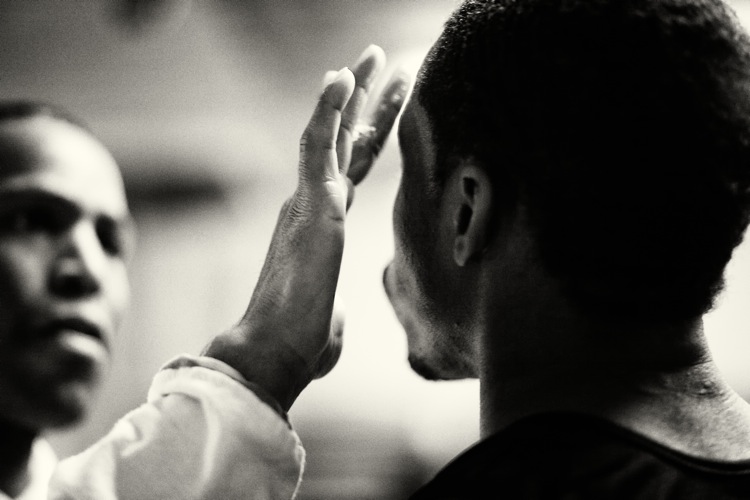
Photographer: Frank McMains
Title: Untitled #1, from ‘Angola Boxing’ series
Year: 2010
Size: 8″x12″
Print: B/W digital print on archival paper
Signed, uneditioned.
Print PLUS a postcard and a mixtape – $100. BUY NOW.
– – – – – – – – – – – – – –
STEVE DAVIS

Photographer: Steve Davis
Title: Untitled #1, from ‘Captured Youth’ series
Year: 2005
Size: 8″x10″
Print: Color, heavyweight archival paper
Signed, special edition of 4.
Print PLUS a postcard, a mixtape and a self-published book – going for $300. BUY NOW.
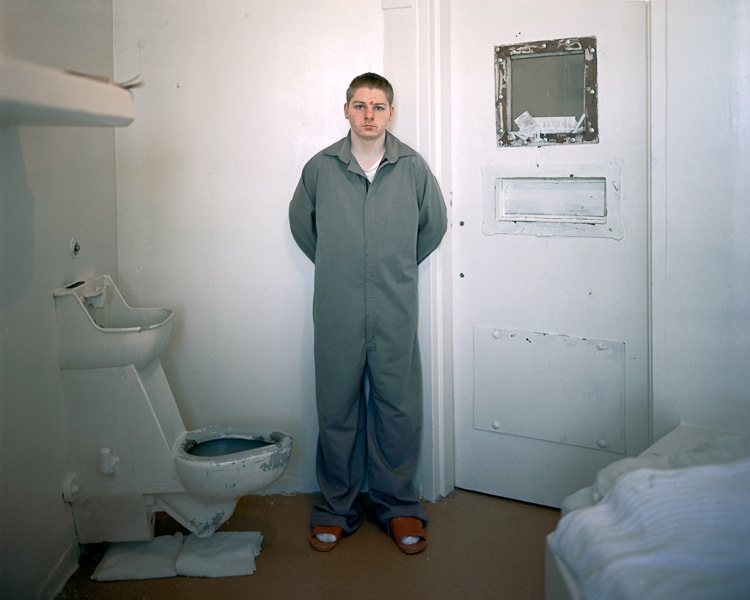
Photographer: Steve Davis
Title: Untitled #2, from ‘Captured Youth’ series
Year: 2005
Size: 8″x10″
Print: Color, heavyweight archival paper
Signed, special edition of 4.
Print PLUS a postcard, a mixtape and a self-published book – going for $300. BUY NOW.

Photographer: Steve Davis
Title: Untitled #3, from ‘Captured Youth’ series
Year: 2005
Size: 8″x10″
Print: Color, heavyweight archival paper
Signed, special edition of 4.
Print PLUS a postcard, a mixtape and a self-published book – going for $300. BUY NOW.
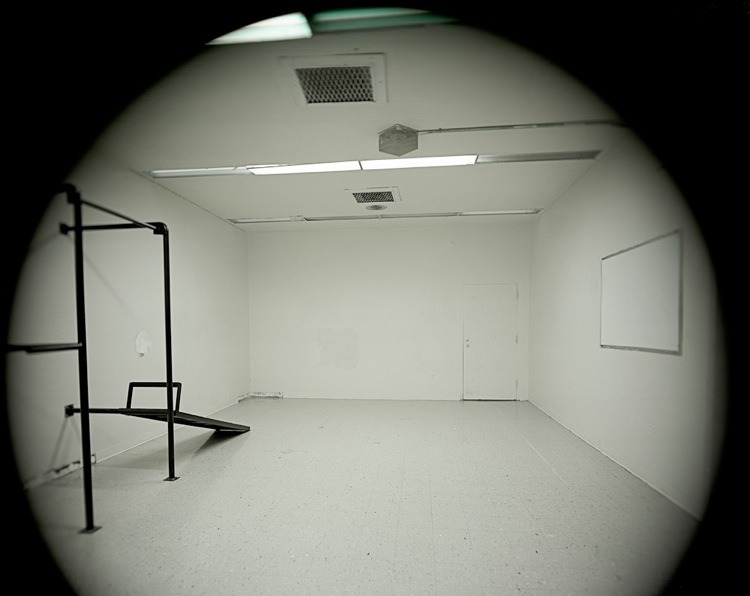
Photographer: Steve Davis
Title: Untitled #4, from ‘Captured Youth’ series
Year: 2005
Size: 8″x10″
Print: Color, heavyweight archival paper
Signed, special edition of 4.
Print PLUS a postcard, a mixtape and a self-published book – going for $300. BUY NOW.
– – – – – – – – – – – – –
RICHARD ROSS

Harrison County Juvenile Detention Center in Biloxi, Mississippi operated by Mississippi Security Services, formerly the Biloxi City Jail, Currently run by Director Warden. A fire in 1982 killed 27 inmates. There is currently a lawsuit against them which forced them to reduce their population. They must now maintain an 8:1 inmate to staff ratio. © Richard Ross
Photographer: Richard Ross
Title: ’12-year old at Harrison County’
Year: 2009
Size: 9″x12″
Print: Color, Epson digital print on enhanced matt
Signed
Print PLUS, self-published book, postcard and mixtape = $1,000. BUY HERE
– – – – – – – – – – – – – –
BRUCE JACKSON

Photographer: Bruce Jackson
Title: ‘Dominoes. Death Row, Texas’
Year: 1979
Size: 12.5″x17″ on 13″x19″ paper
Print: B&W, Ilford Gallerie Gold Fibre Silk Paper.
Edition: #3 of an edition of 20
Signed
From Bruce Jackson and Diane Christian, “In this Timeless Time”: Living and Dying on Death Row in America (University of North Carolina Press, 2011)
Print PLUS, self-published book, postcard and mixtape = $800. BUY HERE
– – – – – – – – – – – – – –
VICTOR BLUE

Gang members of the Mara 18 help another with his wounds in the El Hoyon prison in Escuintla Guatemala Tuesday August 23, 2005. El Hoyon was the scene of a prison riot the week before in which members of a rival gang, the Mara Salvatrucha, killed 23 members of the Mara 18 using firearms, knives, and handgrenades. © Victor Blue.
Photographer: Victor Blue
Title: ‘Closing a Wound, Mara 18’
Year: 2005
Size: 11″x14″
Print: Color, archival print
Signed
Print PLUS, self-published book, postcard and mixtape = $200. BUY HERE
– – – – – – – – – – – – – –
LORI WASELCHUK

Mary Bloomer, a prison security guard, watches from the levee as prisoners form Field Line 15 from Wolf Dormitory at Camp C at Angola, Louisiana’s maximum security prison. Angola is a massive top-security prison, occupying flat delta land equal to the size of Manhattan. Prisoners walk or ride in buses to and from their jobs every day. © Lori Waselchuk
Photographer: Lori Waselchuk
Title: ‘Prison Guard Watches from the Levee, Angola Prison’
Year: 2007
Size: 12″ X 24″
Print: B&W, archival pigment print
Edition: #2 of an edition of 15
Signed
Print PLUS, self-published book, postcard and mixtape = $400. BUY HERE

Lloyd Bone, a prisoner at Louisiana’s State Penitentiary, rides atop a horse driven hearse carrying the body of fellow prisoner George Alexander, who died at the age of 56. The hearse was hand built by prison carpenters. The elaborate funerals for inmates buried in the prison’s cemetery is an example of how hospice volunteers (with the support of Warden Burl Cain) have created a tone of reverence for the dying and the dead at Angola Prison. © Lori Waselchuk
Photographer: Lori Waselchuk
Title: ‘Lloyd Bone Drives the Funeral Hearse’
Year: 2007
Size: 7″ x 14″
Print: B&W, archival pigment print
Edition: #7 of an edition of 25
Signed
Print PLUS, self-published book, postcard and mixtape. SOLD
– – – – – – – – – – – – – –
JAN STURMANN

Wards offer each other comfort and support before entering the Sweat Lodge. No blood has ever been spilt in the Sweat Lodge area, and gang rivalries and personal disputes are often resolved during this time. Since 1991 Native American Spiritual Leader Jimi Castillo has conducted this ceremony each Thursday at the Herman G. Stark Youth Correctional Facility in Chino, CA, east of LA. The ceremony is open to all wards, irrespective of race. © Jan Sturmann
Photographer: Jan Sturmann
Title: ‘Juvenile Prison Sweat Lodge’
Year: 2005
Size: 8″x10″
Print: Color, archival inkjet print
Not editioned
Signed
$50
– – – – – – – – – – – – – –
ARA OSHAGAN

Photographer: Ara Oshagan
Title: ‘Liz, 21 years old, Chowchilla State Prison, CA, 2003’
Year: 2003
Size: 30″x8″
Print: Color and B&W, archival pigment ink print (Giclee)
Edition #2 of 10
Signed
Print PLUS, self-published book, postcard and mixtape = $400. BUY HERE
– – – – – – – – – – – – – –
STEPHEN TOURLENTES

Photographer: Stephen Tourlentes
Title: Comstock, NY State Prison
Year: 2009
Print: 11″x14″ B&W, Archival Pigment Print
Aritist’s Proof, Signed
Print PLUS, self-published book, postcard and mixtape = $500 – BUY NOW
– – – – – – – – – – – – – –
SYE WILLIAMS

Photographer: Sye Williams
Title: ‘The Four’
Year: 2001
Size: 11″x14″
Print: Color
1st edition 2/25
Signed
Print PLUS, self-published book, postcard and mixtape = $900. BUY HERE
– – – – – – – – – – – – – –
ADAM AMENGUAL

Photographer: Adam Amengual
Title: ‘Adrien Caceres’ from the “Homies” series
Year: 2011
Size: 11″x14″
Print: Color, archival inkjet print
Edition #2 of 10
Signed
Print PLUS, self-published book, postcard and mixtape = $750. BUY HERE
– – – – – – – – – – – – – –
JENN ACKERMAN
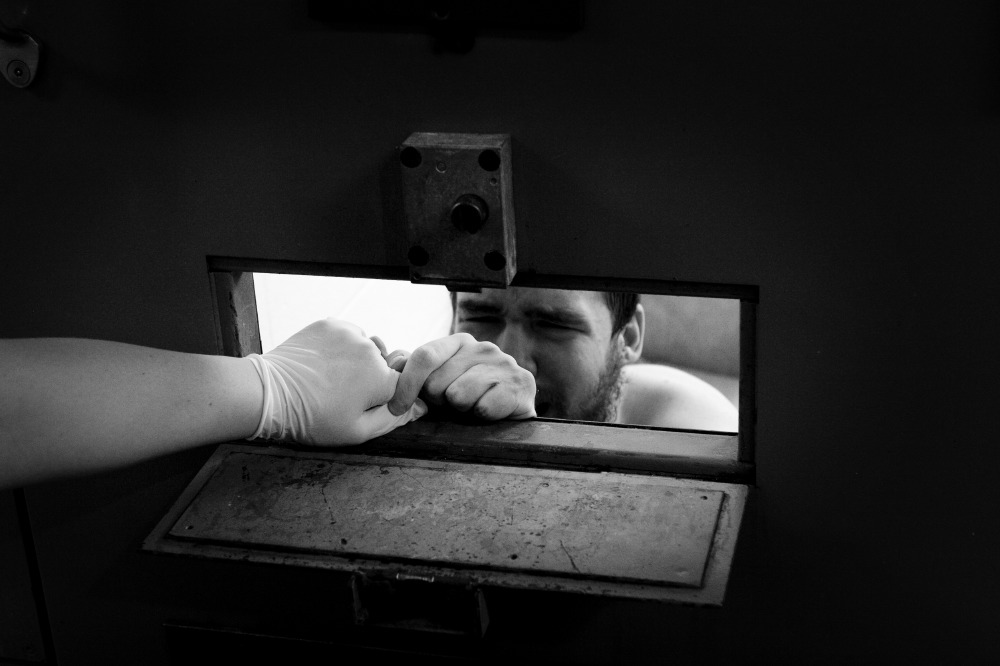
Julia Lish, a correctional officer, comforts an inmate during one his psychotic episodes. “Its going to be OK,” she repeats as he cries and yells to the voices in his head. © Jenn Ackermann
Photographer: Jenn Ackerman
Title: ‘A Hand to Hold’ (2008) from the series, Trapped.
Print: 11×14. B&W, archival matte.
Edition: #2 of an edition of 25.
Signed.
Print PLUS, self-published book, postcard and mixtape = $600. BUY HERE
– – – – – – – – – – – – –
TIM GRUBER
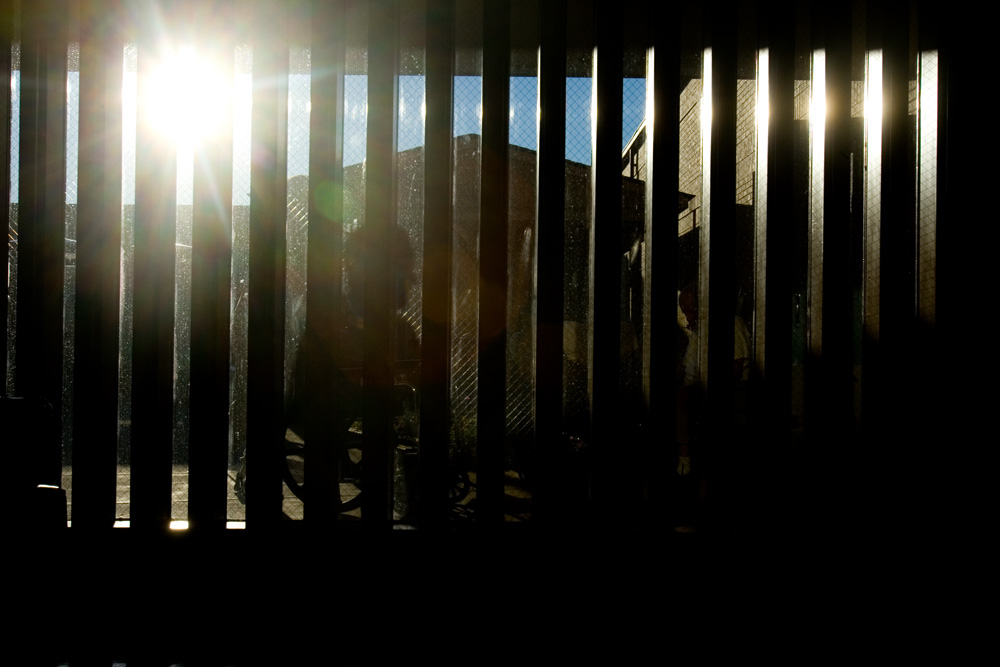
The sun breaks through the bars of the Nursing and Hospice Care Unit at the Kentucky State Reformatory, as part of the series ‘Served Out.’ © Tim Gruber
Photographer: Tim Gruber
Title: ‘Sunset Behind Bars’
Year: 2008
Print: 14×11″ B&W, archival pigment print on matte paper.
Edition: #1 of an edition of 25.
Signed.
Print PLUS, self-published book, postcard and mixtape = $500. BUY HERE
MAX WHITTAKER
Any photo from Max Whittaker‘s archive, signed and printed at 11″x17″.
Print PLUS, self-published book, postcard and mixtape = $200. BUY HERE
– – – – – – – – – – – – – –
ADAM SHEMPER
Photographer: Adam Shemper
Title: ‘In the Wheat Fields, Louisiana State Penitentiary, Angola, Louisiana’
Year: 2000
Print: 9″x9″. B&W on archival paper
Signed
Print PLUS, self-published book, postcard and mixtape = $325. BUY HERE
– – – – – – – – – – – – – –
JON LOWENSTEIN
Photographer: Jon Lowenstein.
Title: Undocumented Mexican Immigrants – Tent City.
Year: 2009.
Print: 11″x 14″ coloor print, on Hannemuehle archival paper.
Signed.
Print, PLUS, self-published book, postcard and mixtape. = $1,000 – BUY HERE
– – – – – – – – – – – – – –
MIKHAEL SUBOTZKY

Photographer: Incarcerated student of Mikhael Subotzky
Title: Maplank in the Workshop, Pollsmoor Prison, 2005
Year: 2005
Print: Silver gelatin print on fiber paper, B&W 35x50cm (frame approx 50x65cm)
Edition: # 1/9
Unsigned, framed.
Print, PLUS postcard, mixtape and self=published book = $1,000 – BUY HERE
___________________________________________________
Please forward the link to this page and my Kickstarter page to anybody whom you think may be interested in the project and potentially donating. Cheers!
___________________________________________________
Here’s a YouTube version of my Kickstarter pitch for those of you who can’t embed from any other video sites (don’t worry the WordPress video upgrade is on its way)

Natasha, Women’s Prison, 2009. © Michal Chelbin
For the past three years, Michal Chelbin has made portraits in the prisons of Russia and Ukraine. You can see a selection of the works from her series Locked on the New Yorker Photobooth blog.
Chelbin’s doleful portraits are striking – something different – and, of course, given their subject matter I was compelled to mention them here. However, without any specialist knowledge of the prisons in Russia and Ukraine, I struggled to think of a worthwhile statement to accompany with them. Is it enough for me just to say that work is beautiful and interesting? I don’t think so.
Therefore, this conundrum becomes the focus of this short post.
The way Chelbin describes it, her portraits are the first step on a journey (of undetermined length) to at least attempt to “know” her subjects:
“When I record a scene, my aim is to create a mixture of plain information and riddles, so that not everything is resolved in the image. Who is this person? Why is he dressed like this? What does it mean to be locked up? Is it a human act? Is it fair? Do we punish him with our eyes? Can we guess what a person’s crime is just by looking at his portrait? Is it human to be weak and murderous at the same time? My intentions are to confuse the viewer and to confront him with these questions, which are the same questions with which I myself still struggle.”
It seems to me that this the type of curiosity we should expect of all photographers and their works; it’s partly how we are drawn into the previously unknown.
But the unknown has its dangers. As Fred Ritchin stated:
“Photography too often confirms preconceptions and distances the reader from more nuanced realities. The people in the frame are often depicted as too foreign, too exotic, or simply too different to be easily understood.”
Beautiful photography is easy to come by these days, and so, for me at least, viewing beguiling portraiture becomes an act of enjoying the beauty but then stepping further and using it to get at something deeper. That might involve a dialogue with someone over coffee; it might be to find comparative examples [1, 2, 3, 4, 5, 6, 7]; it might be to read up on the conditions for juvenile prisoners in Russian prisons; it might be to read the photographer’s statement or even contact the photographer directly to seek the missing pieces.
Photographs, and particularly portraits, are often a door unlocked but often in our busy lives we don’t even try the handle.
Perhaps now is a good time to return to some thoughts on what makes a great portrait, here and here.
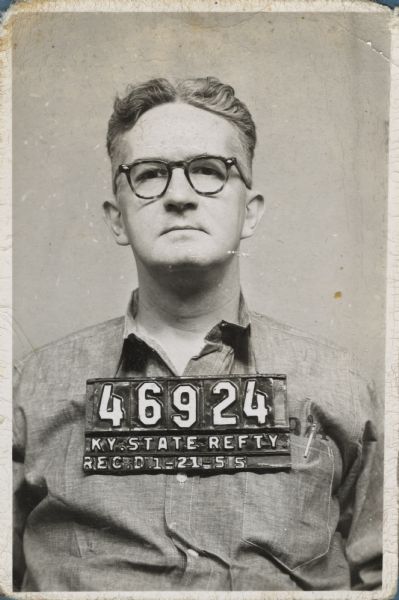
CARL BRADEN
I was surfing through the Wisconsin Historical Archives, like you do, and came across the above image of Carl Braden.
Braden and his wife Anne Braden were journalists-turned-activists who were part of the union movements and later the radical interracial left of the 40s and 50s. The Braden’s bought a house on behalf of the Wade family, their African American friends in suburban Louisville, Kentucky. When neighbours found out a Black family had moved in they burnt a cross outside the house and went after the Braden’s. Carl was charged with sedition in what is known as the Wade Case. Carl was sentenced to 15 years and served 8 months, eventually paying $40,000 to get out.
The Anne Braden Institute (ABI) now operates out of the University of Louisville. The ABI has a Flickr stream of scenes from her full life.
KARL BADEN
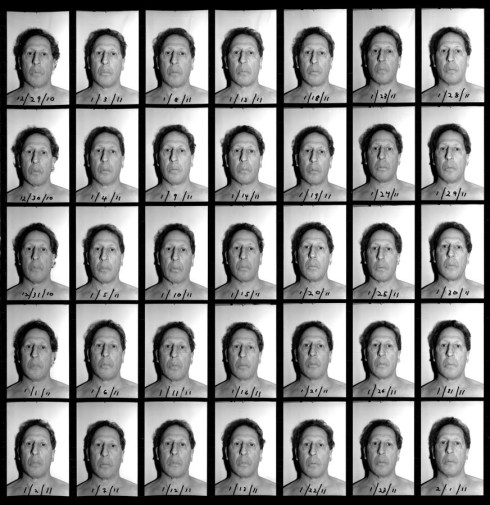
Karl Baden has chosen to put himself in the picture everyday for 24 years. Somewhere he has set up a self-imposed mugshot identification room. All these can be seen at his website Every Day.
It’s worth noting that Baden and Noah Kalina are the original and best for these vaguely masturbatory, mirrored versions of themselves in time-lapse. Others include a girl with a nice set of scarves, two dudes (one and two) with beard-growing missions, a guy with an 800 day commitment and Homer Simpson.
There is also Diego Goldberg who self-documents he and his family once a year, every year on the 17th June.
Baden has established a unique set of data for a limited case study in visual anthropology. The date runs like an I.D. number at the bottom of his shots.
As Baden describes the project, he removes emotion and variables from the photography, just as police or criminal justice photographers do for mugshots:
Every Day is performed within a set of guidelines. […] Reserved exclusively for this procedure are a single camera, tripod, strobe and white backdrop. […] I use the same type of high-resolution film (Kodak Technical Pan until it was discontinued in 2007, Ilford Pan F since then) and the same strobe lighting. The camera is always set and focused at the same distance. When taking the picture, I try to center myself in the frame, maintain a neutral expression and look straight into the lens.
Baden lists the key tenets of Every Day to be mortality; incremental change; obsession (its relation to both the psyche and art-making); and the difference between attempting to be perfect, and being human. I’ll grant him those things, but I also wonder is does the project not feel like a sentence?
And my question to you, readers, is what should we make of this type of project? It could be just inventive fun or it might be one of the most present-minded approaches to photography there is? I can’t decide.

In South African slang “pap” means spineless, wet or without character.* Why anyone would want to make a demand for immediate pap (of such a description) is beyond me. And yet, in its chosen company name PapNow! unintentionally hits upon the central tenet of its bilious enterprise – namely a mindless demand for crap.
PapNow! announced itself in June as the place to buy and sell your own celebrity pictures.
The venture takes advantage of the fact everyone has a camera. In my view, PapNow! exploits peoples’ contorted versions of citizenship in a celebrity culture; that they should mimic, stalk and waste time over the looks of others. PapNow! is, one assumes, in it to make money. It is – in the guise of a business model – the reckless, wolfish, jealous little brother of citizen journalism.
Its online presence might just be enough for users to convince themselves PapNow! has value.
There may be other sites like PapNow!; I haven’t bothered the time to do research because I know I’d say the same about each of them. Besides, high value paparazzi shots will always find their monetised routes to the tabloids anyway. My criticism of PapNow! is based purely on how it lowers the bar for entry into the already bottom-feeding paparazzi industry.
The timing is remarkable. Last week, The News of the World scuttled it’s destroyed brand in the wake of the phone hacking scandal that united Britain in disgust. As far as the NOTW is concerned it’s good riddance to bad rubbish, but I worry now that newspapers’ role as arbiters of gossip and candid snaps may be adopted by the docile masses. By process of unconscious assimilation, could the consumers become the producers? Could we end up with a dominant visual culture of only street scuffles, fashion commentary, nipple-slips, antagonism, and up-skirt photography?
Hope not.
By the by, the etymology of the word paparazzi is rather interesting.

 Prison Photography