
You are currently browsing the category archive for the ‘Photography: Non-Prison’ category.

Last year, in the article Photographing the Prostitutes of Italy’s Backroads: Google Street View vs. Boots on the Ground, I compared the work of artists Mishka Henner and Paolo Patrizi both of whom were making images of prostitution on the back roads of Spain and Italy.
I argued that the photographs by Patrizi, due to their physical and emotional proximity had more relevance. Patrizi actually went to the roadside locations whereas Henner, making use of Google Street View, had not.
Around the same time, Joerg Colberg posted some thoughts about Henner’s No Man’s Land.
Shortly thereafter, Mishka Henner emailed me and mounted an impassioned defense of his work. Henner felt he had been “thrown to the cyber-lions.” Not wanting to see anyone with his or her nose bent, I offered Henner a platform on Prison Photography for right of reply.
CONVERSATION
PB: What was your issue with the commentary on No Man’s Land?
MH: There’s a section of the photo community judging No Man’s Land according to a pretty narrow set of criteria. So narrow they’re avoiding one of the elephants in the room, which is what role is left for the street photographer in the age of Google Street View? Comparing No Man’s Land to other projects on sex workers could be interesting but the way it’s done here is resulting in a pretty narrow discussion about whether it’s valid, ethical or just sensationalistic. I don’t see how that helps move documentary forwards. All the projects you mention, including mine, assert themselves as documents of a social reality. But in your discussion, this is secondary to how they make you feel and Colberg even argues Patrizi’s approach makes you care. My motivation isn’t to make you feel or to care – it’s to make you think.
MH: No Man’s Land uses existing cameras, online interest groups, and one of the subjects interwoven in the history of photography. And I think the ability to combine these elements says something about the cultural and technological age we live in. In some photographic circles, that’s the way it’s being discussed and I’m surprised Colberg and yourself have dismissed it in favour of more reactionary arguments that seem to hark back to what I see as a conservative and nostalgic view of the medium.
PB: Well, if preference for boots on the ground and a suspicion of a GSV project is reactionary, then okay. Why did you use GSV for No Man’s Land? Are you opposed to documentary work?
MH: This is documentary work, how can it not be? And what’s this suspicion of GSV? Would you have been suspicious of Eugene Atget walking the streets with his camera? I’m sure many were at the time but that suspicion seems ridiculous now. And your response is reactionary because it validates and dismisses work according to quite spurious and nebulous criteria. What does it matter if I released the shutter or not? A social reality has been captured by a remote device taking billions of pictures no one else ever looked at or collected in this way before. You’re only seeing this record because I’ve put it together. The project is about the scale of a social issue, not about trying to convince a viewer that they should have pity for individual subjects. Yet in these circles, the latter uncritically dwarfs the former as though it’s the only valid approach.
MH: Paolo Patrizi’s A Disquieting Intimacy is evidently an accomplished visual body of work, as is Txema Salvans’ The Waiting Game but to argue they offer a deeper insight into the plight of sex workers is, I think, generous to say the least.
MH: The assumption underlying much of the critiques of No Man’s Land (in particular Alan Chin’s) is that there’s no research and it’s a lazy, sensationalistic account of something fabricated. But what if I told you it was researched and took months to produce; what basis would there be then for dismissing it? Doesn’t research inform 90% of every documentary photographer’s work (it did mine, maybe I wasn’t doing it right)?
What’s left unsaid in these critiques is that No Man’s Land doesn’t fit a rather narrow and conservative view of what one community believes photography should be. The fact we’re drowning in images and that new visions of photography are coming to light are a scary prospect to that community, hence the reactionary and defensive responses. But there’s more to these responses than simply validating boots on the ground. You’re prioritising a particular way of seeing and rejecting another that happens to be absolutely contemporary.
PB: I think we can agree Patrizi is accomplished. I was deliberately lyrical in my description of his work and I meant it when I was personally moved by Patrizi’s work. That is a personal response.
MH: That’s fine, but what does Patrizi tell us that is missing from No Man’s Land? Is the isolation and loneliness of a feral roadside existence and the domestication of liminal spaces really that much more evident in one body of work than the other? Surprisingly – given your sympathy for Patrizi’s’ approach – even the women’s anonymity is matched in each project. No captions, no locations, no names, and no personal stories. Just a well-researched introductory text that refers in general terms to the women’s experiences. I think you’re viewing the work through rose-tinted spectacles.
PB: I can’t argue with your point about anonymity. There may be an element of gravitating toward [Patrizi’s] familiar methods. This might be because reading the images resultant of those methods is safe for the audience; they find it more easily accessible, possibly even instructive in how they should react?
MH: Working in documentary for many years, I can’t deny I aimed for these lofty aspirations. But I now consider the burden of sympathy expected from a narrow language of documentary to be a distracting filter in the expression of much more complex realities. Pity has a long and well-established aesthetic and I just don’t buy it anymore. In themselves the facts are terrible and I don’t need a sublime image to be convinced of that. In the context of representing street prostitution, striving for the sublime seems a far more perverse goal to me than using Street View and much more difficult to defend.
MH: Alan Chin’s comments surprised me because I wouldn’t expect such a knee-jerk reaction from an apparently concerned photographer. But his work is a type of documentary that I’m reacting against; a kind of parachute voyeurism soaked in a language of pity that reduces complex international and domestic scenarios into pornographic scenes of destruction and drama. It’s the very oxygen the dumb hegemonic narrative of terror thrives on and I reject it. Why you would pick his critique of my work is beyond me – we’re ships passing in the night.
PB: I quoted Chin because he and I were already been in discussion with others about the many photo-GSV projects. He represented a particularly strong opposition to all the GSV projects including No Man’s Land.
MH:No Man’s Land is disturbing, I agree. And it troubles and inspires me in equal measure that I can even make a body of work like it today. But it isn’t just about these women, it’s also about the visual technologies at our disposal and how by combining them with certain data sets (in this case, geographic locations logged and shared by men all around the world), an alternative form of documentary can emerge that makes use of all this new material to represent a current situation. It appeals to me because it doesn’t evoke what I think of as the tired devices of pity and the sublime to get its point across.
PB: It’s not that I don’t like No Man’s Land, but I prefer Patrizi’s A Disquieting Intimacy; it is close(r) and it is technically very competent work. There’s plenty of art/documentary photography that doesn’t impress me as much as Patrizi’s does. A clumsy photographer could’ve dealt with the topics of migration and the sex industry poorly. I don’t think Patrizi did.
MH: I don’t know what you mean by clumsy. If by clumsy you mean a photographer who shows us what they see as opposed to what they think others want to see then bring it on, I’d love to see more of that. No Man’s Land might seem cold and distant, it might even appear to be easy (it isn’t), but it’s rooted in an absolutely present condition. What you consider to be its weakness – its inability to get close to the photographic subject, its struggle to evoke pity – is what I consider to be its strength.
PB: The detachment is the problem for all concerned. People may be using your work as a scapegoat. This would be an accusation that I could, partly, aim at myself. Does your work reference the frustration of isolation and deadened imagination in a networked world?
MH: At first, I reacted strongly to your description of my work as anemic but now I think it’s a pretty good description of the work. And it’s an accurate word for describing what I think of as the technological experience today, our dependence on it and its consequences.
PB: Consequences?
MH: I know, like most working photographers, that for all the fantasies of a life spent outdoors, much of a photographer’s workload happens online. And if you’re a freelancer, the industry demands that you’re glued to the web. It’s not the way I’d like it to be; it just happens to be the world I’m living in. And anyone reading this online on your blog is likely to share that reality. So it seems natural and honest that as an artist, I have to explore that reality rather than deny its existence.
PB: For audiences to grasp that you’re dealing – with equal gravity – two very different concerns of photography (the subject and then also contemporary technologies) opens up a space for confusion. Not your problem necessarily, but possibly the root of the backlash among the audience.
MH: Well, it’s surprising to me that few critics have actually discussed the work in relation to the context in which it was produced, i.e. as a photo-book. If even the critics are judging photo-books and photographs by their appearance on their computer screens, then I rest my case.
PB: What difference does the book format make to your expected reactions to the body of work?
MH: For one thing the book takes the work away from the online realm and demands a different reading. That in itself transforms it and turns it into a permanent record. Otherwise I’d just leave the work on-screen. I recently produced a second volume and intend to release a third and then a fourth, continuing for as long as the material exists.
PB: On some levels, people’s reactions to your work seem strange. If people are so affronted, they should want to change society and not your images?
MH: Too often, I find that beautifully crafted images of tragedy and trauma have become the safe comfort zones to which our consciences retreat. It’s something people have come to expect and it doesn’t sit easily with me. When I think of No Man’s Land, I keep returning to Oscar Wilde’s preface to The Picture of Dorian Gray:
No artist has ethical sympathies.
An ethical sympathy in an artist is an unpardonable mannerism of style.
All art is at once surface and symbol.
Those who go beneath the surface do so at their peril.
Those who read the symbol do so at their peril.
It is the spectator, and not life, that art really mirrors.
Diversity of opinion about a work of art shows that the work is new, complex and vital.
When critics disagree the artist is in accord with himself.
– – – – – – – – – – – – –
No Man’s Land will be on show – from May 3rd until 27th – at Blue Sky Gallery, 122 NW 8th Avenue, Portland, OR 97209. Tuesday – Sunday, 12-5 pm.

Cruel and Unusual, an exhibition of prison photographs that I co-curated with Hester Keijser at the Noorderlicht Photo Gallery in Groningen, Netherlands closes on Sunday (8th).
You probably know about it because I haven’t been shy to promote it; it is one of my proudest achievements. I’d like to take this opportunity to share with you some thoughts on the Noorderlicht team and publish some installation shots. Part debrief, part abridged journal entries.
The show balanced two interrelated parts. One could not exist with out the other.
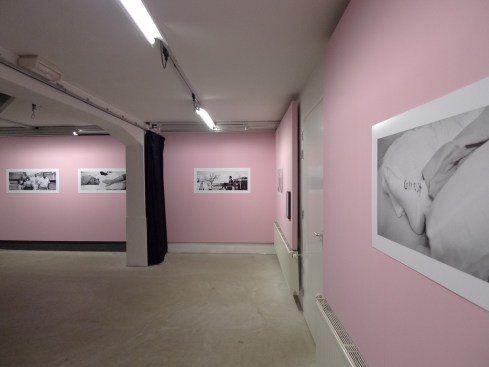
The main section of Cruel and Unusual looked exactly like a tradition photo show – ordered, framed prints of 11 named photographers. Cerebral and reliable. Mindful. The mind.
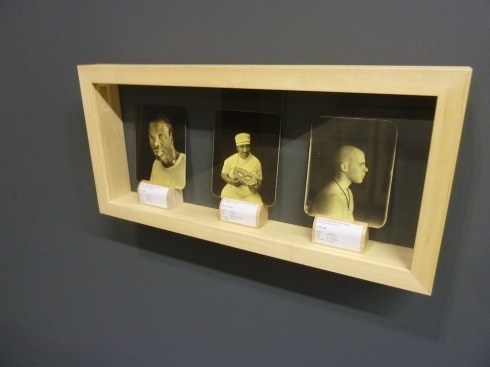
The counterpart was the PPOTR wall – a “mayhemic reflection” of some of the stories and images I encountered during Prison Photography on the Road. It included the photographs and quotes of another 18 photographers.
The PPOTR wall was messy, imperfect, unmediated, and attached to the core of my sprawling interest in prison imagery. It was the best solution Hester and I could think of to reflect our frantic immersion in international, blogging photo-territories. Physical, with tentacles, corporal. The body.
Body and the mind are inseparable. They communication with one another through a central nervous system. Noorderlicht, our host was backbone, nerve centre and sensitivity.
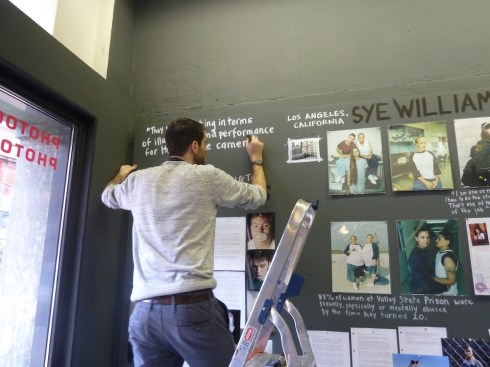
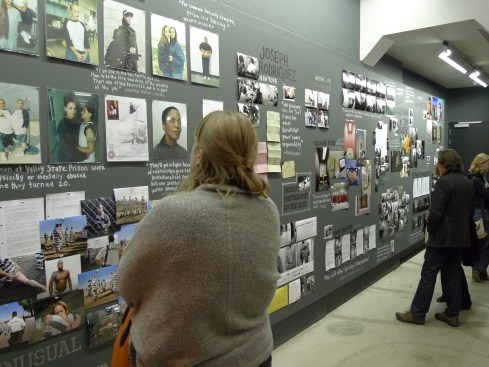

Outside of my home country (and my comfort zone) I clamped onto my host. Noorderlicht gallery connected mind and body; perfection with imperfection; polished ideas with raw, in-process threads; finished photographs with found stories.
The PPOTR wall was the first time I’ve tried to bring my sprawling project to some sort of overview suitable for visual consumption (lecture Powerpoint presentations excepted). As such, I was required to direct the PPOTR installation.
It is at the point of installation, one begins to appreciate the attitudes of the host and its staff.
As a practitioner with little experience in installation, the Noorderlicht installation team of Marco, Ype and Margriet were supportive without qualification, enthused, and willing to make gentle interventions when necessary. Their relaxed professionalism is one reflected through the organization from top to bottom. I worked with Charissa Caron on press liaison, with gallery director Olaf Veenstra on business decisions. Geert printed the work. There was always fresh coffee on hand. There were flowers in the gallery. At the opening they let dogs come in to see the artwork!
Noorderlicht is more than a workplace. It is a home.
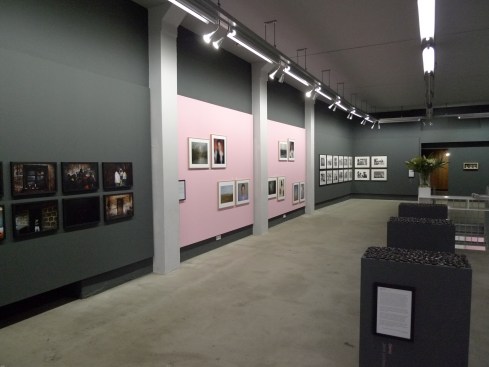


It was somewhat of a risk for Noorderlicht to commission two photobloggers to curate. Yes, we have the knowledge and the online networks, but blogging (writing emails, forging prose, editing online galleries) is very different to herding photographers and liaising with gallery staff for a physical show.
I should say that Hester is a much more accomplished gad about phototown with a long CV of collaborations and in the past year has taken on the role of curator at large for the Empty Quarter Gallery, Dubai. Her knowledge and discipline propelled the pre-show nuts-and-bolts organizing. Without her, I’d have been knocked on my arse early in the venture.
There is a reason Noorderlicht took a risk on us though. It is because they do it often. Noorderlicht is probably best known for its international photography festival. The size and reputation of their festival is astounding given the foundation’s modest size. Take a look through the festival archives and see how many big name photographers showed their work at Noorderlicht before they became big names. They are pioneers.
Groningen is in the north of the Netherlands, 3 hours drive from Amsterdam and the rest of the cultural heart of Holland in the west and south (den Haag, Utrecht, Lieden and Rotterdam). Because of this Noorderlicht often gets overlooked or pigeonholed. I think in some cases, folk might be slow to acknowledge Noorderlicht’s accomplishments. We know how London and NYC dominate the cultural psyches of the UK and the U.S., and I think a similar imbalance persists in the Netherlands. If I am in anyway correct – and I wish I were not – then this is everybody’s loss.
The risk paid off.
Cruel and Unusual was extended by a week due to public demand. Visitor numbers have been substantial and the Dutch press went doolally over it. National radio, newspapers, magazine features – the whole shebang.
This does not surprise me. For many reasons, the subject matter is compelling. But I think the show has been a success because there is a dearth of discussion about prisons in Europe. As grand an ambition it may sound, Hester and I hoped the show would be a warning shot across the bows of Europe: DON’T REPEAT AMERICA’S MISTAKES. DON’T MASS INCARCERATE! It would seem people were hungry for Cruel and Unusual because the topic was a challenging breath of fresh air. Much of the work was also being shown in Europe for the first time. As thrilling as photography can be, I think the show was a thrill.
At the opening, were visitors from Amsterdam photo circles. It was huge validation to welcome knowledgeable folk venturing such a distance from their reliable cultural locale. Another indicator of legitimacy.
I am grateful the show was a success. Prior, I didn’t think about it; I didn’t know how to define success with a show. And I don’t know what I’d have done if it had been a flop!
I’m happy for all the beautiful staff at Noorderlicht that it has worked out. Hester and I were treated like family. That’s not an exaggeration – I’ll leave you with the words of Ton Broekhuis, Noorderlicht Foundation Director as written to me in an email following my return to the U.S.
“Pete, you mentioned ‘being welcomed into the Noorderlicht family’. You did not mention leaving the Noorderlicht family, which is reasonable. Everyone who joins the family by free will makes – at the same time – a promise to come back. Family is family. It is forever.”

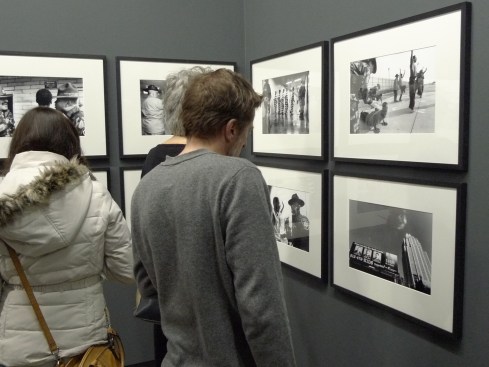

PRESS FOR CRUEL AND UNUSUAL
American Photo: “There’s a wide range of photography blogs on the internet, but how would it be possible to measure their impact on the real world? It’s difficult to see the offline effect of an idea published online. […] We’re interested to see what other ways photography bloggers choose to usher their projects into the real world, and Brook certainly sounds excited. “This is going to sound crazy,” he said, “but I’ve never seen these works any bigger than 600 pixels wide on a screen.” Spoken like a true 21st-century curator.”
Elizabeth Avedon: “Noorderlicht Gallery is producing a ‘must-have’ catalog for Cruel and Unusual, designed as a newspaper by Pierre Derks in an edition of 4,000. Along with visuals from the main exhibition, the catalog contains articles, interviews, ephemera and material from photographers Pete Brook encountered during his crowd-funded road-trip through the U.S.” (One and Two and Three)
Daylight Magazine: “What steps are being taken to productively rehabilitate inmates, rather than simply secluding them from society and releasing them once their term is up? The Nooderlicht Photogallery has curated a show from nine women photographers to explore the effect that mass imprisonment has had on our sense of justice and virtue.”
Marc Feustel: “Brook and Keijser write two of the most dynamic and esoteric blogs that you will find on the web. To state the obvious, prisons are not exactly a sexy subject and the fact that they have managed to put this show together is very impressive. Instead of a ‘traditional’ exhibition catalogue, the curators have put together a newspaper in an attempt to reach more readers than an expensive photobook could. The world of photography online can be an exasperating, sprawling mess, but the fact that it can lead to projects such as this one makes it genuinely worthwhile.”
Stan Banos: “If you’re interested in documentary photography and interviews with the top notch photographers who made the work, Cruel and Unusual [newspaper] is very much worth the look.”
Greg Ruffing: “How citizens (aka taxpayers) understand the prison system and life behind bars, and how do they formulate their thoughts and convictions about mass incarceration based on the information they receive (and where that info is filtered through)? Cruel and Unusual gets to the heart of that issue by examining how prisons and prisoners are presented in images, and how those images are created, distributed, and consumed.”
Colin Pantall: “It is testament to how the internet and blogs are having a real impact that is breaking new ground and making new visual discoveries and connections.”
No Caption Needed: “Cruel and Unusual will provide another occasion to consider how the carceral system condemns those within and without, and how photography can reveal and build relationships where before there was only confinement, within and without.”
re-PHOTO: “Regular readers will know that I’ve often mentioned Pete Brook’s Prison Photography blog on these pages. He’s someone who has often raised interesting issues, both photographic and political, and the forthcoming show Cruel and Unusual at Noorderlicht which he is curating together with Hester Keijser looks to continue in that vein.” (One and Two)
Lens Culture
Eastern Art Report
La Lettre De La Photographie
Wayne Bremser
GUP Magazine
Dutch Press
FotoExpositie
FocusMedia
PhotoQ
Hamburg Art & Culture blog
Dutch free daily, De Pers ran a double spread of Scott Houston’s Arizona Female Chain Gang work. Dutch and Google translated English.
Noorderlicht has links to the De Pers article as a PDF and also a PDF of the Vrij Nederland feature on Alyse Emdur’s work (Dutch only)
Hester did three interviews for Dutch Radio
Radio Netherlands Worldwide
NOS, Netherlands Public Radio (Dutch only)
VPRO, Netherlands Public Broadcaster (Dutch only)
*Auto-Press*
Hester with the announcement and the backstory, and Hester reflecting on the churn that was newsprint catalogue design and production.
Prison Photography: Announcement, thoughts on the newsprint catalogue, newspaper distribution.
And finally, a Feature Shoot interview I did with about how the road-trip and exhibition have shaped the Prison Photography “Project”.


April 4th is the United Nations’ International Day for Mine Awareness.
Raphaël Dallaporta‘s Antipersonnel is a typology of these little fuckers that take doors off armoured vehicles and dice humans into small bloody portions.
Photographed against a black backdrop with the high production value of advertising photography, Dallaporta in some ways disarms us (‘xcuse the pun). Dallaporta’s work has some of them looking more like Tamagotchi’s than instruments of war. If we’re not careful, we might forget that for most of their existence these objects are either being put together in a factory, stored in cache or waiting to blow. They’re a one purpose gadget with only negative outcomes.
Human’s piece the deathly components together and then bury them under shallow soil in full knowledge they’ll exist quietly, perpetually, until someone or something presses down a medium amount of load. Yes, it’s all or nothing for these little fuckers.
But, I am anthropomorphising. These objects are not to blame. We are to blame. You can fire 1000 rounds from a gun and you cannot know how many will achieve their destructive purpose. But 1000 landmines are going to rip apart 1000 lives. They’re a guaranteed return. They are the absolute in nihilism and hate. That’s why it is important to distinguish antipersonnel mines from other weapons and that is why it is good the UN leads an effort to see them banned.
The UN:
Since the Convention on the Prohibition of the Use, Stockpiling, Production and Transfer of Anti-Personnel Mines and on Their Destruction, commonly known as the Anti-Personnel Mine Ban Convention opened for signature in 1997, 156 countries have ratified or acceded to it. More than 41 million stockpiled anti-personnel mines have been destroyed, and their production, sale and transfer have in essence stopped.


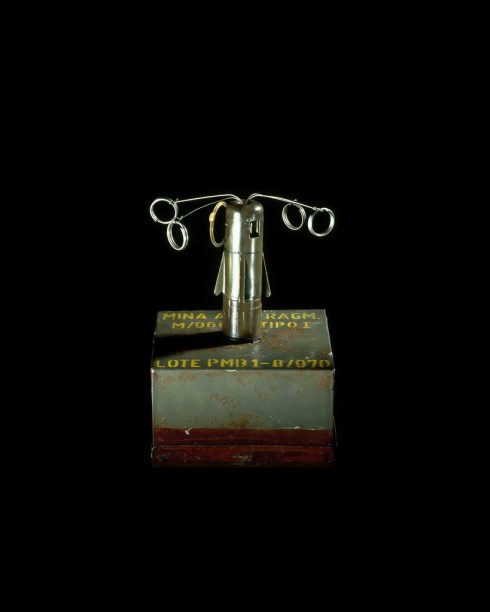
All images: Raphaël Dallaporta
– – –
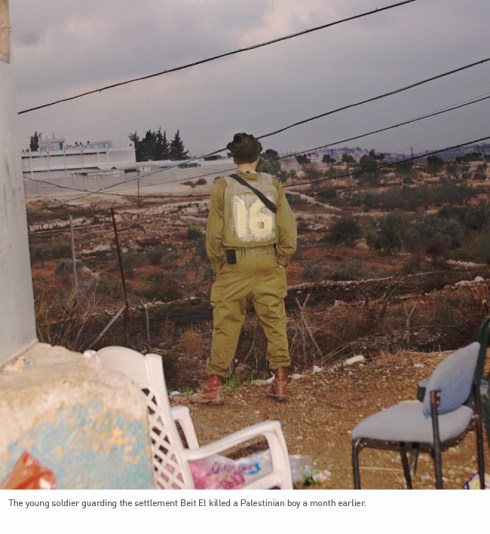
Life’s A Blast is a personal meditation on Israel and Palestine as seen through the lens of a young Swedish visitor. Linda Forsell visited Israel, Gaza and the West Bank several times between 2008 and 2010. She returned with a selection of images that read like a journal.
I first became aware of Forsell’s work when Life’s A Blast was shortlisted for the 2010 Magnum Expressions Award. I’m a big fan. I, therefore, did not hesitate to write a foreword when invited to do so by Linda. Below, punctuated by Linda’s images, is the I essay I wrote the new-release book Life’s A Blast.
– – –

– – –
“He lowered the glasses and pulled down the cotton mask from his face and wiped his nose on the back of his wrist and then glassed the country again. Then he just sat there holding the binoculars and watching the ashen daylight congeal over the land. He knew only that the child was his warrant. He said: If he is not the word of God, God never spoke.”
— Cormac McCarthy, The Road
It’s fair to speculate that all photography surfacing from Israel and Palestine is about land. Knowing what we do about land disputes, settlements and segregation in the region, it’s difficult not to ascribe images a political position favoring the land claims of either the Israelis or Palestinians. This is understandable in a climate of contemporary opinion that has roundly rejected the idea of photography and photographer as objective agents.
Linda Forsell’s photographs are not landscape photographs in the traditional sense. However, the beguiling vignettes within the pages of this book do return us to issues of land, and to the discomfiting realisation that no one in Israel or Palestine has a grounded or reliable relationship to the land.
In considering the surety of land-claims – claims backed with violence – in Israel and the Palestinian Territories, it may seem absurd to describe peoples’ connections to land as without root. Perhaps, the word ‘ambiguous’ more faithfully describes the disconnect. Between the certainty of established political positions and the uncertainty of physical existence in the region there exists a vast gulf of ambiguity.
Life’s A Blast is a challenge to convention and photographic authority, a sustained and deliberate visual wobble.
Within a photograph of an older man teetering atop a wall, the wobble is literal. In the photographs of children wielding weapons and playing among destroyed buildings, the imbalance is allegorical. Men, women and children in Forsell’s work maintain relationships among themselves, but struggle to find their feet.
The tropes of photography – particularly photojournalism – in Israel and Palestine are well known; the checkpoint; the rock-slinging youth; the huddled mother; the wall; the distant settlements on a desert hillside; the coffin raised high at a funeral; and – perhaps with most appearances on international newspaper front pages – the flag. The flag is often accompanied by some billowing smoke.
These tropes persist because, within the boundaries of a news story, these scenes are the illustrative of the quote/unquote action. As consumers of images, we must keep at the forefront of our minds that living in Israel and Palestine goes on outside the boundaries of news column inches.
– – –
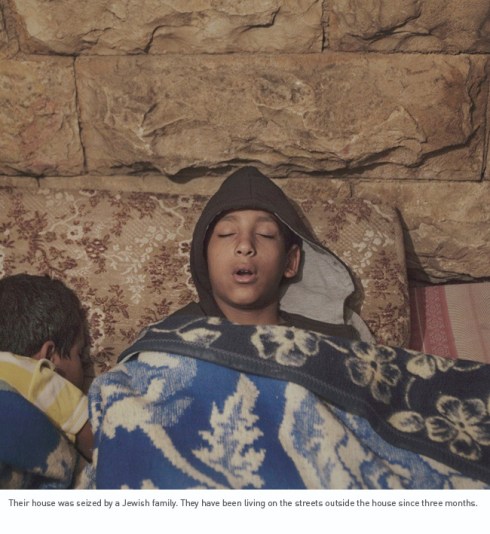


– – –
We have begun to see a small but noticeable response by contemporary photographers who have consciously moved away from “crisis photography” – I’m thinking here of recent work and publications by Irina Rozovsky and Yael Ben Zion – toward subtler observations of subtler gestures.
Forsell’s concern for the individual is noticeably different to the drawn back and almost cartographical response by celebrated photographers such as Sophie Ristelbuehler, Willie Doherty, Paul Seawright, Simon Norfolk and Richard Mosse. Of this group, curator and critic Charlotte Cotton says:
“Rather than being caught up in the chaotic midst of an event, or at close quarters to individual pain and suffering, photographers choose instead to represent what is left behind in the wake of such tragedies, often doing so with styles that purpose a qualifying perspective.” [1]
Equally committed to ideas of scarification and dislocation, Forsell, by contrast, takes us closer to people, not further away. In so doing, we encounter the personal and psychological; a soldier who doesn’t want to be there, an old man perplexed by border-point paperwork, the laughter of military-men, a side-street pat down and the confused glances of children. There’s vanity amid the daze and haze, too, in the form of rock-throwing demonstrators that look like they’re dressed for a violent-chic photoshoot. It’s only disconcerting if you accept there are no easy answers for the people of Israel and Palestine.
Too often, repeated news images provide us the excuse to think that events don’t change and can’t change. Worse still, is the trap to think that Israelis and Palestinians are different from us. Such thinking allows us to rationalise ongoing abuses. In discussing atrocities generally, lawyer and feminist scholar Catherine McKinnon characterises attitudes:
“If the events are socially considered unusual, the fact that they happened is denied in specific instances; if they are regarded as usual the fact that they are violating is denied; if it is happening, it’s not so bad, and if it’s really bad, it isn’t happening,” [2]
McKinnon describes the trap and illogic of apathy. The exit door from denial is to first see the victims of abuse as humans. To identify common emotions and thus ourselves in Forsell’s subjects is our responsibility to them … and her gift to us. Turning these pages is to shake the foundations of our excusatory logic.
Life’s A Blast is a significant contribution to the visual discourse of Israel and Palestine. It abandons literal depiction of the region and, instead, looks toward emotional territories.
It is the prior exploration of these emotional lands that will provide the most reliable base on which to stand for those who desire to debate the geopolitics of the region’s contested borders, laws and land.
– – –
1. Charlotte Cotton, ‘The Photograph as Contemporary Art’, p.167. Thames & Hudson, October, 2004.
2. Catharine McKinnon, ‘Are Women Human?: And Other International Dialogues’, p.3, Belknap Press, 2007.
– – –


– – –
Life’s a Blast (106 pages) 10 x 13 inches.
Published by Premiss Förlag.
Printed by Elanders Fälth & Hässler.
ISBN: 9789186743055
Available at the Premiss Förlag website.
Life’s a Blast does not yet have U.S. distribution, so if you want to buy a copy in cold-hard-cash-dollars you’ll have to email Linda and ask nicely: linda@lindaforsell.com
– – –
… in the Feature Multimedia Category.
Mike Davis that is. A man who 3 days ago almost gave up on multimedia. For which, I said he had failed logic.
Is this all a ruse; a brilliant marketing strategy? Had he forgotten he’d photo edited Leah Nash‘s work with which Ian McCluskey was to work his producer magic? Is Davis self-loathing?
More to the point, well done to Leah Nash for some wonderful images, for giving her subject wide scope to describe her own experiences, and for securing the funding for this story along with four other parts. The series was published by Portland newspaper Street Roots, which provides vending opportunities, income and housing for 100s of people in Portland, OR.

Anne Bauer lies with her Scoreboard in her Portland, OR home. Bauer has Aspergers Syndrome. Photo Credit: Leah Nash. (Source)
From The Comfort of Acceptance.
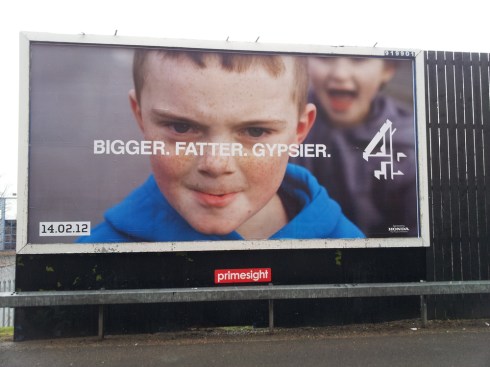
Channel Four in the UK has launched this controversial ad campaign for a new series of ‘My Big Fat Gypsy Wedding.’ Image by Ross McCullough.
This post has nothing to do with prisons, but as you know I’m appalled when imagery is not used responsibly.
In the past 24 hours I’ve come across two advertisement campaigns that are beyond indecent. I am incensed.
The situation is more galling given the fact that both advertisers are groups that I’d expect to have an enlightened approach to the politics of representation.
CHANNEL FOUR
In the UK, the usually responsible Channel Four has launched a controversial ad campaign for a new series of ‘My Big Fat Gypsy Wedding.’ Emblazoned across image of gypsy youth are the words: BIGGER. FATTER. GYPSIER.
Matt Daw, Projects Manager at PhotoVoice today said:
The first two words just seem inappropriate. The last is inconceivable in today’s world. In short, the advert presents a boy’s recognisable face and asks us to make a huge number of assumptions about him based on his being a member of an ethnic minority. No other context is offered.
Members of the Hackney Traveller community have said:
These adverts are stigmatising us by the words and pictures they use. This programme is turning us into something that we are not’.
Manchester-based journalist and photographer, Ciara Leeming who has worked extensively with Roma (European travellers in the UK) groups tweeted that the campaign was “downright racist.”
Photovoice will be picketing Channel 4 today.
PETA
Meanwhile, the animal rights group PETA wants to fight cruelty against animals by making light of violence against women.
The premise of their latest TV campaign is ludicrous: If your boyfriend becomes vegan, he’ll immediate be such a “stud” that you should be ready for sex marathons so violent, he’ll put your head through the wall … resulting in a neck brace. After that he’ll send you down the road – in your underwear – to buy post-coitus vegetables.
Unbelievable.
This is the latest of PETA’s “ads” produced for web distribution with the intention to shock and no hope of making it on to TV. But still.
What is wrong with you people? Oh yeah, you’re single minded advertisers with dollar signs obscuring your view of the sensible and right.
Matt Bors, my favourite Portland-based cartoonist batters PETA with his post, PETA Targets No One Ever With Its Latest Campaign: “I’m big into not injuring the women I have sex with or bashing their heads into walls.”














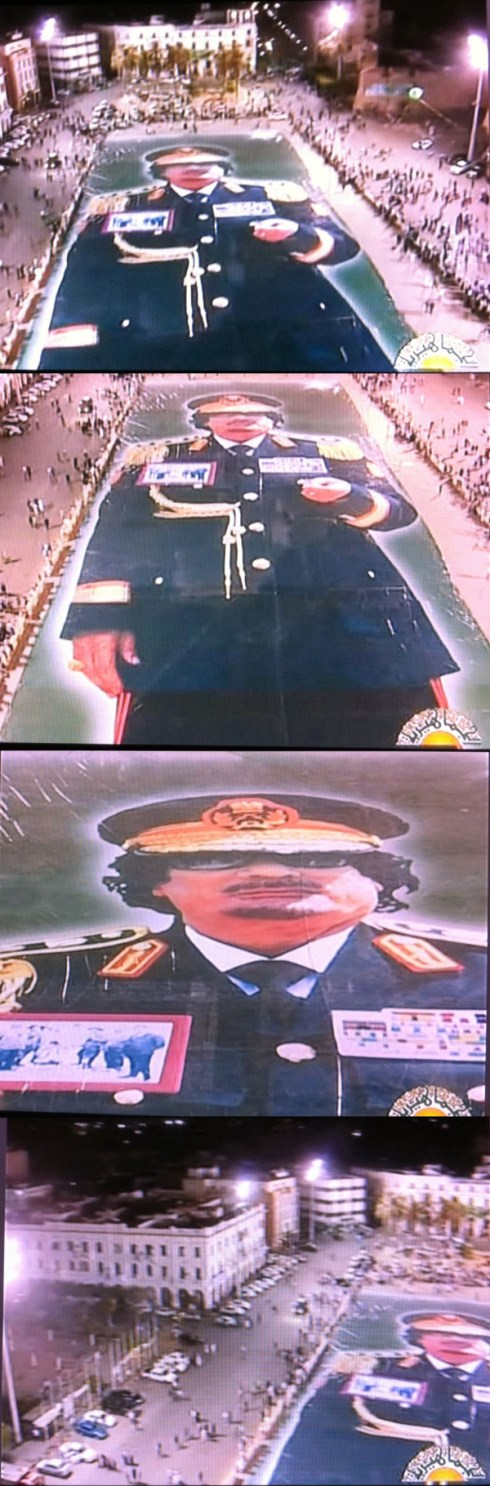
Late last night, I heard a report by a BBC World Service journalist from Tripoli. Escorted by a government liaison officer, the journo only met members of the public who were fervent Gaddafi supporters (one of Gaddafi’s information officers was captured by rebels last week and estimated 70% of people in Tripoli supported Gaddafi.)
During the report, he spoke with men piecing together a huge “photo” of Gaddafi in Green Square. I had heard nothing of this so this morning jumped on my computer to see for myself.
If it weren’t for the BBC report, I may have considered the above images an elaborate hoax – a) because I’d not heard of this month-old photo-stunt, and b) because it just seems so bonkers.
The images are screengrabs from Libyan TV made Sate Hamza ساطع, whose Twitter profile reads, “Syrian-Canadian dermatopathologist practicing in Winnipeg. Lived in the US. Enjoy comedy, world music & multimedia. Follow global news & current affairs. Vegan.” He blogs here.
Sate, whose Twitter handle is sate3 posted the screengrabs to TwitPic on 24th July with the message, “Giant photo of Gaddafi in Green Square in Tripoli unveiled yesterday (July 22, 2011), on Libyan TV. #Libya”
So, I ask for a bit of feedback. Had anyone else heard of this massive photograph? If so, can you help me with some more resources. If not, why not? How does this compare to other examples from history of nationalistic/cult of the personality shows of strength?

 Prison Photography