
You are currently browsing the category archive for the ‘Photography: Non-Prison’ category.
PART THIRTEENTH INSTALLMENT IN A SERIES OF POSTS DISCUSSING JOURNALISTS ACTIONS AND RESPONSES TO THE KILLING OF FABIENNE CHERISMA IN PORT-AU-PRINCE, HAITI ON THE 19TH JANUARY 2010.
The world only knew of Fabienne Cherisma’s life in the aftermath of her death.

15-year-old Fabienne Cherisma lies dead after being shot in the head in Port-au-Prince. Photograph: Carlos Garcia Rawlins/Reuters
Carlos Garcia Rawlins’ photograph was used for Rory Carroll’s Guardian article, He had not picked her up since she was a toddler. Last week he carried her home (Tuesday 26th January). The article is succinct and dignified; Rory Carroll details Fabienne’s simple life and bold aspirations. For me, it remains the best news piece I have read about Fabienne and her family.
Thus, I went to the source and asked Rory to clear up some basic facts about Fabienne’s story.
PP: When did you meet with the Cherisma family?
RC: I met them on Friday 22nd January. I interviewed the parents and sister, Amanda, at their market-stall, and accompanied them to their home where we finished the interview.
PP: Who exactly, makes up Fabienne’s immediate family? I have seen many different spellings – can you verify their names?
RC: Father Osam, mother Amante Kerly, sister Amanda, brothers Ruben, Jeff, Jimmy and Biterly (not sure about spelling of latter, nor if brother or sister). (In all the photographs of the Cherismas the only brother known to us is Jeff (below). Many news outlets – including this blog – have had Amanda incorrectly referred to as Samantha)
PP: When was Fabienne buried in Zorange? What date?
RC: Wednesday 20th, the day after she was killed. (This answer is interesting as it means that Nick Kozak and the Cherismas chanced upon one another on the same day she was buried – I presume before the Cherismas left for Zorange.)

Photo: Nick Kozak, January 20, 2010
PP: What did the Cherismas intend to do.
RC: [They planned to] continue as before, working at the stall, with no plans to sue or prosecute.
PP: You said at the end of your report, “The one photo of her, in which she smiles, is lost. So is her birth certificate. The family thinks the hospital which recorded her birth was destroyed. There is no police investigation and the death is not registered. Officially, it is as if the teenager never was.” Do you think this will always be the case?
RC: Maybe not. Hopefully not – given the media attention paid to the story.
– – –
Time and time again through my investigation I have found that few, if any, options exist for the Cherismas to launch an inquiry and insist upon an accountability for Fabienne’s death. The idea that they’ll “continue as before” – as if the expectation of public awareness and criminal prosecution is unreasonable – is a travesty.
– – –
ALSO IN THE ‘PHOTOGRAPHING FABIENNE’ SERIES
Part One: Fabienne Cherisma (Initial inquiries, Jan Grarup, Olivier Laban Mattei)
Part Two: More on Fabienne Cherisma (Carlos Garcia Rawlins)
Part Three: Furthermore on Fabienne Cherisma (Michael Mullady)
Part Four: Yet more on Fabienne Cherisma (Linsmier, Nathan Weber)
Part Five: Interview with Edward Linsmier
Part Six: Interview with Jan Grarup
Part Seven: Interview with Paul Hansen
Part Eight: Interview with Michael Winiarski
Part Nine: Interview with Nathan Weber
Part Ten: Interview with James Oatway
Part Eleven: Interview with Nick Kozak
Part Twelve: Two Months On (Winiarski/Hansen)
Part Fourteen: Interview with Alon Skuy
Part Fifteen: Conclusions

The five boys who came to illustrate the class divide. Photograph: Jimmy Sime/Getty Images
Ian Jack wrote a glorious piece in today’s Guardian about Jimmy Sime‘s iconic image.
‘The photograph that defined the class divide’ describes 70 years of misreadings and its use as illustration for shallow assessments of Britain’s class disparities.
Jack is masterful in his analysis because he keeps it based in fact. The consequent lives of the five boys (which are not what you’d expect) are ultimately the critical blow to all the users and abusers of Sime’s image down the years.
“When a newspaper had asked the three men to get together to reconstruct the picture at Lord’s, one of them refused. I could see why: which of us would want to be remembered as a stereotype, especially in a class war where we’re given no choice of sides?”
Jack doesn’t dismiss the notion that Britain is still divided by class. To the contrary he says that Britain remains the European nation with the biggest gap between rich and poor. He (and I) can see that these arguments about UK inequality are better made with relevant illustration and not this nostalgic claptrap that does nothing to inform or elaborate.
” If a photographer wanted to re-create Sime’s picture, he might be faced with five boys dressed much the same, in jeans and brand names. Giving a superficial impression of equality, the picture would be even more of a lie than before.”
Just to prove the entrenched and idle use of Sime’s photo right up to present day, Jack finishes with this:
“What picture accompanied the Daily Telegraph’s report in January 2010? Sime’s, of course; the same as Picture Post had published in January 1941. There they were again: Wagner, Dyson, Salmon, Catlin and Young, doomed for ever to represent our continuing social tragedy.”
Brilliant stuff!

War wounds: Don McCullin on photography. The acclaimed frontline photojournalist speaks about the horrors of conflict, struggling with ‘this terrible name, war photographer’, and why shooting landscapes instead of battle zones has finally granted him a sense of peace.
WELL SAID MR McCULLIN
My post, Staring at Death, Photographing Haiti got a lot of attention. It was a simple format – an extensive collection of links to online photography coverage of Haiti. It was posted a week after the earthquake and very soon after was out of date.
It may have been apparent from my other posts on Haiti [1, 2, 3, 4, 5] that I appreciated words alongside images.
I was grateful for the interviews by the New York Times of Damon Winter, Maggie Steber and Daniel Morel.
Well, add Lynsey Addario to that list.

Even Orphanages Spawn Orphans in Haiti is the type of approach and reflexivity I admire in journalism. It is a great salve to the overly-anxious who worry that photojournalism has lost it’s soul.
Of course, I have a few buddies who’d insist that Haitian voices be heard also, so I don’t want to suggest that PJ audio interviews are the crowning point of crisis reporting – they obviously aren’t but they are a necessary component.
To hear the photojournalist’s voice and responses to their subject reminds us that photographers are not camera-wielding automatons operating in vacuums.
Dawoud Bey suggested during his address to the Society for Photographic Education 2010 Conference audience, Saturday night that ‘diversity’ had become not an ideal but a political mantra of art institutions that papered cracks and contributed nothing to long-term involvement of people of colour.
Bey argued the word ‘diversity’ has been appropriated, misused and redefined. Bey does not foresee a reclamation of the word but calls for an abandonment of the institutional practices the word has come to stand for.
Bey wants ‘inclusivity’, a firm shared understanding of the term, and relevant action instead. Bey distinguishes:
Diversity to me implies that there is still some normative paradigm at the center that we are seeking to destabilize rather than doing away with it in favor of something quite different. It suggests that institutions have an inherently white and male identity that needs to be added to. To operate out of this paradigm is, of course, a kind of tokenism by yet another name and seeks to trade on the momentary (but always empty and short lived) self-congratulatory excitement of seeing a new color in still unexpected places. It would seem to me that by now we should be approaching a point where anyone should be expected to be anywhere.
I think it’s time to turn away from “diversity” as an operative objective and turn instead towards the more meaningful and substantial goal of making institutional spaces ever more inclusive and embrace the goal of inclusivity, in which everyone’s identity is central to the whole. One way to accomplish this is to consider how in fact the institution’s identity can be meaningfully transformed and expanded conceptually by this enhanced inclusiveness in a way to deeply transforms the very nature of that institution. Inclusivity implies a desire to actually change through institutional expansion, while diversity implies to me that those being brought in have to simply fit into the normative and dominant existing paradigms and simply add “color” to it.
[My bolding]

The full lecture which Bey transcribed to his blog is essential reading as it sums up with authority the history of localised art movements, the legacy of protest among minority communities against silenced or non-represented voices (even in shows dedicated to the work of African American artists for instance!)
Bey recounts the protests against the “Harlem On My Mind” exhibition at the Metropolitan Museum of Art in 1969. Bey reminds us that Roy DeCarava carried a sign outside reading, “The White Folks Show the Real Nitty Gritty.”
Bey traces many of his own successes not to umbrella changes in culture or industries but to committed artist actions doing the leg work for themselves. He is the inheritor of community spirit so to speak.
Bey drives the point home exquisitely by pointing to one of New York’s favourite and largest art love-ins:
And then along comes the Whitney Biennial 2010 to remind us just how little some things have changed … In an exhibition that ironically uses an image of Barack Obama on the catalogue cover, we find among other things absolutely no Latino artists and a total of three black artists among fifty-five artists in the exhibition. What is your response to that? What would the response have been in 1969? I can’t imagine that this kind of situation would have been tolerated at that moment.
[My bolding]
CONCLUSION
Again, cold hard figures don’t lie, and I think Bey has shown that history doesn’t lie. We’ve got a lot to do.

Qamar Jan,18, an Afghan refugee from Peshawar poses at the Ali Medical clinic in Islamabad, June 14, 2007. © Paula Bronstein
In my last post, I suggested the repetition of subject matter in photography is inevitable.
Equally, I’d like to stress that our constant exposure to (predominantly web-based) imagery may likely result in more frequent associations and recall (partial, total, overlapping) between photographers and their works.
Here, I’d like to argue that the gravity of some photography – or rather the gravity of the story it bears witness to – means that ultimately the name of the photographer is inconsequential.
MOTIF, MEME, PERSISTENT THEME
In my last post, I also challenged the notion of plagiarism and inserted the notion of ‘meme’. I was hasty. I used the term ‘meme‘ because meme evolution within host populations can occur without any awareness of said host population; I wanted to infer that repetition, mimicry, copying, mirroring mustn’t always be accorded a conscious origin. Conscious origin is precedent, is ownership, is lawsuit. And I want to live in a world where not everything is subject to ownership and contest.
That said, I want to back-track on the term ‘meme’. Meme is more appropriate for discussing larger shifts, whereas I am really discussing trends. Instead of ‘meme’ I’d prefer to use the term ‘persistent theme’.
FINE ART vs PHOTOJOURNALISM
In Burdeny’s work, the use of a persistent theme (including the minutiae of another artists’ motifs, style) just looks bad. Simply, Burdeny is a prat, but if you want to get uppity you’d argue he has debased artistic notions of respect, brevity and creative integrity.
In the light of Burdeny’s antics (1, 2, 3, 4, 5 & 6), any number criticisms are understandable BUT would anyone level criticisms at photographers in journalism repeating the work of others if it that work pertained to a story that perhaps has not been told enough?

Memona Karachi. 20 years old. Over 30 operations. Attacked by a boy on her way to school. © Izabella Demavlys
ACID ATTACKS: A CRUDE CRIME OF MODERN TIMES
Shouldn’t ‘persistent themes’ in the photography of journalism be judged on different criteria?
Joerg’s post on Izabella Demavlys today recalled the work of Paula Bronstein, Q. Sakamaki, Diego Ibarra, Katherine Kiviat and Emilio Morenatti. (Stan was impassioned by Morenatti’s work recently)
An acid attack is a heinous crime, but made all the worse by lack of awareness, empathy or rehabilitative service. Of course, photography plays second-fiddle to medical intervention in the aftermath of acid attacks, but that is not to say it can’t play its part.
Or are these portraits exploitative? Personally, I don’t think they are. The recurring ‘exploitation’ argument doesn’t develop a discussion – it merely demands you accept or decline the notion of ever-unequal power relations between the operator and subject of a camera. It becomes a discussion about photography and not about the reason the photographer and subject shared a space in the first place.
Personally, again, I don’t think we understand enough about the motives or consequences of these types of brutal attack, and I think portraiture and caption have their role in informing interested parties.
Fortunately, the reports alongside these images describe accessible medical treatment for victims (one woman has had 30 surgeries). More than physical healing though, many of the women have a resolve and psychological determination beyond words. (Read Nick Kristof’s NYT article).

A victim of acid attack stays in the hospital of the Acid Survivors' Foundation. In 2002 Bangladesh introduced very tough laws to try to stop acid throwing, including the death penalty in the most serious cases. However, acid attack is still common in the country -- more than 260 cases in 2005, since "The law is just like a dead law," according to Salma Ali of the Bangladesh National Women Lawyers' Association. Dhaka, Bangladesh, July 12 2006. © Q. Sakamaki
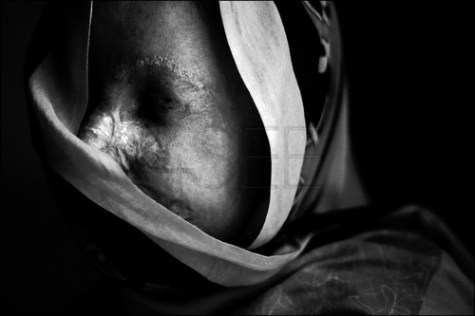
© Diego Ibarra. Portrait of a woman attacked by acid. The consequences of the attacks are for life. Islamabad. Pakistan, May 2009
Saira Liaquat
Both Kiviat and Morenatti photographed Saira Liaquat in the space of a year (the captions for her age must be inaccurate) but opprobrium will never be dealt Kiviat or Morenatti for their repetition.
Saira bears witness to her injustice and both photojournalists help her advocate.
Saira’s name and her story matter, the photographers names really don’t.

Saira Liaquat, 22 yrs, burn victim and survivor, holding an old photograph of herself before she was burned with acid by her husband. Photographed at Saira's parents' home in Lahore, Pakistan on February 7, 2009. Saira is presently working as beautician at the Depilex beauty salon in Lahore, Pakistan. There are presently over 300 cases of burn victims registered in Pakistan. Most victims are between the ages of 14 - 25 years old. Motives vary, but are most frequently obsession, jealousy, suspected infidelity, husband wanting to re-marry, sexual non-cooperation. The face and genitalia are the areas most generally targeted, those guaranteeing complete disfiguration. © Katherine Kiviat/Redux
DISASTER PHOTOGRAPHY
I ran across the University College Dublin’s Photography & International Conflict project this week. It operates out of UCD’s Institute for American Studies … and it’s awesome.
Or as awesome as something about war can be … or at least the best academic offering on photos and carnage since Photography and Atrocity served up at Leeds University a couple of years ago.
If you fancy going all rogue-scholar then this is the site for you: Imaging, Africa, ethics, Northern Ireland, the political economies of photography, America, Vietnam, the former Yugoslavia and well known academes of the media/photo/critic world.

Anyhoo, this is all by the by, because amongst this thinkers-paradise are some straight video interviews with leading photography editors.
SATURATION POINT
Roger Tooth, Head of Photography for the Guardian UK says (at about 18 minutes and 30 seconds):
I would have thought we are at saturation point for photojournalists, but then you have the colleges churning out thousands of graduates each year, so its all a bit worrying really. I haven’t got a clue what these people are going to do? I would have thought we’ve got enough people to go around at the moment. What I suspect they’ll do in the future, I suspect they’ll do video because that’s going to be the currency.
Well, how’s about that?! Seriously, great site and plenty of food for thought.
Found via the reliably excellent CONTACT blog, which keeps me real with all things Britski.
UPDATE
As if on cue, A Photo Editor has this interview with Vincent Laforet about his switch over to moving images.

© Bob Adelman/Magnum Photos. Washington DC. 1963. At the climax of his "I Have A Dream" speech, Martin Luther KING Jr., the final speaker at the March on Washington, raises his arm on the steps of the Lincoln Memorial, and calls out for deliverance with the electrifying words of an old Negro spiritual hymn, "Free at last! Free at last! Thank God almighty, we are free at last!"
PREAMBLE
When doing research for Wired’s Raw File piece on Dell’s acquisition of 185,000 Magnum press prints, reactions were unanimously positive.
The deal was understood as incentivised in the right ways so that Magnum, Dell’s MSD, the Harry Ransom Center, the individual photographers and – last but not least – the public would all win; the deal meant advanced archiving, preservation, research, lectures, education and access to the materials.
I leant particular weight to the feedback of Eli Reed and Susan Meiselas, two senior Magnum members, both grateful for the collection’s new lease of life.
CONTRASTING POSITIONS
I’d like to quickly bring to your attention two differing opinions I’ve come across this past week.
Firstly, Stephan Minard takes a suspicious view. Minard is the former director for stock-sales and archives of Magnum (Paris, London, New York & Tokyo) between 2008 and 2009. Here is Minard’s article (French) and here is a poor Google translation.
Minard sees the issue of the deal as “bigger than just a deal for money and posterity. It is more the sign of the incapacity of the photographers to protect a common treasure, to build a common project for the agency.”
Minard puts the Dell acquisition in the context of recent acquisitions of Magnum photographers’ works by outside parties (Capa’s “Mexican Suitcase” owned by the ICP, Henri Cartier Bresson’s archive owned by the HCB Foundation in Paris).
I think Minard deals somewhat in hyperbole and paints Dell as an unsuitable custodian. He believes Magnum has sold its ability to own and write its own history, whereas many in the industry feel the retention of all rights by the photographers has ensured exactly the opposite.
Magnum is a business and as such it would be useless hoarding sections of its past collections if in so doing they jeopardised the careers of its current and future members. Magnum is not a museum.
In the other corner, George Zimbel speaks of Michael Dell as an ever-benevolent father figure of documentary photography. Read here.
Zimbel asks a general question as applied to any number of hidden collections and obscured archives, “Where are those prints? I don’t know. No one will have to ask that question about the Magnum archive. Thank you Michael Dell.”
Zimbel knew Cornell Capa in the 1940s. Zimbel did the annual report for Xerox Corp. in 1961. When he couldn’t repeat the contract the following year, Xerox hired all of Magnum to continue the documentary approach.
Zimbel then rattles through a numbers of folk, generations and degrees of seperation to end up at the desk of a family friend Alex Gruzen, Senior Vice President Consumer Products Group at Dell Computers in Austin Texas, “I am sending Alex Gruzen a copy of my catalogue “George S. Zimbel, IVAM 2000″ to give to Michael Dell. He really values documentary photography. It’s like family.“

 Prison Photography