
You are currently browsing the category archive for the ‘Photojournalism’ category.
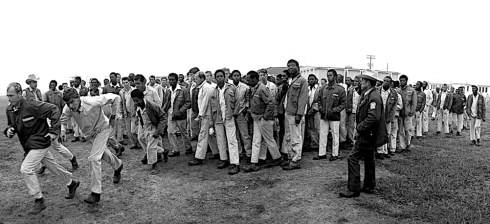
Credit: Bruce Jackson
NY Times LENS Blog
Here, there and everywhere people are celebrating the New York Times’ LENS Blog as a messianic gift for the photophile. I was therefore happy to see that less than two weeks in LENS is featuring Bruce Jackson’s wide angle documentary work from Arkansas Prison in the early 1970s
Bruce Jackson should be a familiar name as it was he that rescued, scanned and shared the enigmatic Arkansas Prison Mugshot series, Mirrors.
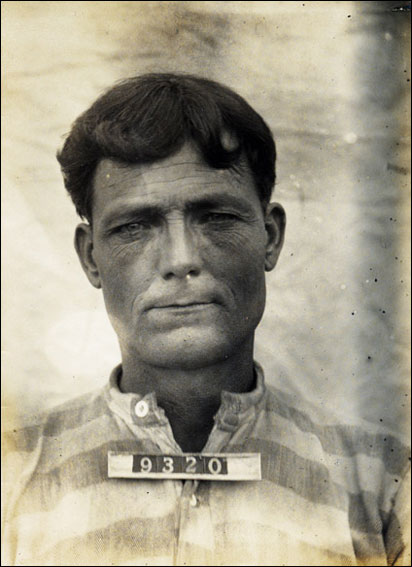
Found and presented by Bruce Jackson. Arkansas State Prisoner Portrait
June 100 Eyes Issue
Over at 100 Eyes, Andy Levin from insists that “Whatever ones perspective, be it victim, civil rights activist or cop, there is one shared idea – something needs to change.”
The June edition of 100 Eyes, titled, America Behind Bars features the work of Dominic Bracco, Jerome Brunet, Darcy Padilla, Jenn Ackerman and Tim Gruber – all very talented and committed photographers.
As editor, Andy Levin, concludes, the genre of prison photography (or to be less aggrandizing) simply the practice of photography within sites of incarceration is often a difficult and thankless task;
The photographers who have contributed to “America Behind Bars” have worked against overwhelming odds to bring back powerful images of American prisons. One can’t simply walk into a prison with a camera. This kind of photography requires long negotiations and often a warden who has the vision and concern to allow a photographer into his jail.
Wonderful exposure for the most pressing of social issues in America today.
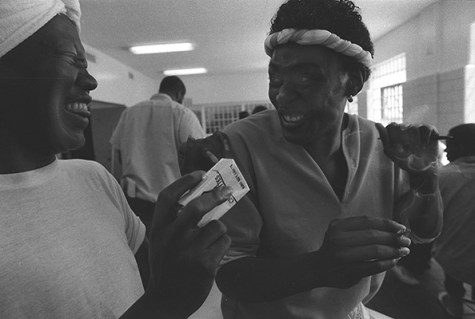
Darcy Padilla. From AIDS in Prison Series.
Prison Photography began its project in September 2008 with a celebration of Darcy Padilla’s portrait of former San Quentin Public Communications Officer, Vernell Crittendon.
In February, I was gob-smacked by Jerome Brunet’s Riding Shotgun with Texas Sheriffs.

Guantanamo © Chris Maluszynski/Agence VU

Guantanamo Map http://www.cubafutour.de/Karte%20Guantanamo%20Provinz.jpg

Guantanamo Bay Tents. Courtesy of The Department of Defense Visual Information Center
I am very happy with the way Prison Photography is progressing. I have done interviews with some outstanding photographers and artists. I have offered opinion where I think there’s something to be said. The most satisfying work on the blog is that contributed by guest bloggers, comment-makers and interviewees. Photographers have contacted me and I have been eager to comment upon their work.
But, there is one audience I never anticipated – The Google Image Search Audience. I get many hits for searches on Guantanamo, Guantanamo video, Iraq prison, Abu Ghraib, Abu Ghraib Images of Prisoners, etc, etc – which is strange because these are topics that many people have grappled over with more proficiency and depth than I am likely to.
It is obvious that there is a need for fast access to images of America’s sites of torture and incarceration, namely Abu Ghraib and Guantanamo. I certainly don’t wish to fuse the two institutional histories so I shall deal only with Guantanamo Bay.
Louie Palu
Walrus Magazine. 8 of Palu’s photographs and accompanying article.
The Atlantic. 6 of Palu’s photographs.
Private galleries. Palu’s Photoshelter profile offers three separate galleries, but they’re password protected. Contact the photographer directly.
NPR Interview. Palu offered insight into his experience and impressions of Guantanamo.
Christopher Sims
Mother Jones. 15 images of daily life outside of the prison complex.
Civilian Arts Project. 25 images of a bizarrely serene Guantanamo Naval Base.
BBC, The Other Side of Guantanamo. Article about Sims’ series.
Daylight Magazine. 4 minute audio of Sims’ experiences on project.
Chris Maluszynski
Agence VU/Moment. Twenty-six images exhibited. Likely more on file at the agency.
Cesar Vera
Guantanamo Prison. 18 Black & White images. 3 Colour.
Joint Task Force (JTF)
Many of the photographs shown in the press over the last few years were taken by members of the Navy’s own Joint Task Force. When press photographers visited the JTF vetted all images before release.
Boston Globe. 30 Hi-Res images.
Repeat of above selection. 20 Hi-Res images selected.
JTF Photo Galleries. 22 months (July 2007 – May 2009). Hundreds of images. Official photography.
Miami Herald
Description of the 8 different camps at Guantanamo
Explanation of the Legal contexts: Key defendants, the judges, the defense and prosecution counsel.
Cursory look at Art influenced by Guantanamo
Magnum
Bruce Gilden. Guantanamo Bay. Enemy Combatant Camps, 2003
Paolo Pellegrin. Guantanamo Detainees, 2006
Stuart Franklin’s work Cuba, 2003, included images from Guantanamo and you’ll need to search the Magnum website for images.
McClatchy
An eight-month McClatchy investigation of the detention system created after the Sept. 11 terrorist attacks has found that the U.S. imprisoned innocent men, subjected them to abuse, stripped them of their legal rights and allowed Islamic militants to turn the prison camp at Guantanamo Bay, Cuba into a school for jihad.
Intro. Text and 11 minute video.
Photos. Detainees held at Guantanamo Bay
Photos. Faces of Guantanamo Detainees. Part one.
Photos. Faces of Guantanamo Detainees. Part two.
Photos. Detainees held in Afghanistan.
Eyeballing
Comprehensive overview of base using Google Maps, official photographs. Details structures, uses and topography of naval base.
Camp America, Camp Delta, Camp V and Administrative & Court building.
Camp X-ray and construction of later detention camps.
Associated Press
Images of facilities and interiors of various detention blocks and camps.
Stars & Stripes “The Independent News Source for the U.S. Military Community”
Work at Guantanamo
Education at Guantanamo
Recreation at Guantanamo
Artistic Turns
David Hicks. Virtual Guantanamo Cell
Penny Byrne. Porcelain Guantanamo Detainee Figurines
Gregor Schneider. 21 Cells, Bondi Beach, Australia
Legofesto. Guantanamo reconfigured with Lego men and Lego pieces and Wired Interview
Flickr – Protest Images
Amnesty International. Guantanamo Protests
Various Photographers. 100 Days to Close Guantanamo and End Torture.
James M. Thorne. Protest images.
Miscellaneous Media
Prisoners of War. 2004 article by the San Francisco Gray Panthers with images of US airforce transporting detainees and early 2003 images of Camp X-Ray.
BBC. Life in a Guantanamo Cell

Rendition. Photographer Unknown
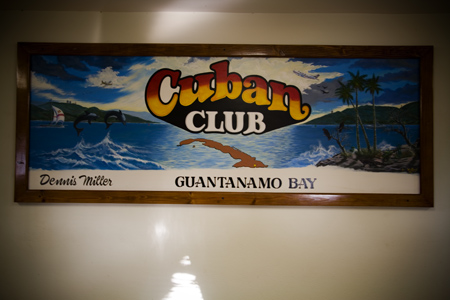
© Cesar Vera

Guantanamo Bay Navel Base with a New Commander-in-Chief. Photographer Unknown. http://www.obamalouverture.com/f39/guantanamo-bay-switch-bush-photo-obama.html
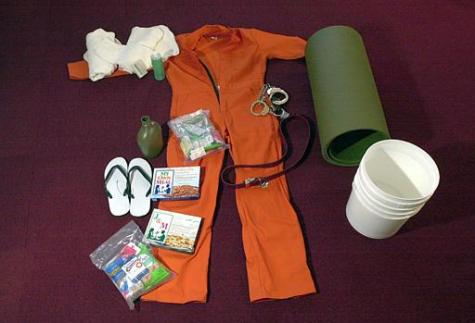
The standard issue of clothing, sleeping mat, food, sandles, canteen, soap, and buckets for detainees of Camp X-Ray is pictured in Camp X-Ray at the U.S. Navy Base at Guantanamo Bay, Cuba, on Wednesday, Feb. 20, 2002. © Tomas van Houtryve/AP Photo
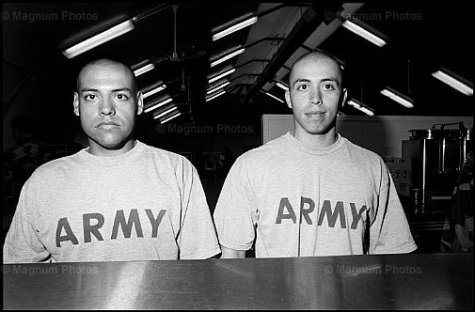
CUBA. Guantanamo Bay. 2003. Soldiers wait for their meals before a prayer breakfast at Camp America. Photo: Bruce Gilden/Magnum
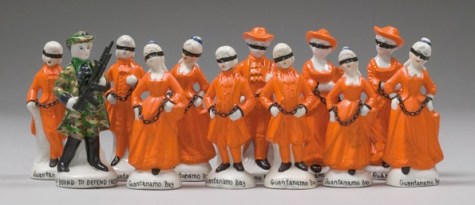
Penny Byrne Guantanamo Bay Souvenirs 2007, vintage figurines, metal chains, epoxy resin, plastic, re-touching medium, powder pigments, 14 x 32 x 10 cm.
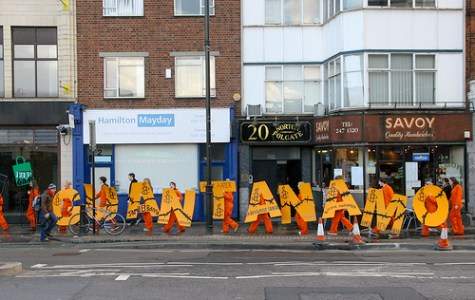
Photo: Jon McClean. http://www.flickr.com/photos/jonmclean/410055117/
IF YOU HAVE ANY RESOURCES TO SUGGEST,
PLEASE CONTACT ME AND I’LL ADD THEM TO THIS LIST.

Pastor Marcos Pereira da Silva and prisoner in Polinter Prison, Rio de Janeiro. © Gary Knight, VII Agency
Dispatches Mag out today with the theme Out of Poverty. It includes Gary Knight’s photo essay from Polinter Prison, Rio de Janeiro.
I have been waiting for Knight to publish these images. An internet-murmur a few weeks ago alerted me to his work in Brazil’s prisons. As I fleshed out the scenario at Polinter Prison those few weeks ago, I won’t go in to huge detail in this post.
In a nutshell, Pastor Marcos Pereira da Silva visits the critically overcrowded prison with his unique brand of evangelism. It starts with anthems of praise and ends up in wailing convulsions and the exorcism of spirits. He acts generally messianic and the prisoners (at least those pressed against the bars at the front of the cages) seem quite responsive.
Knight is uncomfortable with these enactions and so am I.
Click here or the image below and you’ll be directed to 9 minutes youtube footage of the said pastor doing his thing.

Still from video of Pastor Marcos Periera de Silva in Polinter Prison, Rio de Janeiro, Brazil.

A TB patient at Tomsk Regional Clinical Tuberculosis Hospital, Building #3. Photograph and caption © James Nachtwey/VII.
“Tuberculosis is a disease of poverty and stress“.
Merrill Goozner, The Center for Science in the Public Interest.
“Sixty percent of all new cases of tuberculosis have resulted from the rapid growth of the post-Communist prison archipelago”.
Proceedings of the National Academy of Sciences. Aug. 26th, 2008
Tuberculosis (TB) was under relative control in the former USSR. Soviets had lifestyles, nourishment and conditions of living that kept disease at bay. When communism fell, so did a civil order in many areas. The phalanx of activity that filled the vacuum involved new systems, new relationships, new businesses and new criminal opportunities.
The prisons filled in a society that needed to organize itself before it could organize it’s transgressors. The prison population swelled to 1.1 million (it is now down to little over 700,000). Post-communist prisons held malnourished, crowded populations with weak immune systems; they have been described as ‘Tuberculosis incubators‘.

Correctional Treatment Unit #1, a TB prison colony in Tomsk, Siberia. TB patient/prisoner gets a chest x-ray. Treatment is supervised by Partners in Health in partnership with the government TB program. James Nachtwey/VII
TB is best treated with various labour intensive methods known under the umbrella-term Directly Observed Therapys (DOTs). Due to TB’s many different strains – each with different drug resistancies – case by case treatments differ according to patient reactions to drugs. At the least, a patient must be observed and his/her drug regime modified over a 6 month period. For Multi-Drug-Resistant Tuberculosis (MDR-TB) the treatment can take as long as two years. And, MDR-TB & XDR-TB are increasingly common among prison and civilian populations of Tomsk and other Siberian urban centers. Unfortunately, closely monitored drug regimes are improbable in over-stretched and poorly funded state systems.
It wasn’t always so dire. The former Soviet provided a regular supply of drugs to abate disease amongst its prison population, but those supplies were interrupted in the fall of Communism – sporadic and incomplete treatments gave rise to multiple resistant strains of tuberculosis. To compound this the side effects of drugs were enough to discourage patients, and rarely, if ever, did courses of treatment go with a prisoner into his community following release.

TB patients smoke cigarettes in the smoking room of Tomsk Regional Clinical Tuberculosis Hospital, Building #1. James Nachtwey/VII
James Nachtwey‘s mega-promoted TED prize crusade addresses the spread of Extremely Drug Resistant Tuberculosis (XDR-TB), its mutant forms and human tolls. This excellent Guardian article notes Nachtwey has photographed the epidemic worldwide, from Siberian prisons to Cambodian clinics.
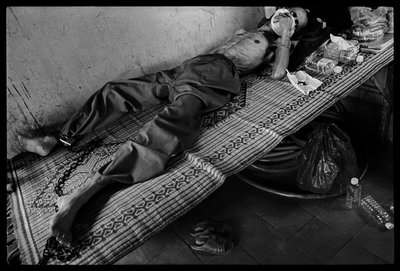
A prisoner who was convicted of murder was moved from prison to the TB ward of Battambang Provincial Hospital, Battambang, Cambodia when he was diagnosed with TB. He is coinfected with AIDS. James Nachtwey
Nachtwey stands with Sebastião Salgado in the “super-photographer” stakes. They both make the ugly beautiful.
Both Nachtwey and Salgado have inspired others to action and both believe firmly in the power of photography to change existences … even in a time when such sentiment is derided as old-fashioned, false idealism.
But, despite the odds, Nachtwey has succeeded in forcing his work into the conscience of millions. For some his work is an inspiration for social justice; but for others his work is a sub-conscious default to guilt, despondency and powerlessness to help others less fortunate.
James Nachtwey puts human faces to global suffering. And we are outraged. Or we feel we should be outraged.
I think Nachtwey wants us to believe in ourselves as agents of change. Nachtwey deliberately chose Tuberculosis – because while the situation is critical, it is not terminal and TB is theoretically entirely curable. Beating TB on a global scale is dependent on the behaviours of individuals and their communities.

Correctional Treatment Unit #1, a TB prison colony in Tomsk, Siberia. A prisoner proves to a nurse that he has swallowed his daily oral TB medication. The prisoners receive treatment through metal bars in order to give security to the nurses. Treatment is supervised by Partners in Health in partnership with the government TB program. © James Nachtwey/VII.
Nachtwey’s work extended beyond the prison walls in Tomsk and went into the public clinics (some images included here show those facilities); TB is no respecter of human walls or demarcations. Regional, economic poverty will spike rates of TB.
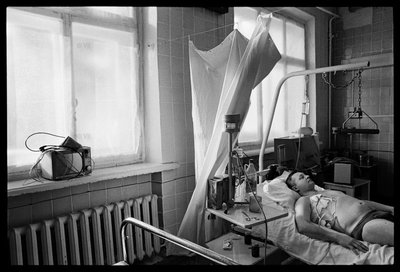
A TB patient has excess fluid drained from his chest a Tomsk Regional Clinical Tuberculosis Hospital, Building #1. James Nachtwey/VII
The worst thing we could do here would be to think that TB is a disease of other nations and other peoples. In Pathologies of Power (2004), Paul Farmer wrote about the New York prison system’s huge Tuberculosis epidemic of the mid-nineties, “By some estimate, it cost $1 billion to bring under control”. The strains that arose in the NYDoC have been directly related to the resistant strains of the former Soviet Union. Tuberculosis is latent within one third of the world’s population. Tuberculosis needs only the conditions for its growth.
Paul Farmer, of Mountains Beyond Mountains fame has taken the lead on combating TB, as well as other infectious diseases, amongst the world’s poorest populations. He worked with Partners in Health partly funded by a Soros Grant to “develop demonstration tuberculosis control projects which could become a model for replication throughout Russia.”
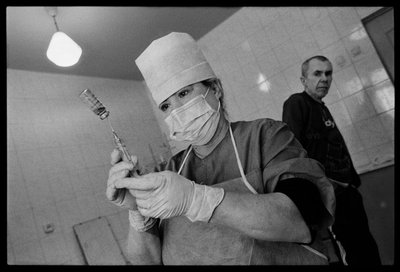
A nurse prepares a daily injection for TB patients at Tomsk Regional Clinical Tuberculosis Hospital, Building #3. James Nachtwey/VII
Prison Photography blog has focused twice previously on photographers’ responses to the USSR and its aftermath – the Gulag and the new prisons that arose. While Anna Shteynshleyger and Yana Payusova are working with very different issues, regions and populations they – along with Nachtwey’s work – remind us of the severe problems facing parts of modern Russian society. Unfortunately, and certainly in the case of Tuberculosis, these problems exist in other nations also. Nachtwey focused on TB because it was not – despite being a global problem – on the radar of most people. That sounds like something I’d say about prisons and prisoners’ rights.

Correctional Treatment Unit #1, a TB prison colony in Tomsk, Siberia. A patient/prisoner receives a daily medical injection. The prisoners receive treatment through metal bars in order to give security to the nurses. Treatment is supervised by Partners in Health in partnership with the government TB program. James Nachtwey/VII
For more information on XDR-TB read the Action – Advocacy to Stop TB Internationally website, and the Center for Disease Control & Prevention website. For the most accessible and recent article, read Merrill Goozner’s 2008 Scientific American article about Russian Tuberculosis strains which also includes a audio segment with a clear explanation of the situation.
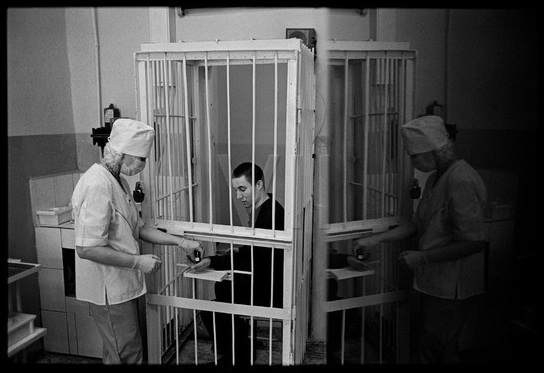
A TB patient/prisoner receives his daily oral medication at Correctional Treatment Unit #1, a TB prison colony in Tomsk, Siberia. © James Nachtwey/VII.
James Nachtwey built his reputation as a combat photographer.
He was always reluctant to be the focus of media attention but after 5 Capa Gold Medals for War Photography he couldn’t escape the curiosity of Christian Frei who made the extraordinary film War Photographer. Nachtwey comes across as an articulate, self-isolated journalist-force devoted to his craft and courteously distant to others; here is a clip.
Nachtwey has done interviews here, here and here. Read an interview about his 9/11 pictures, and associated videos on Digital Journalist. The images were published in TIME.
He worked in Rwanda for his book Inferno.
View his TED Prize acceptance speech and the consequent October 2008 launch of his XDR-TB project and Flickr pool.
Two months ago I interviewed Emiliano Granado about his experience photographing the San Quentin Giants.
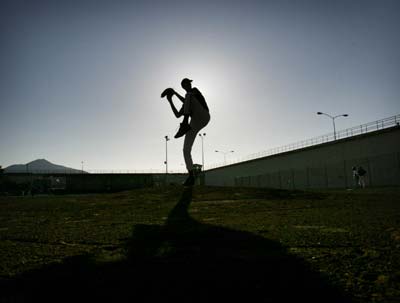
Pitcher for San Quentin Giants. Credit: David Bauman/PE.com
In my research I came upon a lot of media coverage, but I recently unearthed this gem of a slideshow by David Bauman. Enjoy.
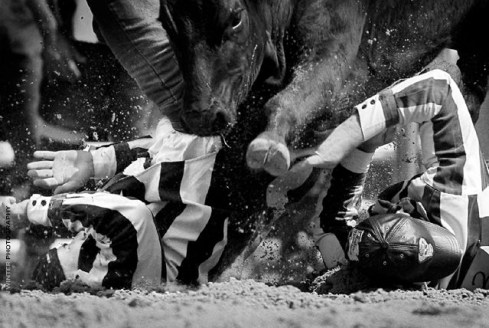
The blogo-photo-sphere has been spinning the past couple of days with the 2009 Pulitzer Prize announcements. Damon Winter took one gong for “his memorable array of pictures deftly capturing multiple facets of Barack Obama’s presidential campaign.” (Featured Photography). Patrick Farrell secured the other with his “provocative, impeccably composed images of despair after Hurricane Ike and other lethal storms caused a humanitarian disaster in Haiti.” (Breaking News Story)
Winter’s images are eye-catching, but to be honest I am suffering from ‘Obama-fatigue’. So saturated were we with so many high-quality images of the new 44th President, I now look for different material. A quick shufties through Winters website revealed all. His portraits of sports stars show a precocious willing to improvise with technique and composition. Winter has a seriously sentimental side also epitomised by his portraits of American Olympians from the 1984 Los Angeles games.
I guess, my hope is that he doesn’t become known as ‘that guy that did Obama’ … which is why I am more interested in his Angola Prison Rodeo photojournalism.
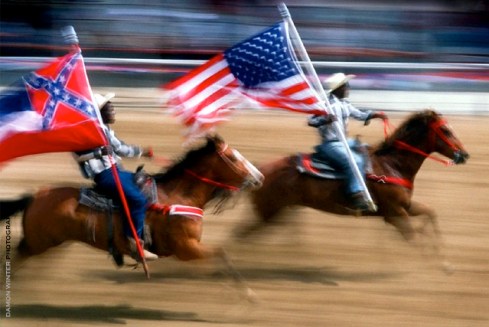
The rodeo featuring the prisoners of Louisiana State Penitentiary, commonly known as Angola, is an old – even traditional – event in the Louisiana calendar. Damon Winter is one of many photographers that have covered the community event. It is a raucous spectacle that brings together populations in and outside of the prison.
I still cannot reconcile this event my existing ethics which this event. There’s a charge that the rodeo is exploitative entertainment for which prisoners can suffer serious injury. Yet, I have not witnessed the rodeo-weekend first hand and I have read in the past that this is an event that provides long-term focus and short-term adulation for the prisoner-competitors. All I want to do is bring Winter’s photographs to your attention and hope they’ll compete with Obama for your attentions!

Winter’s pictures capture the strong forces and consequent risks of rodeo competition. I deliberately picked his colour images. The black & white stripes of inmates harry within Winter’s ‘red, white and blue’ palette. The star-spangled palette imbues the series with patriotism, pomp and faux-purpose. I almost feel we are subliminally less inclined to question Angola’s unique display of pseudo-gladiatorial entertainment when the games are suffused with hues of the American flag.

_________________________________________________________
View Damon Winter’s Obama campaign coverage for the New York Times, and listen to an audio interview with Winter about his experiences. Winter and PDN did an interview in 2008.

London Metropolitan Police Anti-Photography Propaganda Campaign Poster
When I began writing this blog, it was meant as a vehicle to display the documentary work of photographers working in sites of incarceration and to generally expound the stories touched upon. It was also meant to deconstruct some of the persistent myths surrounding prisons and prison populations and how visual culture has played its part in weaving some of those myths.
Not once did I envisage the current situation whereby the act of photography could bring about the threat of detention and imprisonment. Such impingement on basic rights of expression has been known in some of the dictatorial and despotic regimes of modern history … but not so much in the West, right? The times they are achangin’.

Photo: Liam Oliver Newton Craik-Horan. http://www.flickr.com/photos/liamch/3423810669/
When my brother visited from the UK last month he couldn’t stress enough how much of a police state it has become. We reasoned that the fingerprints taken by US homeland security are know also the possession of the UK government. It used to be the case that fingerprints were only taken and kept on file in the UK if you had been convicted for a crime. How things change.
A few months ago I signed up as a member of ACLU, the decisive moment was when the ACLU representative said to me, “You don’t want the US turning out like Britain with all those cameras and surveillance do you?”

Photo: Stickerklub. http://www.flickr.com/photos/stickerklub/3420240889/
Britain really is a country that has got itself on edge; it’s culture promoting men and women in all guises of security to exert illegitimate power and enforce ludicrous policy. Unfortunately, this robotic application of rules has infected even our art galleries, as the venerable John Berger discovered.
This past months have seen a slew of stories coming out of Britain regarding the rights of photographers in public spaces. All these are in response to a slew of legislation to slowly whittle down the rights of photographers; the rights of UK citizens.
On 16th February, the Counter Terrorism act came into effect making it illegal to photograph a police officer or “elicit information” about them. The British Journal of Photography has the details.
After the disgust at such brazen restriction of rights, the response by the photographic community in London was to go to Scotland Yard, headquarters of the Metropolitan police, and in an act of mass civil disobedience take lots of photographs of lots of officers.
The Guardian UK has been the mainstream print media that has really pursued this topic, reminding us all of what we have just lost. They broke the story that Kent police monitored members of the press during an environment protest, for which the Kent constabulary have apologized.
The Press Gazette explained this tactic and the associated tension between police and photographers.
David Hoffman, a photographer with 32 years’ experience, said he now carries shinpads in his bag, claiming he had been kicked by police officers at protests.
“The police today [NUJ Protest] have been beautiful – but that isn’t always the case,” he said. “Recent protests have been very bad. The worst was October last year, at the Climate Rush demo. One copper spent his time kicking my leg. Stood there with his steel toe caps kicking away – and me, a silver-haired man. I’ve still got chunks missing from my legs five months on. They want you to think: I won’t cover it next time. They have been using FIT [Forward Intelligence Teams, who use cameras], they have been using intimidation.”
Hoffman added, “It’s important the police know they’re being watched and observed. If you don’t see what’s going on, your society’s less democratic.”

Photo: Tom Kondrat. http://www.flickr.com/photos/toguko/3409931955/in/pool-met
It is almost like the lines have been drawn so indelibly, people are having to pick a side. It is sad to see but the police fall in line with the government and the majority sympathise with the press. This has led to a conflation of stories involving the G20 protests, police misconduct, and the death of (and vigil for) Ian Tomlinson. Judging by the Guardian’s recent coverage, you’d be forgiven for thinking that London was on the edge of civic breakdown.
I think the media and the Guardian in particular are taking a principled stance here and just reminding the Met at every opportunity that they are watched and the press will not be cowed. I think most of us realise that with millions of people in possession of recording equipment it is unenforceable to stop people from documenting the streets.

Photo: Tristam Sparks. http://www.flickr.com/photos/friendly-fire/3287739662/in/set-72157613984292743/
Ian Tomlinson’s death received a lot of coverage and rightly so, but I shall wait for the inquiry ruling before making a call, despite the early damning evidence. We, however, in the business of images know that they can never tell the full story. This is now an investigation of excessive force by the police and distinct from the main issue of photographers/civil rights.
Yesterday, the Guardian published this footage of the police threatening photographers with arrest if they did not move. Again, later the force apologized. But what is interesting here is the Guardian‘s decision to line up video footage of various scenes of confrontation from different days in the right hand nav bar. It is a dossier of police activity and unlike anything I have seen in mainstream media.

Photo: Roger Lancefield. The protesters stickers read "I am not a Terrorist, I am a Photographer". http://www.flickr.com/photos/rlancefield/3285904973/in/set-72157613975803636/
From the sublime to the ridiculous, the Guardian showed that front-line press aren’t the only ones under scrutiny. Metropolitan police deleted a tourist’s photographs this week to “prevent terrorism”. Klaus Matzka, the tourist involved summed his experience up as such:
“I’ve never had these experiences anywhere, never in the world, not even in Communist countries.”
So, at best you are harassed for your photographic activity and at worst, if thought to hold sinister motives, arrested and face a 10 year sentence.

Photo: Tristam Sparks. http://www.flickr.com/photos/friendly-fire/3414147417/in/pool-met/
Before all this gets to any court, however, the clashes are felt on the street, on the shins and in the constantly diminished rights to freedom of expression. Where citizen photographers may feel powerless, it seems the press – and the Guardian in particular – are just getting powered up.
_________________________________________
Thanks to all the Flickr users credited above for their images, but more importantly their acts of documentation in the face of legislation to prevent such freedoms. I hope we all stay out of prison.
When Jehad Nga’s photographed Somali pirates it was at a time when frigates not people were perceived as the main victims of their contemporary skull-duggery. It was also before American military engagement and the associated global media entered the fray
The main reason I focussed on Nga’s work back in December was because his pirate-subjects were imprisoned. Nga’s work at the time was featured in Time Magazine and The New York Times and I’d be lying if I wasn’t part of the consuming public that took more notice of the pictures than the politics.
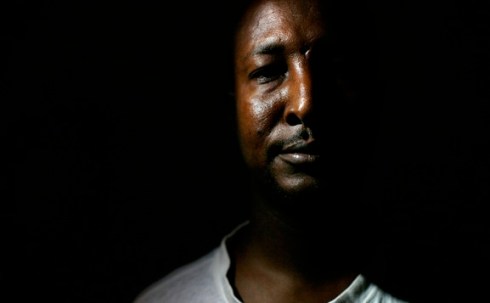

Since the close of 2008, activities in the Gulf of Aden have ramped up. So has Nga’s career; in photojournalist terms he unleashed another blockbuster this week with his portraits of US Marines in the New York Times. I’ll confess – I’m a sucker; I think Nga’s Chiaroscuro portraits are irresistible. My only problem is that the same aesthetic has been put in place by Nga and I am left confused.
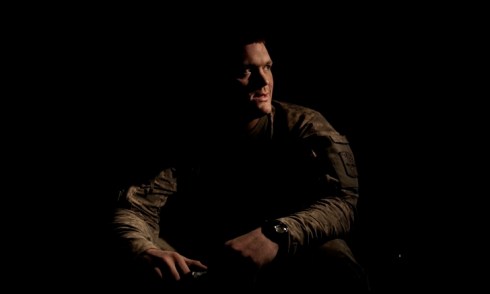


Nga described the jails in which Somali pirates were kept as dark and dank, so his visual language makes sense when working in that context. Has he made multiple photo essays of high contrast, using vibrant colour-schemes and dark negative space. Nga, has to my mind, forged himself a visual brand.
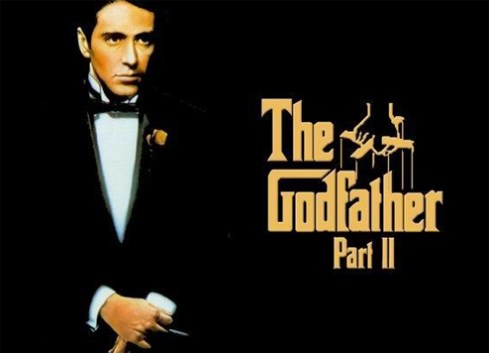
What is the end result of this? Is Nga just playing a longview game, in which his brand sustains longer than the stories? Is Nga just giving the public the cinematic frames it has lapped up previously? Is it problematic that he gives the same treatment to the ‘vilified pirates’ and ‘patriotic heroes’ we’ve seen in the newspapers this week? Are my queries unfair. After all one man’s terrorist is another’s freedom fighter. One man’s criminal is another’s political prisoner. Is it even Nga’s place to distinguish, or use visual devices to shape viewers’ thinking? We’d do well to remember Brando and Pacino played great villains, but they were villains we loved to hate.
What do you think? Do you contemplate the character of a subject differently when it is struck by bright pockets of light if it is an American soldier or Somali pirate? How do you reconcile that?

All images, except the Godfather II and Apocalypse Now still (final image) ©Jehad Nga.

 Prison Photography
