
You are currently browsing the category archive for the ‘Prison Non-Photography’ category.

It’s an open secret that the bail and bail bond systems — like other aspects in the criminal justice infrastructure — take a different toll on individuals depending on their ability to pay. When the poor can’t afford bail, the poor stay locked up. Making this point, a few years back Laura Sullivan for NPR made a phenomenal three-part series that skewered the bail bond system.
CHASING BAIL
We have a more recent view at the lives and fortunes at stake in a criminal justice system influenced by market rules. Al Jazeera’s Fault Lines series has a pedigree when it comes to criminal justice reporting, so I eagerly anticipate Chasing Bail which examines America’s multi-billion dollar bail bond industry. Two of approximately 15,000 bounty hunters are featured in the show, also.
In the show, reporter Sebastian Walker meets the family of 56-year old Jerome Murdough, who was found dead in a 101-degree Rikers Island jail cell, NY. Murdough was unable to make his $2,500 bail and awaiting trial at the time of his death. He was jailed for a misdemeanor trespassing charge.
The program makers also go to Prince George’s County Detention Center, Baltimore, MD — a region with one of the highest arrest rates in the country — and interviews prisoners incarcerated on bails of less than $3,000. People, the program explains, who are incarcerated pre-trial are far more likely to plead guilty.
The program also follows Rob Dick, a bounty hunters in Sacramento, CA — a county in which courts set over $16 million in bail money each month.
Al Jazeera writes:
The U.S. is one of only two countries (along with the Philippines) that allows companies to bail people out of jail at a profit. In all but 4 states, bail bondsmen are allowed to take almost any legal measure necessary to capture fugitives, including crossing state lines and breaking into homes. It’s a dangerous business for almost everyone involved, with few rules and little oversight.
In a nation where, on any given day, nearly 70% of the jailed population is awaiting judgment – how does money affect who goes free and who stays behind bars?
————-
Fault Lines’ Chasing Bail airs at 7pm ET/4pm PT, Saturday, May 24th. Find out how to tune in near you.

There’s an ugly scene unfolding in Illinois right now. The local paper in Champaign-Urbana, The News Gazette, published three attack pieces on James Kilgore, each one calling into question his character and the wisdom of the University of Illinois Champaign-Urbana (UICU) to hire Kilgore as a lecturer.
Kilgore is a respected researcher, writer, educator and criminal justice activist. He is also a former political insurgent who took up arms against federal authorities.
In the early seventies, Kilgore was part of the Symbionese Liberation Army (SLA) (of Patty Hearst infamy). He has been open about having felony convictions resulting from his political activities. Kilgore was on the run from 1975, living in Australia, Zimbabwe and South Africa until his arrest in 2002 in Cape Town. He saved the Feds the troublesome extradition process by voluntarily returning to the U.S., making a plea bargain, and pleading guilty to charges pertaining to the possession of explosives (in 1975) and passport fraud. Kilgore served 6 years in a California prison and upon his release in 2009 moved to Illinois to be with his wife, who is on the faculty of UICU. Since 2010, Kilgore has been a temporary faculty member at UIUC, teaching classes in Global Studies, Urban Planning and the College of Fine and Applied Arts.
These are the facts of the case. Jim Dey writing for The News Gazette in a Feb 9th OpEd piece In Plain Sight covers these facts. Dey’s tone is one of passive wonderment as to what UI might be thinking. The opinion piece is peppered with accounts of SLA violence from before Kilgore’s involvement. In Dey’s estimation, all the ideological mistakes of the fringe (and, yes, very damaging) SLA movement are all Kilgore. If only Dey had spent the same amount of time looking into Kilgore’s contributions in the interim four decades. It’s as if Dey and The News Gazette do not believe in change or maturation. If this is the case, then I call into question the commitment of author and outlet to the complexity of reporting and to journalism neutrality.
Kilgore is much more than his past indiscretions. As an aside, I know a person who used to be on the FBI most wanted list. This person’s charges were trumped up and when this person came out of living underground for 13 years faced no prison time. This person is one of the most politically aware, active and socially critical individuals I know.
There’s much more to Kilgore’s story than the character assassination as laid out by Dey. I believe it is motivated by a will to limit Kilgore’s very effective activism against a proposed new jail in Champaign-Urbana. Kilgore has proven himself a very adept strategist and activist leader in the town. Kilgore was instrumental in the fight. He has shared the successful tactics of the campaign with anti-prison groups across the nation.
News Gazette publisher John Foreman clearly has Kilgore in his sights. In the second OpEd piece (Feb 16th), Foreman perhaps a little miffed that Dey’s piece hadn’t wildly inflamed opinion enough) threw a hissy fit about the silence of Kilgore and UICU. What did Foreman expect? Answering to bully-boy tactics is not what Kilgore needed to do here. After all, The News Gazette had seemingly made up its mind about Kilgore a long time ago.
In his attempt to discredit UICU and question its priorities, Foreman opens his opinion piece by brushing aside a case of gross racism and sexism launched by a small (and troubled) group of students upon UICU Chancellor Phyllis Wise. Foreman mocks UICU’s attempts to deal with sexism and racism proving he’s more interested in cranking his newspaper’s controversy-du-jour than he is in taking a balanced view at all issues effecting his hometown community.
One week later, on the 23rd February, Foreman gave a platform to Dennis A. Kimme, the president of Kimme & Associates Inc., the firm that was trying to win the bid to build Champaign-Urbana’s new jail. Kimme is bitter about Kilgore’s attitude and expresses dismay that Kilgore would question the ability of Kimme’s company to assess the need for prison beds while trying to win a multimillion dollar contract to build those same beds! Of course, Kilgore and those opposed to a new jail would question motives.
Kimme’s contract bid failed on its own merits.
As if The News Gazette hadn’t already staked out its patently political position in text, it sent Jim Dey onto a talk show with it’s affiliate radio station to “discuss” the matter. Don’t bother listening to it. Host Jim Turpin is in cahoots with Dey as they proudly salute one another for their moral outrage.
I find it interesting that the UICU student newspaper has responded to this *controversy* with the statement: “The Daily Illini chose not to report on Kilgore’s status as a former felon because we did not believe that his status was news. Kilgore’s status as an instructor was no different than any other instructor.”
On April 9, the University Provost, in a private meeting, informed Kilgore that UICU would not approve any future contracts to employ him and declined to give him any explanation whatsoever as to why, how and by whom this decision had been made.
Fortunately, there is a community in Champaign-Urbana that sees the issue as more nuanced and is willing to look at the Kilgore of 2014 as well as the Kilgore of the early 1970’s.
A petition to UICU Chancellor Phyllis Wise has been circulated and already received the goal of 1,000 signatures. It reads:
We the undersigned scholars, legal professionals, activists and concerned individuals believe that the University of Illinois gave in to political pressure and refused to approve future employment contracts for James Kilgore on the basis of his background and sensationalist media coverage, rather than on his job performance.
Kilgore does not shy away from his past. He has answered to the full extent of the law his past acts and he has served time for them.
The SLA was committed to the overthrow of the federal government with planned attacks on police and federal buildings. They were of an era; one in which the violence of insurgency paled in insignificance compared to the violence waged in Vietnam. The SLA funded themselves largely through bank heists. SLA tactics were extreme, there is no doubt. The SLA cause achieved little. The SLA made grave mistakes. The SLA wasn’t the only homegrown group devoted to insurgency within U.S. borders.
Of all these activities, Kilgore was involved in one that led to a fatality. On April 28, 1975, SLA members including Kilgore robbed the Crocker National Bank in Carmichael, California. Myrna Opsahl, a bank customer was shot add killed during the robbery. Kilgore’s comrade fired the shot. Kilgore, it is reported, was furious that a gun was discharged. There’s talk of a light trigger, but still, take a gun into a bank and you should only predict unpredictability.
In a March 22 Chicago Sun-Times article, the university responded to UICU’s unceremonious dumping of Kilgore with a supportive statement from Associate Provost Robin Kaler:
He does a great job. He’s very well-respected among students. He served his time in prison. He is very remorseful. He didn’t do the shooting. He is a good example of someone who has been rehabilitated, if you believe in second chances and redemption, he’s someone who helps prove that’s the human thing to do. A child of the victim said he has served his time and should be allowed to go on with his life.
The American Association of University Professors echoed Kaler’s thoughts in their own official statement on the matter.
The News Gazette‘s OpEd series misses the point. It’s none-to-subtle rightwing attack against the classic bogeyman, against the non-patriot, argues that academia provides a profitable hiding ground for those that enacted political direct actions many decades ago. Think of the kids!?
What is at stake here is academic freedom.
More-so, we must ask do we want to believe in the ability for individuals, ANY INDIVIDUAL, to change, to improve, to educate and give back? The wording of the petition in support of Kilgore frames this perfectly:
Refusing to approve Kilgore’s employment contracts has serious implications for the 15 million Americans who have felony convictions and face a constant battle to access employment.
Get angry. Sign the petition. Follow James’ valuable work. Don’t let the boo-boys scare you.
Image: PM Press

I’ll be partaking in the student-organised prison reform SPEAR Conference this weekend. If you’re in or near New Jersey think about stopping by. Some very knowledgable thinkers, doers, journalists and activists will be convening. Below is the program.
BUILDING A NEW CRIMINAL JUSTICE: MOBILIZING STUDENTS FOR REFORM
April 4-5, 2014 , Princeton University
Friday
1:00pm. Opening Address: Marc Mauer, Executive Director of the Sentencing Project.
2:15pm. Panel 1: Academic Research on Incarceration. Brings together academics from a range of disciplines to discuss their research on mass incarceration.
Emily Owens, Associate Professor, Department of Criminology, University of Pennsylvania ; Charles Loeffler, Jerry Lee Asst. Professor of Criminology, University of Pennsylvania.
Kiminori Nakamura, Asst. Professor, Department of Criminology and Criminal Justice, University of Maryland; Jill Witmer Sinha, Asst. Professor, Rutgers School of Social Work. Moderator: Imani Perry, Professor, Princeton University Center for African American Studies.
4:30pm – 6 pm. Panel 2: Alternative Approaches to Prison Reform. Exploring alternative approaches to prisoner education and reentry programs through arts, entrepreneurship, job training, and urban farming.
Bert Smith, CEO, Prison Entrepreneurship Program; Pete Brook, Writer-editor-blogger, Prison Photography; Francis Lawn and Diane Cornman-Levy, Roots to Reentry; Charles Rosen, Founder, New Ark Farms.
7:30pm. Film Screening – The House I Live In, followed by discussion with Eugene Jarecki, filmmaker; and Chris Hedges, Pulitzer prize-winning journalist.
Saturday
9:30am – 10:50am. Panel 3: Prison Education. Brings together various perspectives on prison education, ranging from participant, to teacher, to policymaker.
Terrell Blount, Mountainview Program graduate ; Fred Patrick, Director of the Pathways Project, Vera Institute; Max Kenner, Bard Prison Initiative.
11:00-12:00pm. Workshop A: Getting Involved. How to implement and improve educational programs between your university and local correctional facilities.
Jim Farrin, Executive Director; Petey Greene Prisoner Assistance Program; Jecrois Jean-Baptiste, Education Director, NJDOC.
Workshops B and C: In the Classroom. How to tutor effectively in prisons, with current/former students and volunteers.
Terrell Blount, Mountainview Program ; David Hammer, Petey Greene Prisoner Assistance Program; Sara Blair Matthews, Bucknell University ; Danielle Rousseau, Director, Boston University Prison Education Program; Jim Matesanz, Field Coordinator, Boston University Prison Education Program.
Workshop D: Reentry Programs. Discussing entrepreneurship programs and other reentry projects.
Dennis Porter, Founder, Prodigal Sons and Daughters; Bert Smith, CEO, Prison Entrepreneurship Program
1:30-2:50pm. Panel 4: Prison Advocacy
After learning about academic approaches and educational programs, what political steps can we take to make our voices heard and affect policy-makers’ decisions?
Liliana Segura, Editor, The Intercept, First Look Media ; Margaret Winter, Associate Director of the National Prison Project, ACLU Jeremy Haile, Federal Advocacy Council, The Sentencing Project.
3:00-4:00pm. Workshops E + F: Affecting Policy Change
How to campaign, lobby state and federal representatives, etc. Jeremy Haile, Federal Advocacy Council, The Sentencing Project; Margaret Winter, Associate Director of the National Prison Project, ACLU; Alan Rosenthal, Leadership at the Center for Community Alternatives; Scott Welfel, Staff Attorney and Skadden Fellow, New Jersey Institute of Social Justice
Workshop G: How to Make Your Voice Heard
How to use various forms of media and journalism in order to begin engaging and effective conversations.
Liliana Segura, The Intercept, First Look Media; Pete Brook, Prison Photography.
5:30 – 7:00pm. Closing Address: Jim McGreevey, Executive Director, Jersey City Employment and Training Program Jobs Former Governor of New Jersey

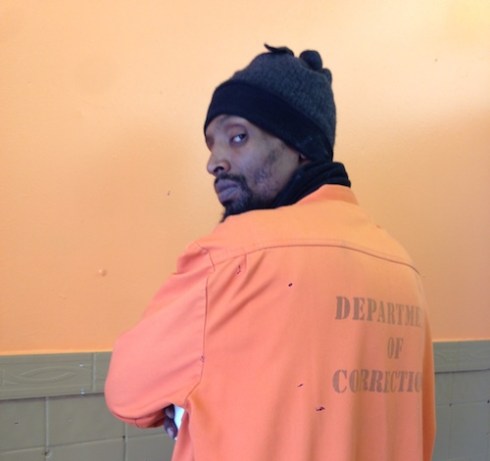
Today, the Huffington Post published 31 Reasons Philadelphia Is The Most Underrated City in America. Having spent two weeks in Philly recently, I can’t argue with most points (veggie friendly baseball park, c’mon!?).
But I can go further. Allow me to add a 32nd reason. Philadelphia’s anti-prison artists and activists.
Case in point: G-LAW. G-LAW, or OG-LAW (God’s Love Always Wins/God’s Love AT Work) is the adopted name of Michael Ta’Bon, an artist and activist who’s message is peace, love and no more prisons.
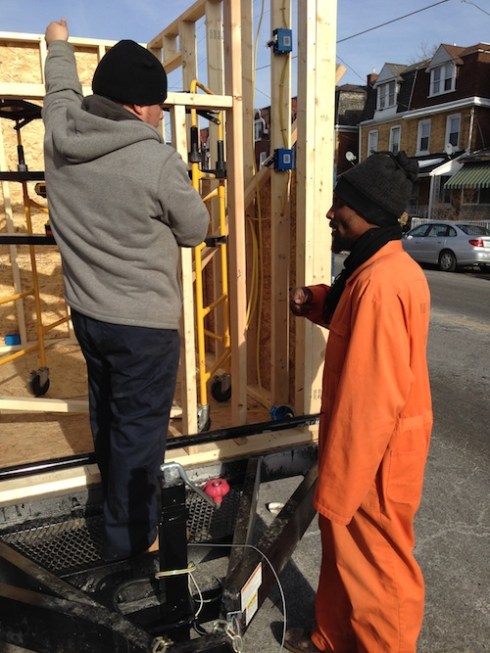
For the month of February, G-LAW lived in a self-built cell-sized space on the streets of Philly. Lori Waselchuk and I visited G-LAW on the first of the month to see how he was going with construction, buy a coffee and learn more about his project. These photos are from that day. I have not heard how the past four weeks have gone, but as with all of G-LAW’s public happenings, I am sure he’s raised a lot of eyebrows and a lot of discussions.
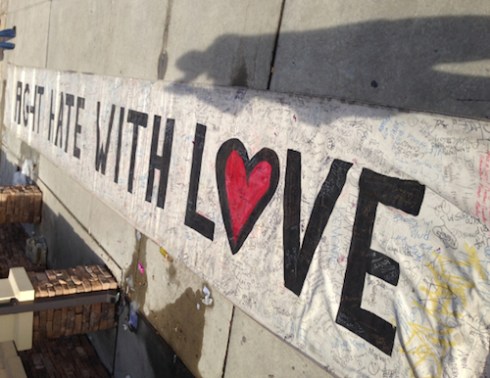
This isn’t the first time G-LAW has protested prison construction, poverty, inequality and hate. He has jogged 10 miles a day for seven days around Philadelphia with a 40-foot banner reading FIGHT HATE WITH LOVE; he has walked with a ball-and-chain from Selma to Montgomery; and this is, in fact, the third time he’s spent the month of February on the Philly streets in his own prison cell. You can see coverage of the the first occasion in 2011 here and here. One year, he mounted the event in Atlanta.

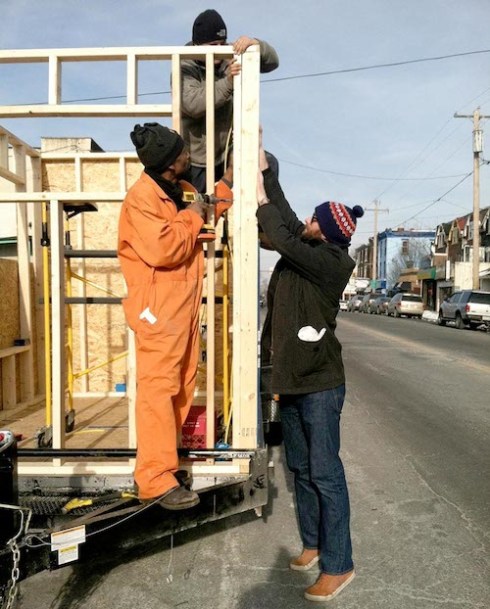

“JAIL IS 4 SUCKAZ!” is one of G-LAW’s many tags lines. He means everyone. He means you. Taxpayers are suckers for stumping the bill to maintain abusive and broken prison systems. One side of his cell is emblazoned with the phrase.
The project as a whole is called The Un-Prison Cell. It’s “the only prison in America designed to keep you out,” laughed G-LAW. It sounds like progress on construction slowed in the days after I visited, due to vicious weather and troubles getting materials.
G-LAW was also away from the site on February 12th as he joined the monumental People’s Budget Hearing protest at the Pennsylvania capital building in Harrisburg (video, audio, photos). The People’s Hearing was organised by DecarceratePA, one of the most effective and inspiring anti-prison activist groups in the nation. Don’t believe me? Listen to DecarceratePA member Sarah Morris debate PA Prisons Secretary John Wetzel and call him out on the misinformation peddled by the Pennsylvania Department of Corrections to the state legislature justify proposed prison expansion.
It was through DecarceratePA that I learnt about G-LAW’s art — you can listen to him on their radio show.
Maintaining momentum against massive forces for grassroots movements is a constant effort. A large part of that is being relevant to people outside the choir, having press strategy and adopting visual strategy too. DecarceratePA’s 100-day #InsteadOfPrisons Instagram campaign was the first and only interesting anti-prison campaign use of Instagram I’ve seen. (I adopted the hashtag myself later to spread the words of PA prisoners who’s work was in Prison Obscura.) Also, look how incredible this visual statement is.
Philadelphia should be proud of its grassroots activism. Bravo. More.
Follow G-LAW. Follow DecarceratePA on Facebook and on Twitter and on Instagram.
Thanks to Lori for some images.



TALKING HEAD
The kind folks at the Cantor Fitzgerald Gallery at Haverford College wanted to make a video to accompany Prison Obscura. So, we sat down with camera and I talked for an hour. It’s a blessed relief for you all that they managed to distill it down to 3 minutes. Much more bite-size than the essay.
Vimeo link. Also available on Youtube.
PRESS
Photo Exhibit Offers Look Into the Lives of Prisoners (Philadelphia Inquirer)
Prison Obscura: A Look Into the Cell of Self (Bi-College News)
Prison Obscura at Haverford’s Cantor Fitzgerald Gallery (The Art Blog)
Shedding Light on a Dim Situation in Prison Systems (The Temple News)
5 Intriguing Things: Thursday, 1/23 (The Atlantic)
‘Lives Lived Behind Bars are Too Often Invisible’ (In These Times)
Prison Obscura, Curated by Pete Brook (aCurator)
Exhibition: Prison Obscura (No Caption Needed)
Installation shots here and here.
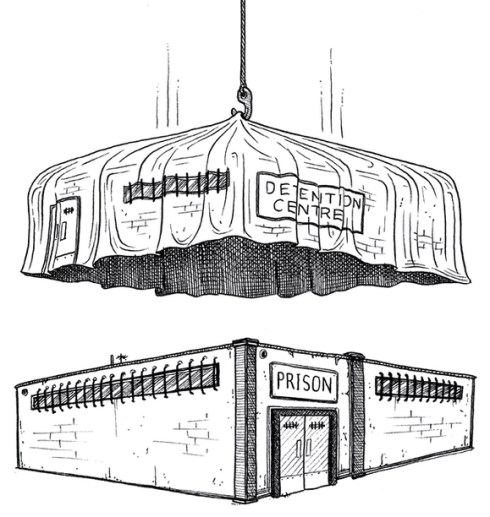
There’s a beguiling animated feature up on the website of Australia’s Global Mail. Illustrated by Sam Wallman, the piece tells the story of a former worker at an immigrant detention facility and how he — along with those locked up — slowly lost his mind. The detention center (we should all just call it a prison) was, and is, a incubator for illogic and for cruelty. An atmosphere that only rewards dehumanisation persists.
The facility is operated by the Serco Group, a British-based multinational corporation with interests and operations in logistics, security, government contracts across the world . It seems detention facilities are a boom sector for a company like Serco which operates all of Australia’s detention facilities. Serco hit the headlines late last year in Britain when it faced allegations of covering up extensive sexual predation and abuse at Yarl’s Wood, the UK’s largest immigration detention center for women.
As I’ve noted before, Australian’s are worried about Serco’s practices.
Not photography, but in this case, more powerful than a photograph. Maybe it’s the human touch within a pen stroke?
Thanks to Gemma Rose-Turnbull (an Australian) for the tip.

My friend Graham MacIndoe made this photograph a couple of years ago in the Gowanus/Cobble Hill area of Brooklyn, NY. “The bit that lies between the projects and the ever expanding gentrification,” explains MacIndoe who just came across the negative again this week.
A second time round, it was one of those not unusual moments of revelation that photographers have. MacIndoe saw story in this old image he’d forgotten since the first go around.
“There were two or three kids about 9 or 10 years old,” recollects MacIndoe of the day he made the shot. “If I recall there were no adults around. The kids had just finished a game and were starting another. One kid was teasing the other about going to jail.”
This photograph, this reality, floors me.
Directly, the image’s visual elements spell-out the school-to-prison-pipeline? It’d be too obvious if it weren’t for the fact, there’s no political statement being made here. This is play. This is play?
Pavement chalk, used by children for generations to invent new games is the type of material that any kid has access to, right? Right. But some kids have access only to chalk and probably not more expensive toys or educational games. The chips are beer bottle tops (Heineken I can identify; the others Bud Light? Maybe Sam Adams?) Is this what happens without XBox? Do children draw themselves acutely closer to reality than adults dare? Does childhood imagination work the other way too? Do we lose brave imagination in adulthood in order to inoculate ourselves against our terrifying, divided reality?
The game the kids have pathed out has depressingly few number of options; in fact it seems to be that you survive outside of prison only until you don’t — it is a case of when, not if.
This is an imagination particular only to poor kids. How horrified would we be if every American child’s imagination turned to these dark concepts? How broken our country would be, huh? Well, as long as we’ve communities so broken that kids dabble in make-believe about jail as easily as Santa then our country IS broken. No child should occupy such a dour imaginative landscape?
SCRAWLS ABUNDANT
Photography has recently focused on, and relied upon to some degree, untrained scrawls to tell stories. From Hetherington’s War Graffiti and Broomberg & Chanarin’s Red House to idiots like me pointing my iPhone at scribbles on walls. It is easy for us to lean on the narrative and evocations of anonymous or near anonymous humans. In prisons, cell walls are etched full with writings coming from a point of deprivation. Photographs reflect that. I’m saying this because, often the motif of photographing writing is dismissed (such is our level of expectation, at this point, is there anything more boring than a not-funny-protest-sign?) And, I’m saying this because I don’t think MacIndoe’s picture deserves to be overlooked.
This picture is literally what is happening on the ground. We’re told about it from the mouths — and minds — of babes.
These kids have created a game for their own world experience. They’ve created a thing not meant for anyone’s consumption but their own. But it is a public thing. In the absence of political awareness rises the most powerful political statement. It is fierce and it is scary. We want to fight back. But we cannot. We cannot doubt these children or discredit the uncomfortable truth they’ve presented. Instead, we are forced to justify this world they’re in. This world is ours and hopefully ours to improve for younger generations.
PICTURE OF THE YEAR
This is the most thought provoking image I have seen all year. I’ve not allowed myself time on a single image like this for a while.
And, yet, I know next to nothing about it. Please help me understand. Are games like this common in that area of Brooklyn? In NYC? In other American cities? These games might be commonplace and it might be merely my inexperience that explains my astonishment. But, of course, knowing the rampant inequality in this country and the exceptionally harsh treatment it reserves for the poor, I should not be surprised.
REST IN PEACE, PETE
Musician, folklorist and champion of the vernacular Pete Seeger died Monday. His legacy is formidable. The New York Times wrote:
His agenda paralleled the concerns of the American left: He sang for the labor movement in the 1940s and 1950s, for civil rights marches and anti-Vietnam War rallies in the 1960s, and for environmental and antiwar causes in the 1970s and beyond. “We Shall Overcome,” which Mr. Seeger adapted from old spirituals, became a civil rights anthem.
Part of Seeger’s widespread collection of folk songs took him, in March 1966, to the Ellis Unit of Huntsville Prison in Texas.
He traveled south with his wife and constant ally Toshi and their son Daniel. Bruce Jackson also joined them.
Afro-American Work Songs In a Texas Prison (30 mins.) documents the music African American prisoners used to survive the grueling work demanded of them. The prison work songs derive directly from those used by slaves and plantations and those directly from West African agricultural models.
Bruce Jackson wrote in his notes about the film:
“Black slaves used work songs in the plantations exactly as they had used them before they had been taken prisoner and sold to the white men. The difference was this: in Africa the songs were used to time body movements and to give poetic voice to things of interest because people wanted to do their work that way; in the plantations there was added a component of survival. If a man were singled out as working too slowly, he would often be brutally punished. The songs kept everyone together, so no one could be singled out as working more slowly than everyone else.”
Mechanization and integration of farming and forestry methods would soon lead to the disappearance of the work songs. There was an urgency to record them.
I spoke with Jackson in late 2011, when he said, “It is, to my knowledge, the only treatment (of that genre and era) that had ever been done. It was Pete’s idea and Pete paid for it.”
Seeger understood the contradiction. A significant type of folk music — a music that reflected the very survival of an oppressed group — was soon to be consigned to the history books, and yet that loss signified an improvement in their circumstances. As the film’s narration notes:
“The songs are still there but sometimes something is missing. The urgency is eased. Gone is that tension born of the original pain and irony of the situation that a man who could not sing and keep rhythm might die. The prison is the only place left in the country where the work songs survives. And it’s days are numbered. Another generation or two and its only source will be the archives. But given the conditions that produced the songs and maintained them for so long one can hardly regret their passing.”
Seeger understood people’s stories are wrapped up in their art. And with it their dignity. His curiosity was a rare and beautiful thing.
Watch: Afro-American Work Songs In a Texas Prison
A NOTE ON JACKSON
Bruce Jackson is a prolific prison photographer. Most of his work was made in the sixties and seventies in the South, from his Widelux images at Cummins Prison, his collected mugshots from Arkansas, his 1977 book Killing Time: Life in the Arkansas Penitentiary (Cornell) and his very recent 2013 book Inside The Wire (University of Texas Press) about Texas and Southern prison farms. Bruce Jackson’s book Wake Up Dead Man (University of Georgia Press) is a highly recommended study of work songs in Texas prisons.

 Prison Photography