
You are currently browsing the category archive for the ‘Prison Non-Photography’ category.

A single wall representing the meals of men and women executed in Texas, part of Julie Green’s The Last Supper: 500 Plates exhibited at Marylhurst University, Oregon (April 16 – May 17, 2013). Photo: Pete Brook.
In The Make — a new(ish) website that celebrates artists in their crafty environments with dedicated studio visits and conversations — has a smashing feature on my friend and fellow Oregonian Julie Green. It sure beats the 2011 write-up of my visit to Julie’s studio!
I’ve been thinking a lot about productivity and it’s obstacles recently and I think Julie maintains an incredible output. Part of that is the security of teaching for her but mostly it is passion and commitment to connections and getting the work seen. What use is studio time if the products are not then widely shared?
Julie’s The Last Supper which is now 552 plates deep, is broad and grasps solidly the size of the issue it takes on. Bravo to Julie for leveraging the agency she has as an artist.
Pop over to In The Make and read what makes Julie tick. Here’s a snippet:
Shipping and installation of fragile ceramics is quite an undertaking. I am looking for a library or a university or a museum- in Texas would be great—to donate the project on a ten-year loan. The Last Supper is not for sale.
I plan to continue adding fifty plates a year until capital punishment is abolished. A poet asked if I ever get tired of painting lumpy blue food. No, I don’t.
Oklahoma has higher per capita executions than Texas. I taught there, and that is how I came to read final meal requests in the morning paper. Requests provide clues on region, race, and economic background.
Why is this important? It is because the death penalty is applied unequally depending on the race of the defendant and the victim, not to mention access to adequate counsel, jury bias, prosecutorial misconduct and a whole plethora of factors that make wrongful convictions too frequent to dismiss. End the death penalty and we’ll end the murder of innocent people. As Bryan Stevenson brilliantly puts it, the question isn’t so much does a person deserve to die, it is do we deserve to kill?
ELSEWHERES
I’ve previously talked about Julie’s work here, here and here.
Coincidentally, I edited a story for Wired about the work of Klea McKenna who is editor of In The Make. Check out Crumpled and Abused Photo Paper Makes for New Landscape Photography

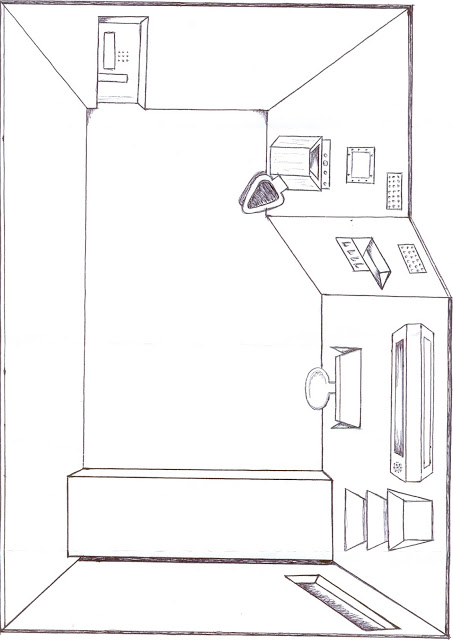
The image above was drawn by Katherine Fontaine, a San Francisco based architect, prison-questioner, friend to all, and book-art-space-collective co-runner.
“There are very few pictures of SHUs. The last drawing that was found at the Freedom Archives in San Francisco was from when Reagan was the Governor of California,” says Fontaine.
With solitary confinement, such a hot news topic, Fontaine was compelled to sketch when she realised there were very few images of solitary cells in circulation.
“I was given the few photos that exist from other similar prisons and a diagram that was used in a previous court case drawn by a prisoner while in an SHU at Pelican Bay. The drawing is what I came up with from the materials I was given,” explains Fontaine who hopes her drawing of a Pelican Bay State Prison Secure Housing Unit (SHU) will be used — in media materials and campaigns — by any organizations protesting solitary confinement.
Fontaine’s commitment to make reliable sketches of prison spaces and apparatus was spurred by a chance encounter with some fellow professionals in an unlikely place. She was among a crowd outside the Central California Women’s Facility protesting overcrowding inside the prison.
Fontaine noticed a person within the crowd with a sign that read ‘Architects Against Overcrowding In Prisons.’ On the back of the sign was www.ADPSR.org. The acronym stands for Architects, Designers and Planners for Social Responsibility. Despite her day job as an architect, ADPSR was not a group with whom she was familiar. Upon reading the statement for the Prison Alternatives Initiative, one of ADPSR’s projects, Fontaine was all-in.
ADPSR state:
“Our prison system is both a devastating moral blight on our society and an overwhelming economic burden on our tax dollars, taking away much needed resources from schools, health care and affordable housing. The prison system is corrupting our society and making us more threatened, rather than protecting us as its proponents claim. It is a system built on fear, racism, and the exploitation of poverty. Our current prison system has no place in a society that aspires to liberty, justice, and equality for all. As architects, we are responsible for one of the most expensive parts of the prison system, the construction of new prison buildings. Almost all of us would rather be using our professional skills to design positive social institutions such as universities or playgrounds, but these institutions lack funding because of spending on prisons. If we would rather design schools and community centers, we must stop building prisons.”
Fontaine’s sketches will regularly appear in Actually People Quarterly, partly to inform as partly as a means to focus her thoughts.
“People need to see them,” she says. “Also it was such a powerful thing for me to draw that SHU cell. I wonder if anyone else can have a similar feeling just by looking at it or if I just feel so changed by it because I drew it. Maybe it is because I’ve spent years of my life drawing, studying, measuring and designing spaces that in actually creating that image I imagined that actual space so much more clearly than I had before? To imagine being an architect and *designing* that space is incomprehensible to me.”
Incidentally, ADPSR was recently featured on the excellent podcast 99% Invisible in an episode called An Architect’s Code, following mainly the activities of Raphael Sperry, ADPSR’s founder.
Below is Fontaine’s sketch of cage used routinely within the California prison system. The cages are sometimes to hold prisoners during transfer between units but, increasingly, used for group *therapy* — an oxymoron if there ever was one.

I’d also like to take this opportunity to share the work of some other determined prison sketchers, some of whom are prisoners.
From the website, Solitary Watch:
One of the most prolific and talented artists in solitary is 60-year-old Thomas Silverstein, who has been in extreme isolation in the federal prison system under a “no human contact” order for going on 30 years. (He describes the experience here.) His artwork appears on this site. It includes meticulously detailed drawings of some of the cells he has occupied, including one pictured below, which is designed (with built-in shower and remote-controlled door to an exercise yard) so that he never has to leave it or encounter anyone at all.

Next is this cell in Ohio, drawn by prisoner Greg Curry.
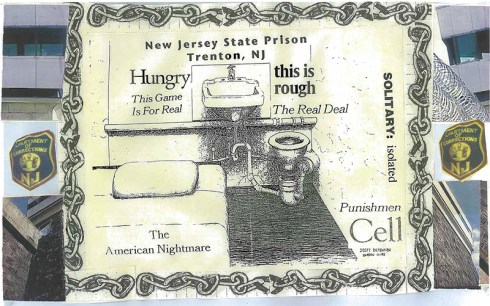
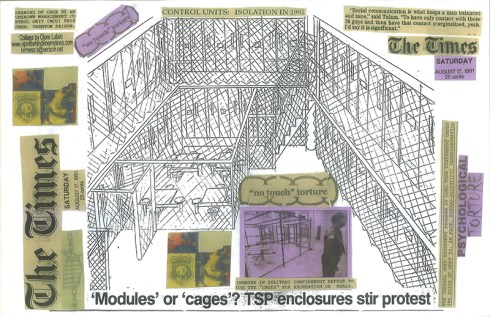
And finally, Ojore Lutalo has made some of the most politically charged prison art I’ve ever seen. Below, an isolation cell, and very below, Control Units, 1992.
When depicting prisons and their abuses there is no hierarchy of medium; sketches, photos, videos and oral testimony conspire to deliver a fuller picture. I will say though that these narrative rich drawings are more powerful than many photographs I come across.

I particularly liked this newsletter by Roger White, Campaign Director, of activist group Critical Resistance. I’ve reproduced parts below.
I especially appreciate White’s reinsertion of slave’s acts of resistance into the historical narrative.
Two and a half years after the Emancipation Proclamation was issued ordering states in the confederacy to release their slaves, Black people in Texas achieved their liberation from chattel bondage. On June 19,1865, General Order Number 3 was read from the Ashton Villa balcony in Galveston, Texas, that demanded that slaveholders free their slaves. That day has become an annual occasion for celebration, reflection, and education about the meaning of freedom and the on-going, universal struggle for liberation from domination.
These questions about the real meaning of freedom are more relevant to the work of abolitionists and those working against the prison industrial complex (PIC) than ever.
Today we struggle with how to stem and reverse the growth of imprisonment, surveillance, and policing. […] In our current work fighting against the construction and expansion of jails and prisons in California and New Orleans, we consistently find that the most durable victories against the PIC take place when the people are active participants in their own liberation. The same resolve that fueled the abolitionists in the state 150 years ago still lives today.
While the history of slave revolt in Texas is less well known, it is why we celebrate Juneteenth today. According to historian James M. Smallwood, “gangs of runaway slaves participated with Indians and Mexicans in a guerrilla-like warfare” against the planter class throughout the 1830’s. Resistance to slavery in Texas included everything from thousands of slave escapees fleeing into Mexico to freedom, to work slowdowns and refusals to submit to the enslavers. This record of resistance counters the popular narrative of a passive Black slave population in Texas that was freed by 2,000 heroic and benevolent Union soldiers on June 19, 1865.
To invoke the language of slavery abolition in calls to end the prison industrial complex may be confusing to some, even perverse to others. ‘What has the struggle to end slavery got to do with 21st century criminals?’ some may ask. For Critical Resistance, however, the inequality between the powerful and the powerless, between the wealthy and the poor are as marked now as ever. Racial bias is in sentencing, in the death penalty, in the drug war; it permeates our criminal justice system.
Critical Resistance is a member-led and member-run grassroots movement to end the Prison Industrial Complex (PIC) by challenging the belief that caging and controlling people makes us safe. Critical Resistance refers to their form of activism as abolitionism very deliberately:
“We call our vision abolition, drawing, in part from the legacy of the abolition of slavery in the 1800′s. As PIC abolitionists we understand that the prison industrial complex is not a broken system to be fixed. The system, rather, works precisely as it is designed to — to contain, control, and kill those people representing the greatest threats to state power.”
Read more on the logic behind CR’s language here. This brief history of CR’s trajectory will also help in positioning them on the political spectrum, which, is to say the far left.
I’ve been thinking about the absolute necessity of peoples’ power recently — about how it emerged briefly during Occupy and wondering where and how it bubbles since. I’m inspired by protests outside of prisons in solidarity with prisoners and when I hear about groups such as DecarceratePA marching from Philadelphia to the capitol in Harrisburg, I’m inspired and wish I could be with them. Walking (or standing) are distinctly undervalued forms of civil disobedience.
Measuring the successes of Occupy is a tricky proposition. Most people will admit that it shifted the politics of a national debate on economic justice back toward the centre, toward the interests of everyday people. Grassroots activism is achieving that constantly at a local level. I just wanted to celebrate that on this, the anniversary of one of the more progressive steps toward equity in American history. Love our neighbours and fight for them.

Video still. On June 10, 2012, Maine Department of Correction’s employee, Captain Shawn Welch sprays OC spray into the face of prisoner Paul Schlosser who is bound in a restraint chair after Schlosser, who has an infectious disease, spat at an officer.
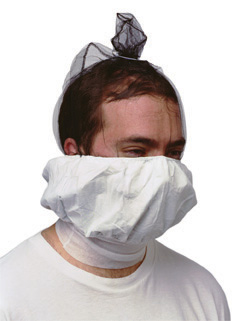
The pepper-spray – dispensed at point blank range – to the face of the restrained prisoner was horrific enough, but it was the use of the spit-mask that truly reflects the vindictiveness of this act of torture. Put on prisoner Paul Schlosser’s face after the pepperspray had doused his mouth, face and eyes, the spit-mask kept the irritant closer. If there was one consistent cry from Schlosser it was that the mask be removed.
Last week, the nation was shocked by video footage of Captain Shawn Welch, a Maine correctional officer discharging oleoresin capsicum (OC) spray, without warning, into the face of Paul Schlosser. Welch held the Mark 9 canister about 18 inches away. The Mark 9 is intended for disabling multiple people at a distance of no closer than 6 feet.
Some experts say the use of pepper spray can be a reasonable way to get control of a situation, even if a person is restrained, but in this case is seemed wholly unnecessary. It seems vindictive and personal.
 The incident occurred in June 2012 and the video came public following a leak. The Portland Press Herald broke the story. Welch was initially sacked but later reinstated following an appeal that took into account his service to the Maine Department of Corrections. It is scandalous that this man returns to a uniform.
Furthermore, as Press Herald OpEd argued the MDOC hunt for the source of the leak missed the point. The issue is the abuse the video shows.
The Press Herald’s coverage of the story has been thorough and I quote from it comprehensively below. The matter that stood out for me was the investigator’s observation that the confrontation became personal between Welch and Schlosser.
In the 24 minutes between Schlosser being sprayed and when he can wash the spray off his face, Welch strolls in and out of the cell holding the OC spray canister, telling Schlosser that if he doesn’t cooperate, “this will happen all over again.”
“You’re not going to win. I will win every time,” he says.
Welch says repeatedly, “If you’re talking, you’re breathing,” suggesting that as long as Schlosser was complaining, he was not in serious medical distress. Welch does call for a member of the prison’s medical staff.
At one point, he whispers to Schlosser, “Useless as teats on a bull, huh … What do you think now?” an apparent reference to an insult Schlosser directed at him two days earlier, according to the investigator’s report.
The investigator concluded that Welch’s treatment of Schlosser was personal.
“Welch continues to brow beat Schlosser and it looks like he has made this a personal issue,” said Durst in the report. “There is not one incident of de-escalation and in fact Welch continues to escalate the situation even after the deployment of chemical agent.”
Schlosser had been self-harming and refusing medical attention, actions which led to the extraction from his cell by riot-gear-clad prison guards.
Welch told an investigator that the use of pepper spray was appropriate because Schlosser, who has hepatitis C, had spit at an officer.
Schlosser gasps and fights for breath. He tries to lean forward to spit out the spray, but the guard holds his head against the back of the chair. One of the guards then puts a spit mask on Schlosser. The mask traps the irritant against Schlosser’s face, at one point covering both his mouth and nose.
Schlosser says he can’t breathe and promises not to struggle or argue anymore.
Pepperspray instantly dries out mucous membranes in the eyes, nose and mouth causing intense and overwhelming pain. Pepperspray leads to a sensation of not being able to breathe, although a National Institute of Justice study found it does not compromise a person’s ability to breathe.
“It’s just like getting jalapeno pepper in your eye, only multiplied by a bunch,” said Robert Trimyer, a use of force instructor and OC trainer with the University of Texas Health Science Center Police Department in San Antonio. Depending on the concentration, OC spray is roughly 300 times “hotter” than a jalapeno pepper.
“It’s painful, but it goes away. The people that have the problem breathing, it’s really more of the anxiety involved,” said Trimyer.
Yerger believes that putting the spit shield on top of the pepper spray would intensify the effect of the spray.
“I have never heard of any trainer I have ever worked with as a peer that would ever say, ‘Put a spit hood on someone after pepper spraying them,'” he said.
“They’re spinning out of control. Restraint, pepper spray, now cover their face — you’re just escalating the situation. In cases I’ve reviewed when people have died in a (restraint) chair, it’s not uncommon to see factors like that involved.”
DIRIGO
Above Schlosser’s restraint chair is the Seal of Maine, on which the latin word Dirigo, meaning “I lead” is emblazoned. Welch only demonstrated to his colleagues how to posture and escalate a situation. The irony ceases to matter when the outcome was so violent.
Independent experts and everyday folk can see that if spit born Hep-C was the real issue here then the spit mask should have been put on long before Welch whipped out his Mark-9 canister. And to be honest, wouldn’t anyone spit after pepper-spray to the face?
Scandalous.
Welch was ordered to take a personalised re-training program except the MDOC sent him away: It had nothing to teach him as he had already taken all recommended courses to the highest qualification. Didn’t seem to inform his conduct in this case, though.
After the episode, Schlosser was sent for a time to Maine State Prison in Warren for mental health treatment and returned to the Windham prison, where he is now in the general population. He said he is doing much better and has had no further encounters with Welch, although they see each other regularly.

Laura Schlosser, mother of inmate Paul Schlosser, watches the video Tuesday, March 12, 2013 of an incident involving her son and Welch. Shawn Patrick Ouellette/Portland Press Herald.

Found photo of an unknown prison cell.
Last week, I was interviewed twice – firstly, for DVAFOTO and secondly, for HERE BE MONSTERS – about Prison Photography On The Road and my activities since.
The DVAFOTO interview opens with my account of my arrest and 9 hours in jail in late 2011. The HBM podcast is about a workshop I delivered in Sing Sing State Prison, New York.
It may be ironic that I’d get locked-up during a research trip that is questioning incarceration, but it’s not funny and it’s no badge of honour. My actions were foolhardy and the police officer’s actions were over-zealous.
I’ve been thinking beyond what I think about the experience (It was stupid, bureaucratic and inconvenient), and more about how I think of the experience (What insight did I gain? What interactions did I have? Who did I meet?)
Inside the release-tank were about 15 men. They were there for different reasons. One young man faced a significant bail amount for a significant possession offense while another was brought in for cycling drunk in the wrong direction of the cycle path on a quiet road. Some men were in for DUI’s and in some cases not their first DUI. Two or three slept through the hours. Others were quiet and some told stories. The younger ones were more talkative and boastful. Several tried using the phone but only one succeeded. When they found out I was in for peeing on a tree and not answering questions they thought it was lame. Lame offense, lame arrest.
A tray of peanut butter sandwiches was brought in, but not enough. Some jumped on them, others weren’t interested. I think one person got two sandwiches.
Of the men with DUIs, I had little sympathy. They didn’t seem to acknowledge that their actions were potentially lethal. For a couple of them, cash-fines, points on their licenses and driving bans didn’t seem to be much deterrent.
A few men seemed contrite. Others seemed beaten down with either addiction or repeated arrogance.
I had huge sympathy for the drunk cyclist. Maybe in this fifties. Grey hair. He thought he was getting out until the administration realised he was a parolee. The bike-ride proved a violation and he was to be automatically rearrested and jailed for a fixed term. He had a job and children. Because of a night of excess, he was to lose those things again. Sure, his behaviour could have been better, but I think the authority’s response was of excess.
I didn’t ask what they did and they didn’t ask me. It was a small space. It was very dirty but not quite filthy. We only moved our place when others left and they did so in groups of 3 and 4 throughout the hours.
Part of me wishes I’d taken the opportunity to ask some questions, tap some opinions (I may have met a great conversationalist who’d improve my thinking as much as I hoped I might improve his). The other part of me knows only an intrusive nerd would be ask out-of-the-blue questions about personal circumstance and attitudes; especially in a temporarily-occupied cell at an unpredictable time.
No clocks.
Two weeks later: No court appearance. No charges brought.
Why is this relevant? The arrest and dismissal of charges — actually, the incomplete documentation of the arrest and dismissal — almost jeopardised my visit to Sing Sing to carry out a workshop with attentive, challenging, respectful and curious students of the education program there.
An arrest will always feature on a record, whether or not a conviction is brought, so-told me a law enforcement employee over the phone. New York Dept. Of Corrections which administers Sing Sing knew I’d been arrested but the information ceased there. I had to scramble for paperwork (that had not been given to me) to prove I had no criminal record. I wonder how much inefficiency and potential mistakes contribute to unfair and/or heightened levels of control. Frustration must be infinite in the prison industrial complex.
All in all, I’m glad I was able to teach and learn in Sing Sing and doubly happy that Jeff Emtman was able to craft a fine podcast splicing together audio of prisoners speaking, myself speaking, music and sound. Jeff conceived of the podcast titled The Other One Percent, to broadly challenge listeners to think about prisons and solutions.
The class, as a whole, discussed many images but specifically in the HBM audio, Robert Rose, Dennis Martinez, Deshawn Smalls and Jermaine Archer talk about these six images.
The first image mentioned is the one below by Brian Moss …

“Fear, I think people would think fear,” says Sing Sing prisoner, Robert Rose. “They can’t see what goes on in here, just as we can’t see much of what goes on out there.”
… then the three below by Alyse Emdur …
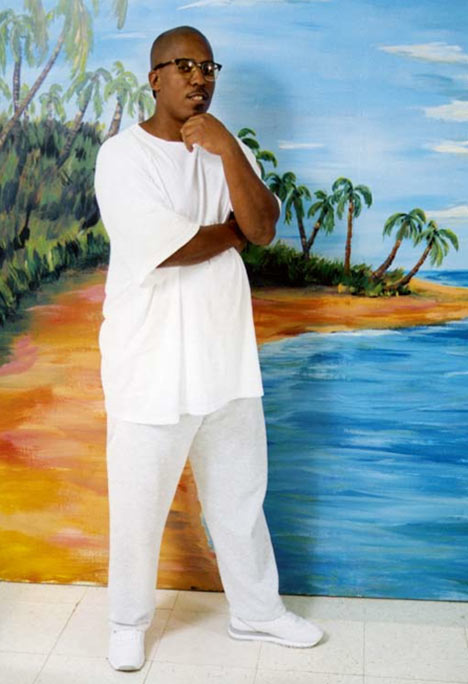

“Something needs to be said about the families who also do time. They are part of the narrative of mass incarceration, but they’re not talked about. They end up carrying the burden,” says Deshawn Smalls, Sing Sing prisoner.

… and finally, the two images below by Richard Ross of juvenile facilities.
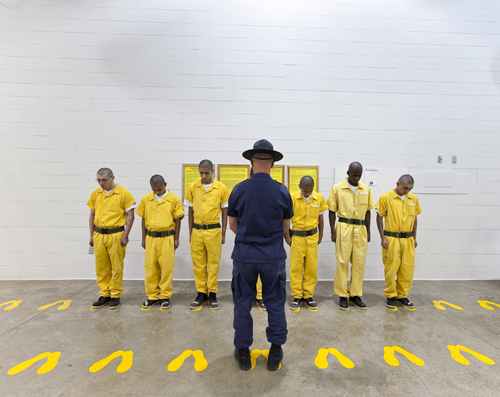
Sing Sing prisoner, Jeremy says, “You may have a man who refused [to adhere to regulations] and this is him in this picture. You probably won’t see the man at first, but he is there.”

HERE BE MONSTERS (HBM) is a podcast audio series about fear and the unknown, by Jeff Emtman, a 2012 Soundcloud Community Fellow.
HBM has previously covered Juggalo culture; placenta medicine; train-hopping; the disillusion and resignation of a favored NPR correspondent; a children’s book about a hallucinogenic trip; and the mind-made images created by the human brain when the body and the eyes experience total darkness – a condition known as ‘Prisoners Cinema.’
I like what Jeff is doing. I’m happy to share my experiences with him.
If you’re still interested in what I’m up to, I cover my immediate plans in the DVAFOTO interview. We also talk about what bloggers can do and do do.
LINKS
The Other One Percent (Here Be Monsters podcast)
Interview: Pete Brook On The Road (DVAFOTO)

“I imagined you’ve seen lots of prison everything so it’s a bit intimidating to send you anything for fear I’m just repeating,” said the anonymous tip off in my inbox. The link was to a film entirely new to me. It blew me away and will you too.
Jonathan Borofsky, famous in recent years for a bunch of monstrous sculptures of 2-D men (usually hammering the air), made Prisoners in 1985. It’s one of the best prison films I’ve seen, mainly because Prisoners doesn’t weave too persistently one particular tale or one particular journey. To be reductive, I’d argue that this is the unique artist’s treatment of the subject in stark contrast to the straight documentarian’s treatment.
Generally, prison documentaries are often about trial and adversity; they necessarily have to depict struggle and hope from all angles. In other words, documentaries are often part-advocacy and answers. Borofsky just had questions. The answers the 32 California prisoners had for him in interviews will stay with you.
Part horror testimony, part philosophy, part confession, part therapy, Borofsky’s Prisoners is a tour de force. It was made in the mid-eighties just as the era of mass incarceration took hold. Back then prisoners had the same issues – poverty, drug addiction, histories of childhood abuse and adulthoods of transgression, bad circumstance and bad choices – there were just fewer of them.
The opening of the film includes atmospheric music and cuts of the more bizarre statements. It jolts. But don’t think Borofsky is setting these men and women up for a fall. Yes, his artistic hand is all over this, but he gives each of the prisoners plenty of time to pierce through our bullshit and take us right to their reality. If it seems weird, it is probably because Borofsky’s subject live weirdness every day. Borofsky let’s them speak. He shows their common institutionalisation but does not pity them.
Hugely compelling.

Photo: Leah Nash for The New York Times. Plates in “The Last Supper,” a show that features Julie Green’s plates depicting death-row meals.
A couple of years ago, I visited the studio of artist Julie Green. I was compelled to do so because I was convinced that her The Last Supper project was more relevant and hard-hitting than the many, many photo projects about the last meals of the executed.
Julie Green has painted the last meal requests of over 500 prisoners on individual plates. It’s an overwhelming body of work. The Last Supper is now on show at The Arts Center in Corvalis, Oregon.
Kirk Johnson has written The Last Supper for the New York Times:
The underlying and compelling theme of the work is choice. What do people who may have lived for years in prison with virtually no choices at all do with this last one they’re offered? Do they reach back for some comforting reminder of childhood? (Professor Green suspects as much in the cases of meals like macaroni and cheese or Spam.) Do they grasp for foods never tried, or luxuries remembered or imagined? (One condemned man ordered buffalo steak and sugar-free black walnut ice cream; another, fried sac-a-lait fish topped with crawfish étouffée.)
As Green says she won’t stop painting until the death penalty is abolished, there’s a long way to go with this project. It’s great to see it going from strength to strength and pressing the issue to the fore. Bravo, Julie.
BOOK
Accompanying the show is a 520-page lunker of a book. The Arts Center received sponsorship assistance to publish a full color catalog of the 500 plates. The catalog will be for sale during the exhibit for an introductory price of $50 (after February 16, 2013 the price will go up). To purchase a catalog, please contact Hester Coucke and let her know a good time to contact you during the business week.
PRESS
View the full NYT gallery here. And the NYT article, Dish by Dish, Art of Last Meals.
Green’s Interview with Oregon Public Broadcasting’s Geoff Norcross.

Barack Obama is TIME’s Person Of The Year. The accolade is less interesting than Obama’s words in the TIME interview. The President of the United States talks about criminal justice and prison reform. Obama says,
“There’s a big chunk of that prison population, a great huge chunk of our criminal-justice system, that is involved in nonviolent crimes. I think we have to figure out what are we doing right to make sure that that downward trend in violence continues, but also, there are millions of lives out there that are being destroyed or distorted because we haven’t fully thought through our process.”
Granted it takes until the fifth page (of five) until we get to criminal justice issues. But, still. I’m going to say ‘wow’.
In November, I half-wrote a blog post about the complete absence of talk about criminal justice policy during the presidential debates. It never published; the details were more depressing than the simple fact. These words by Obama in some way make up for that. Watch this space. Watch Obama’s team.
via Prison Policy Initiative.

 Prison Photography