
You are currently browsing the category archive for the ‘Prison Non-Photography’ category.
Yesterday, we were talking about Google Street View. So, the segue to today’s topic is pretty seamless.
There’s been plenty of reporting on the prison robots designed and now being trialled in South Korea. This simple breakdown of info on these over-sized dehumidifiers is as good of a place to start than anywhere.
Lets be honest, these storm-trooping bread-makers are weird but they’re a pretty clumsy use of technology. Yesterday, I deleted my Linked In account, at the weekend I was talking about nuclear war initiated by software viruses (a la Stuxnet). I mean to say that, if we’re thinking about technologies, digital footprints and code-based (non-physical) manifestations of monitoring and interaction are far more pervasive, instant, destabilising and effective ways to intervene in – and disrupt – the world. These stupid, pearly-white ionisers on wheels deserve nothing but mockery.
No matter how good their 3-D cameras and behaviour analysis softwares are, the damn thing still turns its back like a human prison guard. Why doesn’t it employ 360 degrees imaging?
The thing looks ridiculous. It will never work. Prisoners will take the first opportunity to kick the shit out of it … and so they should. In such a scenario, would disciplinary sanctions against a prisoner for vandalising a robot be dealt with in the same way the authority might punish a prisoner for an assault on a prison guard?
The isolation of solitary confinement destroys people; the threat and the psychological isolation of prisoners damages people; unhealthy and inhumane relations with gang-affiliated prisoners and/or stressed, possibly abusive or indifferent, officers damages people. If we expect prisoners to rehabilitate themselves we need to prepare them for reentry into majority society, not subject them to sci-fi distopia surveillance for the sake of saving a buck.
This is market economics gone mad. A product with a cost and with a projected cost-saving. At nearly a million bones a pop I hope they’re dismantled very rapidly by any prisoner class that encounters them. It wouldn’t be vandalism it’d be a service to humanity.

Image: Rupert Ganzer
California has more prisoners serving life than any other state.
Life Support Alliance (LSA) has identified a group of prisoners – the life-term prisoners – who have increasingly become subject to Kafkaesque procedure in California justice. LSA advocates on behalf of these life-term prisoners and educates the public on the invisible cycle of parole denial.
CONTEXT
There are four types of sentences handed down to California prisoners; the death sentence (execution), life without parole (never released), determinate sentences of a fixed period (3,5,10 years for example), and indeterminate sentences (5 to life, 12 to life, 20 to life). It is in this last category that life-term prisoners fall. If they are ever to win release they must serve the minimum term first and then convince a parole board that they are suitable for release. Suitability means not being a public threat.
In California there are 22,000 men and women on indeterminate term-life sentences. The average number of years served by a prisoner serving a life sentence with the possibility of parole is 20 years. For all these prisoners release is dependent on the Board of Parole Hearings.
GAIL BROWN ON THE CALIFORNIA PAROLE SYSTEM
The Board of Parole Hearings is not a neutral group however, and it is susceptible to political influence. New appointees to the board are made by the Governor. During our conversation, Gail Brown, Founder of Life Support Alliance talks about how the parole grant rate under Governor Gray Davis was 0%. During the tenures of Schwarzenegger and current Governor Jerry Brown, the figure rose as high as 20% and now sits at 18%. This increase is partly due to a more sensible approach to criminal justice, but also down to the economic crunch and to the fact that the governorship is likely to be Brown’s final job in public office; he doesn’t have to bow to powerful *tough-on-crime* lobby groups. Incidentally, California is one of only 3 states in which the governor has veto power over the board of parole hearings.
LISTEN TO OUR CONVERSATION ON THE PRISON PHOTOGRAPHY PODBEAN PAGE
We should listen to Gail Brown. Her proposals will save every CA taxpayer money, forge progressive and forgiving attitudes, and force a return to legal procedure that means thousands of prisoners won’t be held in limbo, or worse, denied release because politicians don’t want to have prisoners – perceived as public safety hazards – released on their watch. (For a lesson in the damage a discharged prisoner can do in the worst circumstances to a political career, read up on Willie Horton and Al Gore.)
It also makes good common sense to release term-life prisoners. They are aging or aged. Costs to house an adult prisoner nearly double from $50,000/year to $98,000 when a prisoner turns 55. When they pass the age of 65, the cost triples to $150,000. The majority of these costs are medical care (which in CA was ruled as cruel and unusual in any case.)
As well as reducing costs, Gail Brown points out that aged prisoners have grown out of transgressive behaviours and are statistically the safest population to release.
In December 2011, the Stanford Criminal Justice Center released the first rigorous empirical study of prisoners serving life sentences with the possibility of parole in California called, “Life After Limbo: An Examination of Parole Release for Prisoners Serving Life Sentences with the Possibility of Parole in California.”
The report found that California has laws enacted through the three branches of government often contradict one another.
In 2008, Marsy’s Law (also known as Proposition 9) gave victims additional rights to participate in parole hearings and the law greatly extended the time between hearings once a lifer is denied parole by the Board.
That same year, the California Supreme Court ruled in the Lawrence Decision that while the commitment offense is probative, in and of itself, it cannot serve as the sole reason to deny parole. The relevant standard for the Board to use in considering whether to release an inmate serving a life sentence with the possibility of parole is whether the prisoner is a current threat to public safety.
To further complicate matters, newly proposed legislation – SB 391 – would authorize the Parole Board to base its decision to deny parole solely upon the circumstances of the commitment offense. That would directly overrule the California Supreme Court opinion.
THE LAST WORD
More than statistics, costs and legal definitions, Brown wants us to heal as a society and look toward restorative justice and not rely on state agencies to enact vengeance within unseen penal institutions. As much as we are all potential victims of crime, we are all potential activists against the cycles of punitive violence that persist in broken prison systems.
As you may know, I’ve recently relocated to Portland, Oregon. The Portlandia TV comedy narrative would have you believe this is a town full of loveable counter-culture stereotypes; under-employed dreamers, kombucha-swilling hippies, and coffee-obsessed yoga-rock-climbers, to name a few.
But …
PORTLAND IS NOT PORTLANDIA
It is fair to say that on the West Coast, the tech boom of the nineties – centred on Seattle, San Francisco and Silicon Valley – bypassed Portland. And the joke is that people pursued fire-eating, tattoos and weed instead of HTML and Java-code.
But Portland is not a harmless bubble populated only by self-aware, contented contrarians. Portland has the same problems with failing schools, violence and inequality as many large U.S. cities. Furthermore, the State of Oregon as a whole has seen dwindling public funds for education as measured against its burgeoning law enforcement and corrections budgets.
As a reality check, I’d like to recommend two articles.
Firstly, Our preoccupation with incarceration costs us in education, by Naivasha Dean in Street Roots:
Oregon is one of only a handful of states in the nation that spends more money on prisons than on higher education, a statistic that is often met with dropped jaws by students struggling for financial aid. The Department of Corrections has been one of the fastest growing state agency budgets that is eating up an ever-increasing percentage of the state’s General Fund. This does not bode well for Oregon’s future and represents a deeply misplaced set of priorities and an archaic approach to addressing crime and public safety.
Why is Oregon’s prison spending so out of control? Oregon can trace the trend directly back to 1994, when voters approved Ballot Measure 11. Measure 11 established mandatory minimum sentences for approximately 20 “person-to-person” crimes, and it automatically sends youth charged with any of those crimes, aged 15 and over, directly to adult court. Mandatory minimums are a one-size-fits-all approach to criminal sentencing that prevent judges from using their discretion and prevents Oregon from using smarter approaches to accountability and crime prevention.
Shortly after the passage of Measure 11, Oregon’s governor and legislature approved plans for more than 8,000 new prison beds, including siting for six new prisons. Since then, the legislature has authorized more than $1 billion for prison construction. As anticipated, Oregon’s prison population exploded — from 6,000 inmates in 1995 to more than 14,000 today, and the Department of Corrections budget more than tripled.

Secondly, Portland, the US capital of alternative cool, takes TV parody in good humor, by Paul Harris. This Guardian article, partly, dispels the temptation to get carried away with TV’s version of PDX life:
Portlandia is not the whole picture of life in Portland. Not everyone is white, urbane, child-free and in their 20s, or acting as if they are. In fact the city is 8% black and 9% Hispanic– communities that often live in poorer neighbourhoods that are gentrifying with newcomers who push out long-established families who can no longer afford rents.
Portland also has a problem with gang violence. […] One man who sees this side of Portland close-up is John Canda, founder of gang outreach group Connected. “I personally have been to 358 funerals,” he said of two decades working in the field. Connected, formed last year after a series of shootings, seeks to lessen violence by having volunteers walk the troubled streets, reaching out to Portland’s youth.
“Our message is talk with us. It starts with a greeting,” he said. For Canda, as a native black Portlander, the world of Portlandia and its concerns over recycling and organic food seem unreal. “It is like a parallel universe,” he said.
Graph courtesy of the Prison Policy Initiative.
Over the past decade, documentary filmmaker Edgar Barens has explored the many issues at play in the American criminal justice system.
For his most recent project Prison Terminal, Barens was granted unprecedented access to the Iowa State Penitentiary (ISP).
Prison Terminal is a moving cinema verité documentary that breaks through the walls of one of America’s oldest maximum security prisons to tell the story of the final months in the life of a terminally ill prisoner and the hospice volunteers, they themselves prisoners, who care for him.
The Iowa Department of Corrections allowed Barens round-the-clock access to the ISP hospice and almost uniquely – to my knowledge – a space for him to cobble together living quarters and a production studio in the prison’s basement.

Jack “Comrade” Hall. Hospice Patient, Iowa State Penitentiary.
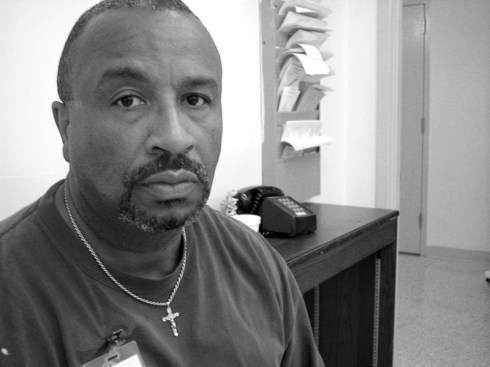
Bertram “Herky” Berkett. Inmate Hospice Volunteer
Prison Terminal is more than a documentary: it is a hub for information and context. You’ll need to spend some time with the biographies of those involved, a host of video shorts and general essays about the prison industrial complex.
Prior to working in Iowa, Barens also documented the hospice program at Angola Prison – a well photographed program probably best known through Lori Waselchuk’s Grace Before Dying.
These two hospice programs remain exceptional in America’s correctional landscape, but it is Barens’ hope that Prison Terminal will assist in making these services permanent throughout U.S. prisons, ensuring that inmates no longer have to die alone.

Charles “Woo” Watkins. Inmate Hospice Volunteer.

Larry “Big Papa”. Hospice Patient
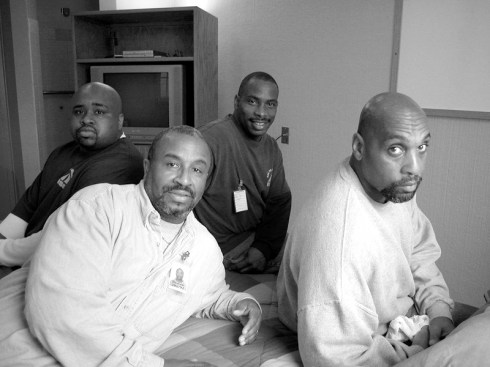
Inmate Hospice Volunteers (Front: Bertram Berkett, Michael Glover Back Row: Michael Williams, Charles Watkins.)
BIOGRAPHY
 Edgar Barens received his Bachelors degree and Masters of Fine Arts in Cinema and Photography from Southern Illinois University, where he concentrated on photography and film production. His body of work includes documentary films, experimental shorts, music videos and public service announcements, which have been screened at film festivals, conferences, broadcast internationally as well as distributed educationally.
You can view all Prison Terminal videos here.
Follow Prison Terminal on Twitter
All images © Edgar Barens

© Richard Ross. Cell of a 15 year old boy on the mental health wing of King County Youth Service Center, Seattle, WA. Many of the children on the wing here are on psychotropic medication. He didn’t leave his house for three years; he hasn’t gone to school in three years. He is locked up because he assaulted his mother and his mother doesn’t want him. Placement will be difficult. The first step will be reconciliation with his mother. Alternatives to Secure Detention (A.S.D). He is under 24-hour observation and checked on every 15 minutes.
“The U.S. Supreme Court hears arguments Tuesday in two homicide cases testing whether it is unconstitutionally cruel and unusual punishment to sentence a 14-year-old to life in prison without the possibility of parole,” says Nina Totenberg (Do Juvenile Killers Deserve To Be Executed) for NPR. “There are currently 79 of these juvenile killers who will die in prison.”
Much of the coverage on JLWOP, an undeniably emotive issue, can be skewed. Totenberg, however, deals with the facts very evenhandedly (as she always does when reporting on the labyrinthine legal SCOTUS cases).
She gets to the heart of the matter, which is to ask ‘Are 14-year-old killers always killers who either can never – or do not deserve – to be rehabilitated?’ Essentially, in the 18 states where JLWOP has been handed down, the law believes that is the case.
It is Bryan Stevenson (whose TED appearance I mentioned last week) that is representing the two boys in this case. He argues that it is cruel and unusual to lock up until death a child who does not have the developmental capacity to appreciate his or her actions nor the ability to fully grasp consequence.
“We’re not saying that juvenile offenders who commit homicide can’t be punished severely,” Stevenson says. “They may even end up spending the rest of their lives in prison. But it’s premature, excessive and unfair to say we know this juvenile will never be rehabilitated.”
The problem is that law prohibits the consideration of an individual’s history or the circumstances of the crime in sentencing.
“Judges can’t consider it. Juries can’t consider it. No one can consider it,” says Stevenson.
Totenberg offers the example of Kuntrell Jackson a 14-year-old who robbed a video store with two others. An employee was shot dead but Jackson was not the gunman. “Under Arkansas’ felony-murder law, Jackson was deemed just as responsible as the triggerman. He was tried as an adult for aggravated murder and, under state law, received a mandatory sentence of life without parole,” explains Totenberg.
Sadhbh Walshe has just written (What JLWOP means: life without parole for kids) about a similar case in Pennsylvania. Robert Holbrook was look out for a drugs deal in which a female was killed.
Also in the Guardian, Ed Pilkington video interviews Quantel Lotts who murdered his step-brother in a fight aged 14 (Jailed for Life at 14: US supreme court to consider juvenile sentences). Lotts is in Missouri.
Pilkington puts it to Lotts that he might be a different person now as a 26-year-old. Lotts characterises his childhood – during which he was told violence solved everything – as a “phase.”
As I said in my last post, retribution cannot be eternal. We cannot justify it and we can only tolerate it if we make it invisible.
I close by repeating the words of an adult I met who had served three decades in prison on a LWOP sentence before winning a governor’s clemency against all odds. He said, “LWOP means you’re dying inside. It’s no different to a death sentence. It IS a death sentence.”

Still from Sentencing the Victim
It is my stated mission to discuss the unprecedented growth, size and activities of the American prison system. I believe that there are better solutions to solving transgressions in our society than warehousing people. I especially believe this with regards to people sentenced to non-violent crimes.
However, prisons should exist for people who are a threat to public safety. I worry that sometimes people may mistake me for an apologist for all criminals. This is not the case.
For heinous crimes – such as rape, kidnap, torture or pre-meditated murder – prison is a fitting punishment.
WOMEN & GIRLS LEAD ONLINE FILM FESTIVAL
As part of Women’s History Month, PBS and Independent Lens – in a series named Women & Girls Lead – are making available (only during the month of March) online films that amplify the voices of women and girls acting as leaders, expand understanding of gender equity, and ‘focus, educate, and connect citizens worldwide in support of the issues facing women and girls.’
There is a vast array of films, some about criminal justice. Me Facing Life is about a 16-year-old sentenced to life for killing a man who picked her up for sex and Troop 1500 is a participatory documentary about, and made by, the daughters of mothers who are serving time for serious crimes, giving them a chance to rebuild their broken bonds.
SENTENCING THE VICTIM
Very different in tone and very difficult to watch, Sentencing the Victim tells the story of Joanna Katz who was gang-raped in 1988. Following the trial of her five attackers, she is required to appear before the North Carolina parole board for each and every parole hearing. The film fluctuates between her account of the ordeal and the repeated visits and legal mantra by parole board members. The inflexibility of a system means the parole hearings of her assailants are not heard at the same time. This difficult process is something Katz and her incredibly supportive and wise parents go through five times as many times as should be reasonably expected.
Katz is now an advocate for all victims of rape and it is a testament to her strength that she produced this film; it is for all our educations. The film was instrumental in streamlining the legal process and lessening the burden on victims.
What I expect of a prison system is that it makes possible for every individual sentenced the opportunity to take full account of their responsibilities. Joanna’s assailants don’t feature in the movie, nor should they given its purpose to roundly describe the victims experience. Violence is a learned behaviour and it can become a disease of communities. It is much easier to continue a life of violence than it is to educate oneself and see the destructive and unforgiving reach of violence for what it is.
Taking responsibility for ones actions is transformative and positive; prisons need to allow the space and the environment for remorse and accountability to surface. Some prison do that and others engender violence further.
To deny liberty to the most predatory of criminals is a reasonable expectation of prisons. But there is too much violence in the world and prisons shouldn’t be incubators of violence. Even for the worst of the worst – especially for the worst of the worst – prisons should be places of self-examination, apology and healing.
ABOUT SENTENCING THE VICTIM
On June 17, 1988, Joanna Katz and another woman were abducted at gunpoint, taken to an abandoned house in Charleston, South Carolina, and brutally raped, beaten and tortured by five men for more than five hours. Sentencing the Victim is the story of how a blood-soaked 19-year-old was able to walk away from her attackers, save her friend from certain death, and continue fighting for the convictions of her assailants — and for the rights of crime victims everywhere.
Under South Carolina law, felons convicted prior to 1996 can eventually be considered for parole every two years. Despite their 30-to-35-year sentences, Katz’s attackers were eligible for parole after serving only a fraction of this time. And in a particularly cruel twist, criminals in South Carolina who participate in a group assault receive separate parole hearings on separate days. Victims who wish to oppose parole for their attackers must subject themselves to an emotionally agonizing experience that must be repeated year after year. In order to ensure that her attackers would remain behind bars, Joanna Katz had to travel more than 100 miles from her home numerous times every year to attend separate parole hearings for each of the men who assaulted her.
The hearings continue until the criminals are either paroled or complete their sentences and are released back into the community. Each hearing reopens old wounds. With each hearing, Katz wonders who was really sentenced: was it her attackers, up for parole after serving a minimal sentence, or was it her, forced to relive her trauma over and over again?
Through April 1st, view the WOMEN & GIRLS LEAD ONLINE FILM FESTIVAL and visit the website.
“THE STUNNING SILENCE”
For every nine people we execute, there is one exoneration.
Bryan Stevenson, founder and Executive Director of the Equal Justice Initiative, makes the point that if one in every ten aeroplanes fell out the sky the entire industry would be shut down overnight.
Why is it we turn a blind eye to unnecessary deaths in the criminal justice system?
“The criminal justice system treats you better if you are rich & guilty than if you are poor & innocent. Wealth, not culpability, shapes outcomes,” says Stevenson.
Why the non-engagement with issues of poverty, racial inequality, disenfranchisement. Why the “stunning silence”?
Stevenson moved hearts and stole the show at this year’s TED conference, one attendee has told me. He lays out some shocking statistics but puts them in a context of optimism, basically saying to the world (and the monied, influential audience) you are party to this ongoing inequality, but you no longer need to deny it.
Stevenson doesn’t say “you”, he says “we” can change it; we can adopt a collective identity that embraces the best and the worst of our society. He warns that living with eyes wide open to injustice and poverty is a much more difficult existence, but – such is his logic, persuasion and truth – the difficulty is one to relish and not one to hide from any longer.
POSTSCRIPT
As I intimated in January, I believe that prison and criminal justice reform is more and more discussed and in the public consciousness. The warmth shown to Stevenson and the receptiveness to his message supports my belief. We can hope that those with money and influence are right behind Stevenson and others of his ilk.
Hat-tip to Suzie Katz of PhotoWings for alerting me to Stevenson’s TED talk.

The Vermont State Police emblem is pictured in this undated handout photo received by Reuters on February 2, 2012 from the Vermont State Police.

Call it petulance, call it resistance, call it subversion, call it opportunism, call it what you want. I’ll call it damn funny.
Vermont prisoners modified the State’s official police insignia, sneaked an image of a pig into the design and saw it printed up on 30 police cruisers that patrolled the roads for a year.
That the amended design went unnoticed for so long is really the story for me. It was finally picked up by a trooper who was inspecting his car while out on the job.
PRISON LABOUR HAPPENS
I suppose the other startling aspect to this story is that it will alert many Americans to the fact that prisoners carry out jobs that we might not expect of an incarcerated class. Most might think it’s foolish to give prisoners even the opportunity to interfere with the emblems of law enforcement, but when it comes to the economics of prison labour, there’s a whole unique logic to be discovered.
I don’t think there’s a license plate in the country that isn’t pressed inside a prison. Each state usually has one prison workshop to punch those out. Prisoners make text books, boots, flags, mattresses, office chairs, floor stripper. They harvest collards and tomatoes, pick almonds and box eggs. In California, the huge Prison Industry Authority (PIA) distributes milk and even produces meat.
Low cost production of goods is practiced in the private as well as public prisons. Depressingly, the ever conniving business lobby-group ALEC have led the loosening of laws to secure cheap prison labor for private business.
May I recommend the article, The Hidden History of ALEC and Prison Labor as a good introduction to the problematic trend and philosophical shift away from rehabilitation and toward profit:
Although a wide variety of goods have long been produced by state and federal prisoners for the US government—license plates are the classic example, with more recent contracts including everything from guided missile parts to the solar panels powering government buildings—prison labor for the private sector was legally barred for years, to avoid unfair competition with private companies. But this has changed thanks to the American Legislative Exchange Council (ALEC), its Prison Industries Act, and a little-known federal program known as PIE (the Prison Industries Enhancement Certification Program). While much has been written about prison labor in the past several years, these forces, which have driven its expansion, remain largely unknown.
If you want to know more about the intersects of business and incarceration, I recommend the book Prison Profiteers, edited by Paul Wright and Tara Herivel.
More on the VT police emblems here. Thanks to Matthew Spencer for the tip.

 Prison Photography