
You are currently browsing the category archive for the ‘Prison Non-Photography’ category.
Some items banned by the Oregon Department of Corrections are understandable, ie, “Weapons or Explosives” and “Escape Device”.
The mail-rooms at all Oregon prisons are instructed to refuse sexually explicit material. Fair enough, you might think (maybe not?) but it is the definitions they provide that make me chuckle. I quote, “Personal Photographs (i.e. individual print or copy or photograph extracted from another source) in which the subject is nude … or exposes any portion of the female breast below the top of the areola.”
Also banned, “Polaroid type photographs with a chemical substance on the back of the photograph.”
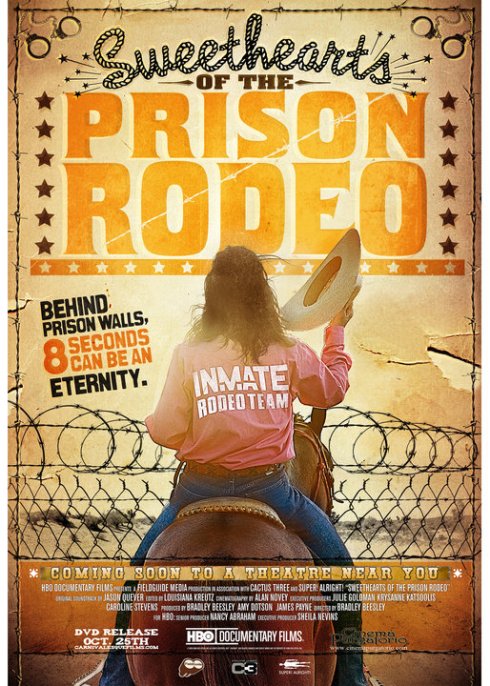
Filmmaker Bradley Beesley and his team admit beginning the project “mostly informed by the cultural lore of prison through film and music such as Cool Hand Luke, Stir Crazy, and Folsom Prison Blues.” That quickly changed. Sweethearts of the Prison Rodeo was released Friday.
I’ve talked about prison rodeos before (Damon Winter, Tim McKulka and Gary Winogrand). The Oklahoma State Penitentiary Rodeo is new to me; didn’t know it existed. It’s the largest “Behind the Walls” rodeo in the US.
From the synopsis, “In 2006, female inmates were allowed to participate in the rodeo for the first time. In a state with the highest female incarceration rate in the country, these women share common experiences such as broken homes, drug abuse and alienation from their children. Since 1940, the Oklahoma State Penitentiary has held an annual ‘Prison Rodeo’. Part Wild West show and part coliseum-esque spectacle, it’s one of the last of its kind – a relic of the American penal system […] Within this strange arena the prisoners become the heroes while the public and guards applaud.”
I was also happy to find a Q&A with three ladies from Sweethearts of the Prison Rodeo at SXSW 2009. They’d been out a year at the time. They are optimistic and they are role models.
Since last year, Sweethearts of the Prison Rodeo has shown around the world and inside prisons.
The self-respect gained by the ladies necessarily tempers my reservations toward prison rodeos. It seems like they’ve genuinely benefited from the activity, but this could have as much to do with the film-making around the activity. The entire package was a program in team building, setting and achieving goals.
The film also has a much needed outreach component:
“We’d like to use this documentary and the stories of the people connected with the film to help recognize the lives of inmates and those re-integrating into society. We’d like to create grassroots dialogue to improve awareness of issues and create opportunities. In addition, Sweethearts of the Prison Rodeo is establishing a Scholarship for inmates attending college while incarcerated.”
Bravo, bravo … I don’t want an encore though. I want the ladies to keep kicking recidivism rates into touch.
Anyone interested in tertiary education in prisons should go to the Higher Education in Prisons: Strategies for Action, a symposium hosted by The Education Justice Project, University of Illinois at Urbana-Champaign.
A very impressive line up of leaders in college level educational programming plan to be there.


© Evan Bissell
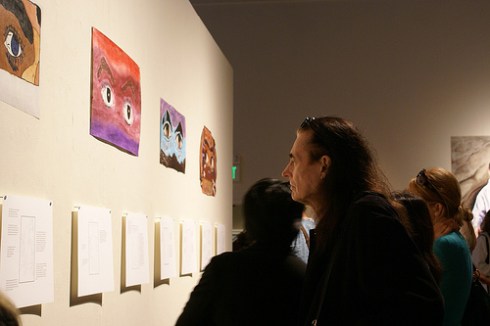
Artist Evan Bissell brought together a group of teens who had not known each other previously, but shared a common circumstance; they were children of men incarcerated at San Francisco County Jail.
The project, What Cannot Be Taken Away: Families and Prisons Project, spanned 9 months.
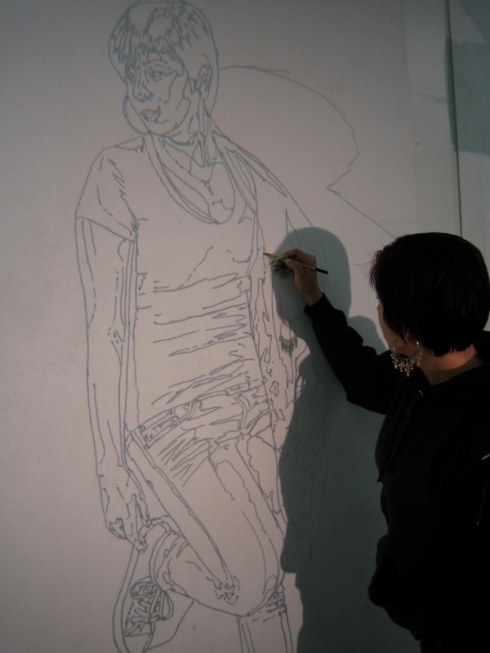
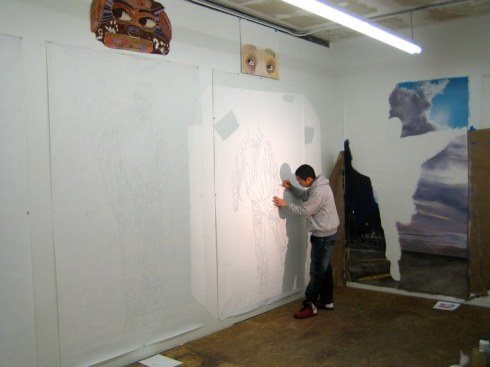
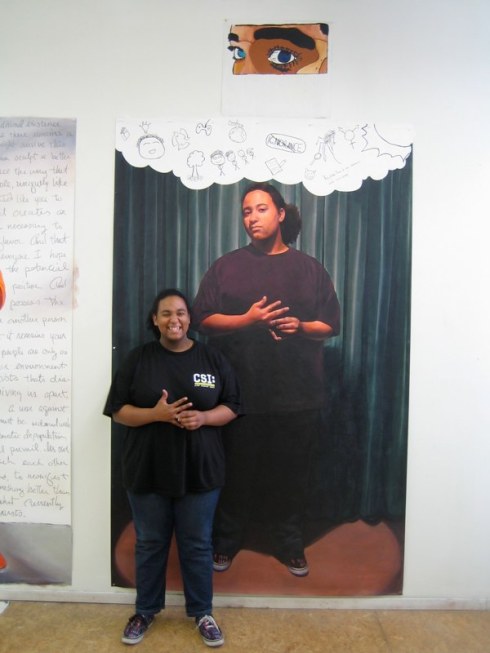
Bissell and the teens shared writings and audio to establish themes for their work. Later they would visit family in SF County Jail and take photographic portraits to work from. Eventual they mounted a show at SOMArts in San Francisco.
I am a little unsure as to the ultimate claim the students have on the final product. Evidently, they decided the elements and the design, but every piece is finished with the polished painting skills of Bissell’s brush. But of course, it wasn’t only these large portraits on view; exploratory/experiential paintings of the students were displayed and the centre-piece of the show was an installation piece.
Despite the apparent dominance by Bissell over the final product, the intangibles of the collaborative project – including but not limited to discussion, new ideas, “healing & justice”, friendship, self esteem – far outweigh a critic’s (my) reserve.
I highly recommend you download the PDF time-line; it offers an impression of the shared politics of the project. Also the process describes the engagement between teacher and student.
PHOTOGRAPHY?
The tie in comes from a quote by Bissell, “I was unfortunately not allowed to photograph our workshops in the jail, so all of the pictures come from our meetings with the youth.”
© Evan Bissell
© Evan Bissell

© SOMArts
© Evan Bissell

© Evan Bissell
© SOMArts

© SOMArts
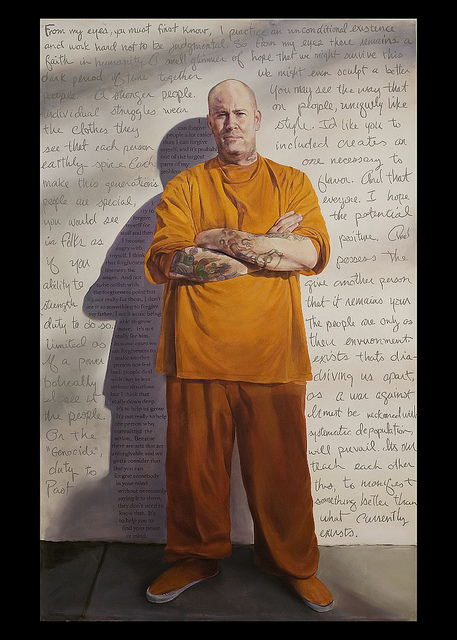
Image credit: Joe, by Evan Bissell, acrylic paint on board. © SOMArts
What Cannot Be Taken Away: Families and Prisons Project. Closing September 19th 12:00-2:00 at SOMArts – 934 Brannan St. in San Francisco (at 8th Street).
All images from Bissell’s WCBTA website and SOMArts Flickr.
This is worrying.
Los Angeles Jail guards at the Pitchess Detention Center, Castiac, CA have a new weapon in their armory. The 7 1/2-foot-tall ‘Assault Intervention Device’ emits an invisible 5-inch-square beam that causes an “unbearable sensation”.

The device is manufactured by Raytheon, an 80 year old multibillion dollar surveillance, radar and missile specialist with a catalogue of space-war technologies. Compared to Raytheon’s sprawling, global and stratospheric innovations, the ‘Assault Intervention Device’ is small, contained and personal.
Cmdr. Bob Osborne of the LA County Sheriff’s Technology Exploration Program, one of several deputies who tested (see video) the ‘Assault Intervention Device’, described the experience, “I equate it to opening an oven door and feeling that blast of hot air, except instead of being all over me, it’s more focused.”
The device – controlled by a joystick & computer monitor and with a 100 foot range – will be mounted near the ceiling in a unit at Pitchess housing about 65 inmates.
NBC Los Angeles reports, “The energy traveling at the speed of light penetrates the skin up to 1/64 of an inch deep. […] ‘Assault Intervention Device’ is being evaluated for a period of six months by the National Institute of Justice for use in jails nationwide.”
The statistics for violence at Pitchess are quite shocking – 257 inmate-on-inmate assaults occurred in the first half of the 2010.
Pitchess, a facility with 3,700 inmates, is a large facility with riots (some very recently) and obviously needs to counter the culture of violence. I just wonder whether shooting brawling inmates with lasers is the right way to go about it?
– – –
I have looked at highly sophisticated technologies before and how their imaging can affect our understanding of prison life, tension, engagement.
How would images of prisoners reeling from a ‘Assault Intervention Device’ laserbeam influence public opinion about this new fan-dangled correctional management tool? The deputies who’ve tested it say it’s unbearable and can only be endured for three seconds maximum, yet everyone knows that tasers are often repeatedly discharged upon stubborn, adrenaline-fuelled (sometimes drugged up) targets.
Again, very worrying.

Always lots of good stuff on MediaStorm and many of the projects from their workshops and training belie the relative “inexperience” of their creators.
Exodus tells the story of Diana Ortiz, 45, who spent over half her life in prison. She says it saved her.
Diana dropped out of high school at 18 to live with a man twice her age. To pay for their drug habit, her boyfriend devised a scheme to lure a man into a secluded Coney Island parking lot and rob him.
In the early hours of August 20, 1983, the robbery veered off-course and two men were shot. One was killed. Though Diana was not at the scene of the shooting, she was sentenced to 17 years to life for her role in the murder.
She served twenty-two and a half years.
While behind bars Diana earned her master’s degree, developed a strong identity and self confidence. She is now an inspiration for other inmates, helping them to rebuild their lives.
This workshop story was inspired by the New York Times story about Diana Ortiz titled Convicted of Murder as Teenager and Paroled at 41. (Which I mentioned here on PP before)
Credits
Photography, audio and video: Laurentiu Diaconu-Colintineanu, Natasha Elkington, Leah Thompson
Producer: Jennifer Redfearn
Executive Producer: Brian Storm
Graphics: Tim Klimowicz
Transcription: Avi Tharoor-Menon

California State Prison, Corcoran. 2006, ink and pencil on paper, 52 x 156 inches.
Not a photographer, but an illustrator.
Within Buddy Bunting‘s Panorama series are five West Coast prison facilities. Prisons pop up in other series such as High Living too.
Bunting, like Sandow Birk and Alex Donis before him uses canny illustration to rifle home the banality of (secure) structures and signs in the mundane US hinterlands. Bunting’s grayscale world is one of malls, excavated hillsides, prisons and abandonment.
These subjects are old and familiar to American artists; artists who have attempted to reconcile their art with the psychology of deserts, gas stations and limitless geographies.
Bunting’s work is brooding, but most disturbingly it stakes out an invisible truth – that being, that post-industrial activities in dislocated rural areas are of sinister and charged ideological purpose.
The celebrated colour photography of Shore, Sternfeld and Eggleston is laconic, seductive and – admittedly – sometimes jarring, but never is it so critical or detached as Bunting’s work. Regarding detachment and the artist’s distance, the claim here that sketching has pushed out the great photographers may seem ludicrous and yet that is how I read Bunting’s very intelligent work.
READ & LISTEN
Jen Graves, the art critic for Seattle’s The Stranger (the best free newspaper in America) wrote this article and conducted this audio interview. Well worth your time!
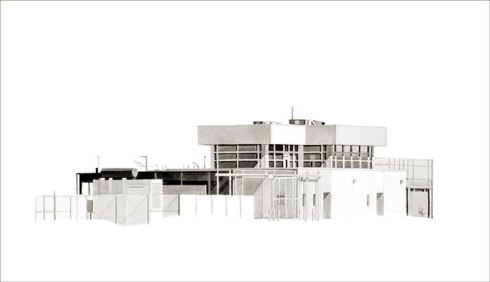
Oregon Gatehouse (its yellow mimicked the shade of rock looming behind as a train went through). 2008, ink and pencil on paper, 30 x 52 inches.
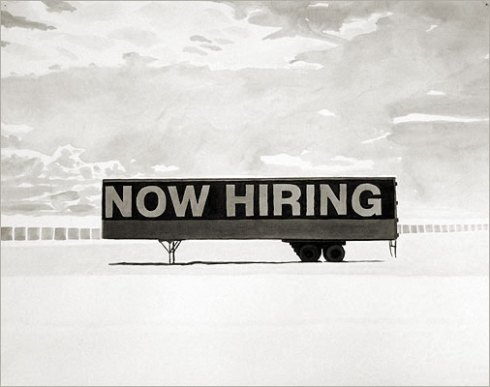
Walmart Distribution Center. 2008, ink and pencil on paper, 20 x 26 inches.
Jon Feinstein (or it might be Grant Willing?) over at Humble Art Foundation blog has been posting the art of serial killers in recent months.
THE DARKEST PHOTOGRAPHY BLOG ON THE CIRCUIT
If you thought serial killer art was as macabre as photography/arts blog could go, you’d be wrong. Every week, I am made to fear for my life because of what HAFNY has posted … and most weeks I find myself wondering “Is that real blood or fake blood?”
Put on your adult diapers and check it out.
ARGHT
“John Wayne Gacy is best known as the “Killer Clown” serial killer who murdered 33 people during the 1970s. While in Prison, Gacy took up painting; his favorite subjects being the Seven Dwarfs, Clowns, and other serial killers. He was executed in 1994 by lethal injection.”

“Ottis Toole was an American serial killer who was charged for three counts of murder, but confessed to four more after being incarcerated.”

“Henry Lee Lucas is an American serial killer who is best known for lying/falsely confessing to upwards of 600 murders. He was sentenced to life in prison after being convicted of 11 murders; he died of heart failure while in prison, so the actual number of crimes committed will never be truly accurate.”


 Prison Photography