
You are currently browsing the category archive for the ‘Prison Non-Photography’ category.
I’d like to feature here two very separate projects. If you’ll allow me, I want to overview Matej Kren’s Book Cell and think of the book literally as a sculptural physical constraint. At the same time, I’d like to introduce Herman Spector’s program of bibliotherapy at San Quentin Prison and frame the book as a pedagogical tool for control.
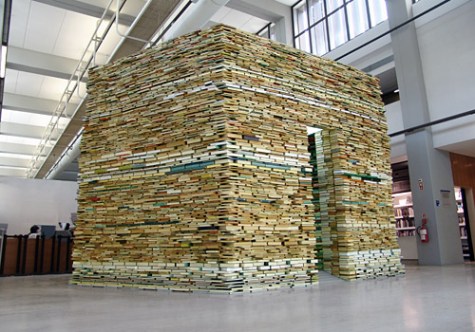
For his 2006 installation of Book Cell at the CAMJAP in Prague, Matej Kren stated:
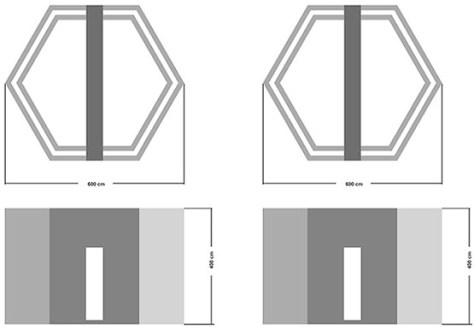
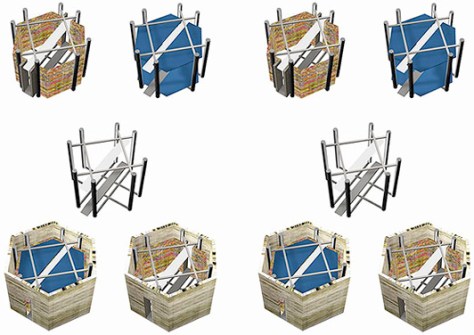
The Book Cell Project repeats the recurring procedure, in the work of this artist, of piling up thousands of books, creating an architectonic structure where we are invited to step inside.
The memory and knowledge accumulated in the books gathered, closed and inaccessible, diverse and precious will be potentially recovered in the end, when all of the books can return to their function of being read, but meanwhile they will have been worked on as sculpting matter and as the spirit of the place where the artist intends to hold us: an hexagonal enclosure with a passage defined by mirrors that assure the vertigo of a fall, the ad infinitum fragmentation, the panic of spatial disorientation characteristic of a virtual infinity.

The fact that these structures are made from the library/archive of the hosting institution makes me shudder. CAMJAP claims a pride in this making the structures site specific.
Prague is a great literary city and the absurdity of being confined by books would be appreciated by Kafka, and yet Krens offers us a way out that Kafka never would. He intends that books return to use and are reborn into cultural thought.
Kren’s literal use of bound knowledge in the fortification of space calls to mind other powerful (if less poetic) uses of books in controlling inmate populations. I’m thinking specifically of Herman Spector’s program of Bibliotherapy at San Quentin State Prison
From 1947 until 1968, Herman Spector was employed as senior librarian at San Quentin. He put in place a meticulous, long-term program offering 7-days-a-week library access and a choice from over 33,000 titles. By the end of his tenure he stated (not estimated, for he knew every book checked out) that 3,096,377 books had circulated through his system. His project drove up prisoner literacy and had inmates reading 98 books/year.
The project sounds nothing but positive and indeed it brought about much self improvement. But, remember this was a grand experiment with a captive audience and Spector had total control over the reading lists – and latterly, the outward correspondence and writing by San Quentin inmates. Spector employed censorship as readily as he conducted reading groups and assigned classic texts.
Five years ago I was fortunate to meet Eric Cummins, whose book The Rise and Fall of California’s Radical Prison Movement details Spector’s manipulations at San Quentin (Chapter Two: Bibliotherapy & Civil Death). It is the most thorough examination of that great experiment. Cummins writes:
‘Books, for Spector, were the “deathless weapons of progress” by which prisoners could be “paroled into the custody of their better selves … by feeding on hallowed thoughts.” And, “The hermitage of a small, dank cell,” Spector wrote, “if provided with books, can yield a rich harvest of sheer delight and practical values.“‘ (Page 26)
‘Though the prison’s official censor was the associate warden for care and treatment, the actual work fell to Spector. Except for mail, which was read in the cell blocks or the mail room, the senior librarian censored all writings by inmates that left the prison and decided what publications would be purchased for the library.‘ (Page 24)

‘Spector stated his own censorship policy as follows: “Those which emphasise morbid or antisocial attitudes, behaviour, or disrespect for religion or government or other undesirable materials are not purchased.” Like most other librarians of the treatment era, Spector gave little thought to the danger of political, class or cultural bias implicit in his prison censorship policies, and he wasted no time worrying that denying prisoners law books might be unfair or even unconstitutional. Books that gave inmates access to the law were to be confiscated at the gates. Books that criticised church or state were seditious.‘ (Pages 25/26)
It wasn’t only reading that was controlled and owned; writing too:
‘The reduced civil status of prisoners was reaffirmed in 1941 in a section of the penal code titled “Civil Death,” penal code 2600-2601. As a consequence of the Civil Death statute, the California Department of Corrections regarded all writing produced by state prisoners as state property, just as a chair or table made in the prison industries belonged to the state.‘ (Page 25)

Almost constantly throughout his tenure, Spector was at odds with the prison administration who were either unable to grasp, or unwilling to endorse, his aggressive methods of control. When Spector left his post over 25 years of meticulous notes and records were destroyed.
Bibliotherapy and censorship, as Cummin’s concludes, ‘separated prisoners from the power of their own words. Even so, the underlying assumptions of bibliotherapy would soon have a tremendous influence on the lives of certain of the brightest of San Quentin’s inmates, for they would take the notion of reform through reading and writin, the foundation of Herman Spector’s faith, as their own first principle … turning the notion of civil death on its head, reconnecting themsleves to the power of words previously denied them.‘ (Pages 31/32)
Conclusion
Spector’s project founded,at San Quentin, a tradition of literacy that would engender the works of Caryl Chessman, Eldridge Cleaver and the expanded political prison writing movement of the 1970’s. In some ways, the approaches of autodidactism and self determination of the Black Panthers began with the obsessive endeavours of the eccentric biblio-evangelist Herman Spector.
The “Prison Movie” belongs to an undefined genre. Everybody has seen a movie that would fall within its flexible parameters of definition, and yet the concept is a little unnerving.
The genre, I believe, is misunderstood and suffers from an overall apathy or misinterpretation of prison realities. ‘Captivity’ – a necessary requisite of prison – has other discomforting associations such as bondage, unequal power relations, psychological violence, abuse & coercion, constant tension, artificial alliances, survival instincts, homosexuality, rape and exploitation to name a few.
Prison movies, because of their (perceived) content are rarely dinner table conversation. To acknowledge a genre is to acknowledge the common problems that arise when one set of humans puts another set of humans in cages.
A prior guest blogger recommended the work of Paul Mason to help me through this quandary. In his excellent introduction to defining the genre, Men, Machines And The Mincer: The Prison Movie, Mason discusses major themes and audience motivations for viewing. Mason sets the tone for discussion with two truisms;
Two dilemmas exist concerning prison movies: first, hardly any research has been undertaken in the area and secondly, there has been little attempt to define the prison movie. Paradoxically, whilst the genre may not be instantly recognisable, there are many prison movies that stick in the memory.
Mason references a multitude of titles including: Brute Force (1947), Riot In Cell Block Eleven (1954), Birdman of Alcatraz (1962), Cool Hand Luke (1962), Papillon (1973), The Mean Machine (1974), Lock Up (1989), Chained Heat (1992), In The Name Of The Father (1994), Murder In The First (1994), A Man For All Seasons, The Count Of Monte Cristo, There Was A Crooked Man, Silent Scream (1990) We’re No Angels (1955), Breakout (1975), Sleepers (1996), The Hoose Gow (1929), Jailhouse Rock (1957), Porridge (1978), Prison Break (1938), Crashout (1955), Breakout (1975), Midnight Express (1978), McVicar (1980), Scum (1983) Lock Up (1989), The Shawshank Redemption (1995), The Loneliness Of The Long Distance Runner (1962), Numbered Men (1930), The Criminal Code (1931), San Quentin (1937), Men Without Souls (1940), Dead Man Walking (1995), The Shawshank Redemption (1995), I Am A Fugitive From a Chain Gang (1932), San Quentin (1937), Wedlock (1990), Two Way Stretch (1960), The Ladies They Talk About (1933), Road Gang (1936), Hell’s Highway (1932), Blackwell’s Island (1939), The Pot Carriers (1962), The Big Doll’s House (1971), The Big Bird Cage (1972), Women In Cages (1972).
Mason elaborates:
The term ‘prison movie’ is both a nebulous and problematic one. It is not a term used in everyday discourse like ‘gangster film’, ‘musical’ or ‘western’ is used and yet most of us would describe Midnight Express, Birdman of Alcatraz and Papillon as ‘prison movies’. Only Querry (1973), Nellis & Hale (1981) and Crowther (1989) have written about the prison movie and none of them attempts to define the genre. It is perhaps the difficulty in definition which explains why so little has been written about the prison film despite over three hundred having been made since 1910.
Mason’s paper was written just over 10 years ago now and if I were to bring the debate up to speed, I’d talk about the many independent documentaries and activist films that have sprouted particularly in response the political landscape of American incarceration since the late nineties – Mr. Big, Up the Ridge, Making the River, Prison Town, Gray Days, In Prison My Whole Life and A Hard Straight are just a few examples.
I’d be eager to hear reader’s favourite, memorable or simply known prison movies.
Bringing us full circle to our medium of choice, this discussion leads me to the difficult task of defining the genre of prison photography which I intend to do in the near future …

Guantanamo © Chris Maluszynski/Agence VU

Guantanamo Map http://www.cubafutour.de/Karte%20Guantanamo%20Provinz.jpg

Guantanamo Bay Tents. Courtesy of The Department of Defense Visual Information Center
I am very happy with the way Prison Photography is progressing. I have done interviews with some outstanding photographers and artists. I have offered opinion where I think there’s something to be said. The most satisfying work on the blog is that contributed by guest bloggers, comment-makers and interviewees. Photographers have contacted me and I have been eager to comment upon their work.
But, there is one audience I never anticipated – The Google Image Search Audience. I get many hits for searches on Guantanamo, Guantanamo video, Iraq prison, Abu Ghraib, Abu Ghraib Images of Prisoners, etc, etc – which is strange because these are topics that many people have grappled over with more proficiency and depth than I am likely to.
It is obvious that there is a need for fast access to images of America’s sites of torture and incarceration, namely Abu Ghraib and Guantanamo. I certainly don’t wish to fuse the two institutional histories so I shall deal only with Guantanamo Bay.
Louie Palu
Walrus Magazine. 8 of Palu’s photographs and accompanying article.
The Atlantic. 6 of Palu’s photographs.
Private galleries. Palu’s Photoshelter profile offers three separate galleries, but they’re password protected. Contact the photographer directly.
NPR Interview. Palu offered insight into his experience and impressions of Guantanamo.
Christopher Sims
Mother Jones. 15 images of daily life outside of the prison complex.
Civilian Arts Project. 25 images of a bizarrely serene Guantanamo Naval Base.
BBC, The Other Side of Guantanamo. Article about Sims’ series.
Daylight Magazine. 4 minute audio of Sims’ experiences on project.
Chris Maluszynski
Agence VU/Moment. Twenty-six images exhibited. Likely more on file at the agency.
Cesar Vera
Guantanamo Prison. 18 Black & White images. 3 Colour.
Joint Task Force (JTF)
Many of the photographs shown in the press over the last few years were taken by members of the Navy’s own Joint Task Force. When press photographers visited the JTF vetted all images before release.
Boston Globe. 30 Hi-Res images.
Repeat of above selection. 20 Hi-Res images selected.
JTF Photo Galleries. 22 months (July 2007 – May 2009). Hundreds of images. Official photography.
Miami Herald
Description of the 8 different camps at Guantanamo
Explanation of the Legal contexts: Key defendants, the judges, the defense and prosecution counsel.
Cursory look at Art influenced by Guantanamo
Magnum
Bruce Gilden. Guantanamo Bay. Enemy Combatant Camps, 2003
Paolo Pellegrin. Guantanamo Detainees, 2006
Stuart Franklin’s work Cuba, 2003, included images from Guantanamo and you’ll need to search the Magnum website for images.
McClatchy
An eight-month McClatchy investigation of the detention system created after the Sept. 11 terrorist attacks has found that the U.S. imprisoned innocent men, subjected them to abuse, stripped them of their legal rights and allowed Islamic militants to turn the prison camp at Guantanamo Bay, Cuba into a school for jihad.
Intro. Text and 11 minute video.
Photos. Detainees held at Guantanamo Bay
Photos. Faces of Guantanamo Detainees. Part one.
Photos. Faces of Guantanamo Detainees. Part two.
Photos. Detainees held in Afghanistan.
Eyeballing
Comprehensive overview of base using Google Maps, official photographs. Details structures, uses and topography of naval base.
Camp America, Camp Delta, Camp V and Administrative & Court building.
Camp X-ray and construction of later detention camps.
Associated Press
Images of facilities and interiors of various detention blocks and camps.
Stars & Stripes “The Independent News Source for the U.S. Military Community”
Work at Guantanamo
Education at Guantanamo
Recreation at Guantanamo
Artistic Turns
David Hicks. Virtual Guantanamo Cell
Penny Byrne. Porcelain Guantanamo Detainee Figurines
Gregor Schneider. 21 Cells, Bondi Beach, Australia
Legofesto. Guantanamo reconfigured with Lego men and Lego pieces and Wired Interview
Flickr – Protest Images
Amnesty International. Guantanamo Protests
Various Photographers. 100 Days to Close Guantanamo and End Torture.
James M. Thorne. Protest images.
Miscellaneous Media
Prisoners of War. 2004 article by the San Francisco Gray Panthers with images of US airforce transporting detainees and early 2003 images of Camp X-Ray.
BBC. Life in a Guantanamo Cell

Rendition. Photographer Unknown
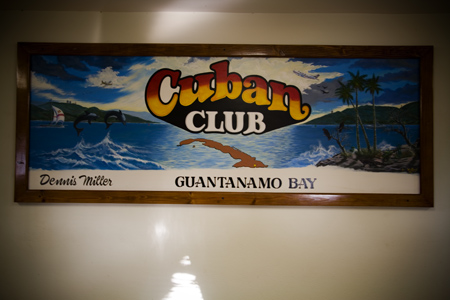
© Cesar Vera

Guantanamo Bay Navel Base with a New Commander-in-Chief. Photographer Unknown. http://www.obamalouverture.com/f39/guantanamo-bay-switch-bush-photo-obama.html

The standard issue of clothing, sleeping mat, food, sandles, canteen, soap, and buckets for detainees of Camp X-Ray is pictured in Camp X-Ray at the U.S. Navy Base at Guantanamo Bay, Cuba, on Wednesday, Feb. 20, 2002. © Tomas van Houtryve/AP Photo
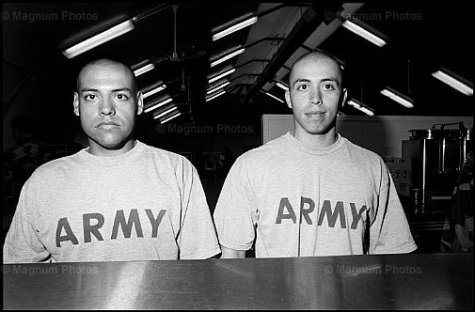
CUBA. Guantanamo Bay. 2003. Soldiers wait for their meals before a prayer breakfast at Camp America. Photo: Bruce Gilden/Magnum
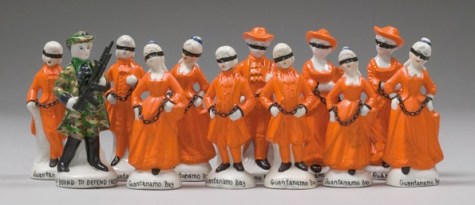
Penny Byrne Guantanamo Bay Souvenirs 2007, vintage figurines, metal chains, epoxy resin, plastic, re-touching medium, powder pigments, 14 x 32 x 10 cm.
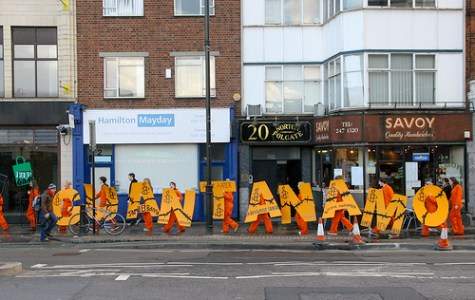
Photo: Jon McClean. http://www.flickr.com/photos/jonmclean/410055117/
IF YOU HAVE ANY RESOURCES TO SUGGEST,
PLEASE CONTACT ME AND I’LL ADD THEM TO THIS LIST.
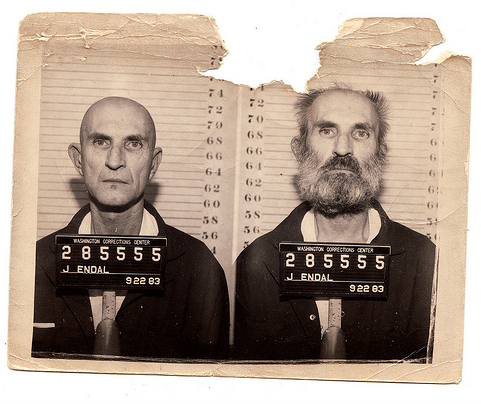
Torn Shorn, Misc. Set. Courtesy of Least Wanted aka Mark Michaelson. http://www.flickr.com/photos/leastwanted/sets/72157605201939008/
Another nod for Blake Andrews. Although not planned, it is welcome, as I think he tries keeps the blogophotosphere fresh, trying new stuff from his hideout in Portland.
Earlier this week I featured Blake’s Brief History of the U.S. Passport Photograph. An artist/collector with hundreds of Passport and ID Photographs, named Least Wanted, followed up with Blake to get the word out on his sprawling collection.
Also earlier this week, I put up a piece about the JUSTICE Art Installation in Bridewell Police Station, London. Coincidentally, one of the artists for the JUSTICE exhibition exhibition was Mark Michaelson, aka Least Wanted. It seems like a small-internet-triangle-of-providence presented itself this morning and it is up to me to draw the hypotenuese …

Head Gear, Misc. Set. Courtesy of Least Wanted aka Mark Michaelson. http://www.flickr.com/photos/leastwanted/sets/72157605201939008/
Least Wanted collects, groups and displays a huge collection of I.D. photos on Flickr. In addition to passport shots, it includes medical photographs, badge I.D. photos and other documentary ephemera. Prison Photography is interested in the majority of the collection: Mugshots.
Least Wanted’s sets are a mad enough curatorial project to keep me going for months. For now, I’ll just echo Blake’s sentiment and point you in the direction of Michaelson’s epic archive.

Austin Old Timer, Misc. Set. Courtesy of Least Wanted aka Mark Michaelson. http://www.flickr.com/photos/leastwanted/sets/72157605201939008/
The three images used in this article were drawn from Least Wanted’s misc. Set
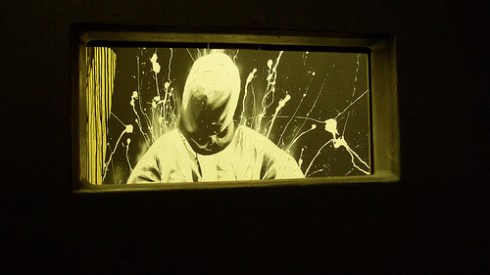
I found this via Wooster Collective who provide good daily visual feeds.
Info from the JUSTICE Flickr set. All images from JUSTICE Flickr set.
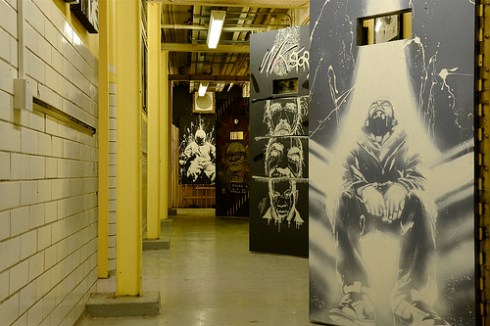
JUSTICE, a concept show based on themes of Law and Order, is the hard endeavours of 5 artists; C215, Dan23, Bruno Leyval, Least Wanted and MC1984.
Traveling to Bristol from France and New York to build JUSTICE, featuring site specific installations, photography, prints, stencils and a range of new original work.
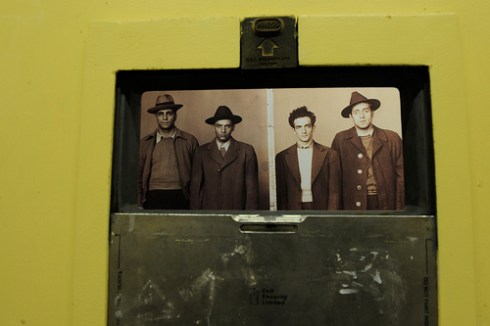
All the artists have a strong collective interest in the plights of minority cultures, human rights, freedom, homelessness and the vacuous subject of law and order, and Justice will display the combined aesthetic of these interests placed within the oppressive environment of Bridewell Police Station’s cells.

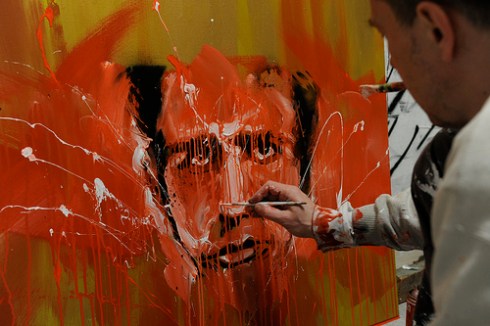
As well as the Old Bridewell Police Cells, the show was at The Long Arm Gallery, Bridewell Street, Bristol, BS1 3PY.
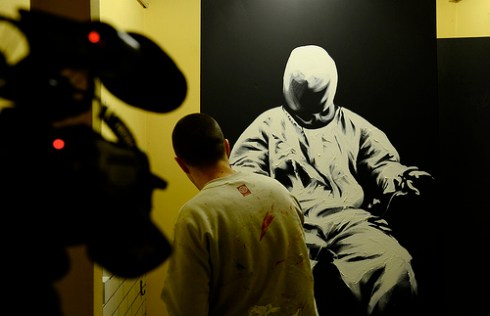


US Soldiers in a Mosul Internet Cafe. Photo Credit: Andy HoboTraveler.com World Travels. http://www.hobotraveler.com/120mosul03.shtml
Last week, BLDGBLOG published How The Other Half Writes: In Defence of Twitter. It slammed Margaret Dowd’s “brain-dead editorial” in which she pouted like an adolescent instead of actually interviewing Twitter founders, Stone and Williams.
In Defense of Twitter was vitriolic and robust in its argument. Geoff usually sticks to urban-tectonics, mobile architecture and Los Angeles, so it was unusual to see him drop down to the base debate over whether Twitter is good or not. Alas, he dropped in and closed the debate.
Geoff’s argument was that Twitter is essentially a note taking application, and we shouldn’t crap ourselves just because the post-its are seen by the world.
Paul Carr’s article in the Guardian today suggested Twitter can take care of itself anyway. Twitter and other webomediasphere-folk have been brought in to consult on the loose ends and cable ends of a frayed Iraq. Carr exhorts
“I am not making this up. The department has just airlifted Twitter’s Jack Dorsey along with representatives from WordPress, Meetup.com, YouTube and Google into Baghdad to discuss how social media can help build Iraq 2.0″
Carr’s article runs at the same time the New York Times picks up on the story.
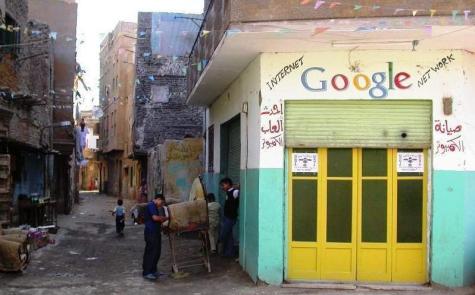
Internet Cafe in Baghdad. Photo Credit: BlogIraq (died April 2008). http://www.blogiraq.info/2007/02/22/at-last-google-opens-and-office-in-baghdad/
The US military’s partnership with non-military groups/corporations takes me back to a presentation made in 2005 (the pre-Obama era). Thomas Barnett bleated about the failings of the Iraq (mainly the “six months of dicking around” after Saddam was toppled). He relates all of this to the US military’s ongoing deficiencies since the end of the cold war. The American army can annihilate any chosen subject but it has not paid much attention to post-major-operations rebuilding. Iraq is a sorry testament to that fact. Barnett suggested a flood of 250,000 “administrators” into Iraq in April 2003 would have stabilised the country a lot quicker.
It seems the US military is now calling upon Twitter and others as “post-war administrators” infrastructure builders, vacuum fillers – whatever you want to call them – as described by Barnett. What should one make of this? Why shouldn’t Twitter et al. be working to improve the long term prospects of Iraq? The US military is great at shock, awe, power and might, but not building community. Barnett prefers his soldiers “young, male, unmarried and slightly pissed off”. But he insists the military personnel be followed up by a flood of partners who facilitate the the rebuilding of infrastructure. A 19 year old marine cannot carry out both distinct functions/philosophies of war.
I don’t like Barnett’s tone. I like his honesty about the realities of military combat, but not his pompous humour. Barnett takes on many groups; multiple government agencies, the UN, TSA, and not least liberals who squirm uncomfortably to pussy jokes. But just because he takes on the military – just because we share opposition to the Iraq war – does not makes us allies in thought. Barnett wants to make military better and ultimately a more efficient killing machine.
Military Icons for PC
It is perhaps this quote by Barnett describing the relationship of military and non-military responsibilities through hypothetical steps of entering, winning and closing warfare, that positions Twitter best. Twitter is part of the second group.
“The first group takes down networks, the second group puts them up. You’ve got to wage war here, in such a way to facilitate that [second group reconstruction activities]. “
Again, what should one make of this? Everyone knows about Halliburton, because of Cheney’s associations. Are Twitter and its do-no-evil web 2.0 pioneers any different to the tens of thousands of other corporate interests in Iraq?
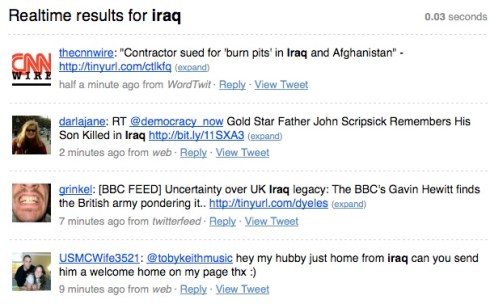
Screenshot of "Iraq" Search on Twitter. April 28th 2009
On Thursday, 28th May, photographs of prison conditions and detainee custody from six facilities other than Abu Ghraib will be released to the public.
Reports over the weekend suggested a figure of 44, but the Guardian has stated over 2,000 photographs are to be made public. Images of Bagram Air base in Afghanistan are included in the cache. Critics will surely scan for similarities in detention/torture methods used in Afghanistan as in Iraq to argue against the ‘few bad apples’ logic that railroaded earlier attempts to bring military and government commanding authorities to full-accountability.

ACLU’s advocacy deserves international acclaim. Not only have they forced the release of photographic evidence they won a ruling to prevent the destruction of audio tapes that record torture scenarios.
This is an interesting counterpoint. I presume we all assume we’ll see the images in the printed press. Would we expect the tapes to play on our televisions and radios? That scenario makes me uncomfortable.
Continuing with issues of format, it will be interesting to see how the media presents the-soon-to-be-released photographic documents in contrast to the recent torture memo’s. WoWoWoW set the bar low with the tabloid inquiry “How Bad Will They Be?” and the Los Angeles Times allays fears with a dead-pan assessment, “examined by Air Force and Army criminal investigators, are apparently not as shocking as those taken at Abu Ghraib.
No doubt these images will be contested and a ‘Meaning-War’ over the images will ensue, but I think people for and against the Bush administration’s interrogation policies are not going to change their position now – whatever the evidence.”
But, I guess it depends who’s looking.

Lefties want more weaponry in the push for prosecution of Bush and his cronies for war crimes. The right is debilitated and otherwise occupied by the economy, stocking guns before the “Obama-ban” and the latest Meghan McCain slur.
Politicians from both parties seem to want this to go away, snarking on about how the release of yet more Un-American activities will only fuel the burning hate toward the US. This position is an insult.
Did Bush care what Iraqi’s would think when he bombed them out of house and home? Did Bush care to think how American’s would react in the face of diminished civil liberties? Yet here, politicians of both parties are scrambling to avoid the negative reactions of entrenched, fundamental opponents INSTEAD of anticipating the beneficial good-will and return to mutual trust provided by honest disclosures of a transparent and constitutional government. Why cover-up a cover-up?
Maybe, the Democrats are shy to see these documents because they may implicate their top brass?

One concern I will air, is that all this could move toward some bizarre show-trial scenario, where lawyers bargain, Bush is spared, the American public settle for a conviction of Cheney, and careers and reputations lie in waste on both sides of the aisle!?!
I certainly didn’t expect the incriminating documents to flood as they have in recent weeks. I have no idea how all this is going to shake down. Obama doesn’t seem to have control of this. That doesn’t bother me. No-one can hold back the truth.
So, as wise at it’d be to remember the date, 28th May, you should bear in mind the photographs of abuse could well leak earlier…
________________________________________________
First Image lifted from Gerry May. http://www.gerrymay.com/?p=1426
Cartoon courtesy of the Nation. http://www.thenation.com/doc/20050307/duzyj
Final Image by Takomabibelot. http://www.flickr.com/photos/takomabibelot/2090273618/
If an individual and the law don’t agree to the point the individual is imprisoned, one hopes lawful imprisonment changes the individual, right? For the better, right?
Unfortunately, American prisons have proved the opposite of rehabilitative or hopeful of positive change. Recidivism rates in America are between 60% and 68% (depending on the source).
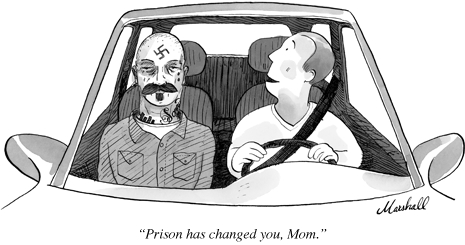
"Prison has changed you, Mom" © 2009 Marshall for the New Yorker
Spurred possibly by the fiscal-driven prisoner releases across the nation, Marshall penciled this pearl.
Some of the best comedy is simultaneously tragedy. The truth is America’s prison archipelago has bruised the lives of the current 2.2 million prison population, the lives of family members AND our lives and communities. Inmates returning to society haven’t been suitably prepared or shown new paths. Change has been for the worse in majority of cases.
I was astonished to read this AlertNet article. It excavates the background to Lovelle Mixon’s massacre in Oakland that killed four people.
I cannot agree with the article’s logic 100%. It would be a sad day if I ever presumed the individual totally powerless and unable to act upon non-violent decisions, but as the author writes:
“Though Mixon’s killing spree is a horrible aberration, his plight as an unemployed ex-felon isn’t. There are tens of thousands like him on America’s streets. In 2007, the National Institute of Justice found that 60 percent of ex-felon offenders remain unemployed a year after their release.”
It is not easy to resist the urge to think of mass-murderous crimes as the singular actions of an individual.
I appreciate Earl Ofari Hutchinson‘s article because it brings together the many invisible and minor trials in life that collectively make daily stress unbearable. I finished the article amazed that there are fewer desperate crimes akin to Mixon’s. An uncomfortable thought.
Again, Hutchinson reminds us that the problems of incarceration, recidivism, education, unemployment and crime are inseparable:
Washington, D.C. is a near textbook example of that. Nearly 3,000 former prisoners are released and return to the district each year. Most fit the standard ex-felon profile. They are poor, with limited education and job skills, and come from broken or dysfunctional homes. Researchers again found that the single biggest factor that pushed them back to the streets, crime, violence and, inevitably, repeat incarceration was their failure to find work.
Q. Why do we warehouse people, break them, and then return them to society in a poorer position to cope?
A. Punitive and immovable laws, collective arrogance & utter denial.
With an estimated 600,000 prisoners either released or due for release in 2009, it’s about time we make a small change in our accomodations – especially given the size of change we expect of former prisoners.

 Prison Photography
