
You are currently browsing the category archive for the ‘Visual Feeds’ category.
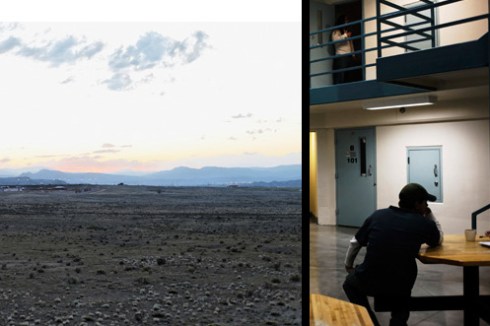
Prison Valley, a documentary by David Dufresne & Philippe Brault, is a haunting view of a one of America’s greatest distopias.
From the introduction: “Welcome to Cañon City, Colorado. A prison town where even those living on the outside live on the inside. A journey into what the future might hold.”
16% of the Cañon City population is inside prison; it is an economy based almost entirely upon incarceration.
Cañon City has a population of 36,000 and 13 prisons, one of which is Supermax, the new ‘Alcatraz’ of America. The new Supermax was described by former warden, Robert Hood, as “a clean version of hell.”
The introduction to the documentary can be a little off-putting at first. The dramatic voice-over deals in emotive-speak and apparent hyperbole. But then you realise that the presentation is not an exaggeration – that the voice-overs are only shocking because of the underlying immutable facts.
Perhaps, as outsiders, French filmmakers Dufresne & Brault are the perfect artists to bring focus upon the most forsaken branch of America’s prison industrial complex?
WEB DISTRIBUTION
As well as taking on old(ish) prison subject matter in a new way, Prison Valley is purposefully designed as a web based project and “Web Documentary”. To view the film beyond its introduction you must sign in with either your Twitter or Facebook social network accounts.
Once signed in the website will bounce you between a mixture of multimedia, interviews, photo-galleries, non-sequitur video clips and auxiliary documents.
The documentary canvases opinion from various characters who the filmmakers meet along the way. The entire project is punctuated with the use of DVD-special-featuresque snippets. You can even attend a memorial ceremony for dead correctional officers.
BLOG
Prison Valley blog here.
PART FIFTEEN IN A SERIES OF POSTS DISCUSSING PHOTOGRAPHERS’ ACTIONS AND RESPONSES TO THE KILLING OF FABIENNE CHERISMA IN PORT-AU-PRINCE, HAITI ON THE 19TH JANUARY 2010.
The aftermath of the Haiti earthquake was zealously covered by the media and American networks particularly.
Several factors likely fed the saturation of disaster over the wires – Haiti’s geographic proximity; Haiti’s diaspora and cultural ties within the US; fresh memories of the controversial, US-backed coup and removal of Jean-Bertrand Aristide; and collective guilt over (or, alternatively, the collective amnesia of) the US’ corporate involvement in Haiti.
The US was going in full-yield again.

The lifeless body of fifteen-year-old Fabienne Cherisma lies on the roof of a fallen building in downtown Port-au-Prince while looters file down the street on January 19, 2010. The young girl was carrying three ornamental mirrors when she was hit by a random shot from Haitian police as she walked with looters on the street. Photo by Lucas Oleniuk / Toronto Star.
WHY ONE IMAGE?
The still Fabienne Cherisma surrounded by the bustle of opportunists jolted me from my image-stupor for long enough to realise it was time to voluntarily step off the media-photo-treadmill and pay attention to a single image, a single person, a single story.
It occurred to me that this was barely a risk. If the majority of the imagery had stopped informing then I really had nothing to lose by redirecting my energies and time elsewhere.
(Please, don’t misunderstand me: I appreciate the purpose for a lot of media images, and I believe that they deliver immediate messages which catalyse reaction, donations and aid. That said, emoting a response in an audience is a distinct function to that of informing an audience.)
WHY FABIENNE?
In all honesty, I may have never have seen that image and with that in mind, I may have paid particular attention to another single victim of the earthquake. Chance? Compulsion? My “small contribution”? I don’t know. I don’t want to minimise my analysis of Fabeinne Cherisma’s death in photographs, but nor do I know exactly what it is yet …
Now, after some time, two unique things about the image of the dead Fabienne Cherisma still stand out.
In other pictures bodies were either buried, dusted, pulverised or piled high with other corpses. If they lay in the streets they were circled by onlookers. Fabienne’s body was isolated. Secondly, unlike 230,000 of her compatriots, it wasn’t the violent instability of concrete in the physical environment that killed Fabienne, it was the violent fallibility of human decision making that killed her; a bullet, from a gun, in a hand.
MAN-MADE NATURAL DISASTER
It has been said that no natural disaster is simply that, but that every disaster comprises natural and man-made factors. Man-made corruption, political instability and resultant poverty led to inadequate (if any) building codes. Just as human decisions prior to the quake cost lives, so they would after the quake.
The rainy season is about to begin in Haiti and the quality of aid, community solidarity, flood and disease abatement measures will determine how many people succumb to this second wave of elemental assault.
Fabienne, to me, was one of the first victims to fall to poor human decision-making following the earthquake. Others have perished since and unfortunately, thousands more are likely to die. (I read an estimated 5,000 people may die in the predicted mudslides, but I don’t know on which this is based – the cold calculation makes me quite uncomfortable).
Fabienne’s death was not in the earthquake but in its aftermath.
VISUAL FORENSICS
The day after seeing Garcia Rawlin‘s photograph for Reuters, I found a virtually identical image by Jan Grarup, except Fabienne’s body was positioned differently. Suddenly, time and timing was brought to bear upon Fabienne’s demise. Two photographers. Soon after, I saw the work of Olivier Laban-Mattei, whose photographs followed the family down the street as they carried the body. Three photographers.
Once I had launched my inquiry, the full picture developed quickly. An interview with Michael Mullady. Four photographers. Shortly after, Edward Linsmier discussed his experiences at the same locations. He was with Nathan Weber. Six photographers.
At this point I was already in contact with Grarup and Mullady. Garcia-Rawlins and Laban-Mattei did not respond to inquiries and have not until this day (I cannot be certain they received my inquiries). Grarup’s response mentioned Paul Hansen and Jan Dago. Eight photographers.
( Jan Dago did not respond to my inquiries. His images of Fabienne are here and this slideshow references looting in its title but actually has little of visual evidence to contribute to my inquiry.)
Hansen was also accompanied by Michael Winarski, US correspondent for Dagens Nyheter. Eight photographers, one reporter.
The next photojournalist to surface was James Oatway. Ten journalists – nine photographers, one reporter. Oatway mentioned Alon Skuy, who in turn mentioned the delayed arrival of Felix Dlangamandla upon the scene. Eleven photographers.
Meanwhile, I stumbled upon Nick Kozak‘s work and upon contacting him learnt of two other Canadian photographers present – Lucas Oleniuk and Matt Levitch (Tranbleman De Te). Fourteen photographers.
Soon thereafter, a reader alerted me to Frederic Sautereau‘s portfolio containing graphic images of disorder, skirmishes, police and Fabienne’s corpse. Fifteen photographers.
CONCLUSIONS
1.) There may well have been more photographers on the scene. It wouldn’t surprise me to learn so.
2.) A couple of photographers mentioned giving others space and trying not to get in others’ shots and avoiding getting photographers in their frames. Why? If a situation is chaotic and journalists are part of that chaos, what does it matter if photographers or journalists are in the scene?

Jan Grarup photographs police beating a looter in downtown Port-au-Prince Tuesday afternoon. © Lucas Oleniuk/Toronto Star.

Tuesday, January 19th. Photo: Jan Grarup/NOOR Images
As a small step, this mutual refusal to depict fellow professionals in the field, can be understood as the first step toward a manipulated in front of a distant audience.
The erasure of fellow media from a scene is a paradox. Journalists are required to record events as they are, but if a photographer depicts them as if he or she is working in isolation – as if from a unique one-off viewpoint – then what is delivered is not an objective, neutral description but a construction.
3.) I am not criticising the photographers who have kindly given their time, thoughts and (often) emotions to this inquiry, but I am questioning the decisions at the photodesks of mass media. I usually only see images that implicate media/photographers when the story becomes about them, when they get injured or kidnapped. Photojournalists are either the directors of a scene or the embattled hero of a scene; they are never bit-part players.
4.) I am convinced, CONVINCED, that enough evidence exists in the digital files of these fifteen photographers to identify and prosecute the policeman who fired the fatal shot.

© Alon Skuy
– – –
ALSO IN THE ‘PHOTOGRAPHING FABIENNE’ SERIES
Part One: Fabienne Cherisma (Initial inquiries, Jan Grarup, Olivier Laban Mattei)
Part Two: More on Fabienne Cherisma (Carlos Garcia Rawlins)
Part Three: Furthermore on Fabienne Cherisma (Michael Mullady)
Part Four: Yet more on Fabienne Cherisma (Linsmier, Nathan Weber)
Part Five: Interview with Edward Linsmier
Part Six: Interview with Jan Grarup
Part Seven: Interview with Paul Hansen
Part Eight: Interview with Michael Winiarski
Part Nine: Interview with Nathan Weber
Part Ten: Interview with James Oatway
Part Eleven: Interview with Nick Kozak
Part Twelve: Two Months On (Winiarski/Hansen)
Reporter Rory Carroll Clarifies Some Details
Part Fourteen: Interview with Alon Skuy
Part Sixteen: Fabienne Cherisma’s Corpse Features at Perpignan (Frederic Sautereau)
Part Seventeen: Brouhaha in Sweden following Award to Paul Hansen for his Image of Fabienne Cherisma (Paul Hansen, Olivier Laban Mattei, James Oatway)
Part Eighteen: A Photo of Fabienne Cherisma by Another Photographer Wins Another Award (Lucas Oleniuk)
Sometimes the name of this weblog-journal means that I simply cannot overlook certain stories or acts of publishing.

@ Tim Dirven / Panos Pictures
In the past couple of hours, the Guardian website ran a nine image Guantanamo photo-gallery. The gallery launches from the largest and most prominent rectangle of the new Guardian redesign, i.e. it is the top story on the home page.
I can only assume that this is an editorial decision to keep Guantanamo in people’s minds? After all. we’ve been distracted by healthcare reform in the US, the chancellor’s TV debate in the UK, Israeli obstinacy in the Middle East and a new guise of terrorism in Russia for which our numbed minds must recalibrate.
I can only assume this is the Guardian’s decision because the essay is totally non-descriptive – in that it is nothing new. We know there are Uighurs, Chinese separatists, who shouldn’t be there; we know they play soccer in cages, we know there are well-cushioned shackles bolted to pristine concrete floors; and we know detainees on hunger strike are force-fed Ensure by tube.
All I want to say is that you should look elsewhere for Guantanamo imagery. My Guantanamo: Directory of Photographic and Visual Resources is a good place to start.
I’ve also provided the previous insights which go beyond Dirven’s nine illustrative images:
Suicide at Guantanamo?
Justice Denied: Voices of Guantanamo
Bruce Gilden once went to Guantanamo
Interview: “Jane Smith” Former Gitmo Guard
Paula Bronstein: Guantanamo Detainees Young and Old
“There is a lot of long lens imagery of Guantanamo prisoners in their orange boiler suits, but I don’t know what that’s telling me.”
A Dozen Visits to Guantanamo
‘Guantanamo’ by Paolo Pellegrin
Guantanamo Photo Essay
– – –
None of this reflects on Tim Dirven. Dirven is a good photographer and photojournalist (check out his work on Orthodox Christians in Ethiopia).
It’s simply impossible to produce a novel photo-essay when the Joint Task Force of Guantanamo walks you around the camp … and they do it every week … with different journalists.
The US military’s media detail is as well-drilled as any other detail at Guantanamo. In fact, I’d go as far to say that the media-liaisons are, at this point, the most critical employees on the base.

READ THIS: Anna Pickard’s review of Gaga’s latest production-laden video says it all. Pickard uses screenshots and the driest of commentary.
“Lady Gaga has out-sexied the entire world and for this crime she’s landed in a semi-nudist jail. Luckily she has a well-known brand of mobile, and her friend Beyoncé, on hand to help,” says Pickard.
“In minute four this happens, Gaga touching herself, wrapped in police tape in a medium to maximum security prison … and that’s intercut with pics of her planning her escape with the help of some really high-profile product placements.”
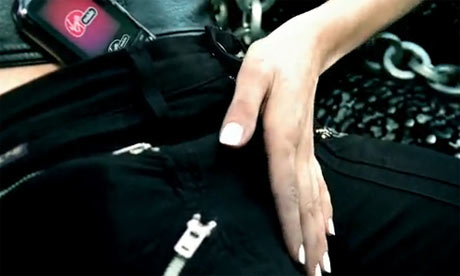
PRISON PHONES
Apart from the ridiculous fetishistic portrayal of jail, the violent skirmish greeted with laughs and the sell-out crotch-rub, the most offensive thing about the video is Gaga’s frustration at the phone line breaking-up.
Families across the United States have been fighting legal battles to break up the monopoly and racket that is prison telephone contracts. You can sign a petition here against MCI/Global Tel Link.
Unfortunately, many lawsuits have fallen away, but as the New York Times reported last November the public attention of lawsuits has brought about significant reform and lowered prices in a “terribly unfair system.”
I’m not saying that prison or jail inmates and families would necessarily be offended by a multimillion-dollar-pop-thing using a failing jail payphone as a prop for her next breast-thrusting million, I am saying that I am.

PRISONS IN MUSIC VIDEOS
This is not the first time I’ve been confused with popstars appropriating prisons for their music videos. Michael Jackson put on the full crotch-grabbing show in a prison chow-hall for his video They Don’t Really Care About Us.

Qamar Jan,18, an Afghan refugee from Peshawar poses at the Ali Medical clinic in Islamabad, June 14, 2007. © Paula Bronstein
In my last post, I suggested the repetition of subject matter in photography is inevitable.
Equally, I’d like to stress that our constant exposure to (predominantly web-based) imagery may likely result in more frequent associations and recall (partial, total, overlapping) between photographers and their works.
Here, I’d like to argue that the gravity of some photography – or rather the gravity of the story it bears witness to – means that ultimately the name of the photographer is inconsequential.
MOTIF, MEME, PERSISTENT THEME
In my last post, I also challenged the notion of plagiarism and inserted the notion of ‘meme’. I was hasty. I used the term ‘meme‘ because meme evolution within host populations can occur without any awareness of said host population; I wanted to infer that repetition, mimicry, copying, mirroring mustn’t always be accorded a conscious origin. Conscious origin is precedent, is ownership, is lawsuit. And I want to live in a world where not everything is subject to ownership and contest.
That said, I want to back-track on the term ‘meme’. Meme is more appropriate for discussing larger shifts, whereas I am really discussing trends. Instead of ‘meme’ I’d prefer to use the term ‘persistent theme’.
FINE ART vs PHOTOJOURNALISM
In Burdeny’s work, the use of a persistent theme (including the minutiae of another artists’ motifs, style) just looks bad. Simply, Burdeny is a prat, but if you want to get uppity you’d argue he has debased artistic notions of respect, brevity and creative integrity.
In the light of Burdeny’s antics (1, 2, 3, 4, 5 & 6), any number criticisms are understandable BUT would anyone level criticisms at photographers in journalism repeating the work of others if it that work pertained to a story that perhaps has not been told enough?

Memona Karachi. 20 years old. Over 30 operations. Attacked by a boy on her way to school. © Izabella Demavlys
ACID ATTACKS: A CRUDE CRIME OF MODERN TIMES
Shouldn’t ‘persistent themes’ in the photography of journalism be judged on different criteria?
Joerg’s post on Izabella Demavlys today recalled the work of Paula Bronstein, Q. Sakamaki, Diego Ibarra, Katherine Kiviat and Emilio Morenatti. (Stan was impassioned by Morenatti’s work recently)
An acid attack is a heinous crime, but made all the worse by lack of awareness, empathy or rehabilitative service. Of course, photography plays second-fiddle to medical intervention in the aftermath of acid attacks, but that is not to say it can’t play its part.
Or are these portraits exploitative? Personally, I don’t think they are. The recurring ‘exploitation’ argument doesn’t develop a discussion – it merely demands you accept or decline the notion of ever-unequal power relations between the operator and subject of a camera. It becomes a discussion about photography and not about the reason the photographer and subject shared a space in the first place.
Personally, again, I don’t think we understand enough about the motives or consequences of these types of brutal attack, and I think portraiture and caption have their role in informing interested parties.
Fortunately, the reports alongside these images describe accessible medical treatment for victims (one woman has had 30 surgeries). More than physical healing though, many of the women have a resolve and psychological determination beyond words. (Read Nick Kristof’s NYT article).

A victim of acid attack stays in the hospital of the Acid Survivors' Foundation. In 2002 Bangladesh introduced very tough laws to try to stop acid throwing, including the death penalty in the most serious cases. However, acid attack is still common in the country -- more than 260 cases in 2005, since "The law is just like a dead law," according to Salma Ali of the Bangladesh National Women Lawyers' Association. Dhaka, Bangladesh, July 12 2006. © Q. Sakamaki
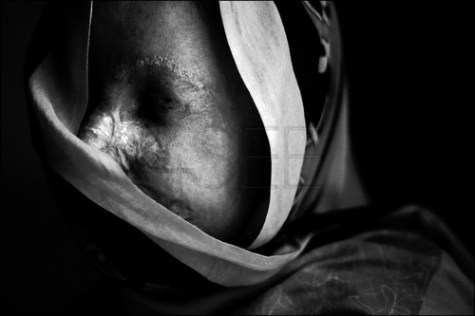
© Diego Ibarra. Portrait of a woman attacked by acid. The consequences of the attacks are for life. Islamabad. Pakistan, May 2009
Saira Liaquat
Both Kiviat and Morenatti photographed Saira Liaquat in the space of a year (the captions for her age must be inaccurate) but opprobrium will never be dealt Kiviat or Morenatti for their repetition.
Saira bears witness to her injustice and both photojournalists help her advocate.
Saira’s name and her story matter, the photographers names really don’t.

Saira Liaquat, 22 yrs, burn victim and survivor, holding an old photograph of herself before she was burned with acid by her husband. Photographed at Saira's parents' home in Lahore, Pakistan on February 7, 2009. Saira is presently working as beautician at the Depilex beauty salon in Lahore, Pakistan. There are presently over 300 cases of burn victims registered in Pakistan. Most victims are between the ages of 14 - 25 years old. Motives vary, but are most frequently obsession, jealousy, suspected infidelity, husband wanting to re-marry, sexual non-cooperation. The face and genitalia are the areas most generally targeted, those guaranteeing complete disfiguration. © Katherine Kiviat/Redux

Green has strong emotional correspondence with safety. Green is the most restful color for the human eye; it can improve vision. Green suggests stability and endurance. Green is used to indicate safety when advertising drugs and medical products. Dull, darker green is commonly associated with money, the financial world, banking, and Wall Street. Dark green is associated with, greed, and jealousy. Aqua green is associated with emotional healing and protection.
Source
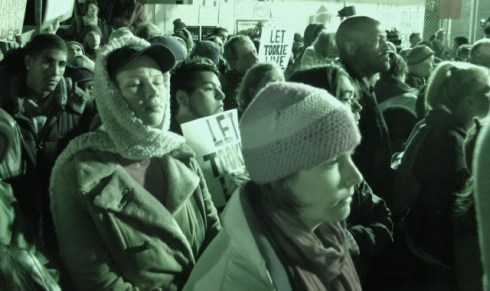
I was looking over the following images of the protest/vigil outside San Quentin Prison on the night of Stanley ‘Tookie’ Williams’ murder by the state of California.
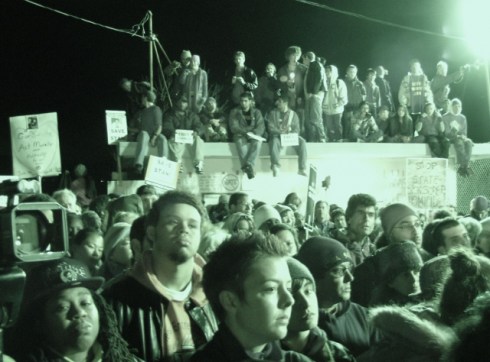

The verdant tones of green dominate and they reminded me – like some ironic twist of a krypto-knife – of California’s death-chamber itself. San Quentin has since constructed itself a new fan-dangled killing suite … and it needed to. The Golden State had taken to injecting people with poison within its old hexagonal gas chamber.
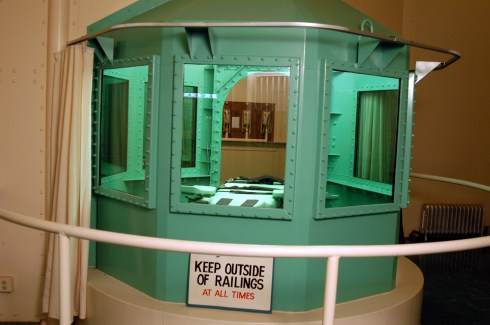
The site became an insult to the escalating industry of death, out of sync with the newest sterile modes of person-erasure. The heavy air-locked lantern no longer suitable for the clinical 21st century methods of snuff so developed by scientists, physicians and judges.

The pea green pod that transports, transforms and accelerates passage to elsewheres; An echo of an echo-death-chamber..

One switch, one injection, one mistake, one outcome.
Two switches, two injections, two mistakes (original crime vs. retaliatory murder), two outcomes (original verdict vs. appeals all boiled in a single decision-cauldron).

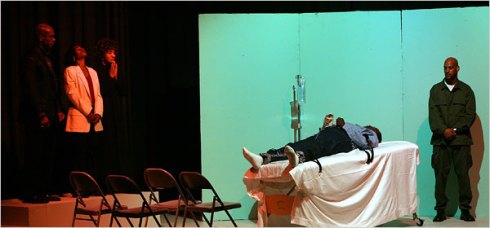
A theatre reenactment. Perfect palette.
Source
Back in San Quentin, the gurney straps itself to itself.

Source
As a ten year old, I remember the same night time visions of green tinted destruction. John Major was in power and war seemed just.
I’ve seen them again recently …
Different century, same annihilation.

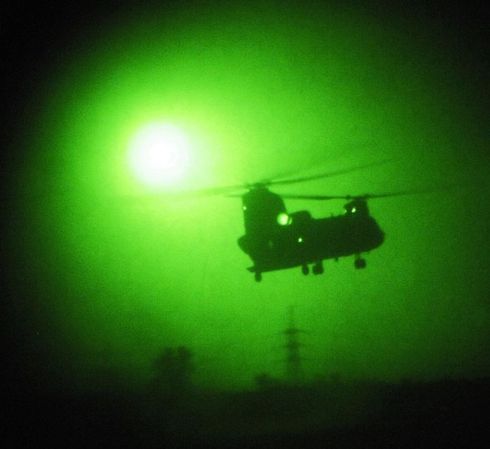
People will disintegrate, body parts will fall off, limbs will be poisoned and charred.
Democracy will teleport itself for its own arrogance, implicating a dictatorship and a sorry hybrid shall limp to an uncertain future.
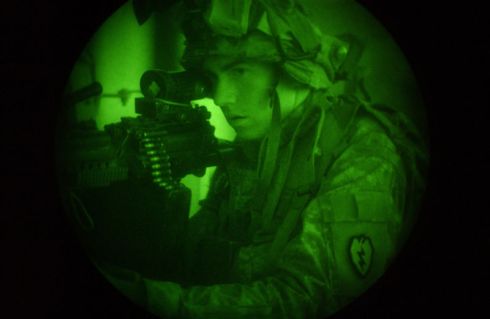
And the toll shall be personal, unsuspected, for the love of the state and its rhetoric.
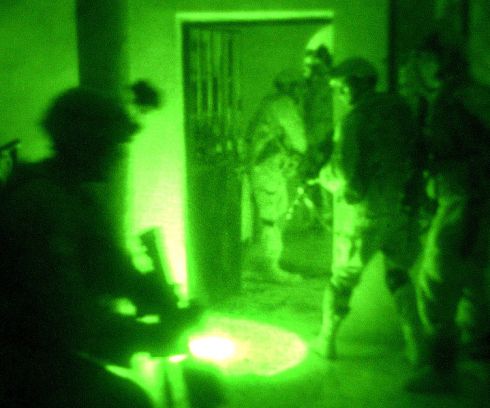
And the children will be the unhindered beneficiaries of a world not of their own, but the world of their violent predecessors, their decisions, amalgamations, actions and murders.

Kids become sad reminders that nostalgia, film photography and wildlife cinematics were forsaken before they could be rightfully demanded back. A new sterile age sports no death cells, no faces, no conscience, no history.
Immunology becomes the new high stakes industry …
…
…
By the way, have you ever noticed that the beat in Boards’ Kid for Today is the clickclack of a slide projector carousel?

For a long time, in the early days of the war on Iraq, Abu Ghraib was a primary target for insurgents. Even before the photographs of torture were leaked, Abu Ghraib was mortared almost daily. Abu Ghraib held thousands of falsely accused men, the majority of whom were later released without charge, ceremony or apology.
Monica Haller‘s new book Riley and His Story is a collection of thoughts, diary entries and digital photographs from his tour of Iraq. For a period, Riley was a nurse in Abu Ghraib and the images from the medical tent are novel, uncensored, bloody.
Riley’s photographs from the hospital sits between snapshots from military vehicles, marines sat in paddling pools, goofy group shots, Al Franken (?) and decaying out-of-use planes.
This is the aesthetic we all know exists and we occasionally glimpse when there is interest, lawsuit or cultural re-use of military personnel snapshots in the media.
There must be millions of digital photos by American marines. Haller’s book is simultaneously a cleverly assembled piece of the wider dissemination of such imagery and an affirmation to the unexpected familiarity of such imagery.
A 21st century war is not a war without vernacular conflict photography.
Just as soldiers of WWI sent home words thus defining modern war poetry, so the soldiers of today bring home pixels and jpegs and define modern war imagery.
The singular prose, simile and letter-writings that painted a mind’s picture have been replaced by the multiple functionaries and fingers of digital observation.
As were the Abu Ghraib torture photographs, why shouldn’t we expect the next most iconic images of this century to be amateur snapshots? And why shouldn’t we be prepared for an equivalent violence in said iconic imagery?
It is curious that discussions about the lamentable loss of unembedded journalism have not always been balanced by discussion on the tumorous growth of ‘soldier-journalism’ (a term unsuitable, but an understandable extrapolation from the term ‘citizen-journalism’).
Whether you like it or not, the Canon PowerShot and its hand-held competitors own the future of war coverage.
Wilfred Owen and Siegfried Sassoon buffered the cruelty of war, but there are few artists now. (We are grateful to Haller for being such a thoughtful manager of Riley’s output.) Nothing is softened or made poetic/metaphorical. Laid bare. Perhaps, both the best and worst of scenarios we should expect is military censorship?
Monica Haller’s book is important not because it is Abu Ghraib and not because the images are snapshots made by American military personnel, but because it is a portent of an aesthetic already upon us. And we are in denial.
From here on in photography is ugly.


I found this project through Alec Soth on the Little Brown Mushrooms blog, via LensCulture.
A video interview with Haller is permanently available at LBM vimeo.
A sizeable preview pdf (over 100 pages) of Riley and His Story is available here.
Riley and His Story has a website. You can find out more about Monica Haller here, here and here.
PART FOUR IN A SERIES OF POSTS DISCUSSING PHOTOGRAPHERS’ ACTIONS AND RESPONSES TO THE KILLING OF FABIENNE CHERISMA IN PORT-AU-PRINCE, HAITI ON THE 19TH JANUARY 2010.
On the 3rd February, Adjustment Layer posted an account by photographer Edward Linsmier. It is the fullest eye-witness account by a photographer of events surrounding Fabienne’s death that I have read.
The account doesn’t name the girl as Fabienne. Her name has been available from different sources for some time.
Also worth noting, Linsmier talks of Nathan Weber, another photographer present. I was not aware Weber was at the scene.

Fabienne Cherisma lies dead after being shot in the head by police. January 19th, 2010. © Edward Linsmier
LINSMIER’S ACCOUNT
Read the full account on Adjustment Layer.
Linsmier opens with the excess necessary to hook the reader, “We heard gunshots and knew we needed to be closer. We processed the thought for a split second and we took off running with our fixer not far behind.” and, “Emboldened by the electricity of the chaos, we advanced further and saw people laying on the ground with police yelling and waving guns in the air and shouting commands.”
Linsmier goes on, “We retreated several steps and waited behind a truck for several seconds until the police were distracted. I saw another photographer up the road and decided that we needed to make a move closer to him so we could make some pictures.”
(One presumes this other photographer is Weber?)
“We followed … onto a downed roof top that led to the exposed insides of several shops filled with the scavenging and excited crowd. We were making pictures.”
“The fixer motioned for me to come because the police had caught a man and had him down on the ground. I, in turn, motioned for my friend and fellow photographer, Nathan Weber, who was still on the slanting concrete rooftop to follow me to the commotion down the road. I yelled his name and he looked at me with a blank stare. Nathan is someone who is on point in a situation such as this. He communicates quickly, clearly and with authority when needed. He is no stranger to photographing in similar situations but something of this magnitude was new to both of us. I knew he heard me and figured he would be right behind me as I headed down to the commotion.”
Linsmier returns to see Fabienne’s body, “[I] climbed back up on the roof to see Nathan in almost the exact same spot where I last saw him, except he was looking at a girl who was lying face down on the slanting concrete roof. As best as I can recall, Nathan spoke in short sentences, “I saw her fall. I thought she tripped and knocked herself out. She’s dead. Fuck. She got shot. I was right here.”
“The decision to continue making photographs was instinctual. More photographers showed up and we were all making pictures, composing the dead girl in the foreground as the looters continued to walk past her, almost over her, carrying whatever they could. Several men stopped to turn her over, seemingly to identify the body. They gently took her arms and almost had to twist her just a little to face her upward. They looked at her with little emotion and left.”
This record of events is interesting because it doesn’t report the bypassers going through Fabienne’s pockets as the Guardian did here.
“She had been shot in the head. From what I could tell, the bullet entered her cheek and exited from the back of her head. The blood had been pooling in some picture frames she was carrying when she fell. After the men moved her, the blood began to run down the slanting concrete roof towards us. We all were still making pictures. To anybody else, it must have looked sick, a crowd of photographers vying for the best position to tell the story of the death of a girl.”
“Just about the time that I figured the pictures were over and we should leave, a frantic man and several others emerged from the crowd. It was the family of the girl. The father hoisted her onto his shoulders and began the journey of bringing his daughter home. The photographers followed. Ordinarily, this would be a scene that hardly anyone could bare to photograph. They were experiencing probably some of the most painful moments of their lives but they knew why we were there. Not once did anyone give a mean look; not once did I hear anyone question why all the photographers were following this family’s grief so intently and so closely. It was part of the story.”
THOUGHTS
The underlining above is mine. It highlights the photographers’ conscious activities. I make no judgments here. Linsmier is aware of the sensitivity of the situation. Like, Mullady, yesterday, Linsmier’s candour should be appreciated.
Photographs are deceiving. I should know that by now. When I began my inquiry into Fabienne’s death, I assumed there was a scarcity of images. I presumed only Grarup and Garcia Rawlins had witnessed and recorded the incident.
It is clear, now, that there was more photography and activity. On the scene, at various points, were six photographers – Jan Grarup, Olivier Laban-Mattei, Edward Linsmier, Michael Mullady, Carlos Garcia Rawlins and Nathan Weber.
I’d like to state that I have no agenda here, I am simply interested in constructing the scene in a wider context. Photographers don’t work in a vacuum and we must demand to turn their images inside out to understand the context in which the images were created.
Mining the conditions of production is a position I have held consistently throughout my writing on Prison Photography. I am a great admirer of Errol Morris’ writings that demystify photography; it is in that spirit I am pursuing this inquiry.
Thanks to Melissa Lyttle for the note on Edward’s interview.
– – –
ALSO IN THE ‘PHOTOGRAPHING FABIENNE’ SERIES
Part One: Fabienne Cherisma (Initial inquiries, Jan Grarup, Olivier Laban Mattei)
Part Two: More on Fabienne Cherisma (Carlos Garcia Rawlins)
Part Three: Furthermore on Fabienne Cherisma (Michael Mullady)
Part Five: Interview with Edward Linsmier
Part Six: Interview with Jan Grarup
Part Seven: Interview with Paul Hansen
Part Eight: Interview with Michael Winiarski
Part Nine: Interview with Nathan Weber
Part Ten: Interview with James Oatway
Part Eleven: Interview with Nick Kozak
Part Twelve: Two Months On (Winiarski/Hansen)
Reporter Rory Carroll Clarifies Some Details
Part Fourteen: Interview with Alon Skuy
Part Fifteen: Conclusions

 Prison Photography