
You are currently browsing the category archive for the ‘Visual Feeds’ category.
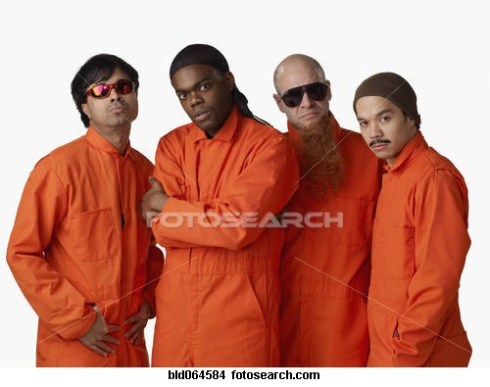
In contrast to the harsh reality of the last post, I present the laughably unreal.
Whenever I find a photographic archive I, by reflex, punch in ‘prison’ into the search tool. I’ve started to do the same with stock agencies.
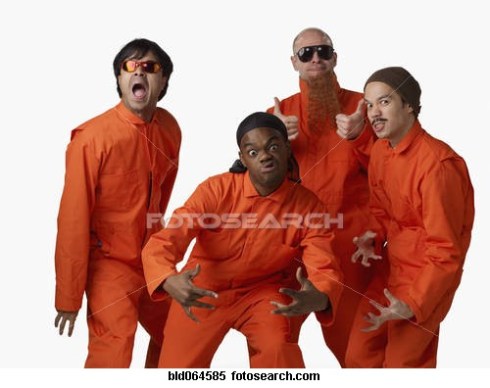
In the microstock world, image search results are disorienting. Instead of American Civil War jails, colonial prisons, prisoners of war, revolutionaries, genocide victims or political prisoners the return is staged portraiture, kitsch orange jumpsuit, bars, locks, handcuffs and silhouetted guard towers.
And, this is beyond the pale. WTF?
For simple graphic design purposes, I am sure even good intentioned advocates scout for imagery in stock databases of complete fiction in order to illustrate their message. Hmm.
A Teachable Moment: Avoiding Cliche
I have bemoaned before the cliche of cell-tier-perspective. I would encourage us all to really think about the relative contribution some prison photographs bring.
Even in photojournalism (a field not without its faults, but a mode I still firmly believe in) photographs of bars, keys and fences are common. So, to practitioners as to viewers, I urge the same rigour in critique.
Jenn Ackerman, Jane Evelyn Atwood, Lloyd Degrane, Jean Gaumy, Andrew Lichtenstein, Danny Lyon, Darcy Padilla, Lizzie Sadin and Taro Yamasaki are just some of the many photographers who’ve managed to describe prison life without overly-relying on the physical fabric of institutions. They spend enough privileged time with the inmates to tell the stories of the inmates.
Two things today. First an important debate. Second my own reflections and housekeeping.
debate
Ben Chesterton at DuckRabbit has had ongoing discussions with MSF / Medicin Sans Frontier / Doctors Without Borders for many months (years?) about the use of media and the fine line between MSF’s promotion of aid work and fair representation of the peoples they work with. Duck has opened a worthwhile debate with Pete Masters of MSF on the duckrabbitblog with regard this new MSF advertisement.
Feel free to add your comments over on Duck’s blog. I know Ben will appreciate and we should all benefit, right?
house keeping
In absolutely no way related – AND, I encourage you not to presume the fictional scene in the MSF ad as one set in Africa – I’d like to return to an image I featured on Prison Photography in December.

The image is by Tim McKulka. The caption reads: The container which serves as a detention facility as human rights and protection officers make an inspection of the capacity of police and prison service. UNMOs from Torit team site were engaged in a long range patrol to Chukudum along with various civilian sections of UNMIS in order to assess the security and social conditions of the area.
Last night, I had the great privilege of attending a YPIN World Affairs Council presentation by Tim McKulka and his partner Anyieth D’Awol about Human Rights in Sudan. There were a few thing that I took from the talk:
1. The problems in Darfur are very serious, but Darfur is not the only conflict in Sudan
2. Things are better now than they were one, two or three years ago – if you measure better by fewer deaths.
3. The predominant source of unrest in the Sudan always stems from the growth of the capital, Khartoum, at the expense of the periphery.
4. Since independence from the British in 1955, Southern Sudan has never known stable or benevolent governance (Civil wars raged from 1956 – 1975; and then from 1982 – 2005). The first war was settled with the drawing of a new boundary between North and South and newly provided autonomy. The second war began because rich reserves of oil were found within the territory of South Sudan and consequently Khartoum and the North reneged on the agreement, grasped for the wealth and resorted to aggression.
5. There exists to this day tribal conflicts in the central areas of contested lands, particularly Aybei where much of the oil reserves lie.
Needless to say the talk was humbling – Tim and Anyieth successfully gave a summary of culture and politics across the entire country, covering the last 60odd years. No small achievement!
I wanted to finally pin down some background to the image and so I asked Tim, “What is that container assemblage exactly?” His response,
It was in a place called Chukudum in southern Sudan, East Equatoria State and it shows that there is no other place to put prisoners. There are crimes being committed but there is no justice, no security; no security sector. The police don’t have guns, or cars, or transportation. They don’t have communications. So the container is what people are left to use when they have prisoners. What else can you do with them?
Tim has followed much of the peacekeeping and reconstruction work in Sudan. This has involved shadowing the training of new prison officers and the establishment of new institutions for juvenile justice. I hope to follow up on this with more involved comments from Anyieth as she, as a human rights lawyer, has far more knowledge in the area … and Tim deferred to her experience.
Here’s Tim’s portfolio Faces of Sudan.
Tim McKulka has been working as the senior photographer for the United Nations Mission in Sudan since September 2006. Prior to that, he was based in New York covering national and international news as a freelance photojournalist for Polaris Images. He graduated with a fine arts degree in photography from the School of Visual Arts in New York. His work has been featured in numerous national and international publications including The New York Times, Christian Science Monitor, Italian Vanity Fair, The Washington Post, and Time Magazine.
Anyieth D’Awol LLB, LLM is an independent researcher working in Southern Sudan. She has worked for the United Nations Mission in Sudan (UNMIS) as a Human Rights Officer. She also worked for the Joint Donor Office as a Policy Officer. Anyieth was a Senior Researcher for the Presidential Advisor on Gender and Human Rights with the Government of Southern Sudan, focusing primarily on sexual violence and human rights issues and the military. She is the founder of a civil society organization providing underprivileged women and girls opportunities for sustainable income through arts and crafts while creating opportunities for capacity development in literacy and numeracy, and providing information on HIV, gender and human rights issues.
This post is to salve the disappointment of thousands of visitors to Prison Photography that are tempted by the post titled View Inside Guantanamo: Video only to find that the Guardian’s rights to the three minute “tour” video have expired.

There exists a bristling irony in the Guardian’s curt and formal explanation of circumstance: the erasure of evidence based upon ‘rights’ pertaining to the command is an insulting reminder of the powerlessness of detainees whose lives are manipulated at will.
Paradoxically, in this case, it is the denied party that is the apologist for the US military’s enforced expiration and unavailability of material. It seems the controlled release of this footage has been trumped by its controlled withdrawal.

As a worthy (and non-governmental) alternative, Magnum offers Paolo Pellegrin’s 11 minute slideshow ‘Guantanamo‘. There are a few interesting things about this piece none of which are the actual photographs. The prints are steeped in morbid detachment and the unsurprising truth that the photographer was also controlled throughout this military prison.
The slideshow’s early description of Guantanamo as a small American town is sinister; the edited audio interviews of former UK detainees, family members, detainee lawyer and psychologist are very successful. The follow-up portraits of former detainees that Pellegrin later completed in Afghanistan are very strong.


All photos copyright of Paolo Pellegrin/Magnum Photos
Please, refer to my earlier post, for a comprehensive directory of photographic resources for Guantanamo including Bruce Gilden’s subtle flash-bulb mockery of Guantanamo’s rank and file. (Search within Magnum archives as deep-linking is impossible).

Quick post & a request. We all know about the relentless Shorpy and the site’s daily dose of long gone photo ephemera. It is indeed a treat.
Today, two images from the 1920s went up. Shorpy’s keen to focus on the visual narratives that arrest the attention. Consider it a human interest archive if you will. It is my guess is he/she/it chose these two photographs relating to crime and punishment because they deal with women and children. If there is still one thing true today as was back then, these two groups are distinguished from, sometimes condescended to, and likely protected and abused in equal measure by, prevailing patriarchies.

Washington, D.C., circa 1920. “Jail, Women’s School.” Alternate title: “Complete this sentence.” National Photo Co. Collection glass negative.

Washington, D.C., circa 1922. “House of Detention, Ohio Avenue N.W.” Equipped with a nice playground. National Photo Company glass negative.
These came at an opportune moment because I’ve been wondering what to do with the following four images from the American Civil War. It is not an area I am well read up on. I guess the make-shift nature of jails and prisons in the vicinity of battlefields and front lines attests to the constant flux and shroud of unpredictability across a bloodied young nation.
Prison Photography blog is often concerned with inflexibility and pursuant damage it can cause as applied to institutions. But the modern prison is merely a permanent abstraction of earlier jails. ‘Transitory’ sites of incarceration, especially in times of war, are even more contested as sites than the Supermax prisons of the 21st century.
It’s got me thinking how Castle Thunder and Belle Isle relate to the the GWOT prisons – namely the early incarnation of Abu Ghraib prison, Bagram Airbase and other as yet unknown ‘Black Sites’ of detention and interrogation.

Richmond, 1865. “Castle Thunder, Cary Street. Converted tobacco warehouse for political prisoners.” Main Eastern theater of war, fallen Richmond, April-June 1865. Wet plate glass negative, photographer unknown.

Spring 1865. Belle Isle railroad bridge from the south bank of the James River after the fall of Richmond. Glass plate negative from the Civil War collection compiled by Hirst D. Milhollen and Donald H. Mugridge.
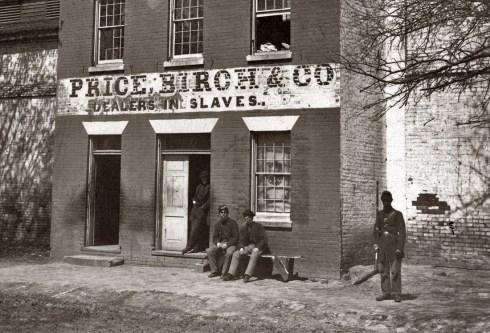
And finally, this site is described as a “slave pen”. This document of slave incarceration is gut-thumping and, however agonising the means, justifies the Civil War and its righteous ends.
Request: I am keen to know more about prisons and jails of the Civil War era. If you’ve any resources I should absolutely be aware of please drop me a note. Thanks

Manchester Evening News published a right-objectionable story that’s probably going to get some blood boiling. Thanks to Steve Silberman for alerting me to this via his virtuoso twitter feed (fine editorial nous).
In America there are gangsta’s, crack heads and wild kids. In Britain there are thugs, scallies and pill-poppers – these are broad categories and don’t describe much, but my effort is to say that the two countries have different types of criminal. It is my feeling that the extreme inequalities of American cities breed a certain type of hardened criminal, whereas Britain’s subtler inequalities breed a certain type of hardened idiot.
Few violent offenders have a sociological grasp on why they’ve made the choices they have and often their bare-faced contempt is hard for most folk to stomach. Kane Barratt is a case in point.

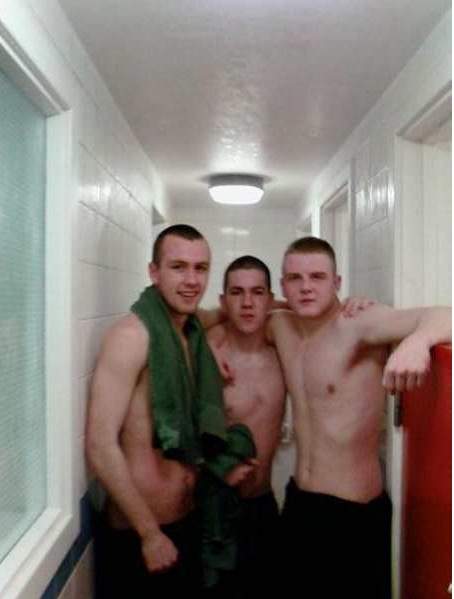
This week, after recent sentencing for 5 and a half years, Barratt used a mobile phone to update his Facebook profile from his cell. He changed his staus, chatted with friends and posted two photos. After the Manchester Evening News told the Ministry of Justice about Barratt’s activity the page disappeared from Facebook. The phone was later confiscated.
I don’t want to glorify Barratt’s actions; he is a violent offender who wielded a machete and held it to his victim’s throats. Barratt shows no remorse only bravado in his Facebook antics. Paul Dillon, Barratt’s last victim pondered, probably quite accurately, “He’ll probably come away from this with all his mates thinking he’s some kind of hero.”
That said, Prison Photography‘s charge is to discuss all modes of photographic production within sites of incarceration: “If a camera is within prison walls we should always be asking; How did it get there? What are/were the motives? What are the responses? (Prison Photography ‘About’ page)
Well, Barratt’s camera phone got there because it was not confiscated . One presumes he wasn’t searched at a key moment. I’d suggest the motive was to stay in touch with his friends outside, take the piss (to a degree) and generally showboat when oversight was lax. Predictably, victims and authorities were left aggrieved, offended and embarrassed.
In Britain, as in America, mobile (cell) phone use is banned behind bars. Wired with the aid of Andrew Hetherington recently ran an article on the smuggling and underground economy of cell phones in California. As did Newsweek. I theorised that prisoners strategic adoption of cellphones is the most serious threat AND damaging maneouver to decades of prison management policy. Mobile communications render obsolete much of the advantages brought to controlling prison populations by segregation.
I teach at a Washington State prison and I am generally disheartened by the lack of access prisoners have to books. By law, state departments of corrections must provide access to libraries, but opening hours and actual physical access (within the institutional regimen) are not consistent. Even when prisoners can get to the library, nearly all learning is self directed. Prisons offer GED programs but only one prison in Washington State (Monroe) offers college courses. I believe only one prison in California (San Quentin) offers college courses.
Nowadays, access to a computer is as essential as access to a library for learning. So, while I understand the need to confiscate phones, I don’t want to see all internet connectivity denied. Ideally, internet would be available to prisoners without compromising security. Social networking would certainly be ruled out.

But even if correctional departments could tailor their own prison firewalls, the structure of Web2.0 – and its embedded networking functions – would still allow manipulation by the minority of seditious prisoners. The likelihood of widespread internet access in US prisons is very small.
This situation alone is cause for some chagrin. If one accepts that computers and networks are essential components of contemporary life then their absence within sites of incarceration forges yet another chasm between the life inside and the life of anticipated release.
But then again, in a week when I had glue sticks confiscated on entering the prison, speculation on the provision of internet in prisons is far from the realities of prison life and, regretably, far from relevant …

Reading the Goethe-Institut Fashion Scene article about Haeftling designers in Berlin, I thought it was an Onion style send up. “Prisoner chic” sounds like something straight out of satire, but I guess I was snoozing when this hit the news wires in 2003.
Haeftling (translated as ‘Prisoner’) employs inmates across Europe to manufacture clothing and housewares inspired (they say) by prison life, “The garments are highly functional and have a classic and timeless cut. Only high-grade, rugged fabrics are used in manufacturing.”
Well, whatever you say. I actually don’t mind how they market it, I am just pleased they support prison reform, the abolition of the death penalty, political prisoners rights and a philosophy of rehabilitative justice.

Haeftling Tray
But let’s not kid ourselves. This project was borne of commercial interests. “It began in the JVA (Justizvollzugsanstalt/prison) Tegel and developed into an international undertaking. More and more prisons have joined and today production is even taking place elsewhere in Europe. One Bavarian prison supplies honey from its own two colonies of bees; a prison in Switzerland even has its own vineyard and exports its own red (Pinot Noir) and white wine (Müller Turgau).” (source)
Karola Schoewe, Haeftling’s PR & communications manager says, “On the whole, the prisons are all very helpful,” says “There are some prisons that have very good production capacities for making homeware.”
Schoewe then marries the business speak to social responsibility speak, “Through its production, Haeftling is creating measures that help to support rehabilitation processes.”

Haeftling Espresso
Without seeing Haeftling’s account-books or sitting in on a board meeting, I have no way to tell if resources and profits are divvied up in a way that benefits prisoners more then in the state run prison industries. This was the situation in July 2003
(Author’s Note: €12.50 is substantial pay compared to American prisons.)
Prison industries are a divisive issue. For some they are the perfect use of prisoners’ time and energies developing job skills, work community & self-esteem. To others prison industries are a modern slave labor exploiting societies’ self-created incarcerated class.
Both viewpoints have legitimacy, but the first makes a prior assumption that could be misleading – that work programs are the only means to provide skills, community or self-worth. Education does this too.
But educating someone instead of putting them to work is going to cost a prison authority rather than generate it wealth.

Generally, I am unnerved by the disconnect between the reality of incarceration and its representation to consumers,
Then again, Klaus-Dieter Blank, of Berlin’s Tegel Prison states the success of the label’s online store has meant that people are beginning to understand “what goes on behind the walls”. Haeftling features on the Tegel Prison website.
Is there too much space here for consumers to create their own version of prison life? What is included and/or played down in the minds of consumers? Are they being coerced and sold a disingenuous view along with that ‘rugged’ product?

"Justiz 82" Scratchy Blanket. Haeftling Product
We can assess this a number of ways – rehabilitative worth, public awareness worth, benefits to state finances, tax-payer savings, external benefits of development in social entrepreneurship.
But essentially, we must ask, “Does this enterprise help reduce prison populations by reducing recidivism? It MUST be compared to other rehabilitative programs. The purpose of prisons the world over should be to create societies where prisons are no longer necessary.
How do you judge this type of enterprise?
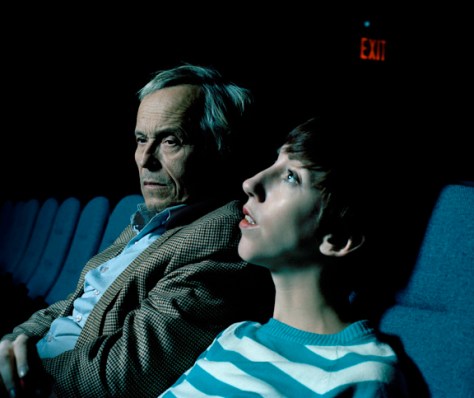
Tina Schula, from the 'Ratline' series
Harlan Erskine contacted me this weekend.
At the moment there are some MFA exhibitions at the blockbuster schools. Before you read this look over Daniel Shea’s neat run down of SVA, Columbia & Yale photography grads.
As concerns Harlan’s graduating class at the SVA, here’s five picks:
Carlos Alvarez Montero for his street portraits, but more so for his meld of youth, friends & skating.
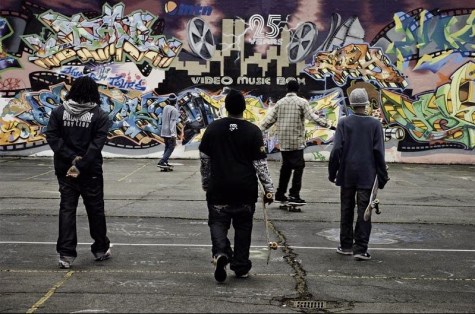
Carlos Alvarez Montero, from the 'Harlem Shuffle' series
Maureen R. Drennan for her sophisticated restraint down at a marijuana farm.

Maureen R. Drennan
Jessica Bruah because I think she takes a lot of shots and edits well. You don’t just “come across” the subjects Bruah photographs.

Jessica Bruah
Scott Houston for a harsh, harsh and close view of meth and people … together. And for proof in the argument that captions are essential; providing caring and careful context for image.

Scott Houston
Tina Schula gets a double shout out for two weird series. Ratlines (very top) is creepy & suspenseful. Oskar’s Sister (below) is playful, offensive & menacing.
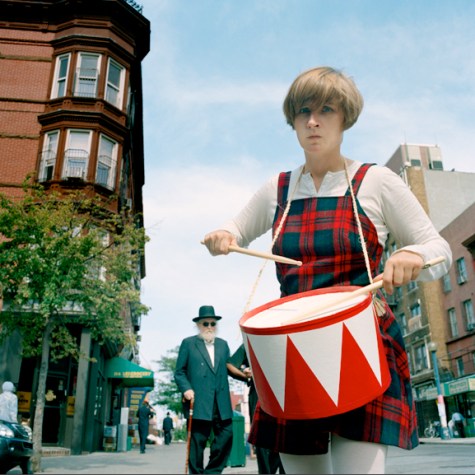
Tina Schula, from the 'Oskar's Sister' series
This week, Metafilter – among others – threw a stats-bomb at my wordpress account. The lure? Uncredited, amateur, pinhole photographs. No name … no logo.

The photography was by Girls in the Remann Hall Juvenile Detention Center, Tacoma, WA during a 2002 Steve Davis arts workshop.
These pictures really struck a chord. I am left to wonder what sort of interpretations are being made by viewers?
One thing I know is that a big CV, a big camera and fancy digijournalist turns may not be enough to secure soul-grabbing images. In fact, I’d argue it probably isn’t possible to compete with those nameless girls of Remann Hall.
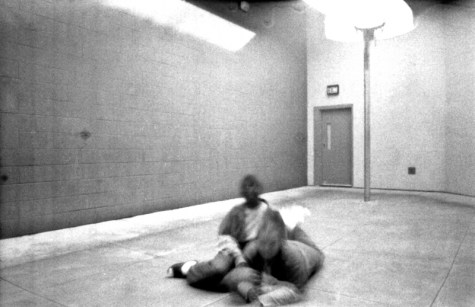
Remann Hall girls 2002. Image created as part of a Steve Davis workshop. Pinhole camera.
Please contact Steve Davis for inquiries about image use and reproduction.

 Prison Photography