
You are currently browsing the category archive for the ‘Words’ category.
Danny Lyon spoke out last week about Google books’ disregard for rights, artistic craft and common respect. In Google vs. The Bikeriders he lays out a short and no nonsense argument.
Lyon doesn’t oppose digital distribution of his work – he just doesn’t want it scanned en masse. He wants publishers, software programmers and artists to do the work.
On the existence of books, Lyon warned, “I’d be real careful about messing with this stuff. I’m not sure I would want to live without them.”
FULL STATEMENT
The Bikeriders 1968, The Destruction of Lower Manhattan 1969, and Conversations with the Dead 1971, were all out of print within two years of their publications. They had all been remaindered by their publishers and would remain out of print for at least twenty years each.
“Conversations” is still out of print. Under Google’s new rules, Conversations with the Dead could be scanned and put on line by Google without even contacting me. Many photo book makers are torn between standing up for their rights, and “being left out” by the Ruler of the Internet.
So what is wrong with having Goggle (sic) bring my out of print work to the world wide web?
1) It is theft. Ownership of out of print work reverts to the author (me). Copyright has worked well in America for centuries and is part of the foundation of our Democracy and the Ist Amendment. I own my writing and my work. They really do have to ask.
2) Picture books are different. You cannot scan them and put them on the internet. Scanning a printed image destroys the beauty of the work which is embedded in the work itself. That is why authors make picture books. They are making a thing of beauty. That is why printers, ink, paper, and publishers and production managers are all so important. They all work to create a thing of beauty, a book. In this case, as picture book.
There is nothing wrong with putting a picture book on the internet. But that can only be done the way a book is printed, which is to scan the individual images. It is the difference between “the real thing” and a bad xerox of it.
If they want “Conversations with the Dead” on the internet they have to work with publishers, who employ the people to make the prints and make the scans and recreate the book for internet use, just the way a person makes a good website.
That’s a lot of work that will create a lot of jobs, and it should.
Publishers are the people to do this, as they are in the book business. Google seems intent on destroying the book business and its just possible, that they will.
Books, the printed smelly kind you hold in your hand, have been part of and have helped advance civilization for five hundred years. The Greeks and Ancient Jews used papyrus rolls, which they also held to write on, and to read, 2,500 years ago. I’d be real careful about messing with this stuff. I’m not sure I would want to live without them.
I am amazed that Lyon even needs to fight a corner on this. He surely is more valuable to us than scanned copies of his books.
How to tell Google to lay off Lyon’s publications?
__________________________________________________
Danny Lyon’s website is Bleak Beauty.
Here for everything else:
http://www.americansuburbx.com/2009/08/theory-end-of-age-of-photography-by.html
http://5b4.blogspot.com/2007/10/like-thiefs-dream-by-danny-lyon.html
http://www.luminous-lint.com/app/photographer/Danny__Lyon/C/
http://www.scottnicholsgallery.com/artists/danny-lyon/23.html
http://www.geh.org/ne/mismi2/lyon_sld00001.html
http://www.americansuburbx.com/2008/01/theory-doing-life-interview-with-danny.html
http://www.nytimes.com/2009/04/26/arts/design/26kenn.html
http://www.mocp.org/collections/permanent/lyon_danny.php
Words
Prisoners All posits that we are all severely impeded, individually and as a community, because of bad politics, poor policy and family devaluation. The posts are really well composed.
The anonymous author – by the pseudonym of Zebulon Brockway – has “worked many years in [California] prisons, and worked many years in journalism” and believes “much written about prisons is misleading at best and wrong at worst. The false impressions and false information are not helpful to public discourse”.
Moving Images
John Malsbary contacted me at the start of the Summer to tell me of his new venture Prison in Cinema.
John’s moving across a country at the moment. His few posts suggest he’ll be worth watching. John brought to my attention the film The Jericho Mile made on location at Folsom State Prison in 1979. Anthony Friedkin photographed Folsom convict portraits twelve years later. Mann’s directing and Friedkin’s shooting share in visual dialogue.

Four Convicts, Folsom Prison, CA. Anthony Friedkin. 1991. Silver Print. 16 x 20 inches.
Reading
Governing through Crime; WA State Library; Grits and Bid’ness in Texas; and Ben Gunn (Serving prisoner) and John Hirst (Released) in the UK.
Followed LEAP’s twittering and other ones …
Stats
The Dallas News reported the ‘Circumstances, Evidence, Problems and Outcome’ of five cases of arson in Texas under re-examination. That includes the Cameron Todd Willingham case. (via The StandDown Project)
‘A Paperclip and a CD’
Matt Kelley at Change.org had a well reasoned rallying call for support of prison book programs. Take Action.
Edmund Clark
A favourite of mine. Since recommended by Nathalie Belayche. Colin Pantall (recently back from a summer blogatical) and LensCulture showing Clark‘s new prison series, ‘If the Light Goes Out: Home from Guantanamo’.
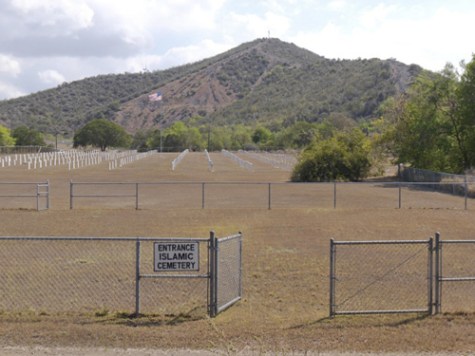
Naval Base Cemetery by Edmund Clark
Naval Base Cemetery (above) is not typical of the project. It is outside. ‘Home from Guantanamo’ uses the same detailed look at everyday institutional and domestic objects in their place. I don’t think it is as successful as ‘Still Life: Killing Time’, as I don’t think this approach lended itself as well to the War About Terrorism as it did to the Geriatric E-Wing of Kingston Prison, Portsmouth. ‘Killing Time’ is best viewed as a slideshow with Erwin James’ commentary.
Reciprocity Success
And finally, thanks to Stan for his coordinations and libations. Stan recommends Courthouse Confessions, as do I.
This is the first of three posts celebrating the work of journalists/academics/photographers bringing to popular conscience the abuse of women in the American prison system.
I have called this triplet mini-series Women Behind Bars and it was spurred by a couple of news stories this week. In New York state, protesters outside the Governors house drew a promise from David Paterson that he’d sign legislation banning the chaining of incarcerated women who are giving birth.
Also, a class action lawsuit is gearing up in Michigan, which seeks a $100million settlement for over 900 female inmates and former-inmates who suffered harassment, groping and rape between the years of 1993 and 2009.
Women Behind Bars as a name for this mini-series was co opted from the Silja J. Talvi‘s most recent book of the same title.
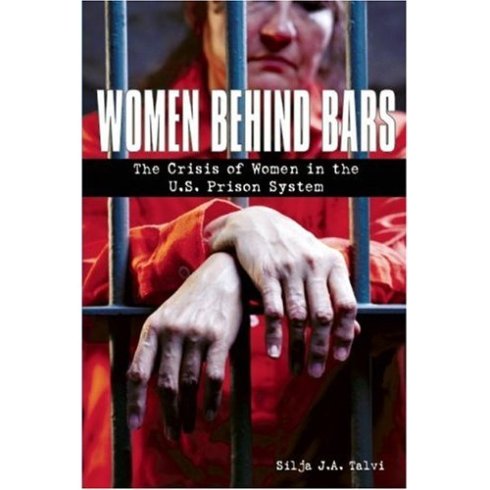
I had the pleasure of hearing Silja talk at the Seattle Public Library. Silja speaks as she writes – without jargon or polygonal argument. She keeps it simple; she is usually retelling the testimony of female prisoners she has visited and interviewed. No flourish required.
Beyond the physical and sexual harassment of female prisoners, Talvi asks us to reevaluate our understanding of psychological welfare as it is handled by the prison system. The 775% increase in the US female prison population since 1977 is – for want of a better word – criminal. It is double the rate of growth for the male prison population. Talvi is in no doubt that this increase is due for the most part to the war on drugs. Talvi also describes the constituencies entering US womens prisons.
Talvi’s work crystallises the fact that the massive incarceration of American women has not been a result of crime on the streets, but a result of criminalisation by writ of political assemblies. In the war on drugs, women are involved but surely we must analyse that involvement. Occupying residence, associating with family drug dealers are indirect misdemeanours that stand to be punished. When a society is blighted by drugs and the dealers are involved in the “war” on the street, usually it is women who hold the threads of family and community – and home – together … despite its faults and its drug use.
Talvi points to another remarkable trend,
There’s also the fact that women are less likely than men to snitch on loved ones. Prosecutors will come to them and say they will go to prison unless they give up the names of three higher-ups, but women usually either say they don’t know those people or will simply decline. Men will snitch and, unfortunately, they often get less time in prison than women who don’t.
The shocking statistics are simply an application of US culture that is too morally bankrupt & class divided to think of more imaginative forms of criminal justice than incarceration.
Prison is a violent, inhumane environment – the modern designations of built with violent offenders in mind. But what proportion of women prisoners are violent? Not nearly as many as our fear-gripped culture would presume.
The prison is a disciplinary tool that has needlessly subjugated women. It has been imposed and it has demolished poor communities.
When Talvi supports prison for violent murderers and rapists and then argues for its non-implementation for female ‘criminals’ she is entirely consistent. The prison has a place, but it is not in the persecution of non-violent females, it’s counter to the notion of justice and it flies in the face of social justice.
As This Is Not A Book Sale put it,
The book Women Behind Bars was produced as part of the Women Behind Bars Project which:
[Source]
Women Behind Bars. The Book: More and more women—mothers, grandmothers, wives, daughters, and sisters—are doing hard prison time all across the United States. Many of them are facing the prospect of years, decades, even lifetimes behind bars. Oddly, there’s been little public discussion about the dramatic increase of women in the prison system. What exactly is happening here, and why?
Bio: Silja J. A. Talvi is an award-winning journalist with credits in more than seventy-five publications nationwide, including The Nation, In These Times, and the Christian Science Monitor. She was honored as a recipient of the 2005 and 2006 PASS awards for criminal justice reporting by the National Council on Crime and Delinquency, a 2006 New American Media Award, and twelve regional SPJ awards for excellence in journalism. Talvi’s work has appeared in numerous anthologies, including Prison Nation: The Warehousing of America’s Poor, Body Outlaws, The W Effect, It’s So You, and Prison Profiteers. She lives in Seattle.
As I refer to it, the cushty-cell-theory, that is to say, the idea that prisoners shouldn’t be any better off than the worst off in open society is common. But, it is not an argument; rather it is an extension of bitterness and misinformation.
It makes no sense to hold the conditions of a single institution, the prison, to the lowest identifiable standards of society elsewhere. To do so is prejudice.
The following passage from the provocative and authoritative The Oxford History of the Prison (Norval & Rothman, eds.) sets out to explain this idea:
Inmates are the best and the worst among us. They include Mahatma Gandhi, Martin Luther King, Nelson Mandela, Thomas More, Oscar Wilde, Bertrand Russell – a very mixed group but not lacking in virtue – and a long list of highly principled dissenters. There is no point in cataloguing the worst. Prisoners are ourselves writ large or small. And, as such, they should not be subjected to suffering exceeding fair expiation for the crimes which they have been convicted. Below that admittedly vague ceiling of suffering, they are entitled to a reasonably safe, clean environment. They must be spared cruelty, cruelty being defined as violations of their bodily and psychological integrities beyond the legitimate necessities of their punishment.
There is one theme, however, that has complicated this whole analysis of appropriate prison conditions – the alleged principle of “less eligibility.” It is the idea, which dates back to at least the nineteenth century, that the prisoner’s condition must not in any particular be preferable, more comfortable, or more adequate than those of the worst off members of the community who have not been convicted of a crime. Otherwise, it is suggested, a positive incentive is created for those worst-off citizens to commit crime so as to improve their conditions. This is a daft idea, but it captures men’s minds. Happily, it is not taken seriously by prison administrators who know that if they are not to operate death camps, their prisons must be run by consent. The administrators hold the ultimate power at the periphery, but within the walls power lies with the prisoners. In the end, the prison embodies the largest power the state exercises over its citizens in time of peace. If the balance between authority and autonomy is struck fairly here, it is not likely to go far wrong elsewhere.
[Emphasis mine]
To postpone all standards for society’s incarcerated class is to distinguish oneself from them. It becomes an “Us & Them” scenario, in which abuses are tolerated or ignored.
I chose to focus on this repugnant prejudice-masked-as-theory for Wednesday Words because I have been troubled for many years at the acceptance and even casual sadistic humour in mainstream society regarding prison violence.
In photography Cornell Capa has huge renown. In prisons, Attica has a huge renown. It is therefore, expected that I’d transcribe Capa’s testimony to the McKay Commission (New York State Special Commission on Attica) Hearings.
After the text I shall offer my opinion.
TEXT
Cornell Capa: I was asked eventually by Arthur [Liman, Counsel] if I would want to look at Attica for the reasons that he mentioned, that photography and a photographer may have something to contribute …
As a human being and a photographer, my personal and professional and civic feeling was to look into it and – as my professional life is involved in understanding human condition – try to perceive what it is all about.
I think photography can serve a most useful role in an investigation and that’s exactly what I consented to do.
I [have] submitted 26 photographs which I will be showing to the commission and I have submitted equally a very short written statement and captions for the photographs.
I would like to really just read my written statement and following that as the photographs go by, I will do the captioning job for them.
At Attica: A Photographic Report.
Recently I spent three days at Attica, having been asked by the McKay commission to take a look at the institution and bring back my visual report.
During the visits to Attica I was, at all times, accompanied by a correction officer and a member of the Commission staff; all persons recognizable in these photographs consented to be photographed.
My photographs and their captions constitute my report for the commission. There is just a little more to add.
A feeling of nervous expectation seems to pervade Attica. Everybody is waiting the result of the work of the Commission’s investigations on the causes of the explosion which occurred there six months ago, and their recommendations for the future avoidance of such a tragedy in the future. Both sides, inmates and guards expect some new things to evolve from the findings – some kind of miracle which will transform the institution into a place where the Biblical lion and lamb will better live together peacefully.
The only hitch: each side has its very own view of the meaning of peaceful and better coexistence, and how to achieve it.
From the outside, Attica situated in the rolling farmland in western New York, has a Disneyland-like appearance, especially at night.
Attica’s inmates are all locked in their cells from approximately 5pm until 7am the next morning. Officers on the night shift make lonely rounds checking the count six times a night.
All movement in Attica is limited by locks. At night the duty officer must carry with him all the keys he will need on his nightly round of inspection
Confined to their 4 x 9 cells, inmates may talk to one another across the cellblocks and play music instruments until 8pm.
Locked in a cell a mirror is an inmates eyes to the rest of his gallery, and whenever something happens, the mirrors appear as if on cue.
After 8pm talking and noise are not permitted. There is little to do until lights out at 11pm except read, write letters or listen to one of the three channels of the prison radio which plays music, sports and the audio portion of TV shows.
In E Block, Attica’s medium security prison with the maximum-security walls, a small group of inmates in special programs are permitted to remain at night in the blocks day room to watch television, play cards or talk.
Corrections officers on the day shift leave homes in the town of Attica and surrounding communities and report for roll calls at 7am, 9.20am, 3pm and 11pm to receive their assignments.
These are the guns and smoke parts etc, what [sic] they keep in the armory for emergency use only.
These are the keys, which they use, the whole system is based on keys. This is just a very small selection of all the keys that open all the doors in Attica
On signal the cells open and inmates in each company line up in two’s to be escorted down one of the endless corridors to the mess hall for breakfast
In his daily movements throughout the institution, an inmate must pass through several times through ‘Times Square’ where the corridors leading from the four main cell blocks converge and gates point in four directions.
Many inmates spend up to five hours a day working in one of the prison industries, the largest of which is a large metal shop, where inmates build steel cabinets and office furniture for state institutions.
For a few hours each day, inmates are allowed to go into their cellblock’s yard for outdoor recreation
The sports facilities, always limited, have been even more curtailed since September. For most inmates the yard means walking around and around or standing around.
The only opportunity for most inmates to watch TV is outside in the yard. Due to the winter climate and the meager daytime TV schedules, few are interested.
While some are out in the yard, others return to their cellblocks. In some areas there are improvised meeting rooms where a few inmates can pursue simple hobbies and handicrafts.
For the rest it is back to the cells to pass the hours until supper. The site of disembodied hands outside the bars playing cards is not unusual here.
Some play chess but the opponent remains unseen.
There is so much idle time; one of the most common activities is preparing legal paper for appeals and writs.
9.30 to 3.30 every day are visiting hours. Those inmates whose families live nearby or who can afford the long journey to Attica may receive a visit. Visits take place in a large room, under the watch of officers and a wire screen separates the inmates from his visitor.
An inmate’s personal touch, often his own creation, is the difference between one cell and another.
One of the statewide changes since the riot is the creation of inmate liaison committees at each institution.
The committee at Attica was elected last month, has adopted a constitution and has begun the task of drawing up projected reforms.
Although life at Attica is again becoming routine, grim reminders of what happened there are everywhere.
This is the round State Shop in damaged condition beyond repair.
Two of the cells blocks were destroyed beyond repair and are still unoccupied. D Block yard on which the eyes of the world were focused for four days last September is deserted now. The trench is filled in but remains visible like a scar reminding one of the great illness which fell upon Attica seven months ago.
[END]
_____________________________________________________
Capa’s review is a rather bland description of everyday life in the prison. This comes as quite a disappointment; I had expected a rousing polemic against the unsuitable conditions of mammoth prisons and their effect on the will of man.
These words seem particularly tame when one considers the magnitude, violence and precendence Attica has in the history of prison resistance. The words are detached from the extremely graphic photographs [WARNING] documenting the riot and its bloody remnants. Capa’s words are the epitome of obsolescence.
Attica was a disaster.
Capa’s words fall short of the strength needed to describe the institution six months on from disaster.
I encourage you all to browse Attica Revisited an encyclopaedic resource of official papers, oral history video and photography.
If I ever have kids I’ll read them Naomi Klein’s Shock Doctrine at bedtime. I’ll use Klein’s words as proxy for my own in imparting the necessary cautions of governments and guns in our f*#ked up world.
(Hold up, there’s reason enough why not to have kids.)
Chapters two and three deal with the growth of Chicago School economics and its pernicious experiments and infiltration into the ‘Southern Cone’.
Throughout the 60s and 70s, the US & the CIA facilitated right-wing opposition movements, juntas, military coups and consequent torture programs in Chile, Brazil, Uruguay and Argentina.
During this time between 100,000 and 150,000 people were killed or ‘disappeared’. Estimates are wide and varied because the murders were out of control, accountability suspended and the terror doled out faster than it could be monitored.
During the Dirty War in Argentina, the terror of each night repeated the previous; a seven-year state-sanctioned massacre that bled into every neighbourhood under the cover of darkness.
The inhumanity is incomprehensible, but Klein attempts to describe the various methods used at times by different forces in each of the countries. Uruguay had a particular penchant for isolation;
Prisoners in Uruguay’s Libertad Prison were sent to la isla, the island: tiny windowless cells in which one bare light bulb was illuminated at all times. High value prisoners were kept in absolute isolation for more than a decade.
“We were beginning to think we were dead, that our cells weren’t cells but rather graves, that the outside world didn’t exist, that the sun was a myth,” one of these prisoners, Mauricio Rosencof, recalled. He saw the sun for a total of eight hours over eleven and a half years. So deprived were his senses during this time that he “forgot colors – there were no colors.”
(Page 93)
In a foot-note Klein remarks:
‘The prison administration at Libertad worked closely with behavioral psychologists to design torture techniques tailored to each individual’s psychological profile – a method now used at Guantanamo Bay.’
Admittedly, Wordsworth was a Romantic English poet of the Victorian Age with some highfalutin ideals and a penchant for a Christian God. But he also had some pretty radical ideas about the health of the human soul being dependent on its environment.
“Heaven lies about us in our infancy! Shades of the prison-house begin to close upon the growing Boy.”
Along with the dirt and the consolidation of British class frameworks, the industrial revolution also ushered in the politics of institutions and discipline. Wordsworth lamented a society in which the economies of labour stacked the odds against the young and unschooled.
The prison was a notion of culture; as visible in the cities as it was felt in the soul. Piers Lewis summarised it as such:
Got any conventions or received ideas you’d like to take the opportunity to shed?
In his book Prisongate (2005), David Ramsbotham, former Chief Inspector of Her Majesty’s Prison Service, quotes a young prison reformer, Winston Churchill.
Ramsbotham read Churchill’s words very early in his employment as Chief Inspector, and kept them close throughout his five year tenure. Ramsbotham understood the following quote as “the clearest possible condemnation of punitive, as opposed to rehabilitative, imprisonment.”
Churchill concluded the parliamentary debate:
We must not forget that when every material improvement has been effected in prisons, when the temperature has been rightly adjusted, when the proper food to maintain health and strength has been given, when the doctors, chaplains and prison visitors have come and gone, the convict stands deprived of everything that a free man calls life. We must not forget that all these improvements, which are sometimes salves to our consciences, do not change that position.
The mood and temper of the public in regard to the treatment of crime and criminals is one of the most unfailing tests of the civilisation of any country. A calm and dispassionate recognition of the rights of the accused against the state, and even of convicted criminals against the state, a constant heart-searching by all charged with the duty of punishment, a desire and eagerness to rehabilitate in the world of industry all those who have paid their dues in the hard coinage of punishment, tireless efforts towards the discovery of curative and regenerating processes, and an unfaltering faith that there is a treasure, if you can only find it, in the heart of every man these are the symbols which in the treatment of crime and criminals mark and measure the stored-up strength of a nation, and are the sign and proof of the living virtue in it.
House of Commons speech, given as Home Secretary, July 20, 1910
Note: Often Churchill’s House of Commons speech, July 20, 1910 is quoted without this first paragraph. Ramsbotham plumped for the expanded version.
Prisongate is a riveting book in which Ramsbotham details his observations, strategies, inspections and concern within a broken UK prison system. The London Review of Books said “Prisongate will make uncomfortable reading for ministers. It is a vivid and at times idiosyncratic account expressive in equal measure of personal frustration and moral outrage.”

 Prison Photography