On November 11th, five imprisoned people at Central California Women’s Facility (CCWF) endured extreme violence at the hands of prison guards. They immediately filed grievances against the officers and called for an independent investigation, but so far none of their requests have been met. They have now developed a more comprehensive set of demands listed in the letter below.

Family members alongside California Coalition for Women Prisoners, Justice Now, Family Unity Network and TGI Justice Project have prepared a petition and are asking the California Department of Corrections and Rehabilitation and the Senate Public Safety Committee for recognition of, and response to, a set of demands penned by the incarcerated women.

My letter below. You can send your own HERE.


Warden Deborah K. Johnson, Scott Kernan and Senator Loni Hancock,

I recently learned about a serious incident of physical assault and sexual harassment at CCWF.

Stacy Rojas, Sandra Rocha, Yvette Ayestas, Melissa Blanchard, Sara Lara and others were subject to degrading treatment during a November 11th incident.

I join the people in prison, their family members and advocacy groups in calling for an independent investigation into the incident and the suspension, pending investigation, of the officers specified in the administrative appeals filed.

Many women and transgender or gender non-conforming people incarcerated at your facility have long histories of sexual and domestic violence and an incident such as this can trigger trauma and PTSD. Yet the officers involved in the incident are still working in close proximity to those impacted by the assault.

I strongly support the demands of the imprisoned people:

• We demand the right to document, expose, and protect ourselves to stop abuses and violations of our human rights without retaliation or punishment.
• We demand safety from retaliation and from being coerced, threatened and blackmailed to betray our imprisoned peers.
• We demand immediate and ongoing medical attention and access to mental health support services. Additionally, we demand access to mental health support if requested, due to the extreme mental stress this assault has caused as a result of the histories of trauma that this incident triggered.
• We demand an independent investigation by the Inspector General’s office.
• We demand that any internal investigation coordinated by the CDCR and through the Investigative Services Unit (ISU) be transparent both during the process and in the sharing of results and that the investigation be conducted in collaboration with legal advocates. Additionally, when ISU is requested by people in the care and custody of CDCR, and most specifically at CCWF where staff misconduct and violence at the hands of CDCR staff was reported, those requests are immediately addressed and responsibly handled.
• We demand immediate suspension of all officers specified in the appeals filed after the incident pending independent investigation. Suspension should include those higher up the chain of command, namely the Captain and Sergeant who were involved in this incident.
• We demand an immediate end to violence and brutality at the hands of prison staff and officials. We demand an end to gender-based violence in all California prisons. We connect this violence and brutality to the state violence people experience in communities of color throughout the country and demand an end to police brutality both inside and outside of prison.

I look forward to hearing your responses.

Pete Brook, San Francisco, Calif.


Send your own letter supporting the petition HERE.

Benedict Fernandez

Benedict Fernandez, Memorial to Martin Luther King, Jr., Central Park, New York, 1968. Courtesy Harvard Art Museums/Fogg Museum

UPDATE: I guess the essay was that good, Aperture had second thoughts about sharing it online? It was deleted from the web a couple of days after publication. You can read a cached version here.

Sarah Lewis, an Assistant Professor of History of Art and Architecture and African American Studies at Harvard University, has a lot of exhilarating thoughts about the roles images play and why they are so important to a justice-inclined society. More exciting for me is the argument she makes about we, as consuming citizens, having to educate ourselves, and to read images. In essence, we must leverage images to our democratic and just ends while rejecting the image-messaging of nefarious sources.

The essay “Vision & Justice” that Lewis penned as intro to the May 2016 Aperture magazine (of the same title) is a call to action, but one that demands buy-in and effort. It’s the opposite of abandoning media because we presume it’s controlled by corporate and state forces. It’s an essay that falls within the pedagogy of activism. Love it. Here’s a snippet:

“Understanding the relationship of race and the quest for full citizenship in this country requires an advanced state of visual literacy, particularly during periods of turmoil. Today, we’ve been able to witness injustices in a firsthand way on a massive scale that would have been unimaginable decades ago. We have had to ask ourselves questions that call upon powers of visual analysis to read, for example, the image of Eric Garner’s killing, virally disseminated through social media, or to understand the symbolism in Dylann Roof’s self-styled portraiture before his killing of the Emanuel 9 in Charleston. Being an engaged citizen requires grappling with pictures, and knowing their historical context with, at times, near art-historical precision. Yet it is the artist who knows what images need to be seen to affect change and alter history, to shine a spotlight in ways that will result in sustained attention. The enduring focus that comes from the power of the images presented in these pages—from artists such as Ava DuVernay and Bradford Young, Deborah Willis and Jamel Shabazz, to Lorna Simpson and LaToya Ruby Frazier—move us from merely seeing to holding a penetrating gaze long enough that we consider what is before us anew.”

And this:

“It was an abolitionist print, not logical argument, which dealt the final blow to the legalization of the slave trade—the broadside Description of a Slave Ship (1789). The London print of the British slave ship Brookes showed the dehumanizing statistical visualization with graphic precision—how the legally permitted 454 men, women, and children might be accommodated by treating humans as more base than commodities (though the ship Brookes carried many more, up to 740). The image it conjured in the mind was intolerable enough to help abolish the institution; the broadside served in parliamentary hearings as the evidentiary proof of slavery’s inhumanity.”

Sarah Lewis is the author of The Rise: Creativity, the Gift of Failure, and the Search for Mastery (2014).

lili Holzer-Glier

Photographer/reporter Lili Holzer-Glier’s Inside the Massive Jail That Doubles as Chicago’s Largest Mental Health Facility marries meaningful and well-reported content and with hard-hitting images under a single byline.

It’s a day-in-the-life-ish of the mental health professionals and patients at Cook County Jail in Chicago, which is the largest walled institution in the United States. What stood out for me was the reason with which both patients and professionals speak and assess the situation. Even though their attitudes could be dismissed as those from a madhouse in the big house, these first-hand-responders are collected and clear in what the problems are and what the solutions might be. And, surprise! Incarceration is not a solution.

I was left to reflect on my own frantic dismay at the United States’ beyond broken mental health policies. But panic doesn’t help anyone. Reliable and committed health helps and this is the overriding takeaway from Holzer-Glier’s piece. The pictures reflect that too. There’s no outbreaks, no violence and no real “noise”. The patients are returning to a baseline and feeling listened to. It’s just a shame they have to be in a jail to receive that attention.

Holzer-Glier opens the piece with a volley of desperate facts.

“According to a May 2015 report by the National Alliance on Mental Illness,” writes Holzer-Glier, “Illinois cut $113.7 million in funding for mental health services between 2009 and 2012. Two state-operated inpatient facilities and six City of Chicago mental health clinics have shut down since 2009. The report goes on to detail that Governor Bruce Rauner’s 2016 budget proposal to slash $87 million of funding for mental health services could cause an estimated 16,533 adults to lose access to care.”

From the way the article reads, it seems Holzer-Glier spent one day (November 10th 2015) observing the in-take and processing. She follows social worker Elli Petacque-Montgomery and her team as they assess new arrivals at the jail.

“Acutely psychotic, violent, or suicidal arrestees [are put] in single cells away from other inmates. People who are psychotic are then sent to CERMAK, the jail’s division for physically ill and acutely mentally ill patients. Those with minor mental illness are sent to Division Two, Dorm Two, where they live in dormitory-style bunk beds…”

While the four prisoner-patients Holzer-Glier meets–Milton, Daniel, Tommy, and Andrew–have problems they aren’t totally bereft of hope. They’re in the bunks of Dorm Two. They provide key insight. Thankfully, Holzer-Glier doesn’t make a case for them, but rather allows them to make their own case. Their statements are transcribed.

They speak with gratitude about how the attention they receive from the medical staff is professional, encouraging and helpful. They have hope they can find stability but they don’t (or can’t) offer too many certain routes to stability. Some plan to leave Illinois when they get out. Some hope to find a good balance from meds that have proved helpful in the past. Another just plans on a steak and a hot bath “to get rid of the crazies.”

In each case, it’s clear they’ll need assistance beyond these jail walls. But will they have access to care? Ask the professionals. Holzer-Glier closes the piece with a series of statements from a clinical psychologist, a social worker, a guard, director of the care center and a corrections rehabilitation worker, all of whom work in Cook County Jail and interface with the mentally ill prisoner-patients. They all report that mental health institutions elsewhere have been closed at a incomprehensible rate and that the majority of people they interface with in the jail should be in a medical facility not a prison.

“You can’t just take a mentally ill person and lock them away. Society has already shown it doesn’t work,” says Printiss Jones, the Superintendent of CERMAK, the jail’s division for physically ill and acutely mentally ill. “Why would we do it here?”

And the piece ends.

Jones says, “Not one of these people should be here.”

THE IMPORTANCE OF GIVING

Securing help, even for the most simplest things, isn’t guaranteed for lots of returning citizens. I once listened to a talk by Troy Williams, who served 18 years in the California prison system, and he ended by pointing out that the state spent (conservatively) $900,000 keeping him locked up and then one the day of release handed him $200 and waved him off at the prison gate. Anyone can see that there is a sick disproportionate allocation of funds, especially if we’re to believe any argument that prison can improve those subject to it.

Across the United States, picking up the responsibility for care during the crucial post-release days, weeks and months, are volunteer groups. 2,100 miles from San Quentin in Champaign, Illinois one such group FirstFollowers are doing amazing work. Orchestrated by all-volunteer workforce, FirstFollowers is made up of activists and the formerly incarcerated who provide support and guidance to the people getting out of prison, to their loved ones, and the community as a whole.

FirstFollowers is currently seeking $10,000 to continue its invaluable work.

DONATE MONEY AT THE FIRSTFOLLOWERS GOFUNDME PAGE

FirstFollowers are committed to peace-bulding process in the community. Crucially they involve all voices in that. Experienced voices.

“In light of the recent spate of gun violence in Champaign, formerly incarcerated people can play an important role in creating a safe environment in our communities,” says FirstFollowers which opened its doors in March of 2015.

Our program grew out of the struggle to stop a 2012 proposal by our county authorities to spend $30 million on jail construction.

“We argued that the county needed more programs and services for the community, not more incarceration,” say FirstFollowers. “Our efforts paid special attention to the fact that our county was targeting Black people for imprisonment. While only 13% of the population of our county is Black, in September 2015, 71% of the jail population and more than 60% of the parole population was African American. We realized that we needed to stop jail construction but we also needed to provide community-based alternatives. We aimed to make FirstFollowers one of those genuine alternatives.”

DONATE MONEY AT THE FIRSTFOLLOWERS GOFUNDME PAGE

There are many reasons to donate money. Here’s a few. Here’s what FirstFollowers provides–a safe stigma free environment; peer mentoring; assistance with employment searches; job readiness training; advocacy for individuals with felony convictions; family reunification; and service referrals

“We don’t seek financial assistance for salaries but for our activities, equipment, and direct support for our participants when they need IDs, birth certificates, court transcripts, even clothes for a job interview. We also want to provide short-term stipends for formerly incarcerated folks to engage in community work.

DONATE MONEY AT THE FIRSTFOLLOWERS GOFUNDME PAGE

Contribution will fund:

  • Training to formerly incarcerated people and their loved ones in advocacy-we need those impacted by incarceration to speak for themselves.
  • Support groups for people with issues of substance abuse, mental health and family reconnection.
  • Training in research skills to our participants so that they can carry out a participatory needs assessment among the formerly incarcerated and their loved ones in our communities.
  • Transportation for family members to visit loved ones, especially those who are incarcerated but are close to their release date.

DONATE MONEY AT THE FIRSTFOLLOWERS GOFUNDME PAGE

For more information, visit the FirstFollowers website. Or contact them via email at firstfollowerscu at gmail.com

©Cosmin Bumbutz. All rights reserved. www.bumbutz.ro

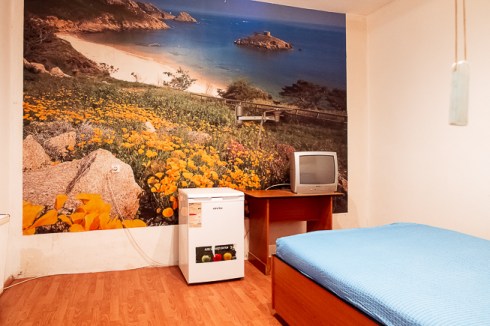
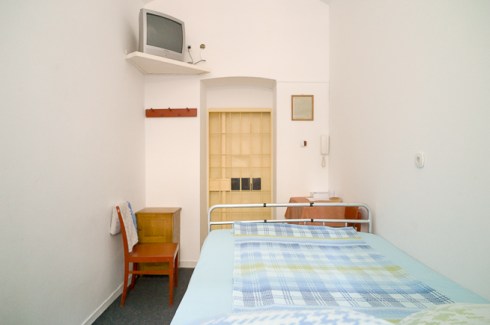
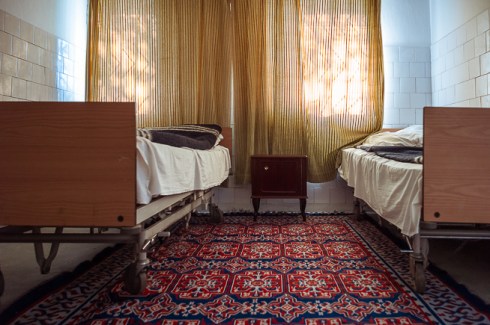
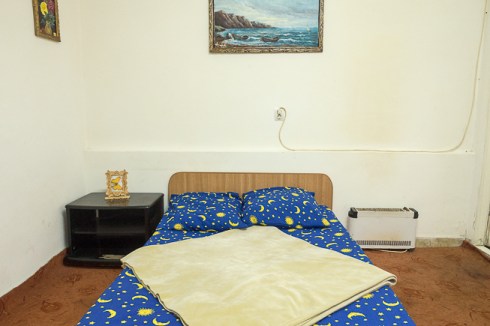
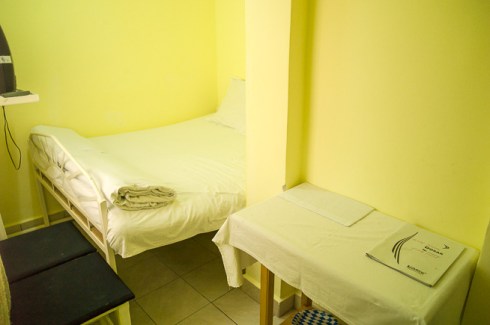
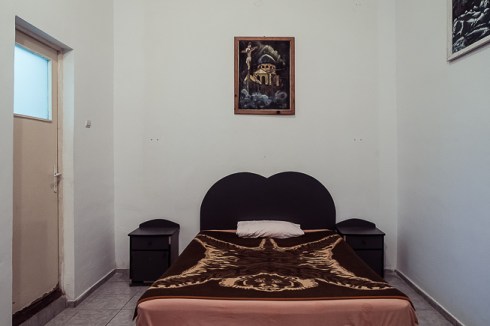
In modernizing institutions, new laws to permit intimate partner visits for prisoners were established. Cosmin Bumbuţ visited every penitentiary in Romania and photographed the boudoirs.

We’re obsessed with sex as much as we’re shy to talk about it open and honestly. We’re fascinated by prisons, particularly fictionalized accounts of prisons (Oz, Animal Factory, Shawshank, Orange Is The New Black, The Green Mile, the list goes on-and-on) but often our fascination doesn’t extend far enough to talk openly about what our prisons actually are and how they’re a symptom of a divided, racist, unforgiving social order. We’ve still a lot to unpack around prisons. Around sex too, we’re picky about what and where we unpack. I say this to acknowledge the fact that this is an article about sex, and prisons, and sex in prisons and those are fiery catalysts to the imagination. Be honest, you’re here because of the headline and you’re wondering whether to read these 1,300 words or just scroll through the pictures.

Fortunately, for us, these pictures, made by Romanian photographer Cosmin Bumbuţ (who is also one half of Teleleu.eu), sate our outsider curiosity without dragging us into a debased voyeuristic quagmire.

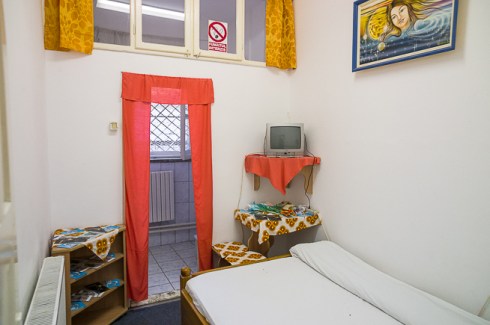
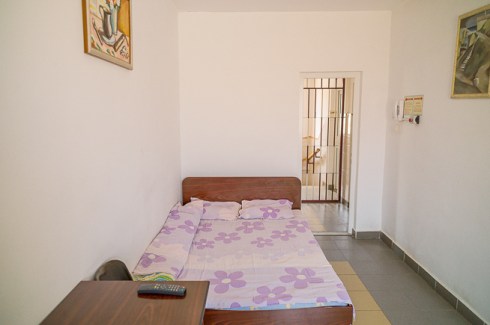
The series, titled Camera Intima, is expertly shot with phenomenal manipulation of space and lenses to secure these angles. Despite some of these rooms being converted basement store-rooms, the photos are well-lit and flooding with joyous color and pattern. Perhaps you enter this photo essay — and these rooms — expecting cheap gags, but you exit with a rounded and informed perspective on a type of room designed to meet 21st century policy, to ensure dignity and to bolster family relationships.

“In 2007, Romania joined the European Union,” explains Bumbuţ. “The whole prison system went through major revamp and the biggest reform was to introduce the right to private visits.”

©Cosmin Bumbutz. All rights reserved. www.bumbutz.ro

©Cosmin Bumbutz. All rights reserved. www.bumbutz.ro

©Cosmin Bumbutz. All rights reserved. www.bumbutz.ro

©Cosmin Bumbutz. All rights reserved. www.bumbutz.ro

Simply put, the price for entry into Europe’s *modern* club was to allow previously-forgotten and despised convicts to get it on with their loved ones. Married prisoners and those in long term relationships have the right to one 2-hour private visit, every three months.

“Plus, if a prisoner gets married in detention he or she can spend 48 hours with the spouse in the special room and is allowed visits once a month in the first year of marriage,” explains Bumbuţ.

It’s obvious to say that these conjugal visit rooms are for sex. But it’s worth noting they are intended only for sex. In the United States, by comparison, conjugal visit trailers and designated rooms are set aside for the whole family. In these Romanian rooms, the only visitors are intimate partners but in the United States the purpose of family visits is broadened beyond just sex. Prisoners spend time with their children, siblings and parents; trailer visits are meant to strengthen family bonds throughout the entire clan. As such, US trailers have kitchens, dining and common areas.
©Cosmin Bumbutz. All rights reserved. www.bumbutz.ro

©Cosmin Bumbutz. All rights reserved. www.bumbutz.ro

©Cosmin Bumbutz. All rights reserved. www.bumbutz.ro

©Cosmin Bumbutz. All rights reserved. www.bumbutz.ro

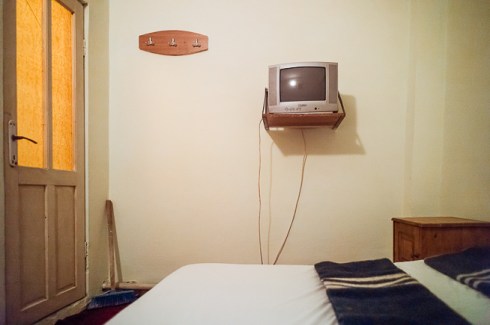
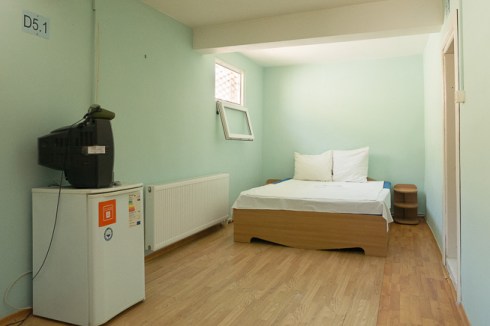
In Bumbuţ’s photos we see mostly, just the beds. For all their undeniably functional design for the carnal, these rooms are rather underwhelming. At its root, this photo essay could be of cheap motel rooms; they share the same essential elements — TV, mini-fridge, the occasional soft furnishing, nasty carpet and a sign or two reminding occupants of rules. The picture that these are prison rooms is Bumbuţ’s image of the cover page of the ‘Intimate Room’ handbook.

©Cosmin Bumbutz. All rights reserved. www.bumbutz.ro

Between 2013 and 2014, Bumbuţ photographed the “private rooms” in all 40 Romanian penitentiaries. “I think I can boast of being the only civilian who entered all the Romanian prisons,” he says.

It wasn’t a project that came out of the blue. Back in 2009, he facilitated a photo workshop for women prisoners in Târgșor Penitentiary (more about that here). Soon after that he embarked on a multiyear project documenting life in the notorious Aiud Penitentiary. He witnessed a creaking and unsanitary lock-up trying to clean up and drag itself into the 21st century.

“In 2005, Aiud looked like a prison from the Communist era. Rooms were dirty and the walls unpainted, the cells were very small and crowded,” says Bumbuţ. “In 2008, it was renovated and the cells were expanded, the prisoners didn’t wear uniforms and were referred to as ‘Persons deprived of liberty’! Romanian prisons started to look like the ones from the American movies, with white walls and new metal shiny doors.”

©Cosmin Bumbutz. All rights reserved. www.bumbutz.ro

©Cosmin Bumbutz. All rights reserved. www.bumbutz.ro

©Cosmin Bumbutz. All rights reserved. www.bumbutz.ro

Even though prisoners are still handcuffed, Bumbut has, since 2008, been prohibited from photographing cuffed prisoners. Now it’s about image as much as it is about policy. When Bumbuţ first made his request to the National Prison Administration to photograph the conjugal visit rooms, he received quick approval and thanks for his dedication and help to the prison administration programs. Bumbuţ became well practiced at working in prisons. He reduced his equipment to a camera, a lens, a spare SD card and a spare battery to get through security checks as quick as was possible (often not quick at all).

The photographer’s good-standing all changed upon the release of his book Bumbata, an anthology of his best photographs from four years of shooting in Aiud Penitentiary. (Bumbuţ and I had an extended conversation about Bumbata in 2013).

The book was considered to gritty and perhaps, even, too sympathetic to the prisoners. Either way, it was seen as a damaging depiction. From there-on out, Bumbuţ was light on his feet and diplomatic. His access was never withdrawn.

©Cosmin Bumbutz. All rights reserved. www.bumbutz.ro

©Cosmin Bumbutz. All rights reserved. www.bumbutz.ro

©Cosmin Bumbutz. All rights reserved. www.bumbutz.ro

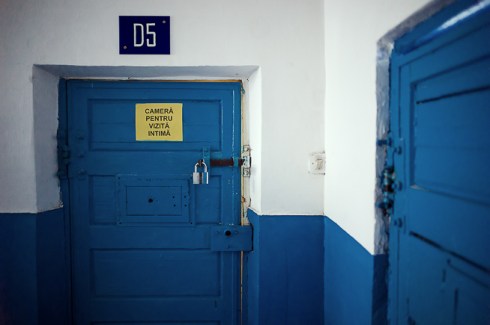
The pregnant pause within these rooms is what gives Camera Intima strength as an body of work. We look at the photographs and they ignite our imaginations about what goes on inside. When the door is open — and we and the photographer peer in — there’s nothing to see. What goes on behind closed doors will never be photographed. This tension is characteristic of good photographic series that insert themselves into the relationships of public/private space and personal/institutional power.

“Prisoners are allowed officially to have sex inside an institution, but they have to follow all the bureaucratic steps,” explains Bumbuţ, “to write a request, to wait for the approval, to obey the rules.”

Guards and the administration hold the promise of access to the rooms as a carrot to motivate prisoners toward good behavior.

“Only prisoners who behave in prison are allowed to have private visits,” says Bumbuţ. “Prisoners are more obedient when they have access to the intimate rooms.”

©Cosmin Bumbutz. All rights reserved. www.bumbutz.ro

©Cosmin Bumbutz. All rights reserved. www.bumbutz.ro

©Cosmin Bumbutz. All rights reserved. www.bumbutz.ro

Similarly, in the U.S., conjugal visits are seen as a very effective way to maintain prisoners’ complicity, even docility. Not all U.S. prisoners enjoy regular time with their family or intimate partners. All conjugal visits are banned within the Federal system and while states are left to rule on their own prison policies, only four — California, Connecticut, New York and Washington — currently allow trailer visits. In 2014, both Mississippi and New Mexico summarily ended their conjugal visit programs.

Sometimes these decisions will be couched in language about security but more often than not the decision rests upon public opinion (outrage), the moral judgements of the administration in power and probably the bottom line. It’s cheaper to keep men and women locked in boxes than it is to provide programming.
©Cosmin Bumbutz. All rights reserved. www.bumbutz.ro

©Cosmin Bumbutz. All rights reserved. www.bumbutz.ro

©Cosmin Bumbutz. All rights reserved. www.bumbutz.ro

Back in Romania, it doesn’t matter what system or prison you’re in, your right to have conjugal visits is protected by law. And Bumbuţ was in many prisons when these visits took place. For a while he toyed with the idea of making portraits of prisoners and visitors.

“I even shot a couple before and after their private visit,” says Bumbuţ. “But when I looked at the portrait, I realised that it became too much about the couple and not about the intimate room.”

Bumbuţ wanted to spark our curiosity. He wanted to focus on the space and all the emotions, release, frustrations, love and contained freedom they embody.

Even though these rooms allow two humans to come together, they’re not places about individuals or individuality. They’re function spaces for the continuance of criminal justice policy. We know that given the choice, no-one would want to opt for these converted cells, cramped quarters or side-thought accommodations for their sexy time. No, Bumbuţ’s photographs are all about the denial of comfort and personal circumstance. These are compromise spaces. They’re about making do as much as they are about making out and they reveal carceral logic itself.

“So I decided to shoot the empty rooms.”
©Cosmin Bumbutz. All rights reserved. www.bumbutz.ro

If you’re still with my these 1,300 words later, I’m glad you stayed the course and I hope I’ve convinced you that these images are more than visual one-liners. That, in fact, by photographing in every Romanian prison — 40 in total — Bumbuţ has created a unique, complete and priceless sociological survey. These four walls are the fulcrum between Romanian rule-of-law and the European Union compact; they’re the pivot of negotiation between prison and prisoner; and, of course, they’re containers for sexual expression between prisoners and loved ones. Ultimately, the rooms are the physical manifestation of contradiction.

“These are spaces for intimacy,” concludes Bumbuţ. “But, at the same time, the prison itself denies almost all desperately needed intimacy.”


In recent years, Cosmin Bumbuț and journalist Elena Stancu have traveled through Romania in an RV telling stories about today Romania, marginal communities and extraordinary people. They are Teleleu.eu. Follow Bumbuț and Stancu at the Teleleu.eu website and on Facebook, Twitter and Instagram.


011_Animals _ People

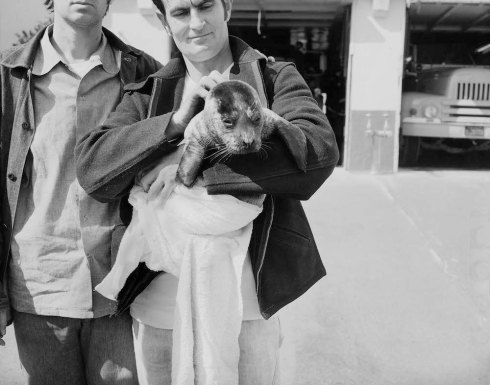
It is every artist, collector or photographer’s dream; the discovery of an archive of thousands of negatives. For artist and professor Nigel Poor, it became a reality. In late 2012, she was making a routine visit to Lt. Sam Robinson’s office in San Quentin State Prison. She’d just finished teaching her class in photo-history and collaborating on image interpretation project with her incarcerated students. Knowing her life in the medium, Robinson pulled out a bankers box.

“He lifted the lid,” recalls Poor. “Inside were hundreds of yellow envelopes that I recognized instantly as those which hold 4×5 photo negatives.”

Poor’s heart “exploded.” More than three years on, Poor has only just finished going through all the negs: she estimates there’s more than 10,000.

Nigel Poor San Quentin

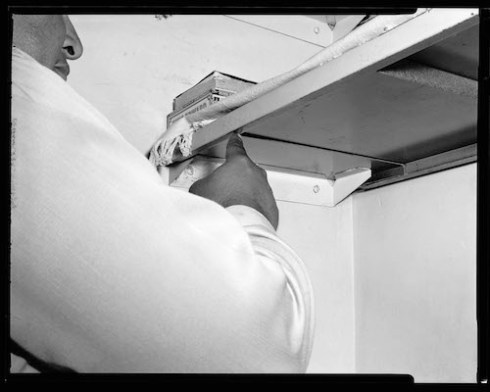
In the weeks, after the discovery, Poor took some negatives and scanned them. She showed the prints to Robinson to prove what she could do and he gave her permission to take the entire box. So far, she’s scanned about 600 of the 4×5 negs. There’s four or five other boxes still to scan and categorize.

I anticipate that there’s hundreds of similar archives gathering dust inside cupboards and administration buildings in prisons across the United States. Kudos to the San Quentin authority for empowering Poor to share the finds with a wider public. The archive ultimately belongs, in my opinion in a California State-run Museum.

Nigel Poor San Quentin

Nigel Poor San Quentin

Nigel Poor San Quentin

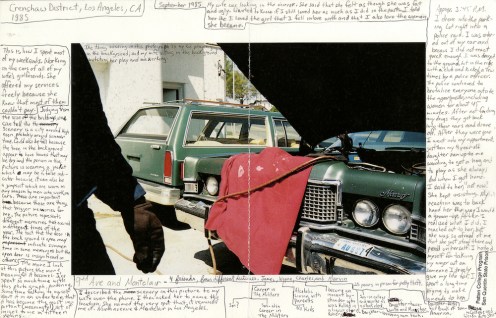
The other wonderful thing that has come out of this is that Poor is using the images as teaching aids. Just as she had done with iconic images from art history (see the William Eggleston, Lee Friedlander and David Hilliard images above), Poor asked her students to deconstruct, examine and interpret the newly-found images from the San Quentin archive. After she had scanned and printed them on card-stock with large white borders, Poor gave them to the men to interpret.

She has given the prisoners first go at interpreting San Quentin’s history. They are writing the latest stories of a very-storied institution.

Read my article about the archive discovery Rarely Seen Images of the Real San Quentin on the Marshall Project. The article was also cross-posted to The Atlantic — Unearthing San Quentin: Resurrected photos capture moments of daily life at the California prison.

Nigel Poor San Quentin

Nigel Poor San Quentin

Nigel Poor San Quentin

Nigel Poor San Quentin

03_Holidays _ Ceremonies

07_Work _ Leisure

04_Education, Food _ Health

01_Escape _ Confinement

09_Family Visits

price4


PRISON AND SOCIAL DEATH BOOK LAUNCH IN BROOKLYN

Get yourselves down to my fave counter-culture culture-space, the Interference Archive in New York City tonight for the launch of Joshua Price’s new book Prison and Social Death.

Joshua Price will be joined by Five Mualimm-ak and Terrence Slater from the Campaign for Alternatives to Isolated Confinement (CAIC) for a discussion of current efforts to end solitary confinement and other forms of extreme isolation in state prisons and local jails in New York and nationally.

“Isolated confinement,” explains the Interference Archive. “involves confining people in a cell for 22 to 24 hours a day without meaningful human contact, programming, or therapy. This practice is ineffective, counterproductive, unsafe, and inhumane, and it causes people detained in these conditions to deteriorate psychologically, physically, and socially. Nevertheless, New York utilizes isolated confinement at rates well above the national average.

price3Price, Slater and Mualimm-ak will discuss the experiences of people who have survived solitary confienment, and review recent legal settlements, legislative initiatives and activist attempts to end or curtail the use of solitary and solitary-like conditions.
BIO

Joshua Price teaches at SUNY Binghamton. He is the author of two books, Prison and Social Death (2015) and Structural Violence: Hidden Brutality in the Lives of Women (2012). He is coediting the forthcoming Decarceration and Justice Disinvestment, which examines the recent drop in the prison population in New York State.

Price has been committed to anti-racist, anti-gender-violence organizing for the last twenty-five years, especially in movements that advocate for currently and formerly incarcerated people. For his work, the Broome/Tioga County NAACP has honored him as Citizen of the Year and the New York State Assembly has cited him for “Outstanding Commitment to the Civil Rights of New Yorkers.”

DETAILS

131 8TH STREET NO. 4
BROOKLYN, NY 11215

Map

THURSDAY, FEBRUARY 18TH

7:30PM ONWARDS

ALL INFO HERE

GET THE BOOK

Prison and Social Death.

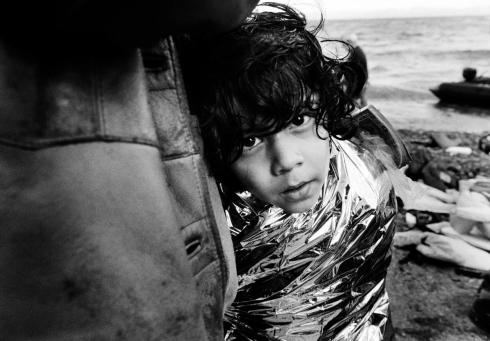
A boy from Afghanistan tries to keep warm after a cold and wet crossing from Turkey. Cases of hypothermia are on the increase as the weather deteriorates across the eastern Mediterranean.

In an image saturated world it’s difficult to define and measure the effects of photographs. We know advertising works, but those are images intended to sell us stuff. What if the purpose of a photograph is to “sell” us of a moral or political point? What if a photograph wants us to shift our emotional and practical response to far away events?

Giles Duley’s work Lesvos: Crossing To Safety made in Greece last October are intended, firstly, to bear witness and, secondly, to provoke action to help the hundreds of thousands of migrants. That’s why he didn’t simply make images and send them to the wires, but he courted the support of the United Nations so that he might extend the distribution of his imagesand the refugees’ storiesfar into global, humanitarian dialogue channels. (This UN-produced feature on Duley’s career and motivations is very thorough.)

Not content with only traditional distribution channels, Duley looked for alternative ways of launching his images into an unorthodox space; a Massive Attack gig.

“The scenes were overwhelming,” Duley said to the UNHCR. “In all the time I’ve worked, I’ve never seen such emotion and humanity laid so bare as I witnessed on the beaches of Lesvos. One of the first emails I sent was to the guys in Massive Attack. Seeing such events, I felt so powerless, I needed to do something. At that stage I had no idea how the collaboration would work, but I knew the band would want to act.”

1

2

Stills of Giles Duley’s photos on screen behind the stage of Massive Attack. Courtesy: Massive Attack.

A founding element of the era-defining Trip Hop genre, Massive Attack are known for taking forthright stances on political and governmental behaviours. Saturday Come Slow, their collaboration with released British Guantanamo detainees, Broomberg & Chanarin and Damon Albarn was poignant, crafted and clever, I thought.

Furthermore, as Alexis Petridis wrote for the Guardian, “Massive Attack have worked with the Stop the War coalition and visited refugee camps in Lebanon, while in 2011, Del Naja and Radiohead’s Thom Yorke threw a party for Occupy protesters who had taken over a UBS bank building in London.”

It’s not surprise Massive Attack are lending their support to Duley and shocking their euphoric crowds with thumping reality. Duley’s images loop throughout the gig, but they get their biggest showing at the close of the show, when the music ends and the band leaves the stage. For minutesin silencethe crowd is shown a mammoth slideshow of Syrians and other migrants landing in boats, hungry, tired and terrified. A far cry from the revelry of a gig. But people stayed. This Channel 4News segment is well worth the watch:

History has taught us that photos can certainly alter the mood of entire populations. Practice has also taught us that earnest, targeted messaging can help photos land. I hope more artists can lend a hand to serve the messages of humanitarian photographers. Usually, professionals commission images to be made to meet their own messaging needs so it’s great to see artists, citizens and successful public figures provide space within their platforms to amplify photographer’s voice.

Included here are Giles Duley’s images from Lesvos, Greece, made in October 2015.

An overcrowded boat carrying Syrian refugees heads to shore. One Syrian man had fallen from the boat into cold water. He was later rescued by volunteer Spanish lifeguards. Despite the approach of winter and worsening weather, refugees are continuing to arrive on the island at a rate of more than 3,200 per day. As of mid-November, at least 64 people have drowned this year in 11 shipwrecks off Lesvos.


Boat after boat lands on the coast of Lesvos between Eftalou and Skala Sykaminia. Over 45 per cent of the 836,088 refugees and migrants who have arrived in Europe so far in 2015 have landed on this Greek island, which is separated from Turkey by a 10-kilometre channel.


An Afghan mother holds her child moments after landing on the beach near Skala Sykaminia. UNHCR and its partners work to prevent family separations and create safe areas for women and children who are particularly vulnerable.

An Afghan family of several generations disembark from an overcrowded boat. Almost 40 per cent of refugees currently arriving on Lesvos are from Afghanistan.

UNHCR is working around the clock with other agencies and aid groups, stockpiling and distributing winter aid items to keep vulnerable people, both in camps and urban settings, protected and warm. Donate money to the UNCHR (United Nations High Commission for Refugees) here.

• The distribution of winter survival kits including high thermal blankets, sleeping bags, winter clothes, heating stoves, and gas supplies.
• The provision of emergency shelters including family tents, refugee housing units and emergency reception facilities.
• Improvement of reception and transit centers and preparing and supporting families for winter conditions.

You can help make a difference. Donate money to the UNCHR (United Nations High Commission for Refugees) here.

A relieved Afghan family, clearly still suffering from the trauma of a rough sea crossing at the hands of people smugglers, disembarks from a flimsy vessel onto a Lesvos beach.

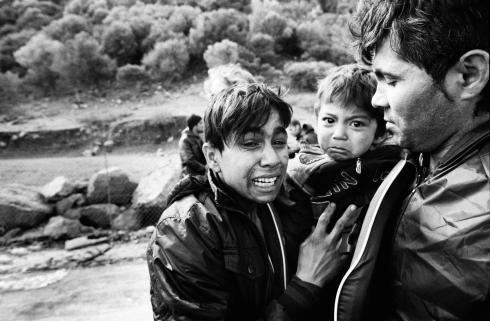
An Afghan mother hugs her child and cries with relief after arriving on Lesvos.

Survivors struggle ashore after their boat has capsized. In the background a Spanish lifeguard, one of the many volunteers working on the beach, swims out to help other survivors.

A Syrian father, his two children now safely wrapped in thermal blankets, looks to the heavens in thanks after landing safely on the beach.

A young Afghan boy with his aunt. His mother is receiving emergency medical treatment after she collapsed upon landing. Since August UNHCR, in close cooperation with the Greek authorities and other humanitarian actors, has considerably stepped up its activities to respond to the increasing needs. This is even more imperative with the onset of winter.

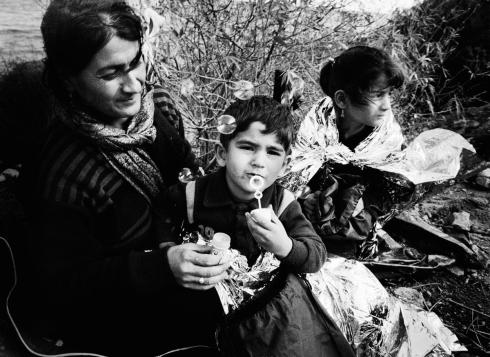
Volunteers prepare to wrap a young girl in an emergency blanket to protect her from the cold wind.

Follow UNHCR on Instagram, Twitter and Facebook. Donate money to the UNCHR (United Nations High Commission for Refugees) here.

Read ‘War Survivor Focuses Lens on Refugees about Duley’s work in Greece. Reacquaint yourself with the ‘Lesvos: Crossing to Safety feature. Read a review ‘How Many Stories Can You Tell In One Second? of Duley’s new book One Second of Light.

Connect with Giles Duley on Facebook, Twitter, Linked In and EW Agency.


EMAIL

prisonphotography [at] gmail [dot] com

Prison Photography Archives

Post Categories