Kyodo/Reuters

From the New York Times:

The Japanese government opened up its execution chambers to the public for the first time on Friday, taking journalists on a tour of Tokyo’s main gallows. The insides were stark: a trapdoor, a Buddha statue and a ring for the noose.

[…]

“Apart from Japan and the United States, the other countries in the world that carry out capital punishment are those accused of other grave human rights violations,” said Kanae Doi, a lawyer who heads Human Rights Watch Japan. “Japan should be ashamed to be on that list.”

The US should be ashamed too.

This recent release piques my interest:

Killed: Rejected Images of the Farm Security Administration prints 130 tri-toned black-and-white images scanned from negatives in the collection of the Library of Congress. Wiliam E. Jones’s book is the first to deal exclusively with the 35mm negatives that FSA director Roy Stryker killed with a hole punch during the early years of the project (1935-39). The book brings to light destroyed or defaced photographs by Walker Evans, Ben Shahn, John Vachon, and others; it also includes two essays by Jones discussing the images and possible reasons for their suppression.

You can search through the 175,000 Farm Security Administration/Office of War Information Black-and-White Negatives and pick out the punched prints yourself. Here’s some off just the first page.

In July, Foto8 reviewed the Punctured, a 5 minute film by the book’s author William E. Jones:

It was not so long ago that photographers and editors editing film would use a hole punch to indicate a selected frame, clipping a small half circle out of the edge of the frame by the sprocket holes where the frame number and film info had been burned into the emulsion during manufacturing.  Stryker was more ruthless with his hole punch, “killing” the work of his photographers by punching a hole directly through the negative image. Unsurprisingly, the photographers objected to this practice, which Stryker ended in 1939. Many of the punched negatives survive in the US Library of Congress FSA archives.

Punctured, Jones explained, is about the “Interface between image making and power…  what images authority gives us and what we do with them.” Jones’ effort is to unsettle those relationships and to this end Punctured is articulate in its explorations of the way that archives are constructed, of the FSA archive specifically as the product of Stryker’s judgments …

OTHER PUNCHY CONTRIBUTIONS

This all leaves me thinking of Lisa Oppenheim‘s Killed Negatives: After Walker Evans.

Lisa Oppenheim, from the project Killed Negatives: After Walker Evans

Carefully Aimed Darts points out the Etienne Chambaud also made use of the defaced FSA negs for the show A Brief History of the Twentieth Century

Installation shot, Etienne Chambaud: Personne, 2008

If only for the similarity between precision-cut and precision-painted holes I am left thinking of John Baldessari:

John Baldessari. Hitch-hiker (Splattered Blue) 1995. Courtesy Marian Goodman Gallery, New York © John Baldessari. Colour photograph, acrylic, maquette

Photograph: Benjamin Sklar for the Guardian

It’s just a brief account of his time in solitary and his time since the overturning of his conviction. 29 years in 24/7 lock-down is a long time for anyone, is it worse for someones who’s innocent?

“I didn’t realise how permanently the experience of solitary would mark me. Even now my sight is impaired. I find it very difficult to judge long distances – a result of living in such a small space.”

Photo: Chip Litherland

I spent all day looking at photography and this was the last thing through my RSS. Exhausted but pissed off, I have to post.

Chip Litherland (@chiplitherland) was on assignment for this story in the New York Times, and shared a few images on his blog. I simply copy & paste the comment I left with Chip here:

The red hues, the spot light (recalling war photography), the drama in general but most of all the solemnity of Jones who poses between the ultimate Hollywood myth and a shooting target – it reeks of a man who’s more obsessed with theatrics & violence than he ever will be with reality.

I expect this was one time you wanted to put down your objective journalist persona and tell him straight he’s a liar, a nutter and a danger to those fooled by his hate.

More of Chip’s images here.

Fair Warning: This will probably be the only post I do about the Islamophobia gripping the vocal minority in America. There’s no point talking about it; it’s hate and those spewing it are dangerous simpletons. My only worry is that TV will continue to bombard people with heady graphics, drastic statement and “passive wonderment” (as Jon Stewart has best described it). At this point, Fox News conjures the wildest conspiracy theories in America.

Ernest Morgan, an inmate since 1987, holds his prison-approved CD player. Photo: Jon Snyder/Wired.com

My friend and colleague Matt Shechmeister at Wired’s Raw File just published Life on Lockdown: See-Through Gadgets, DIY Media, No Internet, an article and gallery on idiosyncratic prison technologies.

Matt went to San Quentin Prison with photographer Jon Snyder (@jonsnyder) to tour cells and music studios to report on the see-through typewriters, prison-sanctioned music selections and contracted companies all shaping the security-minded tech-culture at San Quentin.

Not an angle seen or read very often. Well worth checking out.

This is worrying.

Los Angeles Jail guards at the Pitchess Detention Center, Castiac, CA have a new weapon in their armory. The 7 1/2-foot-tall ‘Assault Intervention Device’ emits an invisible 5-inch-square beam that causes an “unbearable sensation”.

The device is manufactured by Raytheon, an 80 year old multibillion dollar surveillance, radar and missile specialist with a catalogue of space-war technologies. Compared to Raytheon’s sprawling, global and stratospheric innovations, the ‘Assault Intervention Device’ is small, contained and personal.

Cmdr. Bob Osborne of the LA County Sheriff’s Technology Exploration Program, one of several deputies who tested (see video) the ‘Assault Intervention Device’, described the experience, “I equate it to opening an oven door and feeling that blast of hot air, except instead of being all over me, it’s more focused.”

The device – controlled by a joystick & computer monitor and with a 100 foot range – will be mounted near the ceiling in a unit at Pitchess housing about 65 inmates.

NBC Los Angeles reports, “The energy traveling at the speed of light penetrates the skin up to 1/64 of an inch deep. […] ‘Assault Intervention Device’ is being evaluated for a period of six months by the National Institute of Justice for use in jails nationwide.”

The statistics for violence at Pitchess are quite shocking – 257 inmate-on-inmate assaults occurred in the first half of the 2010.

Pitchess, a facility with 3,700 inmates, is a large facility with riots (some very recently) and obviously needs to counter the culture of violence. I just wonder whether shooting brawling inmates with lasers is the right way to go about it?

– – –

I have looked at highly sophisticated technologies before and how their imaging can affect our understanding of prison life, tension, engagement.

How would images of prisoners reeling from a ‘Assault Intervention Device’ laserbeam influence public opinion about this new fan-dangled correctional management tool? The deputies who’ve tested it say it’s unbearable and can only be endured for three seconds maximum, yet everyone knows that tasers are often repeatedly discharged upon stubborn, adrenaline-fuelled (sometimes drugged up) targets.

Again, very worrying.

“Women actively participated in every significant photographic movement and school of the twentieth century. […] As a young historian I discovered that a little digging in any period yielded important women who had been exhibited and published locally, nationally, and internationally. Women’s representation and the acknowledgment of their contributions declined or disappeared only when later historians evaluated a movement. The more general the compendium, the less likely women were to be well represented.”

Anne Tucker’s foreword for Reframings: New American Feminist Photographies

Kate Wilhelm of Peripheral Vision has put together a thoughtful post about the exposure, visibility and success of female photographers in the industry. Wilhelm’s main contention is the standards that exist in photography are male standards, a set-up particular to photography and not seen, as such, in other visual arts. I think she might be on to something.

I think photography (particularly fine art) is aggressively contested and often antiseptic, emotionally detached photos win over. I am not saying women have the market on emotion, but I do think female photographers might be attracted to subjects other than the cold observations that tend to dominate.

We seem to welcome softness, expression and emotive content in painting, but we either balk or yawn at the “sentimental” use of bokeh, lens flare, and golden hour dreamscapery in photography. I guess I worry that photography can be a cynical practice (?)

Photography has become synonymous with detachment and I think men are more comfortable celebrating detachment … Je suis désolé … I argue that solitary aesthetics, pursued by men in photography, have influenced the judging standards across the entire discipline.

Wilhelm provides these stats, which are her own observations, counts but a good start for discussion.

500 Photographers has only covered 17 women out of the 94 photographers it’s so far covered. That’s 18 percent.

Image Makers Image Takers has interviews with 20 photographers. Five of them are women. (Incidentally, it was edited by a woman.) That’s 25 percent.

The photograph as contemporary art, by Charlotte Cotton, discusses 219 photographers, give or take a few. 91 of them are women. That’s 42 percent.

Leventi, David - Stateville, Joliet, IL

Following my recent post of David Leventi‘s work, a reader contacted me to alert me of the potential (and presumably happenstance) development of Stateville Correctional Center, Joliet, Illinois as an art object.

Consistently through the representations of Stateville is the description of the roundhouse as one of the last remaining prisons in America adhering to the Panopticon model developed by Jeremy Bentham.

Let us be clear, the Panopticon is an outdated and abusive model for corrections; it relies on a small number controlling a large number through the threat of constant supervision. Modern correctional management must look beyond disciplinary techniques based upon spatial arrangement and look toward truly transformative (educational) engagement with prison populations.

Still one can only speculate that the roundhouse prison is of interest to artists primarily because of its “purity” of form as understood – and communicated – through the formal qualities of composition within the photographic print.
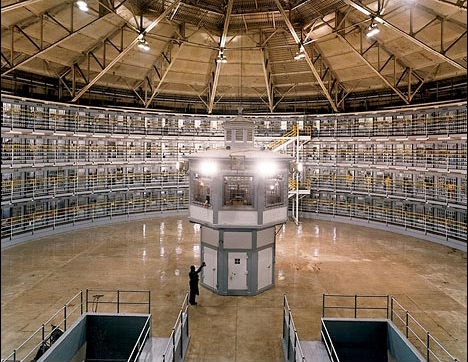
USA. Illinois. 2002. Stateville Prison. F house. There were originally four circular cell houses radiating around a central mess hall. The buildings were based on Jeremy Bentham's 1787 design for the panopticon prison house. The first round house was completed in 1919, the other three were finished in 1927. F house is the last remaining panopticon cell house. It's used for segregating inmates from the general prison population and for holding inmates who are awaiting trial or transfer. -Doug DuBois & Jim Goldberg.

In 2002, Doug Dubois, along with Jim Goldberg, went to Stateville Correctional Centre, and took a picture (above) of the prison’s interior. The New York Times later published the photograph.

A while later, Dubois found out that Andreas Gursky had too gone to Stateville, apparently inspired by Doug and Jim’s photograph and took a picture himself (below). Gursky has admitted in his career he finds ideas for images in newspapers and other popular media. Gursky’s image put in context here, at the Brooklyn Rail.
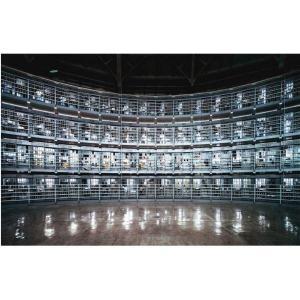
Andreas Gursky, “Stateville, Illinois” (2002), C-print mounted on Plexiglas in artist’s frame. Courtesy Matthew Marks Gallery, New York.

So, this raises questions. Has Stateville prison inadvertently become a tease, and a subject for curious photographic artists?

Do the individual activities of artists have a bearing on one another? Should these images exist within the same discourse? Do photographic attentions of the 21st century have any relation to the need and stresses of current correctional politics in Illinois?

Does the ascendancy of Stateville onto gallery walls effect any significant – or measurable – impression of Stateville prison within public consciousness?

Or are Dubois, Goldberg, Gursky and Leventi just continuing an intrigue which has continued throughout the decades?
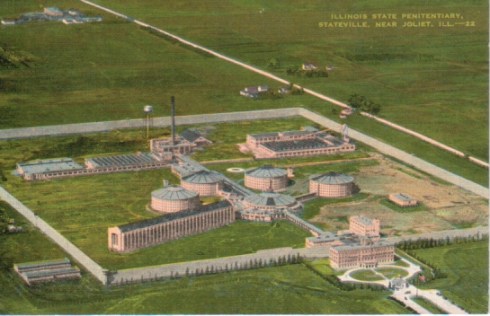
Postcard: Stateville Penitentiary, near Joliet, Illinois (ca. 1930s).
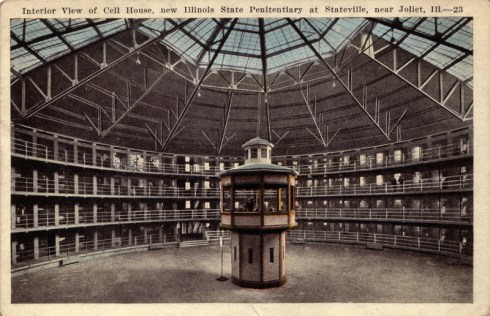
Postcard of an American panopticon: "Interior view of cell house, new Illinois State Penitentiary at Stateville, near Joliet, Ill." Source: Scanned from the postcard collection of Alex Wellerstein. (Copyright expired.)
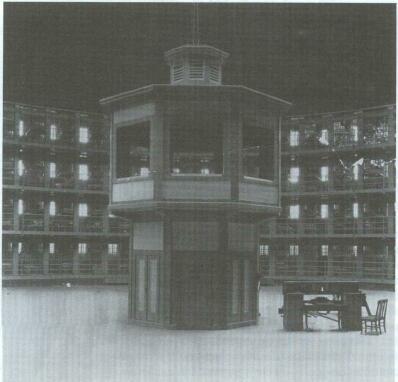
Postcard of an American panopticon: "Interior view of cell house, new Illinois State Penitentiary at Stateville, near Joliet, Ill." Source: Scanned from the postcard collection of Alex Wellerstein. (Copyright expired.)

Photo of guard tower in round house at Stateville. Courtesy of Illinois State Historical Library. The second state prison was authorized at Joliet in 1857. It was built by convict laborers. That 135-year-old Joliet prison still houses more than 1,100 inmates. Meanwhile, Stateville. prison, also in the Joliet area, opened for business in 1917.

Photo of guard tower in round house at Stateville. Courtesy of Illinois State Historical Library. The second state prison was authorized at Joliet in 1857. It was built by convict laborers. That 135-year-old Joliet prison still houses more than 1,100 inmates. Meanwhile, Stateville. prison, also in the Joliet area, opened for business in 1917.

Inmates at Stateville Penitentiary in 1957. (Sun-Times News Group file photo)

Inmates at Stateville Penitentiary in 1957. (Sun-Times News Group file photo)

Prison guard in a security tower, Stateville Penitentiary, Joliet, Illinois, USA. © Underwood Photo Archives / SuperStock
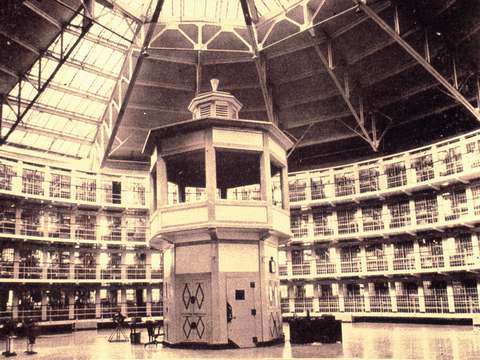
Prison guard in a security tower, Stateville Penitentiary, Joliet, Illinois, USA. © Underwood Photo Archives / SuperStock

Panoptic guard tower at Stateville Prison, Stateville Prison (US Bureau of Prisons, 1949, p. 70), 1940s

Panoptic guard tower at Stateville Prison, Stateville Prison (US Bureau of Prisons, 1949, p. 70), 1940s

EMAIL

prisonphotography [at] gmail [dot] com

Prison Photography Archives

Post Categories