I greatly admire Broomberg and Chanarin‘s work and I’ve followed Massive Attack since their debut album Blue Lines. So, I was stoked to see them pair up and meditate on the tortuous capacity of sound, mix in an interview with former Gitmo prisoner and UK citizen Ruhal Ahmed, and then get Damon Albarn in on the act too.

Saturday Comes Slow was recorded at Cambridge University’s anechoic chamber (designed to create total silence). It is neither film, photography nor journalism; the video is part activism, probably art and definitely a call to thought.

At this years Les Rencontres d’Arles Photographie Festival the official photographs of the French prison inspectorate make up an exhibition entitled Behind the Walls of Cliche.

The independent French prison inspectorate (contrôleur général des lieux de privation de liberté) is nominated for six years and during that time he cannot receive any instruction from any authority; he can be neither removed nor renewed; and he cannot be prosecuted for his opinions he formulates or for the actions he carries out in his functions.

Currently, the director is Jean-Marie Delarue (here’s an interview with him about the state of French prisons).

Delarue’s team take photographs as documentation as they tour France’s prison system and it is these images that are currently on show at Rencontres d’Arles.
To my mind, this is a truly unique exhibit. I know not of any other arts festival that has put front-and-centre the administrative photography of a working independent or government agency overseeing prisons.

BLURB FROM LES RENCONTRES D’ARLES SITE

Sixty thousand detainees in French prisons: surely the problem can’t be all that hard to solve!

The Rencontres, in their own way, are part of the media, and this exhibition based on the report of France’s Inspector General of Prisons, Jean Marie Delarue, shows just how the world of French gaols, far from being an aid to social reintegration is, rather, an insult to the human condition. This is a call to look beyond the standard ideas about prison.

The exhibition also demonstrates the limitations of photography, which cannot convey the nuances of everyday unhappiness in prison. In a photo a TV set, a workshop and a library seem to offer possibilities which in fact are non-existent for most prisoners, and certainly not available on a regular basis. The rules of hygiene and safety are flouted every day, the psychological stresses are chronic, and the laws regarding the minimum wage and access are broken by the state itself. None of this is visible in a photo.

Pictures of a new prison seem to suggest a solution; but the image doesn’t tell you that new prisons have a higher suicide rate than old, dilapidated ones. Three people in a cell is something you can see; but what you don’t see is that one inmate standing means two lying down, because there’s nowhere to sit. And with prisoners spending 22–24 hours a day in their cells, it’s easy to imagine their physical and psychological state.

This is definitely not photojournalism, but rather an alarm signal regarding one of democracy’s least well known instruments.

François Hébel, exhibition curator

Excerpt from Law no. 2007-1545 of 30 October 2007:

’The Inspector General of Prisons is an independent authority whose duty it is, without prejudice to the prerogatives attributed by the law to the judiciary or jurisdictional authorities, to monitor the conditions of incarceration and transfer of persons legally deprived of their freedom, so as to ensure respect for their fundamental rights.

Within his field of responsibility, he takes no orders from any authority… He cannot be relieved of his duties before his term has expired… The authorities in charge of places of imprisonment cannot oppose a visit by the Inspector General except for grave, imperative reasons relating to national defence. The Inspector General may demand from those authorities all information and documentation required by the carrying-out of his mission. In the course of his visits he may speak, under circumstances guaranteeing the confidentiality of what is said, with any person whose participation he sees as necessary.

At the end of each visit the Inspector General makes known to the relevant ministers his observations regarding the state, organisation and functioning of the site visited, and the condition of those imprisoned there… Each year the Inspector General submits a report to the President of the Republic and to Parliament. This report is made public.’

The 2009 report is published by Dalloz.

PREVIOUSLY ON PRISON PHOTOGRAPHY

I’ve noted French prison photography before. From Jean Gaumy, the first photojournalist in the French prison system to contemporary artist Mathieu Pernot; from the archives of Henri Manuel to portraitist Phillipe Bazin; and to the recent exhibition Impossible Photography – artistic survey of French prisons.

– – –

Of course, if you want to get really involved check out Melinda Hawtin’s French Prison Photography graduate work.

France even has its own National Museum of Prisons!

– – –

Thanks to Yann Thompson for the tip!

Always lots of good stuff on MediaStorm and many of the projects from their workshops and training belie the relative “inexperience” of their creators.

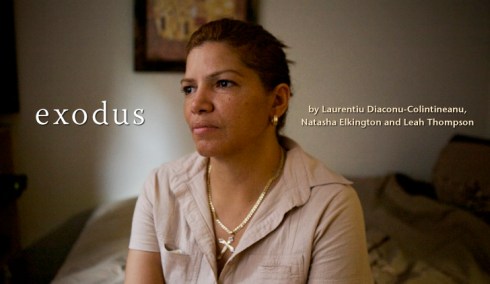
Exodus tells the story of Diana Ortiz, 45, who spent over half her life in prison. She says it saved her.

Diana dropped out of high school at 18 to live with a man twice her age. To pay for their drug habit, her boyfriend devised a scheme to lure a man into a secluded Coney Island parking lot and rob him.

In the early hours of August 20, 1983, the robbery veered off-course and two men were shot. One was killed. Though Diana was not at the scene of the shooting, she was sentenced to 17 years to life for her role in the murder.

She served twenty-two and a half years.

While behind bars Diana earned her master’s degree, developed a strong identity and self confidence. She is now an inspiration for other inmates, helping them to rebuild their lives.

This workshop story was inspired by the New York Times story about Diana Ortiz titled Convicted of Murder as Teenager and Paroled at 41. (Which I mentioned here on PP before)

Credits
Photography, audio and video: Laurentiu Diaconu-Colintineanu, Natasha Elkington, Leah Thompson
Producer: Jennifer Redfearn
Executive Producer: Brian Storm
Graphics: Tim Klimowicz
Transcription: Avi Tharoor-Menon

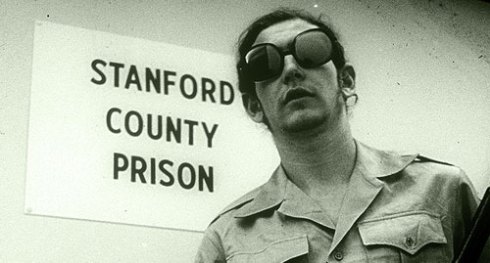
39 years ago today, Philip Zimbardo and his psychology students embarked on The Stanford Prison Experiment and demonstrated that we are all capable of psychological and physical violence upon other humans in conducive institutional environments.

The fabricated prison in the basement of the Stanford University Psychology Department became grim reality when the volunteers – randomly selected as either ‘prisoners’ or ‘guards’ – played out their parts with authoritarian abuse and complete submission, respectively.

The experiment was abandoned after six days. It was intended to last two weeks.

Everything you could ever want to know about the original experiment and its legacy can be found here.

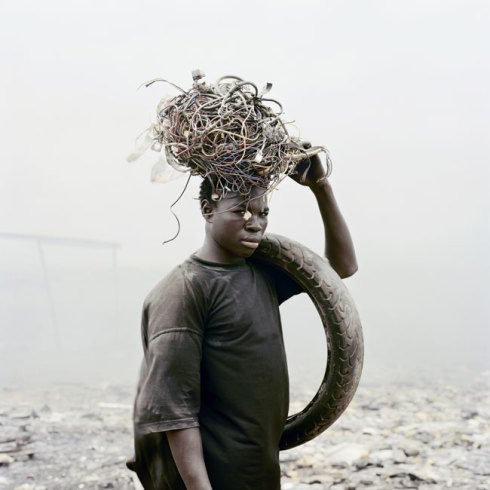
Yakubu Al Hasan, Agbogbloshie Market, Accra, Ghana 2009

Yakubu Al Hasan, Agbogbloshie Market, Accra, Ghana 2009

Pieter Hugo’s series Permanent Error appeared in last weeks New York Magazine under the title A Global Graveyard for Dead Computers in Ghana.

The style is not too distant from Nollywood or The Hyena & Other Men, the former of which dusted up a small (and in my opinion, unnecessary) brouhaha last year about neo-colonialism/exploitation in photography.

Hugo’s case, in this instance, is not helped by the fact that the NY Times magazine piece is purely a gallery with no journalist  elaborations, save the captions.

The merits and shortcomings of Hugo’s photographic approach is only half the issue; our denial of the extent of racial and economic inequality colours our response.

Hugo graduated in 1994. In this interview (which I think I came across amongst James’ youtube feast) Hugo gives an interesting perspective on how his work fits historically in the South African tradition.

“The photography in South Africa comes from a very political background. Pre-1994, it was an extreme situation here. And if one had the skill you had a certain responsibility to inform the world what was happening here. It was very much all black and white. This is wrong and this is right. There are good guys and there are bad guys.

That’s all changed now. Guys that were good are now bad and the lines aren’t as distinct as they were. […] Things are more complex […] One of the things I hope people get when they look at my pictures is that things are complex.”

This still might not excuse an aesthetic that aggressively depicts African subjects as “the other”, but then, what split second act of opening the shutter is not a machine-mediated differentiation between user and subject?

AFTER THOUGHT

The overtly-political nature of South African (photojournalism) photography is something David Goldblatt, as an art-documentarian, had to negotiate himself away from. And yet, as Fred Ritchin remarks, “during Goldblatt’s career, which began in the early 1960s, nearly everything that he saw was contextualized by the distorting prism of apartheid.”

This makes me wonder if there’s been an adequate survey of ‘South African photography from the second half of the 20th century’ toured on an international stage. If there has been, please let me know.

Between April and now, right under everybody’s noses, Visura Magazine only went and interviewed about over a dozen of the really important folk in photography. Here’s a few:

Interview: Jessica Ingram
Interview: Michael Itkoff
Interview: Mark Murrmann (Mother Jones)
Interview: Claire O’Neill (NPR Picture Show)
Interview: Nathalie Herschdorfer (Curator, Musée de l’Elysée): reGeneration project
Interview: Brian Storm (MediaStorm)
Interview: James Estrin & Josh Haner (NY Times Lens Blog)
Interview: David Alan Harvey (Burn Magazine)
Interview: Nelson Ramírez de Arellano (Curator, Fototeca de Cuba)
Interview: Jon Levy (FOTO8)
Interview: Ricardo Viera (Curator, LUAG)
Interview: Idurre Alonso (Curator, MoLAA)

And in plain sight of everyone, Gerald Holubowicz went long-from and interviewed on film some of the sharpest minds and forward thinkers in the industry (Sharpness is a must to mastermind the diversification and survival of leading collectives such as VII and Magnum.)

Gerald’s interview series “Sortir du Cadre” (Think outside the box) has so far quizzed

Interview: Stephen Mayes (Director of VII)
Interview: Mark Lubell (Managing Director of Magnum)
Interview: Paul Melcher (Cofounder and Senior Vice President of PictureGroup)
Interview: Jean Pierre Pappis (Founder of Polaris Images)

– – –

First class efforts from Gerald and from Adriana Teresa and Lauren Schneidermann at Visura

Over the next few weeks, posts at Prison Photography may thin out a little as I devote a chunk of energies to a new gig at Wired’s photography blog, Raw File. For the following reasons, this is an exciting new departure for me:

– I can call on the expertise of a knowledgeable and calm editor (when I pitch ideas, he says “home run” or “leave it alone”)
– I can piggyback on the back of some ridiculous stats (I guess that’s just Wired for you?!)
– Readers of Raw File have a many more reasons to stop there than they do here (ie, they’re not only tangentially interested in prison reform or in the past somehow stumbled upon my photography commentaries) … and they are harsh critics.

So far I’ve looked at:

– Laura Pannack’s recent work and success – Striking Teenage Portraits Boost Young Photog’s Career
– The alternatives to the Norsigian/Ansel Adams saga – Troves, Caches and Suitcases: Famous Lost Photographs Discovered
– and a Southern California Rapid Transit Employee of the Month Portrait Archive – Fabulous Bus Driver Photos Show Off Mustaches, Sunglasses

TWEETS

My tweeting activity shall also migrate from @brookpete to @rawfileblog. Please follow and spread the word on this newly-active-stretches-every-morning twitter account.

La Fenice, Venice, Italy, 2008.

La Fenice, Venice, Italy, 2008. © David Leventi

I first saw one of David Leventi‘s Opera House prints at Exposed, the 2009 Critical Mass Top 50 exhibition at the PCNW, Seattle in March this year. To be honest, I struggled to access it. I am grateful therefore, for his interview with Sarina Finkelstein in which Leventi outlines his motivations and emotional response to these architectures. Toward the end, Leventi discusses his recent interest and move toward roundhouse prisons as subjects – and how they compare to opera houses:

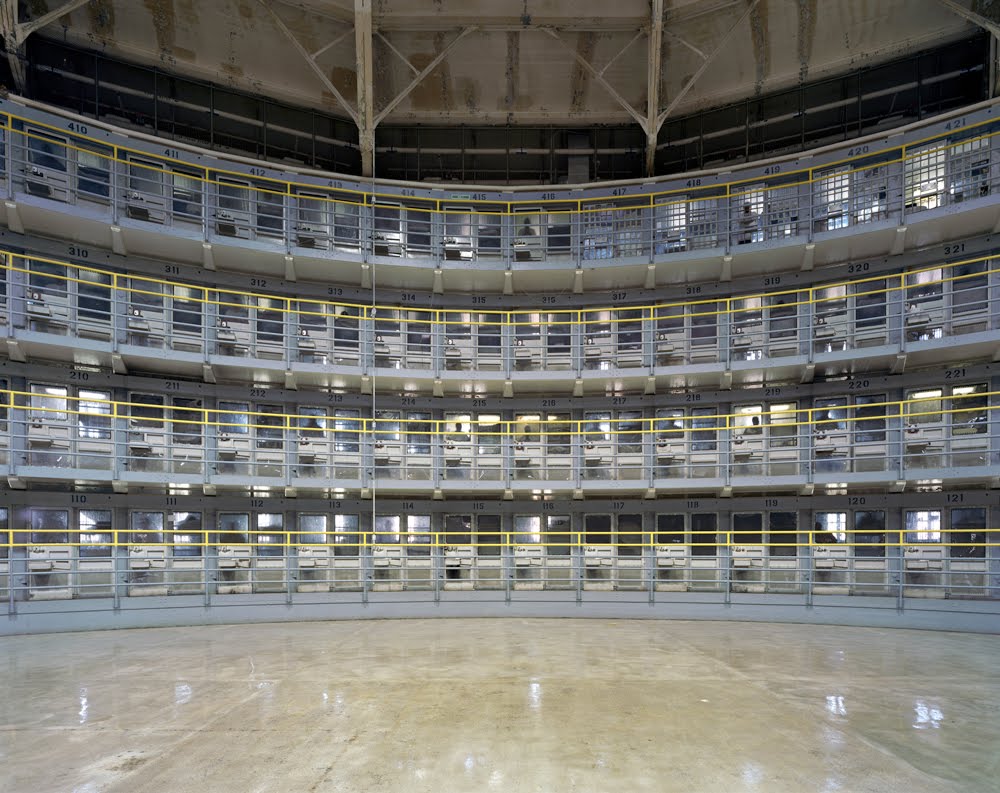
“[Stateville Correctional Center, Joliet, IL] happens to be a reverse opera house. It has basically the same architectural structure as an opera house, but the difference is in who is observing who. In an opera house, the audience of many is observing a few. In a jail, it’s the reverse, giving me the opportunity as a photographer to better understand what it must feel like to be a tenor performing for a full house, albeit with a captive audience.”

Prisoners in their cells, Stateville Correctional Center, Joliet, IL, 2010. © David Leventi

Leventi adds, “I have always had stage fright. Photographing from the center of a round prison is pure anxiety. The in-mates are all yelling, jeering, talking, in cacophony. You become the center of attention and taking the photograph becomes a performance in itself.  At first, I was really intimidated, but then I blanked everything out and focused on photographing. It must be the same for the performer.”

Leventi adds that in the case of both opera houses and prisons, access is the most difficult aspect of his work. No surprise there!

All interesting stuff. I’ll be eager to see his continued progress on this subject matter. Roundhouse prisons are a rarity these days; Bentham’s Panopticon is more likely to crop up in discourses on philosophy than it is in those of criminology or correctional management.

Leventi’s images of opera houses and Stateville prison are reminiscent of some of Richard Ross’ photographs from Architecture of Authority. And, likewise, Leventi plans to look at churches and religious buildings, presumably drawing more parallels between these complete spaces.

EMAIL

prisonphotography [at] gmail [dot] com

Prison Photography Archives

Post Categories