After today’s verdict, it would be understandable if we concluded that – in the eyes of the law – Oscar’s life didn’t matter. The jury had verdict options of murder, voluntary and non-voluntary manslaughter. They choose the latter; the most lenient. After slaying Grant in front of hundreds of witnesses, Johannes Mehserle may well be out of prison in two years. face a five to 14 year sentence if he is not granted probation (Source for the correction).

There’s so much to say about this verdict. Simply, I’ll say today was a sad day for justice, for Oscar’s family and for his memory.

Print from Just Seeds

Irina Rozovsky has done a really good job at confusing me with her series One to Nothing. Intrigued by the palette, I found myself cycling through the edit over and over again, each time conjuring a new narrative in my mind.

I’ve talked about biologist Nalini Nadkarni and the Sustainable Prisons Project in Washington State before here and here.

Well, Nadkarni is back at TED again, this time delivering a quick 6 minute piece on how the things we consider static – trees, perceptions, prejudices and the lives of prisoners – are all open to change … if we see the possibilities, if we allow the possibilities.

At times, Nadkarni’s implored arguments (about tree art) are a bit of a stretch, but ultimately I am focused only on the practical & repeatable efforts her team is making to engage the prison population – a population of whom most others have given up.

Spread from Toppled

Toppled by Florian Göttke

Two weeks ago, Foto8’s Guy Lane reviewed Toppled by Florian Göttke. The review is what it is – a description of Göttke’s “(mainly) pictorial study of the destruction, desecration and mutation of many of Iraq’s plentiful statues of its former dictator.”

Lane’s conclusion points to the significance of Göttke’s study:

“Perhaps this might all appear somewhat peripheral, an iconographical diversion from the real business – invasion, subjugation, and expropriation – of Occupation. But from amongst Göttke’s collated written testimonies and reports, it is possible to sense something of the importance that was attached to the Coalition’s iconoclasm. For example, a BBC account of British activities in Basra concluded that ‘the statue of Saddam is in ruins. It is the key target of the whole raid.’ Meanwhile, in Baghdad a US army captain was ordered to delay destroying a statue until a Fox TV crew arrived. Most famously, the Firdous Square episode appears to have been – to a degree – choreographed for the benefit of the foreign media based in the overlooking Palestine Hotel. ‘American and British press officers were indeed actively looking for the opportunity to capture the symbolic action of toppling statues and have the media transmit these to the world,’ writes Göttke. As such, Toppled’s events and pictures correspond tellingly and damningly to the Retort group’s analysis of our ‘new age of war’.”

Would I buy the book? Probably not. The book is a concept. I understand the concept. And, the images are essentially props to the concept (illustrations of the new biographies of statues, of things).

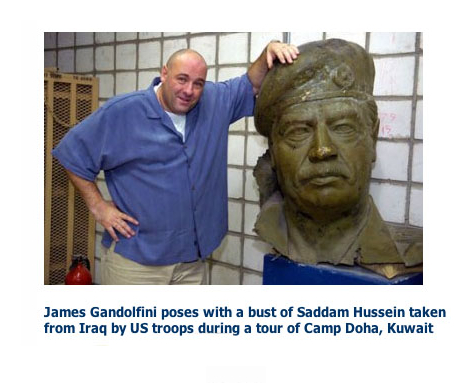
Besides, I can get my fill elsewhere. The best (most ridiculous) image – James Gandolfini meets the Butcher of Baghdad – is on the accompanying Toppled website.

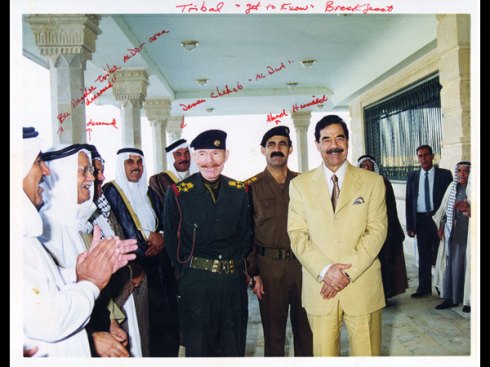
SADDAM’S PERSONAL PHOTO ALBUM

Göttke’s work leaves me wondering how Saddam’s personal photo-album fits in?

Similarly, these images were found and taken during the invasion of Iraq: “On the night of June 18, 2003, the soldiers in the 1-22 Infantry stormed a farm in Tikrit, Iraq, hoping to find a fugitive Saddam Hussein. They didn’t find their target, but they did find a consolation prize: Saddam’s family photo album […] When he returned from Iraq, Lt. Col. Steve Russell, the commander of the 1-22 Infantry, donated the album to the National Infantry Museum at Fort Benning, Ga.” (Source)

This is a reversal, no? Not the effigies of megalomania, but personal snapshots. Not public monstrosities but flimsy two-dimensional depictions. Would these have got pissed on and slapped with sandals? Would they have been torn up/burned up had Lt. Col. Steve Russell not slipped them into his luggage?

Also, to describe the collection (for media publication) as the dictator’s “personal album” is one thing, but to what extent were these Saddam’s photo-memories? Are these really the contents of an album he valued? Are we even glad that Saddam’s images still exist?

One final thought, how do we distinguish between the staging of Saddam’s images to the staging of the images in Göttke’s survey?

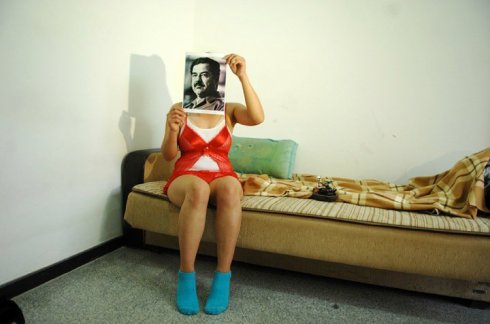
JAMAL PENJWENY

On a less-grander scale, Jamal Penjweny is attempting (with his Iraqi subjects) to make sense of the spectre of Saddam. The series is called Saddam is Here. It’s not great photography but I don’t think this type of playful exploration needs to be.

© Jamal Penjweny

"New Orleans, Louisiana," 1965, by Leonard Freed. © Leonard Freed / Magnum Photos, Inc. Courtesy the J. Paul Getty Museum, Los Angeles.

Kristina Feliciano interviewed Brett Abbott, curator of photography at the Getty, about their summer show Engaged Observers

Abbott succeeds in saying not a lot (it is a brief interview). Abbott lists the exhibit’s famous photographers and recounts the Getty mantra on commitment financial muscle to support acquire documentary photography.

That said, his analysis of Leonard Freed’s image (below) is pause for thought.

KF. What are some of your personal favorites of the photos on view in the show?
BA: Leonard Freed’s picture of two men passing one another on the street in Washington D.C.:  Freed’s protagonists face off, their noses nearly touching on the two dimensional surface of the print.  The older white gentleman occupies a commanding presence in the center of the photograph, but it is the African American on the right who is in focus.  Within the context of Freed’s larger project on racial tension in America in the 1960s, they can be seen as representing basic and opposing forces of the civil rights movement: white and black, the old generation and the new, center stage and marginalized, present and future.  Indeed, the two play out this dialectic beneath a balcony clearly marked as belonging to the house where Lincoln died.
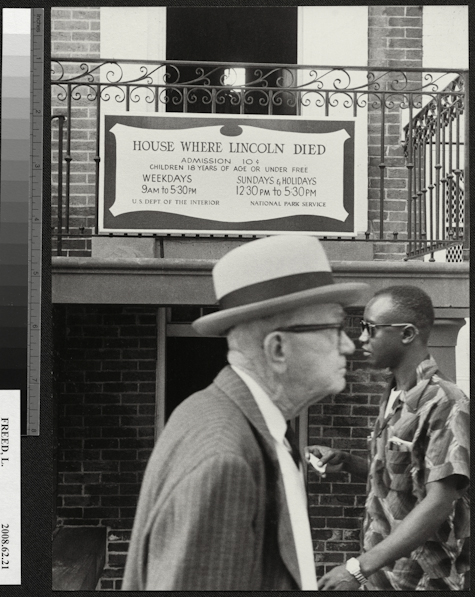
"Washington, D.C., 1963" Leonard Freed (American, 1929 – 2006) © Leonard Freed / Magnum Photos, Inc. Courtesy of The J. Paul Getty Museum, Los Angeles

BLACK AND WHITE IN AMERICA

Leonard Freed observed race in America throughout the sixties; this work eventually taking him to the prisons of Louisiana. Before we get to that, here’s how Magnum describes Freed’s best known work:

In 1962 Leonard Freed went to Berlin to shoot the wall being erected. There he saw an African American soldier standing in front of the wall and it struck him; that at home in the US, African Americans were struggling for civil rights, and here in Germany an African American soldier was ready to defend the USA. This prompted a lengthy examination by Freed of the plight of the African Americans at home in the United States. Freed traveled to New York, Washington, D.C. and all throughout the South, capturing images of a segregated and racially-entrenched society. The photos taken at that time were then published in 1968 in “Black in White America“.

The images below are from prisons within the same state, Louisiana.

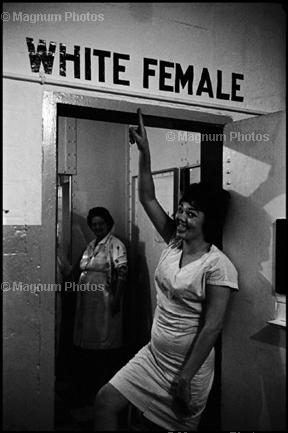
New Orleans, Louisiana. 1963. City prison. Image Reference: NYC21690 © Leonard Freed/Magnum Photos
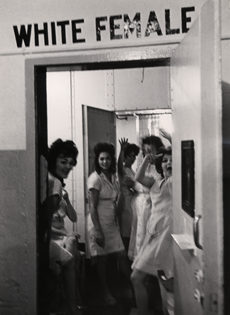
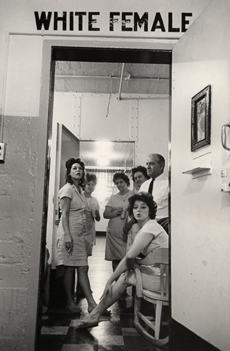
Freed’s documents of the New Orlean’s City Prison are galling. The mood and theatre played out by these women (inmates? nurses? orderlies?) in the “white female quarters” as compared to the claustrophobia and groping along the “colored tier” is confusing, appalling.

I am at pains to know what scene Freed is capturing here in the “white female” section.

The screengrab (below) is taken from the first of two online videos – here and here – in which Freed talks about contact sheets; money and its’ substitute; motivations; and of course, race.

Freed discusses his experience on the “colored tier” from 4:36 to 6:00.

The attitude of the guards is beyond disgusting, “If we desegregate this place there will be blood. Mixing white men with animals. Can’t make us do that.”

If we take Freed at his word, and there is no reason not to, the portrait he paints of Angola was a place where Black men were willingly left to stew; a place where overcrowding was used as a disciplinary tactic, and a place in which racism was the unifying policy. Foul, totally foul.

YESTERYEAR / TODAY

That Freed should have visited a prison in the South as part of his survey on race in America was logical, for perhaps in prisons – more than anywhere else – the least tolerant and most simple interpretations on race existed.

Even today, prisons perpetuate cycles of poverty in minority groups. Furthermore, prison facilities only harden the tensions and misgivings between different racial groups of the prison population.

Freed went to Louisiana, but prisons across the South during the sixties were much of a muchness; they were borne from the same structures that had informed slavery. Robert Perkinson is perhaps the best historian to map this institutional-metamorphoses. In it’s basic premise, his recent book Texas Tough, can apply to prison management not only in Texas, but right across the South.

I highly recommend Marie Gottschalk’s review of Perkinson’s book which summarises his key positions, and is shocking enough in and of itself.

– – – – – – – – – – – –

ENGAGED OBSERVERS

PhotoInduced just reviewed Engaged Observers.

NPR ran a gallery pertaining specifically to the Engaged Observers exhibition.

FREED

Bruce Silverstein and Lee Gallery present Freed’s works online.

Screengrab - Inmate Benjamin Terry stands with Sierra, a mustang he trains as part of the Wild Horse and Inmate Program at the Cañon City Correctional Complex on March 17, 2010 in Cañon City, Colorado.. © Dana Romanoff

Screengrab - Inmate Benjamin Terry stands with Sierra, a mustang he trains as part of the Wild Horse and Inmate Program at the Cañon City Correctional Complex on March 17, 2010 in Cañon City, Colorado. © Dana Romanoff

This is a great photo essay, simply because it is a great story. Unexpected.

Dana Romanoff documents efforts by The Bureau of Land Management (BLM) to round up wild horses and consequently tame them and offer them up for adoption.

“There exist approximately 63,000 wild horses under BLM management. The BLM currently has more than 36,000 horses in captivity in short term corrals and long term pastures. In 2009, the BLM removed 6,300 horses from the wild and in 2010; the BLM plans to remove nearly 13,000 more.”

“A few thousand of the rounded up horses temporarily live at the Cañon City Correctional Facility, Colorado. Under the Wild Horse Inmate Program (WHIP) inmates care for, train and ready selected horses for adoption by the public. Some say the Wild Horse Inmate Program “takes the wild out of both the man and the mustang.” Often an inmate has one horse that he works with and gets to name. Inmates learn a trade and the responsibility of having a job while horses are taught to trust humans, and be saddle and bridal trained. Both a bit spooked at first, the tattooed and muscled inmate and the scared and wild horse learn to trust each other form a bond.”

Who knew?

Well, probably many if they follow Getty Reportage, who are now also on Twitter at @GettyImagesRPTG.

See the prisoner-stereotype-busting images of ‘Wild No More’ here.

BLM

As a footnote, if you go ever go camping in the West do so on BLM land. It is well run, sparsely occupied and has fewer restrictions than any other government run land. For camping, conditions are perfect.

– – – – – – – – – – – – – – –

Who Knew? UPDATE (07.06.10)

Matt Slaby has also covered this story in the past.

BLM UPDATE (07.06.10)

While I’m yapping on about the quality of undisturbed camping, Ellen Rennard is bringing more serious questions to the table about BLM’s relationship with environment-killing big business. (See comments/sources below). Thanks Ellen!

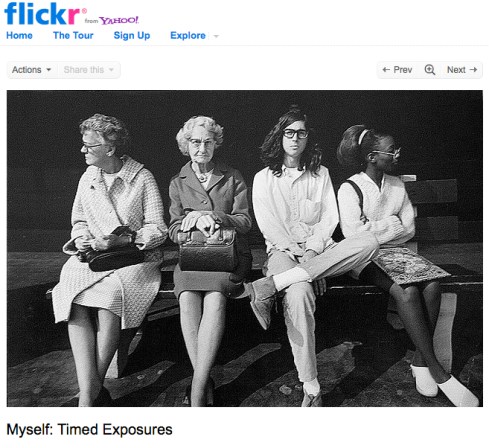
I was surprised to find that Mike Mandel has posted some photographs on Flickr. I thought legends stayed away from “the democratisation of the image.” And yet, Mandel has chanced his arm.

Incredibly, ten images from ‘Evidence‘ are even posted (All rights reserved).*

I was really taken by his mischievous ‘Myself: Timed Exposures’ (1971):

“In Myself: Timed Exposures I attached my 35 mm camera to a tripod and walked out into public space looking for situations to insert myself and create a picture. Once I found a likely opportunity I would set up the camera, release the self-timer on the shutter, and walk into the frame. The mechanical timer would noisily unwind for ten full seconds, allowing the world to change its complexion in front of my static lens. People, strangers to me, would be jarred for a moment from their routine and their perceived public isolation. I was standing uncomfortably close next to them, an abandoned camera buzzing a few feet away. I might say something or nothing at all. And suddenly, ‘click’, the machine had made its own “decisive moment” and only the film would know what latent treasure it owned.”

* ‘Evidence’, in my humble opinion, is one of the best photobooks ever produced.

Since getting to know photographer Robert Gumpert his discomfort with the current world of journalism has been a constant. He doesn’t gripe about technologies like some photojournalist elders (which I don’t have a problem with, by the way), but Bob can’t see a way back from slipping standards as we veer toward the bottom-line priorities of “Newsonomics.”

Bob says:

From the beginning there has been a fight in journalism over where the “firewall” between advertising and the newsroom should be and, as a related question, “what is news?” Is news what readers need to know, or what they want to know?

And so these two articles caught my attention.

The first is At Yahoo, Using Searches to Steer News Coverage. It’s a good headline and pretty much says it all. Yahoo will be using what the reader wants to know to determine content. This is now called democratizing content. In the past it was called tabloid news. […]

[Secondly,] “Gaps in Watchdog Journalism Reflected in News From a Trial.” You could not ask for a better example of why good aggressive journalism is needed and what happens when it isn’t around. The article concerns the coverage of a police torture case in Chicago by John Conroy. Everyone should read this article. I say read this article instead of his regular pieces because no one is employing Mr. Conroy anymore, and few news outlets are doing his kind of investigative reporting.

We are all, individually and as a country, more vulnerable for it.

Here, here! It’s a pleasure to know you Bob.

EMAIL

prisonphotography [at] gmail [dot] com

Prison Photography Archives

Post Categories