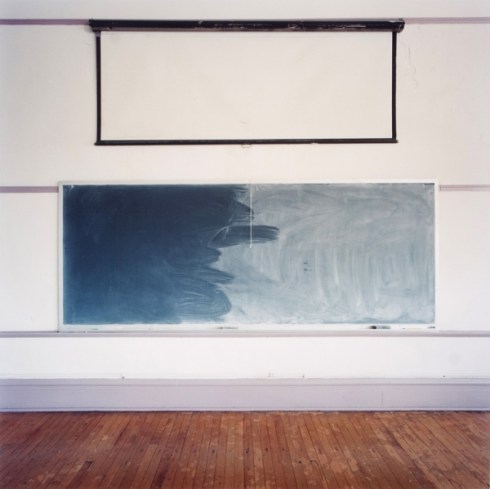
Still from Marilyn Minter’s video ‘Green Pink Caviar’

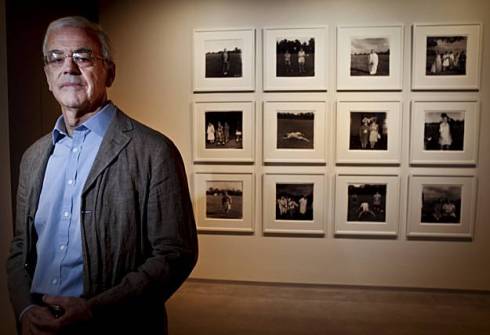
In San Francisco, Andy Pilara has opened the largest gallery space for photography in the country. It’s called Pier 24 … guess where it’s located?!

Although you can get background info from The San Francisco Chronicle or The New Yorker, I’ll point you in the direction of blogger Jin Zhu‘s debriefing for it ponders both the art and the economy of art distribution.

“If you want to see [Eggleston’s] Peaches photo, go to Pier 24 immediately! The American contemporary room is a color lover’s paradise!”

“The place left me with a bittersweet feeling as a side effect of too much exposure to $$$$. You can work at your aesthetic language and photograph for 20 years, but in the end, the people who end up bringing your work to the public in an affordable, appealing way are the super rich guys.”

The motives of arts patrons are wide and varied (exposure, public statement, benevolence, pride, market influence) (?) so I won’t speculate. I will visit when I am in San Francisco next month, though.

Photo: Russell Yip / The Chronicle

I’ll be honest and say I was surprised when I saw Hamburger Eyes and Fotovision team up for an annual fundraiser.

Hamburger Eyes specialises in the grubby, PBR-stained, punk-inertia of San Francisco. High-brow by comparison, Fotovision flies the flag for photojournalism as crucial art in our cynical times. It’s like a teenage kid having a joint birthday party with their sensible aunt?

But, what the feck do I know? The line up is astounding:

Prints by: Larry Fink, Dorothea Lange, Nick Waplington, Bill Owens, Herb Ritts, Michelle Vignes, Colin Finlay, Marcus Bleasdale, Tim Hetherington, Ami Vitale, James Whitlow Delano, Camille Seaman, Kim Stringfellow, Ian Martin, Doug Menuez, Matt Herron, George Ballis, Richard Gordon, Darcy Padilla, Michael Rauner, Chris McCaw, Ernest Lowe, Jack Picone, and Antonin Kratochvil.

Signed collectible books by: Susan Meiselas, Sebastião Salgado, Alec Soth, Alex Webb, Ken Light, Amy Arbus, Chris Killip, and Danny Lyon.

Hamburger Eyes offerings include: Jim Goldberg, Ray Potes, Michael Jang, John Harding, Bill Burke, Ari Marcopouos, Peter Sutherland, Barry McGee, Ted Pushinsky, Oscar Mendoza, and Elena Carrasco.

The auction opens TODAY. Go to Hamburger Eyes’ eBay auction or Fotovision’s online listings. Then go to a big party on the 25th July from 5:30 – 9pm at the Fotovision Office at 5515 Doyle St, Emeryville, CA 94608.

– – – – – – – – – – – – – – –

Photograph by Michael Jang, who interviewed with Wired’s Raw File last year.

These pictures are presumably in Italy? Is this one prison or did you visit several?

This was seven different prisons in Sardinia and Sicily. Being from Sardinia it was a lot easier to get permission to photograph. I also knew someone in Sicily. But saying “easier” doesn’t mean it was easy. It took a year and a half to get my permission. Two of the seven prisons are juvenile facilities.

Why did you arrive at this subject?

Two things. Firstly, I was doing my BA in photography at the London College of Printing and I started photographing [London] prison walls in my second year. I have never done anything with those images; I never even scanned them. But they made me curious and for my final project I wanted to go inside. So, I sent letters to prisons here in London, but it was very hard to get permission. Being Italian, I resorted to try in Italy.

Secondly, the main thing that inspired me was Envoi a poem by Octavio Paz:

Imprisoned by four walls
(To the north, the crystal of non-knowledge
a landscape to be invented
to the south, reflective memory
to the east, the mirror
to the west, stone and the song of silence)
I wrote messages, but received no reply

It is absolutely beautiful, so simple.

What does Envoi translate as?

Envoi? It is a bit of a mystery. I was reading a book by Henri Lefebvre, The Production of Space, and on the very first page there is Paz’s poem. Now, Octavio Paz was Mexican, Henri Lefebvre is French, but I have never found this poem in Spanish of French. So, only the English version, yet the title is in French. Envoi means to “send out” and in French it is also used in a way that means not to just send out a letter, but to send out emotion … communicating emotion to other people.

This project was based around this poem. It is a poem that describes the four directions – north, south, east, west and these are the four walls. They describe the life of a prisoner.

But your photographs are of Sicilian and Sardinian prisons and yet your explanation seems to describe something more universal – something based in emotion, not in geography.

Precisely. I did not say where these prisons were on my website. It doesn’t matter where they are. It is about the idea of a reinvented life within four walls. Obviously, it doesn’t apply to every prisoner. If you only have a six-month sentence your cell is less important, but if you have a life sentence then I feel that experience is applicable to this poem.

Right, and within your images of cell interiors we can see details. Are you interested in individual objects? Do you want them to act as substitute for the inhabitant? For this is a common ploy – I am thinking of work by Jeff Barnett-Winsby and Jürgen Chill.

Yes and no. Let me jump to one of your other questions. You asked if it was my decision not to photograph inmates. Yes, it was deliberate, and beyond the fact it would be difficult to get permission. Again, based on this poem, I didn’t feel I needed to show these people.

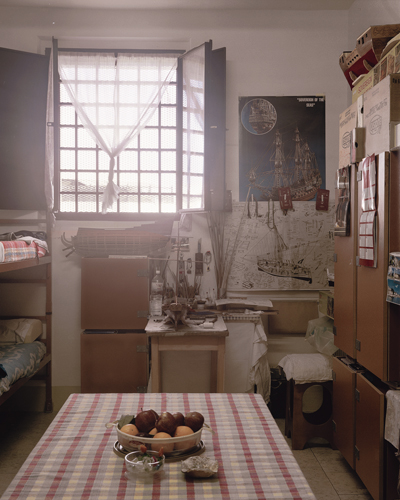
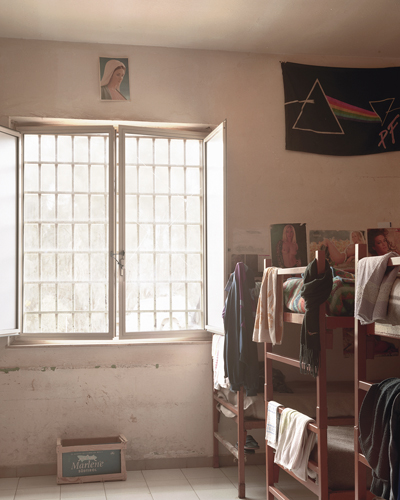
I didn’t want to show a face. I thought it was enough to see their belongings and witness their presence that way.
What was the reaction of the inmates and staff at the prisons?

The staff didn’t understand why I wanted to photograph at the prison. They make jokes and suggest I should go to the beach to photograph, as it was “more beautiful down there.” That’s fine, they have a job and support their family and they’re happy that way.

The inmates were very enthusiastic. I mean, it’s a different day. A day different to all the other ones; to have a photographer come into your cell.

I was continually escorted except for at two open-prisons where I was free to go anywhere I wanted. Whenever I saw a cell I wanted to photograph, I had to ask permission from the inmate, not the guard. That made me understand that it was his house. I had to ask him, just as I’d ask you if I knocked on your door. Sometimes we’d have coffee. Some of the guys gave me recipes about how to make certain types of pastas. It was a very strong experience.

Do you know if any of the guys have seen your work – did you provide prints or may they have been released and looked it up online?

I grew up in an area of Cagliari that wasn’t the best so I knew some of the guys inside. Some of them were surprised to see me there; I was not so surprised to see them there.

As far as I know they are still in. There was another guy who was famous in the area for being involved in the mafia. He was on a life sentence. I expect not many have seen the work. Really though, I have no idea if they have looked at the pictures or not.

Is photography an adequate tool for communicating stories about prisons?

Yes it is, but you need to be very careful. You could make things a lot more dramatic. For example, I could have chosen a 24mm lens, got very close-up, shown rotten teeth of inmates … I could make it dramatic.

But, my position was a central position. Really, I know nothing [about prisons]. I didn’t, I can’t, stand on any side. I try to be neutral.

Tell me about your use of light.

I used long exposures. I wanted the light to flow from the windows. The light behaves as a one-way system; in the same way Octavio Paz’s poem spoke of writing messages but receiving no reply. In prison, communications are always interrupted; they become one-way communications.

At times “your” prisons seems quite spiritual? Was religion ever an undertone for your work? These could by cells that monks live in.

I’ve never thought of the spiritual aspect of the images. However in terms of environment, the ascetic life of a monk and the imprisonment of an inmate are not too different – only one is a choice, and the other not. Two of the prisons in Envoi used to be convents.

Pursuing that notion of religious visual cues – this isn’t a typical prison as we expect (in the US at least). Instead of barbed-wire, these prisons have rounded arches, some have vaulted ceilings. Some of the detail evokes ecclesiastical spaces.

The entrance with the rounded arch is the entrance to female section of the prison. This is in Sicily, which doesn’t have enough female prisoners to warrant a designated female facility. There were perhaps forty of fifty female inmates in this section.

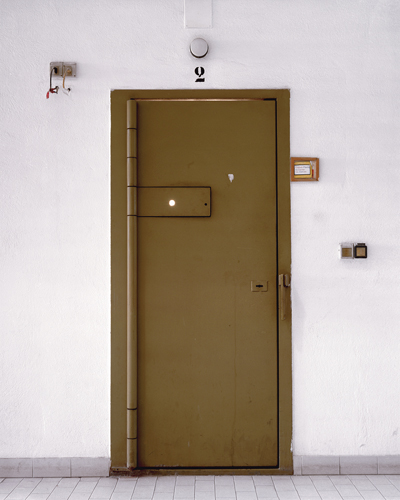
I was actually quite intimidated by this gate – it was very heavy and very loud. It really gave the sense of being incarcerated.

How did you work while in a state of intimidation?

The first day I got in I took no photographs. I didn’t know where to start; immediately I felt like I’d got in too deep. Over time I got excited, I got focused. In Italy we have a saying that all things – good and bad – are felt in the stomach first. It’s the centre point of the body; everything important is felt there. I took these images after feeling emotion from the stomach.

How many times did you go to these prisons?

I went to Italy twice – both times for a month. I visited some prisons only once, others eight or ten times. I visited the prison in Cagliari, my hometown the most.

Did you do any research before the project? Did you look at other photography done in prisons?

Lucinda Devlin’s Omega Suites was a huge inspiration. Her work is beautiful.

Another project I like is Ghetto by Broomberg and Chanarin, although they completed it since Envoi (which was done in 2003). Broomberg and Chanarin photographed in South Africa and in Central and South America, not just in prisons but other institutions.

Yes, I have looked at their work before. My conclusion was that they now have the luxury of reputation, time and money to take a very slow approach to their photography. That is how I explain their remarkable results.

I think they deserve all the recognition they get. Their work is astounding. I was in a show last year, which also had their work. Their prints are amazing.

Tell us about your exhibition of Envoi?

It was a bit problematic. Firstly, I think they [The Ministry of Justice] gave me permission to photograph in order to get rid of me.

After the project, I wanted help to organise an exhibition. The exhibition I had in Sardinia was great but it was also a compromise.

The Ministry of Justice didn’t provide me money but they involved the town hall and private galleries and it became good publicity for them.

I used them and they used me for their own interests. They never understood my concept. They kept advertising the show as a one about Sardinian and Sicilian prisons and I kept telling them it was about a broader concept.

In the exhibition I used labels beneath the images to identify each prison.

[At the opening] I didn’t want to give a speech but they forced me. The Ministry of Justice didn’t really know what to say either but they had to say something; it is politics.

What are your politics on prisons now?

This was the first and only experience I have of prisons. I made my own personal interpretation of prison, but I don’t really know what happens inside. I want to take the position that this exists and is part of our society. Now in America, as you’ve said, there are the most prisons in the western world, and that is something relevant, but the way I looked at it from the start was that I was not going to make a judgement. I was curious about this place. It is a place we’d not want to experience but [about which] we’re all curious. My father was a cop and he worked in the anti-narcotics division for many years. He’d go to interview people inside jail. As a teenager, I always wanted to join him.

Do you aim to inspire curiosity?

The show was quite successful. Somehow people were reading what I was reading. I could see the majority of people reacting as I expected which doesn’t happen with my other projects! [Laughs] Generally, I was happy with the comments.

I did hear many people at the exhibition say, “It [prison] is not as bad as I expected.”

How did you respond to those readings? Did you challenge your audience?

No. I mean they didn’t see what I saw and they didn’t hear the doors slamming. Every step you take, there’d be another door closing at your back, one after another. It took a long time to get through the prisons.

Do you consider your images a literal description of the space. Is that enough?

No, no, certainly not and it is not enough. “This is the concept of prison and it is in these 20 pictures?” No, no, no, no. [laughs]. It is one piece of truth in an infinite world.

What are you working on now?

I am working on observations of tidal movements, the change in landscape. It is a study of seaside societies and the way they relate to coastline. I have visited Norfolk a lot – it’s amazing. In Italy you have the sea, the beach – it is always there, you don’t have these movements.

In Norfolk and other places, I take two pictures; one at low tide, then I wait six hours and take one at high tide.

Soon, I’ll be taking up a residency in Holland – the BADGAST residency – and I’ll look at Dutch sea society. Then, maybe Canada. Nova Scotia has the largest tidal movements in the world – as large as 52 feet!

Thank you Danilo.

Thanks Pete.
To see more of Envoi and Danilo’s other portfolios visit http://www.danilomurru.com/

ALL IMAGES © DANILO MURRU


It seems like I’ve been saying a lot on prison tattoos (here and here) recently … which is true, but it’s not even an area of keen interest for me. Maybe this will be the last one, or maybe not, depending on what friends and photographers continue to produce.

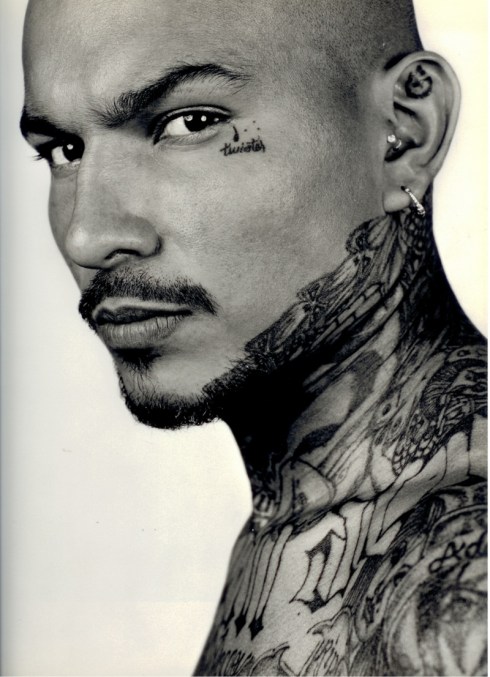
I have expressed reservations about photographing prison tattoos because inevitably the images may fail to penetrate the coda that prisoners share, understand and guard.

Therefore, I applaud Bob Gumpert for providing his audience with as much understanding as he has drawn during his documentation. Accompanying American Prison Tattoos the multimedia piece published on Foto8 last week, Gumpert provides a “short and incomplete glossary of tattoo markings & terms” and a “list of slogans reflecting beliefs or attitudes.”

Of course, Bob Gumpert‘s work is about much more than just tattoos. He has been working in the San Francisco and San Bruno jails systems for 14 years and it touches upon every imaginable story of American cities, families and experience. I encourage you to check out Take A Picture, Tell A Story, his multimedia platform for his jail work; his general website; and his blog.

Last week, I sent this clip over to Brendan Seibel who knows a thing or two about punk, rock and Bay Area discontent.

In return, Brendan sent this clip describing it as “one of those what-the-f#@k moments when San Francisco was cool.”

Just thought you should know.

Nina Cleveland, 1999

Tom Jones (b.1964; resides Madison, WI) is a Ho Chunk Native American. All of his projects represent some aspect of the Ho Chunk tribe, but the series not to be missed is The Ho Chunk People.

Jones: “Historically it has been outsiders who have taken these photographs of Native Americans. We have generally been represented with beads and feathers; this example can be seen through the extraordinary photographic portrayals of Edward Curtis. While this is an aspect of our life, the emphasis of my current body of work is focused on the members of my tribe and the environments in which they live, giving a name and face to the individuals and their way of life in our own time. […] I am ever mindful of my responsibility to the tribe and to carry on a sense of pride about who and what we are as a people.”

More here and here.

Last week, when Foto8 ran Katarzyna Mirczak‘s article about of the detached and preserved skin of prisoners’ tattoos, I was, of course, compelled to post about it. But, in truth, I need to do a lot more than duly note a story published elsewhere.

HOW HAVE PHOTOGRAPHERS TAKEN ON THE SUBJECT OF PRISON TATTOOING?

The simple answer is with limitations. Photography can describe tattoos very precisely, but description is not comprehension. Often, prison tattoos are a tactically guarded language.

Even if tattoo symbols are deciphered, they may carry different meanings in other cultures. Prison systems exist across the globe, within and “outside” different political regimes, thus the tattoos of each prison culture should be considered according to their own rules – and this caveat applies even at local levels.

Janine Jannsen offers a good introduction to the history of different tattooing cultures. She summarises tattooing in “total institutions” (navy, army, the penitentiary); tattoos and gender; and tattoos and the demarcation of space.

With regards to prison tattoos, maybe it helps us to think of photography as secondary to sociological research. Photography should be thought of as an illustrative tool to aid external inquiry.

That said, there are a number of photographers who have made honorable efforts to describe for a wider audience much of the significance of prison and gang tattoo cultures.

Araminta de Clermont

After their release from prison, Araminta de Clermont tracked down South African gang members and discovered their stories. Interview with Araminta and her subjects here.

© Araminta de Clermont

Donald Weber

Donald Weber mixed with former prisoners (‘zeks’) in Russia and concentrated on how their prison tattoos relate to their identity and criminal lifestyle. The relationships of these men with female criminals and prostituted women (‘Natashas’) who become their companions feature in Weber’s complex investigation.

“Some rules are simple: you can only get a tattoo while in prison.”

September 1, 2007: Vova, zek. The origins of Russia’s criminal caste lie deep in Russia’s history. Huge territories of Russia were inhabited by prisoners and prison guards. Thieves, or zeks, distinguish themselves from others by tattoos marking their rank in the criminal world: there are different tattoos for homosexuals, thieves, rapists and murderers. © Donald Weber / VII Network.

Rodrigo Abd

Rodrigo Abd‘s portraits of Mara gang members in Chimaltenango prison in Guatemala illustrate gang tattoos that are used less and less (from 2007 onwards) due to the unavoidable affiliation and violence they brought the bearer; “After anti-gang laws were approved in Honduras and El Salvador, and a string of killings in Guatemala that were committed by angry neighbors and security forces, gang members have stopped tattooing themselves and have resorted to more subtle, low profile ways of identifying themselves as members of those criminal organizations. Today, gang members with tattooed faces, are either dead, in prison or hiding.”

© Rodrigo Abd / AP

Luis Sinco

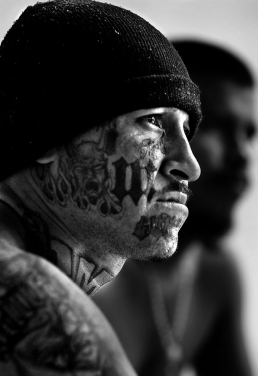
In 2005, Luis Sinco of the Los Angeles Times documented Ciudad Barrios Penitentiary in El Salvador, home to 900 gang members, many of whom have been deported from the US. Ciudad Barrios incarcerates only members of the MS-13 gang, which traces its roots to the immigrant neighborhoods west of downtown L.A.

“In the woodshop, inmates made a variety of home furnishings, most of which featured the MS-13 logo. The items sold outside the walls help supplement the prisoners’ meager food rations.”

“It was a of microcosm of L.A.’s worst nightmare transplanted. Claustrophobic, crowded tiers led to darkened, bed-less holding cells and fetid latrines overflowing with human waste.”

Multimedia here.


Moises Saman

In 2007, Moises Saman documented the anti-gang activities of Salvadorian Special Police and the inside of Chalatenango prison, El Salvador. At times Saman’s project focused on the tattoos but is more generally a traditional documentary project. More here and here.

© Moises Saman

Isabel Munoz

Much of Isabel Munoz‘s portraiture deals with markings of the body – what they reveal and conceal. For example, she has previously photographed Ethiopian women and their scarification markings. For her project Maras, Munoz shot sixty portraits in a Salvadorian prison of ex-gang-members. She also photographed the women in these mens’ lives. More here and here.

© Isabel Munoz

Christian Poveda

In El Salvador, Christian Poveda photographed and filmed Mara Salvatrucha (known as MS) and M18, the two Las Maras gangs in open conflict. Poveda wanted to describe their mutual violence and the absence of ideological or religious differences to explain their fight to the death. He described the origins of their war as “lost in the Hispanic barrios of Los Angeles” and as “an indirect effect of globalisation.”

Poveda was shot dead aged 52 as a direct consequence of his journalism. His work from El Salvador was entitled La Vida Loca. Full gallery can be seen here. B-Roll from his work can be seen here.

© Christian Poveda

More Resources

Ann T. Hathaway has collated (disturbing) information and links here about a number of prison tattoo codes.

Russian criminal tattoos have warranted their own encyclopaedia.

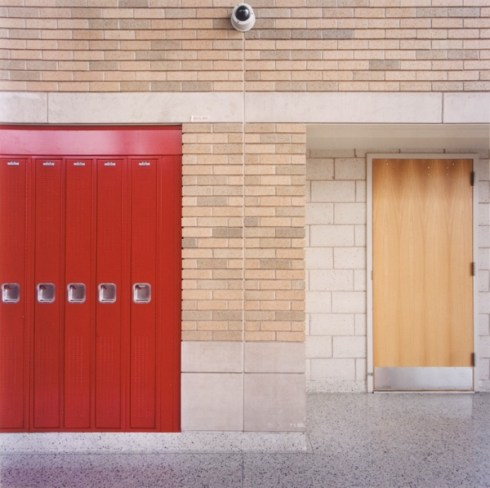
Scott Fortino‘s book Institutional: Photographs of Jails, Schools, and other Chicago Buildings (2005) is important because it hit the shelves two years prior to Richard Ross’ Architecture of Authority (2007).*

People tend to think of Richard Ross’ Architecture of Authority as being the authoritative (pun unintended) photographic statement on use of identical spatial psychologies across the breadth of contemporary institutions. Perhaps Fortino can, and should, disrupt that position.

Patently, the publishing date of a book doesn’t close the argument, but I think it is apt to call these two photographers contemporaries in every sense of the word.

There are differences between Fortino and Ross’ work. Fortino’s work looks exclusively at Chicago institutions, whereas Ross – powered by a Guggenheim grant – took his survey international.

Fortino has an unusual bio, working as a photographer and police patrolman. Ross, on the other hand, is a professor in photography for the University of California, Santa Barbara. Interestingly, Ross, the son of a policeman is open about his father’s influence on his work.

I’d really like to see Fortino sat down giving a commentary on his work, just as Ross has here. Better still, I’d love to see Fortino and Ross at the same table!

– – – –

Scott Fortino’s Institutional portfolio, and more here from the Museum of Contemporary Photography Chicago.

BIO

Scott Fortino is a photographer who also works as a patrolman with the Chicago Police Department. His photographs are in the permanent collections of the LaSalle Bank of Chicago, the Museum of Contemporary Photography in Chicago, and numerous private collections.

* The synopsis provided for Institutional: Photographs of Jails, Schools, and other Chicago Buildings by UC Press, for me, misses the mark completely. Fortino’s work isn’t about the “subtle warmth and depth” of these spaces but of the disciplinary form written in the materials, demarcation and use of these spaces.

EMAIL

prisonphotography [at] gmail [dot] com

Prison Photography Archives

Post Categories