I am toying with the idea of listing my 100 favourite (online) digital photography archives, but museums, universities, historical societies and Flickr keep moving the goal posts. I see a new archive virtually every week.
If I stop to think what all this digitsation means, I suspect I’ll miss the boat on just enjoying the documents of times past.
It’s good that the drive toward digitisation and the “competition” (as I’ve defined it) is ongoing among these archives.
THE SKINNY
“The National Library of Scotland joined the Flickr Commons on July 13, 2010, with over 2,000 photographs, focusing on a collection of official British photography from the First World War. A smaller but equally rich set is chosen from a survey of the South Side of Edinburgh in 1929, photographed by Alfred Henry Rushbrook. And along with the letter ordering the massacre at Glencoe, is the last letter of Mary, Queen of Scots.”
Recently, I’ve been focused on photography a lot. The distraction from prisons is mostly due to the great writing and comment I read daily on the photography blogs I respect.
It occurred to me that the names of the blogs may stick longer in the memory than the names of the bloggers themselves (which might be the intent … and the branding, possibly?).
Nevertheless, I updated the hyperlinks down the left hand side to include the bloggers’ names and copy a list below.
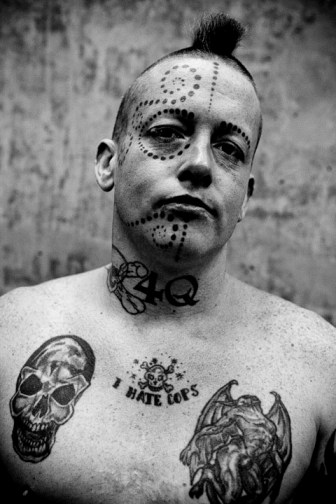
I’ve talked recently about photographers Bob Gumpert and Deborah Luster. A couple of months ago, upon my recommendation, Bob actually bought Luster’s monograph One Big Self.
The next day he emailed me to say that one of Luster’s sitters from Transylvania, Louisiana in May of 2001, he had photographed in San Francisco County Jail in February of 2009. Bob interviewed the man yesterday and posted the audio.
This is the first instance I’ve come across in which two independent photographers have photographed the same prisoner. I don’t know if it is significant or not?…
“I recognized several of the photographs that the Oakland PD had released as my own photos that I’d taken the night of the riots and had posted to my own Flickr account. I was never contacted by the Oakland PD regarding their use or distribution by Oakland PD. It’s interesting to see law enforcement taking photos by citizen media and using them this way.”
Under Creative Commons (which these images were) there is no problem with anyone, including police, “to copy, distribute and transmit the work” provided they attach attribution. Unfortunately, the Oakland Police Department didn’t name Hawk as the photographer, seemingly passing the images off as their own.
If you are in NYC and you’re quick on your feet you might just make it to Zwelethu Mthethwa’s artist’s talk tonight. Followed by a reception and book signing at Museum of Contemporary Diasporan Arts in Brooklyn (begins at 6.30pm).
Mthethewa’s work will be on view at The Studio Museum in Harlem until October.
AFRO-PESSIMISM
Afro-Pessimism is a term introduced by Okwui Enwezor (for the essay of Mthethwa’s monograph) in an attempt to describe what Zwelethu Mthethwa’s art is not.
I had dozens of working titles for this blog post each one reflecting an approach (and/or quote) by Mthethwa which described his process, his collaboration with the sitter, the waves of culture in which we exist, whether poverty in photography is a problem for the practitioner or audience, etc, etc. These topics are too huge for a title of course, fortunately there’s plenty of wonderful online videos and chances to hear Mthethwa talk about his art:
“Before foreclosing the effectiveness of photography or to ask whether we have reached the end of photography, we should address the diverse manifestations of photography in societies in transition where its powerful effects of seeing is constantly battling different logics and apparatuses of opacity. All through the years of apartheid, photography was at the center of this battle between transparency and opacity, thus lending the medium a far more discursive possibility than it would have enjoyed as purely an instrument of art. One can in fact, argue, pace Georges Didi-Huberman, that in the context of apartheid photography was an instrument of cogito.”
“In South Africa, for the critics of documentary realism or anthropological realism, especially black artists such as Mthethwa, documentary realism was always at the ready to link the iconic and the impoverished with little recourse to examining its spectral effects on social lives. Because of this, documentary realism generated an iconographic landscape that trafficked in simplifications, in which moral truths were posited without the benefit of proven ethical engagement.”
From what I can gather Georges Didi-Huberman’s thesis is that images are killed, denied their truth, narrative or violence within the dominant art historical canon that has elevated the image to art. The image becomes cogito – an object of thought – not an object pertaining to reality or even to action.
Mthethwa’s images are against such failings; they are attempts at transparency, honesty. Mthethwa talks in the interviews about his ethical and slow engagement with his subjects.
Afro-Pessimism is on the decline.
BIOGRAPHY
Zwelethu Mthethwa (born in Durban, KwaZulu-Natal, South Africa, 1960) received his BFA from the Michaelis School of Fine Art, University of Cape Town, a then–whites-only university he entered under special ministerial consent. He received his master’s degree while on a Fulbright Scholarship to the Rochester Institute of Technology. Mthethwa has had over thirty-five international solo exhibitions and has been featured in numerous group shows, including the 2005 Venice Biennale and Snap Judgments at the International Center of Photography, New York. Mthethwa is represented by Jack Shainman Gallery, New York. He lives in Cape Town, South Africa.
Mari Bastashevski photographs the rooms of victims of kidnap. “Abduction as a concealment tactic became prevalent in 2000 during the second Russian-Chechen conflict. The practice continues today. The rooms are preserved by family members who don’t know the fate of their loved ones,” says Bastashevski.
I’m not being flippant here; I think her work is remarkable and I also think it is successful in translating the bleakness of the situation for abductees and the families left behind (not all photography can elevate an issue in this same way).
‘File 126: Disappearing in the Caucasus’ has all the right ingredients to hook the Western audience; the cachet of post-Cold-War politics; the same cold-exoticism of photographers such as Carl de Keyzer or Bieke Depoorter; the details of anaesthetised domestic interiors; and fundamentally, hundreds of profoundly tragic and must-be-heard stories about political terror.
Russian-born Bastashevski read the case files before she began visiting families. Human rights organizations in the Russian North Caucasus have spent years documenting the abductions of young people, which they attribute to the state security forces conducting a brutal counter-insurgency campaign[ …] Some stories verged on madness, like the genteel lady who was certain, after five years, that her sons were still alive in a secret prison in the forest, if only she could reach them. (Source)
DIFFERENT CONTINENT, SAME CRIME
One of the reasons I am so interested in Bastashevski’s work is that it mirrors the work – intellectually and in terms of its activism – of those photographers exploring and documenting the legacies and memories of the Disappeared in Argentina. (“Those photographers” I have written about before here, here, here and here).
That means two of the eight jurors I knew of. The other six are new to me:
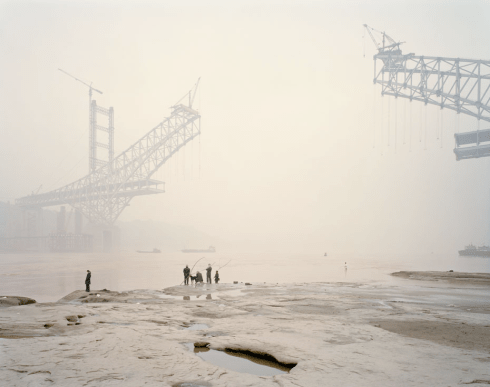
The Prix Pictet Growth will judged by an internationally recognised panel of experts led by Professor Sir David King, Director of the Smith School of Enterprise and Environment at the University of Oxford. Other members of the judging panel include Shahidul Alam, Photographer, Curator and Founder of the Drik Agency in Bangladesh; Peter Aspden, Arts Writer for the Financial Times; Michael Fried, Art Historian and Critic; Loa Haagen Pictet, Pictet & Cie’s art consultant; Nadav Kander, Winner of the second Prix Pictet; Christine Loh, CEO of Civic Exchange, Hong Kong; and Fumio Nanjo, Director of the Mori Art Museum, Tokyo.






 Prison Photography