Ed responds to this article in The Art Newspaper profiling gambling millionaire David Walsh, whose private collection has just been opened to the public in the purpose built, subterranean Museum of Old and New Art.
Walsh on MONA’s raison d’être:
“Mona is my temple to secularism,” he adds, explaining that he is interested in “talking about what we are”, in other words what makes humans human. “People fucking, people dying, the sorts of things that are the most fun to talk about.”
Walsh on the potential benefits Mona will have to local business:
“We don’t know whether I’m going to make any difference to the economy and I must say I don’t particularly care. If it happens, great. If it doesn’t happen, I don’t give a shit.”
Walsh on curating:
“I believe most curation is bullshit … curators tie together a bunch of stuff they can get their hands on then create the most abstruse and obtuse reality and, in the end, fill an exhibition up with a few things that are slightly connected and the upshot is that about 30% of the art is just there to fill space.”
Walsh on being an artist:
“No one makes art for art’s sake. There are only two reasons to create art: to get laid or defy death.”
Talk to anyone about American documentary photography, they’ll probably mention Danny Lyon. Talk to anyone about prison documentary photography and they’ll definitely mention Danny Lyon.
In terms of US prison journalism, Lyon was the first photographer to a) give a shit, b) gain significant access, and c) distribute journalist images far and wide.
I have a few things to say about the chapters I’ve read so far, but those thoughts need more brewing. While I mash those brain-hops, I’d like to draw your attentions to Lyon’s comments about prisons in America:
“You really need a friend, or family member inside a prison, to appreciate what we are doing. America has two million people inside of her prisons. Only China, a dictatorship, tops us in this growth industry. I like to think of the words of Fredrick Douglas “Be neither a slave nor a master.” All of us, outside of prisons, are the masters.“
“Prisons should be turned into bowling alleys, schools, and daycare centers, or demolished. We could probably do better with 90 percent of the inmates being released. Communities should deal with offenders on a local level. Review panels should meet with all of the 200,000 prisoners doing life sentences. Many of these people are harmless and aged, and should be released. I would like to see review panels sent into all the prisons, to meet with inmates face to face. Most should be released.“
“When I was working in the Texas prisons (1960s and 70s) there were 12,500 men and women inside and no executions. Today there are 200,000 in Texas and they kill prisoners all the time. Prisons are now everywhere, a major employer in upstate New York. Simply put, everything about prison is worse.”
“The best way to change yourself is to go outside your world into the world of others. It’s a big world out there. The worst thing about New York City is that all the young people that gather there are extremely like-minded. Creative people are comfortable there, but they are preaching to the choir. I always wanted to move Brooklyn to Missouri. Everyone would benefit.” (Source)
I couldn’t – and have not – ever put it better myself.
– – – – – – – –
Buy a signed copy of the book Like a Thief’s Dream at Danny Lyon’s website, Black Beauty.
Postcard sent by the author to Renton in prison in the early 1980s
A bathroom inside the Maze Prison, near Lisburn, Northern Ireland, on Tuesday, April. 11, 2006.
Andrew McConnell‘s work The Last Colony from the Western Sahara has gained some traction recently, promoted at DVAFOTO and backed up by TPP.
McConnell is from Northern Ireland so I was not too surprised upon looking through his portfolio to find a series on the Maze prison.
I’ve seen a few projects from Maze Prison – the most well-known being that of Donovan Wylie – and yet a few of McConnell’s images really stood out.
STATEMENT
McConnell: “HM Maze Prison, also known as Long Kesh and the H-Blocks, held some of the most dangerous men in Europe during its 30 year operation. The prison closed in September 2000 after 428 prisoners had been released under the Good Friday Agreement. There are now plans to turn the abandoned site into a national football stadium.”
The bathroom image (above) is admittedly more powerful to me, having seen the bloodied-knuckle washing scenes in Steve McQueen’s powerful debut film Hunger.
Also, admittedly the image of the football (below) is more loaded given the now-defunct plans to convert the site into a national stadium.
In January 2009 plans to build the £300 million multi-purpose stadium were officially axed with politicians saying plans to start the construction of the stadium wouldn’t be reconsidered for another 3 to 4 years. (Source)
An old football lies in the exercise yard of the Maze Prison, July 18, 2006.
I had been under the impression every structure at the Maze had been demolished but apparently not:
Discussion is still ongoing as to the listed status of sections of the old prison. The hospital and part of the H-Blocks are currently listed buildings, and would remain as part of the proposed site redevelopment as a “conflict transformation centre” with support from republicans such as Martin McGuinness and opposition from unionists like Nigel Dodds who are against erecting a memorial to those who died during the hunger strike. (Source)
Which ties nicely back into the crucial question about McConnell’s photographs of the site. Are these photographs of memory, for memory, for memorial? What audience do they serve?
It seems to me that politics and emotions vary so wildly, that when a photographer (so soon after decommission) takes on a contested site such as this, his/her photographs are open to many different interpretations. The Maze and its history are fascinating, discussion-worthy topics, but is it the case here that the images are nothing more than notable ‘urban exploration‘?
Donovan Wylie dodged this suspicion by documenting over a five-year period the slow demolition of The Maze. Wylie has talked about wanting to create an archive of this transitional moment. However, if a photographer’s series is too brief (either within its own boundaries or by comparison to another practitioner’s series) then how is it justified or explained?
I don’t want to be dismissive here, as I think this is a problem many political-documentary photographers face – namely, their work may not adequately reflect or contain the disputed political landscape it references.
Perhaps we should read McConnell’s The Maze as undefinable and undecided, just as the former prison site remains?
The Cages of the Maze Prison, Northern Ireland, July 18, 2006.
Biography
Andrew McConnell was born in Northern Ireland in 1977 and began his career as a press photographer covering the closing stages of the conflict in his homeland and the transition to peace. He later worked in Asia and moved to Africa in 2007 to document the issues and stories of that continent which are widely overlooked by the international media.
His images have appeared appeared internationally in publications such as National Geographic Magazine, Newsweek, Time magazine, The New York Times, The Guardian, FT Magazine, L’Express, Vanity Fair (Italy), the Sunday Times Magazine, and Internazionale.
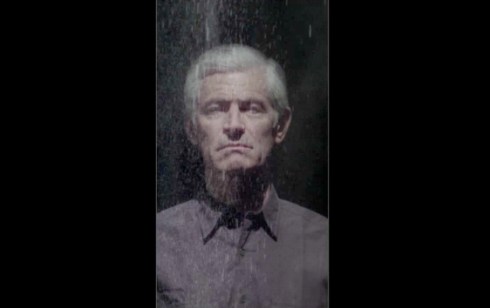
Get past the fact that Asa Mader is repeating Bill Viola’s tricks, my response to this installation video is that James Nachtwey is serious, and he is silent, and there’s some stuff falling to the ground around him.
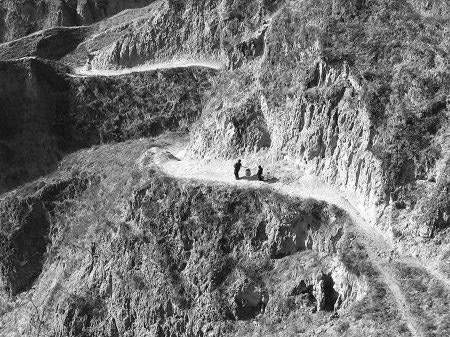
Zhang Ziping's revised photo of Ren Shichen's work.
Zhang Ziping, the winner of the 2010 “Human and Water” international photography competition was stripped of his title after he plagiarised the work of Ren Shichen.
“I never entered the competition, how could my work get the top award?” Ren was astonished to see the photo he took three years ago in Gansu’s Zhengning County listed among the winning photos on the Internet. “He (Zhang Ziping) downloaded my work from the Internet and changed it with image processing software.” (Story)
Crude, but it makes you wonder how often – across the globe – these types of antics occur!?
Afghanistan is a very poor country, placed 174th out of 178 in the Human Development Index. The literacy level is 50% for men and 20% for women and the average life expectancy is below 44 years. Only one in three people have clean drinking water and life expectancy is 43. It has suffered many years of war. This is a very challenging environment in which to introduce a formal, state-wide justice system based on written texts, record-keeping, databases (and a regular supply of electricity) and all the appropriate protections for the rights of suspects, defendants and prisoners that accompany such systems in the West.
Manca Juvan, the subject of a post on Sunday, also photographed in an Afghanistan women’s prison. Juvan is only one of several photographers to take on this subject matter – Anne Holmes, Andrea Camuto, Katherine Kiviat, and David Guttenfelder being others.
The portfolios of Juvan and her contemporaries had me thinking. Many photographs were from 2003 or later in 2007/08 (due to media coverage of allegations of abuse or the construction of a new prison).
I’d like to present a few images, but am I only comfortable doing so if I also provide an accurate summary as it is NOW for women imprisoned in Afghanistan.
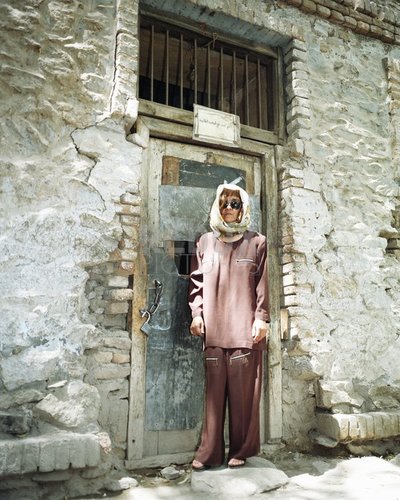
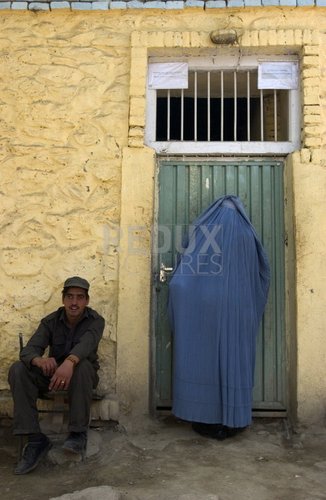
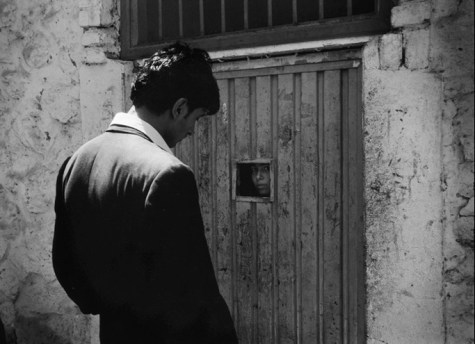
Firstly, I just like to point out the two pairings above and below. Kiviat and Juvan (above) both show the same portal at Walayat women’s prison, Kabul. In 2004, one year later, Kiviat also photographed this door which is the same as that shot by Andrea Camuto (below). Camuto identifies the door as belonging also to Walayat women’s prison.
Wayalat still operates as a prison, but it no longer houses female inmates. A 2003 IRIN report detailed the dire need for humane facilities at Wayalat:
‘According to Lt-Col Habibuallah, in charge of Wolayat prison, the present building with its 17 rooms and four toilets was built some 90 years ago to accommodate up to 200 people. “There are 511 men and 32 women imprisoned here,” he said. There were no categories for offenders and the accused and convicted were generally mixed together, including some inmates on death row. “There are no basic facilities, no ambulance, no proper medicine and health care, and the increasing problem of overcrowded rooms is a tragedy,” Habibuallah said. Even the 35 staff members lacked access to a toilet and were forced to sleep on the roof or in the courtyard at night. “We have worse conditions than the prisoners,” he claimed. Women inmates fare slightly better. Located in a separate building, the painted cells house between five and seven prisoners each, but the lack of adequate health care is felt more by the detained women.’
Manca Juvan‘s work focused on the women and their children in Wayalat. Katherine Kiviat‘s work is part of a larger body of work describing the new roles and careers (including that of prison guard) of women in Afghanistan. The collection is called Women of Courage.
Andrea Camuto‘s work, shot in 2005, 2007 & 2009 followed returning refugees and the “forgotten” women of Afghanistan to the cheaper countryside rents, to the hospitals … and to the prisons if necessary.
The common theme for these photographers is the injustice suffered for many women whose imprisonment is based upon judgement for “moral crimes” and “bad character” including sentences for adultery (which includes inappropriate acts both in and out of wedlock), being drunk, wanting a divorce or even just leaving a husband for a night to stay with family after suffering a beating.
PUL-E CHARKI
On the outskirts of Kabul, Pul-e Charkhi is Afghanistan’s most notorious prison. It has been used by every regime to house it’s enemies.The unearthing of mass graves in 2002 confirmed the Soviets’ use of the site for mass-killings and the Americans adopted and expanded the prison to house Taliban fighters. In 2006, there was a major rebellion and riot by the prisoners.
Anne Holme‘s work from Pul-e Charkhi was conducted in 2007. Holmes’ story is that of the struggle to raise children inside the walls, the quashing of legal rights and despite the “warden’s genuine concern” the inability of the justice system to provide fair hearing for the women.
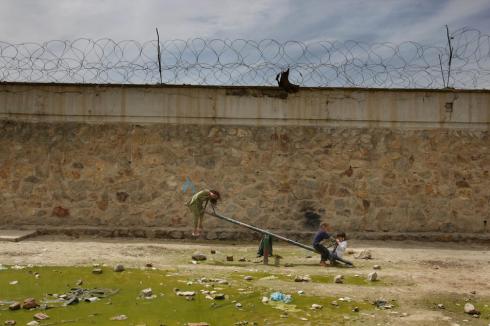
In April 2008, David Guttenfelder visited Pul-e Charkhi. His work, Kids in Prison reveals disturbing figures – “There are 226 young children in Afghanistan’s prisons, including many who were born there. They have committed no crime, but they live among the country’s 304 incarcerated women.”
Pul-e Charkhi was a brutal living environment. This report details inadequate sanitation, frigid winter temperatures, rape and humiliation.
In the same month that Guttenfelder photographed – April, 2008 – the women and children of Pul-e Charkhi were moved to a new purpose built facility. Recognising the special requirements of female prisoners, Badam Bagh was constructed by the United Nations Drugs and Crime Office (UNODC) with the financial support of the Italian Government.
The two videos below offer some comparison between the two facilities:
PUL-E CHARKHI
BADAM BAGH WOMEN’S PRISON
LYSE DOUCET AT BADAM BAGH
To bring us right up to date, the best reporting is not that in the photographic medium, but straight news reporting. Lyse Doucet‘s report for the BBC is a must see.
(I have applauded Doucet’s journalism in the mens’ wings at Pul-e Charkhi before).
At a moment when the White House is to open talks with the Taliban and the media is comfortably using the phrase “unwinnable war”, it is perhaps responsible to consider the lives of those caught up in the broken justice system of Afghanistan. The prisons of Afghanistan are one of the last priorities for a society that is war torn and divided. Afghanistan hasn’t got the resources to support the basic human rights of those it incarcerates when the rights of those outside prison walls cannot be guaranteed.
Despite being four years deep in his project USER, Tony Fouhse is more confused than ever by what it all means.
I recommend you read his latest blog post. Fouhse talks about beginning his fourth and final year on the project, subjects who have died, and the gratitude of one of his subjects now she is clean.
The post is a reflection and it is as much for him as it is for us.
USER
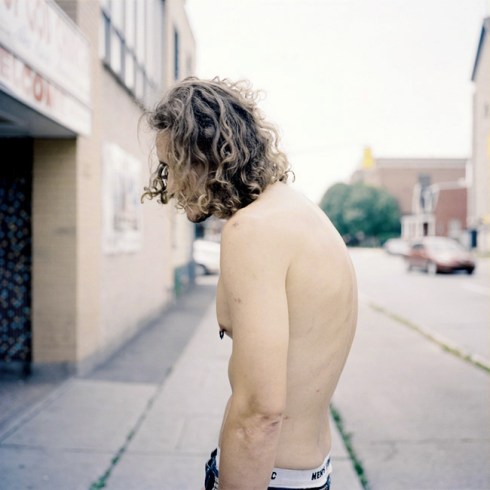
I hope that you are all aware of his work photographing the crack addicts in Ottawa – not forgetting the interviews, the coverage, the love and the controversy that follows any project such as this that positions addicts as the subject of fine art.
So, I want to say a few things.
– Tony has been very open to discussion and criticism of his work. He will also defend his work with vigour, as often criticism leveled at his work is – in some guise – puritan criticism of photography in general.
– Tony’s subjects love his work; many go to the USER exhibition openings. Dawn was one of Tony’s subjects; her letter is included in Tony’s latest blog post: “I would like the picture so I can remind myself that I do not want to look that horrible or be that desperate again. I really do appreciate your work and all that you do. I have followed your work since I got clean. Please let me know if you have a copy of the picture.”
– Tony has shown real commitment to his process and the subjects. Yes, he is trying to construct a meaningful “complex sequence”, but that doesn’t mean he is manipulating his subjects, dropping in and out of their difficult lives. The best illustration of this is the map below. Every portrait over the past four years he has shot on this same corner. He knows all these men and women.
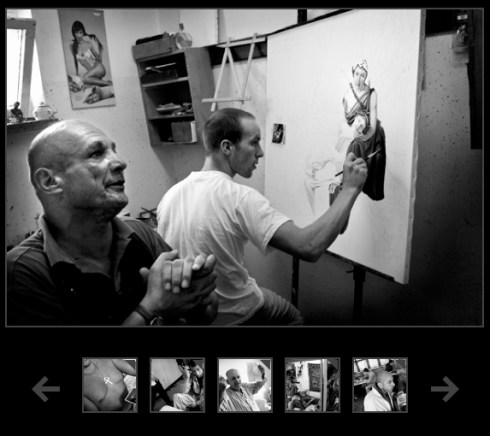
Juvan photographed Dob, the oldest and largest prison in Slovenia (built in 1963).
Dob has the unfortunate problems of many large prisons – overcrowding, inadequate sanitation, high-rates of infectious disease, violent & non-violent offenders jointly housed and the intractable hierarchies of prison culture.
Dob prison was built according to a new penology in Slovenia, which prioritised management of – as opposed to rehabilitation from – anti-social behaviour:
” The main goal of Dob prison was and still is the accommodation of a larger “aggregate” of dangerous offenders who have to serve long term sentences. The prison has met the particular security technical standards (high walls, wires, electric current, a buffer area, dogs, etc.). Treatment programs of inmates within the prison exist, and they are implemented, but the clear priorities in Dob prison are the control and security (Brinc and Petrovec, 2001).”
(Source: ‘Overview of Inmates’ Treatment in Slovenia’ by Danijela Frangež & Jerneja Šifrer. VARSTVOSLOVJE, Journal of Criminal, Justice and Security, Year 12, no. 2, pp. 217-234.)
A STORY NEEDING MORE THAN PHOTOGRAPHS
The portfolio is all too brief. Juvan works hard to focus attention on the individual inmates and the activities they choose to fill their time; it is respectful work but I feel the series just falls short. I suspect if Juvan had had longer in Dob prison she could’ve really teased out some more stories.
This is the type of photoessay that would benefit hugely from audio or multimedia components. If it is appropriate/needed, there’s no excuse now for a photographer to not include audio in his or her online portfolio (just ask duckrabbit).
In terms of “presenting photography on a computer”, I think user expectations and internet publishing tools limit the advanced reflexivity Joerg is championing. Between user-demands and web-tools, which will develop most rapidly to force development in the other? It’s time we start demanding more.








 Prison Photography